
Home | Category: Aboriginals / Arts, Culture, Media
ABORIGINAL ART FROM QUEENSLAND
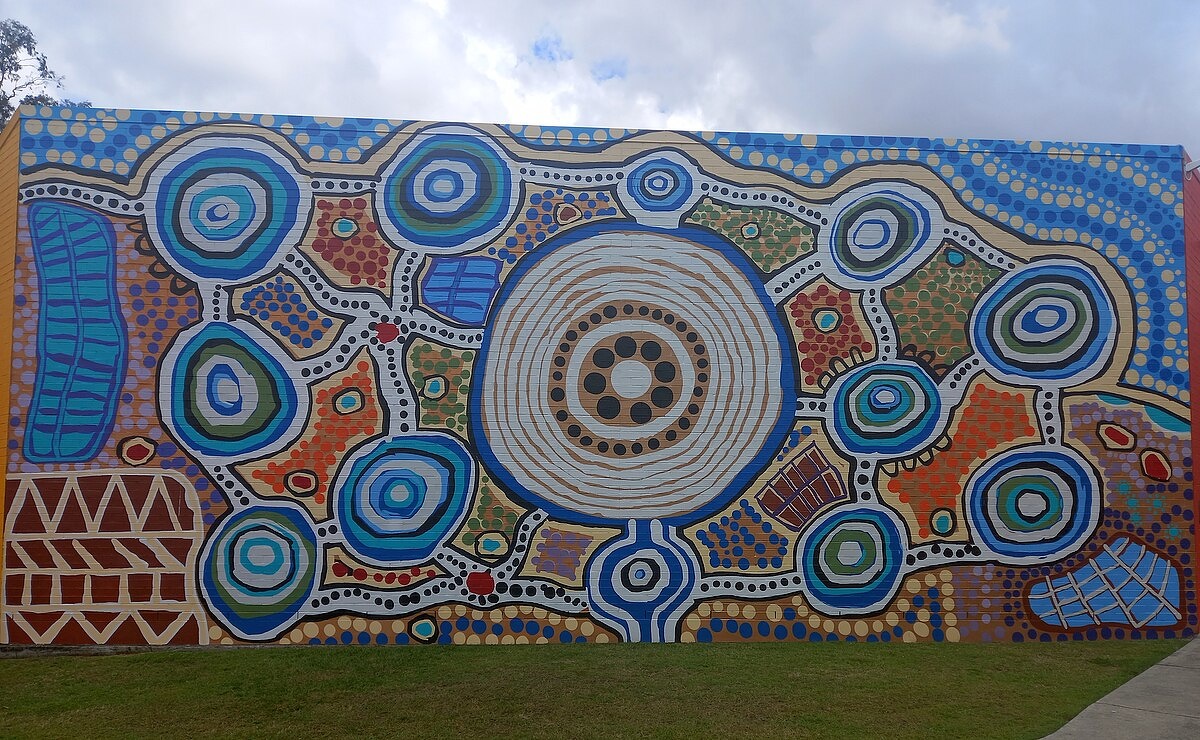
mural on the eastern side of the Logan City Council Art Gallery in Logan Central, Queensland
North Queensland features extraordinary rock art. Many feature the Quinkan spirits, which come in two forms: the crocodile-like Imjim with knobbed club-like tails; and 2) the stick-like Timara. Clubs, shields, boomerangs and woven baskets have been made with a wide variety of designs.
There are also a number of Aboriginal art objects from Queensland in museums such as the Metropolitan Museum of Art in New York, including a mid to late 19th century spear thrower, made of wood, shell, resin and paint, from Aurukun on Cape York. It measures 89.2 x 8.9 x 2.2 centimeters (35.1 x 3.5 x D. 0.9 inches)
A shield, dating to the late 19th–early 20th century, form Central Queensland is made from wood, paint and is 9 3/4 inches high, with a width of 25 5/8 inches (24.8 x 65.1 centimeters). With its strongly convex surface, oval form, and brightly painted designs, this shield is likely from western Queensland. Carved from soft, light-weight wood, it served to ward off weapons, such as clubs, spears, or boomerangs, wielded or thrown by an opponent during fighting. Shields in western Queensland were decorated using a variety of techniques. Some examples were adorned with engraved designs, others were painted, and some were decorated using a combination of the two techniques. The present work is painted with a bold, hourglass-shaped motif in red, white, and black pigments. Although a number of motifs appear repeatedly on shields from this region, there is no historic information on the significance of the individual designs. [Source: Metropolitan Museum of Art]
The Metropolitan Museum of Art collection also contain a basket (Jawun) made by Northern Queensland people in the late 19th–early 20th century. According to the museum: The unique bicornual ("two-horned") baskets known as jawun produced by the rainforest peoples of northeastern Queensland in Australia are among the most elegant and versatile baskets in Oceania. Created only in the comparatively small region that lies between the modern settlements of Cooktown in the north and Cardwell in the south, jawun were used for collecting and processing food and, in the case of larger examples, at times for carrying young infants.

jawun (basket) from Queensland
The baskets had two handles, only vestiges of which remain on the present example. The first, a short loop, was used to hang the basket from a tree branch or the post of a shelter to keep the contents safe from animals. The second was a long, straplike handle that was looped around the wearer's forehead, allowing the basket to be worn hanging down the back to keep the user's hands free. Jawun were used for collecting and carrying food, such as nuts and seeds, on forays in the rainforest. They were also employed as sieves in the process of leaching toxic substances from certain plant foods in order to render them safe to eat. Filled with the food to be leached, such as the large seeds known locally as "black beans," jawun were placed in running streams with the open top facing upstream and the hornlike projections wedged among the river stones. There they were left, at times for several days, to allow the water to flow through them and leach out the toxic compounds in the food. [Source: Metropolitan Museum of Art]
In former times, jawun were made by men but today artists of both sexes create these distinctive baskets. Typically plain, they are at times painted. Jawun painted in natural pigments with designs that replicate those seen on rainforest shields were used in ceremony or for exchange. The present example is decorated with images of a kangaroo and a turtle. Although these may be depictions of game animals, they possibly represent animals from the Dreaming (primordial creation period). The jawun in the Metropolitan Museum of Art collection is made of fiber and Dating to the late 19th–early 20th century and measures 52.1 × 41.9 × 27.3 centimeters (20.5 × 16.5 x 10.7 inches)
RELATED ARTICLES:
ABORIGINAL AUSTRALIAN ART ioa.factsanddetails.com
VERY, VERY OLD AUSTRALIAN AND ABORIGINAL ROCK ART ioa.factsanddetails.com ;
AUSTRALIAN ABORIGINAL PAINTINGS ioa.factsanddetails.com
MODERN AUSTRALIAN ABORIGINAL ART: PAPUNYA, MANGKAJA, REDISCOVERY, REVIVAL, AND A NEW AUDIENCE ioa.factsanddetails.com
AUSTRALIAN ABORIGINAL ART FROM DIFFERENT REGIONS ioa.factsanddetails.com
ABORIGINAL ART OF NORTHERN AUSTRALIA: ANCIENT ROCK ART AND BARK PAINTINGS ioa.factsanddetails.com
WELL-KNOWN ABORIGINAL ARTISTS: THEIR LIVES, WORKS AND IMPACTS ioa.factsanddetails.com
ABORIGINALS (FIRST NATION PEOPLE) OF AUSTRALIA: NAMES, DEMOGRAPHICS, LANGUAGES ioa.factsanddetails.com
EARLY MODERN HUMANS IN AUSTRALIA ioa.factsanddetails.com
LIFE OF EARLIEST HUMANS IN AUSTRALIA: TOOLS, WEAPONS, ART, SETTLEMENTS ioa.factsanddetails.com
PEOPLE WHO LIVED AUSTRALIA 20,000 TO 10,000 YEARS AGO ioa.factsanddetails.com ;
RITUAL LIFE AND MYTHS OF ANCIENT AUSTRALIANS ioa.factsanddetails.com
EARLY ABORIGINALS ioa.factsanddetails.com ;
AUSTRALIAN ABORIGINALS AT THE TIME EUROPEAN COLONIZATION BEGAN ioa.factsanddetails.com
AUSTRALIA ABORIGINALS FROM 1900 TO PRESENT: DISCRIMINATION, ASSIMILATION, SOME RESTITUTION ioa.factsanddetails.com
AUSTRALIA’S STOLEN GENERATIONS: VICTIMS, LAWS, RATIONALE, OUTRAGE ioa.factsanddetails.com
AUSTRALIAN ABORIGINAL RELIGION: TRADITIONAL BELIEFS, DEMOGRAPHY AND DEATH ioa.factsanddetails.com
AUSTRALIAN ABORIGINAL CUSTOMS, SOCIETY AND RITUALS ioa.factsanddetails.com
ABORIGINAL LIFE: WHERE THEY LIVE, WORK, DIET, HEALTH, ALCOHOL ioa.factsanddetails.com
TRADITIONAL ABORIGINAL LIFE: FOOD, HOMES, HUNTING ioa.factsanddetails.com
ABORIGINAL MEN AND WOMEN: GENDER, MARRIAGE, SEX ioa.factsanddetails.com
ABORIGINAL AUSTRALIAN SEX: PRACTICES, ATTITUDES, ADOLESCENCE ioa.factsanddetails.com
ABORIGINALS IN QUEENSLAND: SOME GROUPS, CUSTOMS, LIFESTYLES ioa.factsanddetails.com
ABORIGINAL AUSTRALIANS IN NORTH NORTHERN TERRITORY: SOME GROUPS, CUSTOMS, LIFESTYLE ioa.factsanddetails.com
ABORIGINALS OF CENTRAL AUSTRALIA: SOME GROUPS, CUSTOMS, ART, LIFESTYLE ioa.factsanddetails.com
ABORIGINALS IN WESTERN AUSTRALIA: SOME GROUPS, HISTORY, CUSTOMS, TRADITIONAL LIFE ioa.factsanddetails.com
Shield from Cape York
On a shield from Cape York in Northeastern Queensland, dated to the mid- to late 19th century Wood and 77.5 centimeters (30 inches) tall, Eric Kjellgren wrote: Although much of Australia is arid, the continent has dense tropical rain forests, which originally covered much of the eastern coast of the Cape York Peninsula, in northern Queensland. In contrast to the more muted palette employed by many Aboriginal groups, rain-forest peoples developed an artistic tradition characterized by the use of boldly patterned polychrome designs, which were applied to the surfaces of weapons and other objects. The tradition found its foremost expression in the large, brilliantly painted shields carried by initiated men. Up to the late 1890s, such shields formed an indispensable element of a warrior's fighting equipment. [Source: Eric Kjellgren, “Oceania: Art of the Pacific Islands in The Metropolitan Museum of Art”, 2007]
Conflicts among the rain-forest peoples primarily took the form of ritualized combat between individuals or groups to settle outstanding disputes; large numbers of people often gathered for the contests, which were sometimes held in association with initiation or other activities.On these occasions, a man with a grievance against another would challenge him to a duel, and the two parties would resolve the issue through single combat. 2 The duels were fought with a distinctive pair of weapons: a long bladelike hardwood club resembling a sword, which was brought down on the opponent in a sledgehammer-like manner, and the painted shield, which was used to absorb the force of the blows.
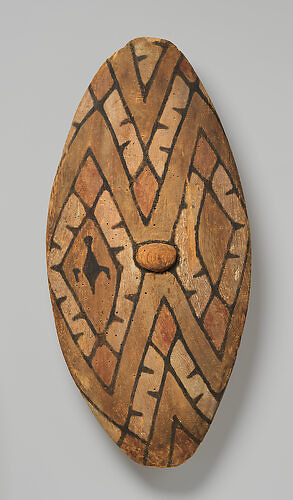
rainforest shield from Queensland
During the fight, combatants stood facing each other and took turns striking, each landing a single blow on his opponent and then receiving one in return. The contest ended when one man grew exhausted and conceded or when a man's shield was destroyed by his opponent, rendering him unable to continue. 4 In less formalized fighting, the shields were used to parry clubs or boomerangs thrown by the enemy and to absorb the impact of spears.
If a man became wounded, he withdrew from the battle; flagging warriors were often saved by older women from their home communities who interposed themselves between the warrior and his opponent, fending off further attack and preventing him from being seriously injured. Fatalities, as a result, were extremely rare.
The broad flat shields were made from the planklike buttress roots of fig trees whose natural contours often imparted a slightly eccentric oval shape to th e finished shield. The shields were made in two sizes- larger, often irregular, oval forms, which often show evidence of extensive battle damage, and smaller ceremonial versions, possibly including the present work, which are said to have been used in dances.
A shield was not considered to be finished until it had been painted. Each shield was painted by two initiated men, who worked together in creating the intricate designs, beginning at opposite ends. The shield designs occasionally incorporate recognizable images of animals or manufactured objects. However, the great majority of shields are adorned with geometric designs that, while they appear abstract to Western observers, represent diverse phenomena from both the human and natural worlds such as implements, plants, fish, stars, comets, or rain bows. Likely representing objects, species, and phenomena associated with the owner's homeland and Dreamings, these designs may have served as totemic clan insignia.
However, no two shields appear precisely alike, and it is possible that the patterns were intended to mark the specific identity of the owner, allowing him to be identified by allies or opponents in battle. Rain-forest peoples had largely ceased producing shields by the end of the nineteenth century. However the making of shields, as aesthetic rather than functional objects, was briefly revived in the 1930s, and examples are occasionally made by artists today.
Rainforest Shield of the Queensland’s Yidinj People
The Metropolitan Museum of Art collection contains a rainforest shield made from Wood and paint by the Yidinj People of Northeastern Queensland. It dates to the mid- to late 19th century and measures 77.5 x 36.2 x 11.7 centimeters (30.5 inches high, with a width of 14. 3 inches and 4.6 inches deep). According to the museum: Vibrantly patterned rainforest shields were made by the Yidinj people and neighboring clans from the region around Cairns in northeast Queensland. The shields were used in both combat and ceremony and were only carried by men, who would receive a shield following the completion of their initiation rites that marked the transition into adulthood. [Source: Metropolitan Museum of Art]
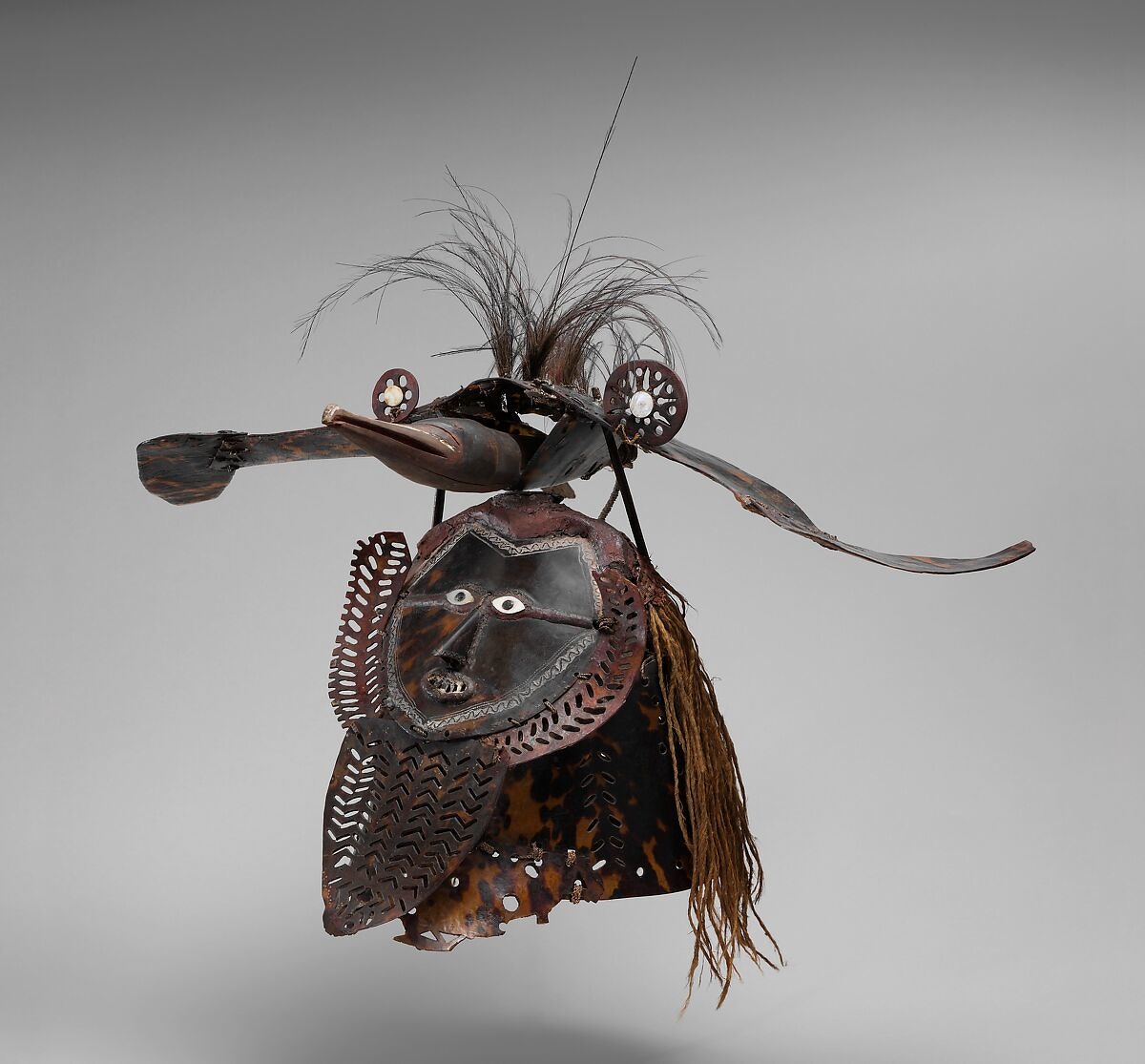
turtle-shell mask form the Torres Islands
Rainforest shields often exhibit a distinctive kidney shape, a result of the curved structures of the native fig tree buttress roots from which they are carved. However, the current example is largely symmetrical. It features a central boss on the front of the shield that was designed to increase the strength of the piece. This shield also features a painted birdlike figure to the right of the central boss. Figurative designs are uncommon in Rainforest shields and the meaning of this motif is unknown. A handle on the bark of the work has been created by carving out the negative space underneath it.
The shields were typically painted by two initiated men who worked simultaneously on the design, one starting at each end. While the designs appear abstract, they are based on hereditary knowledge of clan designs that refer to people, animals and Country. Thus, despite the hands of two artists being present on a single shield, there is a strong visual cohesion across the work.Today rainforest shields and their designs are a source of inspiration for several contemporary Aboriginal artists from the rainforest region including Michael Anning and Paul Bong.
Turtle Shell Masks of the Torres Strait
Eric Kjellgren wrote: The unique turtle-shell masks created by artists on the Torres Stra it Islands, which lie between the Cape York Peninsula of Australia and the southern coast of New Guinea, are among the most renowned of all Oceanic art forms. The masks were fashioned using a distinctive construction technique in which individual plates of turtle shell, heated by the mask maker and bent to the desired shape, were pierced with holes along the outer margins and then stitched together to create complex three-dimensional images. [Source: Eric Kjellgren, “Oceania: Art of the Pacific Islands in The Metropolitan Museum of Art”, 2007]
Once assembled, the masks were completed by the addition of hair, shell, feathers, nuts, and, occasionally, carved wood elements. The creation of masks and effigies from turtle shell was a centuries-old tradition; the earliest Western witness, in 1606, was the Spanish navigator Don Diego de Prado y Tovar, a member of the first European expedition to sail through the Torres Strait. Turtle-shell masks continued to be made until the end of the nineteenth century, when production and use largely ceased under the influence of Christian missionaries and colonial officials.
In recent years, however, some Torres Strait Islander artists have revived the tradition of mask making, including examples made from turtle shell. The forms and names of turtle-shell masks differed in the western and eastern islands of the region. In the west the masks were fantastic composite forms that combined the images or features of humans and animals. They were referred to generically as buk, krar, or kara, the latter two terms meaning "turtle shell." In the eastern islands the masks consisted almost exclusively of human images and were called le op, a term meaning "human face." Each individual mask also had a specific name, typically describing its purpose or the ceremony in which it featured. Although there is little precise information on the identity and function of individual examples, turtle-shell masks were used in similar contexts across the region.
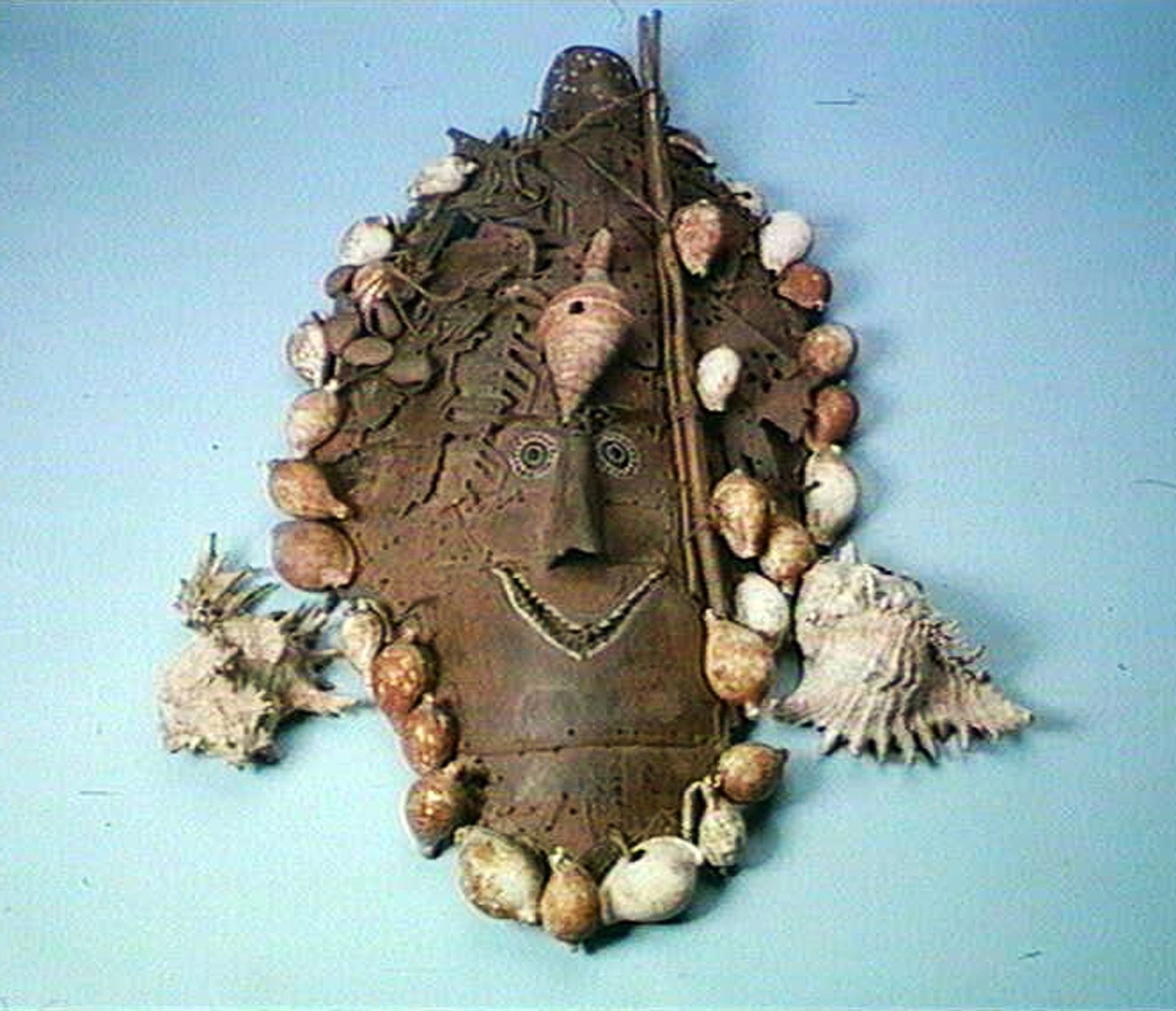
turtle-shell mask form the Torres Islands with skulls at its centrepiece, from the Australian Museum
Turtle-shell masks in the Western Torres Strait ((Buk, Krar, or Kara) reportedly were used during funerary ceremonies and increase rites, designed to ensure bountiful harvests and an abundance of fish and game. The ceremonies often involved performances in which senior men, wearing the masks and rustling costumes of grass, reenacted events from the lives of culture-heroes, which were drawn from oral tradition. Worn over the head like a helmet, this work depicts a human face, possibly representing once such culture-hero. It is surmounted by a frigate bird, perhaps representing his personal totem. One at the Metropolitan Museum of Art is made from turtle shell, wood, cassowary feathers, fiber, resin, shell, paint, Torres Strait Islander and measures 54.6 x 63.5 x 57.8 centimeters (21.5 x 25 x D. 22.75 inches) [Source: Metropolitan Museum of Art]
Modeled in the round and equipped with an opening on the underside just large enough to allow it to be slipped over the head, the mask would have completely covered the performer's head and face when worn. Although they were in some instances used in initiation and, possibly, other rites, le op masks appear to have been employed primarily in funerary ceremonies (keber). Throughout the Torres Strait, these ceremonies were performed to honor and appease the spirits of the dead, enabling them to travel onward to the island of the dead, known in the eastern strait as Boigu, which lay in the direction of the setting sun.
Turtle Shell Masks and Torres Strait Religion and Ceremonies
Eric Kjellgren wrote: Torres Strait masks were integral elements of religious life, serving as vital components of diverse ceremonies that maintained the relationships and balance between humans and the supernatural world. Turtle-shell masks were used in a great variety of ritual contexts, including male initiation rites, funerary rituals, and hunting and war ceremonies, as well as in a number of increase rites devoted to ensuring bountiful harvests and an abundance of animals in both land and sea. Many initiation and funerary ceremonies centered on or culminated in dance performances, during which senior men, clad in turtleshell masks and shaggy, rustling costumes of grass, reenacted crucial events from the lives of legendary culture heroes, drawn from oral tradition. [Source: Eric Kjellgren, “Oceania: Art of the Pacific Islands in The Metropolitan Museum of Art”, 2007]
Although there is no direct evidence, it seems reasonable to suggest that some of the masks portray these legendary beings. Many of the New Guinea masked performances, particularly the initiations and certain funeral rites, were restricted to the men and young male initiates involved. However, others, including many increase rites, were open to the entire community.' When not in use, the masks, sacred objects in their own right, were placed in the care of important men and carefully preserved, kept in structures located at the ceremonial grounds (kwod) or cached in caves or other hiding places in remote locations, from which they were retrieved and reused when required.'5 As a result, some examples, though requiring periodic repair, may be of considerable age.
Attributed to Mabuiag Island, catalogue number 83 displays the composite imagery typical of western Torres Strait masks. Worn over the head in the manner of a helmet, it consists of a human face surrounded by delicate openwork filigree and crowned by the graceful image of a frigate bird, which appears to glide effortlessly above it. Masks of this type may have been used during funerary or increase ceremonies. Many masked performances in the western Torres Strait were centered on the exploits of the culture hero Kwoiam, a warrior of great strength and ferocity who came from Cape York in Australia and traveled across the Torres Strait Islands to southern New Guinea, conquering all in his path until he was finally slain near Mabuiag lsland.
In the Torres Strait, culture heroes were often associated with specific animals, which served as their totemic species. Thus, it is possible that the present work portrays one such hero and that the frigate bird represents his personal totem. Adorned with a lifelike coiffure and beard made from human hair, catalogue number 84, attributed to Erub Island, is a classic example of the le op masks of the eastern Torres Strait. Its ears show the distinctive piercing and artificial extension of the earlobes formerly practiced in the region.
Image Sources: Wikimedia Commons, Metropolitan Museum of Art
Text Sources: “Encyclopedia of World Cultures, Volume 2: Oceania,” edited by Terence E. Hays, 1996, National Geographic, Live Science, Natural History magazine, Australian Museum, Australia Geographic, New York Times, Washington Post, Los Angeles Times, Smithsonian magazine, Encyclopedia.com, Times of London, Library of Congress, The Conversation, The New Yorker, Time, BBC, CNN, Reuters, Associated Press, AFP, Lonely Planet Guides, Culture Shock! Australia, Wikipedia, The Guardian and various websites, books and other publications.
Last updated October 2025