
Home | Category: Aboriginals
TRADITIONAL AUSTRALIAN ABORIGINAL RELIGION
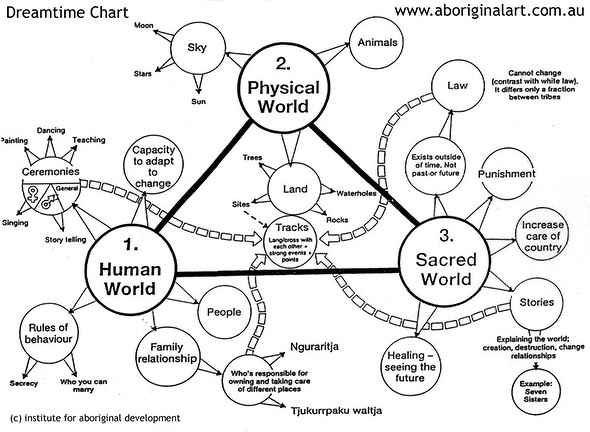
Dreamtime Chart
Traditional Aboriginal religion revolves around "Dreaming" (also known as Aboriginal Dreaming, the Dreaming and Tjukurrpa) — a philosophy and belief system that connects people to the spiritual realm, their land, ancestors, and the creation of the world. It encompasses the story of the Ancestral Spirits, who created the world, the laws for living, and all life. It is a holistic system that connects the past, present, and future, shaping Aboriginal identity, culture, and spirituality, and is shared through stories, art, songs, dances, and rituals.
Less than two percent of Aboriginal Australians list traditional Aboriginal religion as their religion. Many more consider themselves Christians or having no religion. With this being the case traditional Aboriginal beliefs are best viewed as aspects of their culture infused into their world views and ways of looking at things rather than as a practicing religion.
Traditionally, religion, history, law and culture were all intermixed and defined by complex beliefs, rituals and behaviors for interacting with the land and other living organisms. There has traditionally been a strong belief in the link between living people and ancestral beings. Traditionally, Aboriginal stories and knowledge have been passed down through generations via song, dance, art, and oral storytelling. Aboriginals have traditionally lived in close contact with nature.
Totems are also an important part of Aboriginal religious identity. Totems are symbols from the natural world that serve to identify people and their relationships with one another in the social world. These totems both defined social groups, such as clans and lineages, as well as individual totems. The conceptual landscape was inhabited by ghosts of the dead as well as a variety of spirits who controlled certain aspects of the natural world, such as the Rainbow Serpent, who brought rain. Rituals were performed to placate these spirits and also to increase the fertility of certain species of animals that were important.[Source: J. Williams, “Worldmark Encyclopedia of Cultures and Daily Life”, 2009, Encyclopedia.com]
Based on a study of the "Rainbow Serpent," a series of 107 rock paintings that are 6,000 years old, the Aboriginal belief system has been described as the world's oldest religion. The Rainbow Serpent is at the center of the Aboriginal Creation Myth. In Dreamtime at the beginning of the earth it arrived on featureless earth and created rivers and bays. An Australian Museum anthropologist said, "We have a major creation being regarded as extremely important for four to six millennia. In that sense the major component of this spiritual belief systems found elsewhere in the world. In contrast, Hinduism emerged about 3,500 years ago and Judaism, Christianity and Islam began with the teachings Abraham, who is believed to have lived 4,000 years ago.
RELATED ARTICLES:
RITUAL LIFE AND MYTHS OF ANCIENT AUSTRALIANS ioa.factsanddetails.com
AUSTRALIAN ABORIGINAL CUSTOMS, SOCIETY AND RITUALS ioa.factsanddetails.com
ABORIGINAL LIFE: WHERE THEY LIVE, WORK, DIET, HEALTH, ALCOHOL ioa.factsanddetails.com
TRADITIONAL ABORIGINAL LIFE: FOOD, HOMES, HUNTING ioa.factsanddetails.com
LIFE OF EARLIEST HUMANS IN AUSTRALIA: TOOLS, WEAPONS, ART, SETTLEMENTS ioa.factsanddetails.com
ABORIGINAL MEN AND WOMEN: GENDER, MARRIAGE, SEX ioa.factsanddetails.com
ABORIGINAL AUSTRALIAN SEX: PRACTICES, ATTITUDES, ADOLESCENCE ioa.factsanddetails.com
ABORIGINAL AUSTRALIAN ART ioa.factsanddetails.com
ABORIGINALS (FIRST NATION PEOPLE) OF AUSTRALIA: NAMES, DEMOGRAPHICS, LANGUAGES ioa.factsanddetails.com
EARLY MODERN HUMANS IN AUSTRALIA ioa.factsanddetails.com
AUSTRALIAN ABORIGINALS AT THE TIME EUROPEAN COLONIZATION BEGAN ioa.factsanddetails.com
AUSTRALIA ABORIGINALS FROM 1900 TO PRESENT: DISCRIMINATION, ASSIMILATION, SOME RESTITUTION ioa.factsanddetails.com
AUSTRALIA’S STOLEN GENERATIONS: VICTIMS, LAWS, RATIONALE, OUTRAGE ioa.factsanddetails.com
AUSTRALIAN ABORIGINAL PAINTINGS ioa.factsanddetails.com
ABORIGINALS IN QUEENSLAND: SOME GROUPS, CUSTOMS, LIFESTYLES ioa.factsanddetails.com
ABORIGINAL AUSTRALIANS IN NORTH NORTHERN TERRITORY: SOME GROUPS, CUSTOMS, LIFESTYLE ioa.factsanddetails.com
ABORIGINALS OF CENTRAL AUSTRALIA: SOME GROUPS, CUSTOMS, ART, LIFESTYLE ioa.factsanddetails.com
ABORIGINALS IN WESTERN AUSTRALIA: SOME GROUPS, HISTORY, CUSTOMS, TRADITIONAL LIFE ioa.factsanddetails.com
Demography of the Religion of Aboriginals
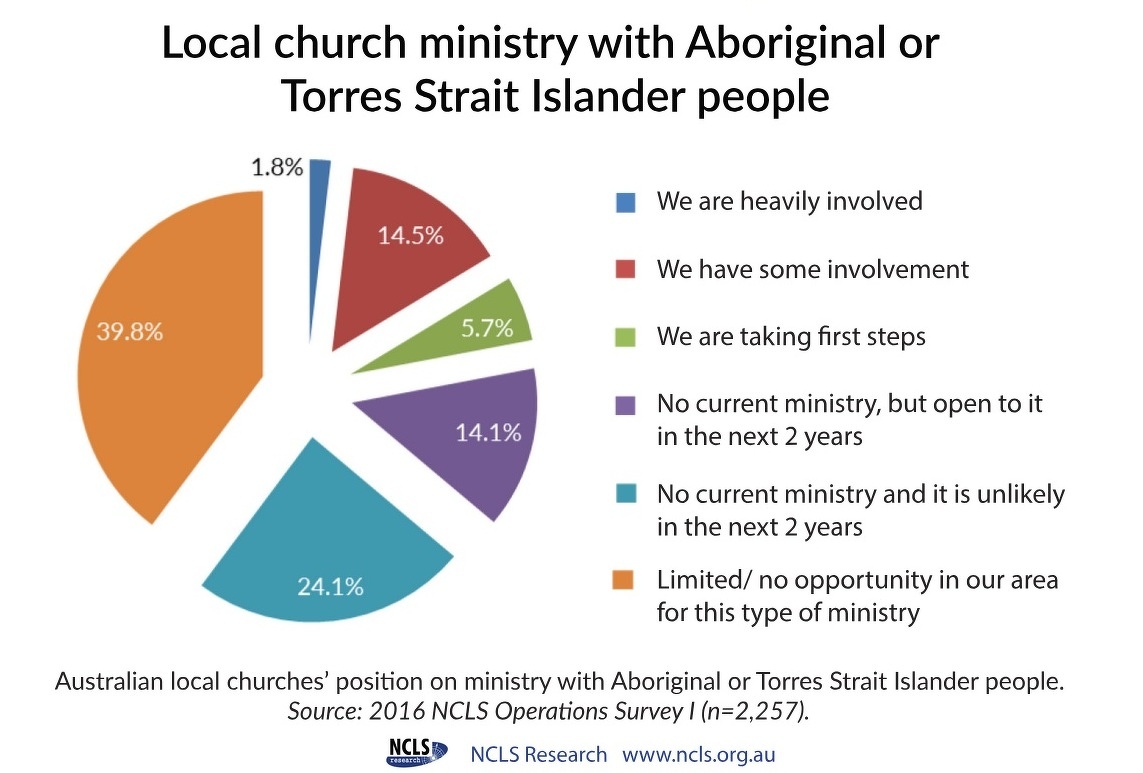
Non-indigenous church involvement with indigenous Australians (Aboriginals)
After the colonization of Australia, many Australian Aboriginals converted to Christianity either by choice or by the influence of education in mission schools. In the 1990s, according to some sources, about 75 percent of Aboriginals indicated that Christianity was their primary religion. [Source: J. Williams, “Worldmark Encyclopedia of Cultures and Daily Life”, 2009, Encyclopedia.com]
The trend among Aboriginals and Torres Strait Islanders in recent years has been a decline in Christian adherence and a rise in no religion. Less than two percent of Australian Aboriginal identify traditional religions as their main religion. The increase in people identifying as having "no religion" is also occurring in the general Australian population. [Source: Google AI]
In the 2016 Census, 54 percent of Aboriginal and Torres Strait Islander people identified as Christian, similar to the non-Indigenous population. The number of Aboriginal identifying as having No Religion rose to 36 percent in the 2016 Census, compared to 30 percent for the non-Indigenous population. The affiliation with Australian Aboriginal Traditional Religions: has remained steady at less than 2 percent of the population for over two decades.
The proportion of Aboriginal and Torres Strait Islander people identifying as Christian has been decreasing since 1991. The percentage of people with no religious affiliation has increased significantly since 2001, with the largest jump occurring between 2011 and 2016. Broader cultural changes in Australian society have contributed to this trend. Census Methodology: Changes in how the census questions are worded and the introduction of categories like "no religion" have also influenced reported affiliations.
In a 1966 census of 80,207 Aboriginals about religion: 32 percent had no reply, 3 percent had no religion, 2 percent were "indefinite" or "non-Christian," 16 percent were Catholics, 21 percent were Anglicans and 13 percent were other Christian denominations. ["World Religions" edited by Geoffrey Parrinder, Facts on File Publications, New York]
Dreaming and Dreamtime
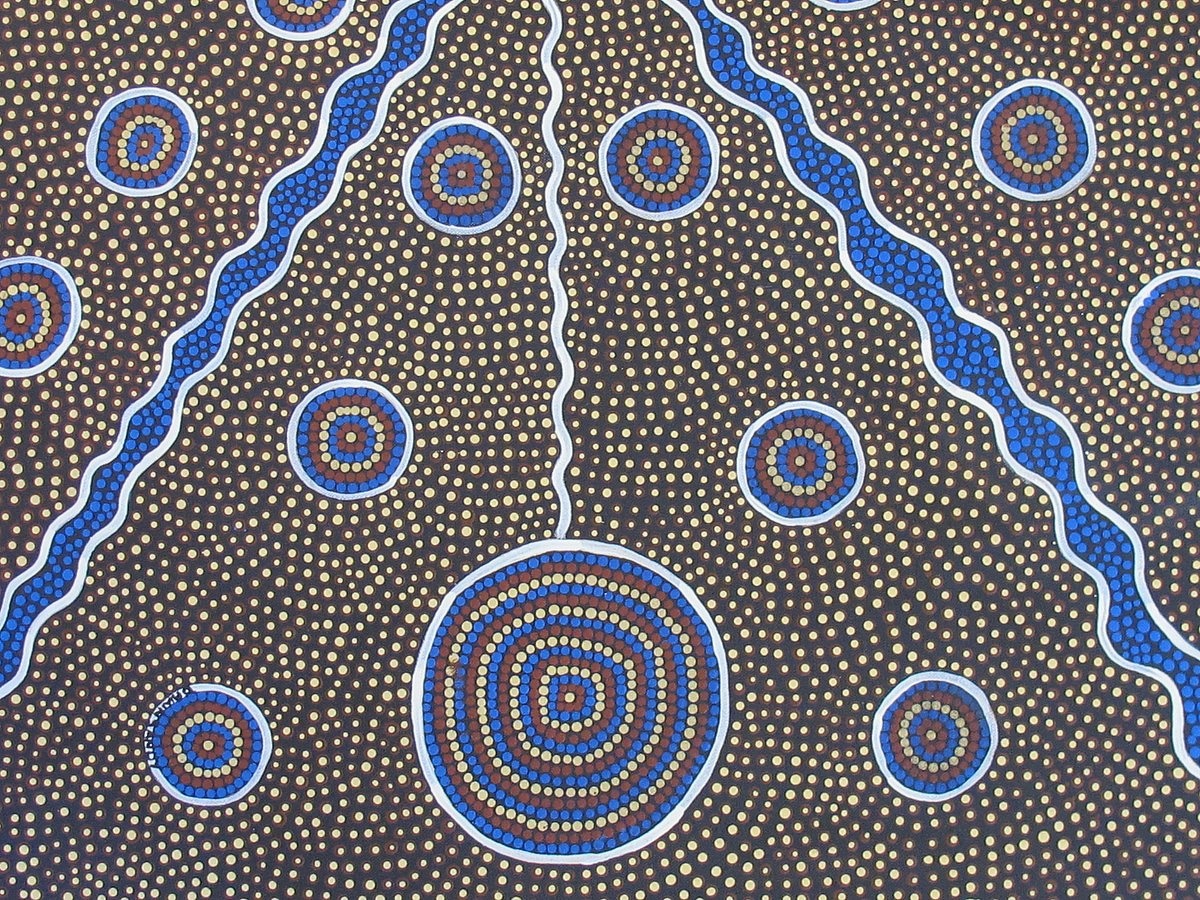
The essence of Aboriginal religion is Dreaming, as we said before, which has been described as metaphysical or spiritual parallel time and space universe that is linked to our own universe. Dreaming in the natural universe can take many forms: in a person, an animal, a place, a community or in a natural phenomena such as rain or wind.
Dreamtime refers to the beginning of life and its continuation into the future. It refers to the creation of the landscape, people and laws by totemic ancestral beings. Each individual has their Dreamtime and their own links to the ancestral beings.
Every individual has two souls: one mortal and one immortal. The mortal one appears when a person is born and disappears when a person dies. The immortal one is linked to Dreamtime, ancestral beings and the Dream places associated with them.
Dreaming varies from tribe to tribe and dates back to the people who arrived in Australia during the Ice Age. Rick Gore of National Geographic described dreaming as "a vision from a time beyond memory yet still persisting, a time in which ancestral beings move across a barren earth, shaping the landscape. It is a time filled with mythical spirits, sacred places, and animal totems."
Aboriginal Creation, Ancestral Beings and Totems
Aboriginals believe that the world was created out of chaos by certain gods. According the Aboriginals creation myth, supernatural beings such as the Rainbow Serpent, the Lightning Men and the Mandjina woke up from Eternal Dreamtime and rose from the flat earth to create features such as rock formations, caves and waterholes. These and other beings, often referred to Aboriginals as their ancestors, were not only linked with the geographical feature they were also associated with ceratin animals and plants. Humans are believed to be the offspring of these several different supernatural beings which means that different Aboriginal groups are often named after different beings, which in turn are linked with their region.
The Dreamtime equivalent of gods are ancestral beings. They have traditionally traveled around and often left signs on the landscape as they passed by. Even though these beings were supernatural they aged as humans did and eventually returned to Dreamtime, where they breath life into newborn infants and influence events in the natural world. The energies of ancestral beings remain alive along the paths they have traveled while they were in the natural world and are particularly intense in the places where they left being signs.
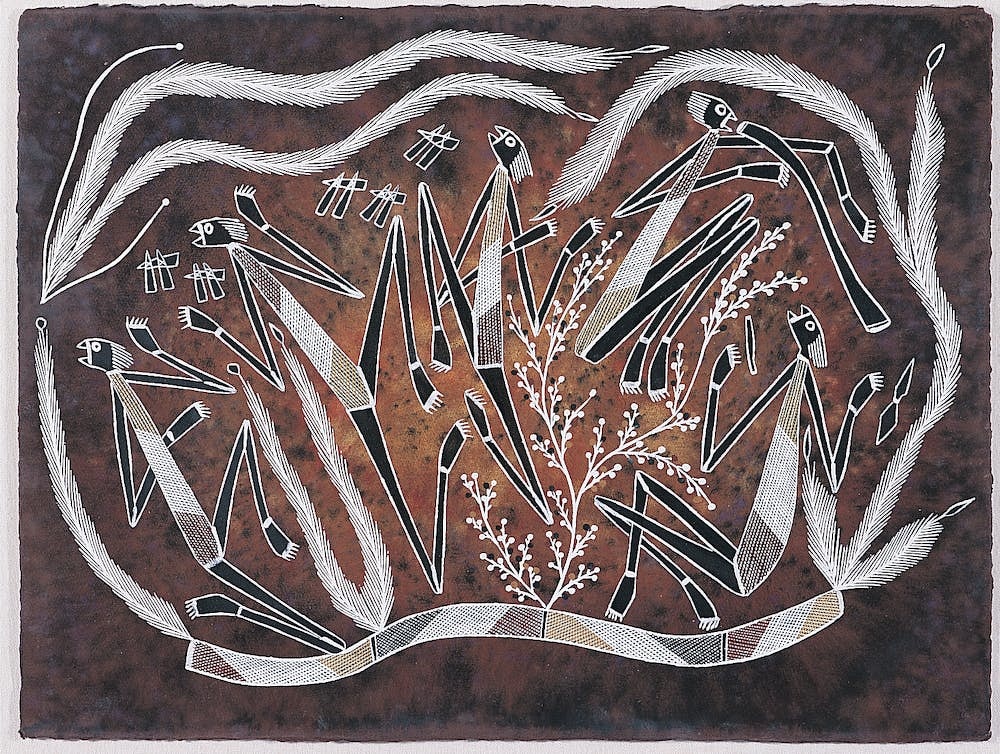
Dancing Namorroddos by Garry Djorlom, Kunwinjku, 1991
Ancestral beings can have a benign or malevolent influence on people and provide valuable information on where to find water or hunt game. They can also provide advice on family, clan and martial relationships. Common ancestral spirits found in northern Australia include Djangkawu, who traveled with and elaborate dilly bag and digging stick used to create water holes; the Wagilag Sisters, linked with water holes and snakes; the Rainbow serpent Yingarna and her offspring Ngalyod; and the Mimi spirits, who are credited with teaching the Aboriginals things like hunting, food gathering and painting.
Ancestral beings can take the form of totems — animals such as snakes, fish and birds or even people. Dream Places and totems are often linked. For Aboriginals a mountain might represent a great bird, or a snake, a celestial serpent. Different family members have different totem signs. A mother may be a possum, a father a goanna, a son a dingo and a daughter, a crocodile. The Aranda Aboriginals of Central Australia use sacred emblems called “tjurungas”. In their dreamtime each “tjurngas” us associated with a particular totemic ancestor and its spirit lived within it. When the spirit entered a women it was reincarnated as a child. Each person has his or her own “tjurngas”.
Aboriginal Monsters and Cannibalism
According to Julie Finlayson of the Center of Aboriginal Economic Policy research in Canberra in some Aboriginal societies "some part of the deceased body may be eaten" in highly ritualized situations to take the dead person's "spiritual qualities." The Theddora tribe of southeast Australia and the Dyaks of Sarawaks used to eat the palms of their enemies. Cannibalism and monsters are often the subjects of Aboriginal art.
Christine Judith Nicholls wrote in The Conversation: A rich inventory of monstrous figures exists throughout Aboriginal Australia. The specific form that their wickedness takes depends to a considerable extent on their location. In the Australian Central and Western Deserts there are roaming Ogres, Bogeymen and Bogey women, Cannibal Babies, Giant Baby-Guzzlers, Sorcerers, and spinifex and feather-slippered Spirit Beings able to dispatch victims with a single fatal garrote. There are lustful old men who, wishing to satiate their unbridled sexual appetites, relentlessly pursue beautiful nubile young girls through the night sky and on land – and other monstrous beings, too. [Source:Christine Judith Nicholls, Honorary Senior Lecturer, Australian National University, The Conversation, April 29, 2014]
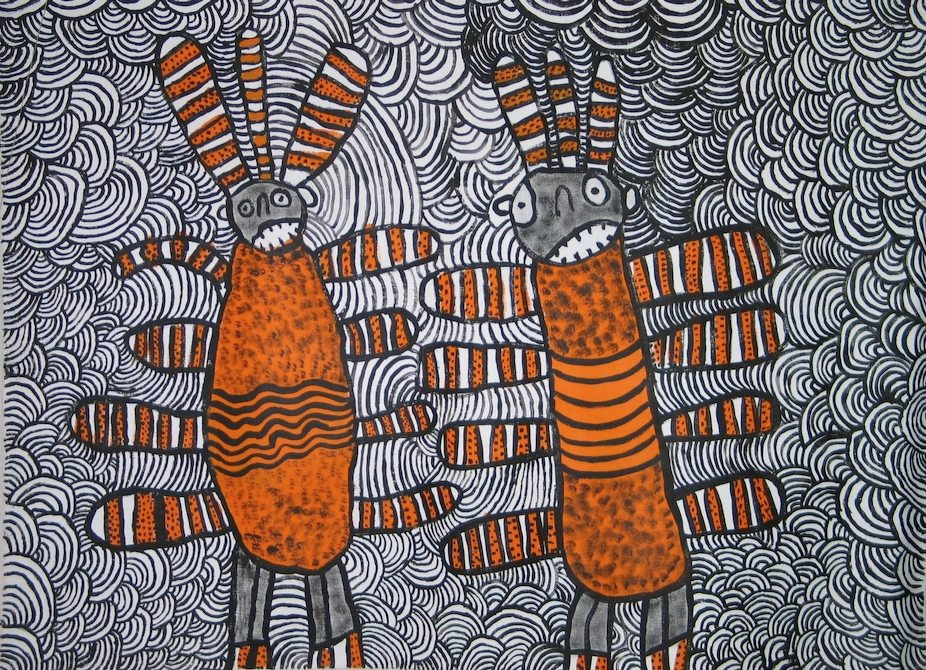
Mamu (Spooky spirits) of the Pitjantjatjara people, South Australia
Arnhem Land, in Australia’s north, is the abode of malevolent shades and vampire-like Wind and Shooting Star Spirit Beings. There are also murderous, humanoid fish-maidens who live in deep waterholes and rockholes, biding their time to rise up, grab and drown unsuspecting human children or adults who stray close to the water’s edge. Certain sorcerers gleefully dismember their victims limb by limb, and there are other monstrous entities as well, living parallel lives to the human beings residing in the same places. In Aboriginal Australia, these figures and their attendant narratives provide a valuable source of knowledge about the hazards of specific places and environments. Most important of all is their social function in terms of engendering fear and caution in young children, commensurate with the very real environmental perils that they inevitably encounter.
The monstrousness of many, although not all, of these monstrous Desert Beings lies in their particular disposition towards cannibalism. In the farthest reaches of the Western Desert, in the Pilbara region, the brilliant although largely unheralded Martu artist and animator Yunkurra Billy Atkins creates extraordinarily graphic images of cannibal beings, including babies. These ancient, malevolent Ngayurnangalku (Cannibal Beings) have sharp pointy teeth and curved, claw-like fingernails. They reside beneath a salt lake, Kumpupirntily (Lake Disappointment). In those environs they have been known to stalk and to feast on human prey – to be precise, Martu people.
Of Kumpupirntily, ANU researcher John Carty wrote: It it is a stark, flat and unforgiving expanse of blinding salt-lake surrounded by sand hills. Martu never set foot on the surface of the salt-lake and, when required to pass it by, can’t get away fast enough. This unnerving environment is grounded in an equally unnerving narrative. Kumpupirntily is home to the fearsome Ngayurnangalku, ancestral cannibal beings who continue to live today beneath the vast salt-lake.
For the complete article from which the material here is derived see “‘Dreamings’ and place – Aboriginal monsters and their meanings” by Christine Judith Nicholls, The Conversation
Dream Places
Aboriginals traditionally believed that certain ancestral beings (gods) inhabited certain places that exist on the Australian landscape. They have traditionally believe that infants were conceived through the union of a man, woman and a dreaming place. When an Aboriginal dies, they believe, he or she return to their dreaming place. Almost every piece of land is someone’s dreaming place and if the place is destroyed, they believe, so to is the soul of the person that occupies it.
Most dream places are natural landmarks, like a sandstone rock formation with features that recall something about a dreamtime spirit. These sites are visited over and over through time by generations of Aboriginals on Walkabout who renewed themselves spiritually and maintained their bond with their gods and nature with each visit. Aboriginal mythology relates directly to the landscape. Aboriginals have said there is no difference between the sacred world and the world around them. They have the earth is their mother.
All people and clans are is linked to their Dream Places associated with their ancestral beings and are believed to be places where spirits sprang up when they were born and where they return when they die. Certain rituals and songs have traditionally been linked with sacred sites and certain members of the clan were responsible for their upkeep. Negligence of these duties is often dealt with harshly because diseases and natural disasters are often blamed on negligence of the sites.
Traditional Aboriginal ceremonies are still held in special Dream Places, some of which are marked with traditional rock paintings. Some places are regarded as dangerous and entrance is restricted by Aboriginal law. For years Europeans scoffed at these superstitions. But some have been off limits for good reasons, such as high levels of natural radiation or fish that make people sick.
Aboriginals have traditionally felt a strong spiritual relationship with the land based on their belief in Dreaming and Dream Places. Elder Aboriginals have said they can feel their ancestors spirits when they return their homeland after a long time away. Describing his "sulking holes," one Aboriginal man told National Geographic, "Pools of water where I'd sit and smoke and meditate. And those hills. I lived with them for a long time but rarely saw them the same way; the light was always changing."
It is no surprise that Aboriginals often get very upset when sacred sites are damaged or destroyed by development or mining. Dream Places are not like churches that can be rebuilt and restored if an old one burns down. Dream Places are believed to be lost forever. Not only are living people affected but everyone in the dreamtime continuum — those who has lived in the past and those who will live in the future.
Songlines
Aboriginals have traditionally described their totems and Dream Places and divided up their land according to Songlines. According to the Dreamtime myth the animals, the land the vegetation came into being by songs from the Ancestors who roamed the world and sang the names of everything they passed bringing them into being. They left behind songlines, trails or words and notes.
Songlines are the lines that connect dreaming places. They are regarded as a trail of words and musical tones left behind by dreamtime ancestors. They are both a map and source of direction. Aboriginals believe their spirits control nature and they can be summoned with verses that the spirits themselves sang at the beginning of time.
Describing what they are Bruce Chatwin wrote in “Songlines”, "Regardless of the words, it seems the melodic contour of the song describes the nature of the land over which the song passes. One phase would say, 'Salt-pan,'; another 'Creek-bed', 'Spinfex', 'Sandhill', 'Mulga-scrub', 'Rockface' and so forth. "If the Lizard Man were dragging his heels across the salt-pan of Lake Eyre, you would expect a succession of long flats, like Chopin’s “Funeral march”. If he were skipping up and down the MacDonnell escarpments, you'd have a series of arpeggios and glissandos, like Liszt's “Hungarian Rhapsodies”.
Certain phrases, certain combinations of musical notes, are thought to describe the action of the Ancestor's “feet”... An expert songman, by listening to their order of succession, would count how many times his hero crossed a river, or scaled a ridge—and be able too calculate where, and how far along, a Songline he was."
Walkabout
A walkabout is a traditional Australian Aboriginal rite of passage, a period of nomadic wandering in the bush to learn skills and gain independence. Historically, it was a crucial coming-of-age ritual for young people to spend time away from their community, living in the bush and connecting with the land. During the walkabout, young people would acquire and demonstrate adult skills, learn traditions, and understand the cultural lore. After the arrival of Europeans, Aboriginal stockmen would return to their traditional life during the wet season, leading to the term being associated with a nomadic excursion.
When Aboriginals went on walkabouts they sang songs as they went. Each verse of the song corresponded to a landmark—a hill, a rock, a water hole—created by Sky Heroes long ago. By following the verses from point to point they keep to preordained song line routes. Some say "Walkabout" describes a spiritual journey to sacred sights for ceremonial or family purposes. Others say it simply means "going home." Some white Australians described walkabout as when a Aboriginal "shambled off his job" so he could "chase his tail" in the desert. When Aboriginal woman was asked how she dealt with the pain of losing a brother and two sons to alcoholism she said, she "went bush."
The English director Nicholas Roeg made a cult classic film entitled “Walkabout” that followed the journey of a young Aboriginal from the tower block in Sydney to the outback. The star of the film was a 15 year old Aboriginal from Arnhem Land who had never seen a film, let alone acted in one.∝
Christianity Among Australian Aboriginals
After the colonization of Australia, many Australian Aboriginals converted to Christianity either by choice or by the influence of education in mission schools. In the 1990s, according to some sources, about 75 percent of Aboriginals indicated that Christianity was their primary religion. The proportion of Aboriginal and Torres Strait Islander people identifying as Christian has been decreasing since 1991. The percentage of people with no religious affiliation has increased In the 2016 Census, 54 percent of Aboriginal and Torres Strait Islander people identified as Christian, similar to the non-Indigenous population.
Proportionally, more Indigenous Australian claim to be Christians than the non-Indigenous population of Australia. Among some Aboriginal Australian Christians traditional religion remains alive. But One aspect of the conversion of Aboriginal people to Christianity is that very few, if any, traditional elements of Aboriginal spirituality have been incorporated into Aboriginal Christianity. [Source: J. Williams, “Worldmark Encyclopedia of Cultures and Daily Life”, 2009, Encyclopedia.com]
The first full translation of the Christian Bible into an Aboriginal language — Kriol — was completed in 2007 after almost 30 years of work and was made available to about 30,000 Kriol speakers in the Northern Territories. The director of the Bible Society in the Northern Territory, Phillip Zamagias, said the Bible has not been translated word-for-word, because in many cases, there is no Kriol equivalent. "If you say something is white as snow, how do they understand what snow is if they've never seen it, or how do they understand what the habits of sheep are because scripture talks a lot about people being like sheep and going astray and so forth, so you have to actually sometimes explain the concept as you go," he said. [Source: ABC, May 5, 2007]
In 1995 Pope John Paul II beatified the Australian nun Mary Mackillop in Sydney, accompanied by 26 Catholic Aboriginal Australians. Aboriginal Australians performed a smoking ceremony to replace traditional incense burning in Catholic mass,with the Pope making special mention of the presence of Aboriginal Australians throughout Australia's history. Members of the Indigenous community who commented on the event said they saw this as a positive step towards reconciling with the Catholic church. [Source: Wikipedia]
Aboriginal Folk Beliefs and Superstitions
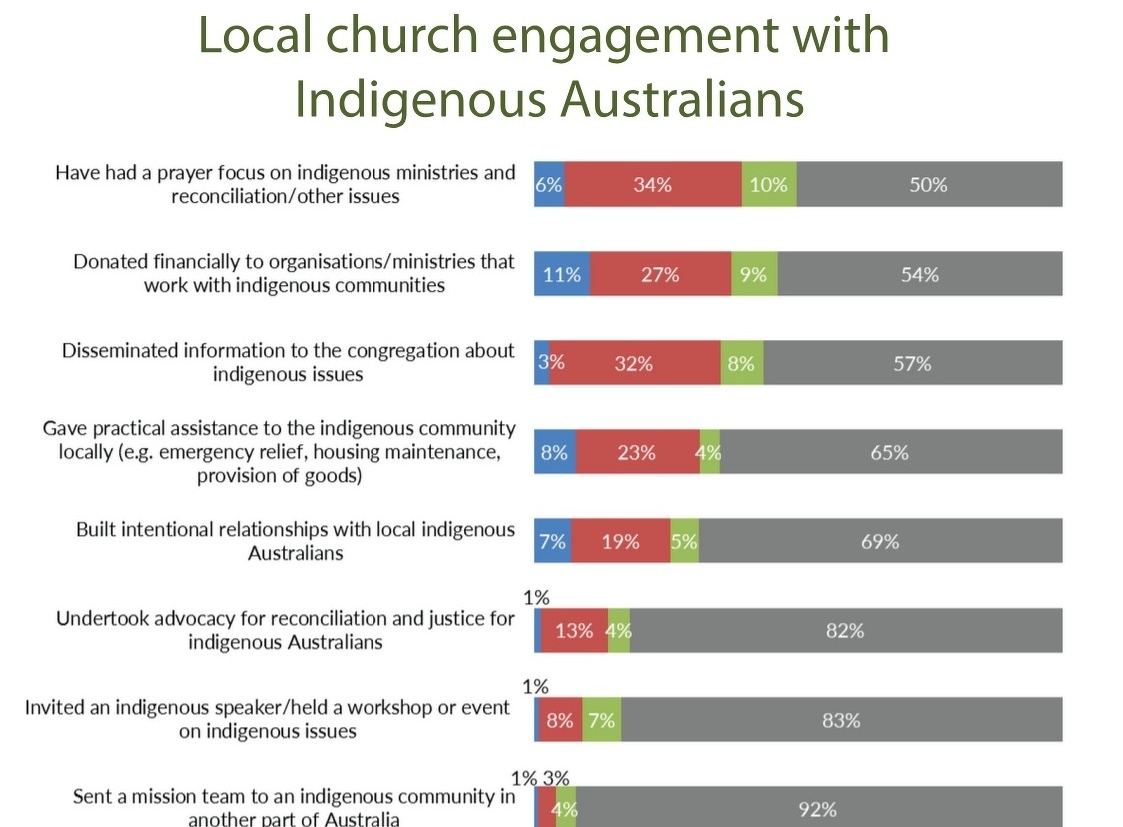
Non-indigenous church involvement with indigenous Australians (Aboriginals): Frequently (blue); occasionally (rusty red); once (green); never (grey)
Many Aboriginals have traditionally believed that whistling at night attracts spirits and unnatural deaths are the result of evil spirits or spells, often cast by an enemy, rather than a natural occurrence. The naming of the deceased or show their images in photographs or in media is a taboo in many communities. The Aboriginals of Cape York Peninsula in northeast Queensland believe that rubbing the back of a sunbird on an infant's lips supplies the gift of speech and that sighting of a brown crab on a rooftop heralds the approach of death.
Aborigines used to drop stones on a man's footprints to make him go lame. Aborigine executioners wore shoes made of emu feathers and human hair that masked their footprints. Aboriginals usually went barefoot and the shoes seem to have been designed to hide their identity. When the Kurnai of Australia saw the Southern Lights they swung the severed hand of a dead man and chanted, "Send it away! Do not let it burn us up!"
Employing a practice called the bone of death, Aboriginal shaman in some places used to place a curse on victims by pointing a bone at them from a distance of 10 to 15 feet and chanting malevolent curses. It was reportedly only used on Aboriginals and is ineffective on whites,
Doctors in Arnhem Land have observed victims die without appearing to have anything physically wrong with them after being cursed. One observer wrote, "He had not been poisoned or other wise harmed. Yet from the moment he was "pointed," nothing could save him, he died before our eyes, in dreadful agony, apparently from the mere knowledge he must die."
Aboriginal Funerals and Beliefs About Death
Traditionally, Australian Aboriginals believed every individual had two souls: one mortal and one immortal. The mortal one appears when a person is born and disappears when a person dies. The immortal one is linked to Dreamtime, ancestral beings and the Dream places associated with them.
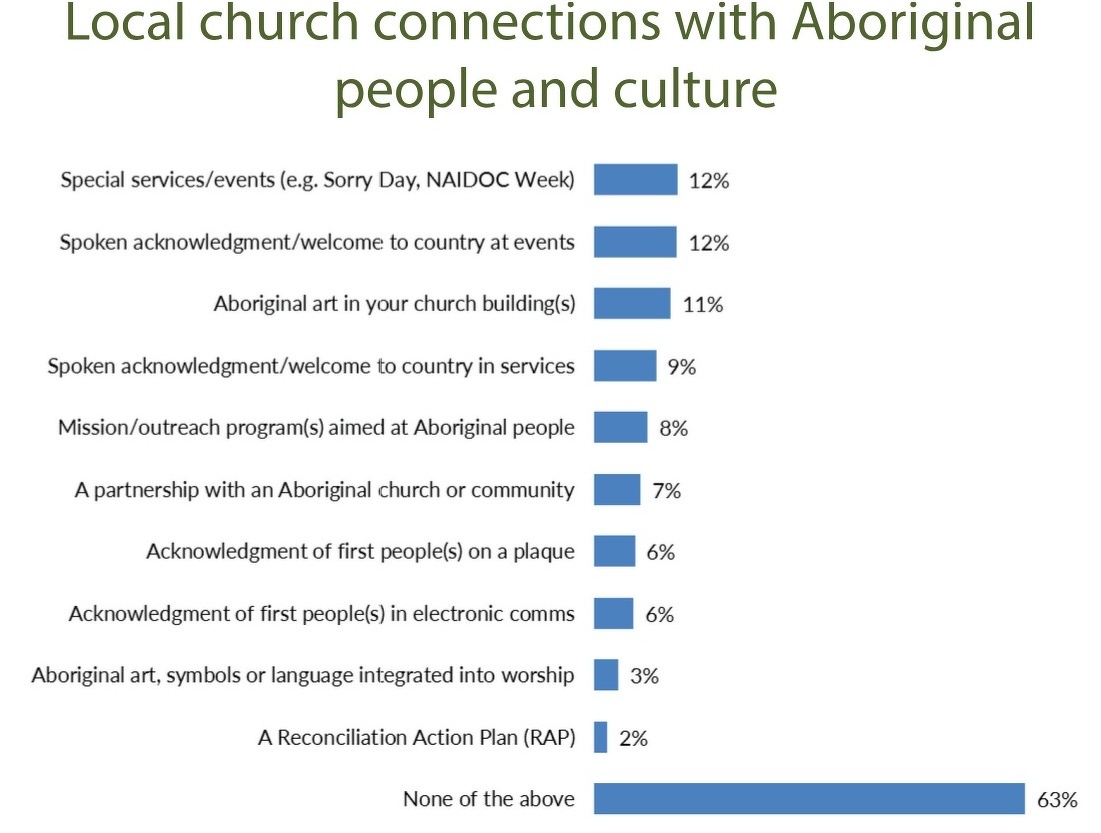
Non-indigenous church involvement with indigenous Australians (Aboriginals)
According to James Frazier, the pattern of Australian belief in reincarnation suggests that doctrine was once universal among all the Australia aboriginals but has declined in recent centuries, a change hastened by contact with white settlers. Aboriginals believed that elderly people could be reborn as children and as creatures other than humans. In the 19th mountains, anthropologists Baldwin Spence and F.J. Gillen wrote: In every tribe without exception there exists a firm belief in reincarnation that is not confined to tribes such as the Arunra, Warramunga, Binbinga, Anula and others, amongst whom descent is counted on the male line, but is found just as strongly developed in the Urabbuna tribe, in which descent, both class and totem, is strictly maternal
According to the “Worldmark Encyclopedia of Cultures and Daily Life”: Death in Aboriginal Australian societies was accompanied by complex rituals. Among the Walpiri of central Australia, a wife would have to isolate herself from the rest of the community upon the death of her husband. She would live in a "widows' camp" for a period of one to two years. During that time she would communicate through an intricate system of sign language. She was not permitted to speak during this period of mourning and seclusion. If a woman chose not to follow these traditions, her husband's ghost could steal her soul, which would lead to her death. [Source: J. Williams, “Worldmark Encyclopedia of Cultures and Daily Life”, 2009, Encyclopedia.com]
Smoking ceremonies (See Aboriginal Customs) are conducted in a deceased person's space to aid their spirit in moving on from the material world and purify or cleanse a location. The ceremony takes precedence over all other events and may involve smoking a deceased person's house, room or car to allow their spirit to return to country. Depending on the Aboriginal group, smoking may be accompanied by sweeping of branches across a location, which is said to weaken the connection between the dead and living world and may have replaced the practice of burning the clothes and belongings of the deceased. Community members may also paint ocher on the living spaces inhabited by the dead, which serves the dual purpose of encouraging the spirit to move on and notifying the community that someone has died. [Source: Wikipedia]
Some Aboriginals placed their dead in in ant and termite mounds and collected the bones after a certain period of time. Groups in Australia, British Columbia, the American southwest and Siberia were known to practice tree burial, which involved wrapping the body in a shroud or cloth and placing it in a crook to decompose. [Source: Heather Whipps, Live Science, December 6, 2007]
Rituals of death are usually conducted to ensure safe passage to the spirit world. Those that don't receive safe passage may come back and haunt the living. The is no link between the good deeds of the living and a better life in the hereafter. Rituals and myths are passed down orally form generation to generation and they are used to invoke food and rain. ["World Religions" edited by Geoffrey Parrinder, Facts on File Publications, New York]
Image Sources: Wikimedia Commons, The Conversation
Text Sources: “Encyclopedia of World Cultures, Volume 2: Oceania,” edited by Terence E. Hays, 1996, National Geographic, Live Science, Natural History magazine, Australian Museum, Australia Geographic, New York Times, Washington Post, Los Angeles Times, Smithsonian magazine, Encyclopedia.com, Times of London, Library of Congress, The Conversation, The New Yorker, Time, BBC, CNN, Reuters, Associated Press, AFP, Lonely Planet Guides, Culture Shock! Australia, Wikipedia, The Guardian and various websites, books and other publications.
Last updated September 2025