
Home | Category: History / Aboriginals
ABORIGINALS IN AUSTRALIA WHEN THE FIRST EUROPEANS ARRIVED
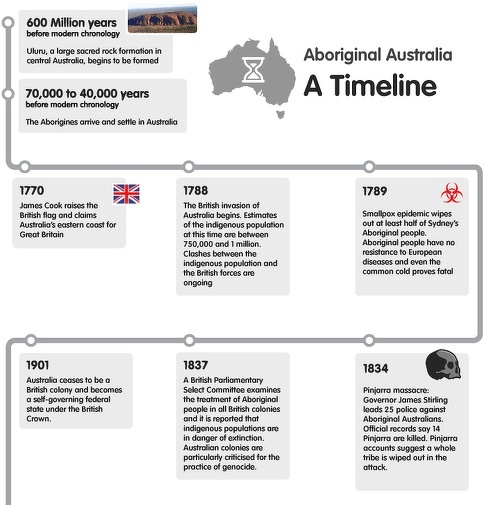
When British settlers began colonizing Australia in 1788, many Aboriginal Australians lived there. Researchers estimate there were between 750,000 and over a million at the time. Soon, epidemics ravaged the island’s Indigenous populations, and British settlers seized their lands.
In addition to its obvious ecological impacts on particular regions, the early clearing of land and importation of hard-hoofed animals by early Australia settlers severely affected Aboriginals by reducing their access to essential resources like food and shelter. They were progressively forced into smaller areas, which reduced their numbers as the majority died from newly introduced diseases and a lack of resources. Widespread indigenous resistance against the settlers led to prolonged fighting from 1788 to the 1920s, resulting in the deaths of at least 20,000 indigenous people and between 2,000 and 2,500 Europeans. [Source: Library of Congress, September 2005]
Aboriginals died as a result of massacres and the poverty as British settlers took their lands. Researchers have documented at least 270 massacres of Aboriginal Australians during Australia’s first 140 years. The term “genocide” remains controversial. However, many believe that the continent’s first inhabitants were wiped out through violence. A recent four-year study conducted by the Indigenous-led Yoorrook Justice Commission concluded that British colonization efforts, beginning in 1834, constituted a “genocide” against the Indigenous population in the state of Victoria. The commission also released some 100 recommendations for redress.
Australia is the only country in the British Commonwealth that has never made a treaty with its First Nations people.When the whites first arrived in Australia, they declared it an ‘empty land’ belonging to nobody, Terra Nullius, and took the land they wanted. Most First Nations people did not have full citizenship or voting rights until 1965. Only in 1967 did Australians vote that federal laws would also apply to Aboriginal Australians.
RELATED ARTICLES:
ABORIGINALS (FIRST NATION PEOPLE) OF AUSTRALIA: NAMES, DEMOGRAPHICS, LANGUAGES ioa.factsanddetails.com
EARLY MODERN HUMANS IN AUSTRALIA ioa.factsanddetails.com
LIFE OF EARLIEST HUMANS IN AUSTRALIA: TOOLS, WEAPONS, ART, SETTLEMENTS ioa.factsanddetails.com
PEOPLE WHO LIVED AUSTRALIA 20,000 TO 10,000 YEARS AGO ioa.factsanddetails.com ;
RITUAL LIFE AND MYTHS OF ANCIENT AUSTRALIANS ioa.factsanddetails.com
EARLY ABORIGINALS ioa.factsanddetails.com ;
VERY, VERY OLD AUSTRALIAN AND ABORIGINAL ROCK ART ioa.factsanddetails.com ;
ABORIGINAL TASMANIANS: HISTORY, ABUSE, LIFESTYLE AND NEAR EXTINCTION ioa.factsanddetails.com
AUSTRALIA ABORIGINALS FROM 1900 TO PRESENT: DISCRIMINATION, ASSIMILATION, SOME RESTITUTION ioa.factsanddetails.com
AUSTRALIA’S STOLEN GENERATIONS: VICTIMS, LAWS, RATIONALE, OUTRAGE ioa.factsanddetails.com
AUSTRALIAN ABORIGINAL RELIGION: TRADITIONAL BELIEFS, DEMOGRAPHY AND DEATH ioa.factsanddetails.com
AUSTRALIAN ABORIGINAL CUSTOMS, SOCIETY AND RITUALS ioa.factsanddetails.com
ABORIGINAL LIFE: WHERE THEY LIVE, WORK, DIET, HEALTH, ALCOHOL ioa.factsanddetails.com
TRADITIONAL ABORIGINAL LIFE: FOOD, HOMES, HUNTING ioa.factsanddetails.com
ABORIGINAL AUSTRALIAN ART ioa.factsanddetails.com
ABORIGINALS IN QUEENSLAND: SOME GROUPS, CUSTOMS, LIFESTYLES ioa.factsanddetails.com
ABORIGINAL AUSTRALIANS IN NORTH NORTHERN TERRITORY: SOME GROUPS, CUSTOMS, LIFESTYLE ioa.factsanddetails.com
ABORIGINALS OF CENTRAL AUSTRALIA: SOME GROUPS, CUSTOMS, ART, LIFESTYLE ioa.factsanddetails.com
ABORIGINALS IN WESTERN AUSTRALIA: SOME GROUPS, HISTORY, CUSTOMS, TRADITIONAL LIFE ioa.factsanddetails.com
Aboriginals Before Europeans Arrived

genomic history of Aboriginal Australia, from Nature
Before the arrival of European settlers in 1788, Aboriginal population of Australia was comprised of diverse hunter-gatherer societies with strong spiritual connections to their land and sophisticated social structures, not based on land ownership but on stewardship. Pre-European Aboriginal lacked written languages and some of sophisticated technologies that European possessed such as advanced metalworking but they had complex knowledge of their environment, engaging in activities like fire-stick farming, fishing, and harvesting.
At the time of European contact, there were roughly 600 Aboriginal nations and groups, each with its own language and customs. Lifestyles varied across the continent, from nomadic hunter-gatherers in drier areas to more settled communities with fish and crop farming in the cooler regions of the south. In northwest Queensland they lived in rainforests.
Indigenous peoples of Australia held a profound spiritual connection to their "Country," which provided sustenance, shelter, and resources, but they did not "own" it in a monetary sense. Their relationship with the land was based on care and responsibility, with elaborate cultural narratives, rituals, and dances binding the human and spiritual realms together. They possessed encyclopedic knowledge of natural history, recognizing and understanding intricate relationships within their ecosystems, elevating these observations into intricate narratives of the Dreaming.
Most Aboriginal communities lived by hunting and gathering, with men hunting large animals and women and children collecting plants, fruits, and berries. Some groups practiced "fire-stick farming," using fire to clear land and promote the growth of certain plants and animals, which also supported fish farming in some areas. Well-established trade networks existed between different tribal groups, facilitating the exchange of goods and resources across vast distances. In the old days, venomous could be very warlike. There were fierce arriors and groups staged raids like those of tribes in New Guinea in decades past and had some awful forms of punishment such as spearing.
Ilsa Sharp wrote in “CultureShock! Australia”: Before European settlement Australia was a patchwork quilt of diverse societies, each with their own customs, rituals and rites collectively known as ‘The Law’. Each group showed great respect for every other group’s ‘country’, entering it only after observing certain accepted protocols seeking permission to enter. This is the reason that in Australia today, all officials, and all thinking events organisers routinely schedule a ceremony at the beginning of their event called ‘Welcome to Country’ in which the ‘traditional owners’, the indigenous Aboriginals, of the ‘country’ in which the event is taking place, formally welcome the ‘intruders’ who have come to the event, and give them permission to carry on and enter their ‘country.’ [Source: Ilsa Sharp, “CultureShock! A Survival Guide to Customs and Etiquette: Australia”, Marshall Cavendish, 2009]
Spearing and Other Traditional Aboriginal Punishments

1874 lithograph depicting Aboriginal spearing
Ancient Aboriginal punishments, or "paybacks," were community-based responses to breaches of customary law, including death, spearing, public shaming, initiation, exclusion, and compensation. These punishments served to restore balance and harmony, prevent ongoing feuds, and ensure the continued well-being of the community by acknowledging the debt incurred by the offender.
Spearing was a physical punishment in which an individual was speared, typically in the thigh or other parts of leg, with the severity of the wound determined by the crime. The practice was generally seen as less cruel than imprisonment but it sometimes resulted in severe injury or death due to the severing of major blood vessels. The intent was to settle matters and prevent further violence.
In severe cases, punishment could include direct execution or indirect death through acts of sorcery or incantation. Dueling — ritualized combat with clubs or other weapons between individuals — was used to settle disputes and restore honor. Singing (or "Pointing the Bone") was a spiritual practice in which a powerful elder called on spirits to inflict har, misfortune or ill health on an offender. Compensation required an offender to provide a gift, property, or even in some cases, a person through marriage or adoption, to the wronged party. The Aboriginal form of ostracism involved banning an offender from the community or certain ceremonies. Public shaming was employed humiliate offenders and get them to correct their evil ways.
The primary objective of these punishments was to restore peace and balance within the community and between individuals after a wrong was committed. Part of this was preventing escalation and cycles of revenge by providing a clear and agreed-upon consequence for misdeeds. By clearly defining agreed-upon penalties, these punishments helped maintain social order and the integrity of kinship and tribal relationships. Specific punishment was often tailored to the nature of the offense, ranging from minor shaming to severe, life-threatening forms of retribution.
Thick Skulls, Club Duels and Ancestral Rings
Noel T. Boaz and Russell L. Ciochon wrote in Natural History magazine: Nineteenth-century ethnographic reports of Australian Aboriginal groups, particularly for central and southeastern Australia describe men or women who “had a bone to pick” with another group member followed a code for resolving the conflict. They challenged their adversary to a duel with a combination club and throwing stick called a nulla-nulla. Once the bout began, it continued until one of the combatants won by knock-out or TKO—that is, until the adversary was disabled and could not continue.[Source: Noel T. Boaz and Russell L. Ciochon, Natural History magazine, February 2004]
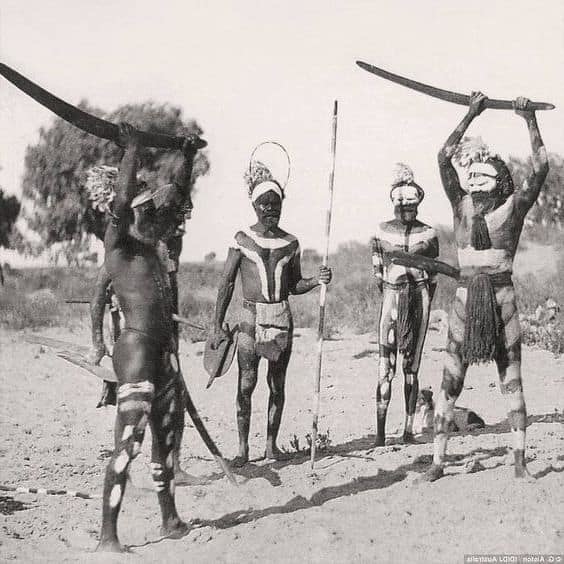
Aboriginals with fighting boomerangs
Peter Brown, a paleoanthropologist at the University of New England in Armidale, Australia, has investigated skull thickness in modern and historical Australian Aboriginal populations, whose cranial bones are the thickest of any living Homo sapiens. In a sample of 430 Aboriginal crania, Brown found evidence of healed depressed fractures on the frontal or parietal bones in 59 percent of the female crania and in 37 percent of male crania. Depressed fractures occurred in these people and they survived; undoubtedly, many others did not. His findings led Brown to hypothesize that the thick skull vaults of the Aboriginals may have evolved as a consequence of the traditional method for settling conflicts.
Archaeology magazine reported: Archaeologists have questioned who made five raised rings in the southeastern Australian state of Victoria. Some have proposed that the 30-meter (65-foot) -wide rings, located in what is now the Melbourne suburb of Sunbury, resulted from postcolonial military or agricultural activity. Scholars now believe the rings were constructed by Ancestors of Woi-wurrung-speaking people, who are the Traditional Custodians of a large swath of the south-central region of Victoria. Such raised rings have a deep history, but only around 100 are thought to remain in eastern Australia today. [Source: Ilana Herzig, Archaeology magazine, July/August 2025]
In 1979, archaeologists excavating one of the Sunbury rings unearthed 166 stone artifacts, but the objects weren’t analyzed in detail. A team of Wurundjeri Woi-wurrung Elders working with researchers led by archaeologist Caroline Spry of La Trobe University has now reopened the excavation trench and reexamined the previously unearthed artifacts. Using optically stimulated luminescence dating, they determined that the ring was constructed and maintained between 1,400 and 590 years ago, confirming that it was created by Aboriginal people. According to the Wurundjeri Woi-wurrung Elders, the Sunbury rings were a meeting place, an area of abundant resources, and a stop along an important travel route. Archaeology, coupled with traditional cultural knowledge, the Elders say, can help improve understanding of the function of the Sunbury rings.
300-Year-old Aboriginal Rock Art Depicts Indonesian Warships
Two examples of Aboriginal rock art from Awunbarna, Arnhem Land in northern Australia are believed to represent images of Indonesian sailing vessels. The illustrations depict watercraft with triangular flags, pennants, and prow adornments typical of fighting ships used in the Moluccas (Maluku Islands) in what is now eastern Indonesia. According to Archaeology magazine: It’s not known how the artist would have encountered the foreign vessels—perhaps through trade or slave raids—but the discovery implies that there was contact between Aboriginal communities in northern Australia and inhabitants of eastern Indonesia around 300 years ago, a relationship that was previously unknown. [Source: Archaeology magazine, September-October 2023]
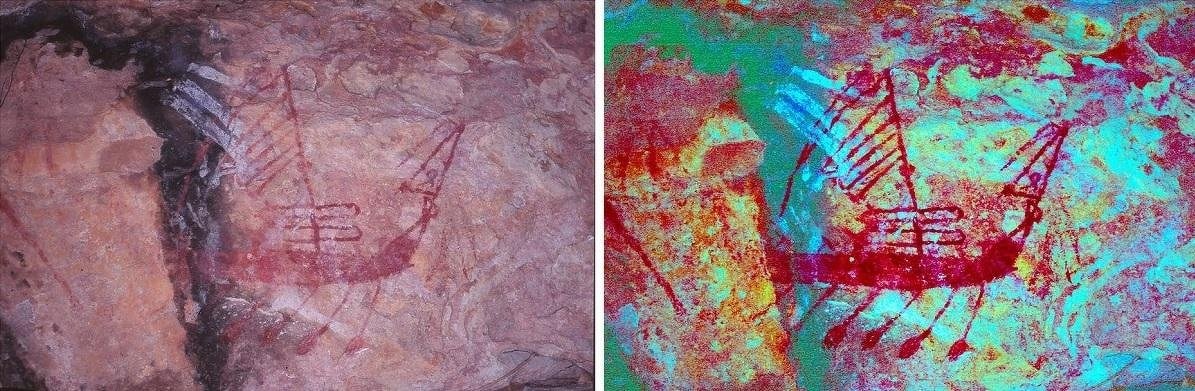
300-year-old Aboriginal rock art depictions Indonesian fighting ships, from Flinders University
The artworks with the ships were discovered in the 1970s and had long puzzled scientists. The identification of the boats as being warships from the Moluccas was announced in a study published May 2, 2023 in the journal Historical Archaeology. "Just these two craft suddenly add another dimension to the sphere of interaction of northern Australia — that Australia is not just some sort of land that's on its own, in the middle of nowhere and is cut off for 65,000 years from everywhere else," study co-author Daryl Wesley, an archaeologist and senior lecturer at Flinders University, told ABC News Australia. [Source: Jennifer Nalewicki, Live Science, June 15, 2023]
Jennifer Nalewicki wrote in Live Science: It was already known that the Moluccans had contact with Aboriginal people in Australia. But unlike other Aboriginal rock art depicting vessels that came from the Moluccas, including Macassan prahus (sailing boats that originated in Indonesia), these drawings have warlike features and "display triangular flags, pennants, and prow adornments indicating martial status," according to the study. "They're fighting craft, decorated with all these pennants and flags and other elements that really set them apart from your usual trading or fishing vessels," Wesley said. "That is really different to our understanding of all the other Macassan ships that are in rock art and in Arnhem Land [in northern Australia]."
Due to the level of detail of the paintings, the researchers think that the Aboriginal people who created the rock art had either "intimate knowledge of the craft through long or close observation or from actually voyaging on them" and that they were "linked to trade, fishing, resource exploitation, head hunting or slavery," according to a statement.The existence of the warship rock art "implies instances of physical violence or at least a projection of power" from the Moluccan people toward the Indigenous Australians. However, more research is necessary to know the rock art's exact purpose, according to the study. "These motifs support existing ideas that sporadic or accidental voyages from Indonesia to the Australian coastline took place before or alongside regular trepang (sea cucumber) fishing visits," lead author Mick de Ruyter, a maritime archaeologist and associate professor at Flinders University, said in the statement.
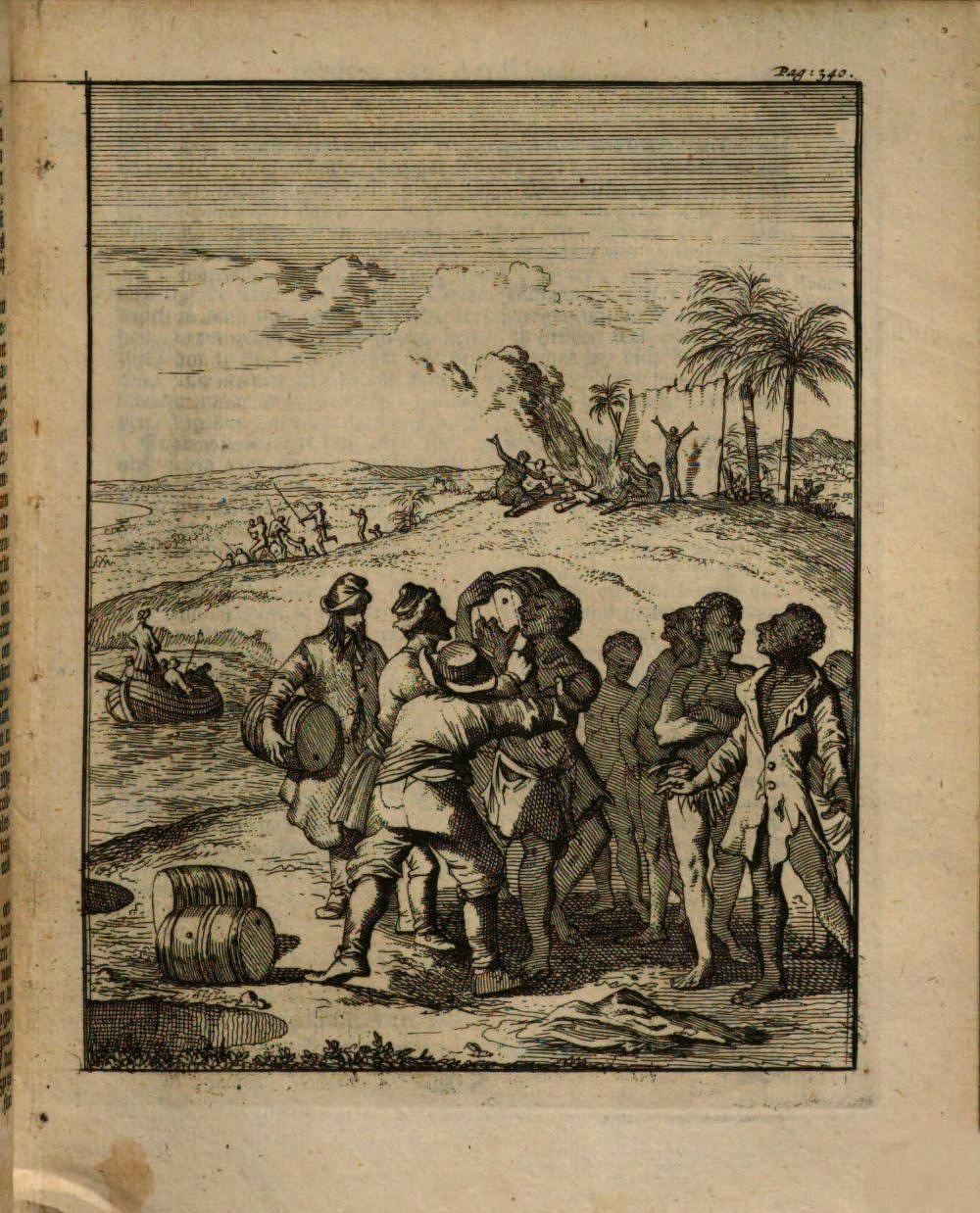
image from William Dampier’s journals
Some of the earliest recorded instances of Indonesian island inhabitants sailing to Australia's northern coast occurred in the mid-17th century, according to the statement. Assuming the Moluccans brought their ships to Australia, the presence of these fighting vessels in Australia "would support a significant departure from the accepted narrative of Macassan coastal fishing and trading" and provides better understanding of contact between the two groups, study co-author Wendy van Duivenvoorde, an associate professor of marine archaeology at Flinders University, said in the statement.
Paul Tacon, a distinguished professor at the Griffith University Centre for Social Cultural Research in Australia who was not involved in the study, told Live Science that the artwork offers a greater understanding of how Aboriginal people recorded their meetings with foreign visitors."This rigorous research convincingly shows evidence of contact between Aboriginal people in Arnhem Land, Australia, and mariners from Moluccan islands hundreds of years ago," he said. "Previously, Macassan [boats] have been identified in Arnhem Land rock art, with the oldest dated to between the late 1500s and early 1600s. This is the first time rock paintings of Moluccan watercraft have been identified and it is fortunate that the paintings are so detailed with distinctive features."
Aboriginals After the Arrival of European Settlers
Anthropologist estimated that between 300,000 and 1 million Aboriginal lived in Australia when Captain Cook initiated the colonization of Australia by Europeans in 1788. At that time there over 250 distinct Indigenous Australian languages and 800 dialects were spoken. At that time neighboring tribes usually spoke different dialects but sometimes they spoke completely different languages.
Soon after the European conquest of the Australia continent in the 18th century, the Aboriginal population began declining rapidly as a result of violence and disease. By 1888 the population had fallen to as low as 60,000 while that of Europeans had risen to over one million. Imported diseases such as smallpox were particularly devastating to Aboriginals, but violence also took its toll.
Europeans often described the Aboriginals as savages and barbarians or some other sub-human term. No treaties were signed by Europeeans with the Aboriginals, who offered less resistance than Maoris on New Zealand, where treaties were signed. As Europeans began settling areas away from the coasts, they came into more direct contact with Aboriginal Australians. Europeans also cleared land for agriculture, impacting Aboriginal Australians’ ways of life.

Mounted police fighting Aboriginals during the Slaughterhouse Creek clash of 1838
European upset the Aboriginals harmonious relationship with the land by chopping down forests, introducing feral animals and exploiting water holes for cattle and sheep. Aboriginals that made the mistake of killing sheep or cattle for food were dealt with harshly. Some Aboriginals voluntarily left their land in pursuit of things like alcohol and tobacco. In the late 19th century Protestant and Catholic missionaries moved into remote parts of Australia to establish missions. The early missionaries attempt to civilize Aboriginals by stamping out their culture and religion.
Well into the late nineteenth century, the Aboriginals were portrayed as being brutal savages. In 1819 the assistant chaplain in New South Wales wrote in a letter to the secretary of the New Zealand Mission that the natives were “the most degraded of the human race. . . . as they increase in years, they increase in vice” . Other Christian ministers in Australia writing to friends were no less denigrating. An anonymous writer in the Chambers Journal of 22 October 1864 described the ways of the Aboriginals: In nothing is the brutality of their nature more clearly shown than in their treatment of females. Among them, women are considered as an inferior class, and are used almost as beasts of burden... Courtship, as the precursor to marriage, is unknown among them. When a young warrior is desirous of procuring a wife, he generally obtains one by giving in exchange for her a sister, or some other female relative of his own; but if there should happen to be no eligible damsel disengaged in the tribe to which he belongs, then he hovers round the encampment of some other blacks until he gets an opportunity of seizing one of their leubras, whom perhaps he has seen and admired when attending one of the grand corroborries. His mode of paying his address is simple and efficacious. With a blow of his mulla-mulla (war club) he stuns the object of his “affections,” and drags her insensible body away to some retired spot, whence, as soon as she recovers her senses, he brings her home to his own gunyah in triumph. [Source: “Marriage Customs of the World From Henna to Honeymoons”: “ by George P. Monger, 2004 ^]
Aboriginals Devastated by European Diseases and Violence in the 1800s
As was true with indigenous peoples in the Americas in the 16th century, Aboriginal populations were devastated in the 18th and 19th century by disease spread by white Europeans. Aboriginal were ravaged by diseases for which they had no resistance such as smallpox, venereal disease, influenza, measles, whooping cough and tuberculosis.
For many early white settlers, the Aboriginal were little more than vermin that needed to be exterminated. Aboriginals were massacred as European settlers fanned across Australia in the 19th century. One historians estimated that 20,000 Aboriginals were killed during a century and half of frontier settlement.
White Europeans shot Aboriginals, drowned them, gave them blankets poisoned with smallpox, They suppressed Aboriginal languages and culture, poisoned water supplies, dispersed communities, denied them human rights. The systematic slaughter continued until the 1930s. In an 1834 massacre of hundreds of Aboriginal men, women and children were killed by armed colonists in Western Australia. In the Western Australia the Aboriginal population dropped from 60,000 in the 1870s to 20,000 in the 1930s.
According to “CultureShock! Australia”: “The infinitely better armed settlers hunted down the simple hunter-gatherer Aboriginals like animals, sometimes even putting out poisoned meat for them, as if for rabid dogs. They raped Aboriginal women and children. They ignored, despised or actively destroyed Aboriginal culture.” Human rights organizations and historians have described what they did as genocide. “This is not to say that there were not incidences of whites who were ashamed of such barbarity or who strove to achieve harmony and understanding with the Aboriginals, nor that there were no individual kindnesses ever shown to the Aboriginals, but the overwhelming trend nonetheless revealed ignorance, fear, contempt and wilful destruction. [Source: Ilsa Sharp, “CultureShock! A Survival Guide to Customs and Etiquette: Australia”, Marshall Cavendish, 2009]
The most famous incident among a long litany of white-settler offences against the indigenous people was the ‘Myall Creek Massacre’ of 1838, in New South Wales state. For this wanton and brutal killing of innocent and defenceless Aboriginal women children and old men, seven of the 11 whites accused were hanged. But such justice was unusual. You will get something of a flavour of the times by watching the movie The Tracker. with an extraordinary performance by Aboriginal actor David Gulpilil.
Aboriginal Rebellions, Prisoners and Outlaws
Aboriginals occasionally tried to fight back but their spears, clubs and other traditional weapons were no match for those of the whites. In some places the Aboriginals held their own until the 1870s when the Europeans replaced flintlock rifles with more accurate deadly breach-loading repeater rifles and early proto machine guns. Those that survived were ultimately put on fenced in reservations.
Between 1838 and 1931, thousands of Aboriginal men and boys were incarcerated on Rottnest Island near Perth, many of them died from disease and malnutrition. Spearheads, fabricated from glass or ceramics, were used by the prison population for trade and perhaps to hunt quokkas, small wallaby-like marsupials. Some are still occasionally found on the island [Source: Jason Urbanus, Archaeology magazine, September-October 2017]
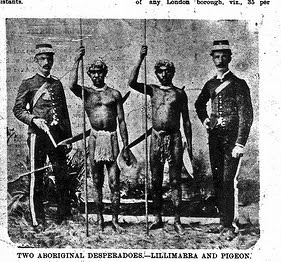
Aboriginals that dared to fight against the Aboriginals included the feared warriors Pemulwy, Yagan, Dundalli,Jandamarra (known to whites as "Pigeon") and Nemarluk. Some people believe that an Aboriginal woman was behind the notorious "bushranger" (outlaw) Captain Thunderbolt.
Jandamarra was a famous Aboriginal outlaw and tracker who killed an Australian constable who had been harassing his people and launched one of the few Aboriginal uprisings against the whites, called Pigeons War. After eluding Australian police for four years, Pigeon was cornered and shot by fellow Aborigine trackers in 1897 at Tunnel Creek, a 2,500-foot-long cavern in Western Australia.
Steve Hawke’s play Jandamarra, the inspiration for the film “Tracker”, tells the story of Jandamarra’s rebellion against his white bosses in the 1890s. His subsequent armed insurrection was doomed to end in traged. After he was killed his head was removed and sent to England as a trophy.
Image Sources: Wikimedia Commons
Text Sources: “Encyclopedia of World Cultures, Volume 2: Oceania,” edited by Terence E. Hays, 1996, National Geographic, Live Science, Natural History magazine, Australian Museum, Australia Geographic, New York Times, Washington Post, Los Angeles Times, Smithsonian magazine, Encyclopedia.com, Times of London, Library of Congress, The Conversation, The New Yorker, Time, BBC, CNN, Reuters, Associated Press, AFP, Lonely Planet Guides, Wikipedia, The Guardian and various websites, books and other publications.
Last updated September 2025