
Home | Category: Aboriginals
ABORIGINALS OF CENTRAL AUSTRALIA
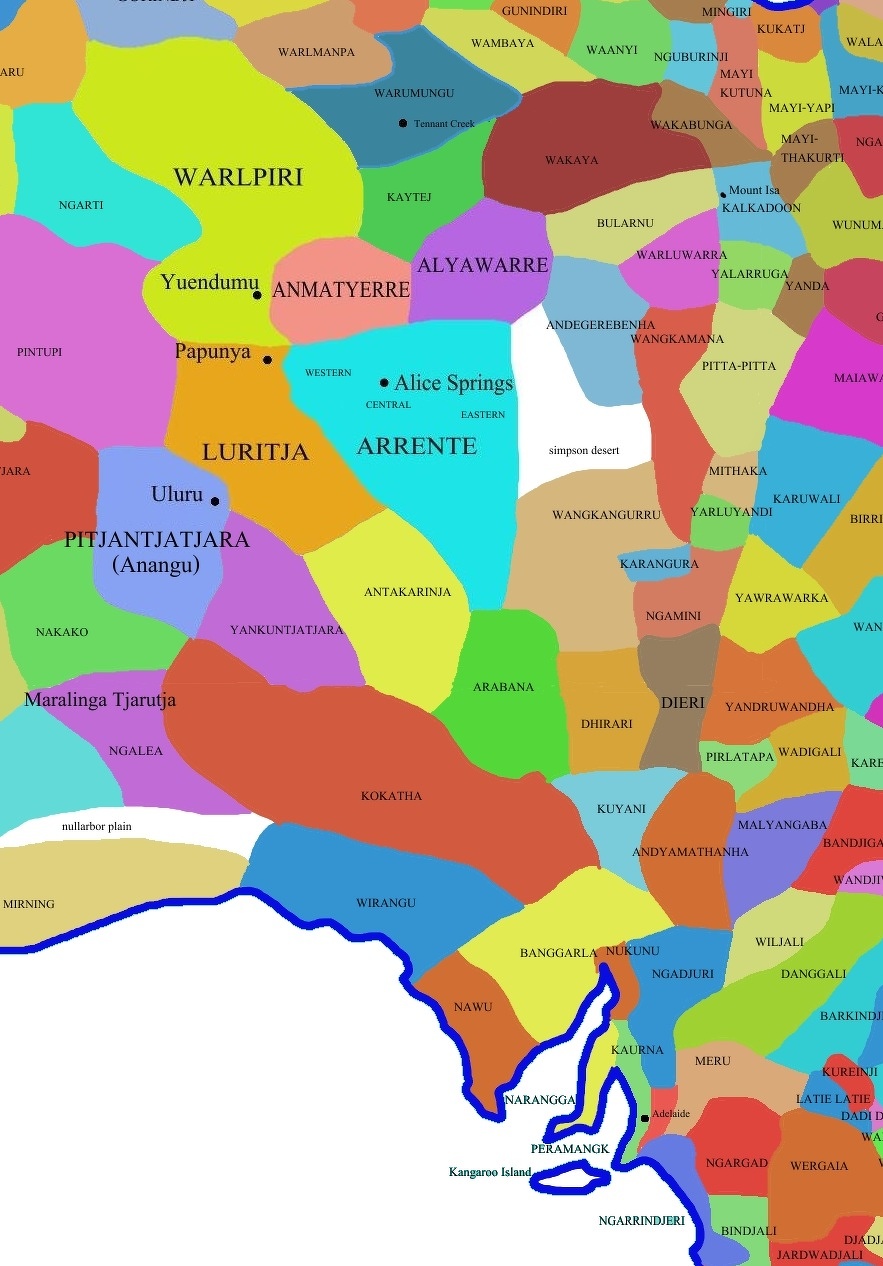
Aboriginal Groups of Central and South Australia
Aboriginal Australians made up a large percentage of central Australia --- 30.8 percent of the Northern Territory's population in the 2021 Census, the highest proportion of any Australian state or territory. The majority of them resides in remote and very remote areas. Many live around Alice Springs. Some live around Ayer's Rock.
The deserts of Central Australia are home to many Aboriginal groups, including the Warlpiri, Arrernte, and Pitjantjatjara. Other groups are often grouped by language or geographical region. The Arrernte are based around Alice Springs in the central part of the Northern Territory and speak Arandic languages. The Warlpiri live further north of the Arrernte. Their language is one of the most widely spoken Aboriginal languages. The Pitjantjatjara reside in the arid central south, near Uluru (Ayers Rock).
Most of Central Australia is in Northern Territory, which is abbreviated as NT; known formally as the Northern Territory of Australia and informally as the Territory. Covering 1,347,791 square kilometers (520,385 square miles), it occupies a large hunk of central Australia and northern Australia and is the third-largest Australian federal division, after Western Australia and Queensland, and is the 11th-largest country subdivision in the world. Northern Australia occupies 20 percent of Australia but embraces only one percent of Australia's population. Most of the territory is comprised of outback desert and most the roads are unsealed tracks. It is the home of Darwin, Arnhem Land, Kakadu National Park, Alice Springs, Ayers Rock and the Olgas as well as vast red sand deserts, meteorite craters and mystifying canyons. The northern part is the territory is called the Top End.
Other Central Australian Aboriginal groups live South Australia. Among these are Adnyamathanha, Arabana, Kokatha, Ngadjuri, and Pitjantjatjara peoples. The Adnyamathanha are based in the Flinders Ranges region. The Arabana are the Traditional Owners of the Lake Eyre region (Kati-Thanda). The Dieri (Diyari) are also Associated with the Lake Eyre region and are neighbours to the Arabana. The Kokatha are group associated with the central west of South Australia. The Ngadjuri inhabit the Mid North region of South Australia. The Pitjantjatjara, also found in the Northern Territory is a major group in the far north of the state, often referred to collectively with Yankunytjatjara and Ngaanyatjarra people as A angu. The Nukunu is a group from the northern parts of the Mid North.
RELATED ARTICLES:
ABORIGINALS (FIRST NATION PEOPLE) OF AUSTRALIA: NAMES, DEMOGRAPHICS, LANGUAGES ioa.factsanddetails.com
ABORIGINAL AUSTRALIANS IN NORTH NORTHERN TERRITORY: SOME GROUPS, CUSTOMS, LIFESTYLE ioa.factsanddetails.com
ABORIGINALS IN QUEENSLAND: SOME GROUPS, CUSTOMS, LIFESTYLES ioa.factsanddetails.com
ABORIGINALS IN WESTERN AUSTRALIA: SOME GROUPS, HISTORY, CUSTOMS, TRADITIONAL LIFE ioa.factsanddetails.com
EARLY MODERN HUMANS IN AUSTRALIA ioa.factsanddetails.com
LIFE OF EARLIEST HUMANS IN AUSTRALIA: TOOLS, WEAPONS, ART, SETTLEMENTS ioa.factsanddetails.com
AUSTRALIAN ABORIGINALS AT THE TIME EUROPEAN COLONIZATION BEGAN ioa.factsanddetails.com
AUSTRALIA ABORIGINALS FROM 1900 TO PRESENT: DISCRIMINATION, ASSIMILATION, SOME RESTITUTION ioa.factsanddetails.com
AUSTRALIA’S STOLEN GENERATIONS: VICTIMS, LAWS, RATIONALE, OUTRAGE ioa.factsanddetails.com
AUSTRALIAN ABORIGINAL RELIGION: TRADITIONAL BELIEFS, DEMOGRAPHY AND DEATH ioa.factsanddetails.com
AUSTRALIAN ABORIGINAL CUSTOMS, SOCIETY AND RITUALS ioa.factsanddetails.com
ABORIGINAL LIFE: WHERE THEY LIVE, WORK, DIET, HEALTH, ALCOHOL ioa.factsanddetails.com
TRADITIONAL ABORIGINAL LIFE: FOOD, HOMES, HUNTING ioa.factsanddetails.com
ABORIGINAL MEN AND WOMEN: GENDER, MARRIAGE ioa.factsanddetails.com
ABORIGINAL AUSTRALIAN SEX: PRACTICES, ATTITUDES, ADOLESCENCE ioa.factsanddetails.com
ABORIGINAL AUSTRALIAN ART ioa.factsanddetails.com
Art from Central Australia
The Arrernte Aboriginals of Central Australia carve sacred emblems called “tjurungas”. In the dreamtime each “tjurngas” was associated with a particular totemic ancestor and its spirit lived within it. When the spirit entered a women it was reincarnated as a child. Each person has his or her own “tjurngas”.
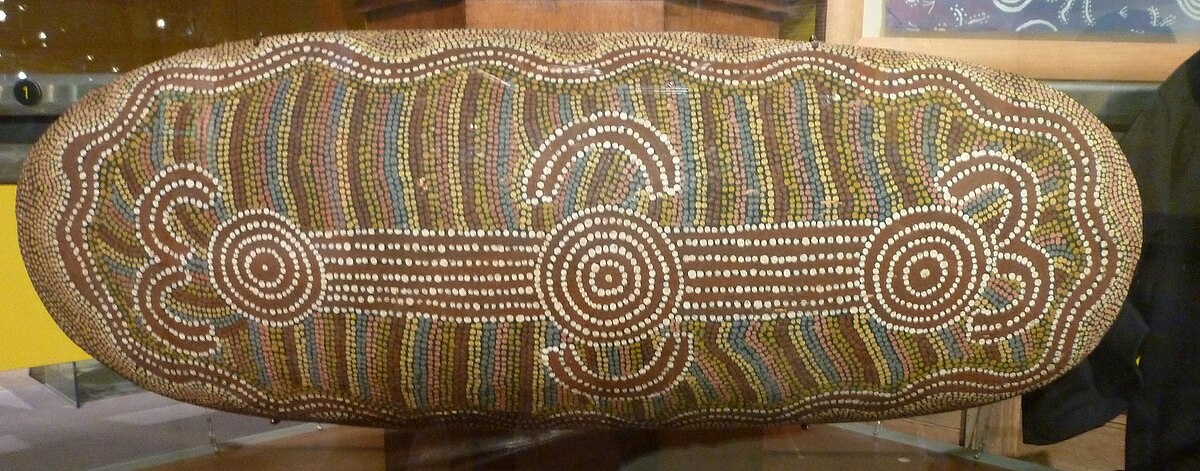
softwood coolamon with acrylic paint design propably made for ceremonial use, acquired by the Australian Museum in 1996, made by an unknown artist from Central Australia
Traditional Artistic expression, largely though not exclusively tied to ritual contexts, encompasses body decoration, ground paintings and carved sacred boards. Common materials include feathers and down and, pigments in red, yellow, black, and white. In the 1930s, many Western Arrernte artists successfully adopted watercolor painting, a tradition that continues today.
Women from Utopia, 140 miles northeast of Alice Springs, are famous for producing batiks with designs based on images traditionally painted on women’s bodies. The same images are also painted on canvases with acrylic paints.
The Dieri people living on the Killalpaninnna Luther Mission near Lake Eyre in South Australia produce distinctive wooden carvings. Many feature figures of possums, goannas and snakes that come in variety of sizes and have designs burned on them with hot fencing wire.
The Pitjantjatjara women in southeast Western Australia and northwest South Australia produce woolen item such as scarves, rugs, belts and traditional dilly bags (carry bags) with designs associated with women's law.
See Papunya Under MODERN AUSTRALIAN ABORIGINAL ART ioa.factsanddetails.com
Dot-Paintings From Central Australia
So called dot-paintings are the most well-known forms of Aboriginal art to come out of central Australia. They are believed to have developed out of the "ground paintings," paintings made on the ground during traditional ceremonies from pulped plant material in different colors dropped on the ground to male outline objects on rock painting and highlight geographical features.
Many of the dot paintings look abstract but to experienced observers they contain images that can be easily identified: the tracks of animals, people or birds; boomerangs; spears; digging sticks and coolamans (wooden carrying dish). The boomerangs and spears are often symbols of men and the digging sticks and coolamans are often symbols of women because these were tools associated with each sex.
The dot paintings are often representations of Dream Place landscapes with concentric circles representing the Dream Places. Although the symbols can often be identified their context and association with other symbols is often known only to the artist.
Arrernte
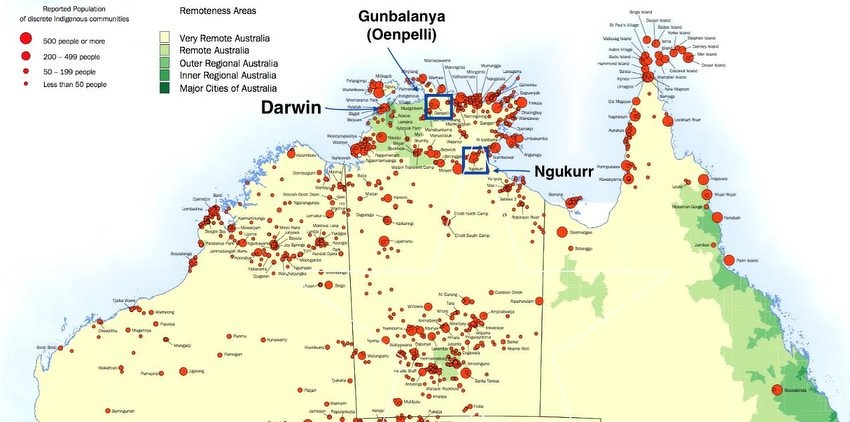
Remote Indigenous communities across northern Australia
The Arrernte are also known as Aranda and Arunta. They are an Aboriginal Australian peoples of Central Australia, with their lands centered around Alice Springs (Mparntwe) in the Northern Territory. They are the traditional owners of the desert region they live in and are known for their rich cultural heritage, including their spiritual beliefs, languages, art, and totemic systems. In the old days, their territory extended into Queensland but not so many live there any more.
Arrernte and Aranda refer to a language group and a people. "Aranda" is a simplified, Australian English approximation of the traditional pronunciation of the name of Arrernte. Arrernte culture is expressed through ancient stories, rituals, and art, which are passed down through generations. Religious life was a significant aspect, with major gatherings held to conduct ceremonies and rituals. The concept of the Dreaming is central to Arrernte beliefs, representing a time of ancestral beings and the origin of life. While some Arrernte people still live in their traditional lands, others have moved to towns, major cities, or overseas. Efforts like "Aranda Tribe Ride for Pride" are underway to revitalize and teach Arrernte languages, which are considered vulnerable, and strengthen of community pride and the importance of passing on cultural knowledge,
Arrerntic and Arandic groups have traditionally been distributed throughout the area of the Northern Territory, Queensland, and South Australia between 132° and 139° S and 20° and 27° E. Their territories were concentrated in the comparatively well-watered mountain areas of this desert region, though several groups—especially along the northern, eastern, and southern edges of the Arrernte-speaking area—also occupied vast sandhill country. [Source: John Morton, “Encyclopedia of World Cultures, Volume 2: Oceania,” edited by Terence E. Hays, 1996 |~|]
The estimated number of Arrernte people (and speakers of Arrernte languages) is around 3,000. The number of people with the Aranda surname is 2,605 individuals recorded in Australia's 2021 census data. The total population of Aranda speakers in precontact times was probably not over 3,000. The population fell very sharply after the arrival of white people, mainly as a result of the introduction of new diseases. At the present time the total population of Arrernte is rising, although the spatial and cultural distribution of the population has shifted dramatically. Major settlements at or near Hermannsburg, Alice Springs, and Santa Teresa account for the bulk of the Arrernte population. |~|
See Separate Article: ARRERNTE: HISTORY, LANGUAGE, TRADITIONAL LIFE, CUSTOMS ioa.factsanddetails.com
Dieri
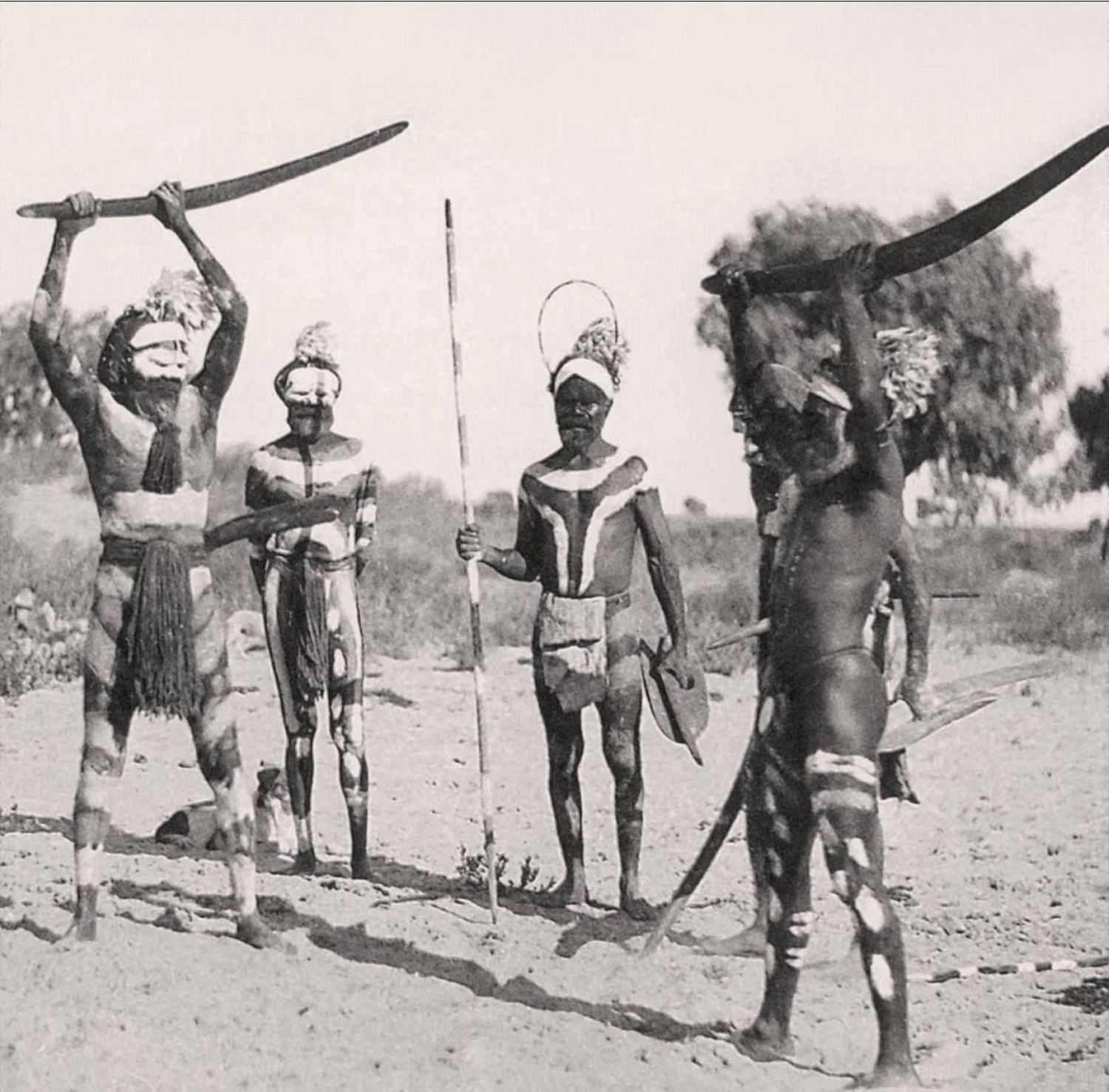
Wangkangurru tribesmen east of Lake Eyre South Australia, 1920
The Dieri (or Diyari) people are an Indigenous Australian group from the lake regions and Cooper Creek area in the far north-east of South Australia, traditionally occupying the area to the east of Lake Eyre (around 139° E, 28°20 S). between Katithunda and Moomba, and up to Clifton Hills station. They have a distinct language, Diyari, and a rich cultural heritage, including ancient dreaming stories and initiation rites. They are also known by various names, including Dayerrie, Deerie, Diari, Dieyerie, Dieyrie, Diyeri, Dthee-eri, Koonarie, Kunari, Ti:ari, Urrominna, Wongkadieri, and Wonkadieri.[Source: “Encyclopedia of World Cultures, Volume 2: Oceania,” edited by Terence E. Hays, 1996]
The Dieri language — Diyari — is classified as one of the Karnic languages of the Pama–Nyungan family. Though earlier described in Ethnologue as extinct, and later "nearly extinct", Peter Austin found the language still has fluent native speakers and hundreds of Diyari who retain some knowledge of it. The Dieri also had a highly developed sign language. It was traditionally used by widows who were not allowed to during the mourning period of several years after their husband’s death.
As of 2016, there were five speakers of Diyari language and an estimated 600 people in the ethnic population identified as Diyari speakers. Around 1,500 people identify as Dieri and they predominantly live in South Australia. Dieri culture includes ancient dreaming stories, the practice of both circumcision and subincision for male initiations, and a deep connection to their country. Male initiation among the Dieri is a gradual process culminating in the wilyaru ceremony, which involves ritual scarification of the initiates. The Dieri were historically displaced by Wongkamala people before European settlement, which also led to the scattering of Dieri communities.
Dieri Kinship and Marriage
The Dieri kinship system resembles that of the Arrernte but differs in two significant respects. First, the Dieri apply a single term both to the father’s mother and father’s mother’s brother, and likewise to the mother’s brother’s (or father’s sister’s) children. Second, unlike the Arrernte, they do not use the same term for the mother’s mother and the mother’s brother, nor do they group the mother’s brother’s children together under this term. Instead, they classify the children of the mother’s mother’s brother’s son with direct siblings (brothers and sisters). [Source: “Encyclopedia of World Cultures, Volume 2: Oceania,” edited by Terence E. Hays, 1996]
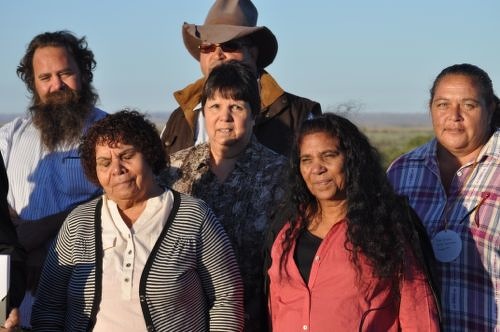
Dieri today
Marriage is preferred with the mother’s mother’s brother’s daughter’s daughter—that is, between the children of two women related as cross-cousins (the children of a brother and a sister). Direct cross-cousin marriage, however, is prohibited, though exceptions have occasionally been permitted. Totemic affiliation is inherited patrilineally: a boy receives from his father a connection to a natural species linked to a specific site within the father’s traditional territory. These sites, or totemic centers, are associated with ancestral beings known as mura-mura, culture heroes believed to have journeyed from southwestern Queensland into Dieri lands.
A boy learns the lore and rituals of his totemic center from his father and other senior male relatives. This patrilineal system closely parallels those of Western Desert peoples. Cross-cutting this is a matrilineal system that establishes wife-giver and wife-taker categories, regulates food taboos, and allows men to participate in certain rituals of their mother’s brother’s clan.
Dieri Culture and Mythology
The Dieri have traditionally been a hunting and gathering people. Those living on the Killalpaninnna Luther Mission near Lake Eyre in South Australia produce distinctive wooden carvings. Many feature figures of possums, goannas and snakes that come in variety of sizes and have designs burned on them with hot fencing wire. In 1879, Samuel Gason described the Diyari as both “treacherous” and “nourished by suspicion from infancy,” while at the same time remarking on their exemplary hospitality, reverence for the elderly, and devotion to their children. Strangers passing through a Diyari camp were customarily provided with food. Gason also reported that infanticide was common—by his estimate affecting around 30 percent of births—and that it was typically carried out by the mother. He noted, too, the close bond the Diyari maintained with their camp dingoes, which were cared for and treated almost as members of the family. [Source: Wikipedia]
In the Diyari creation story, Mooramoora, the good spirit, first made small black lizards. Delighted with them, he decided they should hold sway over all other created beings. Man was created by remodeling this variety of lizard: cutting off the tail and using a forefinger to create a nose. Then, man was divided into male and female. Mooramoora then had the Moon create all creatures. Humans could not catch the fast, tasty emu, so the deity was asked to create heat to tire the emu out so humans could catch and trap it. Men were asked to perform certain ceremonies that Gason considered obscene. After they complied, Mooramoora created the sun.
In 1880, Lorimer Fison wrote: After the creation, brothers, sisters, and others of the closest kin, intermarried promiscuously, until — the evil effects of these alliances becoming manifest — a council of the chiefs was assembled to consider in what way they might be averted, the result of their deliberations being a petition to the Muramura (Good Spirit), in answer to which he ordered that the tribe should be divided into branches, and distinguished one from another by different names, after objects animate and inanimate, such as dogs, mice, emu, rain, iguana, and so forth; the members of any such branch not to intermarry, but with permission for one branch to mingle with another. Thus, the son of a dog might not marry the daughter of a dog, but either might form an alliance with a mouse, rat, or other family. This custom is still observed, and the first question asked of a stranger is, "What murdoo?", i.e., "Of what family are you?".
Wangkangurru and Arabana
The Wangkangurru, also written Wongkanguru and Wangkanguru, and Arabana, also known as the Ngarabana, are an Aboriginal Australian people of the deserts in the the state of South Australia. They speak Arabana or Arabuna, an Australian Aboriginal language of the Pama–Nyungan family. This language is almost extinct, decline, from an estimated 250 speakers according to 2004 NILS, to just 21 speakers found in the 2006 census. [Source: Wikipedia]
Norman Tindale ( 1900-1993) estimated the Arabana controlled about 51,000 square kilometers (19,500 square miles) of tribal land. They were present at the Neales River to the west of Lake Eyre, and west as far as the Stuart Range; Macumba Creek. Southwards their lands extended to Coward Springs. Their terrain also took in Oodnadatta, Lora Creek and Lake Cadibarrawirracanna. The neighbouring tribes were the Kokata to the west, with the frontier between the two marked by the scarp of the western tableland near Coober Pedy. To their east were the Wangkanguru.[
Several traditional Arabana stories are well documented, especially the one about a man-eating buzzard and his eaglehawk mate. The chief protagonists are three animals: 1) Wantu Wantu, the man-eating black-breasted buzzard; 2) Irritye, a friendly wedge-tailed eagle; and 3) Kutta Kutta, also called Akwete Akwete, who is described as a small hawk but is actually a spotted nightjar.
The Wangkangurru occupied the Simpson Desert for tens of thousands of years. Their Country, known as Munga-Thirri (“Land of Big Sand Hills”), extends from Dalhousie Springs to Birdsville. Survival in this arid environment was made possible through the excavation of wells (Mikiri), which provided reliable sources of water and became focal points for settlement. Some wells reached depths of 4–6 metres and could sustain family groups of up to 40 people. To date, more than 18 such wells have been recorded. Sustainability was ensured through careful management of these sites. In good years, when water was available elsewhere, families would leave the wells and range widely across the desert. These extended absences—lasting months or even years—allowed the wells to recover from the pressures of continuous occupation.
At intervals, large gatherings were held at major meeting places, where groups came together to trade, arrange marriages, conduct initiations, negotiate laws and boundaries, and perform songs and ceremonial dances.The Wangkangurru also navigated and understood their land through Dreamtime narratives that mapped the desert. These stories, recounting the ancestral shaping of the landscape, functioned as oral maps: they connected people to landforms and desert features, identified the locations of precious wells, and offered guidance for sustainable living in the fragile desert environment.
Warlpiri
The Warlpiri are an Australian Aboriginal group defined by their Warlpiri language. although some don’t speak it. There are 5,000–6,000 Warlpiri, living mostly in a few towns and settlements scattered through their traditional land in the Northern Territory, north and west of Alice Springs (Mparntwe). The Warlpiri are also known as the Yapa, Ilpirra, Wailpiri, Walbiri, Walpiri, Elpira, Ilpara and Wailbri. Walpiri.[Source: Wikipedia; Nicolas Peterson, “Encyclopedia of World Cultures, Volume 2: Oceania,” edited by Terence E. Hays, 1996 |~|]
Warlpiri country lies in central Australia, with its center about 180 kilometers (115 miles) northwest of Alice Springs. Traditionally the Warlpiri-speaking people occupied the Tanami Desert in a territory estimated to cover 140,000 square kilometers (53,000 square miles). Today many Warlpiri people live in Alice Springs, Tennant Creek, Katherine, and the smaller towns of Central Australia. Their largest communities are at Lajamanu, Nyirripi, Yuendumu, Alekarenge and Wirlyajarrayi/Willowra (an Aboriginally-owned cattle station). Others can be found scattered across the top of northern Australia and the Kimberly region.
Prior to colonization, it is estimated that there were around 1,200 Warlpiri speakers. By 1976, this number had increased to an estimated 2,700, perhaps somewhat generously. However, it can confidently be assumed that there are now more than 3,000 speakers. All of these people have Warlpiri as their first language and English as their second, third, or fourth language.
See Separate Article: WARLPIRI OF THE CENTRAL AUSTRALIAN DESERT: HISTORY, TRADITIONAL LIFE, CUSTOMS ioa.factsanddetails.com
Pitjantjatjara
Pitjantjatjara are an Aboriginal people of the Central Australian desert near Uluru (Ayer’s Rock). They are closely related to the Yankunytjatjara and Ngaanyatjarra and their languages are, to a large extent, mutually intelligible. All are varieties of the Western Desert language. Pitjantjatjara language is used as a general term for a number of closely related dialects which together, according to Ronald Trudinger were "spoken over a wider area of Australia than any other Aboriginal language". It shares an 80 percent overlap in vocabulary with Yankunytjatjara. Pitjantjatjara women produce woolen item such as scarves, rugs, belts and traditional dilly bags (carry bags) with designs associated with women's law. [Source: Wikipedia]
The Pitjantjatjara people refer to themselves as Anangu (“people”). They live mainly in northwestern South Australia, extending across the border into the Northern Territory south of Lake Amadeus, and westward into parts of Western Australia. Their land is inseparable from their identity, with every feature imbued with stories and spiritual meaning. From the 1950s onward, many Anangu were forced to leave their traditional lands due to British nuclear testing at Maralinga, and some were exposed to radioactive fallout. Their struggles over land rights and native title in South Australia have been distinctive. Following four years of campaigning and negotiations with government and mining groups, the Pitjantjatjara Land Rights Act was passed on 19 March 1981, granting the Anangu freehold title to 103,000 square kilometers (40,000 square miles) in the state’s northwest.
Pitjantjatjara languages are among the most widely spoken Aboriginal Australian languages. They are spoken in a wide area ranging from Kalgoorlie and Ceduna in Western Australia to the south and west, Ernabella and Musgrave Park in South Australia to the east, and Papunya and Areyonga in the Northern Territory to the north. Linguistic classifications currently accept Pitjantjatjara as part of the Wati subgroup of the Southwestern group of the Pama–Nyungan family, also called the Western Desert family. Most Pitjantjatjara language speakers are multilingual at the dialect level and often switch dialects when residing in new areas. The Western Desert linguistic family shares many features with other Aboriginal Australian languages. With the exception of a group in northern Australia, linguists believe these languages are closely related and diverged from a single ancestral language within the last 10,000 years. However, the separation of these languages from their Asian antecedents occurred so long ago that no clear genetic connections have been detected with Asian languages today.
Pitjantjatjara and Uluru (Ayer’s Rock)
The sacred sites of Uluru (Ayers Rock) and Kata Tjuta (the Olgas) hold deep ceremonial and spiritual importance for the Pitjantjatjara. The area contains more than 40 named sacred sites and 11 distinct Tjukurpa (“Dreaming”) tracks, some of which extend as far as the sea. Though separated from Pitjantjatjara lands by the South Australia–Northern Territory border, Uluru and Kata Tjuta are central to Anangu traditions. Today, the sites are both a major tourist attraction and a national park.
The Pitjantjatjara are the traditional custodians of Uluru, a massive sandstone monolith in Australia's Northern Territory that was given the name Ayers Rock by European explorer William Gosse in 1873. The rock's features are considered to be sacred scriptures by the Pitjantjatjara, providing cultural information that should only be viewed in its original location by specific people, according to the Uluru-Kata Tjuta National Park official website. The site was named Uluru by the Pitjantjatjara people long before Europeans arrived in Australia. In 1993, the rock was officially given dual names: Ayers Rock/Uluru, the first time this was done in the Northern Territory. In 2002, the names were reversed at the request of the Regional Tourism Association, and the official name became Uluru/Ayers Rock.
Image Sources: Wikimedia Commons
Text Sources: “Encyclopedia of World Cultures, Volume 2: Oceania,” edited by Terence E. Hays, 1996, National Geographic, Live Science, Natural History magazine, Australian Museum, Australia Geographic, New York Times, Washington Post, Los Angeles Times, Smithsonian magazine, Encyclopedia.com, Times of London, Library of Congress, The Conversation, The New Yorker, Time, BBC, CNN, Reuters, Associated Press, AFP, Lonely Planet Guides, Culture Shock! Australia, Wikipedia, The Guardian and various websites, books and other publications.
Last updated September 2025