
Home | Category: History / Aboriginals
LIFESTYLE EARLY MODERN HUMANS IN AUSTRALIA
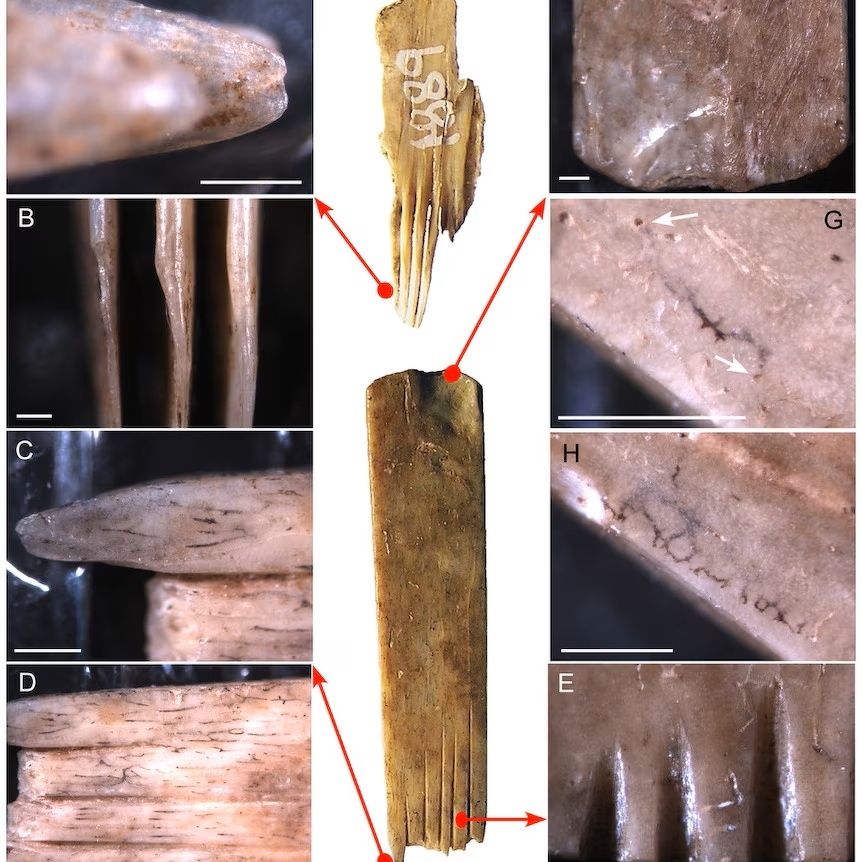
46,000-year-old kangaroo bone tools from the Kimberly
The earliest evidence of modern humans in Australia comes from Madjedbebe, a sandstone rock shelter in Arnhem Land, in the Northern Territory of Australia. Artifacts there have been dated to be 50,000- 65,000 years old. The oldest human skeletal remains are the 40,000-year-old Lake Mungo remains in New South Wales. Humans appear to have been widely dispersed in Australia at very early dates. Human ornaments discovered at Devil's Lair in Western Australia have been dated to 48,000 years ago. [Source: Wikipedia]
Matt Stirn wrote in Archaeology Magazine: Butchered bones and plant remains from a variety of sites suggest that the first hunter-gatherers to arrive on the continent, having crossed a land bridge from Papua New Guinea, quickly adapted to Australia’s diverse landscape by harvesting resources from the sea, rivers, and inland desert. The distribution of sites across the landscape and tool assemblages found at these sites indicate that throughout the time people have lived in Australia, their lifestyles have often been dictated by the environment and weather. In the short term, people moved around seasonally in response to the yearly monsoons. In the longer term, hunter-gatherer groups exploited extensive swaths of territory during stable and drier conditions, but in episodes of climatic instability and increased precipitation, they commonly stayed closer to home, using rock shelters and caves as semipermanent dwellings. [Source: Matt Stirn, Archaeology Magazine, May/June 2021]
Physical archaeological remains of human activity in Australia include stone tools, rock art and ocher, shell middens, charcoal deposits and human skeletal remains. The oldest human fossil remains found in Australia date to around 40,000 years ago — 10,000 to 20,000 years younger than the oldest human artifacts — after the earliest archaeological evidence of human occupation. Nothing is known about what the first humans that entered Australia look like but — based on skeletal remains that Aboriginal people living in Australia between 40,000 and 10,000 years ago had much larger bodies and more robust skeletons than they do today and showed a wide range of physical variation. [Source: Fran Dorey, Australian Museum, September 12, 2021]
When the first people arrived Australia was much wetter than it is now. First arrivals found vast mud flats with mollusks that never been harvested by humans, seas that had never been fished and species that had never faced an predators. These animals were probably very easy to hunt because they had never faced predators before. The oldest known grinding stones for plants appeared around 30,000 years ago. The might have been created because the easy animals to hunt for meat were extinct. [Source: “Countries of the World and Their Leaders Yearbook 2009"]
Related Articles:
DID HUMANS REALLY MIGRATE TO AUSTRALIA 65,000 YEARS AGO ioa.factsanddetails.com
HOW THE FIRST PEOPLE GOT TO AUSTRALIA 50,000 (MAYBE 65,000) YEARS AGO ioa.factsanddetails.com
EARLY MODERN HUMANS IN AUSTRALIA factsanddetails.com ;
OUT OF AFRICA AND THEORIES ABOUT EARLY MODERN HUMAN MIGRATIONS factsanddetails.com ;
MIGRATIONS OF EARLY MODERN HUMANS factsanddetails.com ;
EARLY MODERN HUMANS MIGRATE TO ASIA factsanddetails.com ;
PEOPLE WHO LIVED AUSTRALIA 20,000 TO 10,000 YEARS AGO ioa.factsanddetails.com ;
EARLY ABORIGINALS ioa.factsanddetails.com ;
VERY, VERY OLD AUSTRALIAN AND ABORIGINAL ROCK ART ioa.factsanddetails.com ;
ANCIENT ABORIGINAL ART OF NORTHERN AUSTRALIA ioa.factsanddetails.com
RITUAL LIFE AND MYTHS OF ANCIENT AUSTRALIANS ioa.factsanddetails.com
AUSTRALIAN HISTORY ioa.factsanddetails.com ;
MODERN HUMANS 400,000-20,000 YEARS AGO factsanddetails.com
RECOMMENDED BOOKS:
“Australia’s Ancient Aboriginal Past: A Global Perspective” by Murray Johnson Amazon.com;
“The First Boat People” (Cambridge Studies in Biological and Evolutionary Anthropology by S. G. Webb Amazon.com;
“First Migrants: Ancient Migration in Global Perspective” by Peter Bellwood Amazon.com;
“Ancestral DNA, Human Origins, and Migrations” by Rene J. Herrera (2018) Amazon.com;
“Out of Africa I: The First Hominin Colonization of Eurasia” by John G Fleagle, John J. Shea, Editors (2010), Amazon.com;
“The Global Prehistory of Human Migration” by Immanuel Ness and Peter Bellwood (2014) Amazon.com;
“Out of Eden: The Peopling of the World” by Stephen Oppenheimer Amazon.com;
“The Journey of Man: A Genetic Odyssey” (Princeton Science Library) by Spencer Wells (2017) Amazon.com;
“Past Human Migrations In East Asia by Alicia Sanchez-Mazas” Amazon.com;
“Homo Sapiens Rediscovered: The Scientific Revolution Rewriting Our Origins” by Paul Pettitt Amazon.com;
“The Real Eve: Modern Man's Journey Out of Africa” by Stephen Oppenheimer (2004) Amazon.com;
“Asian Paleoanthropology: From Africa to China and Beyond” (Vertebrate Paleobiology and Paleoanthropology) by Christopher J. Norton and David R. Braun Amazon.com;
“Who We Are and How We Got Here: Ancient DNA and the New Science of the Human Past” by David Reich (2019) Amazon.com;
“Our Human Story: Where We Come From and How We Evolved” By Louise Humphrey and Chris Stringer, (2018) Amazon.com;
50,000-Year-Old Human Settlements in the Australian Interior
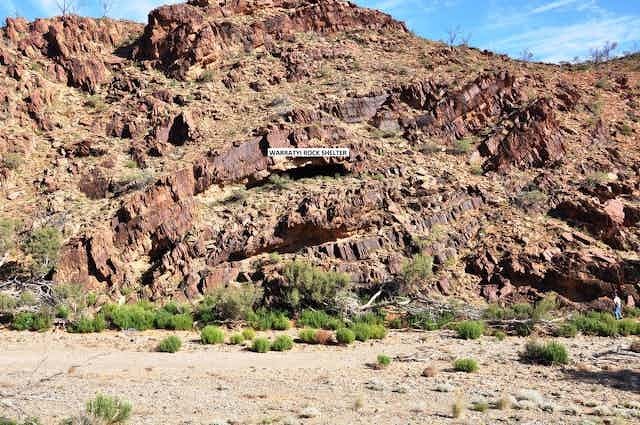
Warratyi site
In 2016, a team of archaeologists in Australia announced they had found extensive remains of a sophisticated human community living 50,000 years ago. The remains — which included a range of tools, decorative pigments, and animal bones — were found in a rock shelter in the Flinders Ranges in Australia’s arid southern interior.[Source: Annalee Newitz, ars technica, November 3, 2016 |+|]
Annalee Newitz wrote in ars technica: “Dubbed the Warratyi site, the rock shelter sits above a landscape criss-crossed with deep gorges that would have flowed with water when Paleolithic humans lived here. From extensive excavations conducted last year, the archaeologists estimate that people occupied Warratyi on and off for 40,000 years, finally abandoning the site just 10,000 years ago. |+|
“By analyzing layers of earth in the shelter, the scientists were able to construct a timeline of settlement in the space. They used carbon dating on nuggets of hearth charcoal and eggshells to discover that the shelter was first occupied about 50,000 years ago. They also used a dating technique called optically simulated luminescence (OSL) on buried grains of quartz. This technique determines when those quartz grains last saw sunlight and heat. Both techniques returned similar dates, adding to the researchers' confidence in their findings. |+|
“This makes Warratyi the oldest evidence of human occupation in the arid Australian interior, long believed too hostile for ancient people who had few tools. But these findings make it clear that the ancestors of Australia's indigenous people were, in fact, seasoned explorers who could survive in difficult conditions. The earliest signs of habitation, older than 38,000 years, showed a human culture that was sophisticated for its time. The people of Warratyi had a wide range of tools, ranging from tiny handheld blades to bone awls. They had two colors of pigment, white and red, for use in art, body decoration, and possibly adhesive. They were accomplished hunters and gatherers, using many kinds of blades to butcher animals and cut plant stalks. Thousands of discarded bones and eggshell shards were buried at Warratyi, representing 17 different species. |+|
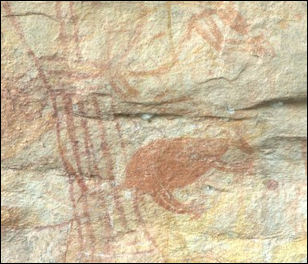 “Two of those species, D. optatum (a massive creature the size of a rhino) and G. newtoni (an enormous flightless bird) are extinct megafauna. Neither would have naturally found its way into the cave, so their bones and eggshells must have been brought there by humans. This proves that humans hunted, ate, and interacted with Australia's megafauna for a considerable time, over a considerable range, before the beasts died out. These findings also provide solid evidence for what archaeologists have long suspected, which is that humans in Australia had an impact on the lives (and extinctions) of megafauna across the continent. |+|
“What's truly incredible about Warratyi is the story it tells about how humans first populated Australia. We're still certain that the early human explorers island-hopped from southern Asia to Australia in reed boats. But archaeologists have long believed that these people settled the continent's coastal regions for thousands of years before broaching the deadly interior. Now the coastal hypothesis has been disproven. The discovery of the Warratyi rock shelter, write the scientists in Nature, "suggests that, following their arrival in Australia, people dispersed more rapidly across the continent than previously thought. The location of Warratyi could imply a more direct north–south route for pioneering human settlers rather than an exclusive coastal route."
“The scientists add that people lived in the shelter sporadically, never settling down there for a long period of time. "Human occupation was repeated but ephemeral in nature, indicating that Aboriginal people may have used Warratyi both as a refuge at a time when the surrounding lowlands and open plains were too arid to exploit and as a temporary campsite when environmental conditions became more stable regionally."
The authors conclude: “Archaeological sites with evidence of modern human colonization, unique cultural innovation, and interaction with now-extinct megafauna are rare in southern Asia and Australia. Sites preserving 50,000-year-old records of human occupation are rarer still. In addition to these landmark discoveries, Warratyi rock shelter reveals evidence for the development of modern human behavior in Australia and Asia. Important technological innovations and early symbolic behavior reveal that a dynamic, adaptive Aboriginal culture existed in arid Australia within only a few millennia of settlement on the continent. Ancient people adapted to Australia's harshest environment shortly after arriving on its shores. Warratyi was a resting point for groups who traveled widely, created art, and manufactured tools for everything from cutting to sewing. The Aborginals who settled the Adnyamathanha lands were basically high-tech explorers of the Paleolithic world. [Source: Nature, 2016. DOI: 10.1038/nature20125]
Tools of the First Australians
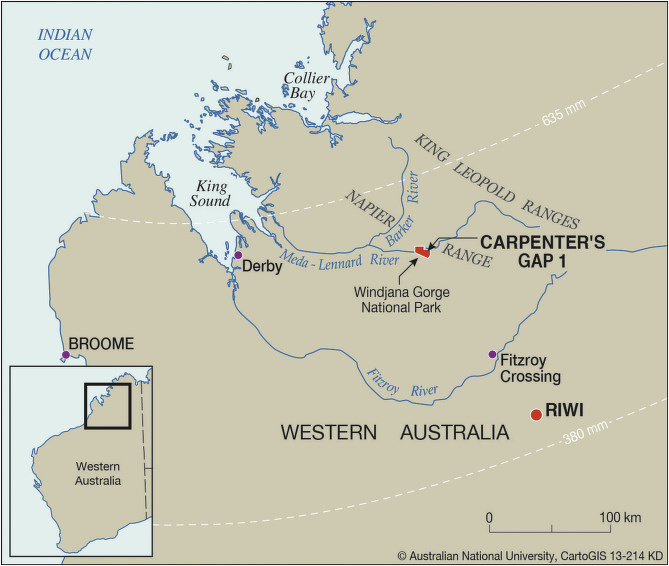
Location of the kangaroo bone tool site in th Kimberly region
Stone tools in Australia, as in other parts of the world, changed and developed through time. According to the Australian Museum Some early types, such as wasted blades, core tools, large flake scrapers and split pebble choppers continue to be made and used to today. About 6000 years ago, new and specialised tools such as points, backed blades and thumbnail scrapers became common. Significant variation between the tool kits of different regions also appeared. Prototypes for this technology appeared earlier in Asia, suggesting this innovation was introduced into Australia. [Source: Fran Dorey, Australian Museum, September 12, 2021]
The ground stone technique produces tools with a more durable and even edge, although not as sharp as a chipped tool. The oldest ground stone tools appear in Australia about 10,000 years before they appear in Europe, suggesting that early Australians were more technologically advanced in some of their tool manufacturing techniques than was traditionally thought.
In 2008, a large cache of stone tools, including chert knives, estimated to be up to 35,000 years old was discovered on the site of one of Australia’s largest iron ore mines, sparking a debate about which was more important — the archaeological site’s preservation or the mine. Reuters reported: Archaeologists uncovered the tools on the site of the US$920 million Hope Downs iron ore mine, about 310 kilometres (192 miles) south of Port Hedland, in western Australia’s ore-rich Pilbara region. “We have always known this is an important part of our history, that our ancestors lived here,” Slim Parker, a senior elder of the local Martidja Banyjima people, told Australia’s Fairfax newspapers. “Our stories and songs tells us this. It is a good feeling to know archaeologists have proved what we say is true. It makes us feel strong. Now we want this place preserved. It is part of our heritage and our culture,” Parker said.
Archaeologist consultant Neale Draper said the Hope Downs site could prove to be one of Australia’s most significant historical finds, and could yield more material up to 40,000 years old. The stone tools, mostly makeshift blades and cutting implements, were found in a rock overhang. Carbon dating tests indicated some were much older than charcoal remnants from ancient campfires. “The oldest-dated stone artifacts are a core, and associated flakes that have a radiocarbon age estimate of 35,000 years,” U.S. archaeologist W. Boone Law said, referring to an implement resembling a stone spike. [Source: Rob Taylor, Reuters, March 7, 2008]
World’s Oldest Known Axe — 49,000 Years Old — Found in Australia
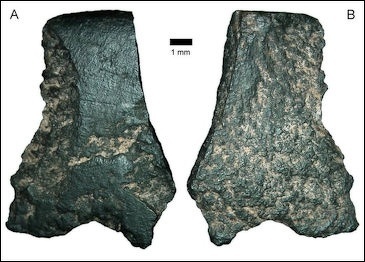
oldest ax
In 2016, scientists claimed that a small fragment found in cave, dated to 49,000 years ago, was part of the world’s oldest ax. Michael Slezak wrote in The Guardian: “It is about the size of a thumbnail and might look like any old piece of rock, but scientists say it is a fragment of the oldest axe ever discovered, created up to 49,000 years ago. Found in Australia, it further undermines ideas that Europe was the birthplace of technology, revealing people developed complex tools not long after they set foot in Australia. [Source: Michael Slezak, The Guardian May 10, 2016 |=|]
“The fragment was excavated in the early 1990s from a cave in the Windjana Gorge national park in the Kimberley region of Western Australia, but only examined recently. New analysis and dating suggests it is a fragment of the cutting edge of an axe that would have had a handle, used between 46,000 and 49,000 years ago. The find pre-dates another axe found in Arnhem Land in Australia dated to 35,000 years ago, and independently invented axes in Japan dated to about 38,000 years ago. |=|
“The fact that the discovery is just a fragment does not matter, according to Peter Hiscock from the University of Sydney, who made the recent discovery. “The great thing about it is it’s really distinctive – it has both polished surfaces coming together on the chip. While you don’t have the axe, you actually have a really good record of what the contact edge looks like.” Although there is no handle, Hiscock says it is not a simple “hand axe” – a sharp tool held directly in the hand – because it has been polished and made of a heavy material, which would not help much for a tool intended to be used by a hand. |=|
“The researchers say the axe was probably invented in Australia, since there is no evidence of similar tools in south-east Asia, from where the migrants came. “This is the earliest evidence of hafted axes [axes with a handle] in the world. Nowhere else in the world do you get axes at this date,” said Sue O’Connor from the the Australian National University, who originally excavated the tool in the 1990s. “In Japan such axes appear about 35,000 years ago. But in most countries in the world they arrive with agriculture 10,000 years ago,” she said. |=|
“Hiscock says the find adds further weight to the idea that humans colonised the world not because they were endowed with some particular skill they could apply everywhere, but because they were creative and could innovate. “We’re looking at people who moved through south-east Asia, where they probably used a lot of bamboo, which is sharp and hard and fantastic for tools. But when they get to Australia, there’s no bamboo so they’re inventing new tools to help them adapt to the exploitation of this new landscape. It’s a fascinating inversion of what European scholars thought in the 19th century. Their presumption was that all the innovations happened in Europe and far-flung places like Australia were simplistic and had little innovation. And it’s turned out that there’s a long history of discovery of axes of progressively earlier ages. This is the place where that sort of technology was invented and it only reached Europe relatively recently.” |=|
46,000-Year-Old Kangaroo Bone Tools from the Kimberley
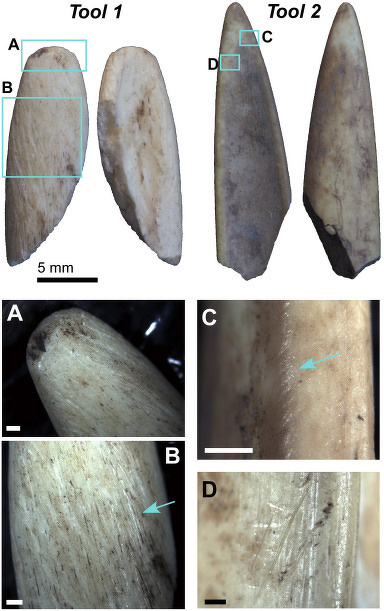
Tools 1 and 2 recovered from the Holocene layers of Carpenter's Gap 1; A) Working edge of Tool 1; B) Sub-parallel linear striations from shaping of Tool 1; C) Polish and short sub-parallel striations along working edge of Tool 2; D) Use striations. Scale Bar = 1 mm
In 2021, Scientists announced that they had found kangaroo bone tools in layers dated to between 35,000 and 46,000 years ago in Riwi Cave, about 90 kilometres south-east of Fitzroy Crossing in the Kimberley region of Western Australia. They are among the oldest tools ever found in Australia. A bone tool found at Carpenter’s Gap 1 (also in the Kimberley) has also been dated to under 46,000 years old. [Source: Amalyah Hart, Cosmos, April 7, 2021]
An analysis and re-analysis of tools from the Kimberly was made by a team of archaeologists from Griffith University, the University of Western Australia, and the Australian National University (ANU) and published in the International Journal of Osteoarchaeology. “We once thought that bone tools were not so important in the north of Australia and were only brought into the toolkit relatively recently,” says co-author Dr Michelle Langley, from Griffith’s Australian Research Centre for Human Evolution. These tools show that wasn’t the case – they were always made and used, we just hadn’t found them because they haven’t been surviving long time periods in the hostile preservation conditions of northern Australia.”
Amalyah Hart wrote in Cosmos: The secrets of the Kimberley bone tools’ use are inscribed onto them in patterns of wear and tear. By examining marks and breakages, the team inferred they were used for a range of activities, including the manufacture of plant fibre items, the processing of spinifex resin, and fish or bird hunting. “They were used for activities which typically do not survive archaeologically,” says Dr Langley. “One indicates plant or skin working (making baskets or working skins) while another appears to have been used in digging up or working resin. Resin was used to glue together tool parts and to make hand holds for tools.”
The tools are also significant in that come from a very arid part of Australia. Co-author Professor Sue O’Connor, from ANU, says: “Until recently bone artefacts of this age were thought to be confined to the cold southern regions of Australia and Tasmania and to have been used in skin working to make clothing as protection against the cold. These new finds from the arid zone have changed our perspective.”
Ancient Australian Weapons
In “First Weapons”, an ABC TV series aired in 2023, host Phil Breslin tested out a range of Indigenous Australian weapons. Amongst these were two striking weapons — the paired leangle and parrying shield, and the kodj. In a study published in Scientific Report in October 2024, scientists used modern biomechanic tools and methods to assess exactly where their striking power comes from and what made them formidable weapons. [Source: Michelle Langley, Laura Diamond, The Conversation, October 30, 2024]
Michelle Langley and Laura Diamond wrote in The Conversation: We studied the kodj made by Nyoongar peoples of the southwest of the Australian continent and the leangle and parrying shield from the southeast. The kodj is part hammer, part axe, and part poker. Its design is likely tens of thousands of years old, though determining exactly when this tool form was invented is difficult — only the stone parts can survive the archaeological record long term. So far, the oldest axe recovered from an Australian archaeological site dates to between 49,000 and 44,000 years ago. It was found in a Bunuba site called Carpenter's Gap 1.
The beauty of this weapon is its ability to be "pivoted by a turn of the wrist so that the blade can cut in any direction." The kodj used in our experiment was made by Larry Blight, a Menang Noongar man from Western Australia. Its handle is carved from wattle wood with a sharpened boya (stone) blade attached to one side and a blunt boya edge on the other with balga (Xanthorrhoea or grass tree) resin.
The leangle and parrying shield we studied were made by expert weapon-makers Brendan Kennedy and Trevor Kirby on Wadi Wadi Country. Each was carved from hardwood and are traditionally used together in one-on-one, close quarters combat. Determining when this weapon was invented is even more difficult than the kodj, because both the leangle and its paired shield are entirely made of wood. Wood rarely survives long term, and certainly not over the thousands of years needed to track its innovation. Currently, the oldest surviving wooden artefacts found on the Australian continent are 25 tools including boomerangs and digging sticks recovered from Wyrie Swamp, South Australia. They are more than 10,000 years old and only preserved because they were in a waterlogged environment which protected them from decay.
Killing-Power and Use of Ancient Australian Weapons
Michelle Langley and Laura Diamond wrote in The Conversation: There are no previous studies describing human and weapon efficiency when striking with a hand-held weapon, so we were starting from scratch. For this study, the show's host, Phil Breslin, acted as the warrior putting the weapons through their paces. Using wearable instruments, we tracked the human and weapon kinetic energy and velocities built up during kodj and leangle strikes. Biomechanical analyses provided insights into shoulder, elbow and wrist motions, and the powers reached during each strike motion. These tests found that the leangle is far more effective at delivering devastating blows to the human body than the kodj. The kodj, on the other hand, is more efficient for an individual to maneuver, but still capable of delivering severe blows that can cause death.[Source: Michelle Langley, Laura Diamond, The Conversation, October 30, 2024]
Over the past few hundred years, European writers have noted a range of weapons have been used in conflict both within and between First Nations on the Australian continent. Stencils and painting of these same weapons appear in rock art, recording their presence prior to European arrival.
Some weapons were also used in dispute resolution. These included "trial by ordeal," whereby an accused person must face a barrage of projectiles (spears or fighting boomerangs) unarmed or with a shield. Such trials often resulted in injuries, but rarely in death. Archaeological evidence for interpersonal violence (injuries of skeletal remains) is rare in Australia, but when found, usually consists of depressions to the skull and "parrying fractures". These are breaks to the arm bones above the wrist, resulting from the raising of the arm in defense against a weapon. This can be either from a direct blow or a glancing blow off a shield — like the one used in this experiment.
Early Modern Human Art in Australia
Another candidate of the world's oldest art are some mysterious cuplike designs and circular coin-like impression made on great orange boulders in a rock formations at the Jinmium site on the coast of Northern Territory in Australia. The impressions have been found on numerous boulders. In almost every case they have the same depth and the same 1.2-inch diameter width. One boulder has 3,500 markings. Scientists theorize the boulders may have marked important food sources or provided directions. Aboriginals in the area believe the markings represent ancestral being that turned to stone.
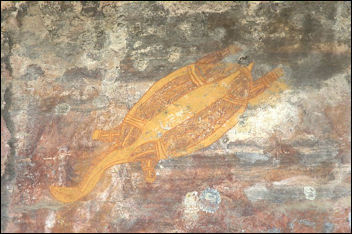
turtle Richard Fullagar, an anthropologist at the Australian Museum in Sydney, dated the impressions and markings using the latest dating methods to be 75,000 years old, an astonishing date. The famous paleolithic cave paintings in France and Spain, by contrast, are 25,000 years old.
Using the thermolumiscence dating method, David Price of the School of Geosciences at the University of Woolonggong, has dated artifacts and ocher found in a rock shelter at Jinmium at 116,000 years old. Price dated a hand tool to be 176,000 years old — an even more astounding date that is hard to believe and would throw off many theories if it turns out to be true. These dates are debated or have been debunked.
The oldest rock paintings in Australia confirmed by carbon dating are 20,000 years old. An image of pregnancy drawn with ocher on a rock has been dated to be 35,000 years old using other dating methods. Some believe that other rock paintings may be 35,000 or 40,000 years old. A 30,000 year old piece of chiseled ocher was found at Lake Mungo.
See Separate Article VERY, VERY OLD AUSTRALIAN AND ABORIGINAL ROCK ART ioa.factsanddetails.com
Ancient Humans in Australia Ate the Eggs of ‘Demon Ducks of Doom’
An analysis of proteins found in the eggshells found in cooking pits used by humans in Australia around 50,000 years ago appears to indicate that these people ate the eggs of Genyornis newtoni, the last living species of a group of birds known as ‘Demon Ducks of Doom.’ The egg of this bird weighs about 1.5 kilograms, more than 20 times the weight of an average chicken egg. Beatrice Demarchi from the Department of Life Sciences and Systems Biology at the University of Turin, and colleagues, completed the protein analysis which resulted in the species identification. Their findings were published in the journal Proceedings of the National Academy of Sciences. [Source: Cassidy Ward, SYFY, June 5, 2022,]
SYFY reported: “Genyornis was two meters tall and 200 kilos. We don’t know exactly what it would have looked like because there are few skeletal remains available. It was certainly a flightless bird with some characteristics shared with ostriches, like the big chest and small wings, but it would have looked more like a big goose or duck,” Demarchi told SYFY WIRE.
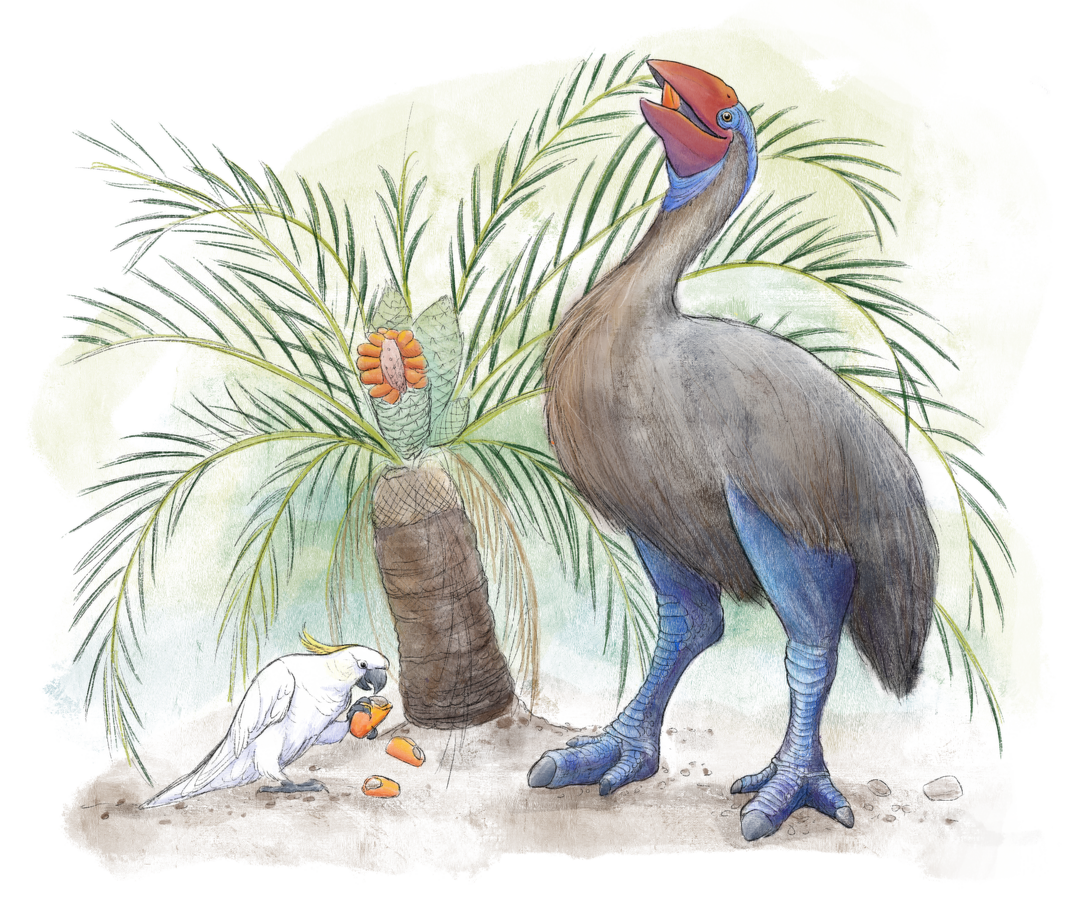
Genyornis
The evidence that humans were eating these large eggs comes from burnt eggshells found among the remains of ancient cultures. Scientists studying these sites find two different types of eggshells, one of which comes from emus and another which was unknown. Looking at the archaeological record, we find that the eggshells start being burned right around the same time people first arrived in Australia. This supports the notion that they were cooking and eating them as they had done with other large, flightless birds in Africa, India, and Eurasia.
The proteins suggest that the eggshells came from a bird more closely related to modern ducks and geese, which supports the Genyornis hypothesis. Sadly, even before humans showed up in Australia, most of the demon ducks had died out and the extra pressure of our presence in the area proved too much for Genyornis to handle. They died out roughly 50,000 years ago, which is about the time the first people arrived.
Animals Found in Australia, 65,000 Years Ago
During the ice ages, when sea levels were 65 meters lower than they are now and the climate was wetter than it is today, Australia, Tasmania and New Guinea were part of a single continent called Meganesia. The geological and biological record bears this out. New Guinea, for example, also has kangaroos. A couple of Indonesian islands may have been part of the 60,000 year old continent: a previously unidentified species of tree kangaroo was discovered on an island near Irian Jaya in 1994. [Source: Tim Flannery, Natural History, June 1993, December 1995]
Prehistoric animals found as recently as 50,000 years ago on the Australian continent included massive carnivorous ghost bats, platypus with large canine teeth, rabbit-size creatures with huge projecting incisors, and nine foot birds that weighed half a ton. Large animals included the rhino-size diprotodon, a wombat-like marsupial plant eater that somewhat resembled a buffalo; giant kangaroo rats, weighing 90 pounds; a Volkswagen-size tortoise; eight-meter-long snakes that were one meter in diameter; and the Genyornis, an ostrich-size flightless bird.
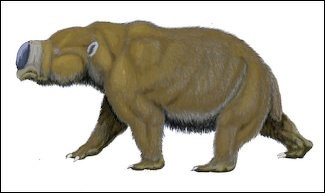
Diprotodon optatum
Ancient large carnivores included Megalania, giant carnivorous goannas that weighed as much as a ton and reached lengths of 20-feet; Quinkana, a 10-foot-long, 500 pound land crocodiles that seemed to able to survive without water, and may have jumped from trees onto their prey. The womambi was large python-like snake that weighed over 100 pounds and had a 12-inch girth. It had an enormous head filled with hundreds of tiny teeth. It lived in a number of different environments including rocks and oases and was found much further south than large snakes today. Marsupial lions as large as their African counterparts may have dragged captured kangaroos into a tree just as leopards do with their prey today.
Ancient animals (and the approximate time they went extinct): 1) Polrchestes, carnivorous kangaroos (30,000 years ago); 2) genyornis (25,000 years ago); 3) diprotodon (20,000 years ago); 4) megalonia prisca and giant goanna (12,000 years ago); 5) Procoptadon, the giant kangaroo (10,000 years ago); 6) thylacoleo, marsupial lion, (9,000 years ago); 7) giant echidna (9,000 years ago).
Some of these creatures were probably wiped out by early Aboriginals just as giant sloths and wooly mammoths were probably exterminated by early American Indians. Some may have been hunted to extinction. A more likely explanation is they were wiped by huge man-made brush fires that changed the ecology of their habitats.
See Separate Articles: ICE-AGE ANIMALS IN AUSTRALIA: WHEN, WHERE AND HOW THEY LIVED AND WENT EXTINCT ioa.factsanddetails.com ; GIANT ICE-AGE ANIMALS IN AUSTRALIA: WOMBATS, KANGAROOS AND THUNDER BIRDS ioa.factsanddetails.com
What 29,000-to-19,000-Year-Old Tools at Submerged Ice-Age Site Reveal
An analysis of over 4,000 stone artifacts published in April 2024 in the journal Quaternary Science Reviews and discovered on an island off northwestern Australia give insights into what life was like for prehistoric humans in Australia, especially during the peak of the last ice age, between 29,000 and 19,000 years ago. The discovery underscores the "long-term connections" that Indigenous peoples have to modern-day Australia, said David Zeanah, an anthropologist at California State University, Sacramento and lead author of a new study describing the analysis. [Source: Emma Bryce, Live Science, April 14, 2024]
Emma Bryce wrote in Live Science: Between 29,000 and 19,000 years ago sea levels were low enough to expose the continental shelf between Australia and what is now Barrow Island, a 202 square kilometers (78-square-mile) territory about 60 kilometers (37 miles) off Australia's northwest coast. Thousands of years ago, it would have formed the high plateau of a vast, continuous plain spanning over 4,200 square miles (10,800 square km), Zeanah told Live Science.
Archaeologists already knew that people once lived on the island, thanks mainly to a trove of archaeological evidence left behind in rock shelters — most famously, in one called Boodie Cave. But for the new research, the scientists looked beyond the island's caves to explore several open-air deposits scattered across Barrow Island. Over three years, they examined 4,400 slicing, cutting and grinding tools from a mix of sites. What surprised the researchers was the variety in the artifacts' compositions. Most of the tools found in caves were fashioned out of limestone, the most abundant geological material on the island. Those discovered at the open-air sites, by contrast, were made mostly from rocks, including igneous and sandstone, that matched sources on mainland Australia.
The findings show "a surprising amount of diversity in stone tool composition over a relatively small area," said Tiina Manne, an archaeologist at The University of Queensland in Australia who was not involved in the research. This diversity is significant because it reveals details about the people who frequented Barrow Island, Zeanah said. "The open sites provide clear links to the mainland geologies, and that infers that people were using the coastal plain that's underwater now," Zeanah said. An example he found particularly intriguing was the roundish, flat grinding stones that are derived from geological sources beyond Barrow Island. The team discovered that these stones were water-worn, suggesting that before they were crafted into grinding tools, they had been hand-selected from stream beds or tidal regions, perhaps from coastal flats or rivers that may have run across the exposed plain that once connected Barrow Island to mainland Australia when sea levels were low.
The indication that many of the island's tools came from far-flung locations is exciting, Zeanah said, as it suggests that the ancient exposed plain may have been a thoroughfare for trade and exchange between different groups. "This was probably not like a single group of people moving seasonally across the plains," Zeanah said. "The area is vast. The materials may have been transmitted by trade, or by Aboriginal people going from group to group. So that implies a social network."
The presence of those grinding stones on Barrow Island supports the idea that mass movement and knowledge sharing unfolded for thousands of years across this landscape, the study authors said. "What that suggests to us is that people knew that there wasn't good stone on Barrow Island, and they often brought cobbles to provision the landscape there, so that they could revisit in the future," Zeanah said. "That shows a lot of logistics, foresight and knowing the landscape well, I believe."
The researchers are unsure why the geological makeup of the cave tools differs from those found outside. The most likely explanation is that artifacts made of limestone do not survive exposure on the surface as well as artifacts made of harder stone from the mainland. Another possibility has to do with how sea levels rose as the ice age declined, which would have gradually severed Barrow Island from the mainland and constricted the movement of people across the plain. In Boodie Cave, only a handful of unearthed tools were made of rocks that originated elsewhere. And in the protected cave environment, it has been possible to show that those tools tend to be older, and therefore may have been deposited earlier, when sea levels were at their lowest.
Therefore, it's likely that these remote tools were brought to the site by groups that could move freely between Barrow Island and the mainland. Limestone tools were used more intensively when rising sea levels began to cut-off the island from the mainland, the study authors said. This separation would have driven the islands' inhabitants to settle in caves and rely on the abundant local limestone to make the tools, the researchers suggested.
Image Sources: Wikimedia Commons
Text Sources: Australian Museum, National Geographic, New York Times, Washington Post, Los Angeles Times, Smithsonian magazine, Nature, Scientific American. Live Science, Discover magazine, Discovery News, Natural History magazine, Archaeology magazine, The New Yorker, Time, BBC, The Guardian, Reuters, AP, AFP and various books and other publications.
Last updated September 2025