
Home | Category: History / Aboriginals
EARLY MODERN HUMANS IN AUSTRALIA
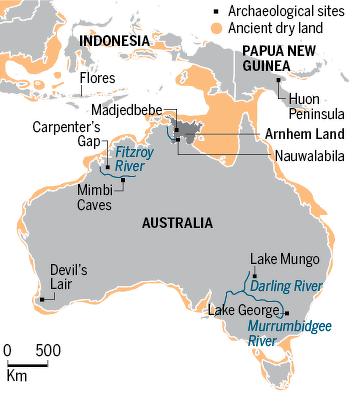
Early Modern Human Sites in Australia, from Science
Surprisingly some of the earliest evidence of modern humans outside of Africa and the Middle East is not in Asia or Europe but in Australia. The earliest evidence of modern humans in Australia comes from Madjedbebe, a sandstone rock shelter in Arnhem Land, in the Northern Territory of Australia. Artifacts there have been dated to be 50,000- 65,000 years old. The oldest human skeletal remains are the 40,000-year-old Lake Mungo remains in New South Wales. Humans appear to have been widely dispersed in Australia at very early dates. Human ornaments discovered at Devil's Lair in Western Australia have been dated to 48,000 years ago. The earliest evidence of modern humans in Tasmania comes from Jordan River Levee. Optically stimulated luminescence results from the site suggest people were ca. 41,000 years ago. Tasmania was connected to Australia by a land bridge. Rising sea level cut off Tasmania around 6000 B.C.. [Source: Wikipedia]
Physical archaeological remains of human activity in Australia include stone tools, rock art and ocher, shell middens, charcoal deposits and human skeletal remains. The oldest human fossil remains found in Australia date to around 40,000 years ago — 10,000 to 20,000 years younger than the oldest human artifacts — after the earliest archaeological evidence of human occupation. Nothing is known about what the first humans that entered Australia look like but — based on skeletal remains that Aboriginal people living in Australia between 40,000 and 10,000 years ago had much larger bodies and more robust skeletons than they do today and showed a wide range of physical variation. [Source: Fran Dorey, Australian Museum, September 12, 2021]
When the first people arrived Australia was much wetter than it is now. First arrivals found vast mud flats with mollusks that never been harvested by humans, seas that had never been fished and species that had never faced an predators. These animals were probably very easy to hunt because they had never faced predators before. The oldest known grinding stones for plants appeared around 30,000 years ago. The might have been created because the easy animals to hunt for meat were extinct. [Source: “Countries of the World and Their Leaders Yearbook 2009"]
Related Articles:
DID HUMANS REALLY MIGRATE TO AUSTRALIA 65,000 YEARS AGO ioa.factsanddetails.com
HOW THE FIRST PEOPLE GOT TO AUSTRALIA 50,000 (MAYBE 65,000) YEARS AGO ioa.factsanddetails.com
OUT OF AFRICA AND THEORIES ABOUT EARLY MODERN HUMAN MIGRATIONS factsanddetails.com ;
MIGRATIONS OF EARLY MODERN HUMANS factsanddetails.com ;
EARLY MODERN HUMANS MIGRATE TO ASIA factsanddetails.com ;
LIFE OF EARLIEST HUMANS IN AUSTRALIA: TOOLS, WEAPONS, ART, SETTLEMENTS ioa.factsanddetails.com
PEOPLE WHO LIVED AUSTRALIA 20,000 TO 10,000 YEARS AGO ioa.factsanddetails.com ;
EARLY ABORIGINALS ioa.factsanddetails.com ;
VERY, VERY OLD AUSTRALIAN AND ABORIGINAL ROCK ART ioa.factsanddetails.com ;
ANCIENT ABORIGINAL ART OF NORTHERN AUSTRALIA ioa.factsanddetails.com
RITUAL LIFE AND MYTHS OF ANCIENT AUSTRALIANS ioa.factsanddetails.com
AUSTRALIAN HISTORY ioa.factsanddetails.com ;
MODERN HUMANS 400,000-20,000 YEARS AGO factsanddetails.com
RECOMMENDED BOOKS:
“Australia’s Ancient Aboriginal Past: A Global Perspective” by Murray Johnson Amazon.com;
“The First Boat People” (Cambridge Studies in Biological and Evolutionary Anthropology by S. G. Webb Amazon.com;
“First Migrants: Ancient Migration in Global Perspective” by Peter Bellwood Amazon.com;
“Ancestral DNA, Human Origins, and Migrations” by Rene J. Herrera (2018) Amazon.com;
“Out of Africa I: The First Hominin Colonization of Eurasia” by John G Fleagle, John J. Shea, Editors (2010), Amazon.com;
“The Global Prehistory of Human Migration” by Immanuel Ness and Peter Bellwood (2014) Amazon.com;
“Out of Eden: The Peopling of the World” by Stephen Oppenheimer Amazon.com;
“The Journey of Man: A Genetic Odyssey” (Princeton Science Library) by Spencer Wells (2017) Amazon.com;
“Past Human Migrations In East Asia by Alicia Sanchez-Mazas” Amazon.com;
“Homo Sapiens Rediscovered: The Scientific Revolution Rewriting Our Origins” by Paul Pettitt Amazon.com;
“The Real Eve: Modern Man's Journey Out of Africa” by Stephen Oppenheimer (2004) Amazon.com;
“Asian Paleoanthropology: From Africa to China and Beyond” (Vertebrate Paleobiology and Paleoanthropology) by Christopher J. Norton and David R. Braun Amazon.com;
“Who We Are and How We Got Here: Ancient DNA and the New Science of the Human Past” by David Reich (2019) Amazon.com;
“Our Human Story: Where We Come From and How We Evolved” By Louise Humphrey and Chris Stringer, (2018) Amazon.com;
Archeological Evidence of Modern Humans in Australia

‘Superhighways’ Used by Earliest Australia
According to the Australian Museum: Over the last few decades, a significant number of archaeological sites dated at more than 30,000 years old have been discovered. By this time all of Australia, including the arid centre and Tasmania, was occupied. The drowning of many coastal sites by rising sea levels has destroyed what would have been the earliest occupation sites.
Archaeological artifacts of things still used today include fishing traps and weirs and stone-base huts. Prehistoric fireplaces contain remains of meals and cooking activities. Such evidence indicates that lifestyle practices varied across Australia and differed depending on climate, environment and the natural resources available. Shell middens (waste dumps of mollusk shells, animal bone and other things) provide clues ro what people ate and can also be radiocarbon dated to establish the age of a site. [Source: Fran Dorey, Australian Museum, September 12, 2021]
Gemma Tarlach wrote in Discover magazine: “Many sites have been dated at 35,000 to 40,000 years ago. The tools found at these sites is less sophisticated than those used in Europe, consisting mainly of Neanderthal-style flaked stones and scrapers, There is little evidence the early Australians hunted large marsupial animals. It has been suggested that it likely they didn't develop more sophisticated tools because they didn't need them. There seems to have been plenty of food and there was no rival human species — like Neanderthals in Europe — to prod them to develop new technologies. Just reaching Australia — most likely with seaworthy rafts — is testimony to their skill and cleverness. [Source: Gemma Tarlach, Discover, July 19, 2017]
Some of the oldest known Aboriginal artifacts, dated between 43,000 and 47,000, are stone tools found at Cranebrook Terrace in Sydney. Evidence of human activity at Keilor, an archaeology site in a suburb of Melbourne dates back nearly 40,000 years. Stone flakes and charcoal deposits have been found in the lowest archaeological levels. One of the key remains from this site was that of a 12,000 year old skull discovered in 1940. It is one of the earlier prehistoric Aboriginal remains found in Australia.
Madjedbebe — the Oldest Known Human Site in Australia
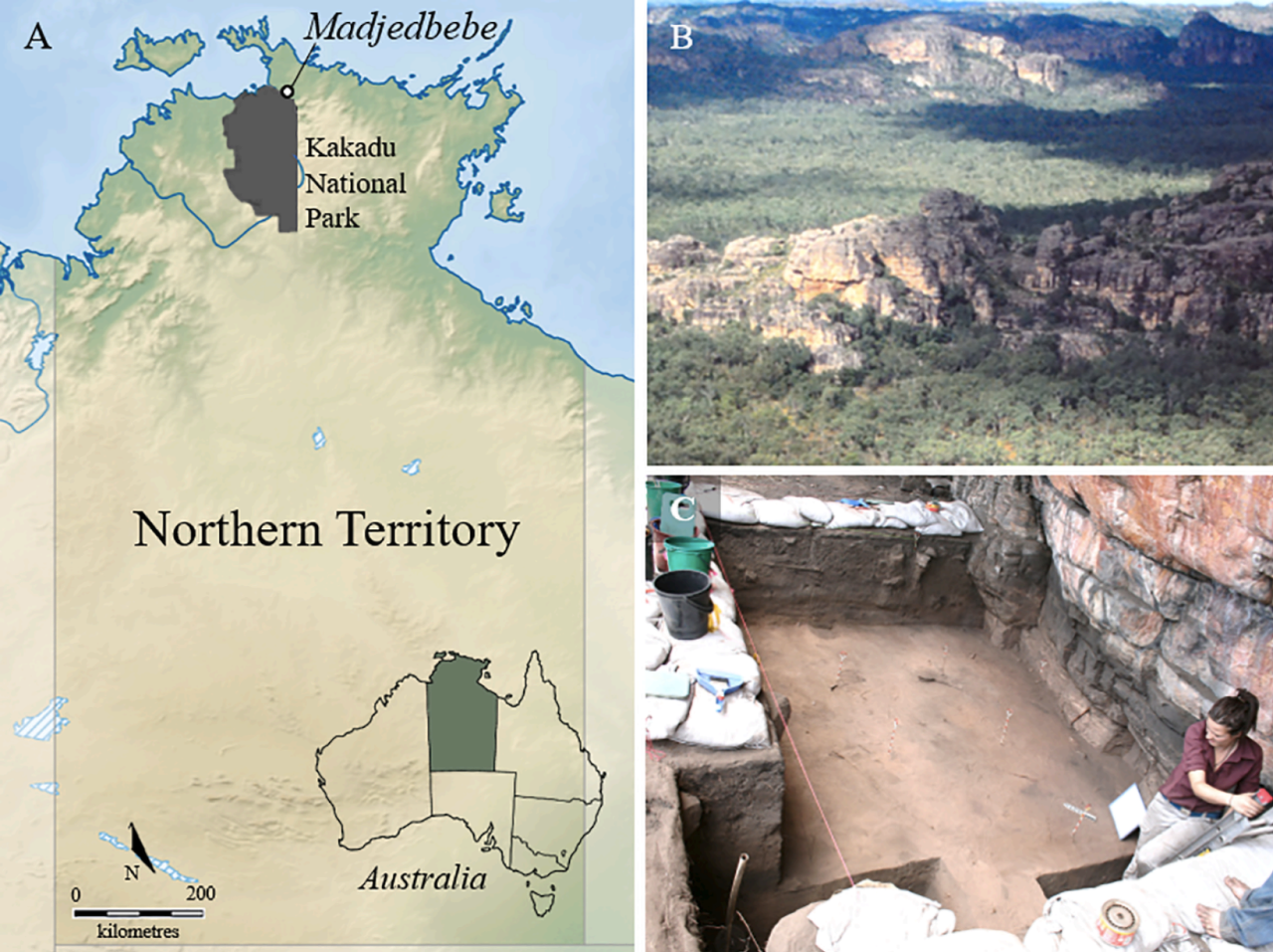
Madjedbebe rock shelter
Gemma Tarlach wrote in Discover magazine: “Madjedbebe, formerly known as Malakunanja II, has long been considered by some to be the oldest human occupation site in Australia. It was first excavated in the 1970s and ’80s and yielded numerous artifacts such as stone tools and ground ocher that were dated as far back as 60,000 years. But, thanks in part to the strikingly old dates and quibbling over how the artifacts and their contexts — their immediate surroundings — were documented, many conventional timeline backers refused to accept the site’s age. Researchers returned to Madjedbebe in 2012 and again in 2015, and in 2017 reported on what they found in more than 20 new small pits dug around the previous excavations. [Source: Gemma Tarlach, Discover, July 19, 2017]
“The new haul is impressive: thousands of stone tools and materials used to make them, grinding stones, hearths, ocher “crayons” and animal bones, including from a thylacine jaw fragment that was covered in pigment, plus other pigments with reflective additives — the oldest evidence of pigment processing in Australia (think Stone Age glitter). Also winning the “oldest in Australia” category: evidence that suggests seed grinding, such as plant matter and specific stone tools used to process it.
“Want more “oldies,” do you? Here ya go: the latest Madjedbebe digs uncovered the oldest edge-ground stone hatchets not just in Australia, but in the world. Of course, with all this talk of oldest this and that, you might be wondering if the dating for the new finds is any more precise and certain than that of previous digs at the site. In a word: yes. When digging down, the team documented not just the layers with artifacts, but the entire stratigraphy of each meter-square excavation mini-site. The deposits were dated using both radiocarbon and optically stimulated luminescence methods, with additional methods used to date fragmentary charcoal samples from the ancient hearths. And the results were, with confidence, an age of about 65,000 years (with, give or take, at most, 3,000 or 4,000 years in either direction).” /\
Lake Mungo and Mungo Man
The oldest human remains in Australia were found at Lake Mungo in south-west New South Wales, part of the Willandra Lakes system. This site has been occupied by Aboriginal people from at least 47,000 years ago to the present. This age range is supported by numerous geochronological ageing techniques including Radiocarbon (C14) determinations, Optically Stimulated Thermoluminesence (OSL) and Thermoluminesence (TL). [Source: Fran Dorey, Australian Museum, September 12, 2021]

Mungo Man
The Lake Mungo area, in southeast Australia not far from Adelaide, was once filled with lakes but they have been mostly dry for the last 18,000 years and Lake Mungo is now a dry lakebed. In the past, lower evaporation and higher runoff from the Great Dividing Range allowed the lakes to fill, supporting plentiful freshwater resources such as fish and shellfish, and making the lakes a valuable source of food for the people that occupied the area. The lakes sometimes fill today after heavy rain. Mungo Lake lies in Mungo National Park in Willandra Lakes area (250 kilometers, 400 miles, west of Sydney), which has been designated a UNESCO World Heritage Site.
Mungo Man, also known as 'Lake Mungo 3’ or (WLH 3) was found eroding out of a sand dune. He was laid out on his back for burial and covered in red ocher before being buried in the beach sands that bordered the lake. There has been some debate over the age of this burial. Dates ranging from 26,000 to 60,000 years ago have been have been obtained using different dating methods, An age around 42,000 years old is the most widely accepted. A 20,000-year-old skull found in the Willandra Lakes area puzzles scientists because it has more primitive features than older remains found in Australia.
DNA analysis of Mungo human remains appeared to indicate that they evolved in Australia not Africa. According to the Australian museum: In 2001, Australian scientists claimed that they had extracted mitochondrial DNA from ‘Mungo Man’ and nine other ancient Australians. They concluded that the genes of the modern-looking ‘Mungo Man’ were different from modern humans, proving that not all Homo sapiens have the same recent ancestor as stated in the ‘Out of Africa’ theory. These claims are controversial and could not be replicated in further studies in 2016 (PNAS 2016), and the only DNA that could be recovered from Mungo Man was European and certainly a contaminant.Ancient DNA is easily contaminated and rarely survives for 30,000 years in conditions like those found in Australia. A complete mitochondrial genome from WLH 4, found several kilometres from Mungo Man, has been reconstructed. This individual was probably buried after the lakes had dried up in the Holocene (less than 10,000 years ago) and contains DNA that falls within the modern human range.
Mungo Lady
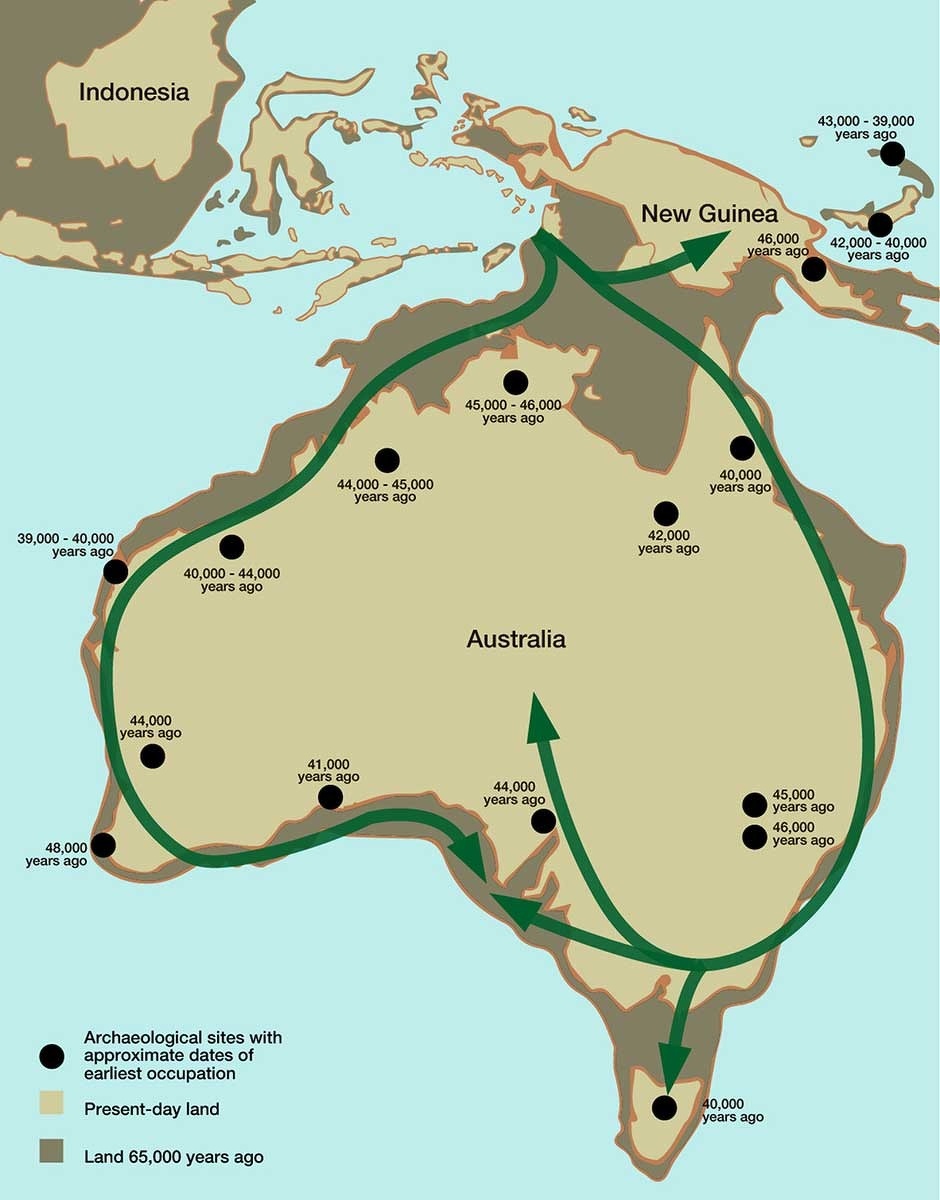
dates of oldest archaeology sites in Australia and New Guinea
Mungo Lady is the name given to a skeleton found in 1968 at Mungo Lake that has been firmly dated to be at least 42,000 years old. Also known as Mungo Woman and ‘Lake Mungo 1’ (WLH 1), she was laid to rest in the most reliably dated human burial in Australia and is the earliest ritually cremated individual found anywhere in the world. The cremation process shrunk her bones, making the skeleton of this originally small-bodied woman even smaller. Dr Alan Thorne reconstructed the skull from over 300 fragments. [Source: Fran Dorey, Australian Museum, September 12, 2021]
The bones were originally dated to be 24,000 years old. In 1999, the sediments the bones were found were redated using three different methods, including the measurement of trapped electrons, and they were found to be 62,000 years old. This finding was extremely controversial at the time, considering the oldest known modern human fossils in Europe were 32,000 years old. In 2003, the Mungo remains were redated again, this time to between 50,000 and 40,000 years , using a technique in which electrons in sand particles found near the fossils were measured.
The Australia anthropologist Alan Thorpe told National Geographic, Mungo Lady “was between 20 and 25 when she died. Her people placed her body on a funeral pyre, and after fire consumed her flesh, they smashed her bones with a club or a digging stick. Then they placed the fragments in a hole at the front of the dune." Covered in red ocher, the skeleton is presented as one of the first known use of pigments for religious or artistic purposes.
50,000-Year-Old Human Settlements in the Australian Interior
In 2016, a team of archaeologists in Australia announced they had found extensive remains of a sophisticated human community living 50,000 years ago. The remains — which included a range of tools, decorative pigments, and animal bones — were found in a rock shelter in the Flinders Ranges in Australia’s arid southern interior.[Source: Annalee Newitz, ars technica, November 3, 2016 |+|]
Annalee Newitz wrote in ars technica: “Dubbed the Warratyi site, the rock shelter sits above a landscape criss-crossed with deep gorges that would have flowed with water when Paleolithic humans lived here. From extensive excavations conducted last year, the archaeologists estimate that people occupied Warratyi on and off for 40,000 years, finally abandoning the site just 10,000 years ago. |+|
“By analyzing layers of earth in the shelter, the scientists were able to construct a timeline of settlement in the space. They used carbon dating on nuggets of hearth charcoal and eggshells to discover that the shelter was first occupied about 50,000 years ago. They also used a dating technique called optically simulated luminescence (OSL) on buried grains of quartz. This technique determines when those quartz grains last saw sunlight and heat. Both techniques returned similar dates, adding to the researchers' confidence in their findings. |+|
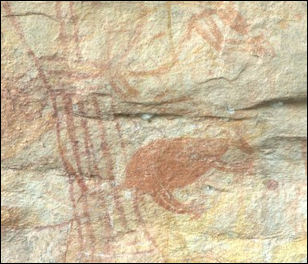 “This makes Warratyi the oldest evidence of human occupation in the arid Australian interior, long believed too hostile for ancient people who had few tools. But these findings make it clear that the ancestors of Australia's indigenous people were, in fact, seasoned explorers who could survive in difficult conditions. The earliest signs of habitation, older than 38,000 years, showed a human culture that was sophisticated for its time. The people of Warratyi had a wide range of tools, ranging from tiny handheld blades to bone awls. They had two colors of pigment, white and red, for use in art, body decoration, and possibly adhesive. They were accomplished hunters and gatherers, using many kinds of blades to butcher animals and cut plant stalks. Thousands of discarded bones and eggshell shards were buried at Warratyi, representing 17 different species. |+|
“Two of those species, D. optatum (a massive creature the size of a rhino) and G. newtoni (an enormous flightless bird) are extinct megafauna. Neither would have naturally found its way into the cave, so their bones and eggshells must have been brought there by humans. This proves that humans hunted, ate, and interacted with Australia's megafauna for a considerable time, over a considerable range, before the beasts died out. These findings also provide solid evidence for what archaeologists have long suspected, which is that humans in Australia had an impact on the lives (and extinctions) of megafauna across the continent. |+|
Supercomputer Plots ‘Superhighways’ Used by Earliest Australia
How the first Australians moved around Australia, New Guinea and Tasmania after they arrived at least 50,000 years and 70,000 years is “one of the really big unanswered questions of prehistory is how Australia was populated in the distant past. Scholars have debated it for at least 150 years,” Sandia National Laboratories archaeologist and remote sensing scientist Devin White to Eurasia Review. In the early 2020s an international team of scientists using a Sandia supercomputer in the largest reconstruction ever attempted of prehistoric travel mapped the probable “superhighways” that led to the first peopling of Australia. Their results were published in Nature Human Behaviour in Mat 2021. [Source: Eurasia Review, May 4, 2021]
According to Eurasia Review: Powered by 125 billion simulations run on a supercomputer typically used to develop autonomous systems and machine learning technologies, the team’s research is the first high-resolution computational analysis of human migration at a continental scale, dividing the entire supercontinent into pixels 1,640 feet (500 meters) across. Archaeologist and computational social scientist Stefani Crabtree, a fellow at the Santa Fe Institute in Santa Fe, New Mexico, and professor at Utah State University in Logan led the study.
Researchers packed a virtual 25-year-old woman with 22 pounds (10 kilograms) of tools and water and sent her on billions of walks across the continent as it would have looked 50,000 years ago. Her task: find the paths that require the fewest calories to traverse without straying too far from reliable sources of water or from highly visible landscape features like large rock outcrops. The team found that the simulations returned to certain paths again and again, which the researchers dubbed “superhighways,” that line up well with the earliest known archaeological sites on the continent.
Researchers affiliated with the Australian Research Council Centre of Excellence for Australian Biodiversity and Heritage (CABAH) also contributed to the project and explained the strong connection between Aboriginal communities, the landscape they have traveled across for millennia and a timeless realm known as the Dreaming.
“Australia’s not only the driest, but also the flattest populated continent on Earth,” said Sean Ulm, the center’s deputy director and a distinguished professor of archaeology at Queensland, Australia-based James Cook University. “Our research shows that prominent landscape features and water sources were critical for people to navigate and survive on the continent. In many Aboriginal societies, landscape features are believed to have been created by ancestral beings during the Dreaming. Every ridgeline, hill, river, beach and water source is named, storied and inscribed into the very fabric of societies, emphasising the intimate relationship between people and place. The landscape is literally woven into peoples’ lives and their histories. It seems that these relationships between people and country probably date back to the earliest peopling of the continent.”
Indigenous Australians: World’s Oldest Civilization, DNA Study Says
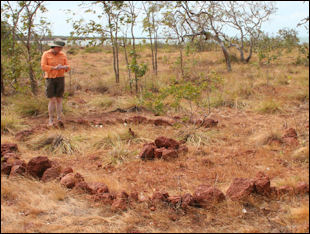
Macassan stone arrangementA population analysis of Indigenous Australians and Papuans published in Nature in 2016 shows they can trace their origins back to the very first arrivals in their homelands around 50,000 years ago. In genetic terms, based on the first extensive study of their DNA, this makes them the most ancient continuous civilisation on Earth. Clues left in their genes allowed scientists to trace origins and amazing journeys to Australia and New Guinea. [Source: Hannah Devlin, The Guardian, September 21, 2016 |=|]
Scientists sifted through the DNA of modern populations in Australia and Papua New Guinea and found their ancestors were probably the first humans to cross an ocean along with evidence of prehistoric interbreeding with an unknown hominin. Prof Eske Willerslev, an evolutionary geneticist who led the work at the University of Copenhagen, told The Guardian: “This story has been missing for a long time in science. Now we know their relatives are the guys who were the first real human explorers. Our ancestors were sitting being kind of scared of the world while they set out on this exceptional journey across Asia and across the sea.” |=|
Hannah Devlin wrote in The Guardian: “Willerslev’s findings, based on a new population analysis of 83 Indigenous Australians and 25 Papuans, shows that these groups can trace their origins back to the very first arrivals on the continent about 50,000 years ago and that they remained almost entirely isolated until around 4,000 years ago. “They are probably the oldest group in the world that you can link to one particular place,” said Willerslev. En route to Australia, early humans would have encountered a motley assortment of other roving hominin species, including an unknown human relative who has now been shown to have contributed around 4 percent to the Indigenous Australian genome. Previously, scientists have discovered that prehistoric couplings have left all non-Africans today carrying 1-6 percent of Neanderthal DNA. Willerslev said the latest findings added to the view that Neanderthals and other now extinct hominins, traditionally portrayed as low-browed prehistoric thugs, were “in reality not particularly different” from our own ancestors. |=|
“Willerslev’s study also resolves the apparent discrepancy between genetic findings implying that Indigenous populations have been in Australia for tens of thousands of years and the fact that the languages spoken by these populations are only around 4,000 years old. “You see a movement of people spreading across the continent and leaving signatures across the continent,” said Willerslev. “That is the time that this new language has spread. It’s a tiny genetic signature. It’s almost like two guys entering a village and saying ‘guys, now we have to speak another language and use another stone tool and they have a little bit of sex in that village and then they disappear again.” Aubrey Lynch, an Indigenous elder from the Goldfields area, said: “This study confirms our beliefs that we have ancient connections to our lands and have been here far longer than anyone else.” |=|
Image Sources: Wikimedia Commons
Text Sources: Australian Museum, National Geographic, New York Times, Washington Post, Los Angeles Times, Smithsonian magazine, Nature, Scientific American. Live Science, Discover magazine, Discovery News, Natural History magazine, Archaeology magazine, The New Yorker, Time, BBC, The Guardian, Reuters, AP, AFP and various books and other publications.
Last updated September 2025