
Home | Category: History / Aboriginals
AUSTRALIA’S STOLEN GENERATIONS
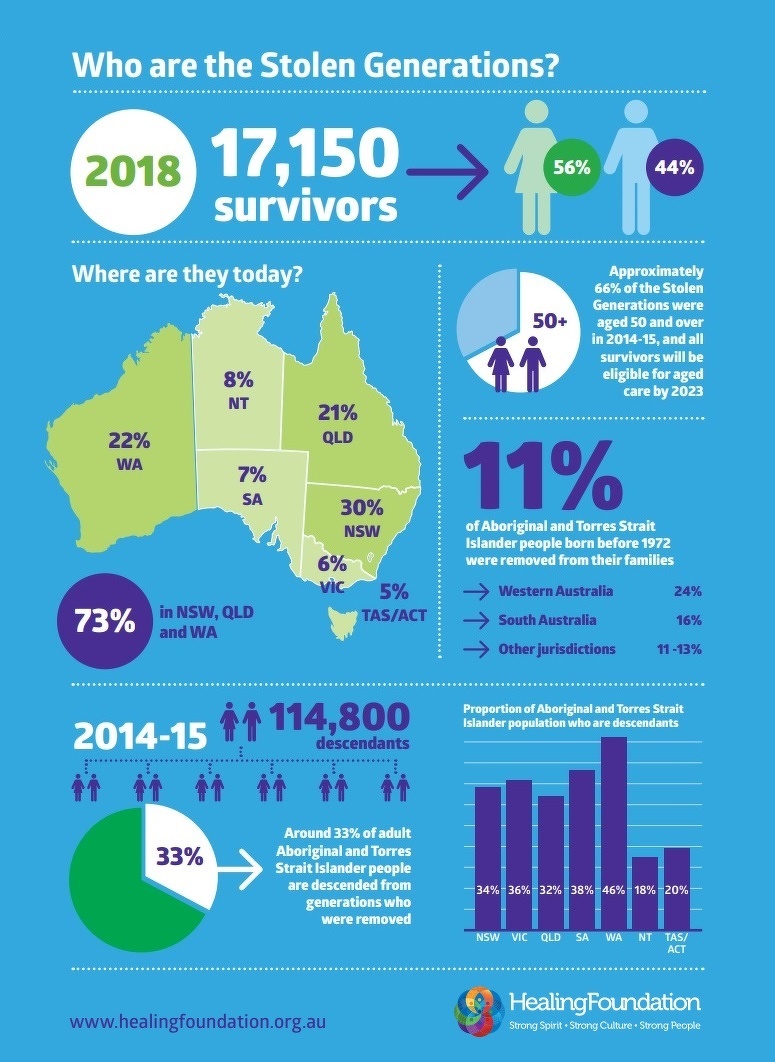
from the Healing Foundation
In a program that lasted from the 1910 to the 1970s about 100,000 Aboriginal children — 10 to 33 percent of all Aboriginal children — were taken from their parents by Australian authorities under state and federal laws to be raised in white-run institutions or foster homes with white parents. The practice continued 20 years after Australia joined a United Nations effort to abolish racial discrimination.
The term “Stolen Generations” is used today to describe the system and victims of it. The children were taken without a court order and made wards of the state from birth and Aboriginal parents were denied guardianship rights. Australia's Human Rights Commission later called the program genocidal because "forcibly transferring children" was done with "the intent to destroy, in whole or in part, the group."
Ilsa Sharp wrote in “CultureShock! Australia”: Out of a sort of twisted benevolence, the white authorities systematically removed Aboriginal children, particularly those of mixed blood, from their mothers ‘for their own good’, in an attempt to integrate them into white society and obliterate their aboriginality forever. Often, however, they were simply put into domestic servitude, akin to slavery. Descendants of Australia’s poor orphans, known as ‘The Stolen Generation’, are still searching for their families and discovering who they really are. Some experts have estimated that two thirds of all mixed blood children — thousands — were impacted by these policies, in the Northern Territory region alone, between 1912 and the 1960s. In his speech opening Parliament in February 2007, Prime Minister Kevin Rudd assessed the overall picture: “...between 1910 and 1970, between 10 and 30 per cent of Indigenous children were forcibly taken from their mothers and fathers. ...as a result, up to 50,000 children were forcibly taken from their families.”[Source: Ilsa Sharp, “CultureShock! A Survival Guide to Customs and Etiquette: Australia”, Marshall Cavendish, 2009]
Melbourne historian and journalist Robert Manne wrote in the Washington Post: No episode in the country's history is more ideologically sensitive than the story of the "stolen generations." In 1997 the publication of an official report into Aboriginal child removal precipitated a harrowing and as-yet-unresolved national debate. Liberal opinion was shocked by the revelation that a violation of such a profound and universal kind — the forcible separation of mothers and children — had occurred so widely and so recently. The right responded that if children were taken it was either because of maternal neglect or because half-castes were rejected by the "full-blood" tribes. The issue was clouded by preexisting arguments between supporters and opponents of Aboriginal land claims and the idea of reparations for past wrongs. Many people dismissed the report as propaganda. [Source: Robert Manne, Washington Post, February 2, 2003]
RELATED ARTICLES:
ABORIGINALS (FIRST NATION PEOPLE) OF AUSTRALIA: NAMES, DEMOGRAPHICS, LANGUAGES ioa.factsanddetails.com
AUSTRALIAN ABORIGINALS AT THE TIME EUROPEAN COLONIZATION BEGAN ioa.factsanddetails.com
ABORIGINAL TASMANIANS: HISTORY, ABUSE, LIFESTYLE AND NEAR EXTINCTION ioa.factsanddetails.com
AUSTRALIA ABORIGINALS FROM 1900 TO PRESENT: DISCRIMINATION, ASSIMILATION, SOME RESTITUTION ioa.factsanddetails.com
AUSTRALIAN ABORIGINAL RELIGION: TRADITIONAL BELIEFS, DEMOGRAPHY AND DEATH ioa.factsanddetails.com
AUSTRALIAN ABORIGINAL CUSTOMS, SOCIETY AND RITUALS ioa.factsanddetails.com
ABORIGINAL LIFE: WHERE THEY LIVE, WORK, DIET, HEALTH, ALCOHOL ioa.factsanddetails.com
TRADITIONAL ABORIGINAL LIFE: FOOD, HOMES, HUNTING ioa.factsanddetails.com
ABORIGINAL AUSTRALIAN ART ioa.factsanddetails.com
ABORIGINALS IN QUEENSLAND: SOME GROUPS, CUSTOMS, LIFESTYLES ioa.factsanddetails.com
ABORIGINAL AUSTRALIANS IN NORTH NORTHERN TERRITORY: SOME GROUPS, CUSTOMS, LIFESTYLE ioa.factsanddetails.com
ABORIGINALS OF CENTRAL AUSTRALIA: SOME GROUPS, CUSTOMS, ART, LIFESTYLE ioa.factsanddetails.com
ABORIGINALS IN WESTERN AUSTRALIA: SOME GROUPS, HISTORY, CUSTOMS, TRADITIONAL LIFE ioa.factsanddetails.com
Rationale Behind the Stolen Generation Laws
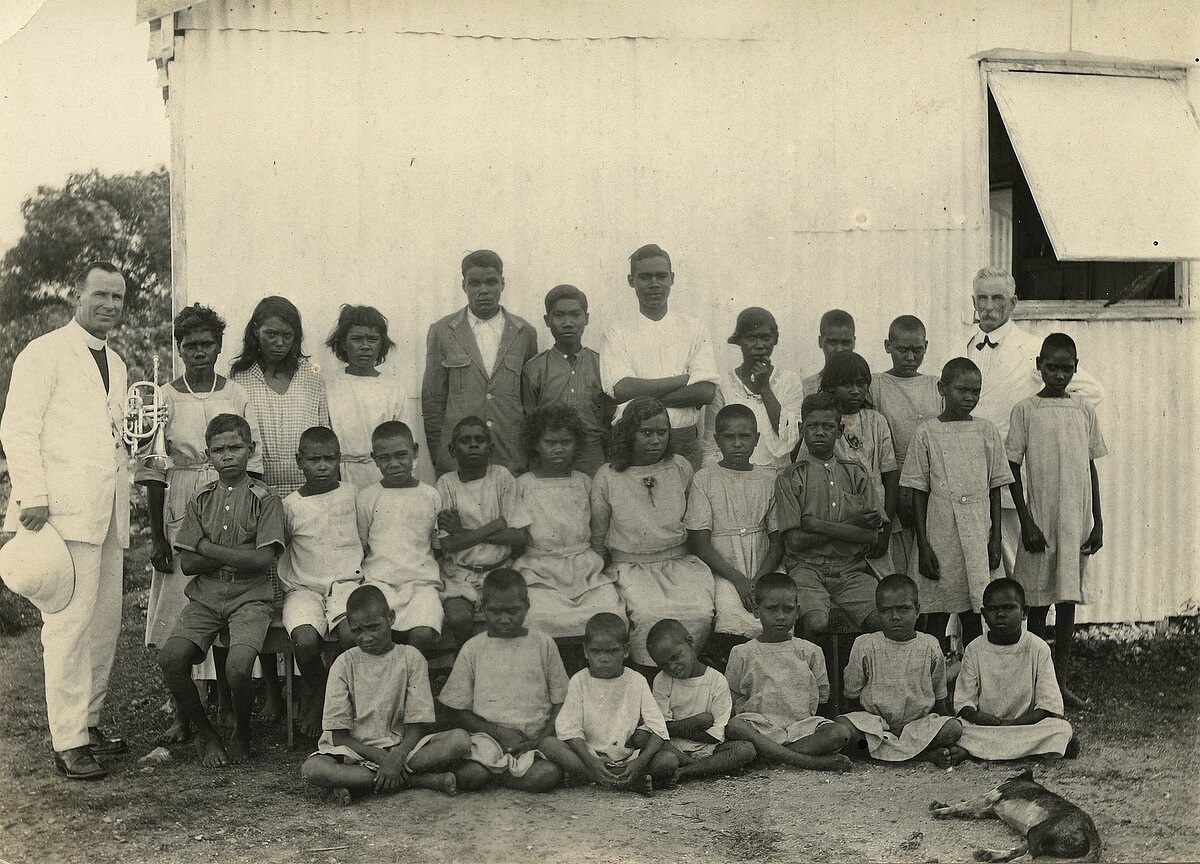
Stolen Generation children at the Kahlin Compound in Darwin, Northern Territory, Australia in 1921
The Stolen Generation laws were passed on the premise that Aboriginals were a doomed race and saving children was a human thing to do. The goal was was to weed, and breed out Aboriginal genes, leaving the full-blood elders to die off peacefully, thus eliminating the Aboriginal race altogether. This was thought to be the ‘kindest’ stratagem for dealing with ‘the problem’.[Source: Ilsa Sharp, “CultureShock! A Survival Guide to Customs and Etiquette: Australia”, Marshall Cavendish, 2009]
The program was originally conceived to help children in remote areas of Australia by planners who though Aboriginals were going to die out as rate in less that 75 years from disease and a low birthrate.
Government officials believed that Aboriginals, particularly lighter skinned ones, could be assimilated into white society. Andrew Markus, a history professor at Monash University in Melbourne told the Washington Post, "The idea at the time was that full-blooded Aboriginal people would die out, while children of mixed descent could be saved. They thought removing the kids from families was doing them a favor."
Background and Laws Behind the Stolen Generation Program
Robert Manne wrote in the Washington Post: Around the turn of the 20th century, the so-called "chief protectors" of Aboriginals in Western Australia, Queensland and South Australia — the three colonies where traditional Aboriginal communities still existed — were each struck by an identical thought. As a result of the frequency of sexual relations between Aboriginal women and European men, a discomfiting new racial type had emerged at the frontier. The protectors believed that it was of the greatest importance that the "problem" of the half-castes be "solved." [Source: Robert Manne, Washington Post, February 2, 2003]
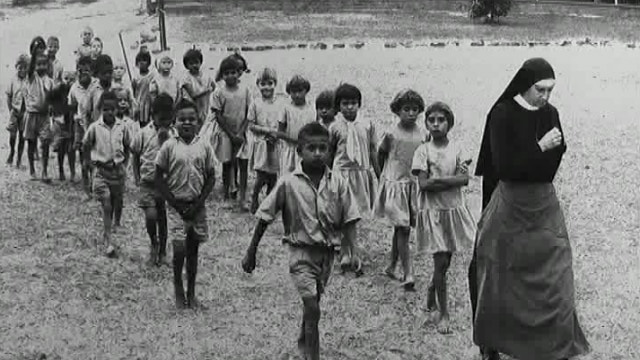
A nun leading children to march at the New Norcia Mission in Western Australia
In 1899, the chief protector in Western Australia, Henry Prinsep, wrote the following typical report: "The intercourse between the races is leading to a considerable increase of half-castes. Each half-caste is a menace to the future moral safety of the community." Prinsep's aim was to remove such children from the Aboriginals' bush camps. Standing in his way was the fact that the law gave him no power to remove Aboriginal children without parental consent.
In 1905, the law was changed in Western Australia to allow for the removal of half-caste children. Other states soon followed suit. The transfer of such children to Christian missions or state institutions now began in earnest. In Western Australia the most enthusiastic enforcer of the policy was James Isdell, that state's traveling protector for the north. In November 1908, Isdell wrote to the chief protector, "I consider it a great scandal to allow any of these half-caste girls to remain with the natives." In January 1909, Isdell was issued the authority to "collect all half-caste boys and girls." He expressed his gratitude: "It should have been done years ago."
Isdell was aware that sentimentalists from the south sometimes wrote letters to newspapers "detailing the cruelty and harrowing grief of the mothers." This seemed to him nonsense. He did not believe that the Aboriginal mother felt the forcible removal of her child any more deeply than did a bitch the loss of a pup. "I would not hesitate," he wrote, "to separate any half-caste from its aboriginal mother, no matter how frantic momentary grief might be. They soon forget their offspring."
A.O. Neville and Stolen Generations Policy and Philosophy
Robert Manne wrote in the Washington Post: In 1915, A.O. Neville, a young, English-born public servant, was appointed chief protector in Western Australia. He was to become one of the most influential administrators of Aboriginals in Australian history. Neville, played by Kenneth Branagh, is the main non-indigenous character in "Rabbit-Proof Fence." [Source: Robert Manne, Washington Post, February 2, 2003]
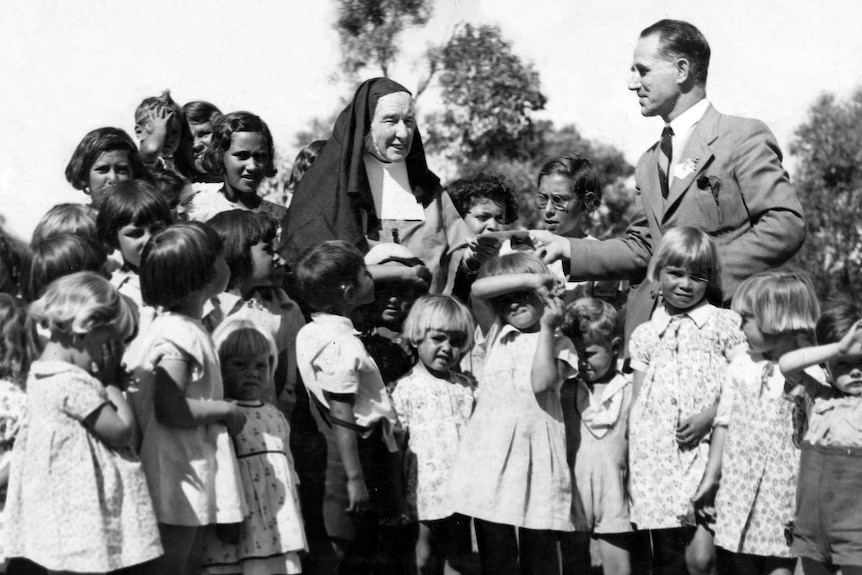
Sister Kate's first mission in Perth was established in Mosman Park in 1933; this was the mission in the film "Rabbit Proof Fence"
The Western Australian archives reveal much about Neville's half-caste policy. Under this system the preferred minimum age for removal was 6, especially in the case of girls. Removals occurred without any reference to the courts; the selection criteria were solely age and racial caste, never parental neglect. Neville was aware that his policy occasioned great suffering among Aboriginal mothers. In 1919, he warned the commissioner of police that it was unwise to notify a local station "beforehand of the date upon which the children are to be taken away, as this would undoubtedly lead to the mother hiding the youngsters."
Of all the racial anxieties concerning Aboriginals of mixed descent none went deeper in the interwar period than the alarm Europeans felt when they encountered a "near-white" child — the offspring of a half-caste mother and a European father — living among the blacks. In one scene in "Rabbit-Proof Fence," Neville inspects the skins of the compound children. His purpose is to select lighter children for transference to a "quarter-caste" institution. Was it true that in the early 1930s an Australian government official might be involved in choosing children for placement in a special-purpose home exclusively on the basis of the color of their skin? [Source: Robert Manne, Washington Post, February 2, 2003]
This takes us to the heart of Neville's philosophy — his determination, as he explained to a startled Perth journalist in 1933, to turn blacks into whites within three or four generations. Neville's racial strategy can be explained briefly like this: Around 1930 most Australians were convinced that tribal Aboriginals were certain, eventually, to die out. But they were also becoming aware that throughout Australia the number of half-castes was rapidly increasing. If these half-castes continued to mate freely with "full-bloods" or their own kind and to form half-caste communities, an incalculable menace to social stability and to the dream of White Australia would arise.
What was to be done? Very occasionally, the sterilization of half-castes was suggested. Far more commonly, however, a program of encouraged miscegenation — between half-caste or quarter-caste females and European males — was proposed, as the only practical solution to the "problem." Neville was one of the most influential advocates of this policy.
The implication is clear. If it was believed that tribal or full-blood Aboriginals would not survive, then a scientific program for the racial extinction of the half-castes represented a policy for the elimination of the Australian Aborigine. This Neville understood. In April 1937, at the first-ever national conference of Aboriginal administrators, he posed the following question: "Are we going to have a population of one million blacks in the Commonwealth, or are we going to merge them into our white community and eventually forget that there were any Aboriginals in Australia?" At this conference, Neville's absorption policy was accepted as a national goal, although after 1945 it was called assimilation and lost its overtly eugenic dimension.
Personal Accounts of the Stolen Generation
Many of the children in the Stolen Generations were mixed Aboriginals with white fathers or grandfathers. Since dark-skinned children were regarded as full-blooded Aboriginals and not targeted by the Stolen Generations laws, many Aboriginal mothers darkened the skin of their children with rubbed charcoal to make them look like full-blooded Aboriginals even when they were full-blooded Aboriginals. Many Aboriginals were not documented by their state and local governments and sometimes children wee taken away simply by they looked — particularly of they Aboriginal features and light skin.
"I was living in nature and with my relatives, really happy," one Aboriginal man from the Cape York Peninsula in northwest Queensland told National Geographic. "When I was six, my mother was captured, raped, chained up, and they shipped us away to Hope Vale. I remember my mom on the jetty. Crying over footprints in the sand. The only trace left of her children."
Many of the children never saw their mothers again. When one Aboriginal who talked with Newsweek was finally able to make contact with her family, her mother was dead. "I will never meet her; I will never know her. I will never speak my mother's tongue," she said. "I lived 32 years of my life not knowing who I was, where I came from and which racial group I belonged to. I need my acknowledged family, or I will never heal."
Aboriginal singer-songwriter Archie Roach told Rolling Stone that he sang a song about his experience called "Took the Children Away" at a concert and "people started coming up to me saying 'Yeah, I was taken away.' I talked to every Aboriginal person in that room that was my age or older and — I kid you not — nearly every one had been taken away when they were children. It was overwhelming." [David Frick, Australia's Other Stars, Rolling Stone, October 1, 1992].
Terry Olsen was taken from his aunt and grandmother in 1973 on a routine visit to a clinic to an immunization injection and taken to a white family a thousand miles away. One man from Tasmania who was taken to Queensland told ABC rabio: "I'm part of the Stolen Generation — 15 kids mum had, I was the only one in the family taken away from Tasmania."
Reports on the Stolen Generation
Ilsa Sharp wrote in “CultureShock! Australia”: The story of these dispossessed children is told movingly by a mixed-blood Aboriginal psychologist-writer-artist, Sally Morgan, in her book “My Place”. A similar understanding of the Aboriginal experience is presented in “Dingo, The Story of our Mob” by Sally Dingo, a white Australian married to entertainer Ernie Dingo, a role model for young Aboriginals. [Source: Ilsa Sharp, “CultureShock! A Survival Guide to Customs and Etiquette: Australia”, Marshall Cavendish, 2009]
The full story is told in agonising detail through the official report “Bringing Them Home: The Stolen Children Report’ resulting from the 1995 National Inquiry into the Separation of Aboriginal and Torres Straits Islander Children From Their Families. In 1991 a special Memorandum of Understanding was signed to allow Aboriginals from ‘the stolen generation’ special access to Australia’s official archives and records of policies resulting in the separation of families, so that they could research their own genealogy more effectively. But most have remained ‘lost’.
The story of the Stolen Generation however should not be seen as pure black and white, as it were. Influential Aboriginal commentator and columnist Noel Pearson has pointed to greater complexity in his writing in The Australian in 2008: Indeed, many have commented on how some of the most successful and articulate Aboriginal leaders are mixed-blood and in fact do come from a background where they were taken from their families and brought up and educated by Christian missions or white foster parents. But this has to be weighed against the deep losses of cultural identity and parental love.
Rabbit Proof Fence — Film About The Stolen Generations
"Rabbit-Proof Fence" is a film about the Australia’s Stolen Generations set in the 1930s and based on Doris Pilkington’s book "Follow the Rabbit-Proof Fence". According to the Washington Post: Many critics, while praising the film, have wondered whether it portrays Australia's past Aboriginal policies accurately. The movie triggered the same question, and far more discord, when it was released in Australia in 2002. [Source: Robert Manne, Washington Post, February 2, 2003]
Robert Manne wrote in the Washington Post:"Rabbit-Proof Fence" tells the purportedly true story of three "half-caste" girls from an Aboriginal settlement in the north of Western Australia who, in accordance with state policy at the time, were seized from their families by police in 1931 and transported to a government compound far to the south. The girls escaped, evaded a hunting party and, in a remarkable feat of ingenuity and endurance, walked 1,000 miles home through the desert. Guiding them was the north-south fence that had been built to keep rabbits out of pastoral lands to the west.
"Rabbit-Proof Fence" is an absorbing drama, as might be expected of a film by Phillip Noyce, a director who is as well-known in Hollywood as he is in his native Australia. In general, it is a faithful account of a real incident, based on public records and on a memoir written by the oldest girl's daughter. But it is also much more than that. In showing that the girls were seized from loving mothers, who suffered overwhelming grief, and that the architect of the removal policy was a man driven by the vision of a society cleansed of so-called half-castes, the film offers a clear and controversial interpretation of Aboriginal child removal policies in 20th-century Australia.
When "Rabbit-Proof Fence" was released in Australia and the story became part of popular culture, this debate deepened. Now the film has reached an international audience, which may not previously have thought of Australia as a country confronted by internal issues of race. It is self-evidently important for audiences to know whether the story it tells is representative and whether the historical interpretation it offers is, broadly speaking, true.
True Story Behind Rabbit Proof Fence
Robert Manne wrote in the Washington Post: The institution to which the three girls in "Rabbit-Proof Fence" were sent was the Moore River Native Settlement, established 80 miles north of Perth in 1916 and operated by the government. In part it served as an Aboriginal dumping ground. In a separate compound, fenced off from the camp, it also served as a place where half-caste children were prepared for work in European society, as manual laborers if they were boys and as cheap domestic servants if they were girls. Not surprisingly, escapes from the compound were common, although successful escapes, of the kind shown in the film, appear to have been rare. [Source: Robert Manne, Washington Post, February 2, 2003]
"Rabbit-Proof Fence" is far from being propaganda. Rather, this simple story of the seizure and escape of three young half-caste girls is a sober, historically accurate account of the racial fantasies and phobias, as well as the frankly genocidal thoughts, that masqueraded as policies promoting Aboriginal "welfare" in Australia's interwar years.
The facts are these: In 1932, Sister Kate Clutterbuck of Perth wrote to Neville offering to establish a home for orphaned or abandoned Aboriginal children. Neville convinced her to establish instead a home for so-called quarter-castes. In 1933, such children began entering Sister Kate's. All connections between them and their families were severed. The children received a standard education and training in "civilized" manners. But that wasn't all.
At Sister Kate's the aim was to exorcise from those children all trace of Aboriginality. In a trivial sense the selection scene in "Rabbit-Proof Fence" is slightly inaccurate. These three girls escaped from Moore River two years before recruiting for Sister Kate's began. In a non-trivial sense, however, the skin-color selection scene is real. In another scene in the film, Neville lectures a small audience of middle-class ladies on his plans for "breeding out the color" of the "half-castes."
Timeline of Stolen Generation Investigations and Apologies
1980s — According to Reuters: Academic Peter Read researches the history of forced separation policies dating back to the mid-1800s, and names those affected as the “Stolen Generations”. [Source: Reuters, February 13, 2008]
1995 — The “Bringing Them Home” national inquiry is set up into the separation of aboriginal children from their families. The report, tabled in the Australian parliament in 1997, found: 1) Between one in three and one in 10 indigenous children were forcibly removed from their families and communities between 1910 and 1970. 2) The children were at risk of physical and sexual abuse in institutions, church missions and foster homes. 3) The policies amounted to genocide under international law, and the laws were racially discriminatory. 4) It recommended a national apology, compensation for the Stolen Generations, and guarantees the policies would not be repeated.
Late 1990s — The state parliaments of New South Wales, Victoria, South Australia, Western Australia and Tasmania, as well as the Australian Capital Territory, apologize to the Stolen Generations in 1997. Queensland’s parliament apologized in 1999, and the Northern Territory parliament in 2001.
2000 — More than 250,000 people march across Sydney Harbour Bridge to support an apology. Tens of thousands of people attend similar marches across Australia. Conservative Prime Minister John Howard does not march. In 1999 he lead a parliamentary motion of “regret” for unspecified past injustices against Aboriginals, but refuses to apologize. He said an apology could leave the government liable for compensation claims, and current generations should not be responsible for past actions.
Late 2000s On February 13, 2008, the Australian Parliament apologizes for historic mistreatment of Aboriginals. The apology was delivered by Prime Minister Kevin Rudd, and is also referred to as the National Apology, or simply The Apology. In August 2007, a court made a landmark damages award of US$450,000 to Aborigine Bruce Trevorrow. He was taken from his mother without her consent when he was 13 months old and did not see her for a decade. In 2006, Tasmanian government set up million US$4.5 million fund to compensate Tasmanian Aboriginals who were removed from their families. In June, 2007, the conservative government sent police and troops to the Northern Territory to curb alcohol-related violence and sex abuse in Aboriginal communities, prompting indigenous fears that children could be taken away.
March 2022 — the government of the state of Victoria announced that Aboriginal Victorians from the Stolen Generations would receive A$100,000 as part of $A155 million reparations package. ABC reported that Aboriginal Victorians removed from their families in the state before 1977 were eligible to access the payments. Other states have also set up redress schemes. As of 2022, Western Australia and Queensland were the only jurisdictions which had not announced reparation schemes for the Stolen Generations. [Source: Richard Willingham, ABC, March 3, 2022]
Image Sources: Wikimedia Commons
Text Sources: “Encyclopedia of World Cultures, Volume 2: Oceania,” edited by Terence E. Hays, 1996, National Geographic, Live Science, Natural History magazine, Australian Museum, Australia Geographic, New York Times, Washington Post, Los Angeles Times, Smithsonian magazine, Encyclopedia.com, Times of London, Library of Congress, The Conversation, The New Yorker, Time, BBC, CNN, Reuters, Associated Press, AFP, Lonely Planet Guides, Culture Shock! Australia, Wikipedia, The Guardian and various websites, books and other publications.
Last updated September 2025