
DREAMING AND SONGLINES
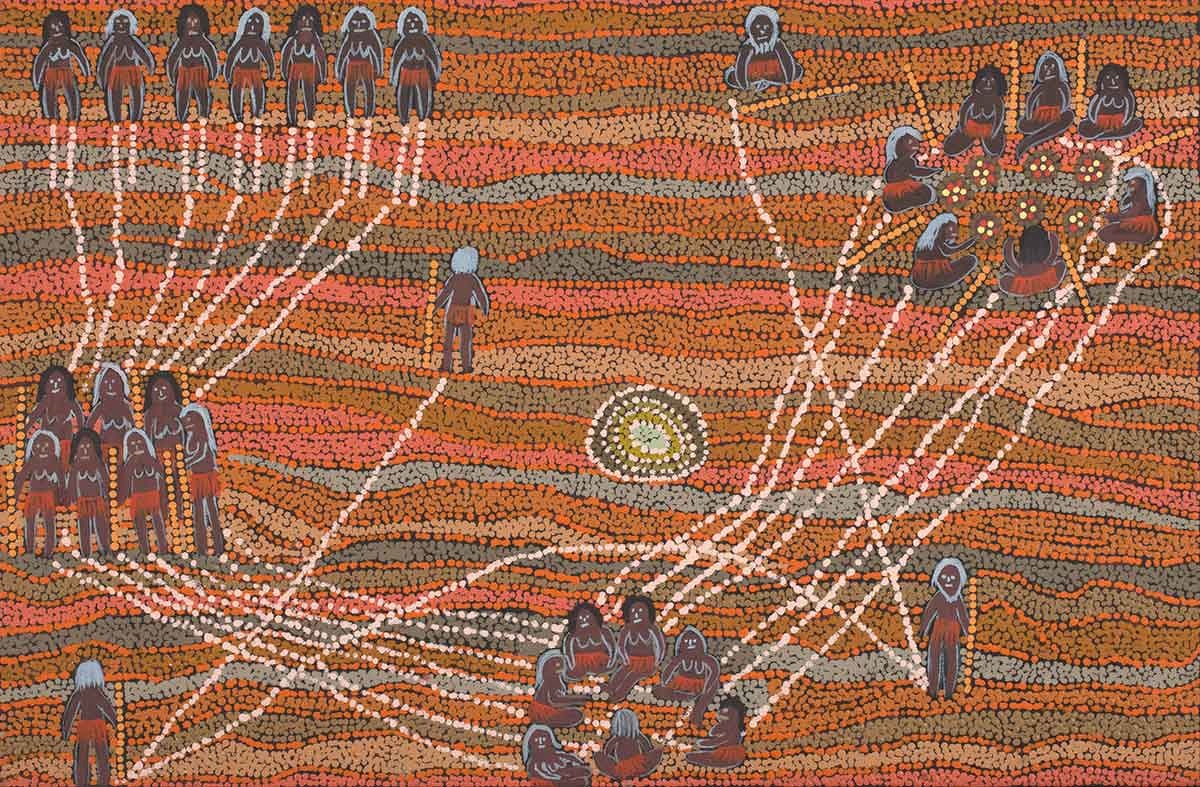
Songlines Tracking the Seven Sisters, from the National Museum of Australia
The essence of Aboriginal religion is something called Dreaming, which has been described as metaphysical or spiritual parallel time and space universe that is linked to our own universe. Dreaming in the natural universe can take many forms: a person, an animal, a place, a community or natural phenomena such as rain or wind. Dreamtime refers to the beginning of life and its continuation into the future. It refers to the creation of the landscape, people and laws by totemic ancestral beings. Each individual has their own Dreamtime and their own links to the ancestral beings.
Based on a study of the "Rainbow Serpent," a series of 107 rock paintings that are 6,000 years old, Aboriginal culture has been described as the world's oldest religion. The Rainbow Serpent is at the center of the Aboriginal Creation Myth. In Dreamtime at the beginning of the earth it arrived on featureless earth and created rivers and bays.
In the unforgiving landscapes of central Australia, native peoples navigated in part by cultivating an oral tradition full of toponyms, each one containing detailed geographic information. Some aborigines describe their totems and Dream Places and divide up their land according to Songlines. Songlines are the lines that connect dreaming places. They are regarded as a trail of words and musical tones left behind by dreamtime ancestors. They are both a map and source of direction. [Source: Kathryn Schulz, The New Yorker, March 29, 2021]
Describing what they are Bruce Chatwin wrote in “Songlines”, "Regardless of the words, it seems the melodic contour of the song describes the nature of the land over which the song passes. One phase would say, 'Salt-pan,'; another 'Creek-bed', 'Spinfex', 'Sandhill', 'Mulga-scrub', 'Rockface' and so forth. An expert song man, by listening to their order of succession, would count how many times his hero crossed a river, or scaled a ridge—and be able to calculate where, and how far along, a Songline he was."
"If the Lizard Man were dragging his heels across the salt-pan of Lake Eyre, you would expect a succession of long flats, like Chopin;s “Funeral march”. If he were skipping up and down the MacDonnell escarpments, you'd have a series of arpeggios and glissandos, like Liszt's “Hungarian Rhapsodies”."
"Certain phrases, certain combinations of musical notes, are thought to describe the action of the Ancestor's “feet”... An expert songman, by listening to their order of succession, would count how many times his hero crossed a river, or scaled a ridge—and be able too calculate where, and how far along, a Songline he was."
Related Articles:
AUSTRALIAN ABORIGINAL RELIGION: TRADITIONAL BELIEFS, DEMOGRAPHY AND DEATH ioa.factsanddetails.com
VERY, VERY OLD AUSTRALIAN AND ABORIGINAL ROCK ART ioa.factsanddetails.com ;
ANCIENT ABORIGINAL ART OF NORTHERN AUSTRALIA ioa.factsanddetails.com
LIFE OF EARLIEST HUMANS IN AUSTRALIA: TOOLS, WEAPONS, ART, SETTLEMENTS ioa.factsanddetails.com
PEOPLE WHO LIVED AUSTRALIA 20,000 TO 10,000 YEARS AGO ioa.factsanddetails.com ;
EARLY ABORIGINALS ioa.factsanddetails.com ;
EARLY MODERN HUMANS IN AUSTRALIA factsanddetails.com ;
LIFE OF EARLIEST HUMANS IN AUSTRALIA: TOOLS, WEAPONS, ART, SETTLEMENTS ioa.factsanddetails.com
PEOPLE WHO LIVED AUSTRALIA 20,000 TO 10,000 YEARS AGO ioa.factsanddetails.com ;
DID HUMANS REALLY MIGRATE TO AUSTRALIA 65,000 YEARS AGO ioa.factsanddetails.com
HOW THE FIRST PEOPLE GOT TO AUSTRALIA 50,000 (MAYBE 65,000) YEARS AGO ioa.factsanddetails.com
AUSTRALIAN ABORIGINAL CUSTOMS, SOCIETY AND RITUALS ioa.factsanddetails.com
ABORIGINAL LIFE: WHERE THEY LIVE, WORK, DIET, HEALTH, ALCOHOL ioa.factsanddetails.com
TRADITIONAL ABORIGINAL LIFE: FOOD, HOMES, HUNTING ioa.factsanddetails.com
Rituals at Cloggs Cave Passed down 12,000 Years
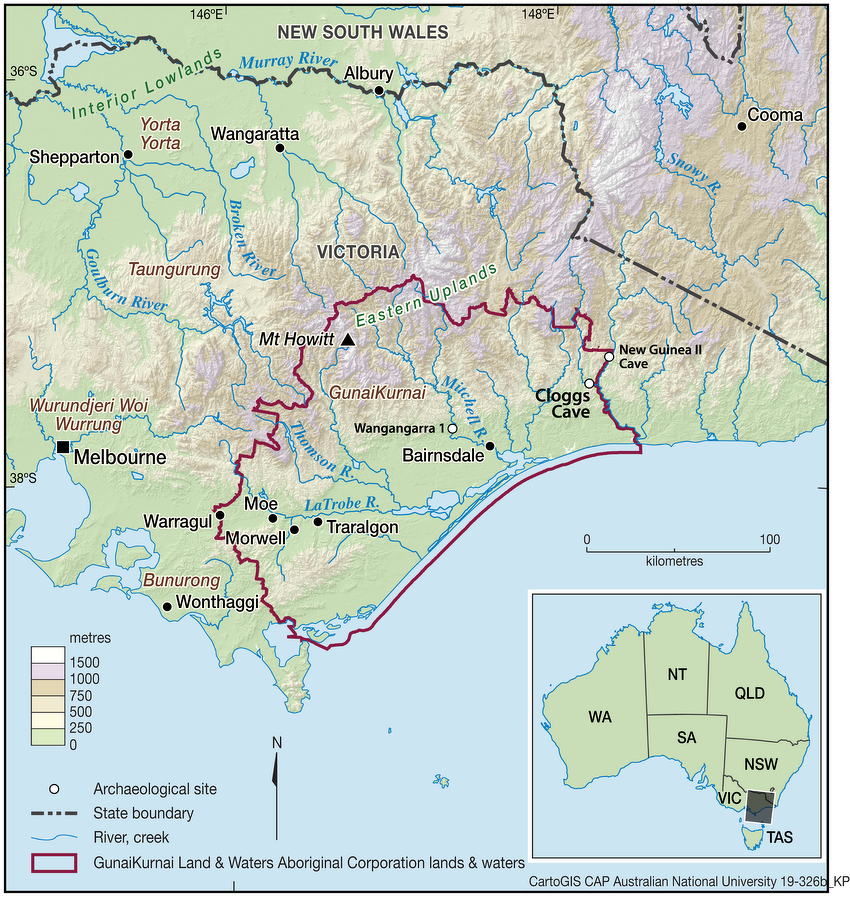
Cloggs Cave location
Unremarkable-looking charred sticks found in Cloggs Cave near the coast in southern Victoria are evidence that the GunaiKurnai people passed cultural traditions down for 500 generations — the world’s longest known continuously practiced ritual. According to Archaeology magazine: . The sticks, which were made from the casuarina tree, are the oldest wooden artifacts ever discovered in Australia. They were smeared with fat and used by mulla-mullung, or medicine men and women, 12,000 years ago to cast spells and cure the sick. During such rituals, a stick was inserted into the ground at an angle and mulla-mullung sang incantations until it fell over, a practice that was still being carried out into the 19th century. [Source: Archaeology magazine, September-October 2024]
CNN reported: While investigating Cloggs Cave, situated near Buchan – a small Australian town about 350 kilometers (217 miles) east of Melbourne – researchers found a piece of wood protruding out of the ground. They cut it, and used carbon dating to determine it’s 12,000 years old, from towards the end of the last Ice Age. “And we were going ‘Wow, what’s this?’ Bruno David, a professor at the Monash Indigenous Studies Centre in Australia who co-authored the paper, said in a recorded conversation shared with CNN. “12,000-year-old artifacts don’t survive in the ground for that long. Normally they just disintegrate.” They also uncovered another wooden stick which, though 1,000 years younger, was remarkably similar. Both sticks were smeared with animal or human fat, found next to miniature fireplaces, and both had been “fleetingly burnt,” according to a Nature Human Behaviour article published in July 2024. [Source: Issy Ronald, CNN, July 4, 2024]
Excavations were first carried out in the cave in the 1970s, and archaeologists were convinced that it was inhabited intermittently by Aboriginal hunters beginning some 23,000 years ago. But the interpretation of the cave as an occasional campsite never sat well with the local GunaiKurnai people, who believe their ancestors used it as a sacred retreat for rituals practiced by medicine men and women known as mulla-mullung, not simply as a dwelling. In recent years, GunaiKurnai Elders requested that archaeologists return to Cloggs Cave and collaborate with them to conduct new excavations informed by their traditional knowledge. A team led by GunaiKurnai Elder Russell Mullett and archaeologist Bruno David of Monash University discovered two miniature fireplaces deep in the cave that each held lightly burned, trimmed sticks covered with animal fat—evidence of a ritual practice dating back at least 12,000 years. [Source: Eric A. Powell Archaeology magazine, January-February 2025]
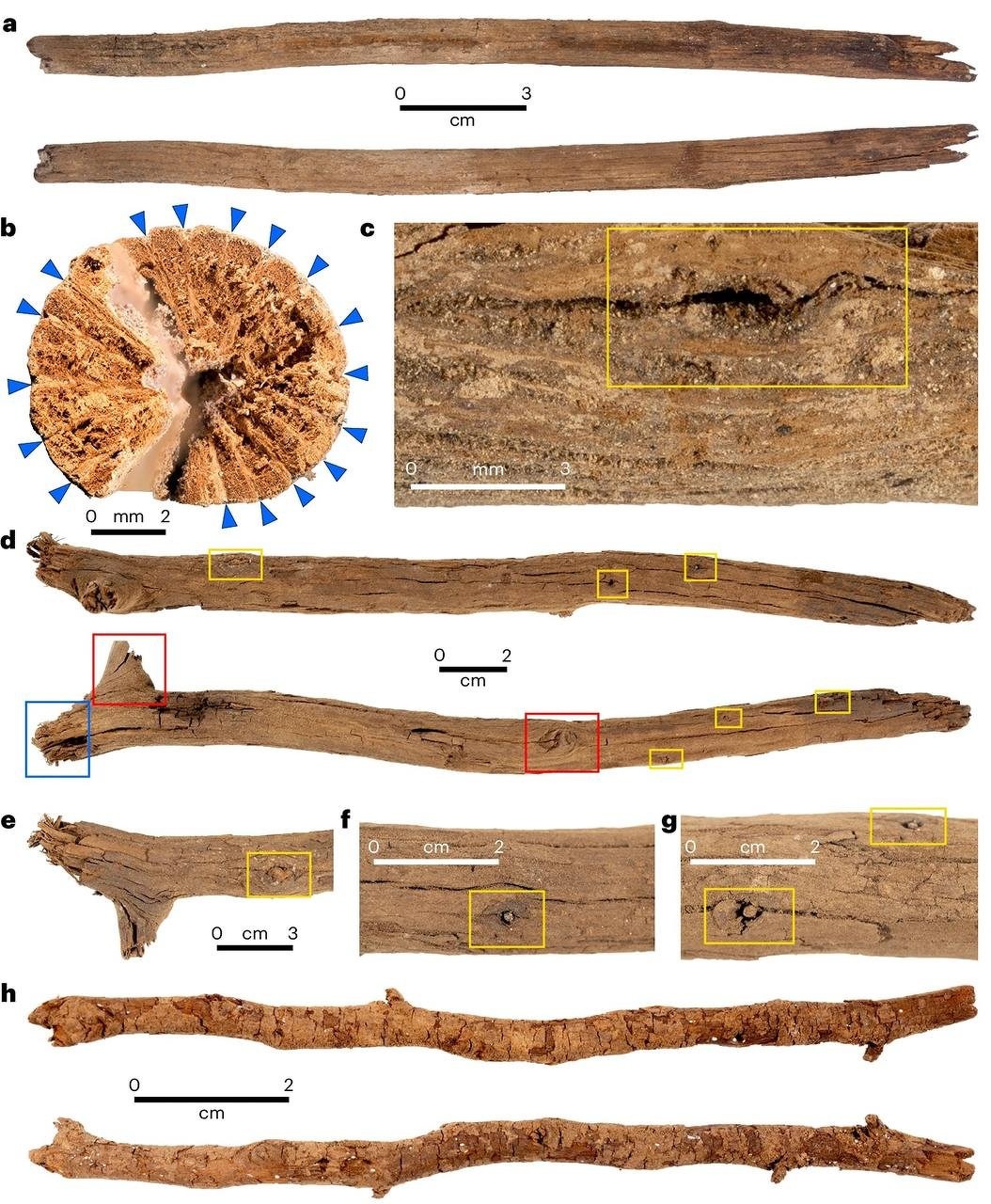
Ritual sticks found in Cloggs Cave that date to 10,000 to 12,000 years ago, from: David et al, Nature Human Behaviour (2024)
Nineteenth-century accounts note that, in order to cure—or curse—someone, a GunaiKurnai mulla-mullung would insert a stick smeared with kangaroo fat at an angle into a small fireplace. They would then sing the target’s name for as long as it took the stick to fall on its side, at which point the spell would take effect. Radiocarbon dating of the sticks and charcoal from the two miniature hearths in Cloggs Cave showed that one fireplace was used around 12,000 years ago and the other some 10,000 years ago. The arrangement of both the hearths and sticks perfectly matches ethnographic descriptions of the GunaiKurnai ritual, suggesting that mulla-mullung passed down knowledge of the rite over some 500 generations, making it the only Ice Age ritual known to have survived unchanged into the modern era.
CNN reported: Howitt detailed the rituals carried out in Cloggs Cave by powerful GunaiKurnai people whom he dubbed “sorcerers,” “wizards,” or “medicine men and women,” but who are known as “mulla-mullung” among the GunaiKurnai people. Their rituals would seek to harm adversaries or heal the sick by finding something belonging to the subject, attaching it to a throwing stick along with human or animal fat. The stick was “then stuck slanting in the ground before a fire, and it is of course placed in such a position that by-and-by it falls down,” Howitt wrote in the 1880s. GunaiKurnai Elder Uncle Russell Mullett said in a recorded conversation shared with CNN that the discovery could easily have been missed in the cave, but he credited “the spirits that still live” in the area for helping researchers unearth it. [Source: Issy Ronald, CNN, July 4, 2024]
Modern Aboriginal Stories Describe Australia 10,000 Years Ago
Aboriginal groups across Australia have stories about describe walking to places that are now islands. Maris Fessenden wrote in Smithsonian magazine: “Three islands lie just off the coast near Perth, Australia. All are popular tourist destinations: Rottnest Island is famous for its population of quokkas, a small marsupial. The tiny Carnac Island has sea lions and deadly tiger snakes. Slender Garden Island is home to a naval base. All three of these islands were originally inhabited by Aboriginal people, though. And, according to Climate Central, an early European settler described some stories told by the Aboriginal people of a time when the islands "once formed part of the mainland, and that the intervening ground was thickly covered with trees." But in one story, those trees caught fire and burned "with such intensity that the ground split asunder with a great noise, and the sea rushed in between, cutting off these islands from the mainland." [Source: Maris Fessenden, Smithsonian magazine, January 26, 2015]
It may seem like a just a story, but researchers recently matched this and other Aboriginal stories to real events. The sea did rush in — at the end of the last glacial period — about 7,500 to 8,900 years ago. Another community tells of a time when northeastern Australia’s shoreline reached all the way out to the Great Barrier Reef. They recall a river that flowed into the sea at what is now Fitzroy Island. For Climate Central, John Upton writes, "The great gulf between today’s shoreline and the reef suggests that the stories tell of a time when seas were more than 200 feet lower than they are today, placing the story’s roots at as many as 12,600 years ago."
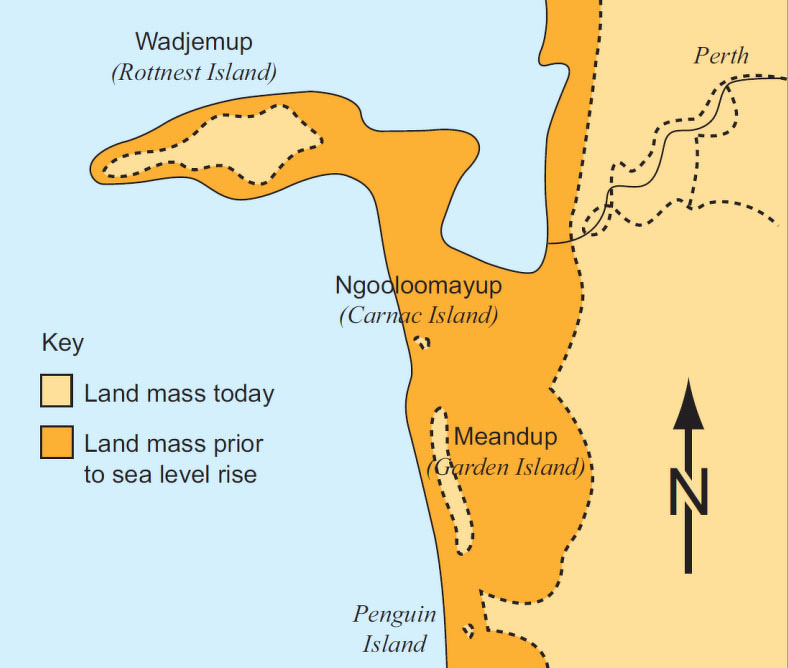
When Rottnest Island and other islands were connected to mainland Australia during an Ice Ager period approximately 10 000 years ago
“It’s quite gobsmacking to think that a story could be told for 10,000 years,” Nicholas Reid, a linguist specializing in Aboriginal Australian languages at Australia’s University of New England, told Upton. “It’s almost unimaginable that people would transmit stories about things like islands that are currently underwater accurately across 400 generations.”
The story did last because the telling of it was kept alive by rich tradition. Without a written language, Australian tribes relied on oral storytelling to keep their identity — it is part of the collection of knowledge, practices and faith referred to as The Dreaming. The stories are more than oral tellings. They include paintings on rock or bark, drawings in sand, ceremonies, song and dance. “There are aspects of storytelling in Australia that involved kin-based responsibilities to tell the stories accurately,” Reid said. That rigor provided “cross-generational scaffolding” that “can keep a story true.”
Reid worked with a geography professor at the University of the Sunshine Coast, Patrick Nunn, to match the stories with the land and how it has changed. A preliminary draft of their work, presented at an indigenous language conference in Japan, makes the case for 18 Aboriginal stories describing the coastal flooding of the end of the last ice age. The paper also argues that researchers who are building a picture of our world and its changes should look to old stories. "[E]ndangered Indigenous languages can be respositories for factual knowledge across time depths far greater than previously imagined, forcing a rethink of the ways in which such traditions have been dismissed," Nunn writes.
Finger Grooves from Ancient Peoples Found in Australian Cave
Research published in the journal Australian Archaeology in August 2025 described handprints made thousands of years ago by adults and children on soft rock surfaces deep in this cave in GunaiKurnai Country in southeastern Victoria, Australia, in the Gippsland region. The Conversation reported: In a limestone cave in the foothills of the Victorian Alps, a team of researchers led by the GunaiKurnai Land and Waters Aboriginal Corporation in partnership with Monash University and international archaeologists from Spain, France and New Zealand studied finger impressions dragged into the walls and ceilings. [Source: Madeleine Kelly, Bruno David, Russell Mullett, The Conversation, August 11, 2025]
The cave, referred to by GunaiKurnai Elders as Waribruk, contains a pitch-black chamber beyond the reach of natural light. To enter and mark these walls, the ancestors would have needed artificial light: firesticks or small fires. The cave's deeper interior walls became soft over millions of years as underground waters penetrated the limestone, slowly weathering and dissolving the rock into cavernous tunnels. The remaining wall surfaces and ceilings became spongy and malleable, much like the texture of playdough. Over time, cave-dwelling bacteria living on the soft, moist rock produced luminescent microcrystals, so that today, the walls and ceiling glitter when exposed to light. It is on these glittering surfaces that the finger grooves are found. We don't know exactly when they were made, but people would have needed artificial light to reach this part of the cave. They would have either carried firesticks or lit fires on the ground.
Archaeological excavations below and near the panels failed to uncover evidence of fires on the ground, but we did find millimeter-long fragments of charcoal and tiny patches of ash, likely dropped embers from firesticks. These were found buried in the cave floor under and near the decorated walls. They date between 8,400 and 1,800 years ago, about 420 to 90 generations past. This, then, is the best estimate for how long ago the old ancestors moved through the dark tunnels of the cave, firelight in hand, to create the finger impressions on the walls.
What they made when they dragged their fingers along the soft rock surfaces deep in the cave is remarkable, revealing rare evidence of ancestral gestures: fleeting bodily movements captured in soft cave surfaces. On one panel, 96 sets of grooves were recorded. The first marks run horizontally, made by multiple fingers, sometimes both hands side by side. Later, vertical and diagonal grooves were added, intersecting the earlier ones.
Among them are two parallel sets of narrow impressions, only 3 to 5 millimeters [0.1 to 0.2 inches] wide for each finger. They are each set a short distance apart, indicating they were made by a small child. However, they're so high up, the child must have been lifted by an adult. Deeper in the cave, a low ceiling panel bears 262 grooves above a narrow clay bench sloping steeply toward a creek bed. The grooves indicate people moved along the ledge, crawling, sitting, or balancing to reach the ceiling. Farther along, 193 grooves trace a path above the creek bed. Fingers were pressed into the soft ceiling, gradually releasing 1.6 meters [5.3 feet] farther along as the people walked forward. All impressions point the same way, suggesting arms and hands raised overhead, capturing a deliberate, embodied gesture as the ancestors moved deeper into the cave.
Meaning of the Finger Grooves from Ancient Peoples Found in Australian Cave
According to The Conversation: Altogether there are 950 sets of finger grooves deep within Waribruk. Their meaning remained unclear for years, but a close analysis of where the marks appear, and where they don't, offers key insights. The grooves are always located in areas where calcite microcrystals coat the cave walls or ceiling, sometimes just extending past the glitter's edges. They never appear in areas of the cave where the soft walls are without glitter. Crucially, they occur far from any archaeological evidence of domestic life: no hearths, no food remains, no tools. This absence matters. GunaiKurnai oral traditions hold that such caves weren't used for ordinary living. They were only frequented by special individuals, mulla-mullung — medicine men and women who wielded powerful knowledge. [Source: Madeleine Kelly, Bruno David, Russell Mullett, The Conversation, August 11, 2025]
Mulla-mullung healed and cursed through ritual, using crystals and powdered minerals as part of their practice. In the late 1800s, GunaiKurnai knowledge-holders told the pioneering 19th-century ethnographer Alfred Howitt about the powers of these crystals, and of the caves. The role of mulla-mullung, they explained, was usually passed on from parent to child, and when a mulla-mullung lost their crystals, they lost their powers. The finger grooves at Waribruk matches these traditions. They are not casual decorations. They are deliberate gestures, linked to crystal-coated surfaces, made in places only a few could enter. The grooves reflect movement, touch, and sources of power for special individuals in the community: an embodied record of people interacting with the sacred.
What survives is not just ancient "rock art." These are the gestures of ancestors, mulla-mullung it now seems, who ventured into the deepest darkness of the cave to access the power of the glittering surfaces. Through these finger trails, we glimpse not only a physical act, but a cultural practice grounded in knowledge, memory and spirituality. A momentary movement, preserved in stone, connecting us to lives lived long ago — and breathing the cave to life through the actions of the ancestors and culture.
Image Sources: Wikimedia Commons
Text Sources: Australian Museum, National Geographic, New York Times, Washington Post, Los Angeles Times, Smithsonian magazine, Nature, Scientific American. Live Science, Discover magazine, Discovery News, Natural History magazine, Archaeology magazine, The New Yorker, Time, BBC, The Guardian, Reuters, AP, AFP and various books and other publications.
Last updated September 2025