
MAMMALS OF NEW GUINEA
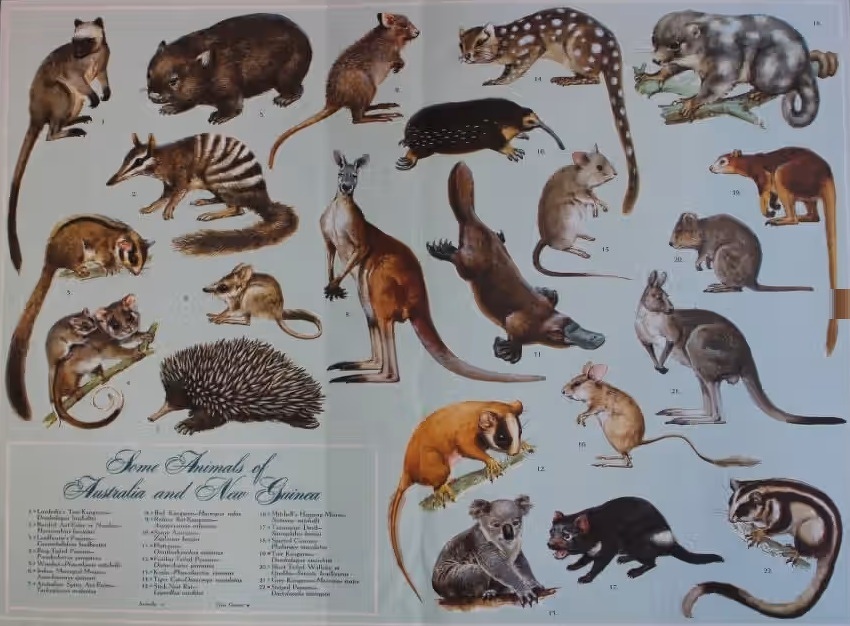
Mammals of Australia and New Guinea
New Guinea — the world’s second largest island, with the country of Papua New Guinea occupying its eastern half and the Indonesian provinces of Papua and West Papua occupying its eastern half — is home to around 276 mammal species.
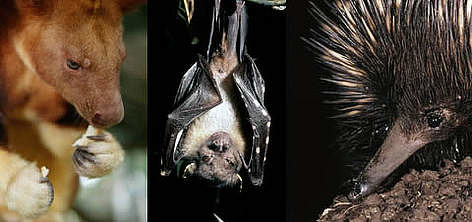
New Guinea is a biodiverse island with many to unique endemic species such as tree kangaroos. The unique long-beaked echidna is a monotreme mammal that lays eggs. Tree kangaroos such as Matschie's tree kangaroo and the Huon tree kangaroos inhabit mountain forests in both Papua New Guinea and Papua and West Papua in Indonesia. Mountain cuscuses and long-fingered triok occupy the in upper canopy of rainforests. Dugongs are found in the coastal waters. New Guinea singing dogs are considered among the world’s world’s oldest dogs and get their name from their "singing" vocalizations.
The wildlife found in New Guinea, Australia and the Aru Islands of Indonesia are similar. This is because a land bridge connected them during the last several ice ages when sea levels were lower and animals could move between them. Australia is well known for its marsupials but Papua New Guinea is also home to over 50 marsupial species. The main difference between the marsupials found in most of Australia and those in New Guinea is that those in Australia are adapted more for deserts and drier conditions while those in New Guinea are adapted more for rainforests and wetter conditions. The animals of rainforests of northeast Australia are most similar to ones in New Guinea.
There are no large mammals and virtually no predators in the interior of New Guinea.There are no elephants, tigers, deer or deer which are found not that far away in Asia. Most of the mammals are small rodents, marsupials and bats. New Guinea is home to a relatively small number of mammals and many of them are bats. This because is the island is only 25 million to 10 million year old and in that time only a few types had time to evolve and diversify. Niches normally filled by monkeys and large mammals have been been filled reptiles, marsupials and birds. There are no large predators. Cassowaries are the largest animals. The largest predators are eagles. Agile wallabies and monkey-like Matschie's tree kangaroo lives in New Guinea.
Endangered Mammals in New Guinea
WWF
There are approximately 60 species mammals in Papua New Guinea listed as threatened or endangered. The International Union for Conservation of Nature and Natural Resources (IUCN) Red List identifies 12 endangered species of mammal, 7 critically endangered species, with 40 listed as vulnerable. Data on animals is not as good for New Guinea as other places because they place is still very wild and undeveloped and figures vary by source and timeframe.
The nations with the most threatened mammals include: 1) Indonesia (128 mammal species); 2) Brazil (71 mammal species); 3) China (75 mammal species); 4) India (75 mammal species); 5) The Philippines (49 mammal species); 6) Peru (46 mammal species); 7) Mexico (64 mammal species); 8) Australia (58 mammal species); 9) Papua New Guinea (57 mammal species); 10) Madagascar (46 mammal species).
Marsupials
Marsupials (Scientific name: Metatheria) are mammals with pouches who bear offspring at an earlier stage of development than other mammals. They are different from eutherians, (placental mammals), the largest mammal group on earth, which includes dogs, whales, lions and humans. Marsupial infants are born earlier and raised in a pouch at a time when they would still be embryos inside the placenta of a mammalian mother. While some marsupial live only one to a few years, some species, such as coarse-haired wombats, have lived up to 26 years in captivity.
New Guinea quoll
The relatively underdeveloped young grow almost exponentially in the mother's pouch. "The young are born alive, but they're very poorly developed," Robin Beck, a lecturer in biology at the University of Salford in the United Kingdom, told Live Science. "They basically crawl to their mother's nipple, which is often in a pouch, and they basically clamp on the nipple and stay there, feeding on their mother's milk for long periods of time — usually, several months." [Source: Laura Geggel, Live Science, March 3, 2019]
Marsupials range in range from a few grams in the long-tailed planigale to several tonnes in the extinct Diprotodon. The word marsupial comes from marsupium, the technical term for the abdominal pouch. It, in turn, is borrowed from the Latin marsupium and ultimately from the ancient Greek mársippos, meaning "pouch". Marsupials constitute a clade stemming from the last common ancestor of extant Metatheria, which encompasses all mammals more closely related to marsupials than to placentals. The evolutionary split between placentals and marsupials occurred 125-160 million years ago, in the Middle Jurassic-Early Cretaceous period. [Source: Wikipedia]
RELATED ARTICLES:
MARSUPIALS IN AUSTRALASIA (AUSTRALIA, NEW GUINEA, NEARBY ISLANDS) ioa.factsanddetails.com
MARSUPIALS: HISTORY, EVOLUTION, CHARACTERISTICS, BEHAVIOR, REPRODUCTION ioa.factsanddetails.com
PADEMELONS: SPECIES CHARACTERISTICS, BEHAVIOR AND REPRODUCTION ioa.factsanddetails.com
Forest Wallabies and Hare Wallabies
Dorcopsis is a genus of marsupial in the family Macropodidae (macropods. kangaroos and wallabies) known as forest wallabies. found on the island of New Guinea. The genus contains the following species: 1) Black dorcopsis (Dorcopsis atrata); 2) White-striped dorcopsis (Dorcopsis hageni); 3) Gray dorcopsis (Dorcopsis luctuosa); and 4) Brown dorcopsis (Dorcopsis muelleri). [Source: Wikipedia]
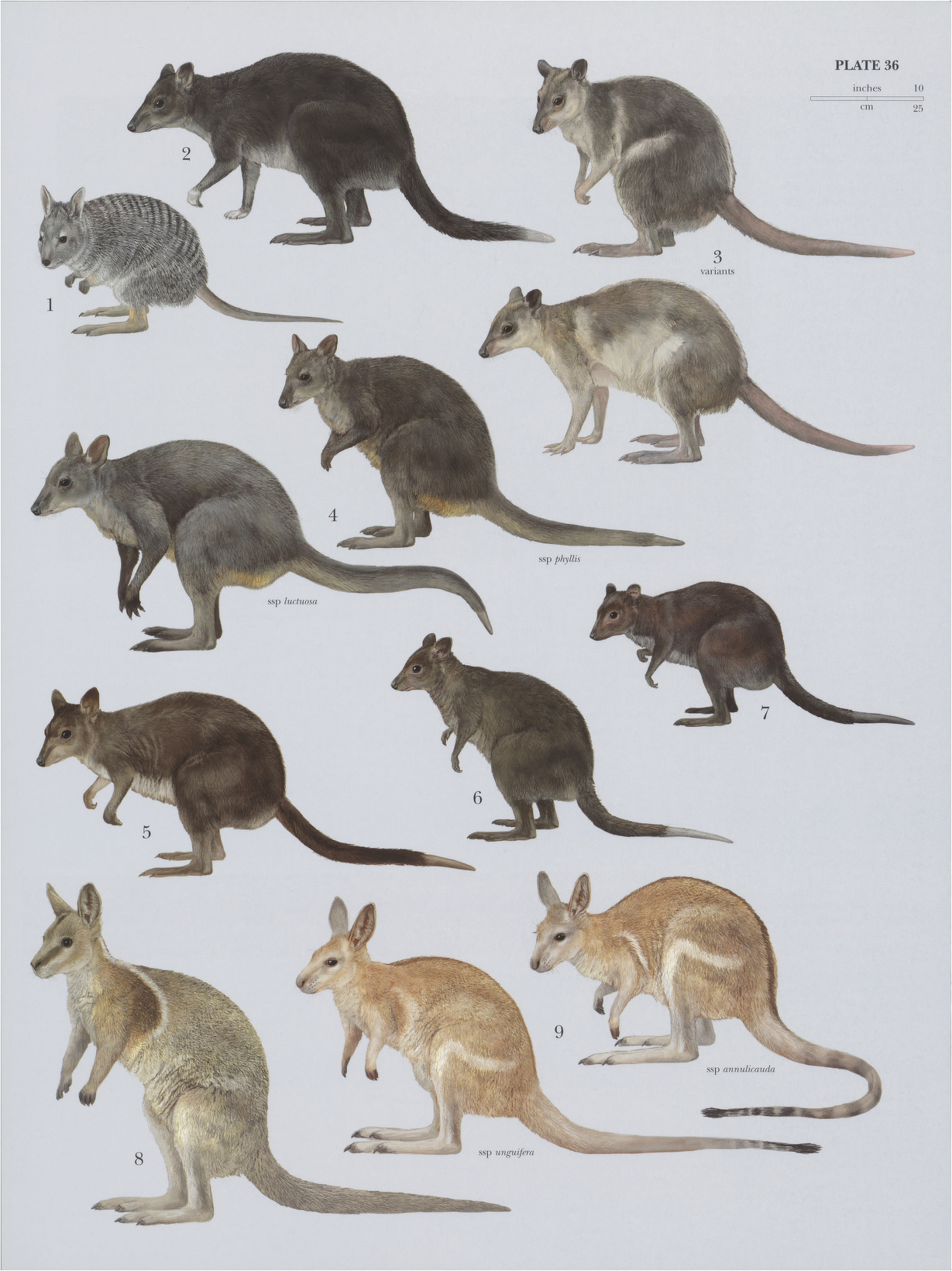
4) Grey Forest Wallaby, 5) Brown Forest Wallaby, 6) Macleay’s Forest Wallaby,7) Small Forest Wallaby
Dorcopsulus is a genus of small marsupials in the family Macropodidae, also known as forest wallabies. They are native to rainforests and montane forests of New Guinea. The genus contains two species: 1) Macleay's dorcopsis (Dorcopsulus macleayi) and Small dorcopsis (Dorcopsulus vanheurni)
The main difference between Dorcopsis and Dorcopsulus lies in their classification within the Macropodidae family and their geographic distribution. Dorcopsis refers to the greater dorcopsises, while Dorcopsulus refers to the lesser dorcopsises. Both genera are found in New Guinea and surrounding islands. Dorcopsulus typically contains smaller species than Dorcopsis. While both genera are found in New Guinea and nearby islands, Dorcopsulus is often associated with more mountainous regions. [Source: Google AI]
Hare-wallabies are small marsupials that resemble hares in appearance and have some movements and habits similar to those of hares. However, like all wallabies, they have larger hind legs than hares, a thinner, hunched body, smaller forelimbs, and a long, thin tail. Lagorchestes is a genus of hare-wallabies. It includes four species native to Australia and New Guinea, two of which are extinct. Hare-wallabies belong to the macropod family (Macropodidae) which includes kangaroos, wallabies, and some other marsupials. The two living species are the spectacled hare-wallaby (Lagorchestes conspicillatus) and Rufous hare-wallaby, (Lagorchestes hirsutus). The name Lagorchestes means “dancing hare.”
RELATED ARTICLES:
FOREST WALLABIES (DORCOPSIS): SPECIES, CHARACTERISTICS, BEHAVIOR AND REPRODUCTION ioa.factsanddetails.com
WALLABIES: TYPES, CHARACTERISTICS, BEHAVIOR, REPRODUCTION ioa.factsanddetails.com
KANGAROOS AND WALLABIES (MACROPODS): CHARACTERISTICS, HISTORY, POPULATIONS ioa.factsanddetails.com
WALLABY SPECIES ioa.factsanddetails.com
HARE-WALLABIES: SPECIES, CHARACTERISTICS, BEHAVIOR AND REPRODUCTION ioa.factsanddetails.com
Tree-Kangaroos
Tree-kangaroos are marsupials of the genus Dendrolagus, adapted for living and getting around in trees. They inhabit tropical rainforests of New Guinea and far northeastern Queensland, Australia along with some of the islands in the region. All tree-kangaroos are considered threatened due to hunting and habitat destruction. They are the only true arboreal macropods (kangaroos and wallabies). Dendrolagus means “tree hare”.
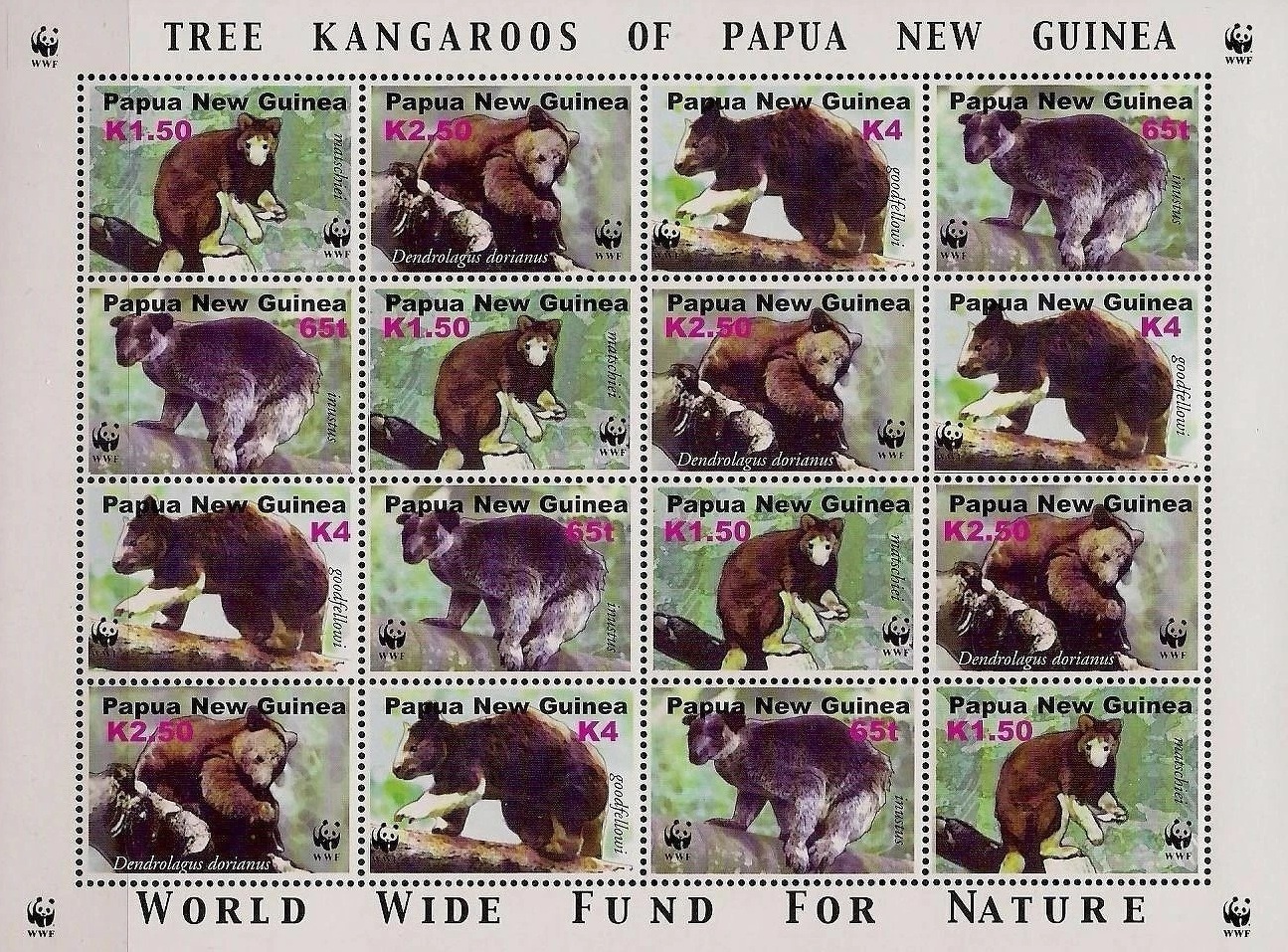
There are 14 known tree-kangaroo species. When early Aboriginals told European hunters about tree-kangaroos, the hunters thought that the Aboriginals were kidding, One explorer wrote in 1872, "to entertain the idea that any kangaroo known to us, or approaching its formation, could climb a tree would be ridiculous: the animals was not formed for such work.”
The Tree-kangaroo’s rainforest habitats are being destroyed or degraded by logging, timber production and coffee, rice and wheat farming. Such habitat loss can make tree-kangaroos more exposed to predators, such as feral and domestic dogs. Tree-kangaroos are hunted by local community and this contributes significantly to their population declines. Data on the deaths if 27 Lumholtz's tree-kangaroo, which live in the rainforests of northeastern Australia, revealed 11 were killed by vehicles, six by dogs, four by parasites and the remaining six by other causes. [Source: Wikipedia]
RELATED ARTICLES:
TREE-KANGAROOS: CHARACTERISTICS, BEHAVIOR AND REPRODUCTION ioa.factsanddetails.com
TREE-KANGAROOS IN PAPUA NEW GUINEA: SPECIES, CHARACTERISTICS, BEHAVIOR, REPRODUCTION ioa.factsanddetails.com
TREE-KANGAROOS IN WEST PAPUA, INDONESIA: SPECIES, CHARACTERISTICS, BEHAVIOR, REPRODUCTION factsanddetails.com
Dasyurids (Quolls, Dunnarts and Planigales)
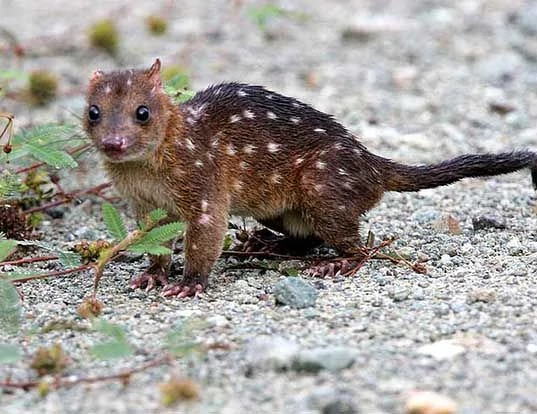
Dasyurids (Dasyuridae) are a family of marsupials native to Australia and New Guinea, including 71 extant species divided into 17 genera. Many are small and mouse-like or shrew-like so its no surprise they are often called marsupial mice or marsupial shrews, but the group also includes larger animals such cat-sized quolls and Tasmanian devils. Dasyurids are found in a wide range of habitats, including grassland, underground, forests, and mountains. Some species are arboreal (live mainly in trees); others are semiaquatic. The Dasyuridae are often called the 'marsupial carnivores', as most members of the family are carnivores, mostly insectivores. [Source: Wikipedia]
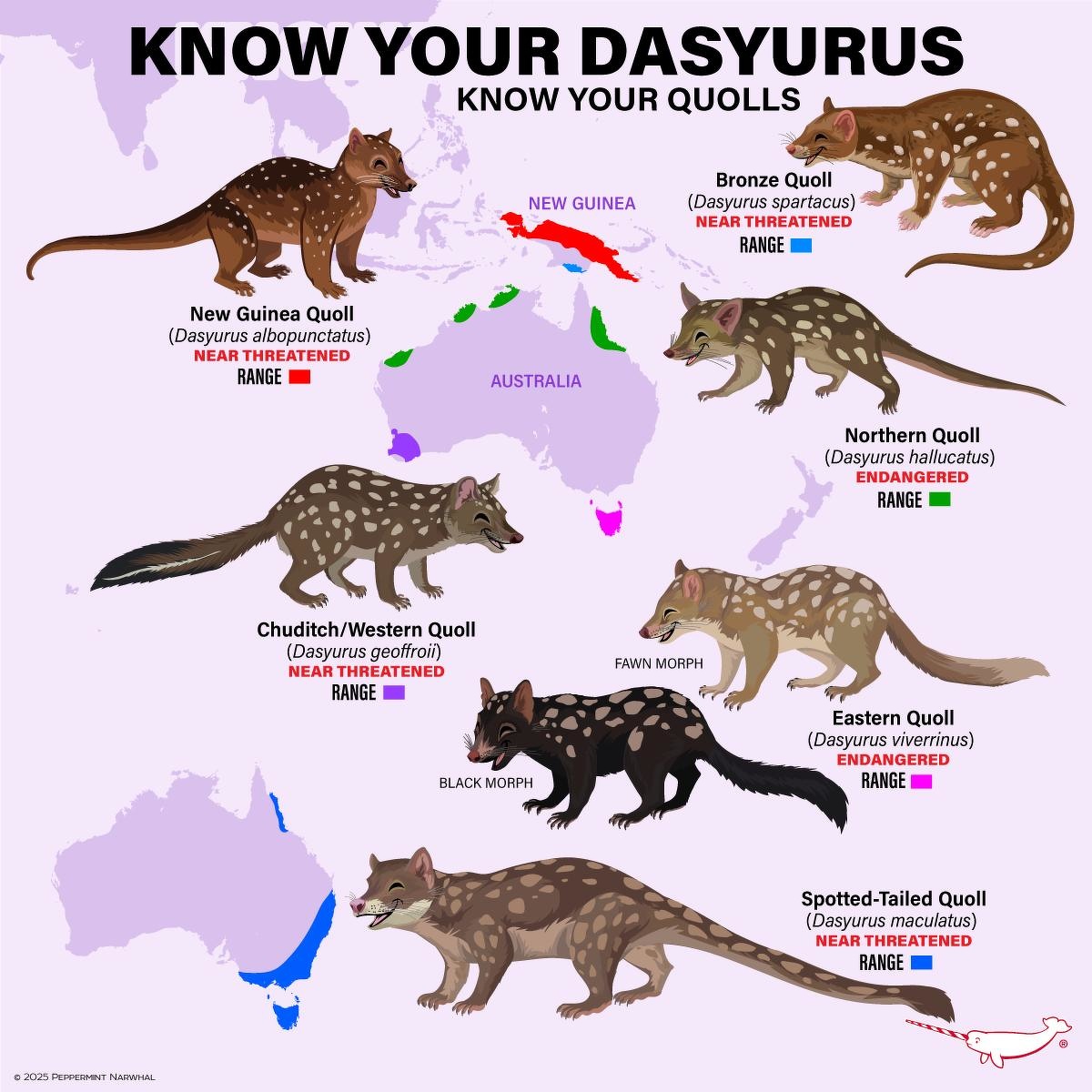
Dasyuromorphia (Dasyuromorphs), meaning "hairy tail", is the order comprising most Dasyurids. Dasyuromorphs are more or less the same as Dasyurids, plus numbats. They include quolls, dunnarts, the numbat, the Tasmanian devil, and the extinct thylacine. The order contains four families: one, the Myrmecobiidae, with just a single living species (the numbat), two with only extinct species (including the thylacine and Malleodectes), and one, the Dasyuridae, with 73 extant species. [Source: Nicole Armbruster Chad Nihranz and Elizabeth Colvin, Animal Diversity Web (ADW) |=|]
Almost a quarter of Dasyuridae have only been scientifically recognised since the late 1990s. Taxonomists divide Dasyurids into four subfamilies, the Dasyurinae (quolls, Tasmanian devil, kowari, mulgara, kaluta, dibblers, pseudantechinuses, and parantechinuses), Phascogalinae (phascogales and other antechinuses), Sminthopsinae (dunnarts and kultarr), and Planigalinae (planigales and ningauis). Evidence for the cohesiveness of the entire group, however, is strong. [Source: Phil Myers, Animal Diversity Web (ADW) |=|]|
RELATED ARTICLES:
DASYURIDS AND DASYUROMORPHS (MARSUPIAL CARNIVORES) ioa.factsanddetails.com
QUOLLS: CHARACTERISTICS, BEHAVIOR AND REPRODUCTION ioa.factsanddetails.com
DUNNARTS: SPECIES, CHARACTERISTICS, BEHAVIOR AND REPRODUCTION ioa.factsanddetails.com
PLANIGALES: SPECIES, CHARACTERISTICS, BEHAVIOR AND REPRODUCTION ioa.factsanddetails.com
Bandicoots
Bandicoots are small to medium-size shrew-like marsupials. They have strong hind legs well adapted for jumping and use their long nose and sharp claws on the forelimbs to probe sand and soil for roots and insects on which they eat. The term “bandicoot” is derived from the Indian-Telugu word for “pig rat”, which initially referred to a large rodent species, the greater bandicoot rat, from India and Sri Lanka., that is unrelated to bandicoots in Australia and New Guinea. |=|
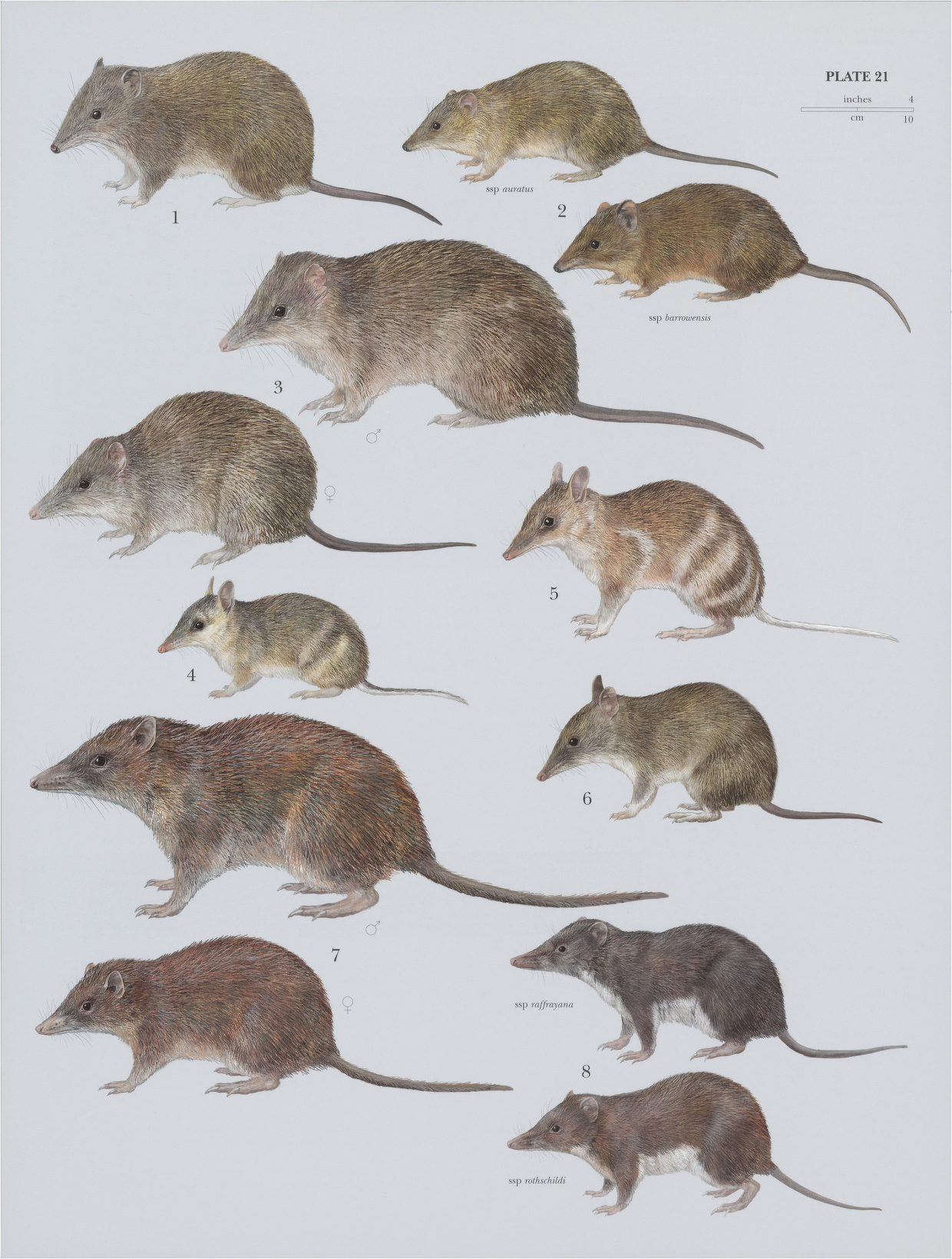
3) Northern Brown Bandicoot, 4) Western Barred Bandicoot, 5) Eastern Barred Bandicoot, 6) Long-nosed Bandicoot, 7) Giant Bandicoot, 8) Raffray’s Bandicoot
Bandicoots average about 24 centimeters (9.5 inches) in length and weigh 172 to 296 grams (6 to 10.4 ounces). They have V-shaped faces, ending with a prominent noses that give them, and bilbies, an appearance family to elephant shrews of which bandicoots are distantly related. Like most marsupials, male bandicoots have bifurcated penises and females have pouches. his pouch is where their young, which are born in a very undeveloped state, develop further after birth. The pouch opening is unique, facing backwards to prevent dirt and debris from entering while the mother is digging for food
There are 20 species of bandicoot. They live mostly in hot places. They have large ears to dissipate heat. A dense network of tiny blood vessels run close to the surface of the skin in ears. Bandicoots also have low body temperatures and low basal metabolic rates which aides their survival in hot and dry climates. They also have low total water evaporative rate and effective panting mechanisms which further aid their survival in hotter temperatures.
RELATED ARTICLES: BANDICOOTS: CHARACTERISTICS, BEHAVIOR AND REPRODUCTION ioa.factsanddetails.com
Possums, Gliders and Cuscuses
There are a wide variety of possums in Australia and New Guinea. They are mostly arboreal have adapted themselves to almost every environment, including cities and suburbs and campsites, where they are notorious for stealing food. The most common species are the common brushtail or grey possum, which are widespread in every state and territory of Australia. Although opossums are marsupials like possums, Australasian possums are more closely related to other Australasian marsupials such as kangaroos. Possums are harmless but they can keep you up at night if you have one holed up in the roof space of your home.
Gliders are gliding possums. Also called flying possums, they resemble flying squirrels but are not related to them and are found in Australia, New Guinea and neighboring islands. Gliders are primarily nocturnal animals that swoop down out of their homes, usually holes in trees, at dusk and travel from tree limb to tree limb with the help of membranes between their front and rear legs. There are several species. Cat-size great gliders and smaller sugar gliders can volplane, or glide, 100 meter. Each time before they take off they make a low whirring moan. Yellow-bellied gliders, sugar gliders and feathertail gliders feed of sap that oozes out of cuts they make with their claws in eucalyptus trees.
Cuscus is the common name generally given to the species within the four genera of Australasian possum in the family Phalangeridae. 1) bear cuscuses (genus Ailurops); 2) genus Phalanger, whose members are found on New Guinea, the Maluku Islands in Indonesia, other nearby small islands, and Australia's Cape York Peninsula; 3) genus Spilocuscus, whose members are found on Cape York, New Guinea, and smaller nearby islands; and 4) dwarf cuscus (genus Strigocuscus), found only in Sulawesi and some of its surrounding small offshore islands. [Source: Wikipedia]
RELATED ARTICLES:
POSSUMS OF AUSTRALIA AND NEW GUINEA: SPECIES: CHARACTERISTICS, BEHAVIOR AND REPRODUCTION ioa.factsanddetails.com
GLIDERS OF AUSTRALIA AND NEW GUINEA: MARSUPIAL EQUIVALENTS OF FLYING SQUIRRELS ioa.factsanddetails.com
GLIDER SPECIES (SUGAR, MAHOGANY, GREATER, YELLOW-BELLIED): CHARACTERISTICS AND BEHAVIOR ioa.factsanddetails.com
CUSCUSES: CHARACTERISTICS, SPECIES, BEHAVIOR AND REPRODUCTION ioa.factsanddetails.com
CUSCUSES OF SULAWESI factsanddetails.com
Echidnas
Echidnas (the family Tachyglossidae) are also known as spiny anteaters. Found on the Australian mainland, and in Tasmania and the highlands of New Guineas, they are porcupine-, hedgehog-like animal with a twist. Like platypuses, they are egg-laying mammals called monotremes that don’t have teeth, and though they both produce milk, they secrete it through their skin for babies (often called puggles) to lap at, because they lack nipples [Source: Amanda Schupak, CNN, May 2, 2025]
Echidna live on land and are covered in pointy quills. They have rear feet that face backward, which kick dirt out of the way as the animal burrows into the ground. Echidnas eats ants and termites and have a long sticky tongue like anteaters and pangolins..
The family Echidnas consists of two genera; Tachyglossus and Zaglossus. The genus Tachyglossus comprises one species — short-beaked echidnas (Tachyglossus aculeatus) — while Zaglossus is composed of the long-beaked echidnas of which there are three species: 1) Western long-beaked echidnas (Zaglossus bruijni), which live in highland forests; 2) Sir David's long-beaked echidnas (Zaglossus attenboroughi), discovered by Western science in 1961 and described in 1998, which prefer a still higher habitat; and 3) Eastern long-beaked echidnas (Zaglossus bartoni), of which four distinct subspecies have been identified. [Source: Neilee Wilhelm, Animal Diversity Web (ADW) |=|]
RELATED ARTICLES:
ECHIDNAS: CHARACTERISTICS, BEHAVIOR AND REPRODUCTION ioa.factsanddetails.com
MONOTREMES: HISTORY, EVOLUTION, CHARACTERISTICS, BEHAVIOR, REPRODUCTION ioafactsanddetails.com
SHORT-BEAKED ECHIDNAS: CHARACTERISTICS, BEHAVIOR AND REPRODUCTION ioa.factsanddetails.com
LONG-BEAKED ECHIDNAS: SPECIES, CHARACTERISTICS, BEHAVIOR AND REPRODUCTION ioa.factsanddetails.com
Bats and Flying Foxes in New Guinea
New Guinea is home to a diverse array of bats, including several species of flying foxes (. Insectivorous Bats (Vespertilionidae and Hipposideridae) in New Guinea include hoary wattled bats (Chalinolobus nigrogriseus), Spurred roundleaf bats (Hipposideros calcaratus) and Maggie Taylor's roundleaf bats (Hipposideros maggietaylorae). Several species of long-eared bats (Nyctophilus) are found, including Nyctophilus bifax, Nyctophilus gouldi, Nyctophilus microdon, Nyctophilus microtis, and Nyctophilus timoriensis are found in New Guinea. The Pipistrellus genus includes species like Pipistrellus angulatus, Pipistrellus collinus, Pipistrellus papuanus, and Pipistrellus wattsi. New Guinea big-eared bats (Pharotis imogene) are a critically endangered.
Flying foxes are the world’s largest bats. They are distinguished from other kinds of bats in that, for the most part, they use their eyes not echolocation to locate objects. Flying foxes get their names from their foxy faces. Some neurological and morphological studies have shown that they may not be that distantly related from primates.
Flying foxes are also called fruit bats and belong to the groupings of Old World Bat and Megabats, of which there are almost 200 species scattered across southern Asia, and the islands off southeast Africa and the South Pacific — but not in the Americas and Europe. They are most common in tropical Asia, Madagascar, Australia and the South Pacific islands. Southeast Asia is home to many species of flying fox. The Indian flying fox is the world’s largest bat. It has a body the size of a house cat and wingspan up to five feet.
RELATED ARTICLES:
FLYING FOXES: CHARACTERISTICS, BEHAVIOR AND REPRODUCTION factsanddetails.com
BATS AND FLYING FOXES IN AUSTRALIA: CHARACTERISTICS, BEHAVIOR AND REPRODUCTION ioa. factsanddetails.com
WORLD’S BIGGEST BATS — LARGE, INDIAN AND GREAT FLYING FOXES — AND THEIR CHARACTERISTICS AND BEHAVIOR factsanddetails.com
FLYING FOXES OF THE ISLANDS OF INDONESIA AND THE PHILIPPINES factsanddetails.com
ASIAN FALSE VAMPIRE BATS: CHARACTERISTICS, BEHAVIOR AND REPRODUCTION factsanddetails.com
Woolly Rat Photographed for the First Time
Andrew Paul wrote in Popular Science: New Guinea’s subalpine woolly rat is the rodent of legends. Mallomys istapantap was first described in 1989, but even then the descriptions were only gleaned from examining historical museum material. The last recorded sighting of the fuzzy rodent 30 years ago failed to yield any photographic evidence, but after six months scouring the jungles of New Guinea, one researcher has finally documented one of the world’s most elusive mammals. [Source:Andrew Paul, Popular Science, May 21, 2025]
The New Guinean woolly rat doesn’t make itself easy to find, but Czech Academy of Sciences doctoral candidate František Vejmělka recently managed to make history with the help of local guides. “If it weren’t for the indigenous hunters who accompanied me in the mountains and helped me locate the animals, I would never have been able to collect this data,” Vejmělka said in a statement.
Vejmělka collaborated with multiple local tribes to survey the region around Papua New Guinea’s highest peak, Mount Wilhelm (14,793 feet). Along the way he documented and genetically identified 61 species of non-flying rodents and marsupials, but it was his firsthand encounters with the woolly rat that stood out from the rest. The murine rodent lives in the region’s remote, steep highlands at elevations around 12,000 feet. They only emerge at night to feed on plant matter and spend their days in underground burrows or high in the tree canopies. Vejmělka’s documentation published last month in the journal Mammalia notes the thick-furred woolly rats measure about 2.78-feet long including their tail, weigh around 4.4 lbs, and feature 3-inch paws. Despite their moderate size, the university announcement describes the animal as a “striking and formidable creature.”
While tropical biodiversity across Africa, the Americas, and Southeast Asia is well-studied, the Australasian regions remain largely unstudied. Collaborating with local indigenous communities to find and document animals such as the woolly rat is crucial to help strengthen biodiversity and conservation efforts, and what is needed to protect them from outside threats. “It’s astonishing that such a large and striking animal has remained so poorly studied,” said Vejmělka. “How much more is there to discover about the biodiversity of tropical mountains?”
Image Sources: Wikimedia Commons
Text Sources: Animal Diversity Web animaldiversity.org , National Geographic, Live Science, Natural History magazine, Australian Museum, David Attenborough books, Australia Geographic, New York Times, Washington Post, Los Angeles Times, Smithsonian magazine, Discover magazine, The Conversation, The New Yorker, Time, BBC, CNN, Reuters, Associated Press, AFP, Lonely Planet Guides, Wikipedia, The Guardian, Top Secret Animal Attack Files website and various books and other publications.
Last updated September 2025