
FOREST WALLABIES
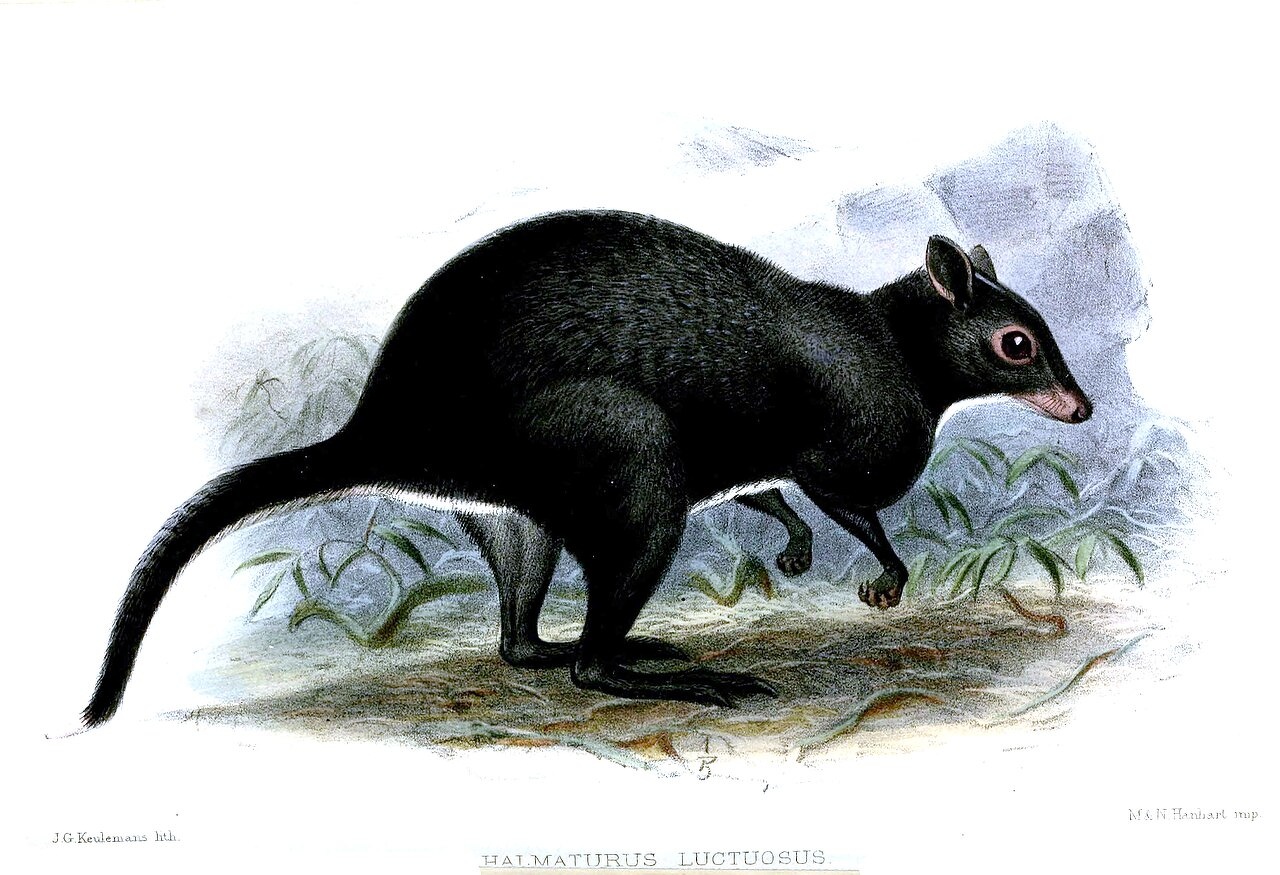
gray forest wallaby
Dorcopsis is a genus of marsupial in the family Macropodidae (macropods. kangaroos and wallabies) known as forest wallabies. found on the island of New Guinea. The genus contains the following species: 1) Black dorcopsis (Dorcopsis atrata); 2) White-striped dorcopsis (Dorcopsis hageni); 3) Gray dorcopsis (Dorcopsis luctuosa); and 4) Brown dorcopsis (Dorcopsis muelleri). [Source: Wikipedia]
Dorcopsulus is a genus of small marsupials in the family Macropodidae, also known as forest wallabies. They are native to rainforests and montane forests of New Guinea. The genus contains two species: 1) Macleay's dorcopsis (Dorcopsulus macleayi) and Small dorcopsis (Dorcopsulus vanheurni)
The main difference between Dorcopsis and Dorcopsulus lies in their classification within the Macropodidae family and their geographic distribution. Dorcopsis refers to the greater dorcopsises, while Dorcopsulus refers to the lesser dorcopsises. Both genera are found in New Guinea and surrounding islands. Dorcopsulus typically contains smaller species than Dorcopsis. While both genera are found in New Guinea and nearby islands, Dorcopsulus is often associated with more mountainous regions. [Source: Google AI]
It has been suggested that forest-wallabies represent a transitional form between macropods and tree-kangaroos. Dorcopsis generally live in rain forests. It has been said they squat rather than sit to avoid picking up leaches.
RELATED ARTICLES:
WALLABIES: TYPES, CHARACTERISTICS, BEHAVIOR, REPRODUCTION ioa.factsanddetails.com
KANGAROOS AND WALLABIES (MACROPODS): CHARACTERISTICS, HISTORY, POPULATIONS ioa.factsanddetails.com
WALLABY SPECIES ioa.factsanddetails.com
WALLABY SPECIES OF SOUTHWEST AUSTRALIA ioa.factsanddetails.com
ROCK-WALLABIES: SPECIES, CHARACTERISTICS, BEHAVIOR AND REPRODUCTION ioa.factsanddetails.com
HARE-WALLABIES: SPECIES, CHARACTERISTICS, BEHAVIOR AND REPRODUCTION ioa.factsanddetails.com
PADEMELONS: SPECIES CHARACTERISTICS, BEHAVIOR AND REPRODUCTION ioa.factsanddetails.com
TREE-KANGAROOS: CHARACTERISTICS, BEHAVIOR AND REPRODUCTION ioa.factsanddetails.com
TREE-KANGAROOS IN AUSTRALIA: BENNETT'S, LUMHOLTZ'S, CHARACTERISTICS, BEHAVIOR AND REPRODUCTION ioa.factsanddetails.com
TREE-KANGAROOS IN PAPUA NEW GUINEA: SPECIES, CHARACTERISTICS, BEHAVIOR, REPRODUCTION ioa.factsanddetails.com
TREE-KANGAROOS IN WEST PAPUA, INDONESIA: SPECIES, CHARACTERISTICS, BEHAVIOR, REPRODUCTION factsanddetails.com
KANGAROO BEHAVIOR: FEEDING, REPRODUCTION, JOEYS ioa.factsanddetails.com
KANGAROOS HOPPING: MOVEMENTS, METABOLISM AND ANATOMY ioa.factsanddetails.com
MARSUPIALS: HISTORY, EVOLUTION, CHARACTERISTICS, BEHAVIOR, REPRODUCTION ioa.factsanddetails.com
MARSUPIALS IN AUSTRALIA ioa.factsanddetails.com
MARSUPIALS IN AUSTRALASIA (AUSTRALIA, NEW GUINEA, NEARBY ISLANDS) ioa.factsanddetails.com
Black Forest Wallabies
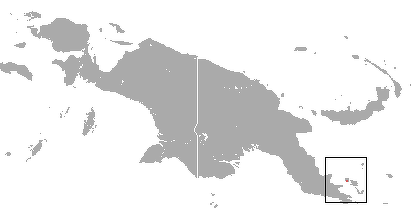
range of the black forest wallaby
Black forest wallabies (Dorcopsis atrata) are also known as or black dorcopsis. They are endemic to Goodenough Island at the southeastern end of New Guinea where they inhabit is subtropical and tropical dry forests. Although the range of these wallabies is fairly restricted range, they occupy a variety of niches including the moist forests of lowland and montane rain forest and some grasslands. On Goodenough Island, they live in oak forests at medium elevations in the mountains between 900 and 1,800 meters but may also come down to sea level. Black forest wallabies were only discovered in 1953 by Westerners during The Fourth Archbold Expedition to New Guinea but are currently listed as Critically Endangered On the International Union for Conservation of Nature (IUCN) Red List due to habitat loss and hunting, [Source: Carmen Borsa, Animal Diversity Web (ADW) |=|]
Black forest wallabies range in weight from 1.8 to 2.3 kilograms (3.96 to 5.07 pounds). Their head and body length is between 0.74.4 one meters (28.9 and 39.2 inches) and their tail length is usually between 28.5 to 39.6 (11.2 and 15.6 inches). The fur of black forest-wallabies is blackish on the back part of their body and dark brown on the front side. The tail is haired except for the terminal half, where it is naked. The nose of these wallabies is large, broad, and naked and its ears are small and rounded. The hind limbs and feet are small, while the front limbs are well-developed and robust. Unlike most other wallaby species, black forest-wallaby are not specialized for jumping. Females of the species have four mammae and a pouch that opens forward.
Black forest-wallabies are motile (move around as opposed to being stationary) are presumed to be nocturnal (active at night), but there is also some evidence that they move around the dense forest during the day. They are herbivores (eat plants or plants parts) and browsers (primarily eats non-grass plants such as bushes and tree parts higher up off the ground), feeding mostly on soft vegetation, including leaves, roots, grasses and fruit. The incisors are used to pick up food, then it is then transferred to the hands so it can be processed by the premolars on the side of the mouth. Females usually give birth to one young at a time.
Greater Forest Wallabies
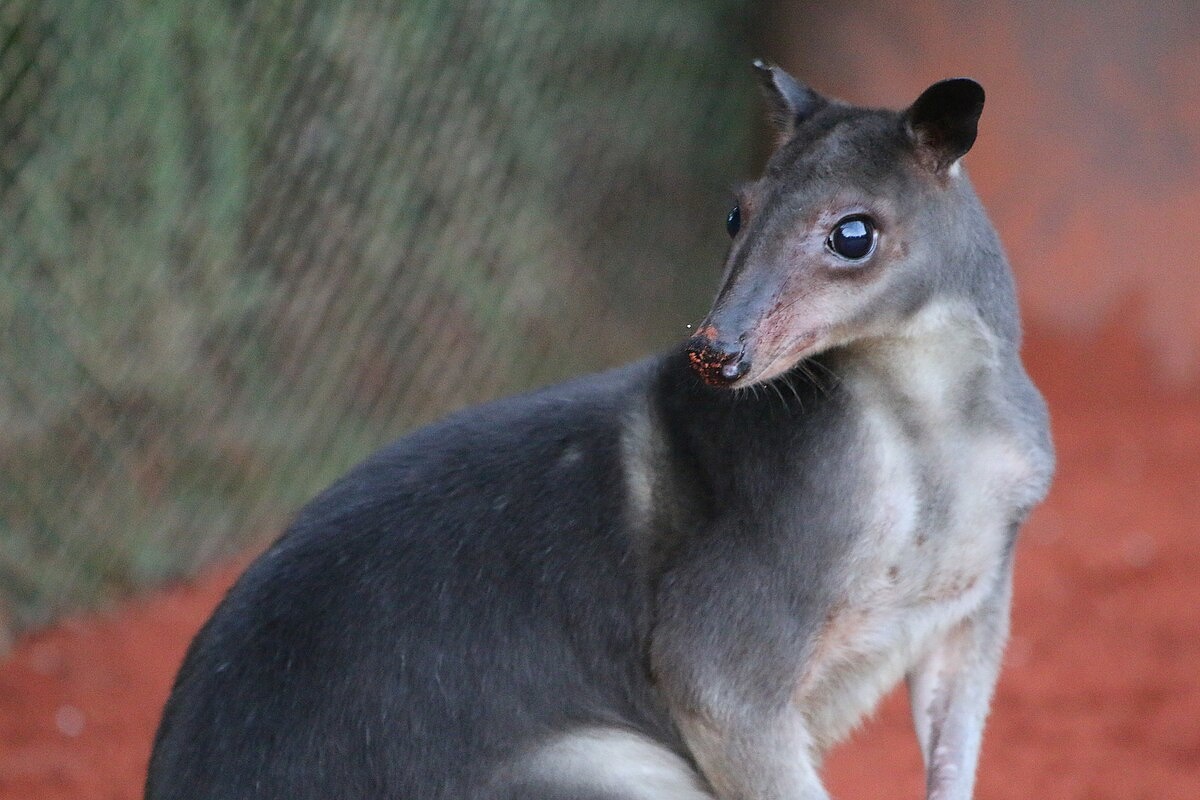
Greater forest wallaby
Greater forest wallabies (Dorcopsis hageni) are also known as white-striped dorcopsis. They are found in northern New Guinea in both Papua New Guinea and West Papua, Indonesia. Their range includes Papua and some parts of Highland Papua in Indonesia and and Papua New Guinea but are absent from the Huon Peninsula. They are generally found at altitudes of up to about 400 meters (1,300 feet) above sea level in both primary and secondary tropical forests and is tolerant of some degree of habitat degradation. In the northern part of their range they are found in alluvial fans at the edge of the Sepik floodplains. In the southern part of its range they are is found in mixed alluvial forest but are absent from even the lowest part of hill forests.
Greater forest wallabies are terrestrial herbivores (eat plants or plants parts) and browsers (primarily eats non-grass plants such as bushes and tree parts higher up off the ground), including on the fruiting bodies of fungi. However, they have been seen during daylight hours turning over flat stones in search of insects and other organisms. Single naked young have been found in the pouches of females during the months of January and April.
Greater forest wallabies are fairly were there is suitable tropical forest habitat. They are not endangered or threatened and have been designated as a species of least concern on the International Union for Conservation of Nature (IUCN) Red List. Other than being hunted by locals for food, they does not face any significant threats. The total number of animals is believed to be large and the population trend stable.
Gray Forest Wallabies
Gray forest wallabies(Dorcopsis luctuosa) are also known as gray dorcopsis. They are found in the southeastern part of New Guinea in West Papua, Indonesia and Papua New Guinea in tropical primary and secondary forest, in particular gallery forest, but also in disturbed areas such as abandoned gardens, at altitudes of up to 400 meters (1,300 feet). [Source: Wikipedia . Gray forest wallabies have a long muzzle and small, rounded ears. The forelegs are relatively long in comparison to their hind legs,The tail is long and has a bare, cornified tip. The short, dense fur is smoky-grey above and paler grey beneath, with a yellowish patch around the single cloacal orifice.
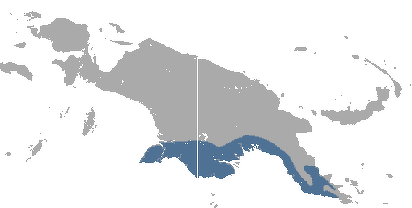
range of gray forest wallaby
Sexual Dimorphism (differences between males and females) is present among gray forest wallabies: Males are much larger than females. Males weigh up to 11.6 kilograms (26 pounds) while females only reaches 3.6 kilograms (8 pounds). The head and body length of males is 97 centimeters (38 inches) in males and 39 kilograms (15 inches) in females, with tails of males reaching 97 centimeters (38 inches) and the tails of females being only 31 centimeters (12 inches)
On the International Union for Conservation of Nature (IUCN) Red List, gray forest wallabies they are listed as Vulnerable. Among the main threats are loss of forest habitat due to logging and deforestation to make way for small-scale agriculture and hunted by locals for bushmeat. In the area of Port Moresby they have hunted so extensively that few animals remain. They used to be found in nearby Varirata National Park but it is unclear whether there any more.
Brown Forest Wallabies
Brown forest wallabies (Dorcopsis muelleri) are also known as brown dorcopsisis. They are endemic to the lowlands on the western end of New Guinea, including the Bird’s Head, in Indonesia in Southwest Papua, West Papua and Central Papua, and the nearby Indonesian islands of Salawati, Misool and Yapen and possibly also Batanta and Waigeo. They prefer swampy tropical lowland forest including areas that flood in the rainy season, and believed to be tolerant of secondary forest, including abandoned gardens.
Five subspecies of Brown forest wallabies are recognised. The dorsal colour is dull brown, chocolate brown, reddish brown or fawn and the underparts are whitish, creamy-yellow or greyish. The arms are sometimes paler than the dorsal surface and the tip of the tail is devoid of hair.
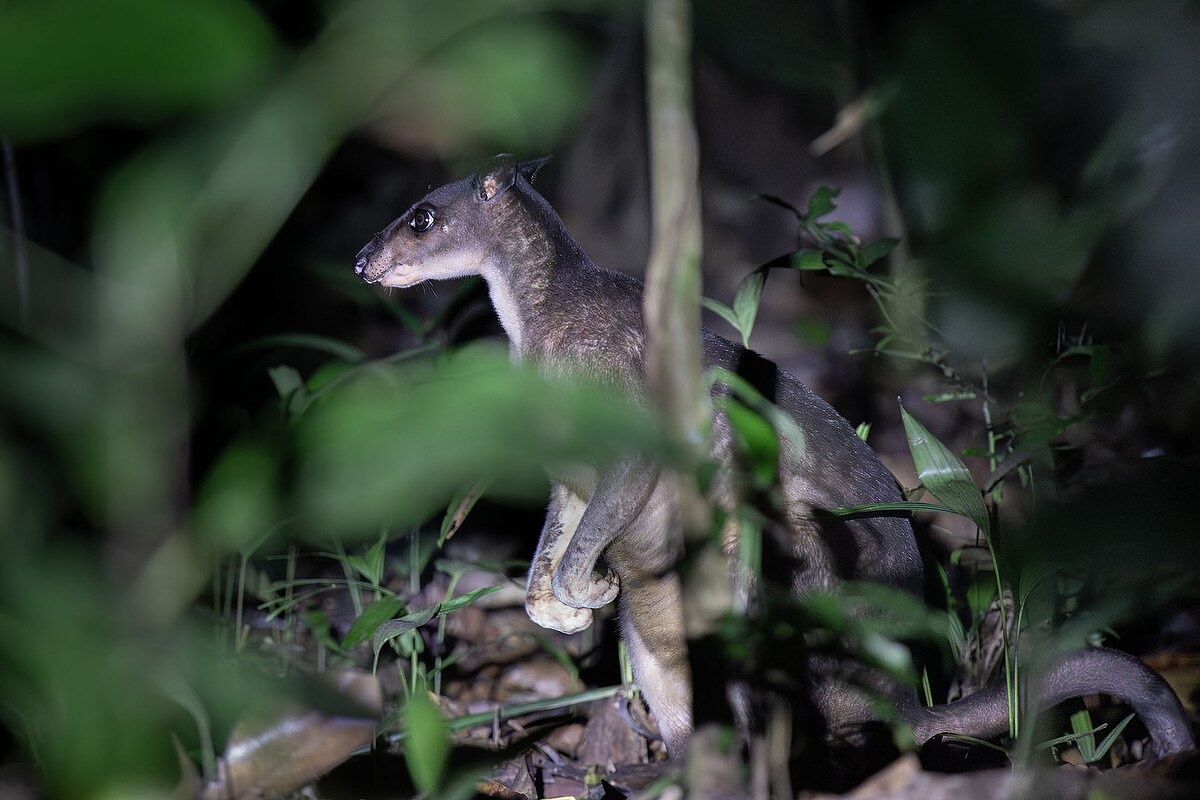
Brown forest wallaby in Malagufuk, Sorong Regency, West Papua, Indonesia,
Brown forest wallabies are known locally as "djief". Many bones of these animals have been found in the deposits on the floor of two caves in western New Guinea used by hunters as far back as 26,000 years ago. One survey found that of 80 percent of the animal bones in the caves belonged to brown forest wallabies. The the occupants of these caves are thus known as "djief hunters".
Brown forest wallabies are listed on the IUCN Red List as a species of "Least concern". They have a relatively broad distribution and are common in the south coastal part of its range but less common in the centre of the Vogelkop Peninsula. The overall population of these wallabies seems to be stable. Much of their range is uninhabited by humans. In places that are close to human habitation they are hunted for meat and their habitat is affected by logging, especially on Yapen Island, and the clearing of forested land for small-scale agriculture.
Papuan Forest Wallabies
Papuan forest wallabies (Dorcopsulus macleayi) are also known Macleay's dorcopsis and Papuan dorcopsis. They are endemic rain forests in southeastern Papua New Guinea, including areas near Port Moresby on the south coast. They utilize cover and roaming space within dense forests and prefer dry areas that are heavily covered by tall trees and have rich floor vegetation. The However, expansion of the broad plains with savannah woodland and grasslands (maintained largely by periodic native burning) has pushed Papuan wallabies to move to higher elevations — 1200 to 1300 meters (3927 to 4265 feet) – in the forest. Their lifespan is estimated to be up to eight years. [Source: Daniel Rosas Alvarez, Animal Diversity Web (ADW) |=|]
Papuan forest wallabies range in weight from three to five kilograms (6.6 to 11pounds). Their average length is 49 centimeters (19.3 inches). Sexual Dimorphism (differences between males and females) is not present: Both sexes are roughly equal in size and look similar. The skull is smaller, shorter, and broader in comparison to the other members of their genus. The tail averages 32 centimeters (one foot), and the hindlimbs are 11.5 centimeters in length Fur is brownish-grey on the back and lighter on the front. The tip of the tail is nearly bare and is white in color. The dentition of Papuan forest wallabies is characterized by a pair of incisors that are small, light, and that do not touch each other. The canines are short and slender, whereas the molars are broad, evenly oval, and short.
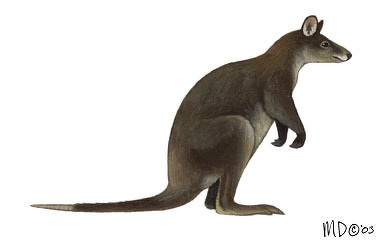
Papuan forest wallaby
Papuan forest wallabies are generalist herbivores (eat plants or plants parts) and browsers (primarily eats non-grass plants such as bushes and tree parts higher up off the ground). They mainly eat leaves, buds, and stems of dictotyledonous plants. Their main natural predators are New Guinea harpy-eagles, carpet pythons, and wedge-tailed eagles.
On the International Union for Conservation of Nature (IUCN) Red List,Papuan forest wallabies are listed as a species of Least Concern. Habitat loss due to logging and conversion of the forest to agricultural land are threats. Papuan forest wallabies have traditionally been hunted for food. Some tribal people have used the furs of Papuan wallabies for trade and as bridal gifts.
Papuan Forest Wallaby Behavior and Reproduction
Papuan forest wallabies are terricolous (live on the ground), nocturnal (active at night), motile (move around as opposed to being stationary), sedentary (remain in the same area), and social (associates with others of its species; forms social groups). They forage near the ground and for the most part do not dig burrows. Their ability to survive on open habitat is reduced because they are forest specialists. [Source: Daniel Rosas Alvarez, Animal Diversity Web (ADW) |=|]
Papuan forest wallabies sense communicate with vision, touch, sound and chemicals usually detected by smelling. They also leave scent marks produced by special glands and placed so others can smell and taste them. Like most marsupials, Papuan forest wallabies have a keen sense of smell.
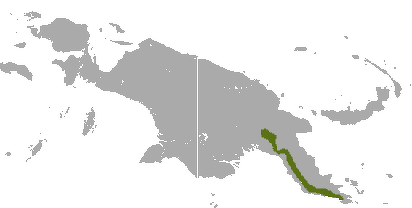
range of Papuan forest wallabies
Papuan forest wallabies are polygynandrous (promiscuous), with both males and females having multiple partners. They engage in seasonal breeding and breed once per year. The breeding season is in January and February. Reproduction appears to be related to female health. Females only go into estrus if they have enough energy and resources to successfully rear their offspring. The average gestation period is 21 days and the average number of offspring is one. Males engage in little pre-mating behavior and increase their chances of producing offspring by mating with as many females as possible. Females release a strong scent when they are in estrus and males smell the genital area of females to make sure that no young are already in the pouch. |=|
Parental care is provided by females. Young are altricial, meaning they are relatively underdeveloped at birth. Birth is so rapid that females do not even feel when their young are born. Newborns moves from the vagina into the pouch and attach themselves to a teat and complete their development inside their mother's pouch. After birth, a young wallaby may spend up to 18 months inside the pouch. There is an extended period of juvenile learning. The average weaning age is 18 months. In the two records of females with offspring, one female had two young in the pouch, another had only one. On average males and females reach sexual or reproductive maturity at age two years.
Lesser Forest Wallabies
Lesser forest wallabies (Dorcopsulus vanheurni) are also known as small dorcopsis, small forest wallabies and sgaw in the Kalam language of Papua New Guinea. The are found in subtropical or tropical dry forests. the mountainous interior of New Guinea in both West Papua, Indonesia and Papua New Guinea. They are is less common than they used to be and the IUCN Red List lists them as "Near Threatened", bordering "Vulnerable" because they were once a common species and their numbers have declined precipitously, especially near human settlements.
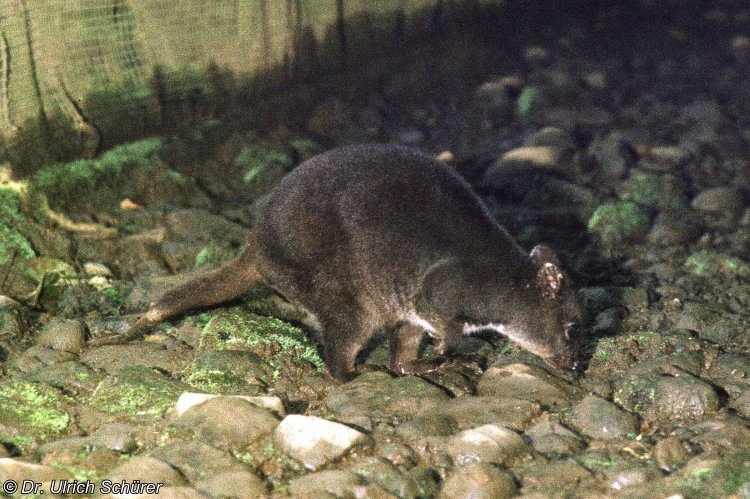
Lesser forest wallaby
Lesser forest wallabies generally reside in hill and upland habitats in the central mountain chain of New Guinea at altitudes between 800 and 3,100 meters (2,600 and 10,200 feet). They used to occur in the Schrader Range, the Hunstein Range and the Torricelli Mountains but no longer do, and it may no longer be present in the Adelbert Range. They live in primary and secondary forests, and forest glades, and are often found near streams. The a home range of individual animals is around one and a half hectares.
Lesser forest wallabies have traditionally been hunted by the Etolo people as food along with a number of other species of animal used/ They were usually caught in traps or taken after being brought down by hunting dogs. The Etolo people trapped the wallabies at the time of the year when they were tending their gardens. Hunting began at the end of the growing season, from December onwards. They also preyed on by New Guinea singing dogs which roam in the interior of New Guinea.
Image Sources: Wikimedia Commons and Animal Diversity Web
Text Sources: Animal Diversity Web animaldiversity.org , National Geographic, Live Science, Natural History magazine, Australian Museum, David Attenborough books, Australia Geographic, New York Times, Washington Post, Los Angeles Times, Smithsonian magazine, Discover magazine, The Conversation, The New Yorker, Time, BBC, CNN, Reuters, Associated Press, AFP, Lonely Planet Guides, Wikipedia, The Guardian, Top Secret Animal Attack Files website and various books and other publications.
Last updated July 2025