
Home | Category: Animals / Kangaroos, Wallabies and Their Relatives
PADEMELONS
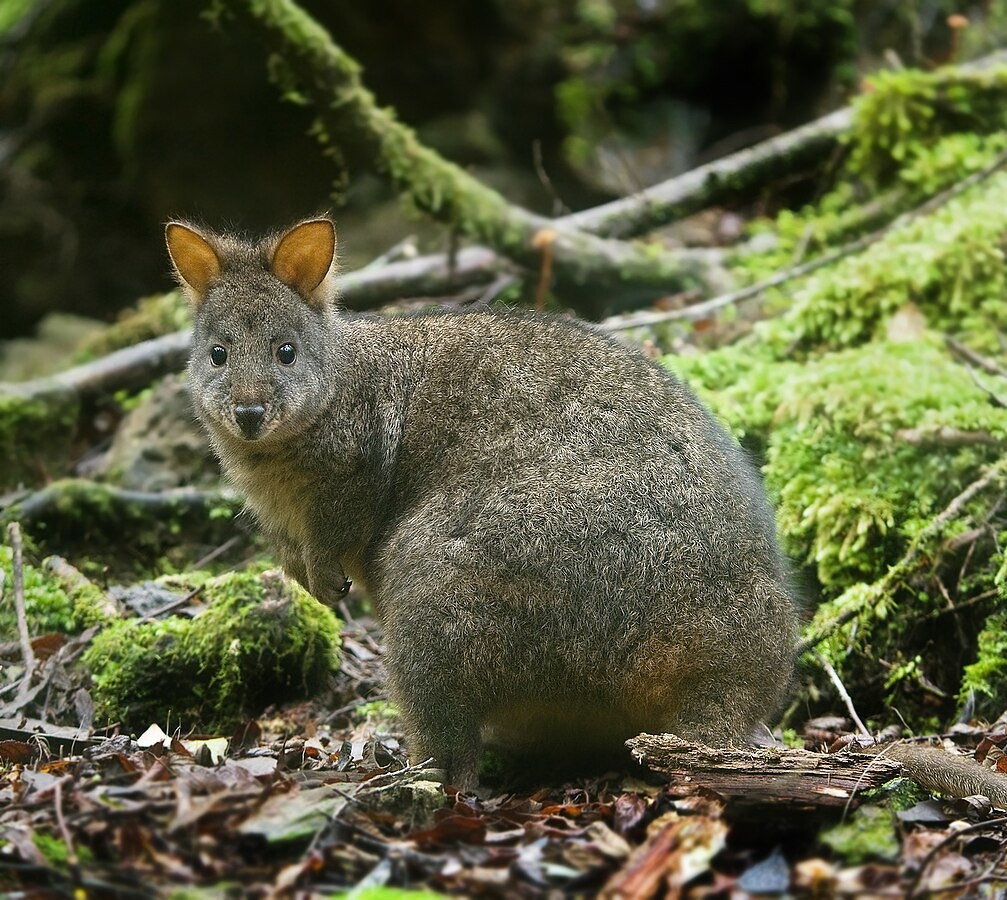
Tasmanian pademelon
Pademelons (pronounced padee melons) are small marsupials in the genus Thylogale. Found in Australia, New Guinea, and surrounding islands, they are some of the smallest members of the macropod family, which includes the kangaroos and wallabies. Pademelons look similar to other macropods but are distinguished by their small size and their short, thick, and sparsely haired tails. Their short tail and compact body are useful for maneuvering through dense vegetation. Like other marsupials, they carry their young in a pouch.
There are seven recognized species in the genus Thylogale:
Tasmanian pademelons or red-bellied pademelons (Thylogale billardierii)
Red-legged pademelons (Thylogale stigmatica)
Red-necked pademelons (Thylogale thetis)
Brown's pademelons (Thylogale browni) live in the northeastern quarter of New Guinea in subtropical or tropical dry forests, dry savanna, subtropical or tropical dry shrubland, and subtropical or tropical dry lowland grassland; they are threatened by habitat loss
Dusky pademelons (Thylogale brunii) are found in the Trans-Fly grasslands ecoregion of southern New Guinea and the Aru and Kai islands in Indonesia in of New Guinea in subtropical or tropical dry forests, dry savanna, subtropical or tropical dry shrubland, and subtropical or tropical dry lowland grassland.
Calaby's pademelons (Thylogale calabyi)are found in a small area of central Papua New Guinea
Mountain pademelons (Thylogale lanatus) are found in a small area of mountains in northeast Papua New Guinea
Pademelons, rock-wallabies and hare-wallabies are the smallest members of the macropod family. Mature male pademelons are larger than females, with an average weight of about seven kilograms and stand about 60 centimeters (two feet). Mature females weigh around 3.8 kilograms. The word "pademelon" comes from the word badimaliyan, which means small kangaroo from the forest in Dharug, an Australian Aboriginal language spoken near what is now Port Jackson, New South Wales. The scientific name Thylogale combines the Greek words for "pouch" and "weasel."
RELATED ARTICLES:
MARSUPIALS: HISTORY, EVOLUTION, CHARACTERISTICS, BEHAVIOR, REPRODUCTION ioa.factsanddetails.com
MARSUPIALS IN AUSTRALIA ioa.factsanddetails.com
MARSUPIALS IN AUSTRALASIA (AUSTRALIA, NEW GUINEA, NEARBY ISLANDS) ioa.factsanddetails.com
KANGAROOS AND WALLABIES (MACROPODS): CHARACTERISTICS, HISTORY, POPULATIONS ioa.factsanddetails.com
KANGAROO BEHAVIOR: FEEDING, REPRODUCTION, JOEYS ioa.factsanddetails.com
KANGAROOS HOPPING: MOVEMENTS, METABOLISM AND ANATOMY ioa.factsanddetails.com
WALLABIES: TYPES, CHARACTERISTICS, BEHAVIOR, REPRODUCTION ioa.factsanddetails.com
WALLABY SPECIES ioa.factsanddetails.com
WALLABY SPECIES OF SOUTHWEST AUSTRALIA ioa.factsanddetails.com
ROCK-WALLABIES: SPECIES, CHARACTERISTICS, BEHAVIOR AND REPRODUCTION ioa.factsanddetails.com
BRUSH-TAILED ROCK-WALLABIES: CHARACTERISTICS, BEHAVIOR AND REPRODUCTION ioa.factsanddetails.com
HARE-WALLABIES: SPECIES, CHARACTERISTICS, BEHAVIOR AND REPRODUCTION ioa.factsanddetails.com
TREE-KANGAROOS: CHARACTERISTICS, BEHAVIOR AND REPRODUCTION ioa.factsanddetails.com
TREE-KANGAROOS IN AUSTRALIA: BENNETT'S, LUMHOLTZ'S, CHARACTERISTICS, BEHAVIOR AND REPRODUCTION ioa.factsanddetails.com
TREE-KANGAROOS IN PAPUA NEW GUINEA: SPECIES, CHARACTERISTICS, BEHAVIOR, REPRODUCTION ioa.factsanddetails.com
TREE-KANGAROOS IN WEST PAPUA, INDONESIA: SPECIES, CHARACTERISTICS, BEHAVIOR, REPRODUCTION factsanddetails.com
BETTONGS: CHARACTERISTICS, BEHAVIOR AND REPRODUCTION ioa.factsanddetails.com
POTOROOS: SPECIES, CHARACTERISTICS, BEHAVIOR AND REPRODUCTION ioa.factsanddetails.com
RAT-KANGAROOS: SPECIES, CHARACTERISTICS, BEHAVIOR AND REPRODUCTION ioa.factsanddetails.com
Tasmanian Pademelons
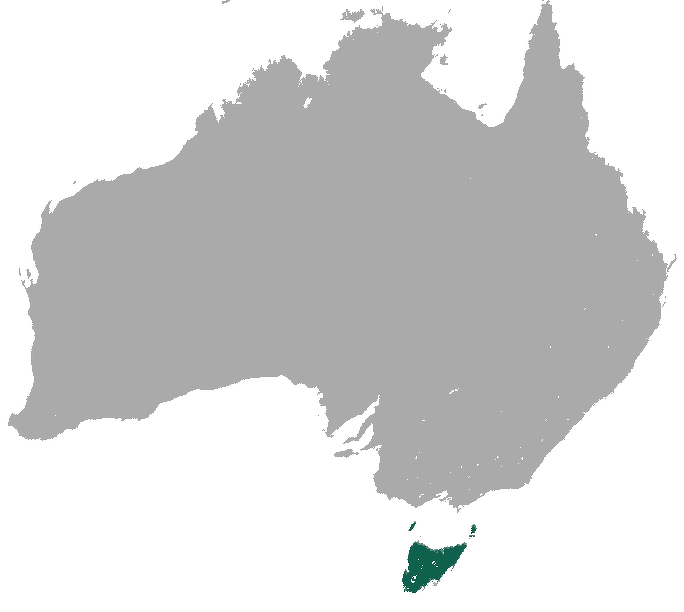
range of Tasmanian pademelon
Tasmanian pademelons (Thylogale billardierii) are also known as red-bellied pademelons and rufous-bellied pademelons. They are the only species of pademelon found in Tasmania, and were formerly found throughout southeastern Australia but they have been extinct on the mainland since the early 1900s. They are still abundant on Tasmania and the larger islands of Bass Strait, where they inhabit areas of dense vegetation, rainforest, wet forest and wet gullies in dry open eucalyptus field. When in open areas, they usually stay within 100 meters of forest shelter. They are heavier and have bushier fur than pademelons in northern Australia and Papua New Guinea. [Source: Adrienne Davis, Animal Diversity Web (ADW) |=|]
Tasmanian pademelons are short stocky marsupials. They range in weight from 2.5 to 12 kilograms (5.5 to 26.43pounds) and have a head and body length of one to 1.5 meters (3.3 to 4.9 feet). Sexual Dimorphism (differences between males and females) is present: Males are larger than females. Adult males weigh about seven kilograms (15.4 pounds); females, about four kilograms (8.8 pounds). Tasmanian pademelons have soft fine fur that is dark brown to grey brown on the back, and reddish brown or lighter brown on the the belly. Males have a broad chest and forearms, which contribute to them being larger than females.
Tasmanian pademelons are herbivores (eat plants or plants parts) and are recognized as folivores (eat leaves). They mainly eat short green grasses and herbs, and occasionally feed on taller woody plants. They like to feed at night close to the protection of the forest. Their main known predators are Tasmanian devils, spotted-tailed quolls and wedge-tailed eagles (Aquila audax) The lifespan of Tasmanian pademelonsis typically five to six years in the wild.
Tasmanian pademelons not endangered or threatened. They are designated as a species of least concern on the International Union for Conservation of Nature (IUCN) Red List. Humans have utilized them for food and ecotourism. Their fur is soft and fine and valuable to humans. Their meat has little fat, and is said to be good to eat. There are a bit of tourism draw in Tasmania. Tasmanian pademelons eat brush and foliage, sometimes intended for livestock and have been controlled by the installation of electric fences. The species is harvested each year to ensure that the numbers remain controlled and abundant.
Tasmanian Pademelon Behavior and Reproduction
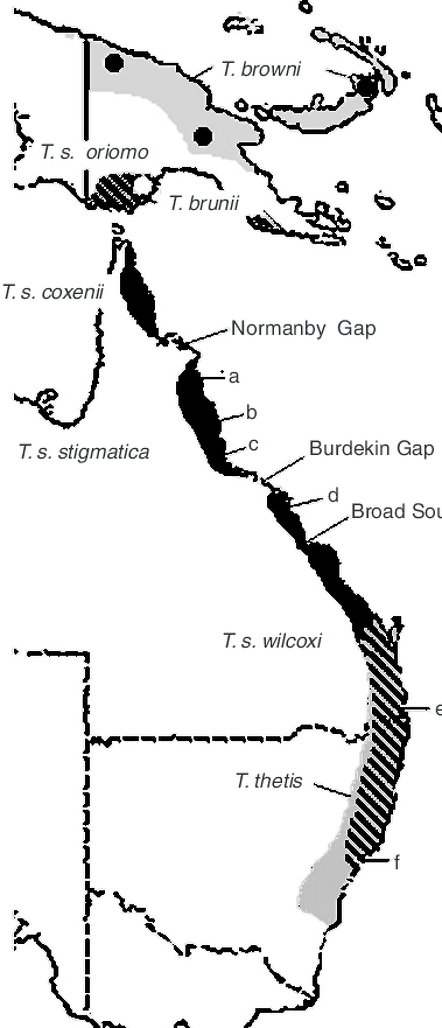
Range of the six pademelon species in eastern Australia and New Guinea, showing the zones of sympatry (hatched); Collection localities are indicated by circles for specific sites, or by letters ('a'–'f') for clusters of localities; Red-legged pademelons (Thylogale stigmatica); Red-necked pademelons (Thylogale thetis); Brown's pademelons (Thylogale browni); Dusky pademelons (Thylogale brunii); Calaby's pademelons (Thylogale calabyi); Mountain pademelons (Thylogale lanatus) [Source: Researchgate]
Tasmanian pademelons are nocturnal (active at night) and motile (move around as opposed to being stationary). They are mainly solitary but come together for mating and occasionally for feeding. Tasmanian pademelons travel to a feeding spot (sometimes as far away as 2km) each evening at dusk and return to a bedding spot each morning. Daytime feeding is extremely rare. As many as ten individuals may come together for feeding; however, they scatter immediately when they sense danger. [Source: Adrienne Davis, Animal Diversity Web (ADW) |=|]
Tasmanian pademelons are polygynandrous (promiscuous), with both males and females having multiple partners. They engage in year-round breeding but breed more in autumn and employ embryonic diapause (temporary suspension of development of the embryo) and delayed implantation (a condition in which a fertilized egg reaches the uterus but delays its implantation in the uterine lining, sometimes for several months). The average gestation period is 30 days. The average number of offspring is one. The weaning age ranges from six to twelve months, with the average being eight months. Parental care is carried out by females. Young are altricial, meaning they are relatively underdeveloped at birth. Females and males reach sexual or reproductive maturity at 14 to 15 months.
Tasmanian pademelons reproduce in captivity year round, but in the wild 70 percent of births are in late autumn. Occasional clicking by males can be heard chasing after females in estrus. At birth young immediately make their way into the pouch and attach themselves to one of four teats. If there are other siblings, the newly born joey will choose a teat not used by a sibling. Immediately after birth, the mother again comes into estrus and mates. The resulting embryo develops into the blastocyst (embryo) stage, and then remains in embryonic diapause. If the current joey is lost or removed, the blastocyst develops. If the current joey develops naturally, it is replaced on the night it leaves the pouch by a new young resulting from the activated blastocyst.
Red-Necked Pademelons
Red-necked pademelon (Thylogale thetis) live in rainforests, thick scrub, grassland areas and eucalyptus forests the eastern coastal south-east Queensland and central eastern New South Wales. They are herbivores (eat plants or plants parts) and folivores (eat leaves) who eat grass, leaves, roots and bark. They feed on forest edge at night in part to reduces their risk of falling prey to diurnal predators. A larger group size increases the range of feeding from forest cover. [Source: Toni Lynn Wainio, Animal Diversity Web (ADW) |=|]
Red-necked pademelons are grizzled gray in color above with a light hip stripe often present. They have a head and body length of 29 to 63 centimeters (11.4 to 24.8 inches). Their short tail is 27 to 51 centimeters (10.6 to 20 inches) long. It is only lightly furred and thick and rounded. Sexual Dimorphism (differences between males and females) is present: Males are larger than females. The average weight for females is 3.8 kilograms (8.4 pounds); for males it is seven kilograms (15.4 pounds), Their average lifespan in captivity is nine years. |=|
Red-necked pademelons are not endangered or threatened. They are designated as a species of least concern on the International Union for Conservation of Nature (IUCN) Red List, However, the distribution of red-necked pademelons has decreased due to clearance of their native habitat for agriculture, dairy farming and forestry. Red-necked pademelons are an ecotourism draw in some places. Predators of red-necked pademelons include introduced red foxes, dingoes and possibly even large birds of prey.
Red-Necked Pademelon Behavior and Reproduction

red-necked pademelon
Red-necked pademelons are terricolous (live on the ground), saltatorial (adapted for leaping), nocturnal (active at night), motile (move around as opposed to being stationary), sedentary (remain in the same area). They are generally solitary animals but sometimes form small groups. They sleep during most of the day in leaf litter and may bask in the sun when cold. They have home ranges of about five to 30 hectares. [Source: Toni Lynn Wainio, Animal Diversity Web (ADW) |=|]
Red-necked pademelons communicate with one another using different clicks and by thumping their hind feet. They get around by hopping. They have an increased muscle fiber to tendon area ratio in their ankles which may play a part in locomotion. When moving around slowly they travel on all four legs and drag their tail behind them.
Red-necked pademelons are polygynous (males have more than one female as a mate at one time). They engage in seasonal breeding and employ embryonic diapause (temporary suspension of development of the embryo). They produce offspring once per year. The breeding season is from during the autumn and spring in the north, and during summer in the south. The average gestation period is 30 days. The number of offspring is usually one. On average females and males reach sexual or reproductive maturity at age 18 months.
Little is known about mating systems in pademelons. Males in captivity tend to be somewhat aggressive toward one another. This combined with sexual dimorphism suggests polygyny. Female red-necked pademelons in estrus have been found around larger males, suggesting females choose the biggest, strongest males for mates. Embryonic diapause in red-necked pademelons occurs the embryo is made up of about 100 cells. This "started" but unfinished embryo is held in the uterus until conditions are right for development to continue. This allows for an embryo to be in the uterus while a mother is weaning another joey in the pouch. Once the nursing joey is weaned, development of the embryo can continue.
Parental care is provided by females. Young are altricial, meaning they are relatively underdeveloped at birth. It is believed that, as with other macropods, at birth young make their way from the birth canal into the their mother’s pouch. Mothers nurse their joeys in a pouch, providing them with milk and protection until they have developed enough to leave the pouch. Red-necked pademelon mothers may throw the joey out of their pouch during hard times to ensure that their own survival. This is a type of infanticide makes sense from a reproduction point of view because the mother is probably already pregnant with another offspring in embryonic diapause and that offsping can ideally be born when conditions are better and have a better chance of survival.
Red-Legged Pademelons

Red-legged pademelon
Red-legged pademelons(Thylogale stigmatica) live on the northeastern coast of Australia and in the southern Fly River area of south central lowlands in New Guinea. In Australia they have a scattered distribution from the tip of Cape York Peninsula in Queensland to around Tamworth in New South Wales, where they are found in rainforests, wet sclerophyll (hard leaf) forests, and dry vine scrub forests. Northern populations use the grassy forest edge and inner portions of the forest. Southern populations rarely venture beyond the forest edge. In New Guinea, red-legged pademelons live mainly in the lowland rainforests and low mixed savanna thickets near swamps in the southern Fly River area. The name Thylogale stigmatica means "prickled-patternned pouched-weasel". [Source: Waseem Anani, Animal Diversity Web (ADW) |=|]
Red-legged pademelons not endangered or threatened. They are designated as a species of least concern on the International Union for Conservation of Nature (IUCN) Red List and have no special status on the Convention on International Trade in Endangered Species (CITES). They are somewhat of an ecotourism draw and reportedly eat crops very rarely. But they can kill young saplings by eating or stepping on them. The main threats to red-legged pademelons are loss of habitat and predation. Clearing of the red-legged pademelons' habitat is an issue there are many parks and reserves where their habitat is undisturbed and forest areas cleared by humans become becomes grassy areas used by pademelons for feeding at night.
The main predators of Red-legged pademelons are dingoes, tiger quolls, amethystine pythons and domestic dogs. Where Red-legged pademelons and dingoes share, these pademelon can make up a large part of the dingoes diet. For the most part Red-legged pademelons they are too big for feral cats. The rate of predation increases following forest fires, when there is less forest cover. For protection Red-legged pademelons forage in scattered groups. If a predator is sensed by an individual pademelon makes a thumping sound its hind legs to alert others in the group.
Red-Legged Pademelon Characteristics and Diet
Red-legged pademelons are small when compared to other species in Macropods like kangaroos. They range in weight from 2.5 to 6.8 kilograms (5.5 to 15 pounds) and have a head and body length of 38.6 to 53.6 centimeters (15.2 to 21.1 inches). Their average height is 76 centimeters (30 inches). Sexual Dimorphism (differences between males and females) is present: Males are larger than females.Males weigh from 3.7 to 6.8 kilograms (8.2 to 15 pounds) and have head and body lengths ranging from 47 to 53.6 centimeters (18. 5 to 21.1 inches), with 37.2-to- 47.3-centimeter (14.6-to 18.6-inch) -long tail. Females weigh from 2.5 to 4.2 kilograms (5.5 to 9.3 pounds) and have head and body lengths ranging from 38.6 to 52 centimeters (15.2 5 to 20.5 inches), with a 30.1-to-44.5-centimeter (11.8-to 17.5-inch) -long tail. [Source: Waseem Anani, Animal Diversity Web (ADW) |=|]
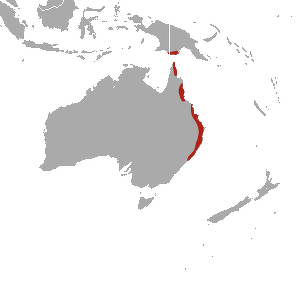
Red-legged pademelon range
Red-legged pademelons have thick, soft fur, short stout tails, round ears, a naked nose, and red-brown markings on their cheeks, thighs and forearms. Pademelons that live in dark forest regions have dark grey-brown coats and cream colored bellies. Those that live in open areas have pale grey-brown coats and pale grey bellies. Their hindfeet have no first digit, while the second and third digits are fused. The fourth digit is long. The maximum life span recorded is 9.7 years in the wild. |=|
Red-legged pademelons are primarily herbivores (eat plants or plants parts) but are also recognizes as folivores (eat leaves), frugivores (eat fruit) and omnivores (eat a variety of things, including plants and animals, Their diet consists mainly of fallen leaves and fruits. They have also been known to eat fresh leaves. Some of the leaves they consume are known to be poisonous. To combat this, they use an enzyme called GST. One of the favorite foods of Red-legged pademelons is the Moreton bay fig (Fiscus macrophylla). Other fruits that make up part of their diet are the Burdekin plum in the northern region and berries. Some plants that make up their diet are dicotyledonous plants, Fishborne ferns, and king orchids. During nocturnal grazing, they consume grasses like Paspalum notatum and Cyrtococum oxyphylum. They have also been known to eat the bark of trees, fungus, and cicadas.
Red-Legged Pademelon Behavior
Red-legged pademelons are terricolous (live on the ground), saltatorial (adapted for leaping), diurnal (active during the daytime), nocturnal (active at night), motile (move around as opposed to being stationary), sedentary (remain in the same area) and have dominance hierarchies (ranking systems or pecking orders among members of a long-term social group, where dominance status affects access to resources or mates). Red-legged pademelons are active around the clock, but tend to be least active from midday to early afternoon and midnight. [Source: Waseem Anani, Animal Diversity Web (ADW) |=|]
Red-legged pademelons are usually shy and solitary but associate in loosely organized groups. They commonly feed alone in the forest, but gather at night when feeding on the forest edge and have been seen together during the winter in basking spots where they keep warm. When foraging, they keep their noses to the ground slowly moving in a quadrupedal fashion. They rest with their tail is between the hindlegs, sitting on the base of their tails and leaning against a rock or tree. When sleeping, pademelons adopt a similar position except their head is leaned forward to rest on the tail or on the ground beside them. They often rest or sleep in depressions made in the ground.
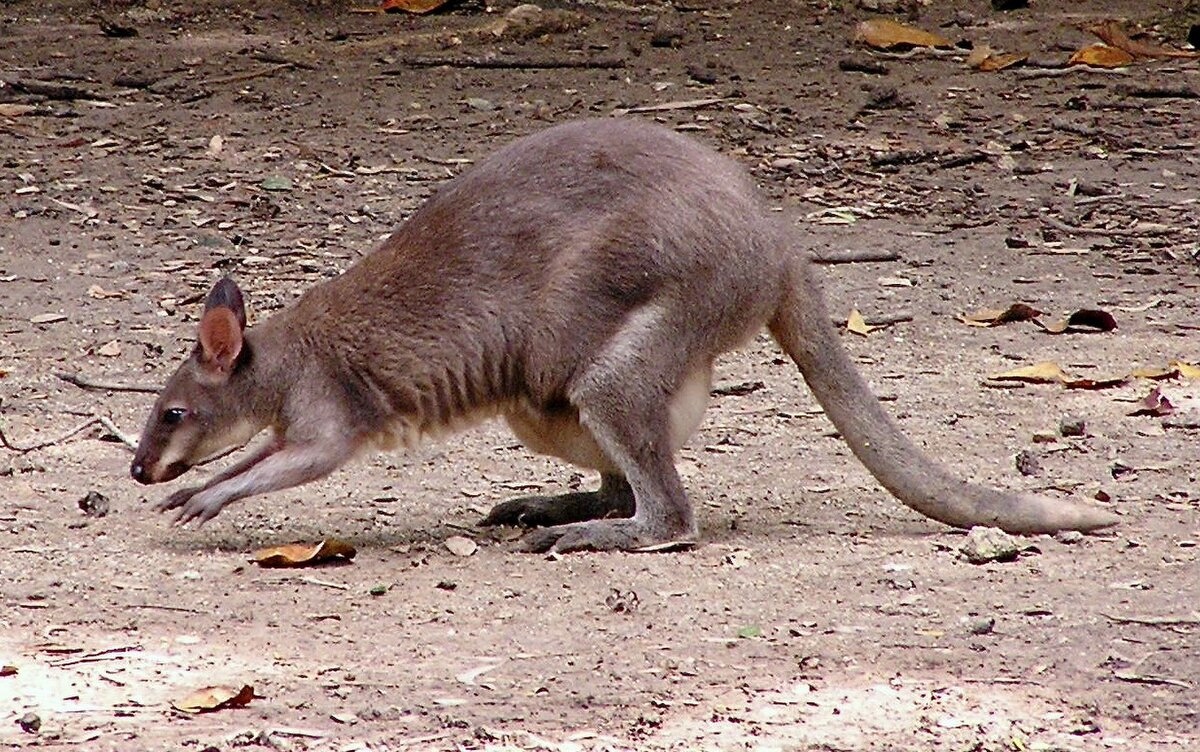
dusky pademelon from southern New Guinea
The home territories of red-legged pademelons range from one to four hectares (2.5 to 10 acres). This territory is separated into two regions: a much larger inner portion of the forest used during the day and a smaller forest edge portion used during the night. Within these areas red-legged pademelons move slowly, but when traveling between the two regions, they moves swiftly. Overall, they are more active in the forest during the early morning and late afternoon when searching for favored food items like dicots. The nocturnal night), region of their habitat is associated with more sedentary behavior and grazing (eating grass or other low-growing plants). While grazing at night, pademelons do not stray more than 70 meters from the forest edge. If frightened, they use a runways they have cleared to quickly move into the forest to take cover. When pademelons feed in the forest, they do so equally spaced at distances ranging from 30 to 50 meters. The spacing and area of feeding is controlled by a dominant pademelon.
Red-legged pademelons sense and communicate with vision, touch, sound and chemicals usually detected by smelling. They communicate mainly through sound. The soft clucking sound used by a mother to call her young is similar to the sound made by males trying to court a female. When frightened or alarmed, they thump their hind feet to alert other pademelonss of danger. At these time the animals use the pre-made runways in the forest to quickly escape.
Red-Legged Pademelon Mating, Reproduction and Offspring
Red-legged pademelons is polygynous are polygynous (males have more than one female as a mate at one time) and practice embryonic diapause (temporary suspension of development of the embryo). Females have an estrus cycle, which is similar to the menstrual cycle of human females. Red-legged pademelons in captivity engage in year-round breeding. The peak breeding season for those in the wild is on the spring but mating has been observed from October to June. The gestation period ranges from 28 to 30 days. The number of offspring ranges from one to one., with the average number of offspring being one. Females reach sexual or reproductive maturity at 10 to 14 months; males do so at 15 to 17 months. Postpartum mating usually occurs two to 12 hours after giving birth. As the young reaches the blastocyst (embryo) phase of development, embryonic diapause occurs. [Source: Waseem Anani, Animal Diversity Web (ADW) |=|]
As red-legged pademelons are mainly solitary, mating is one of the few times they can be found together in the wild. The estrus cycle of females generally lasts 31 days. Males in search of mates make soft clucking sounds to advertise their interest in females. Females that reject courting males make harsh rasping sounds. Males fight for access to females. When they fight, the two males hold their heads back to protect their eyes while standing upright on their hindlegs and swing their claws at each other. The goal of the fight is to knock the opponent off balance. When a male has accomplished this, he kicks the opponent in the abdomen. The fighting can often results in loss of fur and looks sort of like the boxing of kangaroos and wallabies.
Young red-legged pademelons are altricial, meaning they are relatively underdeveloped at birth. Parental care is provided by females. When the young is born, it infant climbs into the pouch of the mother pademelon with its well-developed forelimbs, as is true of all marsupials, and attaches itself toa teat. While it is in the pouch, an infant's sex is distinguishable even after 21 to 28 days. Vibrissae (whiskers) appear 56 to 70 days after birth. Pinnae (external part of the ear) become erect after 105 to 126 days. Teat detachment occurs 91 to 126 days after birth. Eyes open after 112 to 126 days. Hair becomes visible after 133 to 147 days. Emergence from the pouch, between 133 to 182 days after birth, is determined by the dirty feet of the young.
Young red-legged pademelons stays in the pouch for about six months. After emerging from the pouch, mothers protects and teaches their young what to eat and where to forage. After leaving the pouch, young continue nurising but only use one teat, leaving the other for its sibling. Mothers produce two types of milk while lactating. Weaning generally occurs between 44 to 111 days after the young permanently leaves the pouch.
Image Sources: Wikimedia Commons
Text Sources: Animal Diversity Web animaldiversity.org , National Geographic, Live Science, Natural History magazine, Australian Museum, David Attenborough books, Australia Geographic, New York Times, Washington Post, Los Angeles Times, Smithsonian magazine, Discover magazine, The Conversation, The New Yorker, Time, BBC, CNN, Reuters, Associated Press, AFP, Lonely Planet Guides, Wikipedia, The Guardian, Top Secret Animal Attack Files website and various books and other publications.
Last updated July 2025