
Home | Category: Animals / Nature, Environment, Animals / Marsupials
CUSCUSES
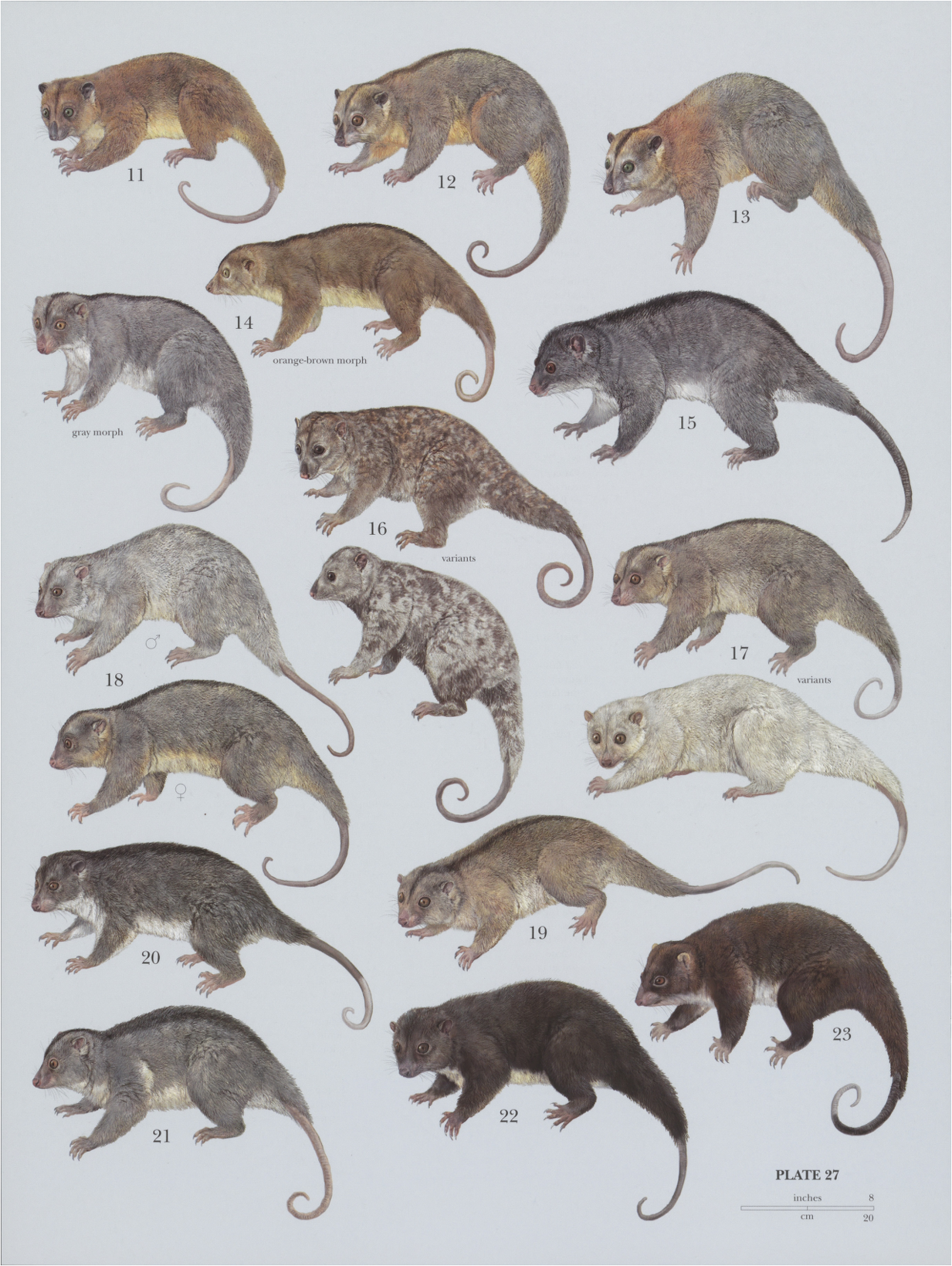
Cuscus species: 11) Peleng Cuscus (Phalanger pelengensus), 12) Moluccan Cuscus (Phalanger ornatus), 13) Gebe Cuscus (Phalanger alexandrae), 14) Obi Cuscus (Phalanger rothschildi), 15) Ground Cuscus (Phalanger gymnotis), 16) Woodlark Cuscus (Phalanger lullulae), 17) Northern Common Cuscus (Phalanger orientalis), 18) Eastern Common Cuscus (Phalanger intercastellanus), 19) Southern Common Cuscus (Phalanger mimicus), 20) Telefomin Cuscus (Phalanger matanim), 21) Stein’s Cuscus (Phalanger vestitus), 22) Silky Cuscus (Phalanger sericeus), 23) Mountain Cuscus (Phalanger carmelitae), 24) Black Spotted Cuscus (Spilocuscus rufoniger), 25) Waigeo Spotted Cuscus (Spilocuscus papuensis), 26) Admiralty Spotted Cuscus (Spilocuscus kraemeri), 27) Blue-eyed Spotted Cuscus (Spilocuscus wilsoni), 28) Common Spotted Cuscus (Spilocuscus maculatus), 29) Australian Spotted Cuscus (Spilocuscus nudicaudatus)
Cuscus is the common name generally given to the species within the four genera of Australasian possum in the family Phalangeridae. 1) bear cuscuses (genus Ailurops); 2) genus Phalanger, whose members are found on New Guinea, the Maluku Islands in Indonesia, other nearby small islands, and Australia's Cape York Peninsula; 3) genus Spilocuscus, whose members are found on Cape York, New Guinea, and smaller nearby islands; and 4) dwarf cuscus (genus Strigocuscus), found only in Sulawesi and some of its surrounding small offshore islands. [Source: Wikipedia]
Cuscus Species:
Ailurops (bear cuscus) genus:
Talaud bear cuscus (Ailurops melanotis) that live on Salebabu Island in the Talaud Islands
Sulawesi bear cuscus (Ailurops ursinus) that live Sulawesi, Peleng Island, Muna Island, Butung Island and Togian Islands
Genus Spilocuscus:
Admiralty Island cuscus (Spilocuscus kraemeri)
Common spotted cuscus (Spilocuscus maculatus)
Waigeou cuscus (Spilocuscus papuensis)
Black-spotted cuscus (Spilocuscus rufoniger)
Blue-eyed spotted cuscus (Spilocuscus wilsoni)
Genus Strigocuscus (Dwarf cuscuses):
Sulawesi dwarf cuscus (Strigocuscus celebensis))
Banggai cuscus (Strigocuscus pelengensis)
Genus Phalanger:
Gebe cuscus (Phalanger alexandrae)
Mountain cuscus (Phalanger carmelitae)
Ground cuscus (Phalanger gymnotis)
Eastern common cuscus (Phalanger intercastellanus)
Woodlark cuscus (Phalanger lullulae)
Blue-eyed cuscus (Phalanger matabiru)
Telefomin cuscus (Phalanger matanim)
Southern common cuscus (Phalanger mimicus)
Northern common cuscus (Phalanger orientalis)
Ornate cuscus (Phalanger ornatus)
Rothschild's cuscus (Phalanger rothschildi)
Silky cuscus (Phalanger sericeus)
Stein's cuscus (Phalanger vestitus)
Cuscus live in tropical areas and spend most of their time in trees. They are marsupials, even though they have some appearances, traits and attributes like those of lemurs of Madagascar, which are prosimians, due to convergent evolution.
The cuscus name comes from the word kusu or kuso in some local related languages spoken in the Maluku Islands like Bacan and Ambonese Malay. The name is also applied in parts of Indonesia to the Sunda slow loris, where people do not distinguish this from the "kuskus" possums. Lorises are primates and are unrelated to the other cuscus species.
RELATED ARTICLES:
CUSCUSES OF SULAWESI factsanddetails.com
POSSUMS OF AUSTRALIA AND NEW GUINEA: SPECIES: CHARACTERISTICS, BEHAVIOR AND REPRODUCTION ioa.factsanddetails.com
BRUSHTAILED POSSUMS: CHARACTERISTICS, BEHAVIOR, REPRODUCTION, SPECIES, PESTS ioa.factsanddetails.com
GLIDERS OF AUSTRALIA AND NEW GUINEA: MARSUPIAL EQUIVALENTS OF FLYING SQUIRRELS ioa.factsanddetails.com
GLIDER SPECIES (SUGAR, MAHOGANY, GREATER, YELLOW-BELLIED): CHARACTERISTICS AND BEHAVIOR ioa.factsanddetails.com
MARSUPIALS: HISTORY, EVOLUTION, CHARACTERISTICS, BEHAVIOR, REPRODUCTION ioa.factsanddetails.com
MARSUPIALS IN AUSTRALIA ioa.factsanddetails.com
MARSUPIALS IN AUSTRALASIA (AUSTRALIA, NEW GUINEA, NEARBY ISLANDS) ioa.factsanddetails.com
Common Spotted Cuscuses
Common spotted cuscuses (Spilocuscus maculatus) are cuscuses that lives in the Cape York in Queensland, Australia and on New Guinea (in both West Papua, Indonesia and Papua New Guinea), and nearby smaller islands at at elevations up to 1000 meters (3280feet). They are also known as white cuscuses and aklang or gabi in the Kalam language of Papua New Guinea. In New Guinea, common spotted cuscus are found in secondary forests and tropical lowland forests, where they forage in the understory, subcanopy, and canopy layers. Common spotted cuscus can live in close proximity to human settlements, agricultural fields and coconut plantations. In Australia, common spotted cuscus also inhabit freshwater and saline mangrove forests. The range of common spotted cuscuses overlaps with the range of southern common cuscuses in New Guinea and in a small portion of the Cape York Peninsula in Australia and with common brushtail possums on the Cape York Peninsula. Southern common cuscuses and common brushtail possum belong to the same Phalangeridae family as common spotted cuscuses. [Source: Alyssa Eby, Animal Diversity Web (ADW) |=|]
Common spotted cuscuses are medium-sized marsupials. They range in weight from three to six kilograms (6.6 to 13.2 pounds) and have a head and body length of 34.8 to 58 centimeters (13.7 to 22.83 inches). The average tail length is 31 to 43.5 centimeters (12.2 to 17.1 inches).4/4. Compared to other mammals, common spotted cuscuses have a relatively low basal metabolic rate. Their average basal metabolic rate is 6.27 W and their basal body temperature is 34.6°C. In captivity common spotted cuscuses have been documented to live for seven to nine years.
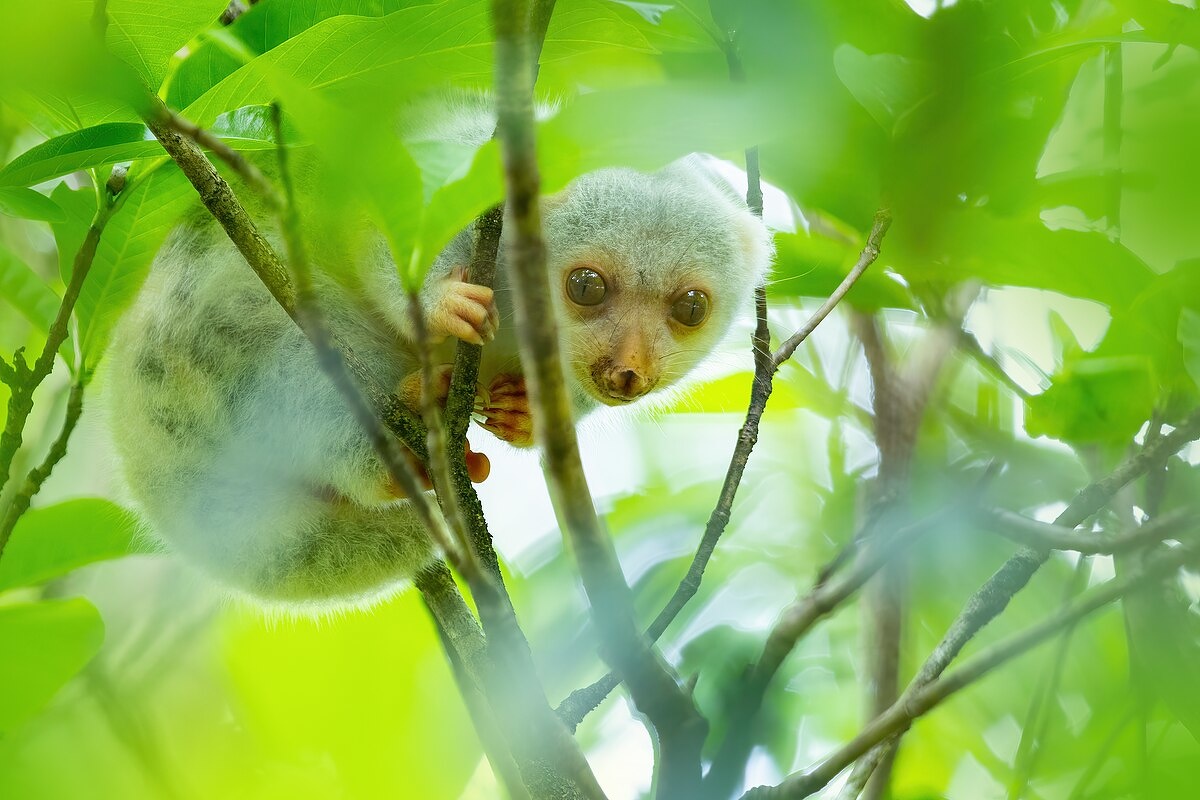
Common spotted cuscus
Sexual Dimorphism (differences between males and females) is present: Males are larger than females and sexes are colored or patterned differently with the male being more colorful. Male fur is white with red-brown spots and female fur is all white without spots. Males range in weight from 4 to 4.8 kilograms (8.8 to 10.6 pounds) and have a head and body length of 51.5 to 55.5 centimeters (20.3 to 21.9 inches). Females range in weight from three to 4.1 kilograms (6.6 to 9 pounds) and have a head and body length of 48.5 to 52.5 centimeters (19 to 20.7 inches).
Common spotted cuscuses have long, prehensile tails, capable of holding on to branches, that lack fur, but have rough papillae on the lower side. The skull is wide and characterized by a short rostrum (hard, beak-like structures projecting out from the head or mouth), thick zygomatic arches and large posterior vacuities on the palate. Common spotted cuscuses have diprotodont dentition with long canines and low crowned lophodont molars. The dental formula of the family Phalangeridae is 3/2, 1/0, 2-3/2-3, The fur of common spotted cuscuses is thick and insulative and whitish or yellowish in color. A ring of yellow-red skin is present around their blue-green eyes. Juveniles have grey downy fur. Juveniles have grey downy fur. Southern common cuscuses have brown fur with a dorsal stripe, a longer snout and larger ears than common spotted cuscuses.
Common spotted cuscuses are not endangered or threatened. They are designated as a species of least concern on the International Union for Conservation of Nature (IUCN) Red List. There are in CITES (Convention on International Trade in Endangered Species of Wild) Appendix II, which lists species not necessarily threatened with extinction now but that may become so unless trade is closely controlled. Common spotted cuscuses are mainly threatened by deforestation and habitat loss but they do fairly well in human-distrubed environments. Humans have hunted common spotted cuscuses for food and for fur and skins used in clothing and accessories such as bags and hats). In New Guinea, hunting sometimes has ritualist meaning and has traditionally been carried by adult and males in groups of one to ten individuals. The main predators of common spotted cuscuses are Kapul eagles, white-breasted sea eagles and humans. Their main defenses are camouflage and escaping in trees.
Common Spotted Cuscus Behavior, Diet and Reproduction
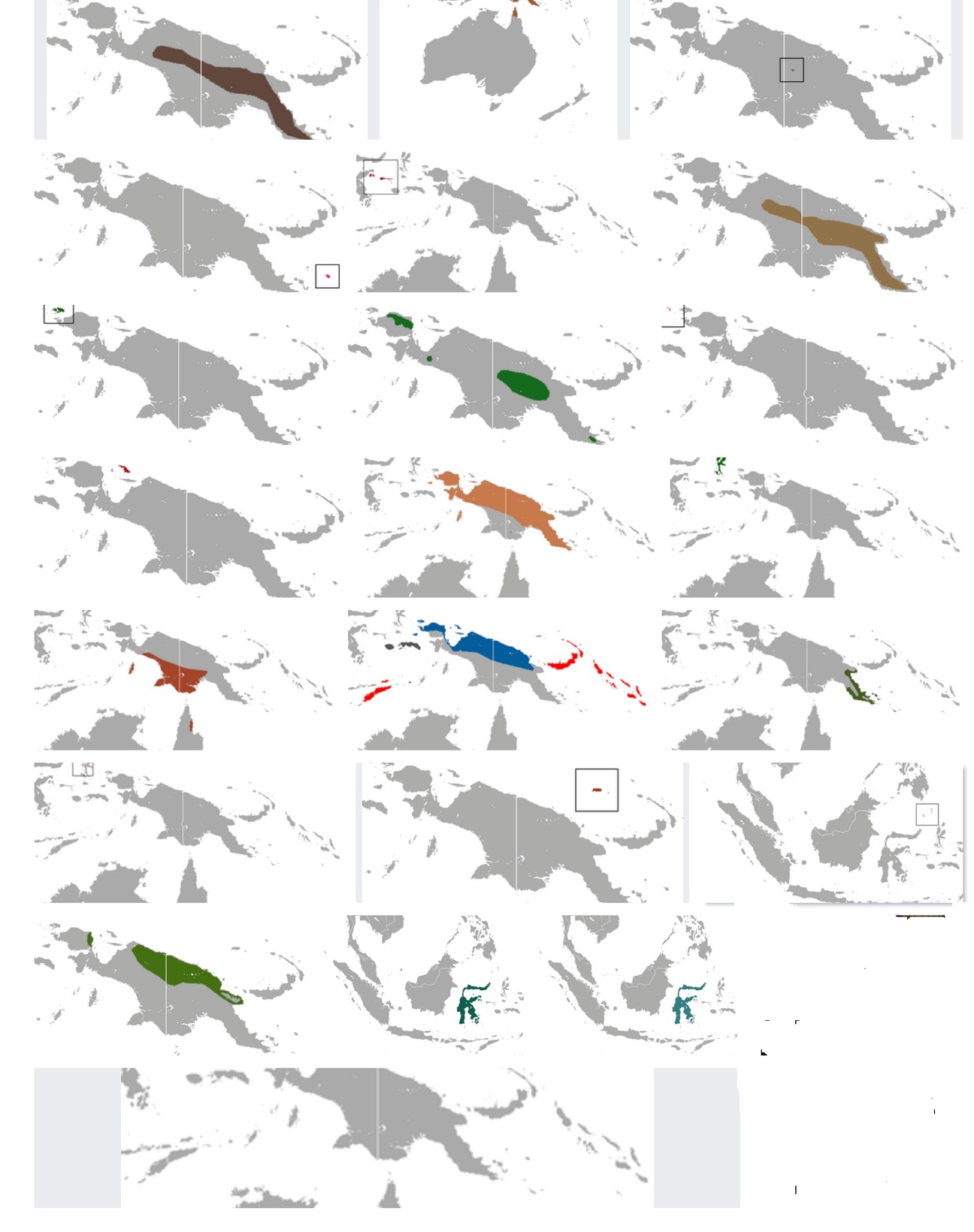
Range of different cuscus species
Top row (left to right): 1) silky cuscus; 2) spotted cuscus; 3) Telefomin cuscus
Second row (left to right): 1) woodlark cuscus; 2) Banggai cuscus; 3) Mountain cuscus
Third row (left to right): 1) Waigeo cuscus; 2) Steins cuscus; 3) blue-eyed spotted cuscus
Fourth row (left to right): 1) Gebe cuscus; 2) ground cuscus; 3) ornate cuscus
Fifth row (left to right): 1) southern common cuscus; 2) northern common cuscus; 3) Eastern common cuscus
Sixth row (left to right): 1) blue-eyed cuscus; 2) Admiralty Island cuscus; 3) Talaud bear cuscus
Seventh row (left to right): 1) black-spotted cuscus; 2)Sulawesi bear cuscus; 3) Sulawesi dward cuscus
Last row: Rothchild’s cuscus
Common spotted cuscuses are arboreal (live mainly in trees), scansorial (good at climbing), nocturnal (active at night), crepuscular (active at dawn and dusk), motile (move around as opposed to being stationary), sedentary (remain in the same area) and solitary. They have an average home range size of about one hectare (2.5 acres). Common spotted cuscuses communicate with sound and probably scents and sense using touch, sound and chemicals detected by smelling. Females produce a bray call when in oestrous. Both sexes are known to make several types of calls, including hissing, screeches and buccal clicks. [Source: Alyssa Eby, Animal Diversity Web (ADW) |=|]
Although common spotted cuscuses are skilled climbers they have also been observed walking between trees and are capable of galloping. During the day they generally sleep in the forest canopy where they shield themselves with foliage to camouflage their bodies from predators. Common spotted cuscus have been observed using behavioral thermoregulation, panting and licking their feet, to stay cool. Captive male common spotted cuscuses are aggressive towards one another and cannot be kept in the same enclosure.
Common spotted cuscuses are omnivores (eat a variety of things, including plants and animals) but are primarily herbivores (eat plants or plants parts) and folivores (eat leaves). The of diet of common spotted cuscuses mainly consists of leaves from plants such as epiphytic ferns, climbers, Piper betle and Ficus species. They often selectively consume young shoots and leaves. Less frequently, they eat immature coconuts, fruits of Pometia pometia, insects, and small vertebrates.
Common spotted cuscuses are polygamous (have more than one mate) and typically breed once a year, which translates to relatively low reproductive rate. Females have an estrus cycle of twenty-eight days. The number of offspring ranges from one to 4, with the average number of offspring being two. The gestation period ranges from 20 to 42 days and the age in which young become independent ranges from five to seven months. Parental care is carried out by females. Mothers have been observed carrying offspring on their back following the emergence of offspring from the mother's pouch. Among Phalangeridae, the family to which common spotted cuscuses belongs, the number of offspring is limited by food availability which influences the reproductive capacity of individuals. On average males reach sexual or reproductive maturity at eight months when their testes descend.
Black-Spotted Cuscuses

Black-spotted cuscus, from Palm Oil Detectives
Black-spotted cuscuses (Spilocuscus rufoniger) are the second largest marsupial in the family Phalangeridae; only bear cuscuses are bigger, and critically endangered. They are relatively colorful and found in forests of northern New Guinea and are threatened by hunting and habitat loss, and have already disappeared from large parts of their range. For a long time,black-spotted cuscuses were considered a subspecies of common spotted cuscuses (Spilocuscus maculates) but were reclassified as a unique species in 1987. They live in northern New Guinea in the provinces of Morobe and Sattelberg Papua New Guinea and northeast West Papua in Indonesia. Black-spotted cuscuses inhabits tropical forests and thick scrub areas up to elevations of 1200 meters (3937 feet). [Source:Lisa Bey, Animal Diversity Web (ADW) |=|]
Black-spotted cuscuses are quite large for a tree-dwelling animal. Adults weigh between is six and seven kilograms (13.2 and 15.4 pounds). Their head and body lngth averages 70 centimeters (27.6 inches), with the tail adding an additional 50 centimeters (19.7 inches) on average. Sexual Dimorphism (differences between males and females) is present: Females are larger than males and sexes colored and patterned differently. Both males and females have striking black and red coloration, but females have a dark saddle on their backs, while males only have an area of mottling or spots. Female black-spotted cuscus have four mammae. Their pouches are forward opening and well developed. Young go through a sequence of color changes as they mature. The fur of black-spotted cuscus is dense and wooly. |=|
Lisa Bey wrote in Animal Diversity Web: Black-spotted cuscuses have short snouts, and their ears are almost invisible. The head is round with a pointed snout and large eyes that are adapted for a nocturnal lifestyle. The first and second fingers are opposable to the other fingers. Their foreclaws are curved and sharply pointed for climbing. The foot is modified for grasping in that the big toe is opposed to the others. This toe is also clawless. The second and third toes are small and fused. Black-spotted cuscus have highly prehensile tails that are naked at the terminal end. The underside of the tail is striated with calluses for grasping. |=|
In both sexes, the frontal bones of the skull are distinctly convex and have a large sinus that does not open into the nasal cavity. The teeth of cuscus have low crowns. Black-spotted cuscuses can be distinguished from other spotted cuscus by the presence of small, peg-like premolars in front of the main premolar of their upper jaws. Cuscus have a well-developed protocone on the first upper molar. The alisphenoid and basoccipital consistently form a more extensive structure that is developed earlier in life than it is in other phalangerids.
On the International Union for Conservation of Nature (IUCN) Red List they are listed as Critically Endangered, which is just short of being declared extinct. On the U.S. Federal List they are classified as Endangered. Their main threats are hunting, deforestation and habitat loss. Because of their large size and colorful fur, Black-spotted cuscuses have long been valued by hunters for their coat and its meat. Papuans value the meat and use the dense fur for caps and capes. Conservation is limited and there are few national parks and reserves to help protect them.
Black-Spotted Cuscus Behavior, Diet and Reproduction
Black-spotted cuscuses are solitary, nocturnal (active at night), motile (move around as opposed to being stationary) and mostly arboreal (live mainly in trees) but occasionally descends to the ground to forage. They rest during day curled up exposed on a branch high in the canopy. They are slow moving and sluggish in their behavior. Individuals usually feed and nest alone and interactions between individuals are often aggressive. They sense using touch and chemicals usually detected with smell. |=|
Black-spotted cuscuses are primarily omnivores (eat a variety of things, including plants and animals). There is little information about the diet of black-spotted cuscuses. They are thought to consime fruits, leaves and nuts. Large acorns of Lithocarpus species have been found with chew marks on them that are thought to be from this cuscus. They possibly feeding occasionally on small animals.
The mating behavior of Black-spotted cuscuses is for the most part unknown. Mating and courtship probably tale place on canopy tree limbs. Young are altricial, meaning they are relatively underdeveloped at birth. Female provides protection for her young in her pouch, where they are and nursed.
Northern Common Cuscuses
Northern common cuscuses (Phalanger orientalis) are also known as gray cuscuses. They are native to northern New Guinea and adjacent smaller islands, but are also found in the Bismarck Archipelago, the Indonesian islands of Buru and Seram in southeast and central Moluccas, the Solomons, and Timor. It is thought that these animals were introduced to these places from New Guinea by humans in prehistoric times. Northern common cuscuses mainky live tropical rainforests and thick scrub in rainforests at elevations from sea level to 1600 meters (5249 feet) and are occasionally spotted in gardens.In the past, northern common cuscuses, eastern common cuscus and southern common cuscuses were thought to be subspecies of the same species but now they are recognize as separate species.[Source: Laura Merlo, Animal Diversity Web (ADW) |=|; Wikipedia]
Northern common cuscuses, like others cuscuses, are powerfully built. They range in weight from one to five kilograms (2.2 to 11 pounds), with their average weight being 2.1 kilograms (4.6 pounds). They have a head and body length of 35 to 55 centimeters (13.78 to 21.65 inches), with their average length being 39 centimeters (15.35 inches). Their tail is 28-to-42 centimeters (11-to-16.5 inches) long. Sexual Dimorphism (differences between males and females) is present: Males are slightly larger than females. Coloration is different In adult males, the thick, wooly fur ranges in color from white to medium or dark grey. In adult females, the color ranges from reddish-brown to brownish-grey. The stomach area is commonly white. The male has a distinct yellowish chest gland. Usually a dark stripe runs from the head to the lower back. Juveniles are reddish-brown. The tail of males is completely white wbile the tail of female tails are white only on the tips.
Northern common cuscuses have a prehensile tail that is naked at the end and covered with horny papillae that the tail grasp branches. The digits are of different lengths and are tipped by long, curved claws. Their paws are fused together, with the first and second digits opposable to the rest. The soles of their feet are naked and striated, useful for moving around on branches and climbing. The female pouch has four mammae. Facial features include large eyes, long canines and a snout longer than that of common spotted cuscuses. The teeth are simple, low crowned and used for grinding.
On the International Union for Conservation of Nature (IUCN) Red List Northern common cuscuses are listed as a species of Least Concern. In CITES (Convention on International Trade in Endangered Species of Wild) they are in Appendix II, which lists species not necessarily threatened with extinction now but that may become so unless trade is closely controlled. Northern common cuscuses are impacted by deforestation and habitat loss. They are hunted for food by local people but not much. Among the known predators are white-bellied sea-eagles, amethystine pythons, carpet pythons and quolls.
Northern Common Cuscus Behavior, Diet and Reproduction
Northern common cuscuses are nocturnal (active at night), arboreal (live mainly in trees), motile (move around as opposed to being stationary) and solitary. They spend the day in a tree hollow and come out at night to foraging for food, moving through the forest at a slow, deliberate pace. Northern common cuscuses grip with three feet at a time and their tail wrapped around a branch for added stability. Ground travel is characterized by a slow, bounding gait. This often done to to get from tree to another. If necessary, northern common cuscuses can move rapidly through the canopy and jump across gaps. Northern common cuscuses are usually solitary and have been observed being very intolerant of common spotted cuscuses when they come in contact. Northern common cuscuses can tolerant of humans, and have been kept as pets. [Source: Laura Merlo, Animal Diversity Web (ADW) |=|; Wikipedia]
Northern common cuscuses are herbivores (eat plants or plants parts) and recognize as folivores (eat leaves) and frugivores (eat fruit). As they move slowly through the rainforests they feed mainly on leaves, tree seeds, fruit, buds and flowers. They have been documented eating the green fruit of the Red Cedar (Toona australis) and the buds and flowers of Corky Bark (Carallia brachiata). A paste derived from the seeds of the Black Bean Tree (Castanospermum australe) was found in the stomach of one animal. In captivity they are primarily fed leaves and fruit.

Northern common cuscus in Indonesia
Northern common cuscuses engage in seasonal breeding — once a year, usually from June through October though March and November births have been observed. The average gestation period is 13 days. Young are altricial, meaning they are relatively underdeveloped and weigh only one gram at birth. Parental care is provided by females. Normally females give to twins, but the number of young ranges from one to three. Usually, one of the twins dies before weaning.
Woodlark Cuscuses
Woodlark cuscusses (Phalanger lullulae) are endangered and endemic to the Woodlark Islands, part of Milne Bay Province in Papua New Guinea. They are largest mammal living on Woodlark Island and also found on the neighboring island of Alcester, 70 kilometers (110 miles) to the south. Woodlark cuscuses prefers primary and secondary lowland dry forest. They are more plentiful on the eastern side of Woodlark Island, where this habitat exists rather than on western side, which is covered by dense jungle. On the International Union for Conservation of Nature (IUCN) Red List, Woodlark cuscuses are listed as Endangered. Before 1987, only eight specimens of Woodlark cuscuses had been so it was believed that the species was on the brink of extinction. Observations in 1987 showed that they were healthy numbers on the Eastern half of Woodlark Island and on Alcester Island, however, they were still considered endangered because they are found in such a small, restricted area. Woodlark cuscuses is hunted for meat by Woodlark Island's indigenous people but not so much and usually only when seas are too rough to fish. The biggest threat to these cuscuses is planned palm oil development by a Malaysian biofuels company. [Source: Corie Hanna, Animal Diversity Web (ADW) |=|; Wikipedia]
Woodlark cuscuses are a medium sized marsupials. They range in weight from 1.5 to two kilograms (3.3 to 4.4 pounds, with an average weight is 1.7 kilograms (3.7 pounds). They have a head and body length of 63.8 to 71.7 centimeters (25.1 to 28.3 inches), with their average length being 68.8 kilograms (27 inches). Sexual Dimorphism (differences between males and females) is present: Females are on average are slightly larger than the males. Woodlark cuscuses have a distinctive fur. It is short and woolly with irregularly marbled brown, ochre, and white markings on the back. The undersides are white with irregular dark spots. Color varies among individuals. from predominantly dark with some lighter spots to predominantly light colored with a few small darker spots. The species has black facial skin and a pink rhinarium. Pale ear flashes are sometimes present. Woodlark cuscuses are highly adapted to living in trees. Their tail is long and prehensile. The end of the tail is naked and used to assist in gripping. Digits one and two are opposable against three, four, and five. The first and second digits of the pes are fused together. The skull is pear shaped and widest at the posterior end of the zygomatic
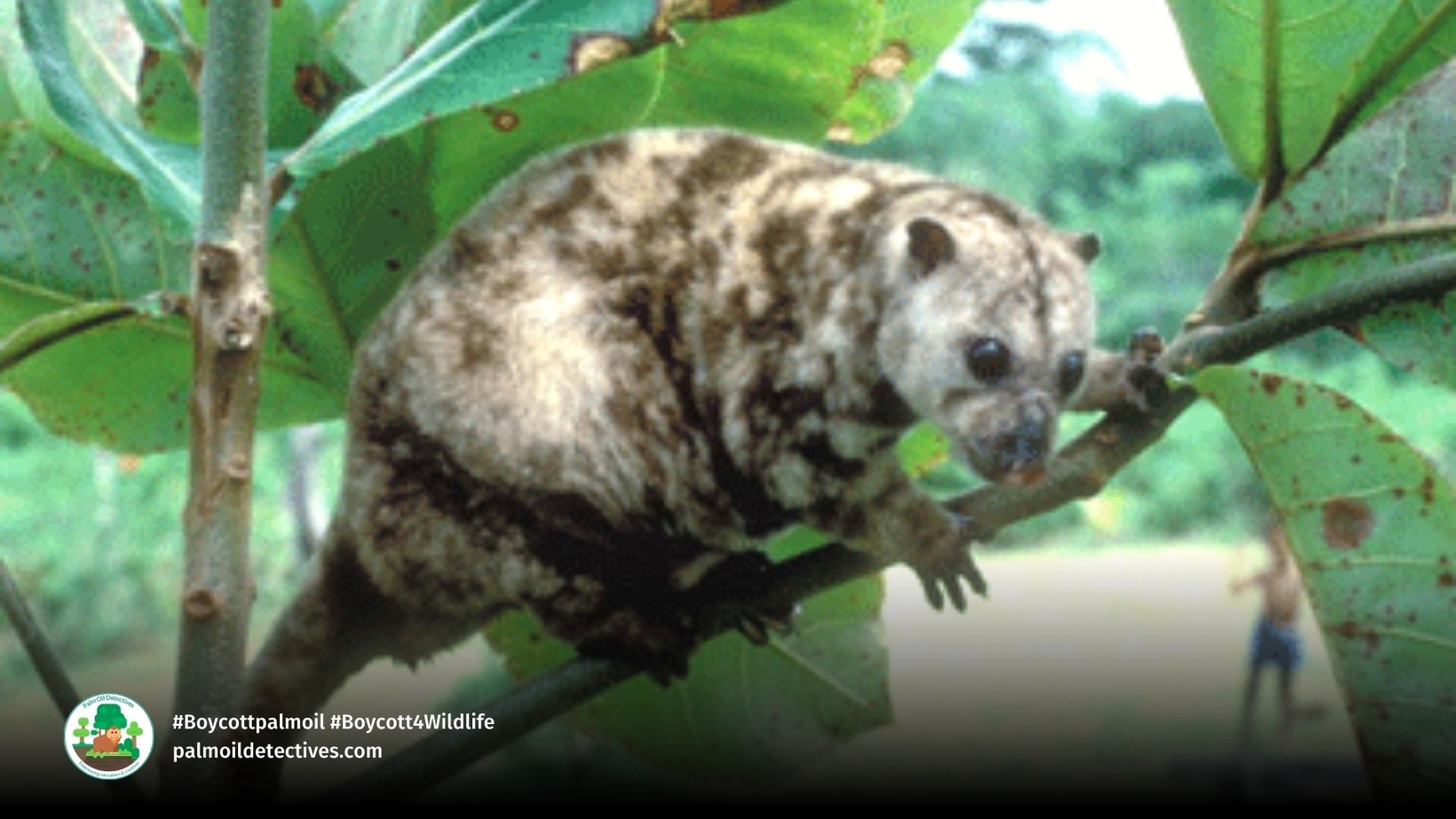
Woodlark cuscus, from Palm Oil Detectives
Woodlark cuscuses are solitary, nocturnal (active at night) and motile (move around as opposed to being stationary). Radio tracking has shown a strong tendency of individuals to center their activities around a small number of sleeping trees. The animals sleep during the day sheltered in hollows within these trees and emerge at night to forage in the upper part of the forest canopy. They are almost completely arboreal. Interactions between individuals are often aggressive Woodlark cuscuses are herbivores (eat plants or plants parts) and also recognized as folivores (eat leaves). Local people on Woodlark and Alcester Islands saud that they mainly feed on two species of vine. They may also eat fruit and even meat when available.
Mating behavior of Woodlark cuscuses has not been observed. In August 1987, five females were captured. One was pregnant, one had no young, two had naked pouch young, and one had a well grown young on its back. From this it can be inferred that the breeding season very long or the cuscuses engaged in year-round breeding.
Ground Cuscuses
Ground cuscuses (Phalanger gymnotis) are found mostly on the northern two thirds of New Guinea, in both Papua New Guinea and West Papau in Indonesia as well as the islands of Yapen, Misool, Salawati and the Aru Islands in Indonesia.. Although rare, they have also been sighted in southernmost regions of New Guinea. Ground cuscuses occupies a variety of habitats including rainforests, caves and gardens from sea level up to 2,700 meters (8,860 feet) but is most common at the lower elevations. Primarily terrestrial, ground cuscuses seek shelter in dens, which are constructed in caves, under trees, and along stream beds. They are sometimes found in cultivated gardens near humans. [Source: Colleen Macke, Animal Diversity Web (ADW) |=|]
Ground cuscuses was formerly a member of the genus Spilocuscus, but molecular data led to its reclassification. There are two subspecies: 1) Phalanger gymnotis gymnotis and Phalanger gymnotis leucippus. The lifespan of wild of ground cuscuses is but individuals in captivity ahve lived up to 15 years of age.
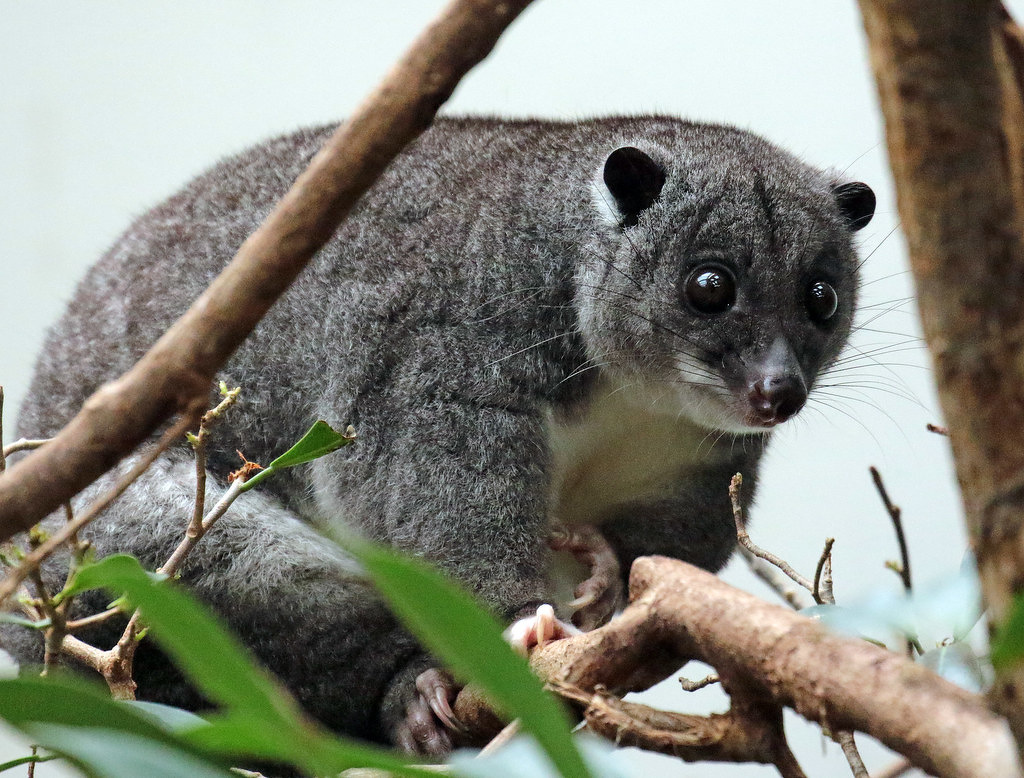
ground cuscus
On the International Union for Conservation of Nature (IUCN) Red List ground cuscuses are listed as a species of Least Concern. They have traditionally been hunted by local people using traps, dogs, and traditional methods for meat and fur. Although hunting has significantly reduced local populations the species remains widely distributed and is abundant throughout its geographic range. In Indonesia, Ground cuscuses are protected by law and cannot be captured, kept or traded. Until recently, it was acceptable for only the most senior members of many regional tribes in New Guinea to consume ground cuscuses, and as a result, they were infrequently hunted. As food taboos in rural villages changed during the 1970s and 1980s, ground cuscuses became an acceptable food source for members of almost all social levels resulting in increased pressure from hunting. Ground cuscuses may dwell in and around cultivated gardens and eat crops such as sweet potatoes and are thus regarded as crop pests.
Ground Cuscus Characteristics and Diet
Ground cuscuses are fairly large marsupials. They range in weight from 1.5 to 4.6 kilograms (3.3 to 10.6 pounds). They have a head and body length of 31 to 54 centimeters (12.2 to 21.2 inches). Their tail ranges from 29 to 33.5 centimeters (11.4 to 13.2 inches) long. Their average basal metabolic rate is 518.2 cubic centimeters of oxygen per gram per hour. Individuals in the northernmost part of their range and at lower elevations tend to be larger than further south and at at higher altitudes. [Source: Colleen Macke, Animal Diversity Web (ADW) |=|]
Ground cuscuses have short, coarse, grey-brown or silver-grey fur and a dark stripe running down their back. Fur covers about part of the tail near the rump. tail. The remainder of the tail is covered in small bumpy growths that help the prehensile tail get a good grip. Ground cuscuses have little or no fur on their ears. This feature and the dark back stripe distinguish ground cuscuses from other cuscuses. At higher elevations tail fur is more dense and may have a white tip. Similar to other cuscuses, ground cuscuses have five digits on each foot, including a single opposable digit — the only digit lacking a claw. The skulls of Ground cuscuses feature apowerful zygomatic arch and prominent sagittal crest. The two subspecies are differentiated by the wider palate and broader nasals of p.g gymnotis.
Ground cuscuses are primarily frugivorous (eat fruits) but are technically omnivores (eat a variety of things, including plants and animals). They consumes eggs, seeds, and leaves and forage on fruit and leaves of plants from numerous genera, including Elaeocarpus, Ficus, Pipturus, Pandanus, Oenathe, Rungia, and Ficus odoardii. Fruit is collected from trees and from the ground. Female ground cuscuses have been observed filling their pouches with fruit and then returning to their home dens where it is stored.
Ground Cuscus Behavior and Reproduction
Ground cuscuses are arboreal (live mainly in trees), scansorial (good at climbing), terricolous (live on the ground), nocturnal (active at night), motile (move around as opposed to being stationary) and solitary. Outside of mating season, ground cuscuses are solitary and asocial, and individuals are often aggressive toward members of their own species. Fighting is common and includes hissing, honking, foot thumping and striking opponents with the forelimbs. [Source: Colleen Macke, Animal Diversity Web (ADW) |=|]
Ground cuscuses build terrestrial dens and forage in the mid to lower canopy at night. They generally remain on low, stable branches while foraging. Using their flexible, gripping tail and opposable hind thumbs, they are good and can easily traverse a variety of forest habitats. While ground cuscuses are mostly nocturnal, some individuals have been observed outside their dens during the early morning.
Ground cuscuses sense using vision, touch, sound and chemicals usually detected with smell and communicate with sound, pheromones (chemicals released into air or water that are detected by and responded to by other animals of the same species) and scent marks produced by special glands and placed so others can smell and taste them. Ground cuscuses uses urine and cloacal gland secretions as scent markers. The scent, produced by both males and females, is said to smell like coffee. They likely use pheromones to demarcate territorial boundaries and to attract potential mates. Ground cuscuses communicate vocally before and during mating and while fighting. While fighting, Ground cuscuses hisses, honks, and foot thumps to communicate aggression.
Ground cuscuses breed year round and employ delayed implantation (a condition in which a fertilized egg reaches the uterus but delays its implantation in the uterie lining, sometimes for several months). The average gestation period is 13 days. The number of offspring range is usually one. In captive populations, males court females by chasing and biting prospective mates when they are in estrus. Chasing may occur during daylight hours, but is most common at night. The mating system is either polygynous or polygynandrous, as males have been noted mating with at least two different females.
Although gestation lasts 13 days, delayed implantation may occur, lengthening the time between copulation and birth. The breeding interval is assumed to correspond with the length of time to independence for young. Young are altricial, meaning they are relatively underdeveloped at birth. Parental care is provided by females. Young remain in the mothers pouch for approximately three months, at which point they exit the pouch at night. They continue to sleep in the pouch until the age of five to seven months, when they leave permanently. Time to weaning is unclear as the continued use of the pouch makes weaning observations difficult.
Image Sources: Wikimedia Commons
Text Sources: Animal Diversity Web animaldiversity.org , National Geographic, Live Science, Natural History magazine, Australian Museum, David Attenborough books, Australia Geographic, New York Times, Washington Post, Los Angeles Times, Smithsonian magazine, Discover magazine, The Conversation, The New Yorker, Time, BBC, CNN, Reuters, Associated Press, AFP, Lonely Planet Guides, Wikipedia, The Guardian, Top Secret Animal Attack Files website and various books and other publications.
Last updated August 2025