
Home | Category: Animals / Animals / Nature, Environment, Animals / Kangaroos, Wallabies and Their Relatives / Marsupials
MARSUPIALS IN AUSTRALASIA
Marsupials are found in Australasia. Australasia is the term used to describe Australia, New Zealand, New Guinea, and the surrounding islands, including many of those in eastern Indonesia and the Solomon Islands Our use of Australasia here excludes New Zealand and includes Indonesian islands as far west the Wallace Line near Bali and Sulawesi. Australasia is a subregion of Oceania. Australasia does not include most of the islands of the South Pacific such Vanuatu, Tahiti, Tonga and Samoa. Marsupials are not found on these Pacific Islands unless they have been introduced by humans.
During the ice ages, when sea levels were 65 meters lower than they are now and the climate was wetter than it is today, Australia, Tasmania and New Guinea were part of a single continent called Meganesia. The geological and biological record bears this out. New Guinea, for example, also has kangaroos. A couple of Indonesian islands may have been part of the 60,000 year old continent: a previously unidentified species of tree kangaroo was discovered on an island near Irian Jaya in 1994. [Source: Tim Flannery, Natural History, June 1993, December 1995]
Niches filled by mammals on other continents are occupied by marsupials on Australasia. "There are, so to speak, lion and tiger marsupials," the journalist Joseph Judge said, "lamb and sheep marsupials, tree climbing and ground hugging marsupials.”
Laura Geggel wrote in Live Science: It's unclear why marsupials thrived in Australasia. But one idea is that when times were tough, marsupial mothers could jettison any developing babies they had in their pouches, while mammals had to wait until gestation was over, spending precious resources on their young, Beck said. Another idea is that there were no placental mammals competing with the marsupials in Australia. But this idea is now contradicted, by a fossil tooth that belongs to a placental mammal or a placental-mammal relative discovered at Tingamarra. This indicates that placental mammals were on the continent as far back as 55 million years ago, Beck said. [Source: Laura Geggel, Live Science, March 3, 2019]
There are around 270 marsupial species currently found in Australasia, which includes Australia, New Guinea, and nearby islands, with around 200 in Australia itself. Approximately half of the mammal species in Australia are marsupials. Australasia is unique in that it is the only continent where all three major groups of mammals (monotremes, marsupials, and placentals) are still found, with marsupials being the most prominent group. Past marsupial faunas in Australia, included rhinoceros-sized, wombat-like marsupial herbivores, kangaroos nearly 10 feet tall, and carnivorous marsupial lions with shearing teeth and retractile claws.
RELATED ARTICLES:
MARSUPIALS: HISTORY, EVOLUTION, CHARACTERISTICS, BEHAVIOR, REPRODUCTION ioa.factsanddetails.com
MARSUPIALS IN AUSTRALIA ioa.factsanddetails.com
KANGAROOS AND WALLABIES (MACROPODS): CHARACTERISTICS, HISTORY, POPULATIONS ioa.factsanddetails.com
KANGAROO BEHAVIOR: FEEDING, REPRODUCTION, JOEYS ioa.factsanddetails.com
WALLAROOS: SPECIES, CHARACTERISTICS, BEHAVIOR AND REPRODUCTION ioa.factsanddetails.com
WALLABIES: TYPES, CHARACTERISTICS, BEHAVIOR, REPRODUCTION ioa.factsanddetails.com
WALLABY SPECIES ioa.factsanddetails.com
WALLABY SPECIES OF SOUTHWEST AUSTRALIA ioa.factsanddetails.com
ROCK-WALLABIES: SPECIES, CHARACTERISTICS, BEHAVIOR AND REPRODUCTION ioa.factsanddetails.com
BRUSH-TAILED ROCK-WALLABIES: CHARACTERISTICS, BEHAVIOR AND REPRODUCTION ioa.factsanddetails.com
HARE-WALLABIES: SPECIES, CHARACTERISTICS, BEHAVIOR AND REPRODUCTION ioa.factsanddetails.com
QUOKKAS: CHARACTERISTICS, BEHAVIOR, REPRODUCTION, ROTTNEST ioa.factsanddetails.com
FOREST WALLABIES (DORCOPSIS): SPECIES, CHARACTERISTICS, BEHAVIOR AND REPRODUCTION ioa.factsanddetails.com
PADEMELONS: SPECIES CHARACTERISTICS, BEHAVIOR AND REPRODUCTION ioa.factsanddetails.com
TREE-KANGAROOS: CHARACTERISTICS, BEHAVIOR AND REPRODUCTION ioa.factsanddetails.com
TREE-KANGAROOS IN AUSTRALIA: BENNETT'S, LUMHOLTZ'S, CHARACTERISTICS, BEHAVIOR AND REPRODUCTION ioa.factsanddetails.com
TREE-KANGAROOS IN PAPUA NEW GUINEA: SPECIES, CHARACTERISTICS, BEHAVIOR, REPRODUCTION ioa.factsanddetails.com
TREE-KANGAROOS IN WEST PAPUA, INDONESIA: SPECIES, CHARACTERISTICS, BEHAVIOR, REPRODUCTION factsanddetails.com
Earliest Marsupials in Australasia
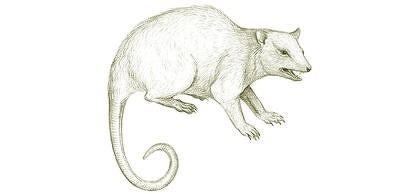
Chulpasia
The earliest marsupials evolved for the most part in the Americas."Marsupials absolutely categorically did not originate in Australasia," Robin Beck, a lecturer in biology at the University of Salford in the United Kingdom, told Live Science. "They are immigrants." Marsupials were around for tens of millions of years before they made it to Australia. [Source: Laura Geggel, Live Science, March 3, 2019]
Laura Geggel wrote in Live Science: Up until about 40 million to 35 million years ago, both South America and Australia were connected to Antarctica, forming one giant land mass. At that time, Antarctica wasn't covered with ice, but instead with a temperate rainforest, and "it was not a bad place to live," Beck said. It appears that marsupials and their relatives bounded down from South America, strode across Antarctica and wound up in Australia, Beck said. There's even fossil evidence: On Antarctica's Seymour Island, there are fossils of marsupials and their relatives, including a close relative of the monito del monte, Beck said. [Source: Laura Geggel, Live Science, March 3, 2019]
The oldest fossil marsupials from Australia are found at a 55-million-year-old site called Tingamarra, near the town of Murgon in Queensland, Beck said. Some of the fossil marsupials at Tingamarra are similar to those in South America. For instance, the ancient and tiny fruit-eating marsupial Chulpasia from Peru is a close relative of another fossil marsupial found at Tingamarra, Beck said. Yet another Tingamarra marsupial, the insect-eating Djarthia, may be the ancestor of all living Australian marsupials, Beck said.
Then, there's a big gap in the Australian fossil record. After Tingamarra, the next oldest marsupial fossils on record are 25 million years old. "What we see then is clearly there's been a huge amount of diversification within Australia," Beck said. "By that time we see koalas, we see relatives of wombats, we see relatives of bandicoots." Basically, all of the major Australian marsupial groups are present by 25 million years ago, he said.
Marsupial Habitats and Ecosystems
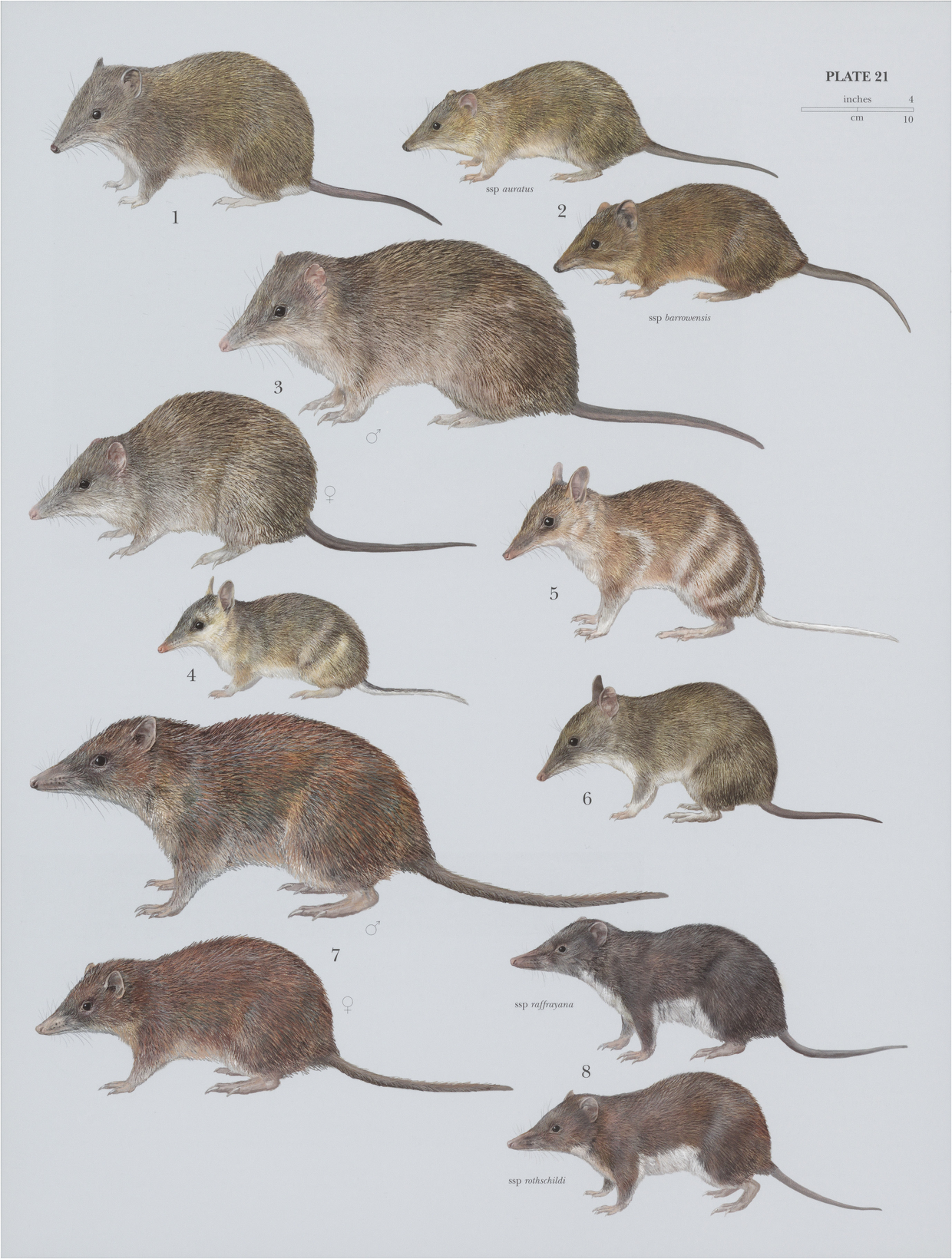
Bandicoots: 3) Northern Brown Bandicoot (/soodon macrourus); 4) Western Barred Bandicoot (Perameles bougainville); 5) Eastern Barred Bandicoot (Perameles gunnii); 6) Long-nosed Bandicoot (Perameles nasuta), 7) Giant Bandicoot (Peroryctes broadbenti); 8) Raffray’s Bandicoot (Peroryctes raffrayana)
Marsupials are very adaptable and flexible and live a wide range of habitats in temperate and tropical climates in freshwater areas, deserts, semi-deserts, savannas grasslands, chaparral, forests, rainforests, scrub forests and mountains. They are found around lakes, ponds, rivers, streams, wetlands and swamps as well as urban, suburban and agricultural areas. .[Source: Matthew Wund and Phil Myers, Animal Diversity Web (ADW)|=|]
Marsupials occupy an enormous variety of terrestrial habitats throughout Australia, Australasia (excluding New Zealand) and Central and South America. They have evolved to fill many niches in many habitats. Many species are fully terrestrial, many are arboreal (live mainly in trees), and at least one species, yapoks (water opossums) of South American, is semi-aquatic.
In Australasia many marsupials live in tropical rainforests or other tropical habitats. With their great diversity of food habits, behavior and habitat use, marsupials can substantially impact their communities and ecosystems in a variety of ways. They may help pollinate plants, distribute seeds, or control pest populations. Most species are prey for other species and thus are an important component of many food webs. Species that dig burrows (e.g. wombats and marsupial moles) create habitat for other organisms and/or help aerate soil. Parasites of marsupials are as diverse as their hosts.
Marsupial Diet and Predators
Marsupial can be carnivores (eat meat or animal parts), insectivores (eat insects and non-insect arthropods), herbivores (primarily eat plants or plants parts), folivores (eat leaves), frugivores (eat fruit) granivores (eats seeds and grain), lignivores (eat wood), nectarivores (eat nectar from flowers) and omnivores (eats a variety of things, including plants and animals). [Source: Matthew Wund and Phil Myers, Animal Diversity Web (ADW)|=|]
Omnivores include American oppossums (Didelphidae), Australian possums (Phalangeridae) and bandicoots (Peramelidae). Among the insectivores are Dasyuridae, which includes marsupial mice, marsupial shrews, cat-sized quolls and Tasmanian devil. Many marsupials, such as koalas (Phascolarctidae), wombats (Vombatidae), and kangaroos (Macropodidae), are strictly herbivores.
Except for a very few species (such as the extinct Tasmanian wolf), marsupials are rarely top carnivores and thus are subject to predation by a host of mammalian, reptilian and avian predators wherever they occur.
Marsupials in Australia
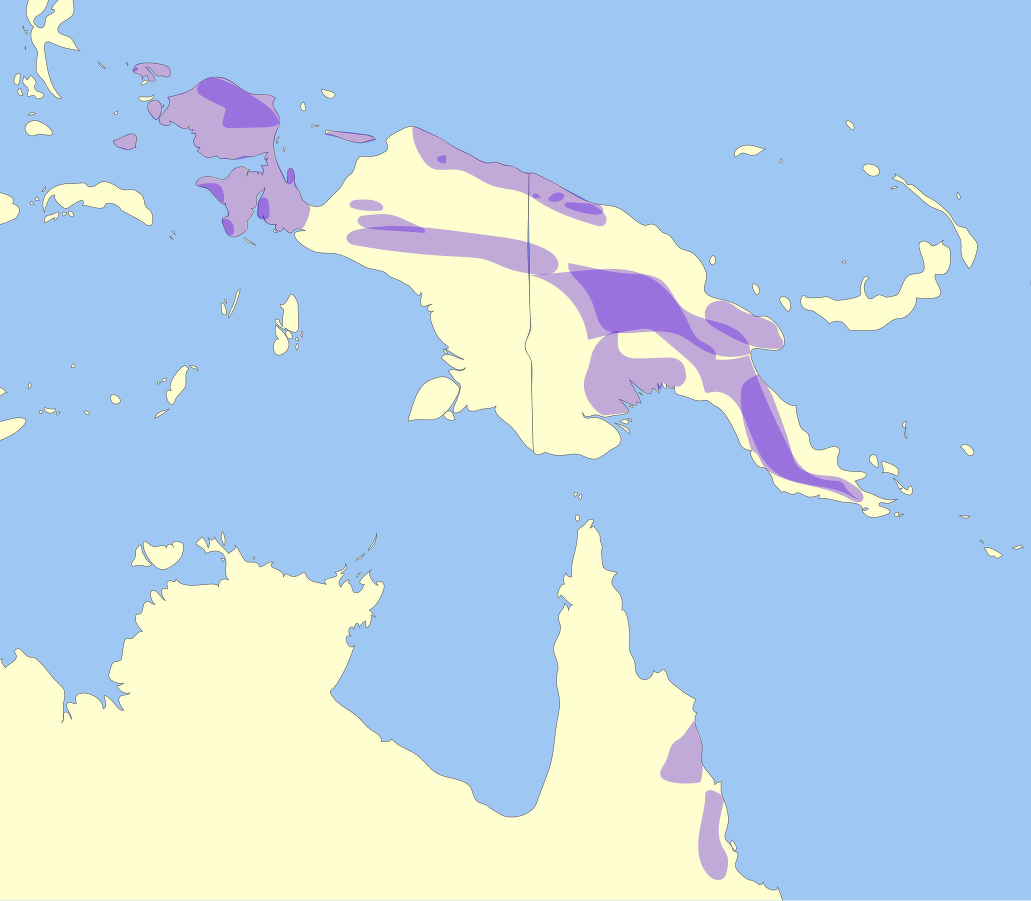
tree kangaroo range
Marsupials in Australia include kangaroos, wallabies, koalas, possums, various mice-like and rat-like ones, and wombats. Ilsa Sharp wrote in “CultureShock! Australia”: The Wombat is a wondrous beast, stocky and powerfully built, like a small bear, weighing in at about 40 kilograms (88 lbs). Somewhat less cuddly is the Tasmanian Devil, a smallish black-and-white carnivorous marsupial endemic to Tasmania, which makes the most appalling screeching and grumbling noises, feeds on almost anything, including carrion, and is equipped with jaws that could reduce the thickest bone to shredded-wheat consistency. Some of the kangaroo-type marsupials have marvellous names, like the Potoroo, the Wallaroo, the Quokka (found only on Western Australia’s Rottnest Island, off Perth — the island’s name means ‘Rats’ Nest’ in Dutch and refers to the Quokkas) and the Pademelon. Possums you may get to know better than you would prefer. Although essentially harmless, they are the bane of many a householder’s life; [Source: Ilsa Sharp, “CultureShock! A Survival Guide to Customs and Etiquette: Australia”, Marshall Cavendish, 2009]
The earliest marsupials evolved for the most part in the Americas."Marsupials absolutely categorically did not originate in Australia," Robin Beck, a lecturer in biology at the University of Salford in the United Kingdom, told Live Science. "They are immigrants." Marsupials were around for tens of millions of years before they made it to Australia. [Source: Laura Geggel, Live Science, March 3, 2019]
Laura Geggel wrote in Live Science: Up until about 40 million to 35 million years ago, both South America and Australia were connected to Antarctica, forming one giant land mass. At that time, Antarctica wasn't covered with ice, but instead with a temperate rainforest, and "it was not a bad place to live," Beck said. It appears that marsupials and their relatives bounded down from South America, strode across Antarctica and wound up in Australia, Beck said. There's even fossil evidence: On Antarctica's Seymour Island, there are fossils of marsupials and their relatives, including a close relative of the monito del monte, Beck said. [Source: Laura Geggel, Live Science, March 3, 2019]
See Separate Article: MARSUPIALS IN AUSTRALIA factsanddetails.com
Marsupials in New Guinea
Marsupials found in New Guinea include tree kangaroos, forest wallabies, marsupial mice, bandicoots and ring-tailed possums. Echidnas are found in the highlands of New Guinea. All of these animals are also found in Australia. Marsupials in New Guinea are different from those in Australia because they are mainly adapted for rain forests found there not the dry outback found in most of Australia.
New Guinea has many marsupials, not as many as Australia but still a lot and they are very diverse. Many of those found in New Guinea are found nowhere else on Earth. While many are related to Australian marsupials, New Guinea's unique environment has fostered its own unique evolutionary path, resulting in a distinct set of marsupial fauna. New Guinea hosts various marsupial groups, including possums (like the long-tailed pygmy possum), and extinct megafauna such as the diprotodontids (which included the giant wombat-like Diprotodon).
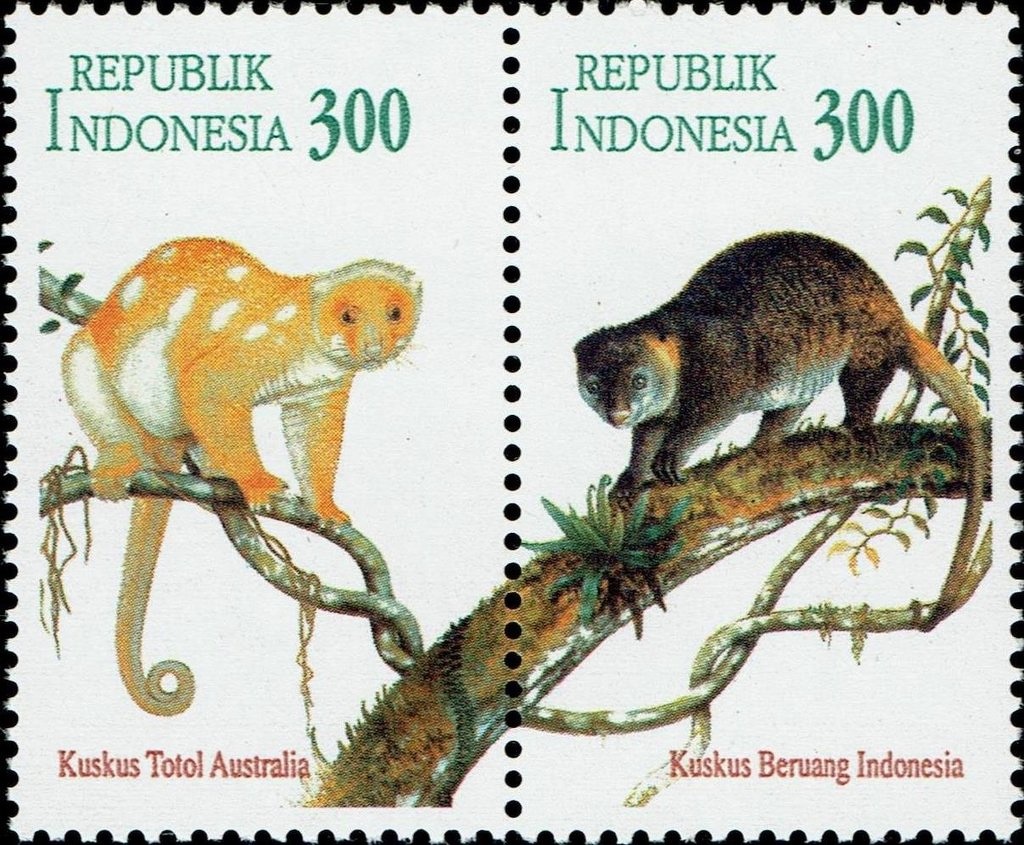
Key marsupial groups in New Guinea include: cuscuses, tree kangaroos, bandicoots and dasyurids. 1) Cuscuses are arboreal marsupials that look sort of like of lemurs and are known for their prehensile tails. Among the species found in New Guinea are the common cuscus and the black-spotted cuscus. 2) Tree Kangaroos are found mostly in New Guinea, which is home to 12 of the 14 known species including a couple that have only been discovered relatively recently. 3) Bandicoots are found in Australia and New Guinea. Among the species found in New Guinea are the long-nosed bandicoot and the spiny bandicoot. 4) Dasyurids is a family that includes various carnivorous marsupials, such as the New Guinean quoll, which is the second-largest surviving marsupial carnivore in the region.
A significant portion of New Guinea's marsupial fauna is endemic, meaning they are found nowhere else in the world. The island's connection to Australia during past ice ages allowed for marsupial migration, but its subsequent isolation led to independent evolution and diversification. Several endemic marsupial species face threats from habitat loss and hunting, highlighting the need for conservation efforts.
Marsupials in Indonesia
Indonesia is home to several species of marsupials, primarily in the Phalangeridae family (cuscuses and brushtail possums). These marsupials are found in Papua (the Indonesian part of New Guinea), Sulawesi, parts of the Moluccas and some other islands. The are all found in the eastern, Australia-facing side of Wallace's Line — the line running through Indonesia that separates areas with Asian fauna from those with Australasian fauna, including marsupials. While some marsupials may have naturally migrated, evidence suggests that humans also played a role in transporting them to some Indonesian islands via canoes.
The marsupials in Indonesia include various cuscus species and tree kangaroos. Cuscuses are sort-of lemur-like arboreal marsupials well-known for their prehensile tails. Sulawesi Bear Cuscuss (Ailurops ursinus) are endemic to Sulawesi and its surrounding islands. Mainly inhabiting lowland tropical forests, they are known for their slow movement, reliance on their tail for gripping, and primarily vegetarian diet. Among the other cuscus species found in Indonesia are the Small Sulawesi Cuscus (Strigocuscus celebensis) and the Peleng Cuscus (Strigocuscus pelengensis). Both are are found on Sulawesi and its offshore islands.
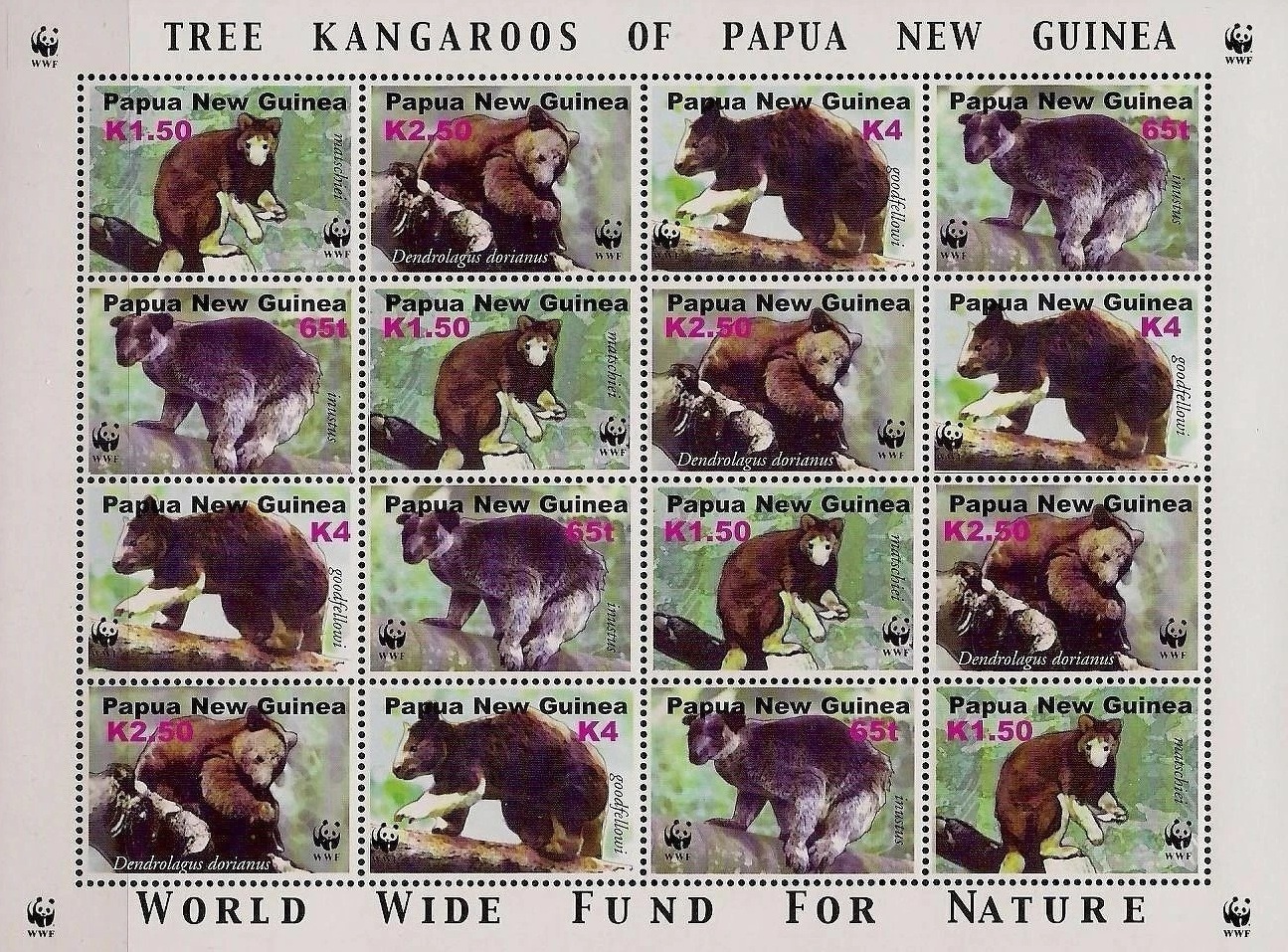
Six tree kangaroo species — the Ndomea, Goodfellow's, Wakera, Mbaiso, Seri's, and Vogelkop tree kangaroos — live in Indonesia, primarily in the lowland and mountainous rainforests of the Papua region (formerly Irian Jaya) and some islands off the coast of Papua. Ndomea tree kangaroo (Dendrolagus dorianus) and Mbaiso tree kangaroo (Dendrolagus mbaiso) are found in various parts of Papua. Goodfellow's tree kangaroo (Dendrolagus goodfellowi) and Seri's tree kangaroo (Dendrolagus stellarum) inhabits both Papua New Guinea and Indonesia. Wakera tree kangaroo (Dendrolagus inustus) is Found in northern and western New Guinea, including some offshore islands. Vogelkop tree kangaroo (Dendrolagus ursinus) is Endemic to the Vogelkop and potentially Fak-fak peninsulas in West Papua.
Some species found in Papua New Guinea also have closely related species in Indonesia, like the Ifola, Tenkile, Doria's, Lowlands, and Huon tree kangaroos. There are also some tree kangaroos in Australia. Goodfellow's tree-kangaroos live in the mid-montane regions of the Central Cordillera in Papua New Guinea and also in the Indonesian province of West Papua. They are found in dense tropical rainforests and deciduous forests, typically at altitudes between 1,000 and 3,500 meters.
Marsupials in the Solomon Islands
The Solomon Islands are home to a single native marsupial species, the Northern Common Cuscus (Phalanger orientalis), which is believed to have been introduced by prehistoric humans. Additionally, the Lowland Ringtail Possum (Pseudochirulus canescens) is also found in the Solomon Islands, as well as in Papua New Guinea and Indonesia.
Northern Common Cuscus (Phalanger orientalis) are found across most of the principal Solomon Islands, with the exception of the remote eastern islands. Also known as gray cuscus, they are native to northern New Guinea and adjacent islands. They primarily live in the tropical forests of northern New Guinea and nearby islands. It's also found in the Bismarck Archipelago, southeastern and central Moluccas, and Timor, where it was likely they were introduced.
Lowland Ringtail Possums (Pseudochirulus canescens) are also found in the Solomon Islands, as well as in Papua New Guinea and Indonesia. They are a member of the Pseudocheiridae family are were introduced to the Solomon Islands . Other marsupial species could potentially exist in the Solomon Islands, particularly on the larger islands or those closer to New Guinea.
Marsupials in New Zealand
New Zealand does not have any native land-dwelling marsupials but it does have some introduced ones, like the common brushtail possum, which are considered pests. Wallabies have also been introduced, and are another invasive species. The only native mammals to New Zealand are two native bat species and various marine mammals like seals, dolphins, and whales.
Common Brushtail Possums were introduced from Australia. They are now widespread and a significant pest due to their impact on native forests and agriculture. Several wallaby species have been introduced, primarily for hunting and sport, but they also cause damage to native vegetation.
Why does New Zealand not have any native marsupials? New Zealand was isolated for millions of years before human arrival, and its land mammal fauna consisted primarily of bats and a few now-extinct archaic mammals. The island environment lacked the predators and conditions that would have allowed marsupials to thrive.
Image Sources: Wikimedia Commons
Text Sources: Animal Diversity Web animaldiversity.org , National Geographic, Live Science, Natural History magazine, Australian Museum, David Attenborough books, Australia Geographic, New York Times, Washington Post, Los Angeles Times, Smithsonian magazine, Discover magazine, The Conversation, The New Yorker, Time, BBC, CNN, Reuters, Associated Press, AFP, Lonely Planet Guides, Wikipedia, The Guardian, Top Secret Animal Attack Files website and various books and other publications.
Last updated June 2025