
Home | Category: Animals / Kangaroos, Wallabies and Their Relatives
HARE-WALLABIES
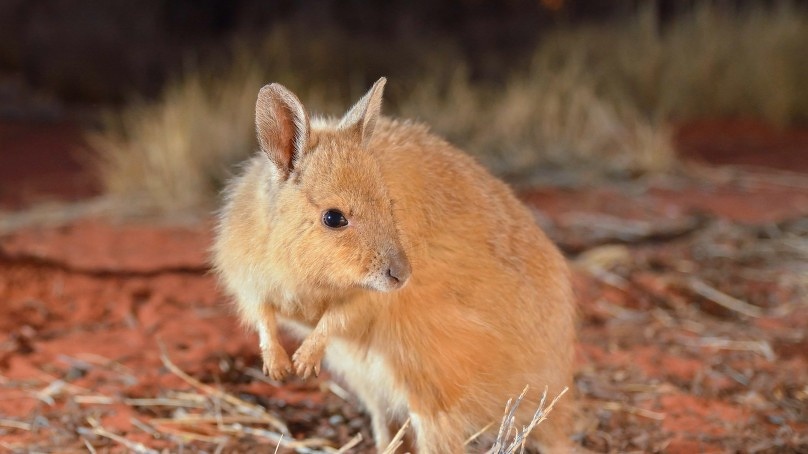
Rufous hare-wallaby, from the Australian Wildlife Conservancy
Hare-wallabies are small marsupials that resemble hares in appearance and have some movements and habits similar to those of hares. However, like all wallabies, they have larger hind legs than hares, a thinner, hunched body, smaller forelimbs, and a long, thin tail. Hare-wallabies are terricolous (live on the ground), saltatorial (adapted for leaping), usually nocturnal (active at night), motile (move around as opposed to being stationary) and sedentary (remain in the same area). Most are solitary but some can be social. They are both quadripedal and bipedal (move with four or two limbs), hopping on strong hind legs or maneuvering on all fours. Their fur is long, soft, and thick. [Source: Jennifer Adkins, Animal Diversity Web (ADW) |=|]
Banded hare-wallabies (Lagostrophus fasciatus) are thought to be the last remaining members of the once numerous subfamily Sthenurinae, and although once common across southern Australia, they are now restricted to two islands off the Western Australian coast which are free of introduced predators. They not as closely related to the other hare-wallabies (genus Lagorchestes) as the hare-wallabies are to the other wallabies.
Lagorchestes is a genus of hare-wallabies. It includes four species native to Australia and New Guinea, two of which are extinct. Hare-wallabies belong to the macropod family (Macropodidae) which includes kangaroos, wallabies, and some other marsupials. The two living species are the spectacled hare-wallaby (Lagorchestes conspicillatus) and Rufous hare-wallaby, (Lagorchestes hirsutus). The name Lagorchestes means “dancing hare.”
Spectacled hare-wallabies were the first to be named hare-wallabies. They were given the name by European settlers who though the animals looked like hares when they were in a crouched position. A spectacled hare-wallaby fossil was discovered in Queensland dating up to 11,000 years ago from the early Holocene. The Bininj people of western Arnhem Land call Spectacled hare-wallabies by the name wularla in the Kunwinjku language. For the Anangu, another Aboriginal people, the Mala or "hare-wallaby people" are important ancestral beings. For tens of thousands of years, the Mala have watched over them from rocks and caves and walls, guiding them on their relationships with people, plants and animals, rules for living and caring for country. Mala Tjukurpa, the Mala Law, is central to their living culture and celebrated in story, song, dance and ceremony.
RELATED ARTICLES:
WALLABIES: TYPES, CHARACTERISTICS, BEHAVIOR, REPRODUCTION ioa.factsanddetails.com
KANGAROOS AND WALLABIES (MACROPODS): CHARACTERISTICS, HISTORY, POPULATIONS ioa.factsanddetails.com
WALLABY SPECIES ioa.factsanddetails.com
WALLABY SPECIES OF SOUTHWEST AUSTRALIA ioa.factsanddetails.com
ROCK-WALLABIES: SPECIES, CHARACTERISTICS, BEHAVIOR AND REPRODUCTION ioa.factsanddetails.com
BRUSH-TAILED ROCK-WALLABIES: CHARACTERISTICS, BEHAVIOR AND REPRODUCTION ioa.factsanddetails.com
QUOKKAS: CHARACTERISTICS, BEHAVIOR, REPRODUCTION, ROTTNEST ioa.factsanddetails.com
FOREST WALLABIES (DORCOPSIS): SPECIES, CHARACTERISTICS, BEHAVIOR AND REPRODUCTION ioa.factsanddetails.com
PADEMELONS: SPECIES CHARACTERISTICS, BEHAVIOR AND REPRODUCTION ioa.factsanddetails.com
KANGAROO BEHAVIOR: FEEDING, REPRODUCTION, JOEYS ioa.factsanddetails.com
KANGAROOS HOPPING: MOVEMENTS, METABOLISM AND ANATOMY ioa.factsanddetails.com
MARSUPIALS: HISTORY, EVOLUTION, CHARACTERISTICS, BEHAVIOR, REPRODUCTION ioa.factsanddetails.com
MARSUPIALS IN AUSTRALIA ioa.factsanddetails.com
MARSUPIALS IN AUSTRALASIA (AUSTRALIA, NEW GUINEA, NEARBY ISLANDS) ioa.factsanddetails.com
Banded Hare-Wallaby
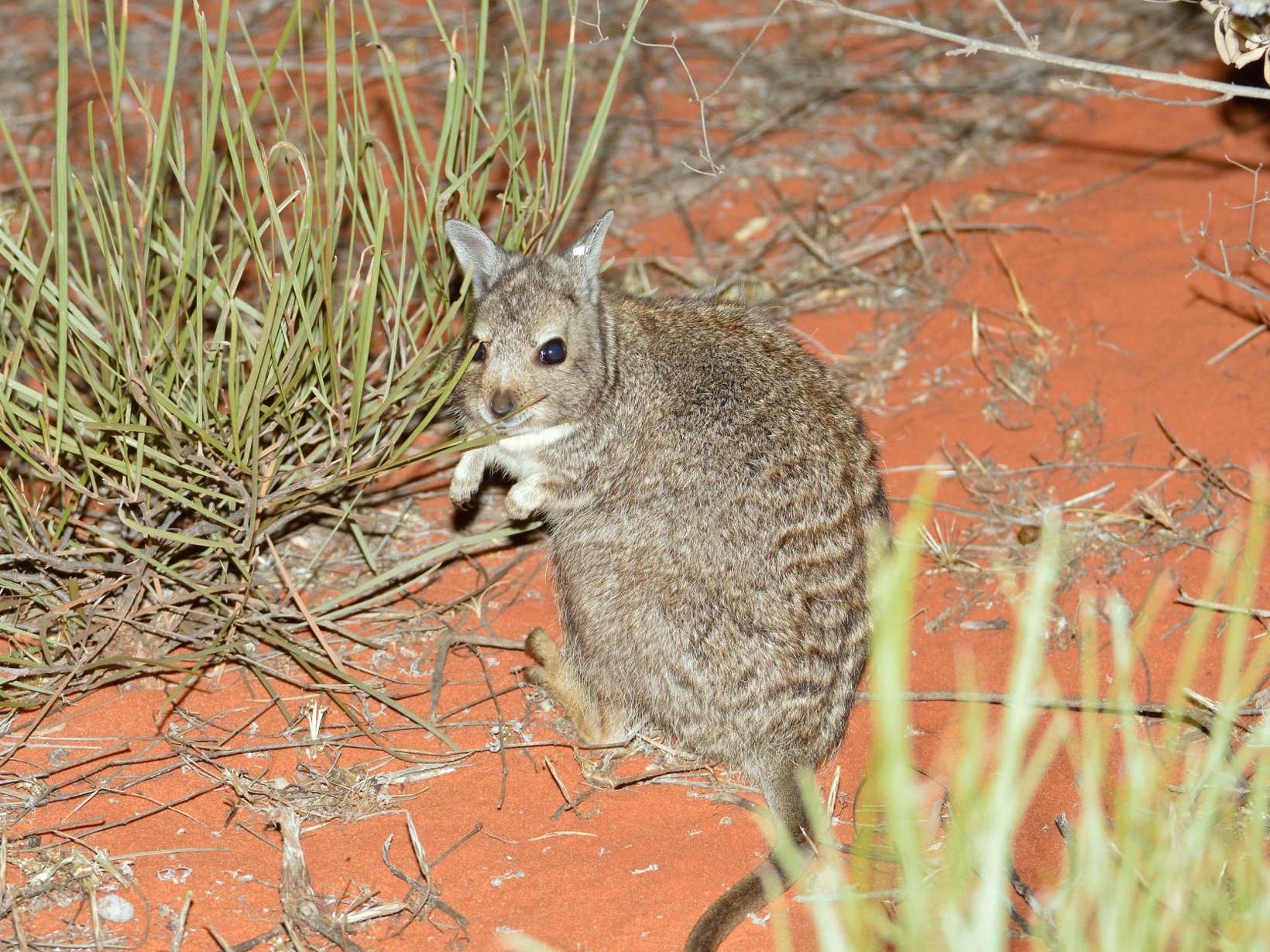
banded hare-wallaby, from the Australian Wildlife Conservancy
Banded hare-wallabies (Lagostrophus fasciatus) are also known as mernine or munning. They are found on Dorre Island and Bernier Island in Shark Bay, 50 to 60 kilometers west of the Australian mainland. The population on Dorre Island is less dense than Bernier Island. On Dorre Island, the population is concentrated in the north, while on Bernier Island it is further south. Reintroduced populations have recently been established on islands and fenced mainland sites, including Faure Island and Wadderin Sanctuary near Narembeen in the central wheatbelt.
Historically, banded hare-wallabies also lived on the mainland of southwestern Australia. The last recorded individual on the mainland was seen in 1906. Fossils of Banded hare-wallabies have been found on Dirk Hartog Island, south of their current location. Attempts to re-introduce Banded hare-wallabies to Dirk Hartog island failed, possibly as a result of predation by feral cats. [Source: Khalil Chedid, Animal Diversity Web (ADW) |=|]
Banded hare-wallabies usually lives in woodlands with thick, dense shrubs, which it uses for shelter during the day. Many of the shrubs are of the species Acacia ligulata. Additionally, banded hare-wallabies form runs under the shrubs. The islands on which they live are of a Mediterranean climate, warm with moderate rainfall and distinct wet and dry seasons.
On the International Union for Conservation of Nature (IUCN) Red List Banded hare-wallabies are listed as Vulnerable and were listed as Endangered in the past. On the US Federal List they are Endangered. In CITES (Convention on International Trade in Endangered Species of Wild) they are in Appendix I, which lists species that are the most endangered among CITES-listed animals and plants. The islands of which banded hare-wallabies live are uninhabited so they don’t come in contact humans. Clearing of land in their original habitat for agriculture, competition with introduced sheep and rabbits, and predation by introduced predators such as foxes and cats are likely to have caused their extinction on the Australian mainland.
Banded Hare-Wallaby Characteristics and Diet
Banded hare-wallabies range in weight from 1.3 to three kilograms (2.7 to 6.6 pounds), although most are under two kilograms (4.4 pounds), and have a head and body length of 35 to 40 centimeters (13.8 to 15.75 inches). Their tail is 35 to 40 centimeters (13.7 ro 15.75 inches) long and their hind feet are 9.4 to 12.1 centimeters (3.7 to 4.8 inches). Sexual Dimorphism (differences between males and females) is not present: Both sexes are roughly equal in size and look similar. Banded hare-wallabies can live up to six years. [Source: Khalil Chedid, Animal Diversity Web (ADW) |=|]
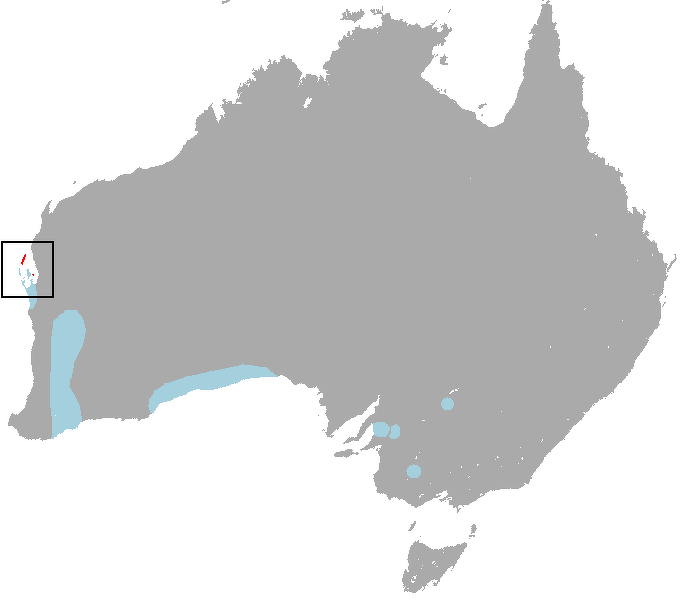
banded hare-wallaby range: present (red), former (light blue)
The fur of banded hare-wallabies is thick, shaggy, long, and gray with a few yellow and silver patches. There are transverse black stripes along the lower back. On the front the fur has a grayish-white color. The face is gray and the flanks have a reddish tint. Their snouts are normally hairless and short. Canines are absent. There are two subspecies: 1) Lagostrophus fasciatus fasciatus and 2) Lagostrophus fasciatus baudinettei. The latter is more reddish in color with less pronounced stripes and a bigger hair crest on the head and maybe a shorter tail.
Banded hare-wallabies are herbivores (eat plants or plants parts). They mainly browse (eat non-grass plants such as bushes and tree parts higher up off the ground) but also occasionally graze (eat grass or other low-growing plants) on foliage and grasses. Individuals accumulate in areas with high densities of Acacia ligulata, A. coriacea, Heterodendrum oleifolium, and Diplolaena dampieri, using them as the main sources of food. They are also sometimes found grazing in Triodia grasslands. They get their water from dew and from their food.
Banded Hare-Wallaby Behavior
Banded hare-wallabies are terricolous (live on the ground), saltatorial (adapted for leaping), nocturnal (active at night), motile (move around as opposed to being stationary), sedentary (remain in the same area), and social (associates with others of its species; forms social groups). In terms of home range, The home range is unknown. [Source: Khalil Chedid, Animal Diversity Web (ADW) |=|]
Banded hare-wallabies usually seek shelter in small groups during the day and forage for food at night. Males can be aggressive twoards each other when competing for food. However, adults of different sexes and adult females with juveniles display no aggressive behavior toward each other.
Wedge-tailed eagles and other raptors prey on banded hare-wallabies. Red foxes and feral cats preyed on them when when they occurred on the Australian mainland. Slow breeding and spending time in open areas during the day made these wallabies vulnerable to predation. Competition between banded hare-wallabies and similar rufous hare-wallabies has been low as they occupy different habitats. Their skull and teeth are also different. Communication between Banded hare-wallaby individuals is not well understood, but it is likely that they use chemical and visual cues and sense using vision, touch, sound and chemicals usually detected with smell. |
Banded Hare-Wallaby Mating, Reproduction and Offspring
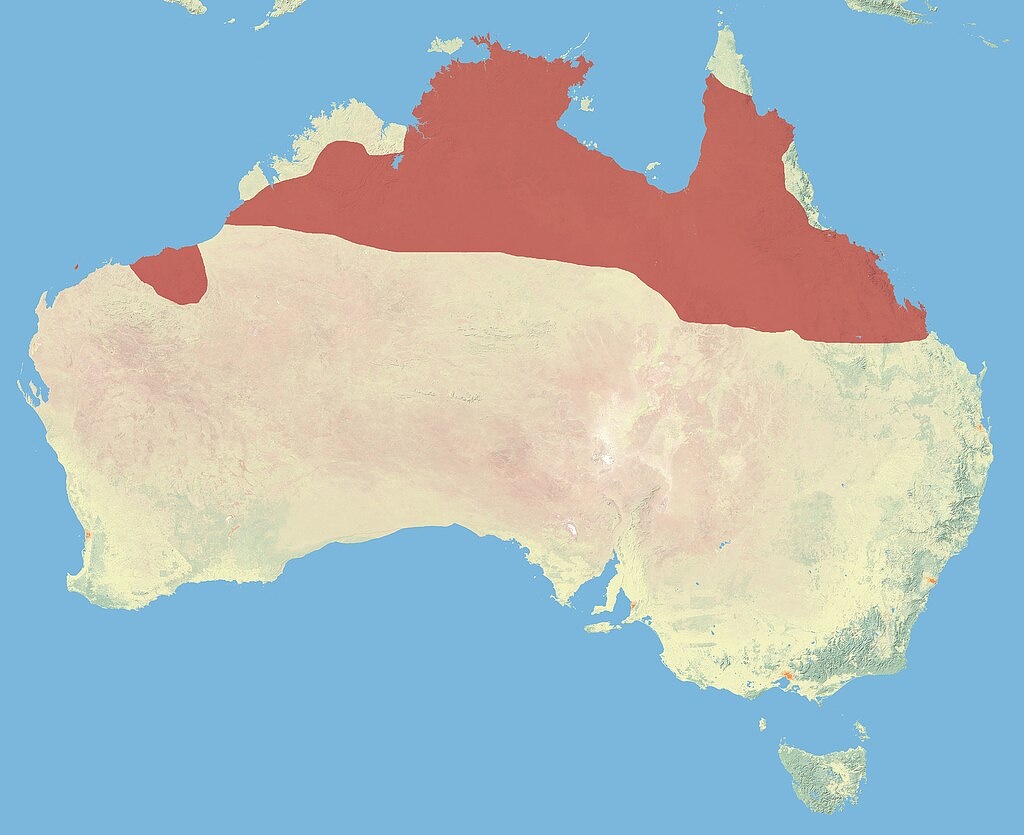
Spectacled hare-wallaby range
Banded hare-wallabies engage in seasonal breeding and practice embryonic diapause (temporary suspension of development of the embryo). They usually breeds once a year, with breeding peaking in the fall. Females have an estrus cycle, which is similar to the menstrual cycle of human females. Typically one offspring is born; occasionally two are. The gestation period is unknown. [Source: Khalil Chedid, Animal Diversity Web (ADW) |=|]
Breeding begins in the summer and peaks in the autumn but may occur from February through August. Drought can change breeding patterns by delaying breeding.. Breeding can occur as early as the end of a female’s first year and the beginning of a male’s second year. However, most individuals do not mate until the age of two. A female gives birth and may mate immediately afterwards. The blastocyst from the second mating then undergoes a period of quiescence until the nursing young is weaned (embryonic diapause).
Young are altricial, meaning they are relatively underdeveloped at birth. Parental care os provided by females, who keep offspring in their pouch for six months. The average weaning age is three months and the age in which they become independent ranges from 9 to 10 months.
Spectacled Hare-Wallabies
Spectacled hare-wallabies (Lagorchestes conspicillatus) are found in northern Australia and New Guinea. Those on mainland Australia are widespread enough so that they are listed as a species of "Least Concern" on the International Union for Conservation of Nature (IUCN) Red List, but they are in decline in parst of the north and were thought to be extinct in the Kimberley region of Western Australia until they were rediscovered in 2014. [Source: Courtney Oser, Animal Diversity Web (ADW) |=|]
Spectacled hare-wallabies are found in Western Australia, Northern Territory and Queensland. A subspecies is found in New Guinea and Barrow Island. These hare-wallabies inhabit forests, woodlands, and arid grasslands, often in places where water is scarce, and temperatures reach over 40°C. They do not need much green grass as long as there is at least some herbaceous cover to feed on. They prefer areas with shrubs, grass tussocks, or spinifex hummocks (coastal grass) for shelter. The use large grass tussocks for shelter from predators and the extreme heat.
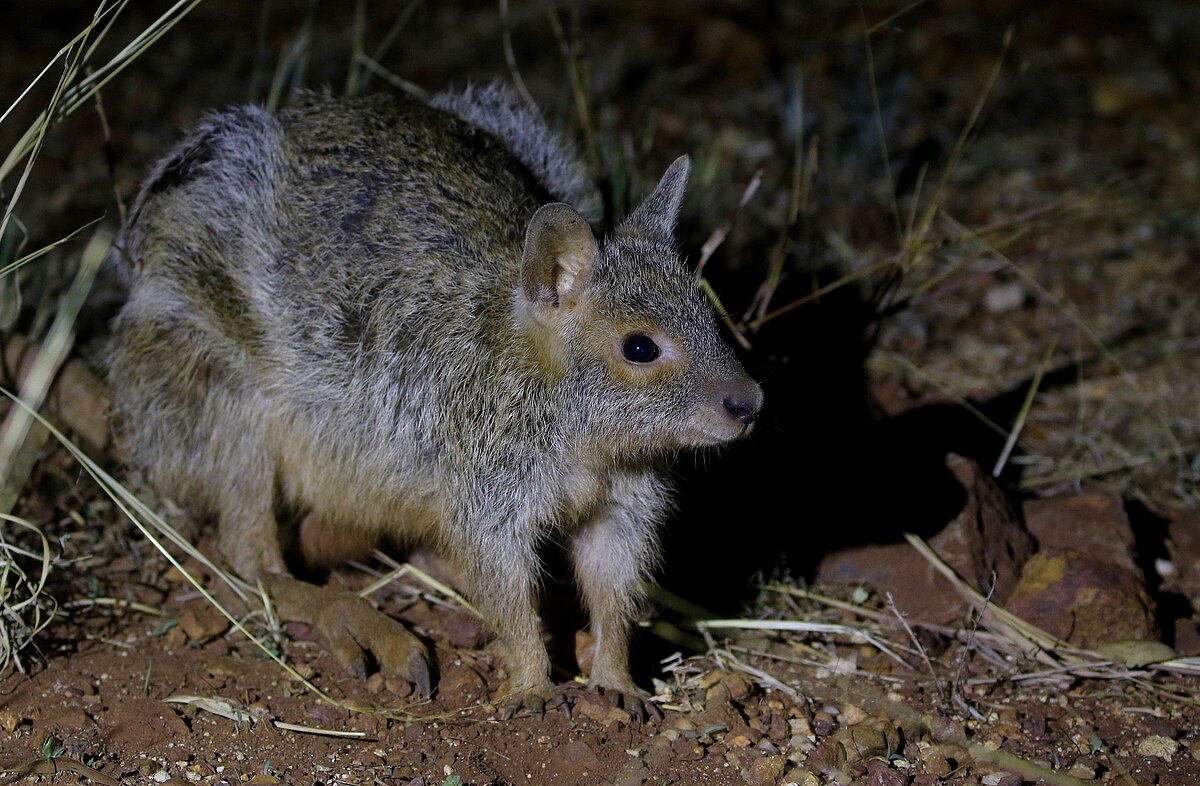
Spectacled hare-wallaby in Queensland
Spectacled hare-wallabies are small mammals that have grey-brown fur with golden tips. They have orange circles around their dark eyes. Sexual Dimorphism (differences between males and females) is not present: Both sexes are roughly equal in size and look similar. Spectacled hare-wallabies are herbivores (animals that primarily eat plants or plants parts). They favor herbs and seeds over most other food items but also eat fruits, grasses, sedges, and succulent shrubs, Their average lifespan in the wild is about six years. In captivity, they have lived up to is 8.8 years.
Threats to spectacled hare-wallabies include wildfires, being trampled by large animals, including livestock and feral camels, horses and water buffaloes, introduced predators such as red foxes and cats and droughts. Spectacled hare-wallabies have been raised in captivity.
Spectacled Hare-Wallabies Behavior and Reproduction
Spectacled hare-wallabies are solitar, saltatorial (adapted for leaping), nocturnal (active at night), motile (move around as opposed to being stationary) and hop in a zigzag pattern when they are disturbed. They do not drink water much or at all because the places they live do not have much water. Instead, they obtain water from the vegetation that they eat. To get rid of their nitrogenous waste, they make extremely concentrated urine to prevent dehydration. [Source: Courtney Oser, Animal Diversity Web (ADW) |=|]
Spectacled hare-wallabies hide during the day amongst vegetation in their tall nests made from spinifex, a coastal grass found in Australia, or porcupine grass. This helps protect them to some degree from predators and prevents water loss. The environments that spectacled hare-wallabies inhabit are extremely hot, so they use controlled hyperthermia and evaporative cooling to prevent heat stress. When evaporative cooling is employed, these wallabies increase their panting to rates over 400 cycles per minute, resulting in a minimal increase in their blood pH after a couple hours.
Spectacled hare-wallabies mate once a year at any time of the year. The estrus cycle lasts 30 days. Females typically give birth to single offspring after average gestation period is 29-31 days. Parental care is carried out by females. The time young spend in the pouch is around five months. The average weaning age is around seven months. Young are often seen with their mothers during the day and night in the wild and are known to follow their mother. On average males and females reach sexual or reproductive maturity at age one year . Females begin breeding at one year old, while males begin to breed when they are slightly older.
Rufous Hare-Wallabies
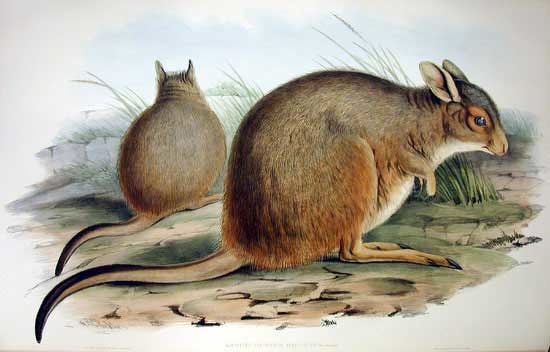
illustration of a rufous hare-wallaby from 1853
Rufous hare-wallabies (Lagorchestes hirsutus) are also known as mala, Western hare-wallaby, and spinifex rat. Before the 1930s they were was one of the most abundant and wide spread macropods in Australia. They were widely distributed across the western half of the Australia, particularly in the central and western deserts. Now they are one of the rarest and have a very limited range — confined to Bernier and Dorre Islands in Shark’s Bay off Western Australia. Predation by feral cats and foxes, and destructive wildfires caused the last wild population on mainland Australia to go extinct in the early 1990s. [Source: Wikipedia]
Rufous hare-wallabies are solitary, nocturnal herbivores that feed on herbs, leaves and seeds. They were historically widespread throughout the arid and semi-arid parts of western Australia and southern Northern Territory. Today, they occur throughout Dorre and Bernier Islands but are more plentiful in the southern parts of both. A few small populations exist on the mainland in captive settings and in experimental reintroduction sites in the Tanami Desert and southern Shark Bay. Small wild populations did exist in the Tanami Desert, Northern Territory until the 1990s. The Tanami Desert has a warm, dry, monsoonal climate and is semi-arid. Drought is common. In contrast, the islands where rufous hare-wallabies have a warm, dry Mediterranean climate and, although still relatively dry, has more rain than the Tanami desert. [Source: Jennifer Adkins, Animal Diversity Web (ADW) |=|]
On the mainland, rufous hare-wallabies did best in mosaics of burnt and unburnt patches of spinifex grassland in the Tanami Desert. The dominant species in such as a habitat are mature Triodia pungens and Plectrachne schinzii. The various stages of fire succession, and the ecotones they created, provided adequate shelter and food supply. Patchiness, degree of senescence, diversity of food and vegetation, hummock size, and habitat structure were important factors influencing suitable and unsuitable areas. The degree of connectivity and accessibility of each of these aspects was important as well.
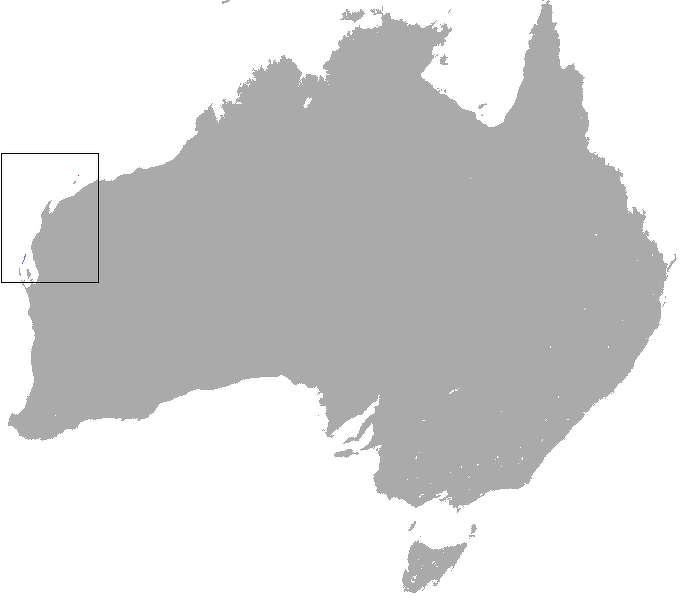
rufous hare-wallaby range
Bernier and Dorre islands have four main types of habitat: 1) sand plain (Triodia species) grasslands, 2) sand plain heath, 3) consolidated dunes, unconsolidated dune-beach, and 4) travertine heath. Rufous hare-wallabies occur throughout these habitats, but favor consolidated dunes, beaches, and both heath habitats. They shelter in scrapes, often under Triodia plurinervata or Thryptomene micrantha, or in single opening burrows.
On the International Union for Conservation of Nature (IUCN) Red List they are listed as Vulnerable; US Federal List: Endangered. In CITES (Convention on International Trade in Endangered Species of Wild) they are in Appendix I, which lists species that are the most endangered among CITES-listed animals and plants. Rufous hare-wallabies were once so abundant that they were an important food source for aboriginal people. Small yearly fires by set aborigines promoted regeneration of plants fed upon by hare wallabies and created a patchwork of habitats for them to live in. The absence of these fires causes a build up of brush, which feeds uncontrollable summer bush fires. On the mainland livestock grazing, competition from introduced rabbits, predation by feral cats and red foxes, and loss of habitat due to fragmentation and clearing decimated rufous hare-wallaby populations there. Island populations are relatively stable, but susceptible to catastrophic events and population fluctuations. Conservation efforts such as the Mala Recovery Plan include maintaining current wild populations, captive breeding and creating three self-sustaining wild populations on the mainland in which predator control is a key element,
Rufous Hare-Wallaby Characteristics and Diet
Rufous hare-wallabies are the smallest hare-wallaby, weighing just 0.8 to 1.9 kilograms (1.7 to 4.2 pounds), with head and body length of 31 to 39 centimeters (12.2 to 15.3 inches) and a tail length of 24.5 to 30 centimeters (9.6 to 11.8 inches). They stand stand roughly 30 centimeters (one foot) and have reached ages of 13.2 years in captivity. Sexual Dimorphism (differences between males and females) is present: Males and females are identical in color, but females are generally larger in size. Females range in weight from 0.8 to 1.9 kilograms while males range from 1.24 to 1.8 kilograms. The length from tip of nose to base of tail for females is 36 to 39 centimeters, and tail length is 24 to 30.5 centimeters. Male head/body length is 31 to 36 centimeters, and tail length is 26 to 27 centimeters. [Source: Jennifer Adkins, Animal Diversity Web (ADW) |=|]
Rufous hare-wallabies get their name from their rufous-grey fur. The color of the fur is rufous (reddish) overall, greyer at the upper back and yellowish at the underside and forearms. Some parts of the population have greyer fur at the underside. Typically their front side and hindquarters are a sandy, buff color while the back and head are grey-rufous. They have long pointed ears, large black eyes, short whiskers, and darker colored paws. The species scientists name hirsutus refers to the fact that their fur gets longer towards their back, giving them a shaggy appearance.
There are four recognized subspecies, 1) L. h. bernieri, 2) L. h. dorreae, 3) L. h. hirsutus, and 4) an unnamed subspecies. Rufous hare-wallabies bernieri is the Bernier Island subspecies, it has noticeably paler fur and shorter ears. Rufous hare-wallabies dorreae is the Dorre Island subspecies, its fur is far redder than the mainland species and its skull is narrower between the orbits. Rufous hare-wallabies hirsutus is extinct, and the unnamed subspecies is extinct in the wild and critically Endangered.
Rufous hare-wallabies are granivores (eat seeds and grain) and herbivores (eat plants or plants parts). Depending on availability they mainly eat seeds, succulent fruits, grasses, sedges, and succulent shrubs and herbs. They alter their feeding habits and diet in response to changes in their environment, primarily seasonal changes in rainfall. Monocots (a kind of flowering plant) make up 44 to 65 percent of their diet. Rufous hare-wallabies prefer the stems and leaves of perennial grasses such as Eragrostis falcata, E. speciosa and Aristida browniana, and the seeds from T. pungens, E. falcata, and Aristida holathera. The plant T. pungens is avoided unless conditions are very poor. Leaves and stems from sedges like Cyperus conicus, C. bulbosus, C. concinnus, Fimbristylis caespitosa, and Bulbostylis species make up 15 to 32 percent of their diet. Dicots (another kind of flowering plant), hardy perennials, and occasional insects are chosen in drier, poorer conditions. The plant material of Goodenia virgata, Neobassia astrocarpa, and Stackhousia intermedia, and the seeds and fruit of Cassytha filiformis were important secondary sources of food. They sometimes feed on nectar-rich Grevillea juncifolia flowers.
Rufous Hare-Wallaby Behavior
Rufous hare-wallabies are terricolous (live on the ground), saltatorial (adapted for leaping), nocturnal (active at night), motile (move around as opposed to being stationary), sedentary (remain in the same area) and solitary. The majority of activities, such as feeding, interacting and grooming, occur early in the night. Rufous wallabies tend to avoid interacting with other and when they do they tend to avoid confrontation and interact in non-aggressive way. In captivity, there is some evidence of a social hierarchy in both males and females, with the male hierarchy involving access to females and food. In the wild however, densities are so low that hierarchies are unlikely to be important. [Source: Jennifer Adkins, Animal Diversity Web (ADW) |=|]
Rufous hare-wallabies rest and seek refuge from daytime heat and predators in short burrows, with an average length of 10 meters and a depth of three meters, They also shelter in small scrapes or squats hidden by spinifex clumps or other bushes. They emerge from their burrows and scrapes after sunset, with males emerging earlier than females. Field data suggests that males have relatively large home ranges that include smaller home ranges of several females. In the Tanami Desert the wallabies home range included dense spinifex cover of T. pungens, open caliche areas, and fire boundaries between mature spinifex and recently burnt areas. Most activity occurs in the boundary areas. The dense spinifex is used for cover while moving and daytime shelters. The open areas are more intensively used for feeding because they have more diversity and abundance of food. Patterns of habitat use are seasonal and based on rainfall.
Rufous hare-wallabies sense using vision, touch, sound and chemicals usually detected with smell and communicate primarily with body language, vocalizations and scent marks produced by special glands and placed so others can smell and taste them. Two females often sniff each other then leave. Males may mark their territory by spraying a tree with urine. Alarmed wallabies make a loud squeaking noise and then hiss as they run for cover. Even though they are nocturnal they still use posture and movements for visual communication, especially during female and male interaction. The main known predators of rufous hare-wallabies are red foxes, feral cats and dingoes. The sandy buff and grey-rufous fur color rufous hare-wallabies allows them to blend in well with their arid, desert like environments.They run out and escape in a zig zag pattern when flushed.
The feeding patterns of rufous hare-wallabies may play a role in altering the distribution and abundance of the plants they feed on. Burrows digging can also also alter the environment. There has been competition between hare wallabies and introduced rabbits for food. Both types of animal are of similar size and have similar metabolic requirements and diets. Diet overlap and competition is highest when conditions are poorest.
Rufous Hare-Wallaby Mating, Reproduction and Offspring
Rufous hare-wallabies are polygynous (males have more than one female as a mate at one time). They engage in year-round breeding and practice embryonic diapause (temporary suspension of development of the embryo). In captivity, rufous hare-wallabies breed continuously throughout the year. In the wild, however, most births occur during times of heavy rainfall, when more high quality food is available. The gestation period is around 30 days. Usually one offspring is born. [Source: Jennifer Adkins, Animal Diversity Web (ADW) |=|]
Rufous hare-wallabies are mostly solitary. When males and females meet, a male will sexually inspect a female. If she is unresponsive, she will move away or kick. Responsive females lay prone and accept mating. In the wild, males may guard their mates, and often times a single ovulating female will attract many males, giving rise to a mating chase. Embryonic diapause allows females to decrease the interval between litters if conditions are favorable and food is plentiful, or put an embryo on hold, or even abort, if a drought occurs. Being able to do this is very important in the unstable environments most hare-wallabies live in. Rufous hare-wallaby females become receptive around the time they are weaning their young in the pouch. This, combined with their relatively short gestation and shortened pouch-life (124 days), allows them to have up to three offspring per year.
Young are altricial, meaning they are relatively underdeveloped at birth. Parental care and pre-weaning provisioning and protecting are done by females. The average weaning age is 124 days. Once weaned, mothers and other mature adults often act aggressively towards juveniles, causing the juvenile to disperse, decreasing the chances of inbreeding and reducing local competition for scarce resources. Females reach sexual or reproductive maturity at five to 23 months; males do so at 14 to 20 months.
Image Sources: Wikimedia Commons
Text Sources: Animal Diversity Web animaldiversity.org , National Geographic, Live Science, Natural History magazine, Australian Museum, David Attenborough books, Australia Geographic, New York Times, Washington Post, Los Angeles Times, Smithsonian magazine, Discover magazine, The Conversation, The New Yorker, Time, BBC, CNN, Reuters, Associated Press, AFP, Lonely Planet Guides, Wikipedia, The Guardian, Top Secret Animal Attack Files website and various books and other publications.
Last updated July 2025