
Home | Category: Animals / Animals
BATS IN AUSTRALIA AND NEW GUINEA
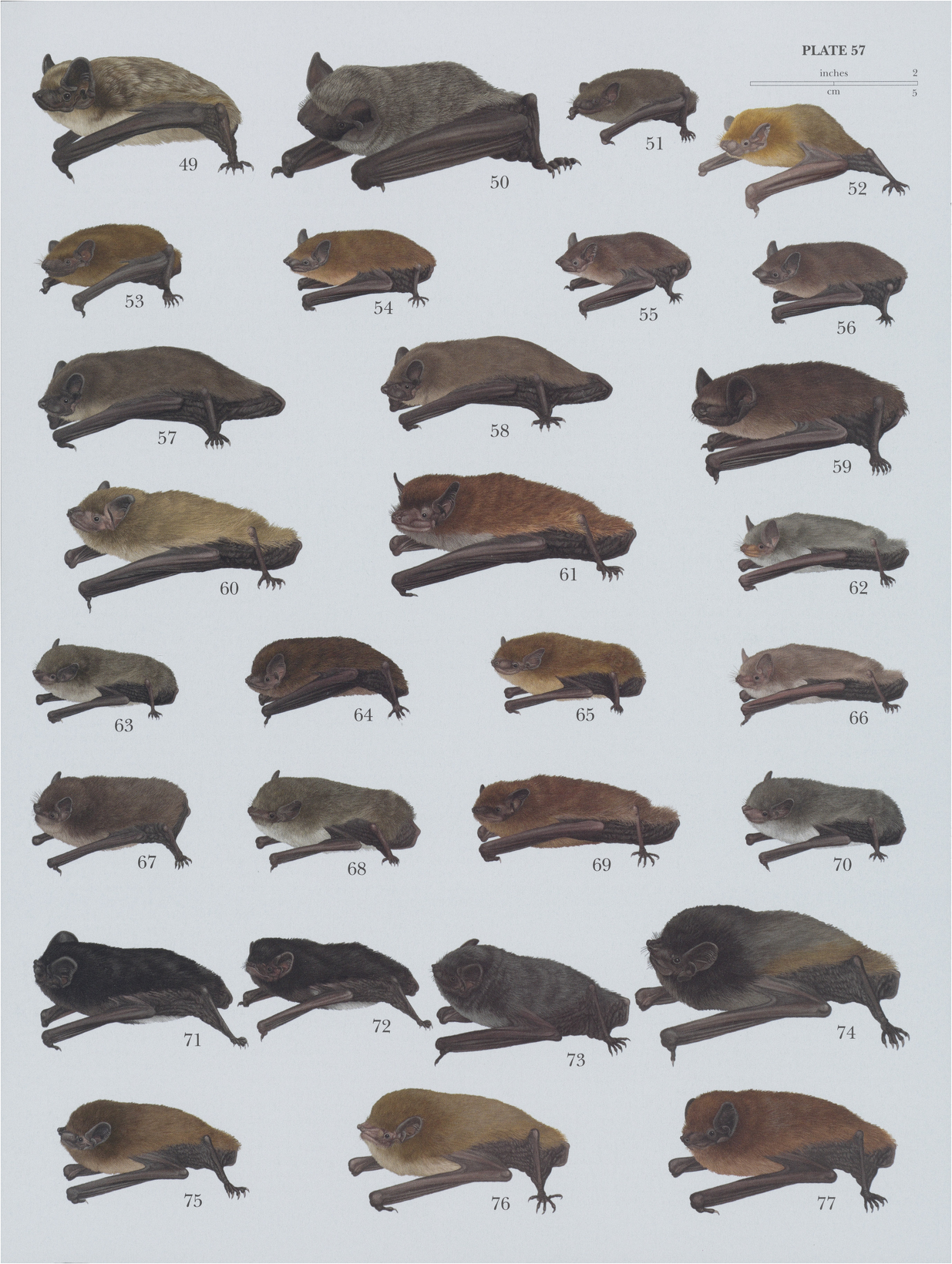
Some bat species of Oceania and Southeast Asia: 49) Eurasian Particolored Bat (Vespertilio murinus), 50) Asian Particolored Bat (Vespertilio sinensis), 51) Pygmy Bamboo Bat (Tylonycteris pygmaea), 52) Indomalayan Lesser Bamboo Bat (Tylonycteris fulvida), 53) Sunda Lesser Bamboo Bat (Tylonycteris pachypus), 54) Tonkin Greater Bamboo Bat (Tylonycteris tonkinensis), 55) Malayan Greater Bamboo Bat (Tylonycteris malayana), 56) Sumatran Greater Bamboo Bat (Tylonycteris robustula), 57) Yok Don Helmeted Bat (Cassistrellus yokdonensis), 58) Surat Helmeted Bat (Cassustrellus dimissus), 59) Rohu’s Bat (Phuletor brachypterus), 60) Western False Pipistrelle (Falsistrellus mackenziei), 61) Eastern False Pipistrelle (Falsistrellus tasmaniensis), 62) Yellow-lipped Cave Bat (Vespadelus douglasorum), 63) Northern Cave Bat (Vespadelus caurinus), 64) Finlayson’s Cave Bat (Vespadelus finlaysoni), 65) Eastern Cave Bat (Vespadelus troughtoni), 66) Inland Forest Bat (Vespadelus baverstocki), 67) Eastern Forest Bat (Vespadelus pumilus), 68) Little Forest Bat (Vespadelus vulturnus), 69) Large Forest Bat (Vespadelus darlingtoni), 70) Southern Forest Bat (Vespadelus regulus), 71) Large-eared Pied Bat (Chalinolobus dwyeri), 72) Little Pied Bat (Chalinolobus picatus), 73) Hoary Wattled Bat (Chalinolobus nigrogriseus), 74) Gould’s Wattled Bat (Chalinolobus gouldii), 75) New Caledonian Wattled Bat (Chalinolobus neocaledonicus), 76) Chocolate Wattled Bat (Chalinolobus morio), 77) New Zealand Long-tailed Bat (Chalinolobus tuberculatus)
Australia is home to a diverse range of bats, with at least 80 known species, including flying foxes. Smaller regular bats such as the lesser long-eared bats and Gould's wattled bat, tend to be insectivores (eat insects), while larger flying foxes are mostly frugivores (eat fruit). Bats make up a significant share of Australia’s native mammals. Australia's bat species diversity is highest in the tropical areas of northeastern Queensland.[Source: Google AI]
Lesser long-eared bats (Nyctophilus geoffroyi) are found across most of Australia.
Gould's wattled bats (Chalinolobus gouldii) are widespread throughout Australia.
White-striped Freetail bats (Austronomus australis) are found across mainland Australia.
Golden-tipped bats (Phoniscus papuensis) are found in eastern Australia.
Ghost bats (Macroderma gigas) are found in northern Australia.
Chocolate wattled bats (Chalinolobus morio) are found in southern and eastern Australia.
Southern Forest bats (Vespadelus regulus) are found in southwestern and southeastern Australia.
Eastern Horseshoe bats (Rhinolophus megaphyllus) are found in eastern Australia.
Large-eared Pied bats (Chalinolobus dwyeri) are found in eastern Australia.
Eastern Coastal Freetail bats (Micronomus norfolkensis) are found along the eastern coast.
Eastern Bent-wing bats (Miniopterus orianae oceanensis) are found along the eastern coast.
Southern Myotis (Myotis macropus) are found in eastern and southwestern Australia.
Several bat species in Australia are listed as threatened or endangered, including the Grey-headed Flying-fox and Spectacled Flying-fox. Threats include habitat loss and degradation, and climate change. Bats play vital ecological roles in pollination, seed dispersal, and insect population control.
New Guinea is home to a diverse array of bats, including several species of flying foxes (See Below). Insectivorous Bats (Vespertilionidae and Hipposideridae) in New Guinea include hoary wattled bats (Chalinolobus nigrogriseus), Spurred roundleaf bats (Hipposideros calcaratus) and Maggie Taylor's roundleaf bats (Hipposideros maggietaylorae). Several species of long-eared bats (Nyctophilus) are found, including Nyctophilus bifax, Nyctophilus gouldi, Nyctophilus microdon, Nyctophilus microtis, and Nyctophilus timoriensis are found in New Guinea. The Pipistrellus genus includes species like Pipistrellus angulatus, Pipistrellus collinus, Pipistrellus papuanus, and Pipistrellus wattsi. New Guinea big-eared bats (Pharotis imogene) are a critically endangered.
Flying Foxes in Australia and New Guinea
Seven species of flying fox occur in Australian territory, mostly in green areas in eastern and northern Australia. Four are well known. 1) Grey-headed flying foxes are the most common and widespread. They are found along the east coast from Queensland to Victoria and South Australia. The other three are 2) black flying foxes, distributed along the northern and eastern coasts of Australia, and inland where there's permanent water; 3) Little red flying foxes, a nomadic species found across much of Queensland and also recorded in South Australia; and 4) spectacled flying foxes, primarily found in the rainforests of north-east Queensland.
Flying foxes found in New Guinea include: 1) Spectacled flying foxes; 2) Black flying foxes ; and Great flying foxes (Pteropus neohibernicus). The latter is among the heaviest bats globally and the largest in Melanesia. They are found throughout lowland areas of New Guinea and the Bismarck Archipelago.
Flying foxes, also known as fruit bats, are known for the shrieking noises they make and can have wingspans up to 1.5 meters (five feet). They are important parts of the Australian and New Guinean ecosystems, playing a crucial role in pollination and seed dispersal. They are known for their ability to fly long distances in search of food, primarily nectar and pollen from native trees.
Flying foxes have traditionally been regarded as pests in Australia. They often travel in flocks that can lay waste to a farmers field overnight. It was estimated that the Australian commercial fruit industry lost approximately $20 million annually in the 1990s to flying foxes and flying foxes were are shot and poisoned as orchard pests in many areas. In his work with flying foxes in Australia, Guy Ballard found that "there was a trend for people who had higher levels of contact with flying foxes to be less positive about them. You give people a lot of contact with wildlife and there's a theory they will grow to love them. But with flying foxes it's not that simple." Ballard notes that people dislike the bats feeding on the homeowners' fruit trees, not to mention the noise, mess, and odor the mammals make. [Source: Stephanie Peatling, National Geographic News, May 6, 2005]
RELATED ARTICLES:
FLYING FOXES: CHARACTERISTICS, BEHAVIOR AND REPRODUCTION factsanddetails.com
GRAY-HEADED FLYING FOXES: CHARACTERISTICS, BEHAVIOR AND REPRODUCTION ioa. factsanddetails.com
WORLD’S BIGGEST BATS — LARGE, INDIAN AND GREAT FLYING FOXES — AND THEIR CHARACTERISTICS AND BEHAVIOR factsanddetails.com
FLYING FOXES OF THE ISLANDS OF INDONESIA AND THE PHILIPPINES factsanddetails.com
BATS, CHARACTERISTICS, FLIGHT, REPRODUCTION factsanddetails.com ;
BAT SENSES AND ECHOLOCATION factsanddetails.com
BATS AND HUMANS: GOOD THINGS, DISEASE, RABIES AND DEATHS factsanddetails.com
KINDS OF BATS: SMALLEST, BIGGEST, VAMPIRE BATS factsanddetails.com
HORSESHOE BATS: CHARACTERISTICS, BEHAVIOR AND COVID-19 factsanddetails.com
ASIAN FALSE VAMPIRE BATS: CHARACTERISTICS, BEHAVIOR AND REPRODUCTION factsanddetails.com
BUMBLEBEE BATS (WORLD'S SMALLEST MAMMALS): CHARACTERISTICS, BEHAVIOR, CONSERVATION factsanddetails.com
Diseases Associated with Bats and Flying Foxes in Australia
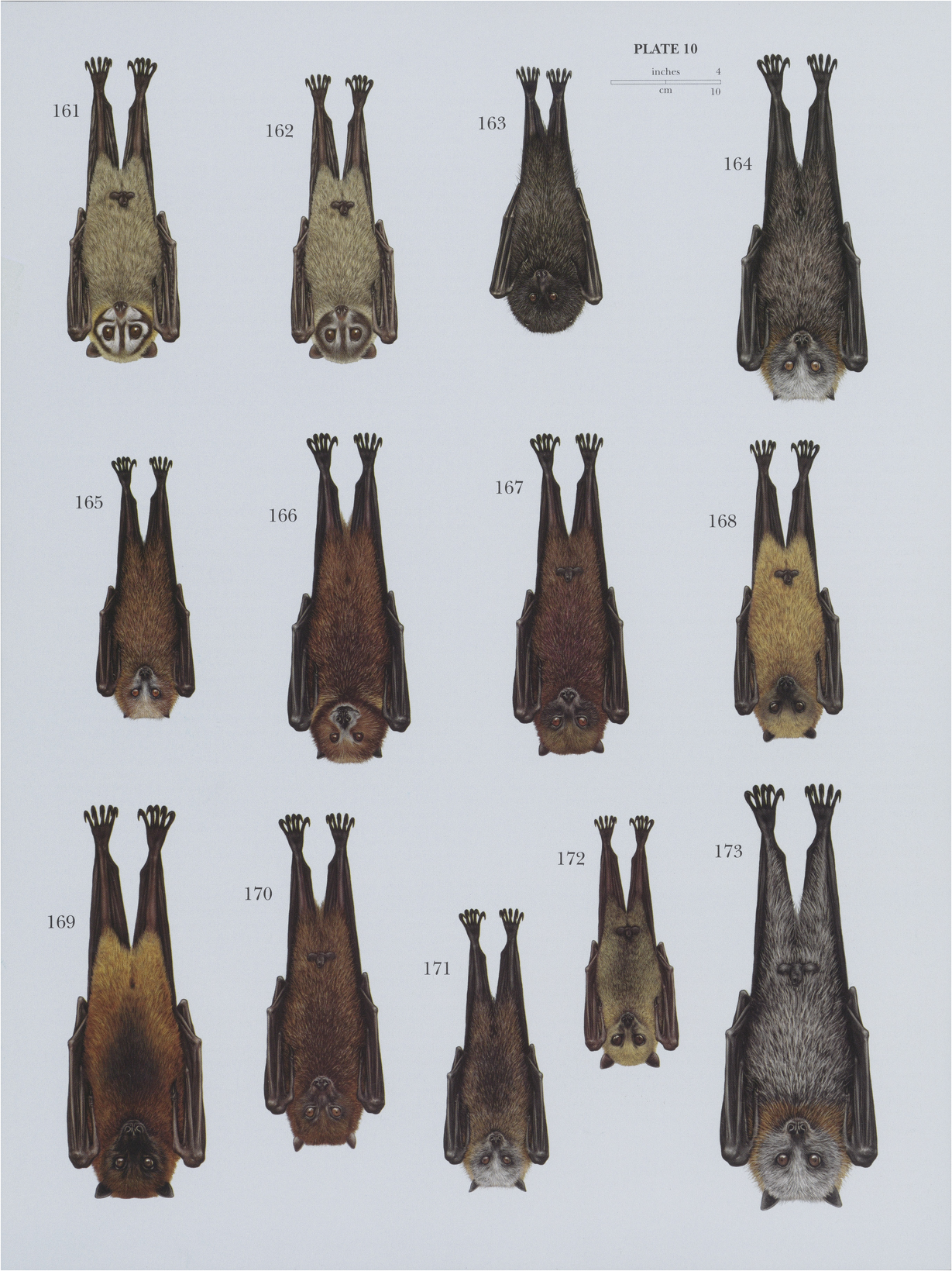
Flying fox species of Oceania: 161) New Britain Masked Flying Fox (Pleropus capistratus), 162) New Ireland Masked Flying Fox (Pleropus ennisae), 163) New Caledonia Flying Fox (Pteropus vetula), 164) Common Samoan Flying Fox (Pteropus samoensis), 165) Banks Flying Fox (Pteropus fundatus), 166) Vanuatu Flying Fox (Pleropus anetianus), 167) Vanikoro Flying Fox (Pleropus tuberculatus), 168) Temotu Flying Fox (Pteropus nitendiensis), 169) Solomons Flying Fox (Pteropus rayneri), 170) Makira Flying Fox (Pteropus cognatus), 171) Rennell Flying Fox (Pteropus rennelli), 172) Temminck’s Flying Fox (Pteropus temminckui), 173) Gray-headed Flying Fox (Pteropus poliocephalus)
Hendra virus is a rare but serious disease in Australia, primarily affecting horses and, less frequently, humans. The Hendra virus was first identified in Brisbane in 1994, where it killed three people and some race horses. Doctors first thought the victims died of Japanese encephalitis because the symptoms were similar but became suspicious when people who had been vaccinated with Japanese encephalitis came down with disease and some pigs got it (pigs don’t get Japanese encephalitis).
Hendra virus is carried by flying foxes bat) and can be transmitted to horses, and from horses to humans. Flying foxes are the natural reservoir for disease. The virus can spread from flying foxes to horses through contact with their urine, droppings, or saliva. Horses can then transmit the virus to humans, though this is rare. Symptoms in humans include fever, cough, sore throat, headache, tiredness, and potentially meningitis or encephalitis (inflammation of the brain). When it does occur, Hendra virus is found in eastern Australia, particularly in Queensland and New South Wales. In July 2025, an unvaccinated horse in southeast Queensland died from Hendra virus. It was the state's first reported case since 2022.
In July 2025, an Australian man in his 50s in New South Wales died several months after he was bitten by a bat carrying Australian bat lyssavirus — an "extremely rare" rabies-like infection transmitted by bat bites "While it is extremely rare to see a case of Australian bat lyssavirus, there is no effective treatment for it," Keira Glasgow, a director in health protection at NSW Health said in the statement. Glasgow said there were 118 people who required medical assistance after being bitten or scratched by bats in 2024, but this is the first confirmed case of the virus in New South Wales, and the fourth case in Australia.[Source: CBSNews, July 3, 2025]
CBSNews reported: Officials said the man was treated following the bite and they were investigating to see whether other exposures or factors played a role in his illness. The virus — a close relative to rabies, which does not exist in Australia — is transmitted when bat saliva enters the human body through a bite or scratch. First symptoms can take days or years to appear. Early signs of the disease are flu-like — a headache, fever and fatigue, the health service said. The victim's condition rapidly deteriorates, leading to paralysis, delirium, convulsions and death. There were only three previous cases of human infection by Australian bat lyssavirus since it was first identified in 1996 — all of them fatal.
People should avoid touching or handling bats, as any bat in Australia could carry lyssavirus, the New South Wales health service said. "If you or someone you know is bitten or scratched by a bat, you need to wash the wound thoroughly for 15 minutes right away with soap and water and apply an antiseptic with anti-virus action," it said. "Patients then require treatment with rabies immunoglobulin and rabies vaccine."
The virus has been found in species of flying foxes and insect-eating microbats, NSW Health said. The species of bat involved in the latest fatality has not been identified."Australian bat lyssavirus is very closely related to rabies and will cause death in susceptible people if they become infected and are not treated quickly," said James Gilkerson, infectious diseases expert at the University of Melbourne.
The virus was first identified in May 1996 by scientists at the national science agency CSIRO, who examined brain tissue from a flying fox that had been showing "nervous signs" in New South Wales. Later that year, a bat handler in Queensland became ill. "The initial numbness and weakness suffered in her arm progressed to coma and death," the science agency said in an online document on the virus. "Two further cases in Queensland — a woman in 1998 and an eight year old boy in 2013 — resulted in death after being bitten or scratched by a bat," it said. There are subtle differences between the lyssavirus in flying foxes and insectivores (eat insects) bats, the science agency has found. Infected bats can transmit the virus to people, other bats and other mammals.
Gray-Headed Flying Foxes
Grey-headed flying foxes (Pteropus poliocephalus) are the largest batsand most widespread flying foxes in Australia. They share mainland Australia with three other members of the flying fox genus Pteropus — little red, spectacled black flying foxes — and live in the forests of southeastern Australia, mostly east of the Great Dividing Range, occupying more extreme latitudes than any other Pteropus species.
Grey-headed flying foxes are is listed as "Vulnerable" on the On the International Union for Conservation of Nature (IUCN) Red List. Other Pteropus species are known to be preyed upon by snakes, such as brown tree snakes, but other than of humans there have been no reportes of other animals killing or preying on grey-headed flying foxes. [Source: Christina DeHaven, Animal Diversity Web (ADW) |=|]
Grey-headed flying foxes have a major impact on ecosystems in Australia mainly as seed dispersers and pollinators. Many different fruits and pollen are consumed and come in contact with grey-headed flying foxes, making this species and they are highly important in seed dispersal and pollination for a wide variety of plants. Certain plants enjoy a wider range due to the long-distance seed dispersal of these flying foxes.
See Separate Article: GRAY-HEADED FLYING FOXES:CHARACTERISTICS, BEHAVIOR AND REPRODUCTION ioa.factsanddetails.com
Little Red Flying Foxes
Little Red flying-foxes (Pteropus scapulatus) are the smallest species of flying fox in mainland Australia and largest distribution of any flying fox species in Australia. Little red flying foxes occurs at the coast and further inland, camping and flying to the tropical to temperate regions that provide them with an annual source of nectar. On occasion, they have been spotted as far away as Papua New Guinea and one individual was sighted in New Zealand. Although little red flying foxes occur throughout Australia, they are particularly abundant in northern Australia. [Source: Jeremie Marko, Animal Diversity Web (ADW) |=|]
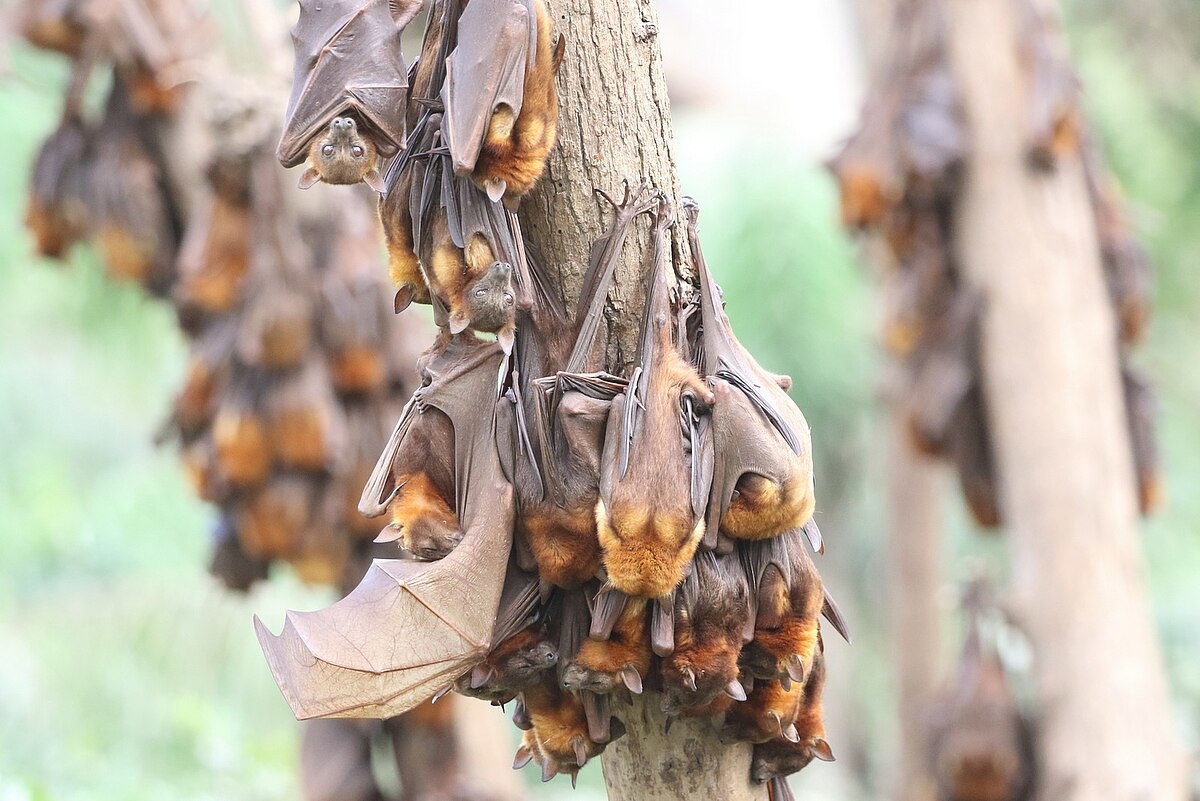
Little Red flying-foxes
Little red flying foxes are medium-sized bats and small flying foxes. They weigh from 0.55 kilograms grams (1.2 pounds) and have head and body length of 12.5 to 20 centimeters (five to eight inches. Their wingspan that ranges from 0.9 to 1.2 meters (3 to 4 feet). Their average basal metabolic rate is 1.353 watts. Sexual Dimorphism (differences between males and females) is present: Males are larger than females. After winter solstice, the testicular size and body weight of males increase.
Little red flying foxes can be found throughout coastal regions as well as arid landscapes of inland Australia. They tend to congregate at camps (gathering places) in riparian habitat environments (near a river or other water body), such as mangroves, bamboo and closed forests and agricultural areas. Selection of camp sites appears to be determined by seasonal variation, presumably based at least n part of food availability as well as by other factors; such as human presence, droughts and fires, and climatic conditions. The distribution of little red flying foxes extends over an area of 3.5 million square kilometers (1.35 million square miles) and ncludes both temperate and tropical regions. During the warmer months of October to April, Little red flying foxes primarily inhabits the temperate regions at the southern extent of its range.
Little red flying foxes are not endangered or threatened. They are designated as a species of least concern on the International Union for Conservation of Nature (IUCN) Red List and have no special status on the Convention on International Trade in Endangered Species (CITES). Their main threats are habitat loss and degradation. Little red flying foxes contributes to the pollination of plants that are important for humans, including trees used for lumber, food, and medicine. In regions of fruit production, this species is considered a pest because of its tendency to feed upon agricultural crops. |=|
Little Red Flying Fox Behavior, Diet and Reproduction
Little red flying foxes are motile (move around as opposed to being stationary), migratory (make seasonal movements between regions, such as between breeding and wintering grounds) and colonial (live together in groups or in close proximity to each other). Little red flying foxes do not echolocate. They communicate with touch, sound and chemicals usually detected by smelling and sense using vision, touch, sound and chemicals. They can be noisy and are believed to communicate with loud vocalizations like other flying fox species. [Source: Jeremie Marko, Animal Diversity Web (ADW) |=|]
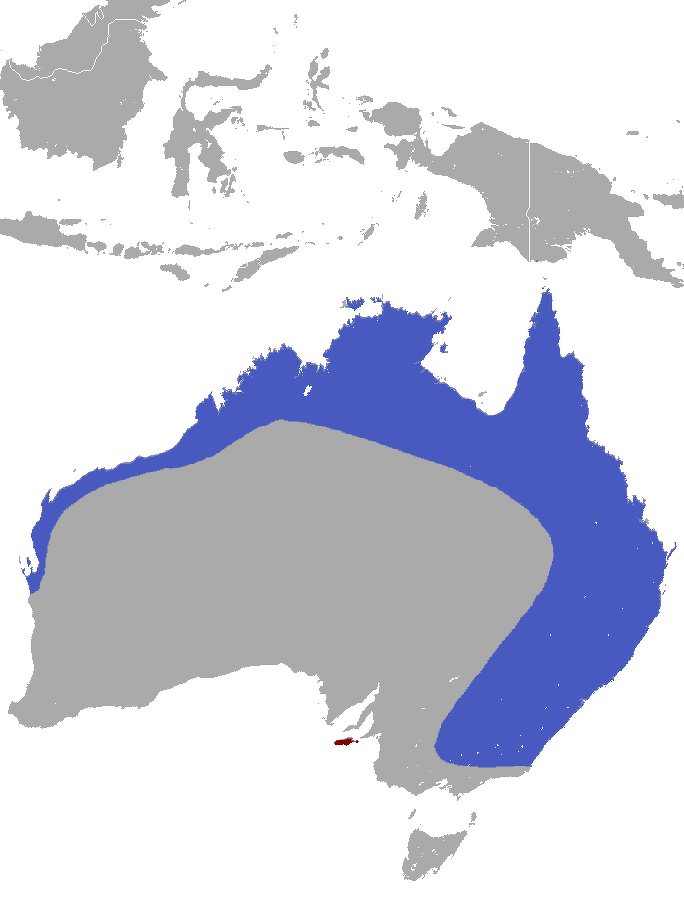
range of little red flying-foxes
Little red flying foxes are herbivores (eat plants or plants parts), folivores (eat leaves) and frugivores (eat fruit). They primarily feed on blossoms of eucalyptus trees. There is some evidence that little red flying foxes follows the seasonal flowering of eucalyptus blooms. These bats also have an unusual method of obtaining drinking water during dry periods: they skim water bodies and gather it onto their fur while they are in flight.
Little red flying foxes are polygynous (males have more than one female as a mate at one time) and employ delayed implantation (a condition in which a fertilized egg reaches the uterus but delays its implantation in the uterine lining, sometimes for several months). They engage in seasonal breeding, once a year in the spring months of November and December at times set by by biological cycles rather than environmental cues. The gestation period ranges from four to five months. The average number of offspring is one. On average males and females reach sexual or reproductive maturity just shy of 18 months.
Female and male little red flying foxes congregate in large camps, especially during the two-month mating season and during the five months of lactation. As many as one million individuals are known to congregate at a single camp. Studies suggest that most females are associated with males in harem groups during the mating season. After mating, females establish small groups consisting exclusively of females. These small female groups are maintained until young are born. Parental care is provided by females. Young are altricial, meaning they are relatively underdeveloped at birth. Young bats are not able to fly from birth. Some female flying foxes carry their young with her for a few months. Lactating flying fox females raise their young close to adult size before they are weaned. Lactation lasts between three and six months.
Black Flying Foxes
Black flying foxes (Pteropus alecto) are found mainly in northern Australia, southern New Guinea, the Indonesian island of Sulawesi and a a few other islands in Indonesia. In Australia, they mainly coastal areas of the northern territory as far as 250 kilometers (150 miles) inland. Their habitat consists of rainforest, eucalyptus open forest, and savanna woodland. They roost primarily in bamboo, rainforests, and mangroves, and occasionally caves. [Source: Diane Ten Pas, Animal Diversity Web (ADW) |=|]
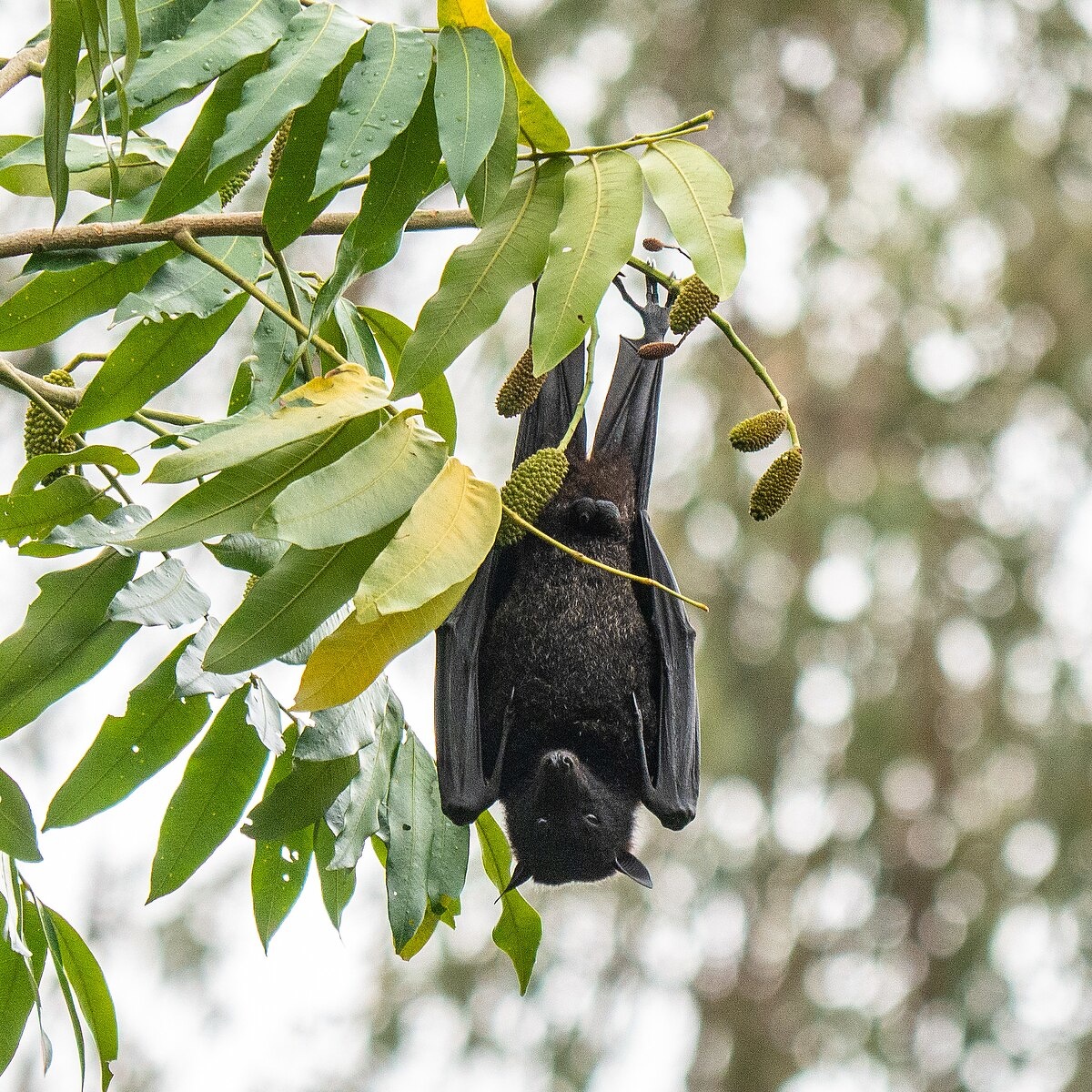
Black flying fox
One study in the 1990s found that, during the cooler dry season months, 74 percent of black flying foxes roosted in bamboo, 20 percent in mangroves, and six percent in rainforest habitats. During the build-up season (characterized by warming temperatures and early rains), 68 percent roosted in rainforest, 17 percent roosted in mangroves, and 15 percent roosted in bamboo. During the wet season, 52 percent roosted in rainforest, 28 percent in bamboo, and 20 percent roosted in mangroves.
Black flying foxes roosting in bamboo thickets roost 12 to 16 meters off the ground, space themselves less than one meters apart, and forage predominantly in woodland habitat. Those roosting in rainforests roost more than 18 meters off the ground, space themselves approximately one meters apart, and forage predominantly in forest and rainforest habitat dominated by Melaleuca species. Females use camps more than males, and smaller camps tend to be primarily made up of males and sub-adults.
Black flying foxes are not endangered or threatened. The International Union for Conservation of Nature (IUCN) Red List they are classified as a species of “Least Concern”. In CITES (Convention on International Trade in Endangered Species of Wild) they are in Appendix II, which lists species not necessarily threatened with extinction now but that may become so unless trade is closely controlled. Black flying foxes have been hunted for food and suffer from habitat loss and degradation. They can be crop pests and cause or carry domestic animal diseases. They sometimes raid fruit orchards and are is known to carry Australian bat Lyssavirus, a deadly rabies-like disease that can be contracted by humans.
Black Flying Foxes Characteristics and Diet
Black flying foxes are one of the largest bat species in the world, with a wingspan of more than one metre (39 inches). Their average weight is 0.67 kilograms (1.5 pounds) Black flying foxes have a black body with some lighter hairs, and a black head. They may have a brown eye-ring, and often have a reddish collar on the back of the neck. The legs are furred to the knee, but are hairless below. The forearm length measures 15.3 to 19.1 (6 to 7.5 inches) Sexual Dimorphism (differences between males and females) is not present: Both sexes are roughly equal in size and look similar.[Source: Diane Ten Pas, Animal Diversity Web (ADW) |=|]
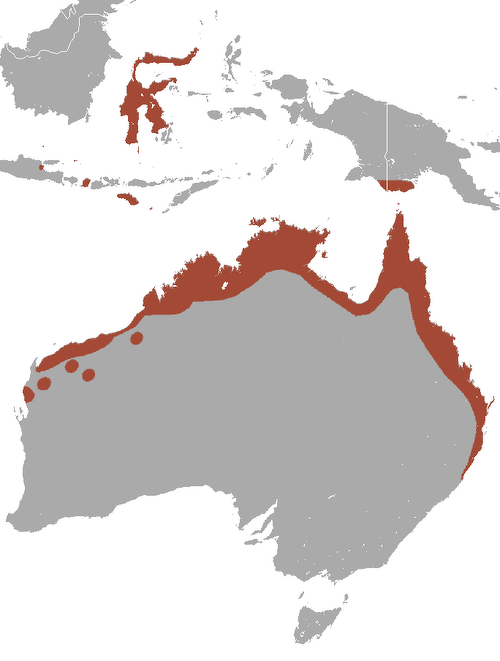
Black flying fox range
The lifespan of black flying foxes is not known but it has been estimated that the females who survive to maturity need to live about seven years to maintain a stable population. Approximately 30 percent of females born survive to maturity, compared to 37 percent in males. Survival rates vary between camps and between years. In years in which food is more abundant, lower levels of mortality are expected. Hybrids between black flying foxes and grey-headed flying foxes have been observed. Individuals had characteristics of both species, however, genetic testing of these hybrids failed to confirm that they were hybrids.
Black flying foxes are herbivores (eat plants or plants parts), frugivores (eat fruits) and nectarivore (eat nectar). They feed on fruits, pollen, and nectar of 23 rainforest species. These species include Carpentaria acuminata, Terminalia microcarpa, Diospyros littorea, Elaeocarpus arnhemicus, Ficus opposita, Ficus racemosa, Ficus scobina, Ficus virens, Eucalyptus miniata, Eucalyptus papuana, Eucalyptus polycarpa, Eucalyptus tetrodonta, Lophostemon grandiflorus, Lophostemon lactifluus, Melaleuca dealbata, Melaleuca viridiflora, Syzygium nervosum, Passiflora foetida, Grevillea pteridifolia, Nauclea orientalis, Timonius timon, Cupaniopsis anacardioides, and Gmelina schlechteri. (Palmer and Woinarski, 1999; Palmer, et al., 2000) |=|
Black flying foxes feed on different foods depending upon the time of year. During the dry season, they forage primarily in Eucalyptus open forest. During the build-up season, they forage primarily in the Melaleuca open forest, and during the wet season, they forage primarily in rainforests. They appear to have a keen sense for selecting sites with abundant food resources choosing them over sites that look the same floristically but don’t have as much food.
Black Flying Foxes Behavior and Reproduction
Black flying foxes are arboreal (live mainly in trees), good fliers, nocturnal (active at night), motile (move around as opposed to being stationary), migratory (make seasonal movements between regions, such as between breeding and wintering grounds) and colonial (live together in groups or in close proximity to each other). On study found that males travel an average of 6.8 kilometers, and females travel an average of 5.8 kilometers between roosts. On average, when foraging at night, males travel 6.2 kilometers and females travel 10.9 kilometers from their roosts. [Source: Diane Ten Pas, Animal Diversity Web (ADW) |=|]
During the day, black flying foxes roosts in colonies called camps. Typically males travel between roosts more than females throughout the year. However, females travel further distances from roosting sites to food than males do. During the build-up season, females travel between roosts more than at any other times of the year. Both males and females travel further between roosting sites and food during the dry season than any other season.
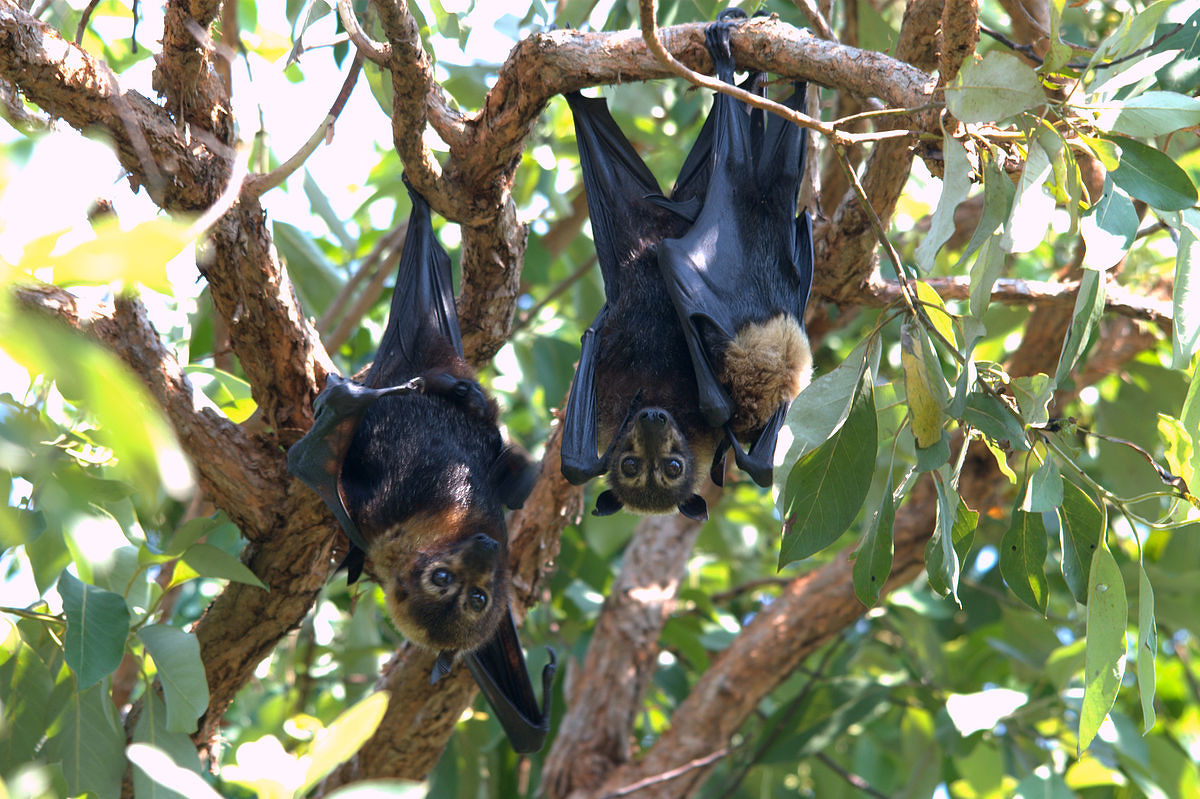
Spectacled flying foxes: male, female and young
There is little information on mating systems of black flying foxes. Peak birth times are correlated with periods of maximal plant productivity, hence, the timing of births varies with location. In Brisbane, most births are in October to November. In the Northern Territories of Australia, peak birth times are from January to March, and births in November are unusual but not rare. On average females reach sexual or reproductive maturity at 14.8 to 17 months years and males do so at 16.3 to 18 months. The usual number of offspring is one, sometimes two. Females tend to grow faster than males. On average, females gain 2.56 grams per day and their forearms grow 0.25 millimeters per day. On average, males gain 2.28 grams per day and their forearms grow 0.15 millimeters per day.
Spectacled Flying Foxes
Spectacled flying foxes (Pteropus conspicillatus) are also known as spectacled fruit bats. They are found parts of northeastern Queensland, north of 19 degrees south latitude, in New Guinea and islands off of New Guinea including Woodlark Island, Alcester Island, Kiriwina, and Halmahera, in Papua New Guinea and Indonesia. They live in primary and secondary growth tropical rainforests, mangroves and paperbark and eucalypt forests and prefer to roost in the middle and upper canopy strata in the full sun and on dead trees or trees stripped of their foliage. They have been showing up more and more in suburban and urban environments. Spectacled flying foxes are important dispersers of many rainforest species. Plants that are adapted to bat dispersal tend to have light-colored fruits, in contrast to the brightly-colored fruits of species adapted to avian dispersal and pollination. [Source: Rachel Mueller, Animal Diversity Web (ADW) |=|; Wikipedia]
Spectacled flying foxes range in weight from one half to one kilograms (1.1 to 2.2 pounds). and have a head and body length of 22 to 24 centimeters (8.6 to 9.4 inches) and a forearm length of 15.7 to 18.1 centimeters (6.2 to 7.1 inches). Spectacled flying foxes are black with a yellow mantle that goes across the back, neck, and shoulders. The fur surrounding the eyes is yellow-green, giving them appearance of wearing spectacles. Some have pale yellow fur on the face and top of the head. Sexual Dimorphism (differences between males and females) is present: Males are larger than females. Females weigh 0.5 to 0.66 kilograms (1.1 to 1.45 pounds) while males weigh .950 to one kilogram (2.1 to 2.2 pounds)
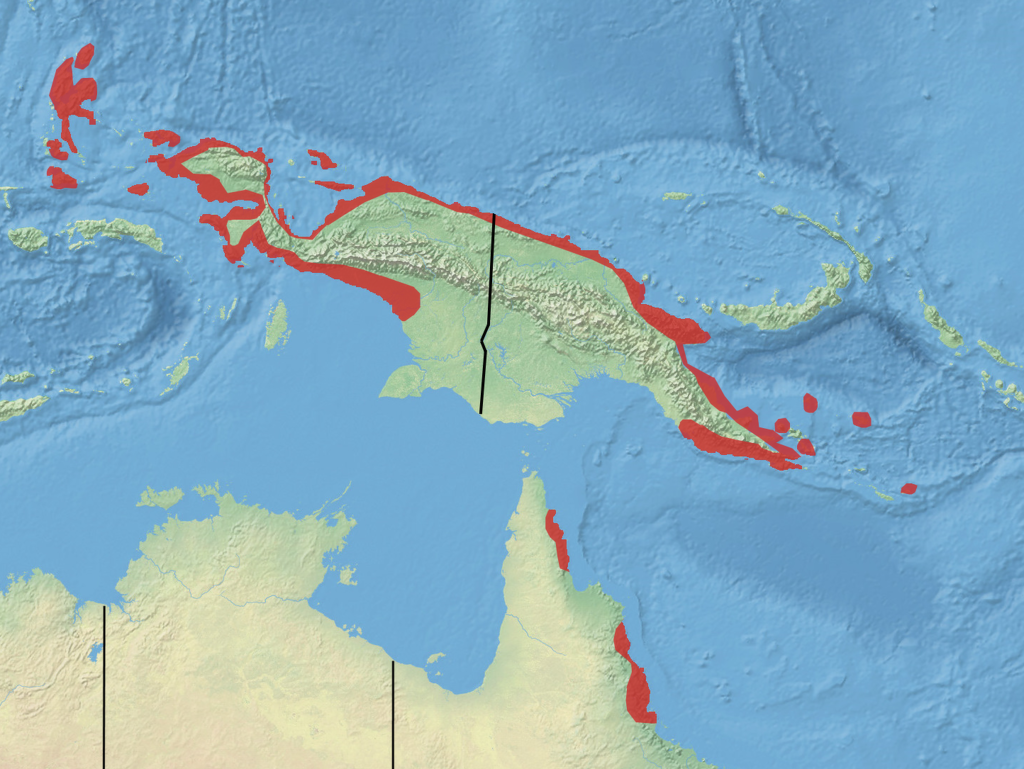
range of spectacled flying foxes
Spectacled flying foxes were designated as a species of least concern on the International Union for Conservation of Nature (IUCN) Red List but have been classified as endangered by the IUCN in 2020. CITES (Convention on International Trade in Endangered Species of Wild) places them in Appendix II, which lists species not necessarily threatened with extinction now but that may become so unless trade is closely controlled. In Australia, spectacled flying foxes were listed as a threatened species under the Environment Protection and Biodiversity Conservation Act 1999. They were considered vulnerable due to a significant decline in numbers as a result of loss of their prime feeding habitat and secluded camp sites. In February 2019, the Australian government upgraded the threatened status from vulnerable to endangered, after almost a third of the bat population died in a severe heatwave in Queensland in late 2018.
Spectacled flying foxes in captivity have lived up to 17 years. Natural predators include carpet pythons and white-breasted sea eagles. Occasionally crocodiles eat bats that skim the water surface while drinking. Spectacled flying foxes have been also eaten by humans.
Spectacled Flying Fox Behavior, Diet and Reproduction
Spectacled flying foxes are arboreal (live mainly in trees), good fliers, nocturnal (active at night), motile (move around as opposed to being stationary), migratory (make seasonal movements between regions, such as between breeding and wintering grounds) and colonial (live together in groups or in close proximity to each other). In the Atherton Tableland colonies leave their roost sites from May through August, which are the months of greatest rainfall and lowest fruit abundance. They often migrate to warmer, lower-elevation coastal regions of Innisfail and Tully where fruit availability is less dependent on season. Because they are not forced to relocate in search of food, coastal colonies occupy roost year-round. [Source: Rachel Mueller, Animal Diversity Web (ADW) |=|; Wikipedia]
Spectacled flying foxes are mainly frugivores (eat fruit). More than 90 percent of their diet consists of fruits of forest trees and palms. They locate food visually; thus, fruits chosen — and pollinated — by spectacled flying foxes are light-colored and stand out against the dark upper rainforest canopy. Common fruits eaten include citrus, mango, Northern Bloomwood, and Apple Box. Spectacled flying foxes sometimes raid orchards and have been reported skimming over the surface of water to drink and are sometimes caught and eaten by crocodiles.
According to Animal Diversity Web: Early in the evening, spectacled flying foxes leave their roosting sites and congregate on fruiting trees. Individuals who arrive early in the evening ("residents") establish ephemeral feeding territories and quickly force out individuals who arrive later ("raiders"). This "raiders vs. residents" model of nocturnal (active at night), territorial (defend an area within the home range), behavior results in long-distance dispersal of fruits, as "raiders" tend to obtain a fruit or two before being driven off in search of a new feeding site. Bats drink by skimming over the surface of water during flight; they have been observed to drink both fresh and sea water in this way. |
Female spectacled flying foxes reach sexual maturity at two years of age. Mating occurs between March and May, followed by a six-month gestation period. Generally, one young is born each year. Males and females form monogamous seasonal pair bonds if the female bears a young that year; if she does not bear a young, males are polygynous. Young bats are weaned after four months.
Male and female spectacled flying foxes sometimes roost together. The sexual composition of the roost changes depending on the season. According to Animal Diversity Web: Following mating, flocks segregate by gender; throughout gestation, males and females roost separately and move independently over different ranges. Females arrive at traditional breeding spots to give birth. Males arrive soon thereafter and establish territories around females. Males display antagonistic behavior towards one another during the establishment of territories. |=|
Image Sources: Wikimedia Commons
Text Sources: Animal Diversity Web animaldiversity.org , National Geographic, Live Science, Natural History magazine, Australian Museum, David Attenborough books, Australia Geographic, New York Times, Washington Post, Los Angeles Times, Smithsonian magazine, Discover magazine, The Conversation, The New Yorker, Time, BBC, CNN, Reuters, Associated Press, AFP, Lonely Planet Guides, Wikipedia, The Guardian, Top Secret Animal Attack Files website and various books and other publications.
Last updated August 2025