
TREE-KANGAROOS IN PAPUA NEW GUINEA

Doria's tree-kangaroo
Tree-kangaroos are marsupials of the genus Dendrolagus, adapted for living and getting around in trees. They inhabit tropical rainforests of New Guinea and far northeastern Queensland, Australia along with some of the islands in the region. All tree-kangaroos are considered threatened due to hunting and habitat destruction. They are the only true arboreal macropods (kangaroos and wallabies). Dendrolagus means “tree hare”.
Twelve of the 14 known species including a couple that have only been discovered relatively recently, live in New Guinea, both in Papua New Guinea and West Papua in Indonesia, and some nearby islands, namely the Biak (Schouten) Islands and the Raja Ampat Islands near Papua, Indonesia. Two species live in Australia. Tree-kangaroos inhabit the tropical rainforests and thrive in the treetops and upper canopy. Although most species are found in mountainous areas, several also occur in lowlands, such as the aptly named lowlands tree-kangaroo. Because they spend much of their time in trees they are good at climbing and jumping between trees and branches. [Source: Wikipedia]
Tree-Kangaroos in Papua New Guinea:
Grizzled tree-kangaroos (Dendrolagus inustus) live in northern New Guinea in both Papua New Guinea and West Papua in the Indonesian part New Guinea and the Bird’s Head in West Papua in the Indonesian part New Guinea
Seri's tree-kangaroos (Dendrolagus stellarum) live mostly in central West Papua in the Indonesian part New Guinea in New Guinea but part of their range extends into central Papua New Guinea; Seri's tree-kangaroos have been described as both a subspecies of Doria's tree-kangaroos and a separate species based on its absolute diagnostability
Goodfellow's tree-kangaroos (Dendrolagus goodfellowi) live in central and southeast Papua New Guinea
Tenkile (Dendrolagus scottae) live in a couple of small areas in northern Papua New Guinea; A population of the tenkile recently discovered in the Bewani Mountains may represent an undescribed subspecies
Doria's tree-kangaroos (Dendrolagus dorianus) live in southeast Papua New Guinea and are one of the largest tree-kangaroo species. They weigh between 6.5 and 14.5 kilograms (14 and 32 pounds) and are 51 to 78 centimeters (20.1 to 30.7 inches) in length, with a long 44 to 66 centimetres (17.3 to 26.0 in) tail; they have long dense brown fur with black ears and a pale brown or cream nonprehensile tail; their large and powerful claws and stocky build gives it a bear-like appearance; They are are mostly solitary and nocturnal. Their diet consists of various leaves, buds, flowers and fruits
Golden-mantled tree-kangaroos (Dendrolagus pulcherrimus) live in a small area near the coast in northern Papua New Guinea; they were first described as a subspecies of Goodfellow's tree-kangaroo but fairly recently has been elevated to species status; Golden-mantled tree-kangaroos are critically endangered; Their range is restricted to two small mountain areas in the north (the Foja and Torricelli Mountains) at elevations between 680–1,700 metres (2,230–5,580 ft) and they are threatened by hunting and habitat loss; They are chestnut brown short with a pale belly, and yellowish neck, cheeks and feet. A double golden stripe runs down its back. The tail is long and has pale rings. They look similar to closely related Goodfellow's tree-kangaroos, differing from them in that they have a pinkish or lighter coloured face, golden shoulders, white ears and smaller size. Some authorities consider the golden-mantled tree-kangaroo as a subspecies of Goodfellow's tree-kangaroo.
ifola
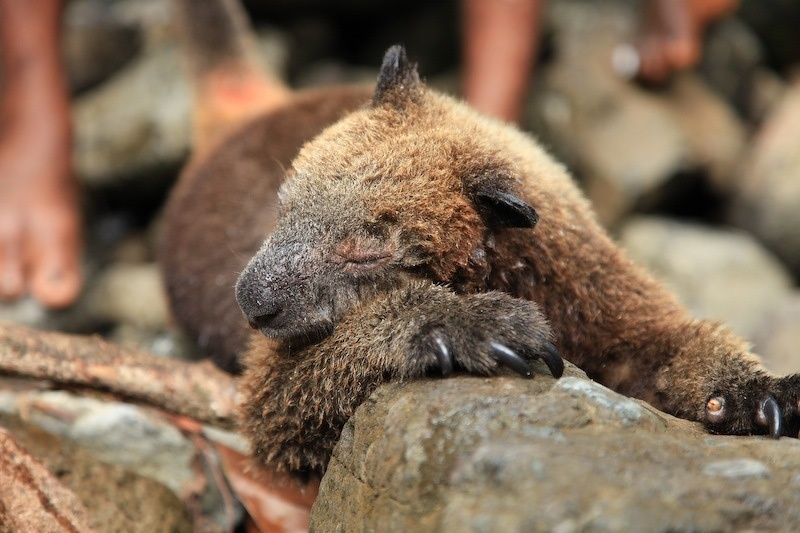
Ifola (Dendrolagus notatus) live in a fairly large area in central Papua New Guinea; They are found in high elevations of the central mountains and are threatened by habitat loss and hunting for food with dogs by local people; The species was considered a subspecies of Doria's tree-kangaroos until being considered as a separate species by Helgen in 2007
Matschie's tree-kangaroos (Dendrolagus matschiei) live in a small area near the coast of central eastern Papua New Guinea; these monkeylike marsupials have a body and head length of 50 to 81 centimeters (20 to 32 inches;, adult males weigh 9–11 kilograms (20-25 pounds) and adult females weigh 7–9 kilograms (15-20 pounds)
Lowlands tree-kangaroos (Dendrolagus spadix) live only in the lowland rainforests in central southern Papua New Guinea; little is know about them
RELATED ARTICLES:
TREE-KANGAROOS: CHARACTERISTICS, BEHAVIOR AND REPRODUCTION ioa.factsanddetails.com
TREE-KANGAROOS IN AUSTRALIA: BENNETT'S, LUMHOLTZ'S, CHARACTERISTICS, BEHAVIOR AND REPRODUCTION ioa.factsanddetails.com
TREE-KANGAROOS IN WEST PAPUA, INDONESIA: SPECIES, CHARACTERISTICS, BEHAVIOR, REPRODUCTION factsanddetails.com
MARSUPIALS: HISTORY, EVOLUTION, CHARACTERISTICS, BEHAVIOR, REPRODUCTION ioa.factsanddetails.com
MARSUPIALS IN AUSTRALIA ioa.factsanddetails.com
MARSUPIALS IN AUSTRALASIA (AUSTRALIA, NEW GUINEA, NEARBY ISLANDS) ioa.factsanddetails.com
KANGAROOS AND WALLABIES (MACROPODS): CHARACTERISTICS, HISTORY, POPULATIONS ioa.factsanddetails.com
KANGAROO BEHAVIOR: FEEDING, REPRODUCTION, JOEYS ioa.factsanddetails.com
WALLABIES: TYPES, CHARACTERISTICS, BEHAVIOR, REPRODUCTION ioa.factsanddetails.com
WALLABY SPECIES ioa.factsanddetails.com
FOREST WALLABIES (DORCOPSIS): SPECIES, CHARACTERISTICS, BEHAVIOR AND REPRODUCTION ioa.factsanddetails.com
PADEMELONS: SPECIES CHARACTERISTICS, BEHAVIOR AND REPRODUCTION ioa.factsanddetails.com
Goodfellow's Tree-Kangaroos
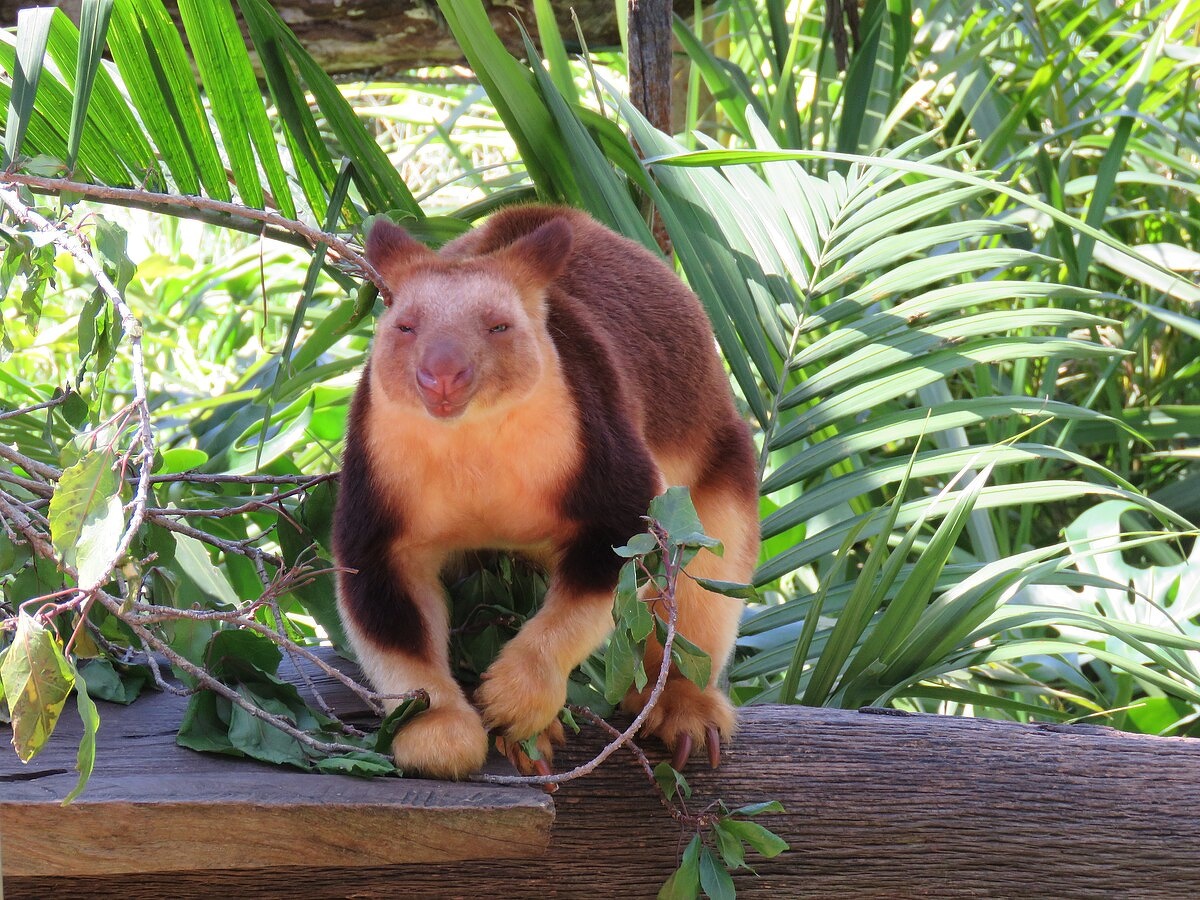
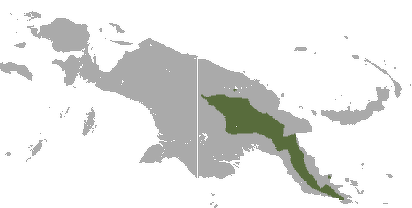
Goodfellow's tree-kangaroos (Dendrolagus goodfellowi) are also called ornate tree-kangaroos. They live in dense tropical rainforests and deciduous forests over mountain ranges, ranging from the border of West Papua, eastward into central and eastern Papua New Guinea. Found at elevations from sea level to nearly 3,050 meters (10,000 feet), they live in the treetops and feed on leaves or other plant matter and carry their young in pouch like other marsupials. Their average lifespan in captivity is 23.6 years. here are two subspecies: 1) Dendrolagus goodfellowi goodfellowi and 2) Dendrolagus goodfellowi buergersi (known as Buergers' tree-kangaroo). Goodfellow's tree-kangaroos are named after Walter Goodfellow (1866–1953), a British zoological collector and ornithologist, who discovered the species. [Source: Scherrie Johnson, Animal Diversity Web (ADW) |=|; Wikipedia]
Found in isolated enclaves of mid-montane forests in Papua New Guinea and West Papua, Goodfellow's tree kangaroos are solitary creatures that reach a length of 1.3 meters (four feet), including a 70 centimeters (2.2 foot) tail, and weigh 10 kilograms (22 pounds). Goodfellow's tree kangaroos rarely touch they ground. Their long tails gives them excellent balance, their powerful legs although to leap from branch to branch and their padded and long claws allow them to climb around easily in rain forest trees. The marsupials eat leaves and fruit and sleep on the forks of trees. These marsupials are rare and their numbers are unknown but are believed to have declined as a result of hunting and habitat loss.
Goodfellow's tree-kangaroo
On the International Union for Conservation of Nature (IUCN) Red List, Goodfellow's tree-kangaroos are listed as Endangered due to an ongoing population decline of at least 50 percent over the past three generations in their range. They are threated by habitat loss and hunting. Large swaths of their original rainforest habitat has been destroyed or degraded by logging, mining and clearing for agriculture. There are reasonably healthy numbers of them in national parks and reserves and and helped by the almost complete absence of any large tree-climbing predators or competitors. There are no good estimates of Goodfollow's tree-kangaroo population numbers.
Goodfellow's tree-kangaroos have a head and body length of 55 to 77 centimeters (1.8 to 2.6 feet) and a tail length of 70 to 84.5 centimeters (2.3 to 2.8 feet). Their average weight is 7.4 kilograms (16.3 pounds). They have a slender body and short, usually woolly fur that is chestnut brown or red-brown to crimson in color. They have double longitudinal stripes on their back and a paler belly. The tail has light spots or rings, and the feet are yellow. The face is gray-brown and the neck and cheeks are often yellow and they have a vortex of hair in the middle of their back. Goodfellow's tree-kangaroos do not have disproportionately large hindlimbs like land-dwelling kangaroo . The forelimbs of tree-kangaroos are strong and have hooked claws for grasping treebranches. Their long tail helps their balance.
Goodfellow's Tree-Kangaroo Behavior and Reproduction
Goodfellow's tree-kangaroos are arboreal (live mainly in trees) and motile (move around as opposed to being stationary). Goodfellow's tree-kangaroos are slow and clumsy on the ground, moving at about walking pace and hopping awkwardly, leaning their bodies far forward to balance the heavy tail. They are unable to move more than two "kangroo hops" in succession and usually get around by taking little hopping steps, in which the two forelegs and the two hind legs alternately touch the ground. In trees Goodfellow's tree-kangaroos are bold and agile and move easily along branches using their strong tails for balance and the padded feet and long claws for climbing.They climb by wrapping the forelimbs around the trunk of a tree and hopping with their powerful hind legs, allowing their forelimbs to slide.
Goodfellow’s tree kangaroo are generally solitary by nature. Females maintain a territory of a few hectares, while males have larger territories which overlap those of several females. Goodfellow's tree-kangaroos are herbivores (eat plants or plants parts). They emerge at night to feed mainly on leaves from silkwood trees (Flindersia pimenteliana) but also eat leaves, a range of fruits, flowers and even grasses and cereals along the forest edges. Large quantities of low-nutrient value leaves are ingested and broken down in their relatively large sacculated stomachs by fermenting bacteria in way that is similar to that of cattle.
Goodfellow's tree-kangaroo range
The reproduction habits of Goodfellow's tree-kangaroos are similar to those of other tree-kangaroos. All female kangaroos have forward-opening pouch that contains four teats. The gestation period is 21 to 38 days. One young is typically born at a time, once a year but can change due to irregular and changing weather conditions. Joeys grows in the pouch for ten to twelve months.
Mother and joey stay together for about a year. Joeys emerge from the pouch at about eight months and take several weeks to gain confidence hopping from branch to branch. Joeys continue to nurse for several months after permanently leaving the pouch, returning frequently to their mother for milk.
Tenkile
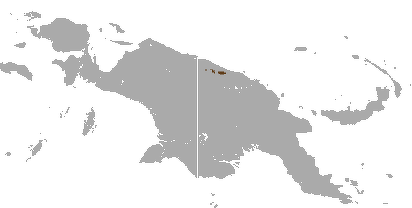
Tenkile (Dendrolagus scottae) are also known as Scott's tree-kangaroo. Endemic to a very small area of subtropical or tropical dry forests in the Torricelli Mountains of Papua New Guinea, they hive off a strong odor, which can last for up to a week on items this species comes in contact with. One of the animals’s names comes from a trust fund named after a man called Winifred Scott. After his death in 1985, the Permanent Trustee Company, a co-trustee of the Scott Trust, donated the trust income to an Australian Museum research program. Participants in this program discovered the tenkile and honored Winifred with the name Scott's tree-kangaroo. [Source: Lindsay Cosens, Animal Diversity Web (ADW) |=|]
Tenkile were only discovered by Westerners in 1989 and have been described as the rarest tree-kangaroo species. Wild populations are rapidly declining, and is now thought to be less than 200 individuals — a 75 percent reduction since 1989. Tenkile are found only in Sandaun Province in Solomon Islands along the Torricelli Mountains on the southern side of Mount Sumoro at elevations of 900 to 1500 meters (2953 to 4921 feet) in an area that covers only about 50 square kilometers (19.3 square miles). To help these animals the Tenkile Conservation Alliance was formed in 1999. Its main aim maintain the tree-kangaroo’s habitat.

tenkile
Tenkile on average weigh around 10 kilograms (22 pounds). Like other tree-kangaroos, they have bodies that are built for climbing up and down trees and for moving along tree branches. Their tail is relatively long and floppy and serves as a counterbalance for maneuvering through the upper levels of the rainforest. Good balance and agility are needed to be able to jump or move from tree to tree without falling. Large foreclaws enable these marsupials to grasp tree branches and climb through the canopy. Their fur is a dark brown in color which makes them hard to see in the shady forest. Like other marsupials, females they have a pouch used in the development of offspring.
On the International Union for Conservation of Nature (IUCN) Red List tenkile are listed as Critically Endangered, which is just short of extinction They are threatened by habitat loss by logging activities and coffee, rice and wheat agriculture and by hunting. Tenkile have traditionally been hunted for its meat, and has been a main protein source for the local tribespeople. The local human population has increased in recent years, increasing demand for tenkile meat. Additionally, tenkiles are poached for their fur and are captured and sold as a part of the illegal pet trade. Domesticated dogs are sometimes used to hunt tenkiles. Industrial logging that occurs in the Torricelli Mountain Range decreases the species' already restricted habitat.
Tenkile Behavior and Reproduction
Tenkile are arboreal (live mainly in trees), terricolous (live on the ground), diurnal (active mainly during the daytime), motile (move around as opposed to being stationary), sedentary (remain in the same area), territorial (defend an area within the home range), and social (associates with others of its species; forms social groups). On the ground they move with small hops. Their tail is held arched over their back and the head leans far forward. Females have may have a territory of few hectares. The territories of males are much larger. [Source: Lindsay Cosens, Animal Diversity Web (ADW) |=|]
Tenkiles are herbivores (eat plants or plants parts). They mainly eat tree leaves, ferns, soft vines, roots and tubers. They forage in the trees and on the ground and mainly terrestrial, though they can climb to escape predators and danger. Native people report that they were previously encountered mainly in groups of four animals, including a male, female, and their young, but are more commonly found as solitary females and young in recent years, this may be the result of severe population declines in recent years. Related females may form social groups that cooperate in defense against unfamiliar males. |=|
Research suggests that tenkiles breed throughout most of the year. Females gives birth to young at 12 month intervals. They give birth to one offspring. In other tree-kangaroo species, gestation lasts about 32 days. Parental care is carried out by females. Young are altricial, meaning they are relatively underdeveloped at birth. Young emerge from the pouch at about ten months and become completely independent at 14 months.
Grizzled Tree-Kangaroos
Grizzled tree-kangaroos (Dendrolagus inustus) are one of the larger tree-kangaroos and spend a lot time on the ground.. They grow to a length of 90 centimeters (35 inches). They live in tropical areas in rainforests at elevations of 100 to 1400 meters (328 to 4593 feet) in northern and western New Guinea and ranges from the Vogelkop (the Bird’s Head) and Fak Fak Peninsula in West Papua of Indonesia to the north coast of Papua New Guinea. They also occurs on the offshore islands of Yapen, Waigeo, Misool and Salawati, and possibly Batanta. Grizzled tree-kangaroos inhabit a wide range habitats. Most report of them are from primary forests. Their lifespan in the wild is thought to be up 10 years. [Source: Yan-Iuan Ho, Animal Diversity Web (ADW) |=|]

Grizzled tree-kangaroo
Grizzled tree-kangaroos range in weight from eight to 15 kilograms (17.6 to 33 pounds) and have a head and body length of 75 to 90 centimeters (30 to 35.4 inches). Sexual Dimorphism (differences between males and females) is present: Males are considerably larger than females. Grizzled tree-kangaroos have stern-heavy bidy, small head and flat muzzle. They closely resemble forest and plains wallabies and often sometimes mistaken for terrestrial mammals. Their hindlimbs and hind feet are relatively long, especially compared to other tree-kangaroos and tree-dwelling mammals. The fourth toe is usually longer than the others. Grizzled tree-kangaroos also have powerful arms and long curved claws like other tree-kangaroos that them climb and move from tree to tree.
The grizzled coloration of grizzled tree-kangaroos distinguishes them from other tree-kangaroos. The coat is slate gray to chocolate brown and of medium length. The thick fur on the shoulders grows in a reverse direction and acts as a natural water shedding device — characteristic shared by tree-kangaroos in Australia. Grizzled tree-kangaroos have distinct black ears — hairless on the inside — on a gray head and have toes and a tail that is usually dark. The tail is bushy and uniform in thickness, but often hairless at the base. The tail serves as a counterbalance when in trees.
On the International Union for Conservation of Nature (IUCN) Red List, grizzled tree-kangaroos are listed as Vulnerable. In CITES (Convention on International Trade in Endangered Species of Wild) they are in Appendix II, which lists species not necessarily threatened with extinction now but that may become so unless trade is closely controlled. They are threatened by habitat loss and hunting. Local people eat them and capture them for the pet trade.
Grizzled Tree-Kangaroo Behavior and Reproduction
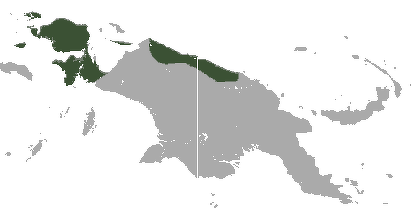
Grizzled tree-kangaroos range
Grizzled tree-kangaroos are arboreal (live mainly in trees), saltatorial (adapted for leaping), and motile (move around as opposed to being stationary). They are agile in trees, traveling from tree to tree by leaping, but are believed to belong to a primitive group of tree-kangaroos because their hind limbs are less adapted for arboreal life than other tree-kangaroos. When leaping from tree to tree, they always flee downward, which has meant they have been often captured by hunters who grab their tail as they flee. They prefer sleeping on strong, horizontal branches and spend most of their time in trees, but they do frequently come to the ground. On the ground, grizzled tree-kangaroos can hop but not so gracefully. The tail is held off the ground and the body moves forward to counterbalance it. It is not known if it is a solitary or social species, but Lumholtz’s tree-kangaroos and Bennett’s tree-kangaroos are both solitary species. [Source: Yan-Iuan Ho, Animal Diversity Web (ADW) |=|]
Grizzled tree-kangaroos are herbivores (animals that primarily eat plants or plants parts). They mainly eat leaves, fruit, and soft bark. The diet includes the leaves of Schuurmansiella angustifolia, Gnetum, Tetracera, Elatostema and arums and the leaves and fruit of fig trees. Grizzled tree-kangaroos in captivity do not eat animal protein such as chicken, but they do eat mealworms and boiled eggs. In zoos, they are fed carrots and bananas.
Not not much known about the mating behavior of grizzled tree-kangaroos but it is assumed it may close to that of their relative in Australia,Lumholtz’s tree-kangaroos, which are polygynous (males have more than one female as a mate at one time), engage in year-round breeding and practice embryonic diapause (temporary suspension of development of the embryo). The number of offspring is almost always one. Young are altricial, meaning they are relatively underdeveloped at birth and parental care is provided by females. The average weaning age is eight to nine months and the age in which they become independent ranges can be up to two years. On average males and females reach sexual or reproductive maturity at age two years.
Lumholtz’s tree-kangaroo males investigate receptive females by standing in front of them, making soft clucking sounds, and pawing gently at her head and shoulders. When the female moves away, the male follows and paws at the base of her tail. It is believed that grizzled tree-kangaroo females give birth soon after a young leave the pouch, and before the older young becomes independent. Males continue to grow throughout their lifetime.
Matschie's Tree-Kangaroos

Matschie’s tree-kangaroo
Matschie's tree-kangaroos (Dendrolagus matschiei) are also known as Huon tree-kangaroos. They are interesting looking and have striking coloration and thus are popular zoo animals. Their average lifespan in the wild is 8 years. Their average lifespan in captivity is 14 years. The scientific and common names honors German zoologist and biologist Paul Matschie (1861-1926), who discovered several other species of tree-kangaroo. Indigenous people refer them as a Boongarry. [Source: Animal Diversity Web (ADW) |=|]
Matschie’s tree-kangaroos are endemic to the Huon Peninsula of northeastern New Guinea in Papua New Guinea. They are the only tree-kangaroo species on inhabits this area and also found on the nearby island of Umboi, where they were probably introduced by humans. Matschie’s tree-kangaroos live in tropical areas in lower montane forests and rainforests at elevations of 1000 to 3000 meters (3280 to 9842 feet). Oaks are the predominant tree species at the lower elevations while conifers are common at the higher elevations. Tree ferns and epiphytes are common and there is a lot of leaf litter on the forest floor.
On the International Union for Conservation of Nature (IUCN) Red List, Matschie's tree-kangaroos are classified as Endangered, which means the species faces a very high risk of extinction in the wild. The estimated population of adult Matschie's tree-kangaroos is fewer than 2,500 individuals. In 1996, the IUCN) listed Matschie’s tree-kangaroos as Critically Endangered, as 50 percent of its population has disappeared in the previous past ten years. Rainforest deforestation and hunting by local are the main threats. Matschie’s tree-kangaroos are the focus of a Species Survival Plan organized by international zoos that involved in both animals in zoos and in the wild.
Matschie's Tree-Kangaroos Characteristics
Matschie’s tree-kangaroos range in weight from six to 13 kilograms (13.2 to 28.6 pounds) and have a head and body length of 55 to 63 centimeters (21.6 to 24.80 inches). Their long tails are about the same length as their body and head. Their average basal metabolic rate is 7.96 watts. Sexual Dimorphism (differences between males and females) is not present: Both sexes are roughly equal in size and look similar. [Source: Animal Diversity Web (ADW) |=|]
Matschie’s tree-kangaroos overall are chestnut to red brown in color with a bright yellow tail, belly, ear edges, and feet. Their faces are yellow and white. They often have a dark stripe that runs down their back and a vortex of fur in the middle of their back. Their fur is thick and grows in an opposite direction on their nape and back, enabling them to easily shed water when crouched in their typical position with head lower than shoulders.
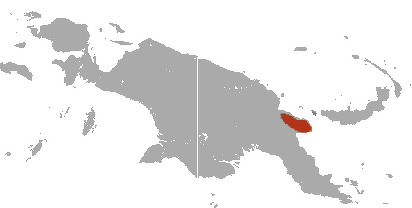
Matschie’s tree-kangaroo range
Matschie’s tree-kangaroos have stocky bodies with forelimbs and hindlimbs closer in proportion to each other than other macropods. Their tails are cylindrical rather than tapered and used for balancing. They have cushion-like pads on their feet covered with roughened skin, and some of their nails are curved. Females have a well-developed pouch with four mammae. |=|
Matschie’s tree-kangaroos can be distinguished from the closely related Goodfellow’s tree-kangaroos (once considered a subspecies) by the absence of golden back stripes, solidly colored yellow tail and more subdued coloration. Matschie’s tree-kangaroos have shorter feet than other tree-kangaroos and have larger ears. They have a diastema between their third incisor and canine of 2.95 +- 0.8 millimeters. The interparietal bone is large with an acute apex. |=|
Matschie's Tree-Kangaroos Behavior and Diet
Matschiei's tree-kangaroos are arboreal (live mainly in trees), diurnal (active mainly during the daytime), motile (move around as opposed to being stationary) and sedentary (remain in the same area). They solitary except when breeding and caring for young and tend to ignore one another even when sharing the same tree. Females do not share territories. Their territory size averages less than two hectares (4.5 acres), while male territories overlap and average more than four hectares (11 acres). Larger territories increase breeding opportunities for males. [Source: Animal Diversity Web (ADW) |=|]
Tree-kangaroos are very agile in trees and can travel rapidly from tree to tree, leaping as much as nine meters down to an adjoining tree.Matschiei's tree-kangaroos are good climbers but more awkward than other tree-kangaroo species.When climbing, they jump up 60 to 90 centimeters (two to three feet), wrap their arms around the tree, place their feet pointing up against the tree and scale the trunk with arms sliding and feet hopping. Tree-kangaroos always back down trees, unlike opossums which can go down head first. They frequently descend to the ground by leaping. The tail, which is arched upward, serves as a counterbalance. On the ground Matschiei's tree-kangaroos move with a hobbling gait and reach speeds of 4.8 kilometers per hour with awkward hopping.
Matschie’s tree-kangaroos are almost exclusively folivores (eat leaves) but are also recognized as herbivores (eat plants or plants parts), even omnivores (eat a variety of things, including plants and animals). They prefer mature leaves. They also east wild fruits, flowers, nuts, insects, bark, sap, bird eggs, and young birds. In captivity, Matschie’s tree-kangaroos are fed a high fiber diet of leaves, fruits and vegetables. Because large quantities of fresh leaves which are high in tannin are not easily obtained by most zoos, the diet is usually supplemented with tea leaves. Without the supplement, captive tree-kangaroos tend to lose the rich color of their coats. Hard-boiled eggs and occasional chicks are also offered. |=|
Although Matschie’s tree-kangaroos retain the large fermentation chamber stomachs characteristic of macropods, their basal metabolic rate is only 70 percent that of the grass eating red kangaroo, possibly an adaptation to a diet of leaves which tend to contain more toxins than fruit or grasses. Tree-kangaroos eat sporadically throughout the day for an average of 15-20 minutes every four hours.
Matschie's Tree-Kangaroo Mating, Reproduction and Offspring
Matschie’s tree-kangaroos are polygynandrous (promiscuous), with both males and females having multiple partners. They engage in year-round breeding although low copulation rates have been recorded from October through March in captivity. Interbirth interval is determined by the nutritional status of the mother. The gestation period ranges from 39 to 45 days, the longest recorded gestation period for any marsupial. One offspring is born. Delayed implantation (a condition in which a fertilized egg reaches the uterus but delays its implantation in the uterine lining, sometimes for several months) does not occur in Matschie’s tree-kangaroos nor is there any embryonic diapause (temporary suspension of development of the embryo).[Source: Animal Diversity Web (ADW) |=|]
Estrus of females occurs every 51-79 days. During estrus, females descend to the ground and approach males. This contact is followed by tongue-clicking, hissing and swatting of the male, but the female usually allows the male to mount within ten minutes. Copulation lasts up to an hour and generally takes place on the ground. Often a semen plug is found. |=|
Parental care is carried out by females. Young are altricial, meaning they are relatively underdeveloped at birth. The average weaning age and time to independence is 12 months. On average females and males reach sexual or reproductive maturity at age two years. Females care for and nurse their young for extended periods of time.
Twenty-four to 48 hours prior to birth, the female isolates herself. When birth is close, she assumes the birth position by sitting on the base of her tail with her tail between her legs. It takes approximately two minutes for the tiny jelly-bean-size joey to crawl up and into the pouch. Cleaning of the pouch is usually occurs right after birth, often with the female's entire head in the pouch. The joey firmly attaches to one of four nipples for three months or a little more after birth. At eight months old, the joey first looks out of the pouch and begins observing what its mother's eats. At 10 months old, the joey first ventures out of the pouch and at just short of year permanently vacates the pouch. Tree-kangaroo joeys have a long pouch life in comparison to other macropods. Red kangaroo joeys permanently exit the pouch at 235 days. |=|
Image Sources: Wikimedia Commons
Text Sources: Animal Diversity Web animaldiversity.org , National Geographic, Live Science, Natural History magazine, Australian Museum, David Attenborough books, Australia Geographic, New York Times, Washington Post, Los Angeles Times, Smithsonian magazine, Discover magazine, The Conversation, The New Yorker, Time, BBC, CNN, Reuters, Associated Press, AFP, Lonely Planet Guides, Wikipedia, The Guardian, Top Secret Animal Attack Files website and various books and other publications.
Last updated July 2025