
Home | Category: Animals / Animals / Marsupials
QUOLLS
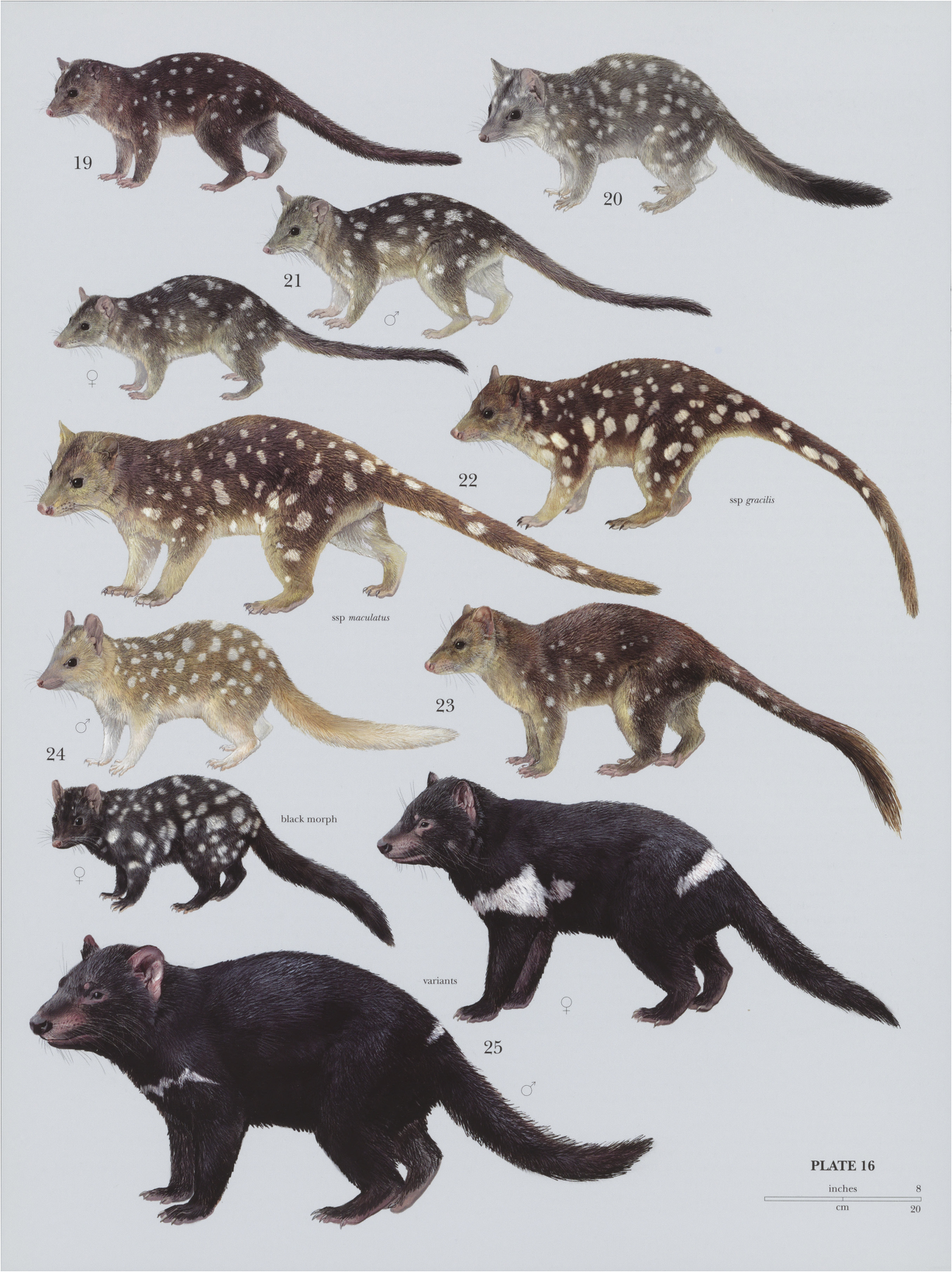
Quoll species: 19) New Guinea Quoll (Dasyurus albopunctatus), 20) Western Quoll (Dasyurus geoffroui), 21) Northern Quoll (Dasyurus hallucatus), 22) Spotted-tailed Quoll (Dasyurus maculatus), 23) Bronze Quoll (Dasyurus spartacus), 24) Eastern Quoll (Dasyurus viverrinus), 25) Tasmanian Devil (Sarcophilus harris)
Quolls (genus Dasyurus) are carnivorous marsupials native to Australia and New Guinea. They are rarely seen by people because they are nocturnal animals that a spend a lot of times in trees and spend most of the day in a den. They are regarded as fierce and efficient hunters. Of the six species of quoll, four are found in Australia and two in New Guinea. Another two species are known from fossil remains in Pliocene and Pleistocene deposits in Queensland.
Sometimes called native cats, quolls are about the size of domestic cats and look like a cross between a cat and a mouse and kind of resemble Tasmanian devils. Quolls are small predators that are classified along with Tasmanian devils as Dasyuroids (predatory marsupials). and if you add numbats Dasyuromorphs. The number of quolls are decreasing They have been hurt by competition and predation from foxes.
There are six species of quoll:
1) Northern quolls (Dasyurus hallucatus) is abundant on the minor islands surrounding northern Australia.
2) Western quolls ( Dasyurus geoffroii) are also known as chuditch. They are restricted to the Jarrah Forest and the central and southern Australian Wheatbelt.
3) Tiger quolls (Dasyurus maculatus) are also known as spotted-tail quolls. They live in Southeastern Australia.
4) Eastern quolls (Dasyurus viverrinus) were widely distributed across southeastern Australia until they became extinct on the mainland in the 1960s but still found in large numbers in Tasmania in pastures, scrublands, forests, and alpine areas. They have been successfully reintroduced to Mt Rothwell and Mulligans Flat Woodland Sanctuary on mainland Australia.
5) New Guinean quolls (Dasyurus albopunctatus) are found throughout most of New Guinea.
6) Bronze quolls ( Dasyurus spartacus) are found in the southern part of New Guinea south of the Fly River.
For the most part quolls are active nocturnal, ambush predators. Their prey may be as small as insects, grubs and small reptiles, or as large as possums and wallabies. Smaller species are more likely to arboreal (live mainly in trees). Males range further while hunting, which may lead to overlapping ranges, although both sexes of all species are solitary in their ranges. All Quoll species are near threatened or Endangered. [Source: Jonah Dineen, Animal Diversity Web (ADW) |=|]
Quolls can live for about two or four years in the wild, significantly shorter than placental counterparts like small wild cats. The lifespan of quolls is very centered on reproductive activity. Most males die after one breeding season, and females usually only survive for one to two more if resources are sufficient. Captive individuals are relatively uncommon. Most are found wildlife rehabilitation centers. Their lifespan can nearly double in captivity, although there has been almost no research done. |=|
Quolls are members of the genus Dasyurus, which belong to the family Dasyuridae, the subfamily Dasyurinae, and the tribe Dasyurini. The common name “quoll” is likely a bastardization of the older Aboriginal language Guugu Yimithirr name dhigul. For a long time quolls were called “native cats” ny Europeans. Quolls are closely related to and look a little by like Tasmanian devils.
RELATED ARTICLES:
QUOLL SPECIES OF AUSTRALIA: CHARACTERISTICS, BEHAVIOR, CONSERVATION ioa.factsanddetails.com
DASYURIDS AND DASYUROMORPHS (MARSUPIAL CARNIVORES) ioa.factsanddetails.com
NUMBATS: CHARACTERISTICS, BEHAVIOR AND REPRODUCTION ioa.factsanddetails.com
TASMANIAN DEVILS: CHARACTERISTICS, BEHAVIOR AND REPRODUCTION ioa.factsanddetails.com
TASMANIAN DEVIL CONSERVATION: HUMANS AND THE DEADLY DISEASE RAVAGING THEM ioa.factsanddetails.com
TASMANIAN WOLVES: CHARACTERISTICS, BEHAVIOR AND REPRODUCTION ioa.factsanddetails.com
TASMANIAN WOLF EXTINCTION, SIGHTINGS, SEARCHES, BRINGING IT BACK ioa.factsanddetails.com
SMALL MARSUPIAL CARNIVORE SPECIES: MULGARA, DIBBLERS, KULTARRS, NINGAUI ioa.factsanddetails.com
DUNNARTS: SPECIES, CHARACTERISTICS, BEHAVIOR AND REPRODUCTION ioa.factsanddetails.com
PLANIGALES: SPECIES, CHARACTERISTICS, BEHAVIOR AND REPRODUCTION ioa.factsanddetails.com
ANTECHINUSES: SPECIES, FALSE ONES, CHARACTERISTICS, BEHAVIOR, SUICIDAL MATING ioa.factsanddetails.com
MARSUPIALS: HISTORY, EVOLUTION, CHARACTERISTICS, BEHAVIOR, REPRODUCTION ioa.factsanddetails.com
MARSUPIALS IN AUSTRALIA ioa.factsanddetails.com
Quoll Habitat and Where They Are Found

Distribution of the Australian and New Guinean quoll species: Present (dark gray) and past (light gray)(clockwise from upper left): 1) Northern quoll (Dasyurus hallucatus); 2) Western quoll (Dasyurus geoffroii), also known as chuditch; 3) Tiger quoll (Dasyurus maculatus) also known as spotted-tail quoll; 4) Eastern quoll (Dasyurus viverrinus); 5) New Guinean quoll (Dasyurus albopunctatus); 6) Bronze quoll (Dasyurus spartacus)
The six quoll species range across Australia, New Guinea, Tasmania and nearby islands but they are becoming more isolated from one another due to increased habitat loss and fragmentation. The current geographic ranges of all species are smaller than they were in the past. [Source: Jonah Dineen, Animal Diversity Web (ADW) |=|]
Northern quolls occur in pockets across northern coastal regions of Australia. Eastern quolls are extant on Tasmania and in the past lived in much of the southern mainland Australia. Tiger quolls are found in Tasmania and a limited and shrinking area of southeast mainland Australia. The most isolated species are Western quolls. They are found only in the far southwest of Australia. New Guinean quolls can be found over most of New Guinea excluding the southwest portion, while Bronze quolls are found in a limited region of southern New Guinea.
Quolls live in savanna grasslands, forests, rainforests, coastal scrub, rocky areas and scrub forests in tropical regions and temperate areas with a climate similar to the U.S. or Europe. They do well in a variety of habitats. They are primarily ground-dwelling but some do spend a lot of time in trees and are skilled climbers.
Quolls tend not to coexist with other mammalian predators including dingoes, invasive red foxes, and feral cats, as they are generally outcompeted or regarded as a prey item. Quoll dens are made in tree hollows, rock piles, or are in burrows placed in areas chosen based on the availability of prey in their vicinity. Quolls do not build their own dens, change dens often and often rely on dens made by other animalss. Prey density and availability are the most important factors in quoll habitat. If they are in short supply they can be limiting factors. If enough prey is available, quolls favor landscape features like gullies, ridgelines, rocky escarpments, unbroken hills and flat areas. |=|
Quoll Characteristics
Quoll species are small, with the largest, tiger quolls, weighing four kilograms, and the smallest, northern quolls, weighing around 500 grams. The different species are similar in appearance to each other, with the main difference being size, coloration, or spots. They all share a triangular face, spots, and a recognizable weasel or cat-like stance. Sexual Dimorphism (differences between males and females) is present: Males are slightly larger than females. [Source: Jonah Dineen, Animal Diversity Web (ADW) |=|]
Quolls have relatively small, long bodies, short, powerful legs and a long tail. They range in color from light and dark brown to black. All species have distinctive white spots on their back. Tiger quolls also have a spotted tail. Members of some species have piebald coloring — irregular patches of two colors, typically dark and light. Quolls have short coarse fur, with thin underfur.
Female tiger quolls are the only species possessing a true pouch, which opens towards the rear. The other five species have folds that result in a shallow, pouch-like place within which are nipples from which young suckle. Quoll species have short, triangular faces with a pink nose and obvious canines, which lead Europeans to compare them to housecats and call them by the common name “native cat.”
Quoll Food, Eating Behavior and Predators
Quolls are primarily carnivores (eat meat or animal parts) but are also recognized as insectivores (eat insects) and can be scavengers. They opportunistic and eat mostly small and medium-sized mammals, including possums, pademelons, wallabies, as well as smaller mammals and carrion. Invasive European rabbits can also make up a large portion of their diet, particularly among tiger quolls. Quolls kill prey by biting them on the neck. |=|[Source: Jonah Dineen, Animal Diversity Web (ADW) |=|]
Smaller and more arboreal species such as northern quolls and New Guinean quolls also eat birds, small reptiles, and occasionally fruits. Among northern quolls eating invasive cane toads (Rhinella marina) can be a problem as they are poisonous and an easy prey that eating too many of them can cause death. Some populations appear to have developed toad-avoidance behaviors that have passed through numerous generations.
Quolls are small enough that they can be prey for predators. Mammalian predators include Tasmanian devils, dingoes, red foxes, dogs and feral cats. Owls and wedge-tailed eagles commonly take quolls, and some snakes feed on them too. The spots on quolls serve as camouflage. They spend their days in protected or hidden dens and are able to run and climb quickly to evade predators.
Quoll Behavior and Communication
Quolls are solitary, scansorial (good at climbing), terricolous (live on the ground), nocturnal (active at night), motile (move around as opposed to being stationary), sedentary (remain in the same area) and territorial (defend an area within the home range). [Source: Jonah Dineen, Animal Diversity Web (ADW) |=|]
Quolls spend a lot of energy developing as quickly as possible to reach sexual maturity by the breeding season. They are only ever in contact with other members of their species during mating and during the period in which pups are reliant on their mother. Most species spend the majority of their time on the ground and in and around fallen logs, although they are all well adapted to climbing trees and can regularly be observed doing so.
Males and females both form territories. Females’ territories do not overlap, but a male’s territory may overlap many others. Near territorial borders, multiple individuals often use communal latrines. Within territories, individuals are highly vigilant and aware of predator or competitor presence.
Quolls sense using vision, touch, sound and chemicals usually detected with smell. They communicate with sound and chemicals and leave scent marks produced by special glands and placed so others can smell and taste them. They have good eyesight but rely on auditory and olfactory communication. Vocalizations that occur when individuals are in close proximity, including hissing, chirping, screaming, and coughing. They sometimes alter their pitches depnding on wether they are communicating with adults, pups, or other species. They avoid contact by marking territories at community latrines.
Quoll’s Unusual Do-and-Die Reproduction
Quolls are rare examples of mammals that practice semelparity — a reproductive strategy where animals reproduce only once in their lifetime and typically die soon after they reproduce. Males only live for a year. Males of most species die within the first weeks or months after mating. Females, who tend to survive for two to three mating seasons, give birth first to mostly male litters, and later in life to mostly female litters. [Source: Jonah Dineen, Animal Diversity Web (ADW) |=|]
Quolls are solitary, and only purposely come together for mating season. Mating takes place in winter, typically in late May or June. To allow for this, mating is synchronized within each quoll species. Mating is an extremely time-sensitive and also represents the only real social contact that quolls engage in after leaving their mothers and are only social activity that many individuals ever experience. There is frequent male fighting for access to females. Females may show preference for smaller or larger males based on external environmental factors. |=|
Quolls can be polyandrous, with females mating with several males during one mating season, or polygynandrous (promiscuous), with both males and females having multiple partners. Because of to this, each pup in a litter can have a different father. Quolls display differing levels of polyandry, with northern quolls displaying a very high levels of it, resulting in more social interaction than members of other species.
Parental care is provided by females. There is no male involvement in parenting as there is an almost complete male die-off following mating and prior to birth. Young are altricial, meaning they are relatively underdeveloped at birth. Litters are made up of anywhere between eight and 30 pups but only six typically survive, as mothers has have six nipples. Prior to mating, the skin folds most species have stretch to form more of a pouch.
Quolls, Humans and Conservation
Quoll species play a role controlling invasive species, particularly rabbits wich can be very destructive to agriculture and ecosystems in Australia. Rabbits make up the majority of prey animals for some quoll species. In some places quolls are a tourism draw.[Source: Jonah Dineen, Animal Diversity Web (ADW) |=|]
Quolls are opportunist feeders and sometimes raid chicken coups and take poultry. They can can tear through nets protecting poultry or ripe produce and carry pathogens that can infect poultry and livestock. But since there numbers are relatively small, quolls don’t do too much damage.
Quoll species all have some conservation issues. Tiger quolls, western quolls, New Guinean quolls, and bronze quolls are all listed as near threatened while Eastern quolls and Northern quolls are classified as Endangered. No species is experiencing serious fragmentation of their habitats, but populations are in decline primarily as a result of habitat loss due to fires and urban and agricultural expansion, and invasive predators, mainly cats, foxes and cane toads. Efforts to reduce invasive rabbit species by poisoning them has also poisoned quolls. Common causes of death are dog predation, getting hit by vehicles, illegal poisoning, and trapping by poultry owners.
Competition predation from native species including Tasmanian devils and dingoes may also contribute the decline of quoll populations. The cultivation of palm oil in New Guinea poses a threat to New Guinean quolls and Bronze quolls. Better fire management and control of invasive species has helped quoll t varying degrees. There are also several captive breeding programs and reintroduction programs being carried out. Some have suggested promoting the idea of quolls as pets as part of the effort to conserve them.
Image Sources: Wikimedia Commons
Text Sources: Animal Diversity Web animaldiversity.org , National Geographic, Live Science, Natural History magazine, Australian Museum, David Attenborough books, Australia Geographic, New York Times, Washington Post, Los Angeles Times, Smithsonian magazine, Discover magazine, The Conversation, The New Yorker, Time, BBC, CNN, Reuters, Associated Press, AFP, Lonely Planet Guides, Wikipedia, The Guardian, Top Secret Animal Attack Files website and various books and other publications.
Last updated July 2025