
Home | Category: Animals / Marsupials
PLANIGALES
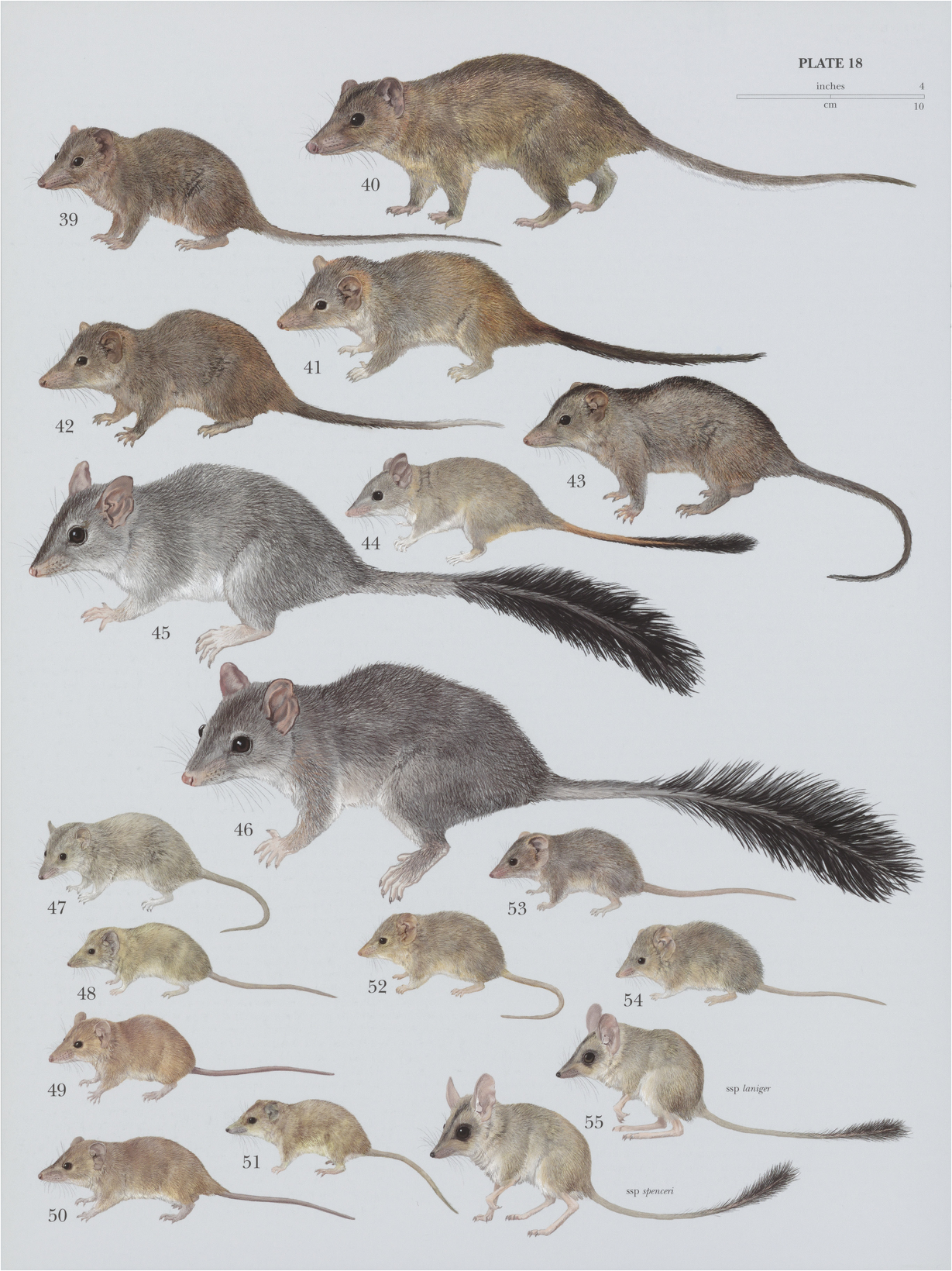
Planigales and fairly close relatives: 41) Short-furred Dasyure (Murexia longicaudata); 42) Broad-striped Dasyure (Murexia rothschildi); 43) Long-nosed Dasyure (Murexia naso); 44) Red-tailed Phascogale (Phascogale calura); 45) Northern Brush-tailed Phascogale (Phascogale pirata); 46) Common Brush-tailed Phascogale (Phascogale tapoatafa); 47) Giles's Planigale (Planigale giles); 48) Long-tailed Planigale (Planigale ingrami); 49) Common Planigale (Planigale maculata); 50) Papuan Planigale (Planigale novaeguineae); 51) Narrow-nosed Planigale (Planigale tenuirostris); 52) Wongai Ningaui (Ningauiride); 53) Pilbara Ningaui (Ningaui timealeyi); 54) Southern Ningaui (Ningaui yvonneae); 55) Kultarr (Antechinomys laniger)
Planigales are the world’s smallest marsupials. The smallest of all is the rare long-tailed planigale, which weighs only four grams (0.14 ounces) — less than an American nickel. But don't let their diminutive demeanor fool you. They are ferocious little creatures that been known to bring down grasshoppers three times their size, the same way a lion brings down a wildebeest.
Planigales (in the genus Planigale) are small carnivorous marsupials found in Australia and New Guinea. “Described as both "shrew-like” and "mouse-like", they are the only genus in the tribe Planigalini of the subfamily Sminthopsinae. The genus has long been known to contain several cryptic species. Five Planigale species had been recognized for a fairly. Two new species have recently been discovered in museum collections. Planigale ingrami and Planigale maculata are known species complexes. [Source: Wikipedia]
The seven species of planigale currently recognized are:
Paucident planigale (Planigale gilesi)
Long-tailed planigale (Planigale ingrami)
Orange-headed Pilbara planigale (Planigale kendricki)
Common planigale (Planigale maculata)
New Guinean planigale (Planigale novaeguineae)
Cracking-clay Pilbara planigale (Planigale tealei)
Narrow-nosed planigale (Planigale tenuirostris)
Because they are very small nocturnal and secretive, planigales are rarely seen. Even so they are generally common in many parts of the arid interior of Western Australia. Their small size and cryptic nature make the various species difficult to tell apart, with head length and shape, body weight, footpad shape and granulation, fur colour, location, and habitat all being important aids to live identification. The Western Australian Museum has taken a series of footpad photos to aid in identification of Planigale species.
Planigales are not endangered or threatened. All species are designated as a species of least concern on the International Union for Conservation of Nature (IUCN) Red List. Little planigales (Planigale subtilissima) are listed as "Endangered" on the U.S. Federal list. The number of planigales is believed to be declining throughout Australia. Feral cats, dingoes, land clearance and wildfires are some of the reasons why, according to a report from the Threatened Species Recovery Hub, a research center partnered with the University of Queensland. “Safeguarding habitat for small mammals can best be achieved by removing large feral herbivores and improving fire regimes so that fires are smaller and less severe,” the report said. [Source: Brendan Rascius, Miami Herald, August 15, 2023]
RELATED ARTICLES:
DASYURIDS AND DASYUROMORPHS (MARSUPIAL CARNIVORES) ioa.factsanddetails.com
SMALL MARSUPIAL CARNIVORE SPECIES: MULGARA, DIBBLERS, KULTARRS, NINGAUI ioa.factsanddetails.com
DUNNARTS: SPECIES, CHARACTERISTICS, BEHAVIOR AND REPRODUCTION ioa.factsanddetails.com
ANTECHINUSES: SPECIES, FALSE ONES, CHARACTERISTICS, BEHAVIOR, SUICIDAL MATING ioa.factsanddetails.com
TASMANIAN DEVILS: CHARACTERISTICS, BEHAVIOR AND REPRODUCTION ioa.factsanddetails.com
TASMANIAN WOLVES: CHARACTERISTICS, BEHAVIOR AND REPRODUCTION ioa.factsanddetails.com
NUMBATS: CHARACTERISTICS, BEHAVIOR AND REPRODUCTION ioa.factsanddetails.com
QUOLLS: CHARACTERISTICS, BEHAVIOR AND REPRODUCTION ioa.factsanddetails.com
QUOLL SPECIES OF AUSTRALIA: CHARACTERISTICS, BEHAVIOR, CONSERVATION ioa.factsanddetails.com
MARSUPIALS: HISTORY, EVOLUTION, CHARACTERISTICS, BEHAVIOR, REPRODUCTION ioa.factsanddetails.com
MARSUPIALS IN AUSTRALIA ioa.factsanddetails.com
Narrow-Nosed Planigales
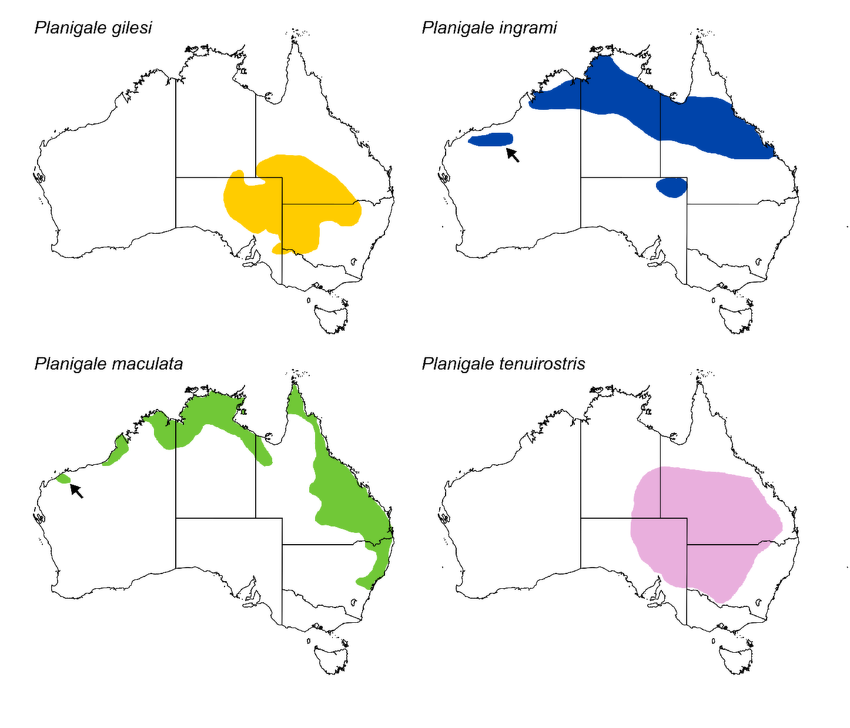
range of four of the planigale species, from Researchgate
Narrow-nosed planigale (Planigale tenuirostris) live inland in southeast Australia in low shrubland and tussock grassland with cracking clay soils. They spend a lot of time underground and occupy the deepest parts of soil cavities and only occasionally emerge at the surface. Preferred habitat is away from water in more open, less densely vegetated areas. The scientific name for the species means "slender-snouted flat-weasel". They live up to three years in the wild but it has been estimated that less than 15 percent of individuals in wild populations survive to an age of two years. [Source: Bradley Reuter, Animal Diversity Web (ADW) |=|; Wikipedia]
Because narrow-nosed planigales spend so much time below the ground (where no larger species could fit), it is well protected from predators. Narrow-nosed planigale lives in same area as Paucident planigale and the two species appear to partitioning food resources. This is partly due to body size differences (Paucident planigales are larger than Narrow-nosed planigale). Also, partitioning occurs due to the fact that Narrow-nosed planigale lives in the deepest parts of the cavities, while Paucident planigales live at intermediate crack depths. |=|
Narrow-nosed planigale are not endangered or threatened but they are not common — or at least observed all that much — either. They are designated as a species of least concern on the International Union for Conservation of Nature (IUCN) Red List and have no special status on the Convention on International Trade in Endangered Species (CITES).
Narrow-Nosed Planigales Characteristics, Behavior and Reproduction
Narrow-nosed planigale range in weight from four to nine grams (0.14 to 0.32 ounces) Their average basal metabolic rate is 0.063 watts. They are small compared to other planigale species and have a flat skull that can be used for shoveling. The fur is brownish, but breeding males have fur discoloration
Narrow-nosed planigales are nocturnal (active at night), motile (move around as opposed to being stationary) and solitary. They are active at night in both summer and winter unlike other Planigale species that are active during the daytime in winter. Short-term activity cycles were recorded as one hour 25 minutes in summer and two hours 56 minutes in winter. A significant amount of time is spent both deep in the soil cavities and above ground.
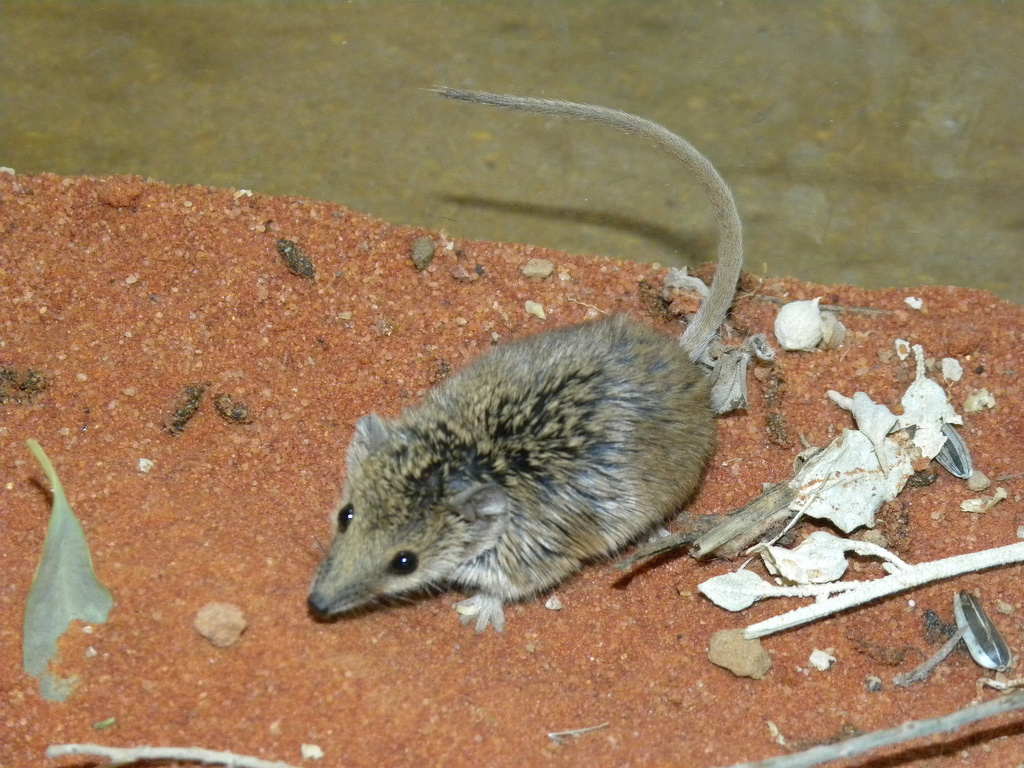
Narrow-nosed planigale
Narrow-nosed planigales are recognized as carnivores (eat meat or animal parts) and insectivores (eat insects and non-insect arthropods). Animal foods includes insects, non-insect arthropods such as spiders and reptiles. They are generalist insectivore, taking available prey. Arthropods commonly eaten include beetles, orbweavers ), taxa not bigger than 800 cu millimeters. They may also eat small lizards. (Read, 1987) |=|
Narrow-nosed planigales engage in seasonal breeding. The breeding season is from July to mid-January. Estrus in females lasts one day and the estrus cycle is 33 days. In males, spermatogenesis occurs in July and again in March. The breeding season coincides with increases in food availability during the spring and summer. The average gestation period is 19 days. The average number of offspring is six. Parental care is carried out by Narrow-nosed planigale females, which have 12 teats and a pouch. Young are altricial, meaning they are relatively underdeveloped at birth. After birth Young young attach themselves to one of their mother’s teats and detach themselves from the teats at 36 days. Their eyes open at 51 days. The average weaning age is around three months. On average females reach sexual or reproductive maturity at 240 days.
Long-Tailed Planigales — the World's Smallest Marsupials
Long tailed planigales (Planigale ingrami) are the world’s smallest marsupial, with adults weighing as little as four grams (0.14 ounces) — about the same as a couple large blueberries. Also known as Ingram's planigales, flat-headed planigales and northern planigales, they are also one of the world’s smallest mammals. They are rarely seen but are quite common in their habitat. Their average lifespan in the wild is only 1.3 years. |=|
Long-tailed planigales are is found in northeastern Australia from the northeastern part of Northern Territory to Mackay and Townsville in Queensland, and south to Brunette Downs, a large cattle station in the Northern Territory. They live in a variety of habitats but are associated most with the blacksoil plains, clay-soiled woodlands and grasslands of Australia's “Top End”, which has seasonal flooded during the monsoon from December to the end of March. The grasslands in that region develop dry, deep cracks in the soil during the eight-month dry season. Long-tailed planigales use these cracks to hide from predators and hunt for invertebrates and other small animals. They will also hide under tussocks of grass.
Long-tailed planigales are generally not considered endangered or threatened. They are designated as a species of least concern on the International Union for Conservation of Nature (IUCN) Red List. There are three recognized subspecies: 1) Planigale ingrami ingrami, 2) Planigale ingrami brunnea, and 3) Planigale ingrami subtilissima, little planigales. |=| Neither P. i. ingrami nor P. i. brunnea are Endangered, but P. i. subtilissima are on the U.S. Federal list as Endangered. |=|
Long-Tailed Planigale Characteristics and Diet
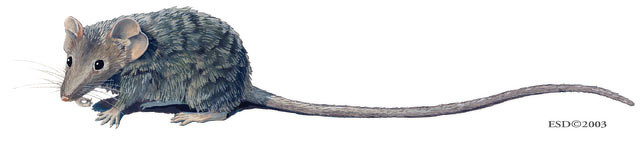
Long-tailed planigale, Animal Diversity Web (ADW)
Long-tailed planigales Long-tailed planigales usually weigh 4.2 to 4.3 grams (0.15 ounces) and have a head and body length of 55 to 65 millimeters (2.17 to 2.56 inches), with their average length being 5.9 centimeters (2.32 inches). Their average basal metabolic rate is 0.0650 cubic centimeters of oxygen per gram per hour. Sexual Dimorphism (differences between males and females) is not present: Both sexes are roughly equal in size and look similar. [Source: Kristen Olson, Animal Diversity Web (ADW) |=|]
Long-tailed planigales are mouse-like or shrew-like marsupials with flat heads and pointed snouts. Their fur is grey-brown with yellow hues and their bellies are lighter in color. They have long bare rat-like tails which is almost as long as their body and head. The central pads on their feet are smooth and not serrated. Their hind limbs are bigger than their front limbs, allowing them to lean back or stand in a semi-crouched position.
Long-tailed planigales are recognized as carnivores (eat meat or animal parts) and insectivores (eat insects and non-insect arthropods). They feed on many invertebrates that are often nearly the same sizes as themselves and often consume insect larvae and sometimes take small vertebrates such as Leggadina (small Australian rodents). They hunt at night and are aggressive predators, pouncing on and often biting their prey many times to kill it. their main diet consists of grasshoppers and crickets. They have been observed eating only the meaty part of the insects, leaving the head and wings. Because of their flat head and small body shape, long-tailed planigales can easily reach into the hiding spots of their prey, which hide in the same cracked soil and leaf litter that the planigales do. |=|
Long-Tailed Planigale Behavior and Reproduction
Long-tailed planigales are terricolous (live on the ground), nocturnal (active at night), motile (move around as opposed to being stationary), sedentary (remain in the same area) and have daily torpor (a period of reduced activity, sometimes accompanied by a reduction in the metabolic rate, especially among animals with highmetabolic rates), which lasts two to four hours to conserve energy. Long-tailed planigales are solitary and forage constantly. Females are quiet and timid if disturbed, whereas males are active and run quickly for cover. [Source: Kristen Olson, Animal Diversity Web (ADW) |=|]
Common predators include cane toads, domestic cats and different species of snakes. As a defense, Long-tailed planigales use their small size and flat skull to squeeze in tight hiding places like cracks in soil, leaf litter, and other small crevices. Their brownish color serves as camouflage, helping them blend in with their surroundings.
Long-tailed planigales are polygynandrous (promiscuous), with both males and females having multiple partners. They engage in seasonal breeding and year-round breeding but mostly during the wet season. Their breeding intervals not known. Those living in the Northern Territories give birth December to March whole those in Queensland give birth in September. The number of offspring ranges from four to 12. Those in the northern part of their range give birth to four to eight young per litter while those in the southern part of their range give birth to up to 12 per litter.
Parental care is provided by female. Young are altricial, meaning they are relatively underdeveloped at birth. The young spend six weeks in their mother's pouch, after which they spend six weeks hidden in in a grassy nest or under bark while their mother searches for food. The average weaning age is 90 days, with independence occurring at the same time.
New Planigale Species
In August 2023, in a study published in the journal Zootaxa, scientists announced the discovery of two new planigales species — Orange-headed Pilbara planigale (Planigale kendricki) and Cracking-clay Pilbara planigale (Planigale tealei) — who scientific names honor a researcher and a museum supporter.
Brendan Rascius wrote in the Miami Herald: Kendricki, the larger of the two animals, is distinguished by a ring of orange fur surrounding its eyes. The long-snouted, long-tailed creature can weigh up to 12.5 grams, making it about as heavy as an AAA battery. Tealei, on the other hand, only grows to weigh a maximum of 6.1 grams and has darker coloring. [Source: Brendan Rascius, Miami Herald, August 15, 2023]
Both species have similar pouches, though tealei’s are smaller with less noticeable folds. The two creatures dwell throughout the arid Pilbara region, though Kendricki appears to prefer low-lying, sandy locales, while tealei favors soil filled with clay. Researchers discovered the two “highly distinctive” new species, which had been lying under their very noses, In fact, the creatures, or at least their remains, had been in the possession of researchers for years, “hiding in plain sight” in museum collections throughout the country. The specimens were collected up to several decades ago by scientists conducting surveys of Pilbara, a sparsely populated region in Western Australia. At the time, they were lumped in with already identified species.
“Thanks to the capabilities provided by genetic screening, researchers were able to run tests on the museum specimens, which included some frozen tissue samples. This process confirmed the identification of the two new species. “This work makes a start at resolving the cryptic diversity within the Planigale genus.
Image Sources: Wikimedia Commons
Text Sources: Animal Diversity Web animaldiversity.org , National Geographic, Live Science, Natural History magazine, Australian Museum, David Attenborough books, Australia Geographic, New York Times, Washington Post, Los Angeles Times, Smithsonian magazine, Discover magazine, The Conversation, The New Yorker, Time, BBC, CNN, Reuters, Associated Press, AFP, Lonely Planet Guides, Wikipedia, The Guardian, Top Secret Animal Attack Files website and various books and other publications.
Last updated July 2025