
Home | Category: Animals / Animals
SHORT-BEAKED ECHIDNAS
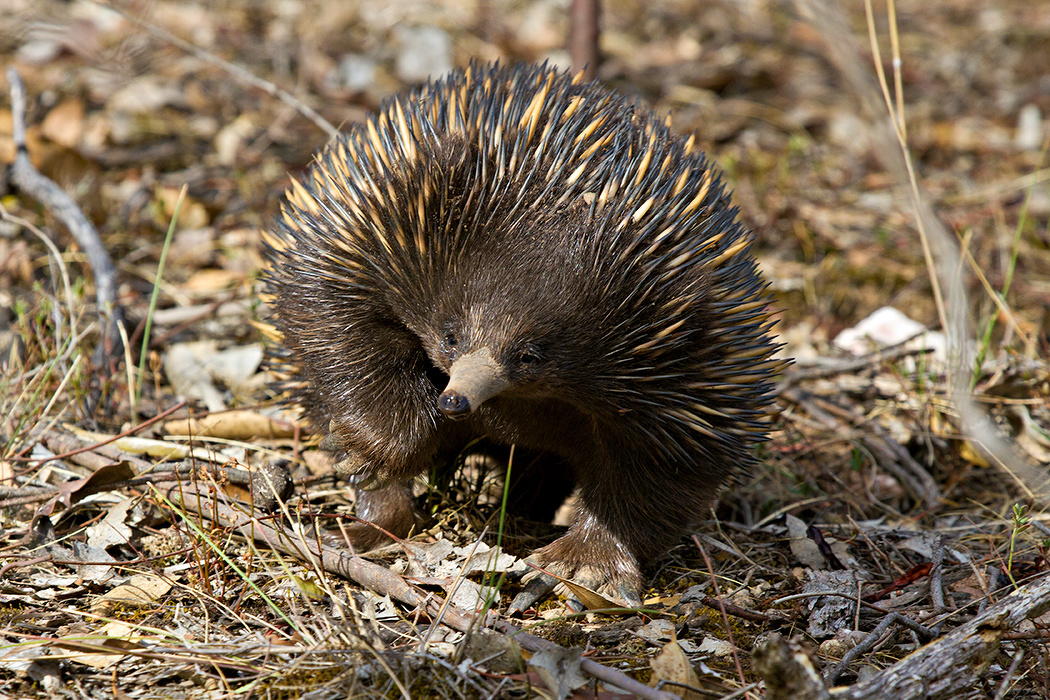
Short-beaked echidna
Short-beaked echidnas (Tachyglossus aculeatus) are also called short-nosed echidnas and spiny anteaters. The only echidnas that live in Australia, they are one of four living species of echidna, and the only member of the genus Tachyglossus. Short-beaked echidnas are covered in fur and spines and have a distinctive snout and a long, specialized tongue, that can lap up ants and termites — the animals’ primary prey — at a great speed. Like the other extant monotremes, the short-beaked echidna lays eggs. Monotremes, which include platypuses, are the only living group of mammals that do so. Short-beaked echidnas also live in southern New Guinea. Tachyglossus come from Ancient Greek “takhús”, meaning "fast", and “glôssa”, meaning "tongue".
Scott Dutfield wrote in How It Works magazine: Echidnas are not only one of the strangest animals in Australia, but possibly the entire world. These hedgehog-like creatures are one of only two kinds of mammals on Earth that lay eggs. They have toothless jaws, so they crush their insect prey — of which they eat around 40,000 per day — between their tongue and the roof of their mouth. Echidnas feed during the night to avoid the high daytime temperatures and to maintain their low body temperature of 90 degrees Fahrenheit (32 degrees Celsius). [Source: Scott Dutfield, How It Works magazine, May 19, 2021]
The earliest fossils of short-beaked echidnas date back around 15 million years ago in the Miocene epoch. The oldest specimens were found in caves in South Australia, often with fossils of long-beaked echidnas from the same period. Ancient short-beaked echidnas were pretty much identical to modern ones except the ancient ones were around 10 percent smaller. This "post-Pleistocene dwarfing" is common in many Australian mammals.
Predation is not a major threat to short-beaked echidnas. They are mainly preyed upon by dingoes and feral cats, foxes, pigs, and dogs. Their spines and rolling into a ball offer a good defense, but if a predator is able to flip them over and gain access to their soft belly, they are more vulnerable prey. Adults also escape predation by hiding beneath rocks or logs, or digging into the ground until only the spiny back is exposed. Animal predators are mostly a threat to young. and subadults. Young echidnas left in burrows are sometimes preyed upon by goannas and snakes.
RELATED ARTICLES:
MONOTREMES: HISTORY, EVOLUTION, CHARACTERISTICS, BEHAVIOR, REPRODUCTION ioa.factsanddetails.com
ECHIDNAS: CHARACTERISTICS, BEHAVIOR AND REPRODUCTION ioa.factsanddetails.com
LONG-BEAKED ECHIDNAS: SPECIES, CHARACTERISTICS, BEHAVIOR AND REPRODUCTION ioa.factsanddetails.com
PLATYPUSES: CHARACTERISTICS, BEHAVIOR AND REPRODUCTION ioa.factsanddetails.com
PLATYPUSES AND HUMANS: CONSERVATION, THEFTS, VENOM ioa.factsanddetails.com
Short-Beaked Echidna Range, Habitat and Subspecies
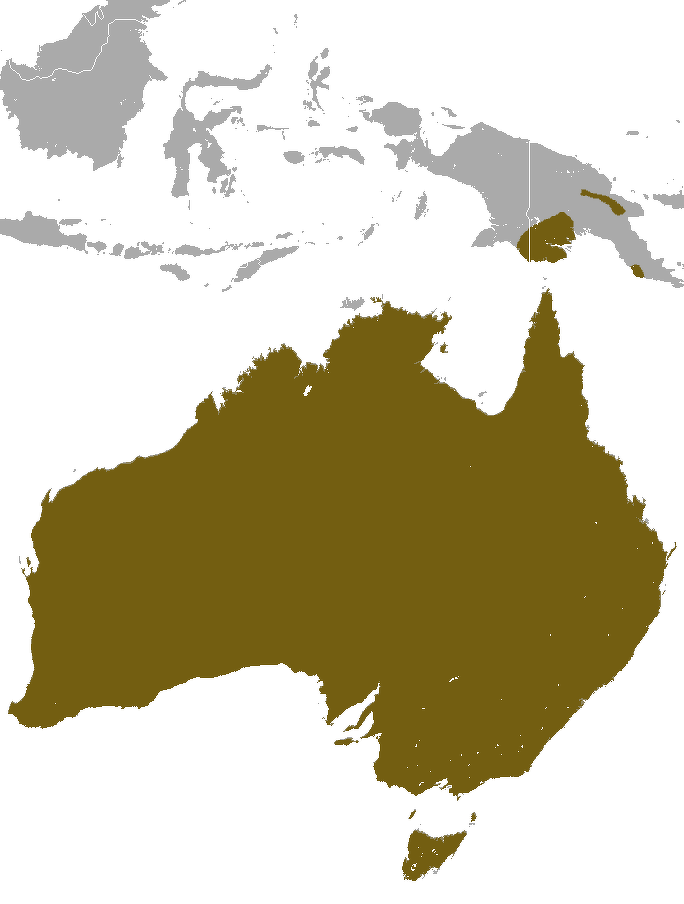
Short-beaked echidna range
Short-beaked echidnas are found throughout Australia and are the most widespread native mammal in Australia and the the most widely distributed extant monotreme. They are also found in coastal and highland regions of eastern New Guinea, where they are known as mungwe in the Daribi and Chimbu languages. Their range includes large portions of the three countries: Australia, Indonesia (West Papua), and Papua New Guinea. [Source: Michelle Cason, Animal Diversity Web (ADW) |=|]
Short-beaked echidnas do well in a variety of habitats including open woodlands, savannahs, grasslands, scrub forests, mountains, agricultural areas, semi-arid regions and deserts. Both coastal and highland areas in New Guinea are home to short-beaked echidnas. In Australia, they thrive in a range of ecosystems from mild coastal regions to above snowline at 1,675 meters (5,495 feet).
There are five short-beaked echidna subspecies, each with a different geographical locations and different hairiness, spine length and width, and the size of the grooming claws on their hind feet:
1) Tachyglossus aculeatus acanthion in the Northern Territory and Western Australia
2) Tachyglossus aculeatus aculeatus in Queensland, New South Wales, South Australia and Victoria
3) Tachyglossus aculeatus lawesii in coastal regions and the highlands of New Guinea, and possibly in the rainforests of Northeast Queensland
4) Tachyglossus aculeatus multiaculeatus on Kangaroo Island
5) Tachyglossus aculeatus setosus on Tasmania and some islands in the Bass Strait. [Source: Wikipedia]
Short-Beaked Echidna Characteristics
Short-beaked echidnas are medium-sized mammals range in weight from two to seven kilograms (4.4 to 15.4 pounds) and ranging in length from 30 to 45 centimeters (11.8 to 17.7 inches). Their elongated beak-like snout is about five centimeters (two inches) long. Their long sticky tongue can extend for more than 15 centimeters (six inches) beyond its snout. Short-beaked echidnas, and other monotremes, have low metabolic rates and low body temperatures, which may be related to such factors as diet and environmental variation. Their average basal metabolic rate is 2.327 watts. Sexual Dimorphism (differences between males and females) is not present: Both sexes are roughly equal in size and look similar. Depending on the subspecies and location, males or females may be larger. [Source: Michelle Cason, Animal Diversity Web (ADW) |=|]
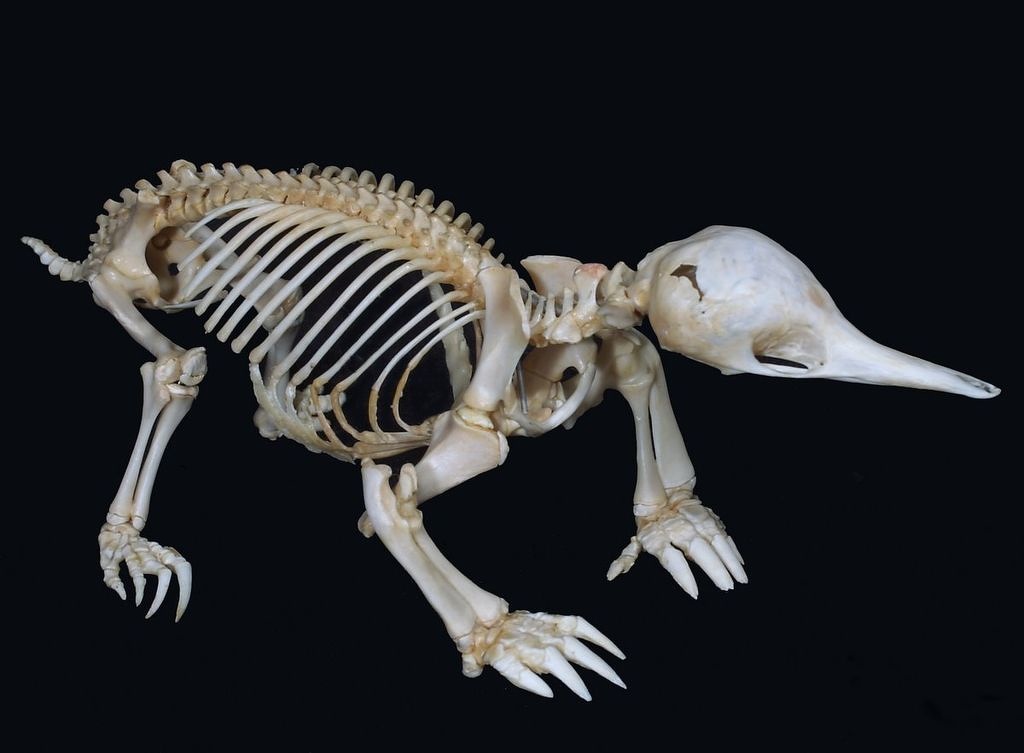
Short-beaked echidna skeleton
Short-beaked echidna spines cover their entire back and sides as well as their small tail. They also have fur, which may be even longer than the spines in some subspecies. Short-beaked echidnas vary in color, from light brown in the hotter, northern regions of main Australia to dark brown further south and black in Tasmania, according to Australia's Department of Planning and Environment.
Short-beaked echidnas have extremely strong front limbs and claws, which allow it to burrow quickly with great power and speed. As they need to be able to survive underground, these echidnas have a significant tolerance for high amount of carbon dioxide and low levels of oxygen. They are not known for their fighting ability. To deter predators they curl into a ball and protect themselves with their spines. Short-beaked echidnas cannot sweat or deal well with heat, so they tends to avoid daytime activity in hot weather.
Short-beaked echidnas lacks external pinnae (external part of the ear). Males have non-venomous spurs on the ankles of their hind legs and females have pouches on their undersides. Both males and females have a cloaca through which feces, urine, and, in females, eggs pass. Males have penises they extend through the cloaca during mating. Short-beaked echidnas have larger brains than would be expected for their body mass. The cerebral cortex, in particular, is large and highly convoluted.
Short-Beaked Echidna Diet, Eating Behavior and Long Lifespan
are carnivores (eat meat or animal parts) and insectivores (eat insects). They eat ants, termites, and other invertebrates. Short-beaked echidnas lack and teeth but do have hard pads in the back of the mouth. They make foraging pits by disturbing the soil when looking for food, and they prefer foraging under the canopies of large trees. Their long snouts and sticky tongues help them exploit their specialized diet. Short-beaked echidnas dig into ant and termite nests with their front paws and poke their long, sticky tongue into nest crevices and pull their mostly insect prey in their mouth, where it grinded with tooth pads. Their foraging technique make separating soil from food difficult. Thus, much of their feces consists of soil. [Source:Michelle Cason, Animal Diversity Web (ADW) |=|]
Short-beaked echidnas are one of the longest-living mammals in Australia and one of the longest-living mammals in Australia for their size. The longest recorded lifespan of a short-beaked echidnas in captivity is 50 years . There are anecdotal accounts of wild individuals living as long as 45 years. A lifespan of 50 years is 3.7 times longer than would be expected based on echidna body size.
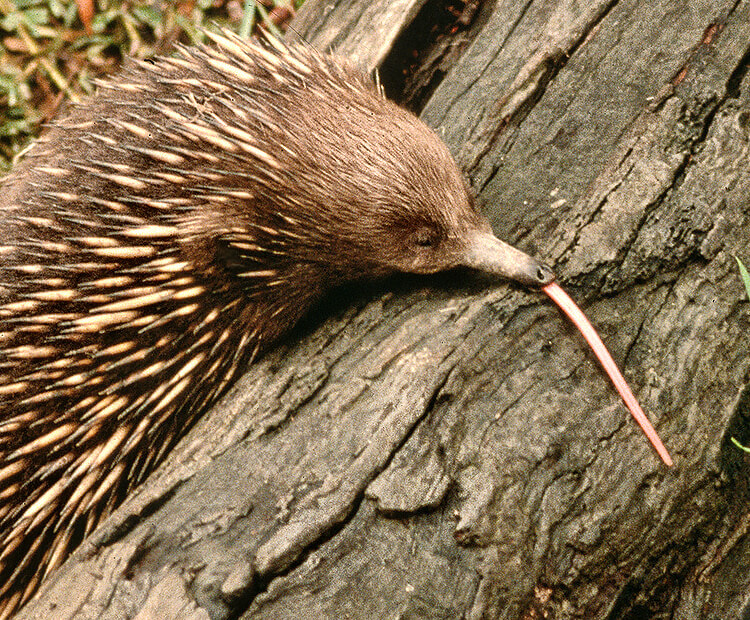
Short-beaked echidna tongue, from the San Diego Zoo
Michelle Cason wrote in Animal Diversity Web: Other long-lived mammals have been observed to have peroxidation-resistant membrane composition, which describes the ratio between polyunsaturates and monounsaturates in membrane lipids. Short-beaked echidna membranes were found to have lower polyunsaturate and higher monounsaturate levels than expected. This composition indicates peroxiclation-resistant cellular membranes in Short-beaked echidnas.
Lifespan is also associated with the production of free radicals, which is proportional to metabolic rate. Short-beaked echidnas have notably low metabolic rates, with the exception of times of arousal from torpor. During these arousal periods, metabolic rates increase by up to9 times that of basal metabolic rates and free radical production is high. Therefore, Short-beaked echidnas is thought to have stress resistance that contributes to a long lifespan. A large and complexly-structured brain may be involved with longevity in Short-beaked echidnas. Such brain characteristics are often correlated with life history traits like slow maturation and single births in other mammals. These traits, in turn, correlate with a long lifespan.
Short-Beaked Echidna Behavior
Short-beaked echidnas are solitary, terricolous (live on the ground), fossorial (engaged in a burrowing life-style or behavior, and good at digging or burrowing), diurnal (active during the daytime), nocturnal (active at night), crepuscular (active at dawn and dusk), motile (move around as opposed to being stationary), and sedentary (remain in the same area). They can swim if need be. Short-beaked echidnas nest at temporary sites, and have overlapping home ranges. Their movements depend on food availability and not territoriality. [Source: Michelle Cason, Animal Diversity Web (ADW) |=|]
Short-beaked echidnas hibernate and go into a period or torpor during the Australian winter to reducie their metabolism to save energy. As the temperature increases, they emerge to mate. Torpor is a period of reduced activity, sometimes accompanied by a reduction in the metabolic rate, especially among animals with high metabolic rates. Hibernation is the state that some animals enter during winter in which normal physiological processes are significantly reduced, thus lowering the animal's energy requirements. In terms of
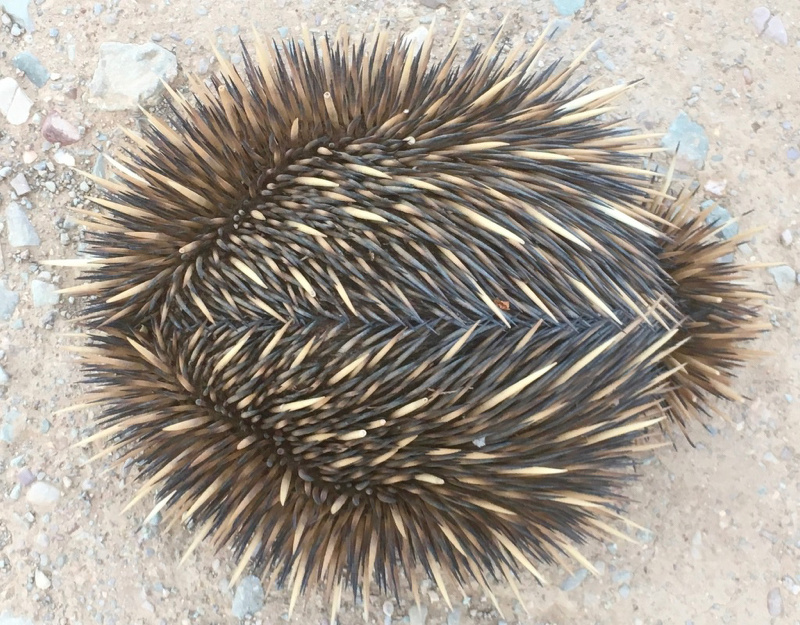
Short-beaked echidna rolled into a ball
Short-beaked echidnas dig into the ground for prey, to escape the hate, for hibernation cover and to construct nursery burrows. They hibernate from early autumn to late spring. They reduce their body temperature to eight to 10 degrees C during torpor and use behavioral thermoregulation to maintain that preferred body temperature. During hibernation there are periodic arousals. In early hibernation, individuals prefer cooler soil temperatures compared with the coldest period of hibernation, at which time they move to warmer substrates, The timing of hibernation seasons varies by subspecies, geographic location, sex, and reproductive state. Short-beaked echidnas are flexible in their exploitation of substrates for hibernacula (burrows), commonly using leaf litter and grass tussocks.
Short-beaked echidnas sense using touch and chemicals usually detected with smell. Their snout has mechanoreceptors and electroreceptors that help the echidna to detect its surroundings. Short-beaked echidnas communicate with chemicals usually detected by smelling. They also leave scent marks produced by special glands and placed so others can smell and taste them and Research suggest feces piles act as an important intra-specific form of communication.
Short-Beaked Echidna Cool Themselves with Snot Bubbles
Candice Marshall wrote in Australia Geographic: For a long time, we have known echidnas can’t sweat, pant, or lick — actions other animals perform to keep their bodies cool. Yet these monotremes have impressive thermal tolerance. How they do it has perplexed the scientific community for years.Now, we finally know the answer. It turns out they stay cool by blowing mucus bubbles through their beak. [Source: Candice Marshall, Australia Geographic, January 18, 2023
Dr Christine Cooper from Curtin University’s School of Molecular and Life Sciences explains: “Echidnas blow bubbles from their nose, which burst over the nose tip and wet it. As the moisture evaporates it cools their blood, meaning their nose tip works as an evaporative window.”
This behavior was discovered using thermal imaging cameras. A group of wild short-beaked echidnas were filmed in a patch of bushland about 170 kilometers southwest of Perth. The footage was then studied to show how the animals exchanged heat with their environment. And it doesn’t stop at snot. Echidnas have other cooling techniques too, allowing them to be active at much higher temperatures than previously thought, says Dr Cooper. “We also found their spines provide flexible insulation to retain body heat, and they can lose heat from the spineless areas on their underside and legs, meaning these areas work as thermal windows that allow heat exchange.”These findings have been published in Biology Letters, titled ‘Postural, pilo-erective and evaporative thermal windows of the short-beaked echidna’.
Short-Beaked Echidna Mating, Reproduction and Offspring
Short-beaked echidnas are oviparous(young are hatched from eggs) and polygynous (males have more than one female as a mate at one time). They engage in seasonal breeding — once a year, from June through August. The average gestation period is 23 days. The number of offspring is one. [Source: Michelle Cason, Animal Diversity Web (ADW) |=|]
Winter, particularly July, is the breeding season for Short-beaked echidnas. The courtship period can can last between a few days and several weeks depending on geographic region and subspecies. As many as ten males at once may pursue a female. Such observations of multiple males following individual females have led to the term “echidna train.” Despite this, females mate with only one male per season and otherwise Short-beaked echidnas are solitary animals. After mating the male has no further contact with the female or their offspring.
Parental care is provided solely by females, who do not have nipples or teats, but nurse young through pores connected to their paired mammary glands. After the 23-day gestation period, female short-beaked echidnas curls up and lay one egg into a pouch on her belly for incubation. Eggs hatch 10 or 11 days later. Young are altricial, meaning they are relatively underdeveloped at birth. Newborn echidna (puggles) are about the size of a grape, through their skin and weigh only 0.3 kilograms but grows rapidly on their mother's milk, which is very rich in nutrients. Short-beaked echidnas have a long nursing period — between 150 and 200 days depending on geography and subspecies.
By seven weeks baby echidnas grow too large and have too many spines to stay in the pouch and are expelled into the mother's burrow. At around six months they leave and have no more contact with their mothers. Maturation takes a long time. Young reach full adult size after three to five years. At the time weaning juveniles weigh 0.7 to 2.1 kilograms. Weaning weight is 28 to 48 percent of adult weight. On average males and females reach sexual or reproductive maturity at 18 months.
Subspecies vary in the way they care for their puggles. Short-beaked echidnas on Kangaroo Island forage with the young in the pouch immediately post-hatching. After 45 to 55 days, mothers deposit their young in nursery burrows, where the young remain until weaning. Mothers return every five to ten days to nurse the young. Short-beaked echidnas in Tasmania remain in nursery burrows with the young for 25 to 35 days after birth. Mothers then return to the burrow every three to five days to nurse. Other subspecies engage in parental care ranging between the two aforementioned subspecies
Short-Beaked Echidna Humans and Conservation
Short-beaked echidnas not endangered or threatened. They are designated as a species of least concern on the International Union for Conservation of Nature (IUCN) Red List. CITES (Convention on International Trade in Endangered Species of Wild) places them in Appendix I, which lists species that are the most endangered among CITES-listed animals and plants. [Source: Michelle Cason, Animal Diversity Web (ADW) |=|]
Short-beaked echidnas have a broad distribution, a large total population with a stable trend, and are tolerant of many habitat types. They occur in protected areas and appear to lack major threats. After introduced predators such as foxes and cats, the biggest threat to short-beaked echidnas is being runn over by motor vehicles. Over-hunting by humans may be a problem in some areas of New Guinea.
Echidnas are a popular species and a symbol of Australia. They provide opportunities for ecotourism. One of the mascots in the 2002 Olympics in Sydney was an echidna. Short-beaked echidnas have been (and may stille be) hunted for food and for ceremonial purposes, especially in New Guinea. Some short-beaked echidnas live in agricultural areas, and may disrupt fields and gardens while foraging, and may be regarded as crop pests for that.
Two Albino Echidna Spotted in New South Wales
In a rare sighting, residents of New South Wales, Australia spotted two albino echidnas in the space of just two weeks. Geoff Hadley found one on a road in the Bathurst region, according to ABC News. He helped the echidna cross safely before reporting the sighting to local council officials, who revealed the animal in a social media post on May 1. "Meet Raffie, Bathurst's rare albino echidna," Bathurst Regional Council staff wrote on Facebook. "We thought he is just too beautiful not to share, and particularly rare with only a handful of the egg-laying mammals, or monotremes, ever sighted in Australia."[Source: Sascha Pare, Live Science, May 22, 2023]
Eleven days after the first sighting, Australia’s Wildlife Information, Rescue and Education Service (WIRES) published images and a video of a second albino short-nosed echidna that appeared to have been hit by a car and sustained minor injuries in New South Wales. "This rare albino echidna, nicknamed Mr Spike, was released into WIRES' care recently after a suspected motor vehicle collision," WIRES staff wrote in a Facebook post on May 12. "Luckily he sustained only a few minor grazes and was given the all clear after a couple of days in care with local WIRES volunteers who then released him back into the bushland near where he was found."
Albinism is a genetic condition that interferes with the body's production of melanin, the main pigment that colors animals' skin, fur, feathers, scales and eyes. Melanin is produced in cells called melanocytes; these cells are present but not fully functional in animals with albinism, making them appear partially or completely white. "An albino echidna is a rare sight," Australia's Commonwealth Scientific and Industrial Research Organization (CSIRO) wrote in a Twitter post on May 22, 2022, alongside a video of another albino echidna that was found last year. "Spotting a non-albino echidna is also pretty uncommon," officials added.
Tiger Shark Throws Up an Entire Echidna
In what was the first-ever sighting of its kind, a team of scientists with James Cook University (JCU) reported that they witnessed a tiger shark vomit a complete echidna The researchers were tagging marine life off the coast of Orpheus Island in north Queensland in May 2022 "got the shock of their lives" according to a university press release, when they watched the shark regurgitate the echidna. [Source: Natalie Neysa Alund, USA TODAY, June 7, 2024]
USA Today reported: Former JCU PhD student Dr. Nicolas Lubitz and his team reported after they caught the shark, it threw the dead animal up — all in one piece. “We were quite shocked at what we saw. We really didn’t know what was going on,” according to Lubitz, who said in the release he could only assume the shark had snatched the echidna as it swam in the shallow waters off the island. “When it spat it out, I looked at it and remarked 'What the hell is that?' Someone said to take a picture, so I scrambled to get my phone."
Lubitz said the dead echidna was whole in its entirety when it was regurgitated, suggesting a recent kill by the 10-foot long shark. “It was a fully intact echidna with all its spines and its legs,” the scientist said. "It’s very rare that they throw up their food but sometimes when they get stressed they can,” Lubitz said. “In this case, I think the echidna must have just felt a bit funny in its throat.”

albino echidna
Image Sources: Wikimedia Commons
Text Sources: Animal Diversity Web animaldiversity.org , National Geographic, Live Science, Natural History magazine, Australian Museum, David Attenborough books, Australia Geographic, New York Times, Washington Post, Los Angeles Times, Smithsonian magazine, Discover magazine, The Conversation, The New Yorker, Time, BBC, CNN, Reuters, Associated Press, AFP, Lonely Planet Guides, Wikipedia, The Guardian, Top Secret Animal Attack Files website and various books and other publications.
Last updated August 2025