
Home | Category: Animals / Marsupials
DUNNARTS
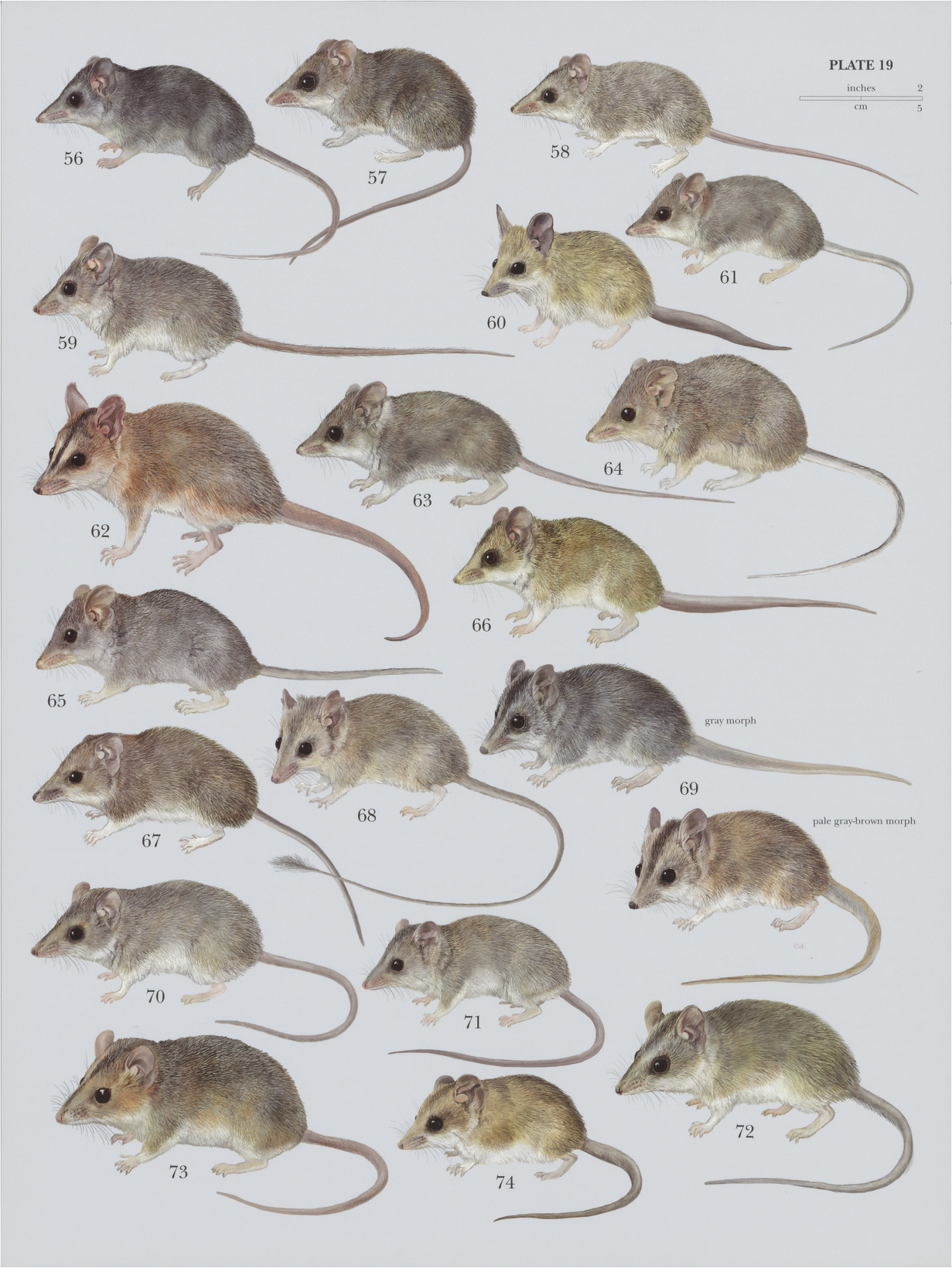
Dunnart Species: 56) Kangaroo Island Dunnart (Sminthopsis aitken), 57) Chestnut Dunnart (Sminthopsis archer), 58) Kakadu Dunnart (Sminthopsis bindi), 59) Butler's Dunnart (Sminthopsis butleri), 60) Fat-tailed Dunnart (Smunthopsis crassicaudata), 61) Little Long-tailed Dunnart (Sminthopsis dolichura), 62) Julia Creek Dunnart (Smunthopsis douglasi), 63) Gilbert's Dunnart (Sminthopsis gilbert), 64) White-tailed Dunnart (Sminthopsis granulipes), 65) Grey-bellied Dunnart (Sminthopsis griseoventer), 66) Greater Hairy-footed Dunnart (Smunthopsis hirtipes), 67) White-footed Dunnart (Sminthopsis leucopus), 68) Greater Long-tailed Dunnart (Sminthopsis longicaudata), 69) Stripe-faced Dunnart (Sminthopsis macroura), 70) Common Dunnart (Sminthopsis murina), 71) Ooldea Dunnart (Sminthopsis ooldea), 72) Sandhill Dunnart (Sminthopsis psammophila), 73) Red-cheeked Dunnart (Sminthopsis virginiae), 74) Lesser Hairy-footed Dunnart (Sminthopsis youngsoni)
Dunnarts are mouse-sized, a narrow-footed marsupial of the genus Sminthopsis. They are largely insectivorous (eat mainly insects) and found in Australia or New Guinea. They are sometimes referred to a "marsupial mouses" and are part of the family Dasyuridae. The genus Sminthopsis can be differentiated from other marsupial mice by skull and dentition features. The word dunnart comes from the Noongar Aboriginal language.
Among dunnart species that have been studied, individuals have home ranges, but the borders and size constantly changes. Males do not show territoriality. Nest sharing is not common during the breeding season, but at other times up to 70 percent of dunnarts shared nests in groups of two to eight. Many enter daily torpor (a period of reduced activity, sometimes accompanied by a reduction in the metabolic rate, especially among animals with highmetabolic rates), when food availability becomes unpredictable.
There are 19 species of dunnart )in the Genus Sminthopsis)
S. crassicaudata species-group
Fat-tailed dunnarts (Sminthopsis crassicaudata)
S. macroura species-group
Kakadu dunnarts (Sminthopsis bindi)
Carpentarian dunnarts (Sminthopsis butleri)
Julia Creek dunnarts (Sminthopsis douglasi)
Stripe-faced dunnarts (Sminthopsis macroura)
Red-cheeked dunnarts (Sminthopsis virginiae)
S. granulipes species-group
White-tailed dunnarts (Sminthopsis granulipes)
S. griseoventer species-group
Grey-bellied dunnarts (Sminthopsis griseoventer)
S. murina species-group
Kangaroo Island dunnarts (Sminthopsis aitkeni)
Chestnut dunnarts (Sminthopsis archeri)
Little long-tailed dunnarts (Sminthopsis dolichura)
Sooty dunnarts (Sminthopsis fuliginosus)
Gilbert's dunnarts (Sminthopsis gilberti)
White-footed dunnarts (Sminthopsis leucopus)
Slender-tailed dunnart s (Sminthopsis murina)
S. psammophila species-group
Hairy-footed dunnarts (Sminthopsis hirtipes)
Ooldea dunnarts (Sminthopsis ooldea)
Sandhill dunnarts (Sminthopsis psammophila)
Lesser hairy-footed dunnarts (Sminthopsis youngsoni)
Additionally, two species are recognized by the American Society of Mammalogists:
Froggatt's dunnart (Sminthopsis froggatti) and Stalker's dunnart, Sminthopsis stalkeri
RELATED ARTICLES:
DASYURIDS AND DASYUROMORPHS (MARSUPIAL CARNIVORES) ioa.factsanddetails.com
SMALL MARSUPIAL CARNIVORE SPECIES: MULGARA, DIBBLERS, KULTARRS, NINGAUI ioa.factsanddetails.com
PLANIGALES: SPECIES, CHARACTERISTICS, BEHAVIOR AND REPRODUCTION ioa.factsanddetails.com
ANTECHINUSES: SPECIES, FALSE ONES, CHARACTERISTICS, BEHAVIOR, SUICIDAL MATING ioa.factsanddetails.com
TASMANIAN DEVILS: CHARACTERISTICS, BEHAVIOR AND REPRODUCTION ioa.factsanddetails.com
TASMANIAN WOLVES: CHARACTERISTICS, BEHAVIOR AND REPRODUCTION ioa.factsanddetails.com
NUMBATS: CHARACTERISTICS, BEHAVIOR AND REPRODUCTION ioa.factsanddetails.com
QUOLLS: CHARACTERISTICS, BEHAVIOR AND REPRODUCTION ioa.factsanddetails.com
QUOLL SPECIES OF AUSTRALIA: CHARACTERISTICS, BEHAVIOR, CONSERVATION ioa.factsanddetails.com
MARSUPIALS: HISTORY, EVOLUTION, CHARACTERISTICS, BEHAVIOR, REPRODUCTION ioa.factsanddetails.com
MARSUPIALS IN AUSTRALIA ioa.factsanddetails.com
Fat-Tailed Dunnarts
Fat-tailed dunnarts (Sminthopsis crassicaudata) live in the extreme southern portions of Queensland. Also known as fat-tail marsupial mice, they weigh 16 grams (.56 ounces) on average and have a head and body length of 6.4 to 11 centimeters (2.5 to 4.3 inches), and a of 5.1-to 12-centimeter (2-to-4.7-inch) tail. Their fur color ranges from buffy to brownish in color, and they have dark patches on their ears and head. Their average basal metabolic rate is 0.121 watts. The average lifespan of females in the wild is 1.5 years; of males, 1.3 years. On the International Union for Conservation of Nature (IUCN) Red List, fat-tailed dunnarts are classified as a species of “Least Concern”. [Source: Nancy Shefferly, Animal Diversity Web (ADW) |=|]
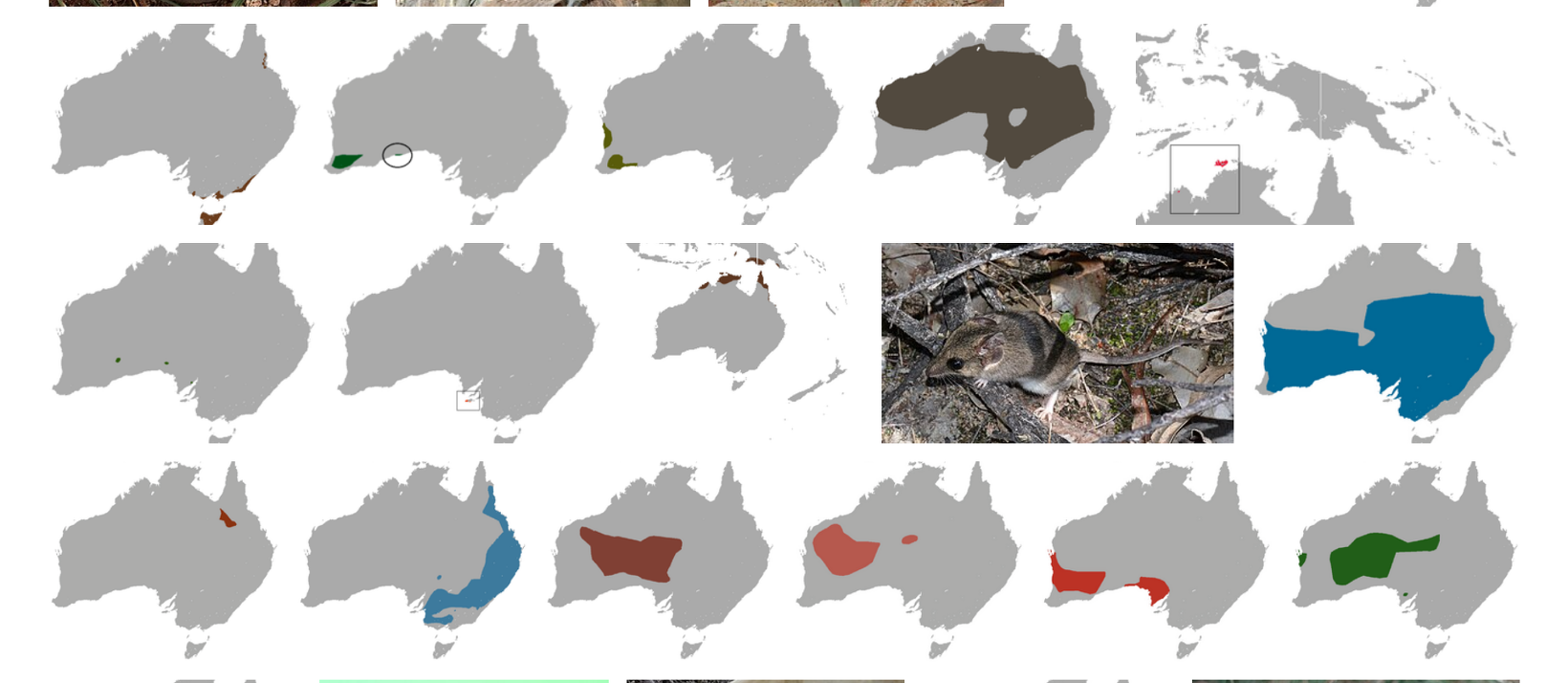
ranges of different dunnart species
Fat-tailed dunnarts are primarily insectivores (eat insects) and eats more than their weight each night, feeding on a variety of grasshoppers, moths, and beetles. They are motile (move around as opposed to being stationary) and nocturnal (active at night), and appear to live in small groups. Studies of captive fat-tailed dunnarts indicate that females are not receptive to the presence of males after they have given birth to a litter. Males housed with females who have litters are often killed by the females. This suggests that females with young may be territorial (defend an area within the home range), and solitary in the wild. Fattailed dunarts, like many marsupials, have poorly developed thermoregulatory abilities. In the colder months, they may engage in thermoregulatory mutualism with mice in which the two species huddle together for warmth. Mixed species aggregations are common during the winter, and there is a low incidence of natural torpor. |=|
Fat-tailed dunnarts reproduce at a very high rate. Female are polyestrus (have multiple estrous cycles, periods of sexual receptivity, within a year). The average gestation period is only 14 days. Females typically reach sexual or reproductive maturity just shy of four months and males do just over five months. Females can breed and raise litters continuously for up to six months if environmental conditions are good. Most breeding takes place between July and February. Litters of up to ten young may be produced. The young first protrude from their mother's pouch at the age of 37 days. They disperse from their natal range when they are 65 to 69 days old. |=|
Long-Tailed Dunnarts
Long-tailed dunnarts (Antechinomys longicaudatus, formely Sminthopsis longicaudata) are a species of Australian dunnart that, like the little long-tailed dunnart, have a tail longer than its body and are also one of the larger dunnarts, ranging in weight from 15 to 21 grams (0.53 to 0.74 ounces) and ranging in length from 2.6 to 3.1 centimeters (10.2 to 12.0 inches). The American Society of Mammalogists moved long-tailed dunnarts from the genus Sminthopsis, which contains most dunnarts, to Antechinomys, which has only two members. [Source: Barbara Lundrigan and Melinda Girvin, Animal Diversity Web (ADW) |=|; Wikipedia]
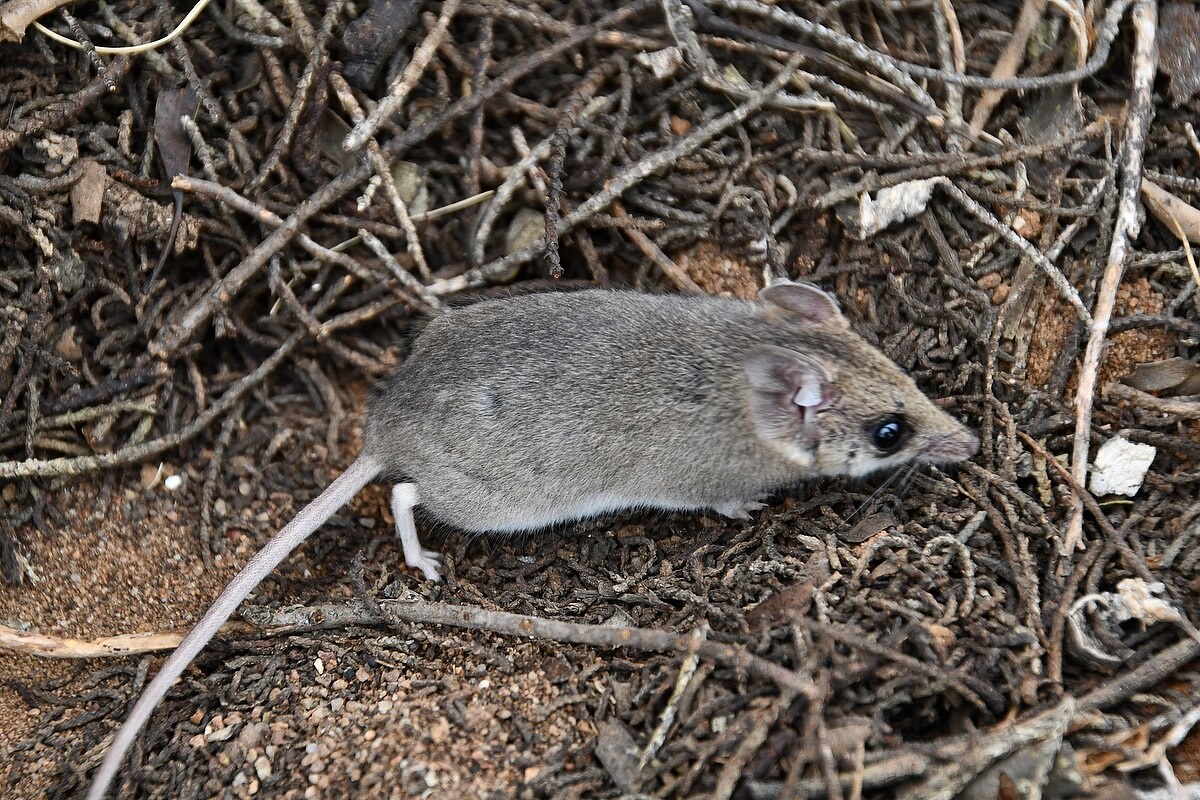
Little long-tailed dunnart (Sminthopsis dolichura)
Long-tailed dunnarts are native to northwestern Western Australia where they inhabit rugged, rocky outcrops Until the 1980s, they were only known from a few museum specimens. In June 1981, nine individuals were captured from the wild, allowing for the study of living specimens for the first time. In western Australia there appear to be only three wild populations of long-tailed dunnarts — two in national parks and the other in a nature reserve.
Long-tailed dunnarts are not considered endangered or threatened by some sources but are according to others. They are designated as a species of least concern on the They are designated as a species of least concern on the International Union for Conservation of Nature (IUCN) Red List. On the U.S. Federal List they are classified as Endangered. In CITES (Convention on International Trade in Endangered Species of Wild) they are in Appendix I, which lists species that are the most endangered among CITES-listed animals and plants. |=|
Long-Tailed Dunnarts Characteristics, Behavior and Reproduction
Long-tailed dunnarts have a a head a body length of 8 to 9.6 centimeters, (3.1–3.8 in) and a 18–to-21-centimeters (7.1–8.3-inch) tail. Their hind feet are 1.8 centimeters (0.71 inches) long and their ear length is 2.1 centimeters (0.83 inches). Sexual Dimorphism (differences between males and females) is present: Males are larger than females.Males have a head and body length of 8 to 10 centimeters (3.1 to 3.9 inches). Females have a head and body length of 8 to 9 centimeters (3.1 to 3.5 inches). [Source: Barbara Lundrigan and Melinda Girvin, Animal Diversity Web (ADW) |=|; Wikipedia]
The back fur of Long-tailed dunnarts is gray, while the underbelly is pale cream to white. The legs and the feet are white. Their slender feet have striated or granulated pads. The head is somewhat flattened in shape with a long snout. The most distinguishing characteristic of long-tailed dunnarts is their long tail, which is more than twice the length of their body — 20 to 21 centimeters (7.9 to 8.2 inches) in males and 18 to 20 centimeters (7 to 8.2 inches) in females. The tail is mostly scaly with a few short hairs; the end of the tail has longer hairs that form a brush-like tip.
Long-tailed dunnarts are nocturnal (active at night), motile (move around as opposed to being stationary) and mostly terrestrial animals Dunnarts are mostly insectivores (eat insects). The diet of long-tailed dunnarts consists primarily of arthropods, spiders, roaches, centipedes, grasshoppers, flies, and various larvae. Occasionally lizards, mice, and other small vertebrates are consumed. Dunnarts dig burrows or build nests of grass and leaves in hollow logs and stumps and in cold conditions may become torpid. There is evidence that long-tailed dunnarts are be capable of climbing. In captivity long-tailed dunnarts maintain small groups if enough space and nesting sites are available. Females with litters have been recorded attacking adult males |=|
Female long-tailed dunnarts are polyestrus (females have multiple estrous cycles, periods of sexual receptivity). Estrus periods last from August through December, with the estrus cycles lasting from 51 to 30 days, with each cycle shorter than the one previous to it. Birth occurs between 17 and 19 days after mating, and young are fully enclosed in the pouch for the first three weeks after birth attached to one of the female's six nipples.
Stripe-Faced Dunnarts
Striped-faced dunnarts (Sminthopsis macroura) are small, nocturnal "marsupial mice". Also called narrow-footed marsupial mice, they occur in arid and semi-arid habitats throughout much of inland central and northern Australia from central Western Australia to western Queensland and northern New South Wales. While the species has a broad distribution range, it has been declining across much of Australia, including the western region of New South Wales. Their average lifespan in captivity is 4.9 years. [Source: Wikipedia]
Striped-faced dunnart are not endangered or threatened.They are designated as a species of least concern on the International Union for Conservation of Nature (IUCN) Red List. Their primary threats are habitat degradation and predation by introduced foxes and feral cats. The Office of Environment and Heritage in New South Wales lists the species as 'vulnerable' there but it is not listed on the Environment Protection and Biodiversity Conservation Act 1999 (EPBC Act).
Recent genetic studies have discovered that striped-faced dunnarts are in fact three distinct species that diverged from each other over several million years. However, because they are difficult to distinguish, they tend to be treated as a single species. The three species of subspecies are: 1) Sminthopsis macroura macroura in central, eastern, and western Australia; 2) Sminthopsis macroura stalkeri in central northern Australia; and 3) Sminthopsis macroura S.m. froggatti in the Kimberley region.
Stripe-Faced Dunnarts Characteristics, Behavior and Reproduction
Striped-faced dunnarts weigh up to is 20.6 grams (0.73 ounces) and a basal metabolic rate is 0.128 watts. Head and body length ranges from 7 to 12 centimeters (2.7 to 4.7 inches), and the tail is approximately 5.5 to 13 centimeters (2.2 to 5.1 inches long). Sexual Dimorphism (differences between males and females) is present: Males are larger than females, with females weighing on average 16 grams (0.6 ounces) and males weighing on average 19 grams. (0.6 0.7 ounces). [Source: Barbara Lundrigan and Julie Harris, Animal Diversity Web (ADW) |=|]
Striped-faced dunnarts are buffy to grayish in color on their back and sides with white underparts. The feet are usually white and the tail is either brownish or grayish. Their feet are slender and they have a black stripe down the face — giving them their common name. The pads on the feet are striated and the hind part of the soles lack pads. Striped-faced dunnarts have a relatively well developed pouch for a dasyurid. During times of abundant food, fat is stored in the tail, which becomes carrot shaped. The fat stores can help the animals endure times when food is scarce.
Dunnarts are motile (move around as opposed to being stationary), nocturnal (active at night) and mainly terrestrial. They move by means of a bipedal gait when traveling fast, but over shorter distances, they may walk quadrepedally. Dunnarts insectivores (eat insects) and have also been known to eat small vertebrates like lizards and mice. Prey is generally caught on the ground. Dunnarts dig burrows or build nests made from grasses and leaves. The nests are often found in hollow logs or under bushes or tree stumps.
Striped-faced dunnarts can breed very rapidly. The average gestation period is pnly 12 days. The average number of offspring is four. On average females reach sexual or reproductive maturity at just shy of four months and males do so at just over five months. Among captive Striped-faced dunnarts the breeding season lasts from June to February. Females are polyestrus (females have multiple estrous cycles, periods of sexual receptivity, per year) with one cycle lasting approximately 26.2 days. Ovulation occurs spontaneously.
After birth young are carried in the pouch for 40 days. Litter size can range from one to eight young. Female striped face dunnarts have eight mammae. If a female has only one or two young she may not rear them. After the young leave the pouch, they are suckled in the nest for another 30 days. Sexual maturity in females depended on when they were born. Those born early in the season matured at 86-159 days, while those born later in the same season matured at an earlier age. Individual male dunnarts are capable of breeding over long periods during the breeding season. Males do not appear to be sexually mature until the season after their birth. It has been found that the timing of mating and litter production corresponds to the period of maximum sperm production. Males have relatively low sperm production compared to other Dasyurid species.
Image Sources: Wikimedia Commons
Text Sources: Animal Diversity Web animaldiversity.org , National Geographic, Live Science, Natural History magazine, Australian Museum, David Attenborough books, Australia Geographic, New York Times, Washington Post, Los Angeles Times, Smithsonian magazine, Discover magazine, The Conversation, The New Yorker, Time, BBC, CNN, Reuters, Associated Press, AFP, Lonely Planet Guides, Wikipedia, The Guardian, Top Secret Animal Attack Files website and various books and other publications.
Last updated July 2025