
Home | Category: Animals / Marsupials
POSSUMS
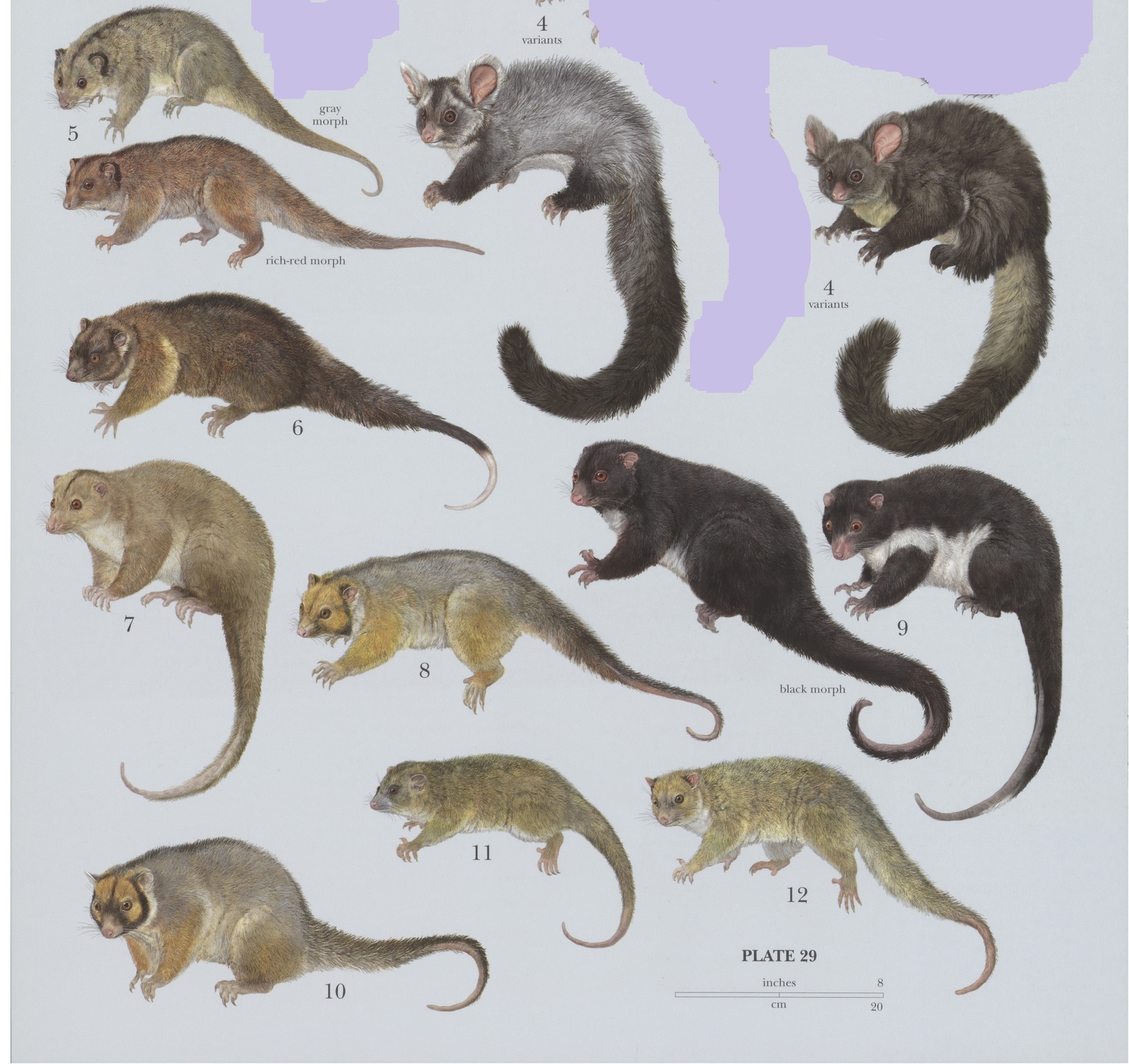
Some Possum species: 4) Southern Greater Glider (Petawroides volans), 5) Lowland Ring-tailed Possum (Pseudochirulus canescens), 6) Weyland Ring-tailed Possum (Pseudochirulus carols), 7) Daintree River Ring-tailed Possum (Pseudochirulus cinereus), 8) Painted Ring-tailed Possum (Pseudochirulus forbesi), 9) Herbert River Ring-tailed Possum (Pseudochirulus herbertensis), 10) Masked Ring-tailed Possum (Pseudochirulus larvatus), 11) Pygmy Ring-tailed Possum (Pseudochirulus mayer), 12) Arfak Ring-tailed Possum (Pseudochirulus schlegeli)
There are a wide variety of possums in Australia and New Guinea. They are mostly arboreal have adapted themselves to almost every environment, including cities and suburbs and campsites, where they are notorious for stealing food. The most common species are the common brushtail or grey possum, which are widespread in every state and territory of Australia.
The term "opossum" is used to refer to American species (though "possum" is a common abbreviation), while similar Australian species are properly called "possums". The common name "possum" derives from the creatures' resemblance to the opossums of the Americas. The word “opposum” comes from Powhatan language aposoum "white animal", from Proto-Algonquian word for "white dog").
Although opossums are marsupials like possums, Australasian possums are more closely related to other Australasian marsupials such as kangaroos. Possums are harmless but they can keep you up at night if you have one holed up in the roof space of your home.
RELATED ARTICLES:
BRUSHTAILED POSSUMS: CHARACTERISTICS, BEHAVIOR, REPRODUCTION, SPECIES, PESTS ioa.factsanddetails.com
GLIDERS OF AUSTRALIA AND NEW GUINEA: MARSUPIAL EQUIVALENTS OF FLYING SQUIRRELS ioa.factsanddetails.com
GLIDER SPECIES (SUGAR, MAHOGANY, GREATER, YELLOW-BELLIED): CHARACTERISTICS AND BEHAVIOR ioa.factsanddetails.com
CUSCUSES: CHARACTERISTICS, SPECIES, BEHAVIOR AND REPRODUCTION ioa.factsanddetails.com
CUSCUSES OF SULAWESI factsanddetails.com
MARSUPIALS: HISTORY, EVOLUTION, CHARACTERISTICS, BEHAVIOR, REPRODUCTION ioa.factsanddetails.com
MARSUPIALS IN AUSTRALIA ioa.factsanddetails.com
MARSUPIALS IN AUSTRALASIA (AUSTRALIA, NEW GUINEA, NEARBY ISLANDS) ioa.factsanddetails.com
Phalangeriformes
Possums and similar animals belong to the Phalangeriformes suborder, which is comprised of about 70 species of small to medium-sized arboreal marsupials native to Australia, New Guinea, Sulawesi in Indonesia and nearby islands. The species are commonly known as possums, opossums, gliders, and cuscus.
Phalangeriformes are quadrupedal diprotodont marsupials (with four limbs and two large, forward-pointing incisors on the lower jaw) with long tails. The smallest species — one of mammals period — is the Tasmanian pygmy possum, which has a head-body length of sven centimeters mm (2.75 inches) and weighs 10 grams (0.4 ounces). The largest are the two species of bear cuscus, which may exceed seven interesting (15.4 pounds). Phalangeriformes species are typically nocturnal and at least partially arboreal. They inhabit most vegetated habitats, and several species have adjusted well to urban settings. Diets range from generalist herbivores or omnivores (the common brushtail possum) to specialist browsers of eucalyptus (greater glider), insectivores (mountain pygmy possum) and nectar-feeders (honey possum).
About two-thirds of Australian marsupials belong to the order Diprotodontia, which is split into three suborders: Vombatiformes (wombats and the koala, four species in total); the large and diverse Phalangeriformes (the possums and gliders) and Macropodiformes (kangaroos, potoroos, wallabies and the musky rat-kangaroo).
Feather-Tailed Possums
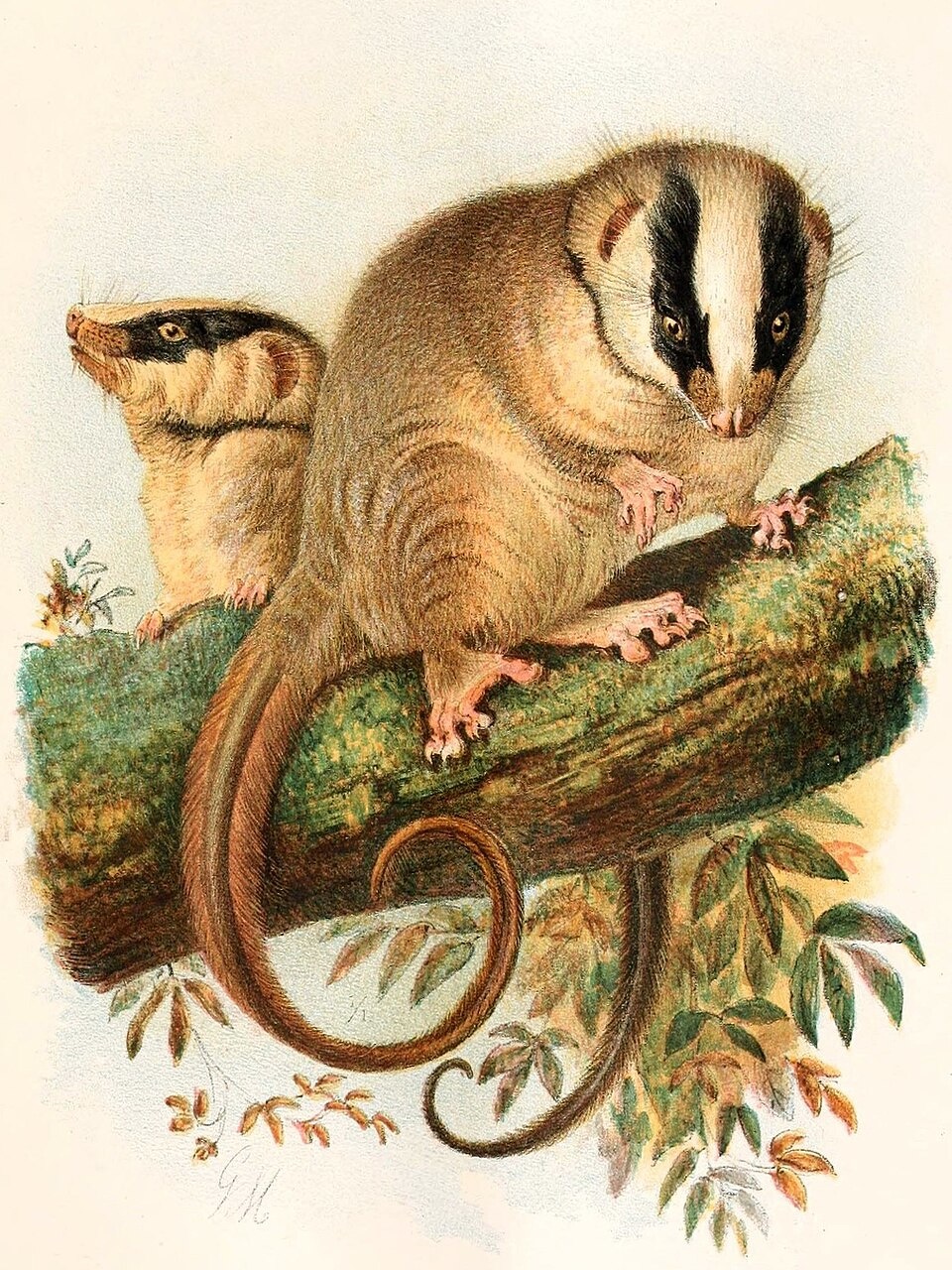
feather-tailed possum illustration (1881)
Feather-tailed possums (Distoechurus pennatus) are a species of marsupial in the family Acrobatidae found in West Papua and Papua New Guinea. They are reside mostly of Papua New Guinea, with the exception of the southern lowlands, in in almost all forest types up to 1900 meter (6,234 feet), including disturbed forest and gardens. They are not to be confused with feathertail gliders, the only other species in the family Acrobatidae. [Source: Wikipedia]
Feather-tailed possums have a head and body length of about 10 to 12 centimeters (3.9 to 4,7 inches) and the tail is 12.3 to 15.5 centimeters (4.8 to 6.1 inches) for a total length of 22.3 to 27.5 centimeters (8.7 to 10.8 inches). The tongue is about 2.1 centimeters (0.8 inches) long and the top side is covered in a mat of small, backward-pointing papillae (bristles) that enable the animal to extract nectar and pollen from flowers.
Feather-tailed possums are dull buff to light brown to grayish in color. Their muzzle and top of the head are striped black and white, with conspicuous black patches behind each small, naked ear. The eyes are large. The tail is naked except for the base and horizontal stiff hairs along each side, giving the appearance of a feather — the source of their name. The tip is prehensile. The feet of the possum have six pads rather than five, an adaptation for climbing, and the claws are sharp and hooked.
Common Ringtail Possums
Common ringtail possums (Pseudocheirus peregrinus) are also known as common ringtails and Queensland ringtails. Ther scientific name is derived from Greek for "false hand" and Latin for "pilgrim" or "alien". They live in a variety of habitats and eats a variety of leaves of both native and introduced plants, as well as flowers, fruits and sap. This possum also consumes its feces (caecotropes), which is composed of material fermented in the cacum and expelled during the daytime when it is resting in a nest. This behaviour is also seen in rabbits and pikas. [Source: Paul Welsh, Animal Diversity Web (ADW) |=|]
Common ringtail possums are found along the eastern coastline of Australia, Tasmania, and the southwestern corner of western Australia and have an extensive distribution. They occur in temperate and tropical areas but rarely found in arid places. It is believed that their wide habitat range is at least partyly due to their ability to feed on a number of different plant species. They can usually be found in dense brush forests, as they favor environments that are plentiful with eucalyptus. The dense brush is also optimal for the construction of dreys (nests usually made from a mass of twigs in a tree.. Along with several other species, the common ringtail possum occupies a range of niches comparable to the niche's of lemurs, monkeys, squirrels, and bushbabies in similar forests on other continents.
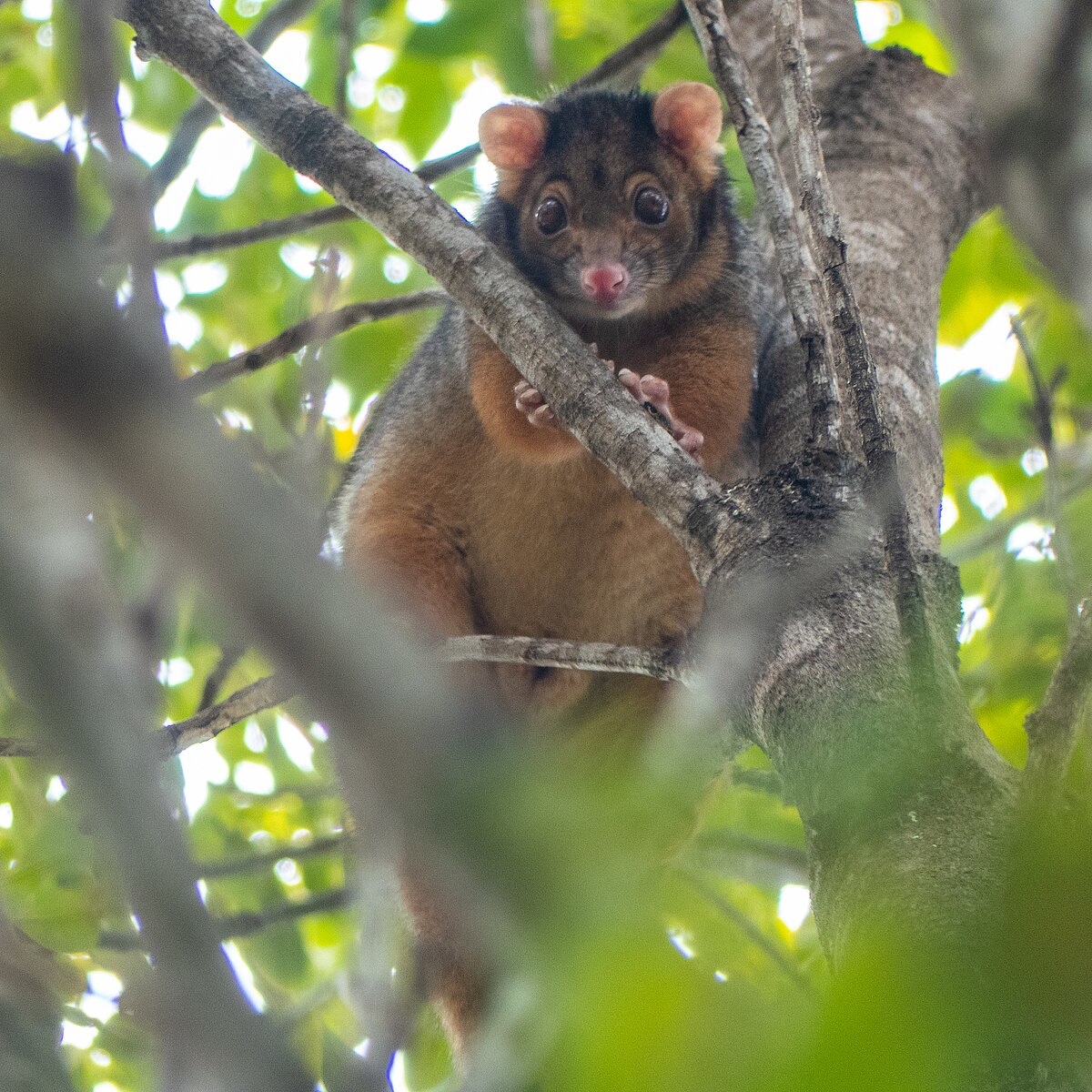
common ringtail possum
Common ringtail possums not endangered or threatened. They are designated as a species of least concern on the International Union for Conservation of Nature (IUCN) Red List and have no special status on the Convention on International Trade in Endangered Species (CITES). Common ringtail possums do not have a bad rap like brushtail possums, which are considered pests in suburban areas and nest within homes or human structures During the 1950s common ringtail possum populations severely declined but the animals appear to have bounced back since then. Threats included deforestation, which destroyes where the live, being struck by cars, and hunted by cats and dogs.
Common Ringtail Possum Characteristics and Diet
Common ringtail possums are the smallest of eight species of ringtail possums that live in Australia. They range in weight from half a kilogram to a kilograms (1.1 to 2.2 pounds), with and weight of 0.7 kilograms (1.5 pounds). The adults of this species typically are between 30 and 35 centimeters in body length, with a tail length that is roughly equal to the body length. Their average basal metabolic rate is 2.27 watts. [Source: Paul Welsh, Animal Diversity Web (ADW) |=|]
The average lifespan of Common ringtail possums in the wild is five years; in captivity, it is eight years. However, typically they do not survive past three years of age and half of offspring do not survive one year after birth. One reason for their short life expectancy is predation. In suburban environment, hunting by cats is an issue. Once a common ringtail possum suffers a bite from a cat it is highly unlikely that it will survive, even of the bite is not too severe.
Common ringtail possums have brown or reddish fur on the upper parts of their body and light colored or gray fur on their undersides. They have large eyes that provide them with good night vision. Two of the claws found on the front feet are opposable and the pads, as well as the tips, of the toes are grooved. These traits are useful for climbing in trees. Common ringtail possums have a strong, but relatively hairless, prehensile tail that is curled when not in use. They can be distinguished from other possum species by their smaller, more rounded ears which have patches of white fur both on and above the ears. The tail of common ringtail possums has a white tip and is tapered.
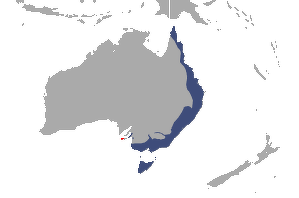
common ringtail possum range
Common ringtail possums are primarily folivorous (leaf-eating). They feed mainly on eucalyptus leaves, but may also eat flowers, buds, nectar, and fruit. Chemicals and microorganissm in the cecum (pouch considered to be the beginning of the large intestine) of common ringtail possums are able to detoxify the tannins and phenols present in eucalyptus leaves. The digestive systems of koalas do the same thing. A low metabolic rate helps common ringtail possums to compensate for the lack of energy and nutrition provided by their specialized diet. Feeding occurs both during the first half of the night and, again, before dawn. Common ringtail possums prefer eating the youngest foliage of the plants they consume. Reproductive is often timed so that young leave the pouch and are weaned during times when flower and fruit growth are at their peaks. Common ringtail possums in urban and suburban areas, like to eat rose buds |=|
Common Ringtail Possum Behavior and Reproduction
Common ringtail possums are nocturnal (active at night), arboreal (live mainly in trees) and motile (move around as opposed to being stationary). They are well-adapted for life in the trees and rarely set foot on the ground. They use their prehensile tail extensively to grab branches and sometimes carry stuff. Their vocalizations have been described as soft, high-pitched, and twittering. [Source: Paul Welsh, Animal Diversity Web (ADW) |=|]
Common ringtail possums are territorial (defend an area within the home range) and use scented secretions to mark their territory. Unlike many species of ringtail possum, common ringtail possums are not solitary. They are typically found in small groups. A typical group consists of one adult male and one or two adult females and their offspring from the previous breeding season. These family groupings can be found in dreys (nests). Dreys are typically constructed of shredded bark, twigs, and ferns, and are usually built in the fork of a tree or in dense shrubbery. They are 25 to 30 centimeters (9.8 to 11.8 inches) across and have an entrance hole on one side which is eight to 10 centimeters (3.1 to 3.9 inches) in diameter.
Common ringtail possums males and females reach sexual or reproductive maturity at one years of age. Females carry their young in a pouch while they develop. Mating takes place between April and December, depending on the region. Most young are born sometime between May and July. Females polyestrus (females have multiple estrous cycles, periods of sexual receptivity, per year) and polyovular (produce more than one egg cell). The estrus cycle lasts 28 days.
Common ringtail possums typically give birth to two offspring, but can have up to four in a litter. The female's pouch has a forward facing opening; two of the four nipples are functional at one time. It has been suggested that six embryos are born at the same time but only two are able to attach to useable nipple and the other four die. Older females can produce up to two litters of young per year. The initial growth of common ringtail possum young is generally slow at first when when female weight is lowest. Between 90 and 106 days after birth, development accelerates. Young are able to open their eyes and make clear vocalizations. Between 120 and 130 days after birth the young emerge from their mother's pouch. Nursing usually continues until young are 145 to 220 days after birth. |=|
Pygmy Possums — Among the World's Smallest Mammals
Pygmy possums are one of the world's six smallest mammals according to Live Science. Remy Melina wrote: Although it looks like it's more likely to be related to a chinchilla than a kangaroo, the pygmy possum (Cercartetus nanus) is part of the marsupial family. Ranging in lengths between two and four inches, pygmy possums weigh 10 to 45 grams. Like their larger possum cousins, pygmy possums are nocturnal (active at night), and use their tails to hang upside-down from trees. They can be found in Australia, Papua New Guinea and Indonesia. During the winter, the petite possum rolls into a tight ball, covers its eyes with its ears and enters torpor, or temporary engage in hibernation. During this time, its body temperature and metabolism is reduced so that it doesn't need to eat, instead receiving nourishment from the fat stored in its tail. [Source: Remy Melina, Live Science, December 03, 2021]|
There are five species of pygmy possums in two genera and together they form the marsupial family Burramyidae. There is one species in the Genus Burramys: the Mountain pygmy possum (Burramys parvus). There are four species in the Genus Cercartetus: 1) Long-tailed pygmy possum (Cercartetus caudatus); 2) Western pygmy possum (Cercartetus concinnus); 3) Tasmanian pygmy possum (Cercartetus lepidus) and 4) Eastern pygmy possum (Cercartetus nanus). [Source: Wikipedia]
Pygmy possums range in weight from six grams to about 80 grams. Phil Myers wrote in Animal Diversity Web: Characteristics of burramyids include a conical head with short muzzle, large eyes, and short rounded ears. Their tail is long, slender, and prehensile. They have an opposable big toe on their hind feet, and their fur is soft, thick, and wooly. Burramyids are diprotodont, with dental formula 3/2, 1/0, 2-3/3, 3-4/3-4. The molars are quadrate and have low, smooth cusps (bunodont). The third upper premolar is bladelike or plagiaulacoid. [Source: Phil Myers, Animal Diversity Web (ADW) |=|]
Their well-developed pouches open anteriorly, like those of most other marsupials. Newly fertilized eggs go through a period of embryonic diapause (temporary suspension of development of the embryo), a common trait among diprotodonts. Burramyids are mostly insectivores (eat insects), but also feed on nectar and sometimes lizards. They are nocturnal (active at night), and arboreal (live mainly in trees), or scansorial (good at climbing), in habit. Burramys parvus, which lives at high elevations, is the only marsupial known to undergo extensive periods of engage in hibernation (the state that some animals enter during winter in which normal physiological processes are significantly reduced, thus lowering the animal’s energy requirements). |=|
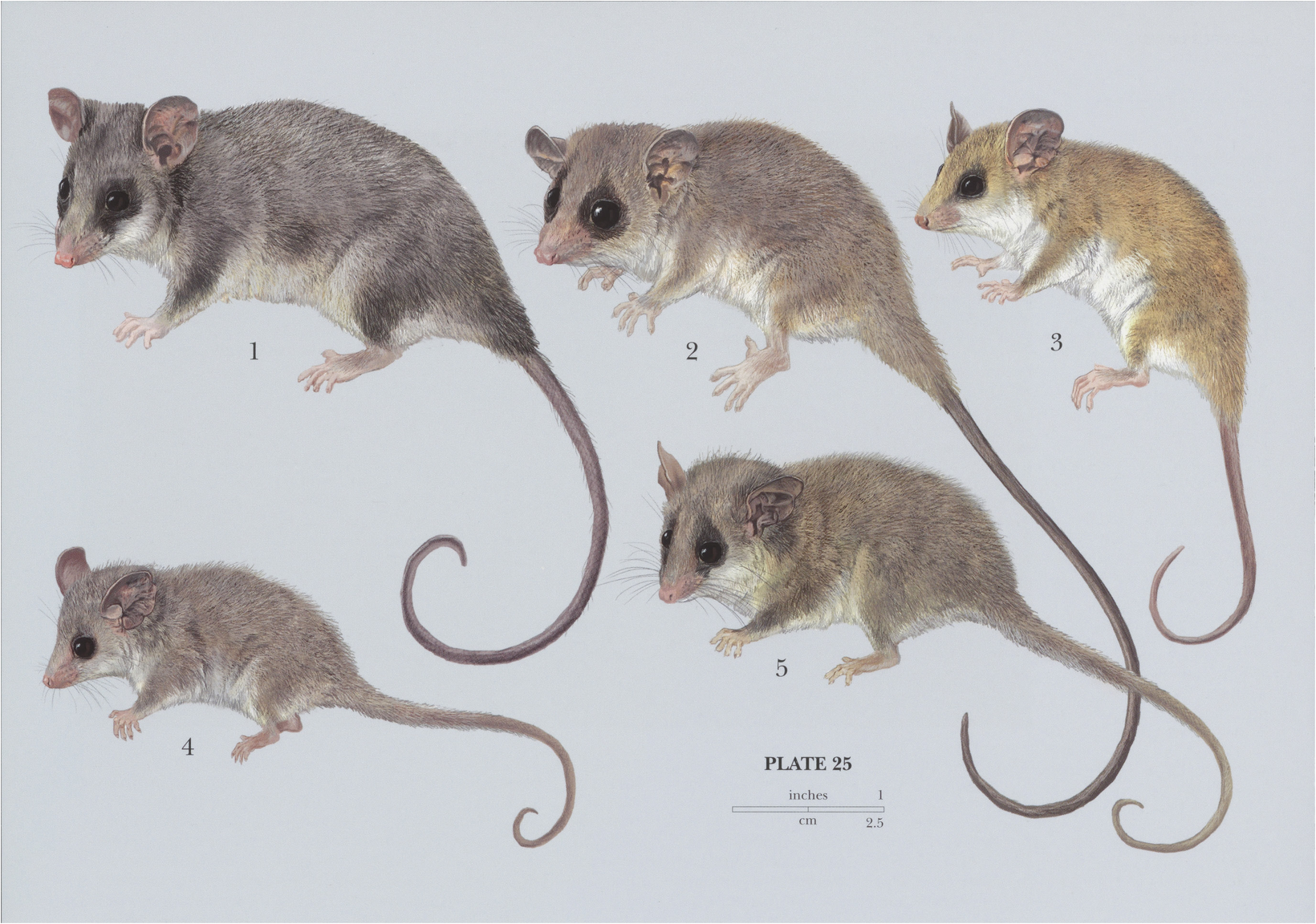
Pygmy Possum Species: 1) Mountain Pygmy Possum (Burramys parvus), 2) Long-tailed Pygmy Possum (Cercartetus caudatus), 3) Western Pygmy Possum (Cercartetus concinnus), 4) Little Pygmy Possum (Cercartetus lepidus), 5) Eastern Pygmy Possum (Cercartetus nanus)
Tasmanian Pygmy Possum — the World’s Smallest Possum
Tasmanian pygmy possums(Cercartetus lepidus) are the world's smallest possum and one of the world’s smallest mammals. Also known as little pygmy possums and tiny pygmy possums, they superficially resemble dormouses but are a marsupials. Adults have in head-body length that ranges from 6.6 to 7.5 centimeters (2.6 to 3.0 inches), with a 6-to-7.2 centimeter (2.4-to-2.8 inch) tail, and weigh only 7 to 10 grams (0.25 to 0.35 ounces). [Source: Wikipedia]
The fur of Tasmanian pygmy possums is soft and thick, and fawn in color over most of the body, fading to a pale grey on the animal’s undersides. The snout is short with long whiskers, and the eyes are directed forwards and surrounded by slightly darker fur, although without the conspicuous black rings seen on other pygmy possums. The ears are mobile and largely hairless. The tail is prehensile, and thickly furred at the base, which may be widened by fat stores beneath the skin. The remainder of the tail is relatively narrow and cylindrical, with only sparse hair between numerous tiny scales.
Tasmanian pygmy possums inhabit sclerophyll (hard leaf) forests, bush made up a of small scrubby mallee eucalyptus and open heathland throughout Tasmania and at one time was probably fairly common in southern and southeast Australia and was thought to be extinct there. In 1964, a Tasmanian pygmy possum was discovered on Kangaroo Island in South Australia, and further populations have since been discovered in the Murray-Darling basin in South Australia and Victoria. The oldest fossils for this species date from the late Pleistocene period (129,000 to 11,700 years ago) and were found on the mainland. The oldest known Tasmanian fossils are much younger. There are no formally recognised subspecies, although it has been proposed, based on genetic information, that the mainland and Tasmanian populations may be subspecies, or even entirely separate species. It had been feared that the Kangaroo Island population may have been wiped out by the 2019 bushfires that burnt almost half the island. But in late 2020, conservation group Kangaroo Island Land for Wildlife recorded live pygmy possums in a fauna survey of unburnt forest.
Tasmanian Pygmy Possum Behavior and Reproduction
Tasmanian pygmy possums are nocturnal and arboreal. They primarily in shrubland or forest undergrowth, and, although a good climber, rarely ventures into the higher branches of trees, presumably because this would make them more vulnerable to avian predators. Pygmy possums use strips of bark to construct dome-like nests in tree cavities or rotten wood, but are solitary animals that do not share their nests with other individuals except for their own young. [Source: Wikipedia]
Tasmanian pygmy possums are omnivorous, feeding on insects, spiders, small lizards, nectar, and pollen, the latter two primarily coming from Banksia and eucalypts. Their preference for eating pollen without destroying the host flower may mean that they help to pollinate some species of plant. Known predators include Tasmanian devils, quolls, kookaburra, masked owls, and tiger snakes. During cold weather, especially below about 6 °C (43 °F), Tasmanian pygmy possums have the ability to enter torpor. While in this state, body temperature drops, and oxygen consumption falls to just one percent of normal.
Breeding occurs throughout the year, although it may be more common in spring and summer. Female have a well-developed pouch containing four teats, which therefore limits the maximum size of a litter to that number. The young leave the pouch at around 42 days, although they may cling to the mother's fur and be carried about after that. They leave the nest to fend for themselves at around 90 days of age.
Striped Possums
Striped possums (Dactylopsila trivirgata) are also known as common striped possums. Found mainly in New Guinea, they are members of the Petauridae marsupial family and are closely related to sugar gliders and are similar in appearance to them but lack a gliding membrane. Striped are black with three white stripes running across their head to their tail. On their head the white stripes form a 'Y' shape.
Striped possums inhabit Australia and New Guinea, including some nearby islands. In Australia they are found in northeastern Queensland, from the tip of the Cape York Peninsula in the north to Mt. Spec in the south. They are widespread over this limited range, but is quite rare. In New Guinea they are much more common and distributed throughout the lowlands and foothills. Striped possums live in trees and reside almost exclusively in lowland tropical rainforest and adjacent woodlands at elevations below 300 meters (984 feet). Within this habitat, they are most common in vine forests, riparian (near a river) woodlands, and monsoonlands. Individuals are sometimes observed feeding in more open eucalypt (Eucalyptus species) and melaleuca woodlands. [Source: Lucas Langstaff, Animal Diversity Web (ADW) |=|]
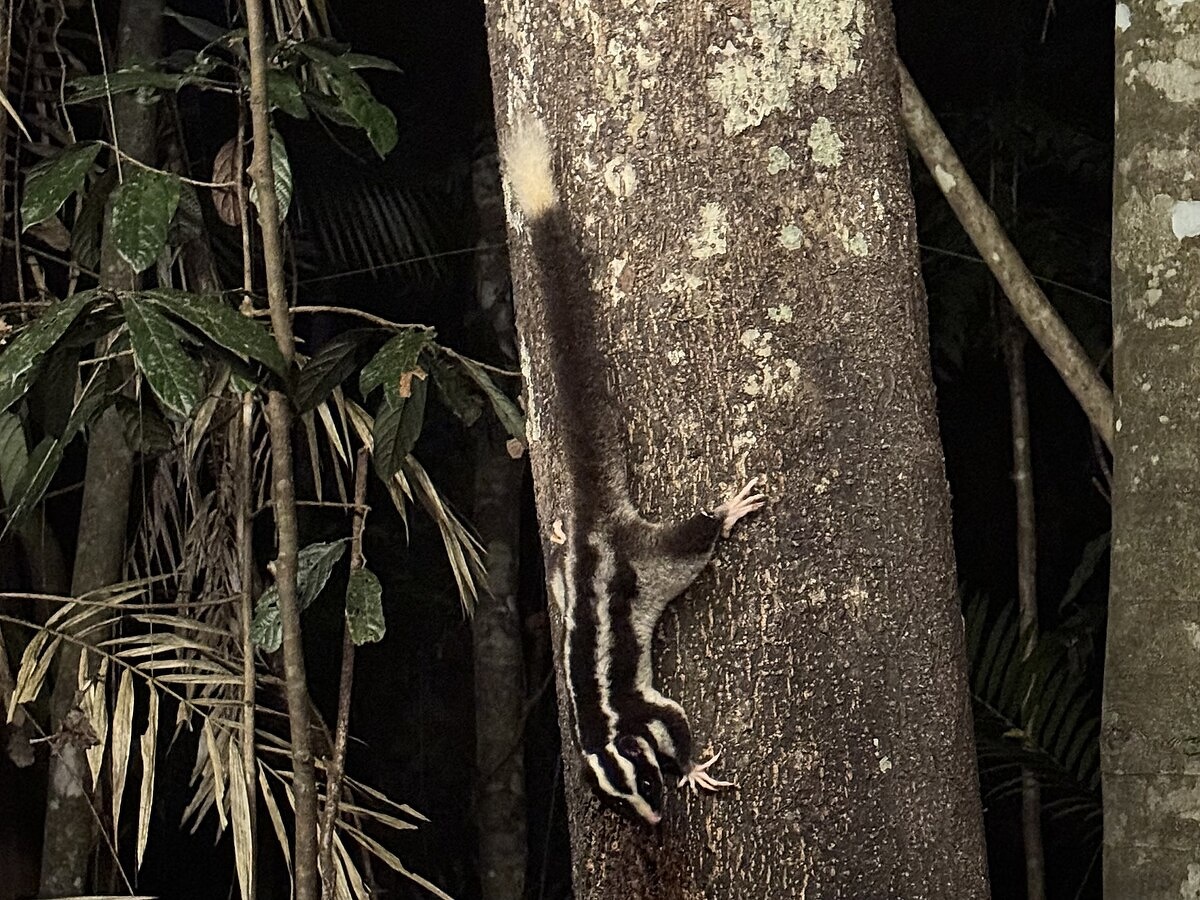
striped possum in Queensland
Striped possums are not endangered or threatened. They are designated as a species of least concern on the International Union for Conservation of Nature (IUCN) Red List and have no special status on the Convention on International Trade in Endangered Species (CITES). Striped possums are hunted for meat and skins by indigenous people in New Guinea. They are relatively common in New Guinea and provide a good food source. The skins are used in certain cultural rituals. In agricultural areas that border lowland rainforest, striped possums sometimes slightly damage sugar cane crops. They break into sugar cane stalks, but it is not known if they consume the sap or are simply looking for insects. Deforestation and human alteration of rainforest may impact this species. In fragmented landscapes, striped possums require habitat corridors that are connected to large tracts of continuous forest. These forests must also contain large trees over 30 centimeters in diameter at breast height because common striped possums need large trees with hollows for den sites.
Striped Possums Characteristics and Diet
Striped possums are mid-sized possums. They range in weight from 246 to 569 grams (8.7 to 20 ounces), with an average weight is 423 grams (14.9 ounces), and have a head and body length of 25.6 to 27 centimeters (10 to 10.6 inches). Their tail is around 32.5 centimeters (12.8 inches) long. Unique morphological features include an elongated tongue, a really long fourth finger, long incisors, and a rounding of the braincase. Their procumbent lower incisors have the greatest relative length of any possum and their first upper incisors project forward. These are likely specialized feeding adaptations. The rounding of the braincase makes enables striped possums to have the largest brain in relation to body weight of any marsupial. The average lifespan of these marsupials in the wild is five years. They have lived up to nine years and seven months in captivity. [Source: Lucas Langstaff, Animal Diversity Web (ADW) |=|]
Striped possums have striking black and white coloration, coarse fur and three longitudinal stripes. The middle stripe runs from the front of the head to the tip of the tail. The two lateral stripes start at the muzzle and course over the eyes and ears to the rump. Branches from the lateral stripes continue down the outside of each limb. The fur of juvenile and subadult animals displays sharp contrast between the black and white markings. The fur of adults has more gradual transitions between black and white markings, and white areas become more grey with age. Their distinct bushy tail is longer than their body and is usually darker on top with the tip being either black or white. |=|
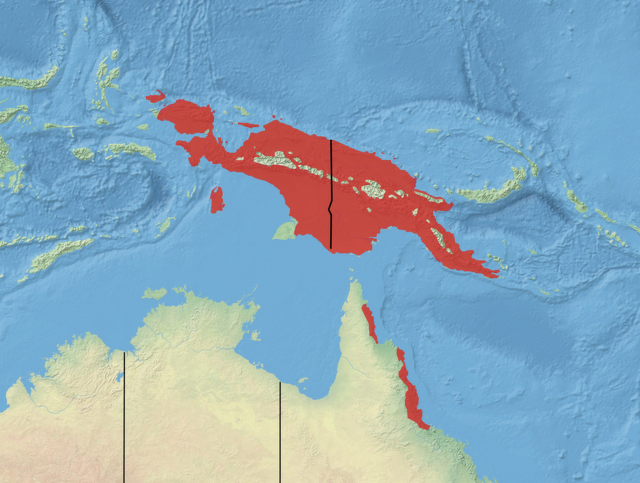
striped possum range
Striped possums are a generalist insectivores (eat insects) and rely more on insects as food sources than other closely-related possums. Striped possums eat insects from at least eight orders, including Coleoptera, Hymenoptera, Lepidoptera, Isoptera, Blattodea, Orthoptera, Hemiptera, and Diptera. Moth and beetle larvae, ants, termites, and crickets make the largest portions of their diet. The large amounts of wood-boring larvae and social insects such as ants and termotes in stomach samples suggests that striped possums targets these high-energy foods. The fat content in these insects is between 20 and 44 percent. The reliance of striped possum on insects rather than relatively-difficult-to-breakdown plant material like leaves is reflected in the simplicity and shortness of their digestive tract. In particular, the length of the cecum (pouch considered to be the beginning of the large intestine), an organ used in fermentation, is significantly shorter in Striped possums than in Sugar gliders and Leadbeater's possum.
Among the insect-hunting physical adaptations of striped possums are forepaws that tap rapidly on wood to locate larvae. Once insects are located, the animals use their powerful jaws and tooth orientation to dig away at bark and wood from living and dead trees to reach ant and termite eggs and other food items. They sometimes use their jaws to break into insect mounds too. Their dexterous elongated fourth finger is used for collecting wood-boring larvae while it is excavating trees. The fourth digit is highly sensitive and some observations suggest that it is used to discriminate different vibration frequencies of various insects and larvae. The fourth finger is so sensitive that it represents 10 percent of the entire primary somatosensory area (SI) of the brain. This compares to a 4 to 5 percent representation of the SI for the fourth digit of northern quolls. Striped possums also consume pollen, nectar, flowers, sap, and fruit but they contribute a very small part of their total diet. In captivity, striped possums have been observed eating small mammals.
Striped Possum Behavior, Communication and Reproduction
Striped possums are arboreal (live mainly in trees), nocturnal (active at night), motile (move around as opposed to being stationary). Their home territories — determined from radio-collared males — range from 5.2 hectares (12.8 acres) for subadults to 21.3 hectares (52.6 acres) for adults. Adult male striped possums are generally solitary, except during breeding season. Males den alone. Juveniles and females often have been found denning together. Striped possums den during the day in dry leaf nests in tree hollows or on mats of epiphytes. Both males and females use a number of den sites, which are spread throughout their home range. Dens are always in forest trees that are over 30 centimeters in diameter. Cordia dichotoma is a common den tree species. [Source: Lucas Langstaff, Animal Diversity Web (ADW) |=|]
Striped possums are most active from 9:00pm to 05:50am and may spend up to nine hours foraging each night. They forages in trees of different sizes, ranging from 10 centimeters in diameter to 110 centimeters in diameter. Striped possums looks for food on living trees, dead snags, downed trees, and rotting logs in forests, but are occasionally observed feeding in adjacent openlands as far as 400 meters from the edge of the woods. They climb up into the canpy as high as 33 meters in their serach for food. While foraging, striped possums move rapidly through the canopy jumping from limb to limb, sometimes leaping considerable distances. Striped possums have a lithe gait and their limb movement have a distinct 'rowing' motion. Striped possums are quite noisy when feeding. They rustle through the leaves, scratch and snort. When they feed a lot of stuff falls to the forest floor and loud sound of chewing and slurping can be heard.
Striped possums sense using vision, touch, sound and chemicals usually detected with smell and communicate with sound, chemicals, duets (joint displays, usually between mates, and usually with highly-coordinated sounds) and pheromones (chemicals released into air or water that are detected by and responded to by other animals of the same species). Striped possums can emit a strong, really nasty, pungent scent that may be a predator deterrent, or possibly plays a role in the social communication or to attract mates.
Striped possums make at least two types of vocalizations. They frequently call in a raspy guttoral "gar-gair, gar-gair" manner (described in "Reproduction," below). These vocalizations are believed to be part of their mating system and are followed by a social aggregation of two or three individuals. The other type of call is a distress call that is used repeatedly when an animal feels threatened. The distress call is a series of five to six creaking "frog-like" sounds that descend in pitch ("erreeh") and probably is used to deter a threat and warn others. . Their main known predators of striped possums are amethystine pythons. Barking owls and rufous owls may also prey on them. The black and white stripes on striped possums serve as camouflage especially in forest where sunlight and moonbeams that breaks through the canopy streak the landscape.
Striped possums engage in seasonal breeding. They mate during the dry season. In Australia this is between February and August. The breeding peak in Australia is June to July. Mating has been observed in New Guinea as early as January and as late as October. Females have well-developed pouches with two mammae. The number of offspring ranges from one to two.
Young are altricial, meaning they are relatively underdeveloped at birth. The degree to which female common striped possums provide care for their young is not known. Males appear not to involved in parenting. Females carry their offspring on their back after weaning, but it is not known for how long.
Observations suggest that there is intense male rivalry for breeding females. Males chase each other and make threatening, raucous vocalizations when in close contact. While coupled, both male and female repeatedly make loud, guttural vocalizations ("gar-gair, gar-gair") and intertwine and thrash their tails about. According to a single observation, copulation lasts approximately ten minutes.
Image Sources: Wikimedia Commons
Text Sources: Animal Diversity Web animaldiversity.org , National Geographic, Live Science, Natural History magazine, Australian Museum, David Attenborough books, Australia Geographic, New York Times, Washington Post, Los Angeles Times, Smithsonian magazine, Discover magazine, The Conversation, The New Yorker, Time, BBC, CNN, Reuters, Associated Press, AFP, Lonely Planet Guides, Wikipedia, The Guardian, Top Secret Animal Attack Files website and various books and other publications.
Last updated July 2025