
Home | Category: Animals / Kangaroos, Wallabies and Their Relatives / Marsupials
MARSUPIALS IN AUSTRALIA
Niches filled by mammals on other continents are occupied by marsupials on Australia. "There are, so to speak, lion and tiger marsupials," the journalist Joseph Judge said, "lamb and sheep marsupials, tree climbing and ground hugging marsupials.”
Laura Geggel wrote in Live Science: It's unclear why marsupials thrived in Australia. But one idea is that when times were tough, marsupial mothers could jettison any developing babies they had in their pouches, while mammals had to wait until gestation was over, spending precious resources on their young, Beck said. Another idea is that there were no placental mammals competing with the marsupials in Australia. But this idea is now contradicted, by a fossil tooth that belongs to a placental mammal or a placental-mammal relative discovered at Tingamarra. This indicates that placental mammals were on the continent as far back as 55 million years ago, Beck said. [Source: Laura Geggel, Live Science, March 3, 2019]
There are around 270 marsupial species currently found in Australasia, which includes Australia, New Guinea, and nearby islands, with around 200 in Australia itself. Approximately half of the mammal species in Australia are marsupials. Australia is unique in that it is the only continent where all three major groups of mammals (monotremes, marsupials, and placentals) are still found, with marsupials being the most prominent group. Past marsupial faunas in Australia, included rhinoceros-sized, wombat-like marsupial herbivores, kangaroos nearly 10 feet tall, and carnivorous marsupial lions with shearing teeth and retractile claws.
Marsupials in Australia include kangaroos, wallabies, koalas, possums, various mice-like and rat-like ones, and wombats. Ilsa Sharp wrote in “CultureShock! Australia”: The Wombat is a wondrous beast, stocky and powerfully built, like a small bear, weighing in at about 40 kilograms (88 lbs). Somewhat less cuddly is the Tasmanian Devil, a smallish black-and-white carnivorous marsupial endemic to Tasmania, which makes the most appalling screeching and grumbling noises, feeds on almost anything, including carrion, and is equipped with jaws that could reduce the thickest bone to shredded-wheat consistency. Some of the kangaroo-type marsupials have marvellous names, like the Potoroo, the Wallaroo, the Quokka (found only on Western Australia’s Rottnest Island, off Perth — the island’s name means ‘Rats’ Nest’ in Dutch and refers to the Quokkas) and the Pademelon. Possums you may get to know better than you would prefer. Although essentially harmless, they are the bane of many a householder’s life; [Source: Ilsa Sharp, “CultureShock! A Survival Guide to Customs and Etiquette: Australia”, Marshall Cavendish, 2009]
RELATED ARTICLES:
MARSUPIALS: HISTORY, EVOLUTION, CHARACTERISTICS, BEHAVIOR, REPRODUCTION ioa.factsanddetails.com
MARSUPIALS IN AUSTRALASIA (AUSTRALIA, NEW GUINEA, NEARBY ISLANDS) ioa.factsanddetails.com
KANGAROOS AND WALLABIES (MACROPODS): CHARACTERISTICS, HISTORY, POPULATIONS ioa.factsanddetails.com
KANGAROO BEHAVIOR: FEEDING, REPRODUCTION, JOEYS ioa.factsanddetails.com
RED KANGAROOS: CHARACTERISTICS, BEHAVIOR AND REPRODUCTION ioa.factsanddetails.com
GREY KANGAROOS: EASTERN, WESTERN, CHARACTERISTICS, BEHAVIOR, REPRODUCTION ioa.factsanddetails.com
KANGAROOS HOPPING: MOVEMENTS, METABOLISM AND ANATOMY ioa.factsanddetails.com
KANGAROOS AND PEOPLE: AUSTRALIANS, HISTORY, ART, SKIPPY ioa.factsanddetails.com
KANGAROOS IN MODERN AUSTRALIA: MEAT, LEATHER, CAR COLLISIONS AND ROO BARS ioa.factsanddetails.com
KANGAROO ISSUES: OVERPOPULATION, PESTS, CULLS, SHOOTERS, ANIMAL RIGHTS ioa.factsanddetails.com
KANGAROO ATTACKS: HUMANS, DOGS, HOW, WHY, WHERE ioa.factsanddetails.com
WALLAROOS: SPECIES, CHARACTERISTICS, BEHAVIOR AND REPRODUCTION ioa.factsanddetails.com
WALLABIES: TYPES, CHARACTERISTICS, BEHAVIOR, REPRODUCTION ioa.factsanddetails.com
WALLABY SPECIES ioa.factsanddetails.com
WALLABY SPECIES OF SOUTHWEST AUSTRALIA ioa.factsanddetails.com
ROCK-WALLABIES: SPECIES, CHARACTERISTICS, BEHAVIOR AND REPRODUCTION ioa.factsanddetails.com
BRUSH-TAILED ROCK-WALLABIES: CHARACTERISTICS, BEHAVIOR AND REPRODUCTION ioa.factsanddetails.com
HARE-WALLABIES: SPECIES, CHARACTERISTICS, BEHAVIOR AND REPRODUCTION ioa.factsanddetails.com
QUOKKAS: CHARACTERISTICS, BEHAVIOR, REPRODUCTION, ROTTNEST ioa.factsanddetails.com
PADEMELONS: SPECIES CHARACTERISTICS, BEHAVIOR AND REPRODUCTION ioa.factsanddetails.com
TREE-KANGAROOS: CHARACTERISTICS, BEHAVIOR AND REPRODUCTION ioa.factsanddetails.com
TREE-KANGAROOS IN AUSTRALIA: BENNETT'S, LUMHOLTZ'S, CHARACTERISTICS, BEHAVIOR AND REPRODUCTION ioa.factsanddetails.com
Earliest Marsupials in Australia

Tingamarra
The earliest marsupials evolved for the most part in the Americas."Marsupials absolutely categorically did not originate in Australia," Robin Beck, a lecturer in biology at the University of Salford in the United Kingdom, told Live Science. "They are immigrants." Marsupials were around for tens of millions of years before they made it to Australia. [Source: Laura Geggel, Live Science, March 3, 2019]
Laura Geggel wrote in Live Science: Up until about 40 million to 35 million years ago, both South America and Australia were connected to Antarctica, forming one giant land mass. At that time, Antarctica wasn't covered with ice, but instead with a temperate rainforest, and "it was not a bad place to live," Beck said. It appears that marsupials and their relatives bounded down from South America, strode across Antarctica and wound up in Australia, Beck said. There's even fossil evidence: On Antarctica's Seymour Island, there are fossils of marsupials and their relatives, including a close relative of the monito del monte, Beck said. [Source: Laura Geggel, Live Science, March 3, 2019]
The oldest fossil marsupials from Australia are found at a 55-million-year-old site called Tingamarra, near the town of Murgon in Queensland, Beck said. Some of the fossil marsupials at Tingamarra are similar to those in South America. For instance, the ancient and tiny fruit-eating marsupial Chulpasia from Peru is a close relative of another fossil marsupial found at Tingamarra, Beck said. Yet another Tingamarra marsupial, the insect-eating Djarthia, may be the ancestor of all living Australian marsupials, Beck said.
Then, there's a big gap in the Australian fossil record. After Tingamarra, the next oldest marsupial fossils on record are 25 million years old. "What we see then is clearly there's been a huge amount of diversification within Australia," Beck said. "By that time we see koalas, we see relatives of wombats, we see relatives of bandicoots." Basically, all of the major Australian marsupial groups are present by 25 million years ago, he said.
Ice-Age Marsupials in Australia

Among the marsupials that lived millions of years ago in Australia were a cow-size wombat, a wolf-size marsupial lion and an order of marsupials so unusual it was called a "Thingaodonta." There were also towering 300-kilogram super-kangaroos up to 2.5 meters tall called protemnodon that were so big that scientists are studying whether they could hop. Prehistoric animals found as recently as 50,000 years ago on the Australian continent included massive carnivorous ghost bats, platypus with large canine teeth, rabbit-size creatures with huge projecting incisors, and nine foot birds that weighed half a ton.
Ancient large animals in Australia included the rhino-size diprotodon, a wombat-like marsupial plant eater that somewhat resembled a buffalo; giant kangaroo rats, weighing 90 pounds; a Volkswagen-size tortoise; eight-meter-long snakes that were one meter in diameter; and the Genyornis, an ostrich-size flightless bird.
The diprdtodon was a plant eating marsupial the size of a rhinoceros. It t had a hoof-like things on its nose. The diprdtodon and a third of the mammals that lived in Australia around the time men first arrived went extinct. The most likely explanation is that they were hunted to extinction by the first inhabitants of Australia.
See Separate Articles: ICE-AGE ANIMALS IN AUSTRALIA: WHEN, WHERE AND HOW THEY LIVED AND WENT EXTINCT ioa.factsanddetails.com GIANT ICE-AGE ANIMALS IN AUSTRALIA: WOMBATS, KANGAROOS AND THUNDER BIRDS ioa.factsanddetails.com
Marsupial Habitats and Ecosystems
Marsupials are very adaptable and flexible and live a wide range of habitats in temperate and tropical climates in freshwater areas, deserts, semi-deserts, savannas grasslands, chaparral, forests, rainforests, scrub forests and mountains. They are found around lakes, ponds, rivers, streams, wetlands and swamps as well as urban, suburban and agricultural areas. .[Source: Matthew Wund and Phil Myers, Animal Diversity Web (ADW)|=|]
Marsupials occupy an enormous variety of terrestrial habitats throughout Australia, Australasia (excluding New Zealand) and Central and South America. They have evolved to fill many niches in many habitats. Many species are fully terrestrial, many are arboreal (live mainly in trees), and at least one species, yapoks (water opossums) of South American, is semi-aquatic.
With their great diversity of food habits, behavior and habitat use, marsupials can substantially impact their communities and ecosystems in a variety of ways. They may help pollinate plants, distribute seeds, or control pest populations. Most species are prey for other species and thus are an important component of many food webs. Species that dig burrows (e.g. wombats and marsupial moles) create habitat for other organisms and/or help aerate soil. Parasites of marsupials are as diverse as their hosts.
Marsupial Diet and Predators
Marsupial can be carnivores (eat meat or animal parts), insectivores (eat insects and non-insect arthropods), herbivores (primarily eat plants or plants parts), folivores (eat leaves), frugivores (eat fruit) granivores (eats seeds and grain), lignivores (eat wood), nectarivores (eat nectar from flowers) and omnivores (eats a variety of things, including plants and animals). [Source: Matthew Wund and Phil Myers, Animal Diversity Web (ADW)|=|]
Omnivores include American oppossums (Didelphidae), Australian possums (Phalangeridae) and bandicoots (Peramelidae). Among the insectivores are Dasyuridae, which includes marsupial mice, marsupial shrews, cat-sized quolls and Tasmanian devil. Many marsupials, such as koalas (Phascolarctidae), wombats (Vombatidae), and kangaroos (Macropodidae), are strictly herbivores.
Except for a very few species (such as the extinct Tasmanian wolf), marsupials are rarely top carnivores and thus are subject to predation by a host of mammalian, reptilian and avian predators wherever they occur.
Families and Species of Marsupials in Australia
There are 20 families of marsupials. Of these there are seven orders of marsupials, with 18 families of marsupials found in Australia and New Guinea. An international conservation group listed 59 threatened Australian marsupials. half of the were listed as "endangered" and "vulnerable." The other half, including the koala, were listed as "potentially vulnerable."
The families of marsupials found in Australia include: 1) kangaroos and, wallabies; 2) koalas; 3) bilbies; 4) wombats; 5) numbats; 6) tasmanian devils, quolls, kowari; 7) pototoos and bettongs; 8) ring-tailed possums; 9) brush-tailed possums; 10) pygmy possums; 11) honey possums; 12) gliders; 13) antechinus and dunnart; 14) bandicoot; and 15) the Ntoryctidae family, which embraces a single animal, a subterranean desert marsupial "mole."
The largest living marsupial on record is a 7-foot-tall 175-pound red kangaroo. The smallest is the rare long tailed planigale, which weighs only .14 ounces. The longest lived marsupial every reliably recorded was a 26½ year old wombat that died at the London Zoo in 1906. Mouse-size feather-tail glider and sugar glider glide like flying squirrels.
Marsupial Moles
Marsupial moles are among of the most unusual animals in Australia and unusual marsupial — both of the which are known for being unusual to begin with. Marsupial moles swim beneath the sand and are said to be ‘the hardest of all animals to find’ because they almost never comes to the surface. Marsupial moles belong to the Notoryctemorphia order of marsupials. There are two species:southern marsupial moles (Notoryctes typhlops) and northern marsupial moles (Notoryctes caurinus)
Marsupial moles are remarkable like usual non-marsupial moles except when it comes to reproduction. Scott Dutfield wrote in How It Works magazine: Unlike its cousins from around the world, this small mammal has a life cycle that is closer to that of a kangaroo than a common mole. As a marsupial, fetuses are partly developed in the womb, before emerging into the mother's pouch to suckle milk until they have grown up enough to leave. However, there have been no recorded sightings of any marsupial mole pups in the wild, so it remains unclear how long they stay in their mother's pouch. [Source:Scott Dutfield, How It Works magazine, May 19, 2021]
Little is known about marsupial moles, according to Animal Diversity Web. It is not known whether they create residential networks of tunnels or a permanent burrow, or whether they are solitary nomads. They are believed to continually burrow through sand, simultaneously filling in the tunnel behind them, Australia's Northern Territory government said in a fact sheet. They have evolved in such a way that enables them to survive on the small percentage of oxygen between the grains of sand.
Marsupials, Humans and Conservation
Humans utilize marsupials for the pet trade and food; their body parts are sources of valuable materials. Tourists seek them out in ecotourism trade and they controls pest populations. Many are eaten as food or their body parts are used to make things. Leather is made from kangaroo hides and koalas and brushtail possums were once hunted for their fur. Some species that eat mice or insects can help control agricultural pests. [Source: Matthew Wund and Phil Myers, Animal Diversity Web (ADW)|=|]
Marsupials are valuable for the ecotourism industry — drawing many tourists to Australia. Some species — such as Petaurus, a kind of glider — are even kept as pets. The Oxford professor Filipe Fernandez-Armesto has argued that kangaroos could have been domesticated. He wrote: A friend of mine had a pet kangaroo when he was a boy. After being released into the wild, the kangaroo often returned to visit him, climbed the steps and knocked on his bedroom door.”
Marsupials generally do not have negative impacts on human other than eating agricultural crops. Wombats are extirpated in some areas because their burrows injured to livestock, or because European rabbits, which have become significant pests in Australia, use wombat burrows as dens. |=|
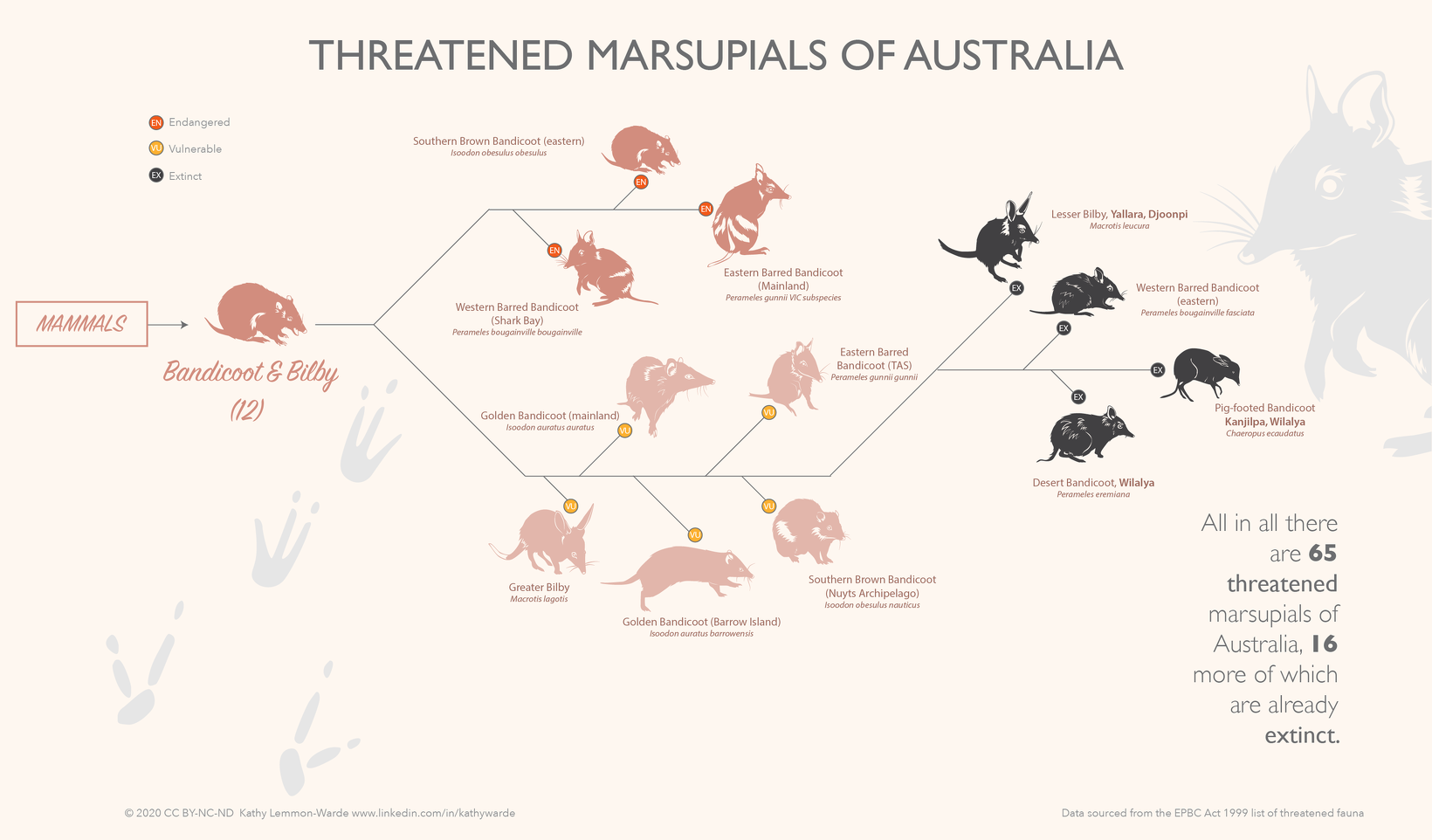
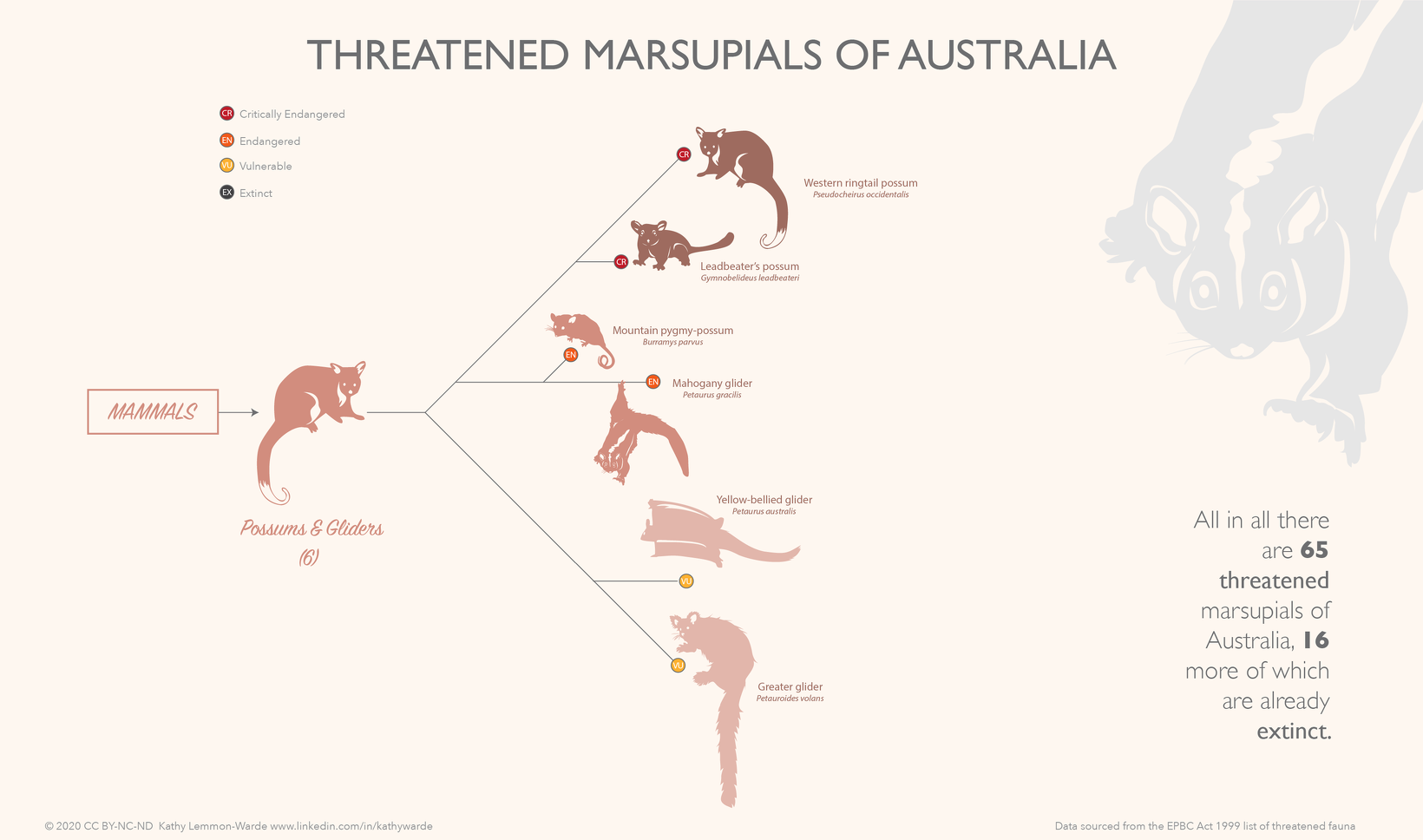
Many marsupials are threatened or Endangered. The International Union for the Conservation of Nature and Natural Resources (IUCN) currently lists over 200 species (more than two-thirds of all marsupials) as being of some level of concern. Habitat destruction, overexploitation, and competition with introduced species and livestock have greatly reduced many populations. Many marsupials are killed each year by foxes and feral and domestic cats that were introduced to Australia in the 1700s and 1800s. A number of species such as Tasmanian wolves have gone extinct within the past two centuries as a direct result of human activity.
Image Sources: Quillshadow, Wikimedia Commons
Text Sources: Animal Diversity Web animaldiversity.org , National Geographic, Live Science, Natural History magazine, Australian Museum, David Attenborough books, Australia Geographic, New York Times, Washington Post, Los Angeles Times, Smithsonian magazine, Discover magazine, The Conversation, The New Yorker, Time, BBC, CNN, Reuters, Associated Press, AFP, Lonely Planet Guides, Wikipedia, The Guardian, Top Secret Animal Attack Files website and various books and other publications.
Last updated June 2025