
Home | Category: Kangaroos, Wallabies and Their Relatives
KANGAROO BEHAVIOR
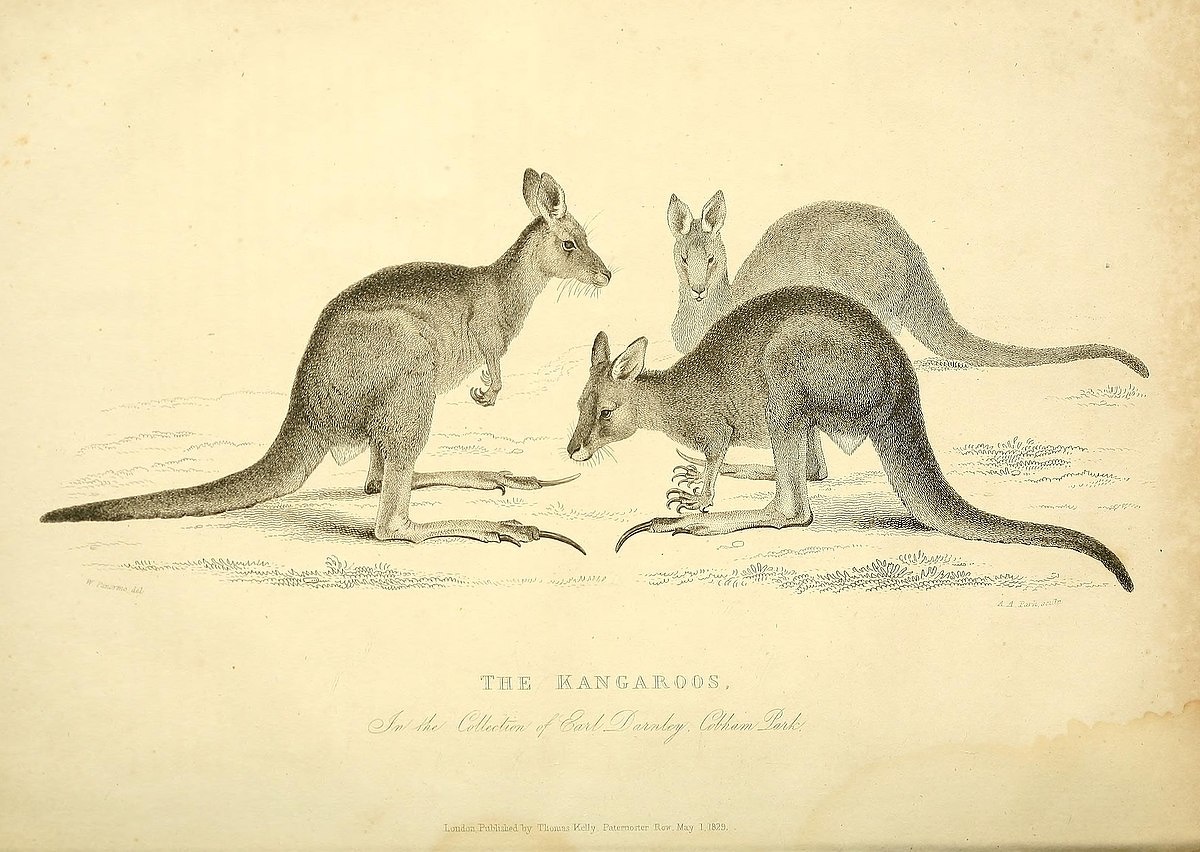
Kangaroos are cursorial (with limbs adapted to moving fast), terricolous (live on the ground), saltatorial (adapted for leaping), and motile (move around as opposed to being stationary). Most kangaroo species are nocturnal (active at night), crepuscular (active at dawn and dusk) and sedentary (remain in the same area). They may be nomadic (move from place to place, generally within a well-defined range). Some macropods growl when they sense a threat. [Source: Tanya Dewey and Minerva Yue, Animal Diversity Web (ADW) |=|]
Some species of kangaroo are mostly solitary. Other species hang out on small groups. Larger kangaroos are more likely to hang out in groups. Sometimes red kangaroos gather in "mobs" several hundred strong. Kangaroos generally feed and graze during the night. During the day they seek the shade of trees and tall grass. The best time to spot kangaroos is in the early morning and late evening when they travel between their rest areas and feeding grounds. The best place to look for kangaroos during the day is around a source of water or under a shady tree. And you probably just as likely to see one on a golf course or in suburban neighborhoods than on the outback.
Kangaroos can high jump, long jump, box and do karate. They even can swim during period of floods. Dingoes and humans are generally the only predators that adult kangaroos have to worry about. Young kangaroos are also taken by eagles and foxes. Kangaroos protect themselves by familiarizing themselves with places where predators my hide and have an escape route ready.
Although some Aussies say kangaroos have the intelligence of a fence post, some species have been taught to differentiate between seven pairs of different colored designs. These kangaroos were able to remember what they learned for 160 days. In contrast opossums could only differentiate between two pairs of stimuli and they completely forgot what they learned in four weeks. When pursued by dogs kangaroos sometimes let themselves get corned by fences that they could easily leap over. Dolphins have also let themselves be trapped by purse string nets that they could easily jump over. In the summer of 1994 kangaroos in some parts of Australia lost their ability to detect large objects and were hopping straight into trees.
RELATED ARTICLES:
KANGAROOS AND WALLABIES (MACROPODS): CHARACTERISTICS, HISTORY, POPULATIONS ioa.factsanddetails.com
RED KANGAROOS: CHARACTERISTICS, BEHAVIOR AND REPRODUCTION ioa.factsanddetails.com
GREY KANGAROOS: EASTERN, WESTERN, CHARACTERISTICS, BEHAVIOR, REPRODUCTION ioa.factsanddetails.com
KANGAROOS HOPPING: MOVEMENTS, METABOLISM AND ANATOMY ioa.factsanddetails.com
KANGAROOS AND PEOPLE: AUSTRALIANS, HISTORY, ART, SKIPPY ioa.factsanddetails.com
KANGAROOS IN MODERN AUSTRALIA: MEAT, LEATHER, CAR COLLISIONS AND ROO BARS ioa.factsanddetails.com
KANGAROO ISSUES: OVERPOPULATION, PESTS, CULLS, SHOOTERS, ANIMAL RIGHTS ioa.factsanddetails.com
KANGAROO ATTACKS: HUMANS, DOGS, HOW, WHY, WHERE ioa.factsanddetails.com
MARSUPIALS: HISTORY, EVOLUTION, CHARACTERISTICS, BEHAVIOR, REPRODUCTION ioa.factsanddetails.com
MARSUPIALS IN AUSTRALIA ioa.factsanddetails.com
MARSUPIALS IN AUSTRALASIA (AUSTRALIA, NEW GUINEA, NEARBY ISLANDS) ioa.factsanddetails.com
WALLAROOS: SPECIES, CHARACTERISTICS, BEHAVIOR AND REPRODUCTION ioa.factsanddetails.com
WALLABIES: TYPES, CHARACTERISTICS, BEHAVIOR, REPRODUCTION ioa.factsanddetails.com
TREE-KANGAROOS: CHARACTERISTICS, BEHAVIOR AND REPRODUCTION ioa.factsanddetails.com
TREE-KANGAROOS IN AUSTRALIA: BENNETT'S, LUMHOLTZ'S, CHARACTERISTICS, BEHAVIOR AND REPRODUCTION ioa.factsanddetails.com
TREE-KANGAROOS IN PAPUA NEW GUINEA: SPECIES, CHARACTERISTICS, BEHAVIOR, REPRODUCTION ioa.factsanddetails.com
TREE-KANGAROOS IN WEST PAPUA, INDONESIA: SPECIES, CHARACTERISTICS, BEHAVIOR, REPRODUCTION factsanddetails.com
Kangaroo Diet and Feeding Behavior
Wallabies and kangaroos are herbivores (eat plants or plants parts) and mainly eat grass. They have the ability to move the lower jaw forward and backward, maximizing the shredding effect. Large kangaroos primarily eat grass, shrubs and leaves from trees. Before livestock was introduced by Europeans around 200 years ago, wombats and kangaroos were the primary grazing animals in Australia. Bettongs and rat kangaroos eat highly nutritious food such as underground fungi. Medium-size wallabies consume a wide variety of leafy vegetation.
Kangaroos take in large quantities of cellulose, the prime ingredient in cardboard. Once a naturalist presented a kangaroo with a box of fruit and lettuce, food he thought the animal would like. The kangaroo ignored the contents and ate the box. One man had a similar problem with a baby wallaby he kept in his house. The animal turned his library into a rubbish heap by eating the covers of his books.♮
There are no meat-eating kangaroos (some small ones eat insects) but there is evidence in the record of giant carnivorous kangaroo that lived hundreds of thousands of years ago. Desert dwelling kangaroos draw all the moisture they need from their food and don't need to drink. One species can survive by drinking seawater. Most macropods have specialized structure called a gastric sulcus in their digestive system that is a kind of modified stomachs for microbial fermentation of food, and also helps facilitates movement of liquid digesta.
Kangaroo Fighting
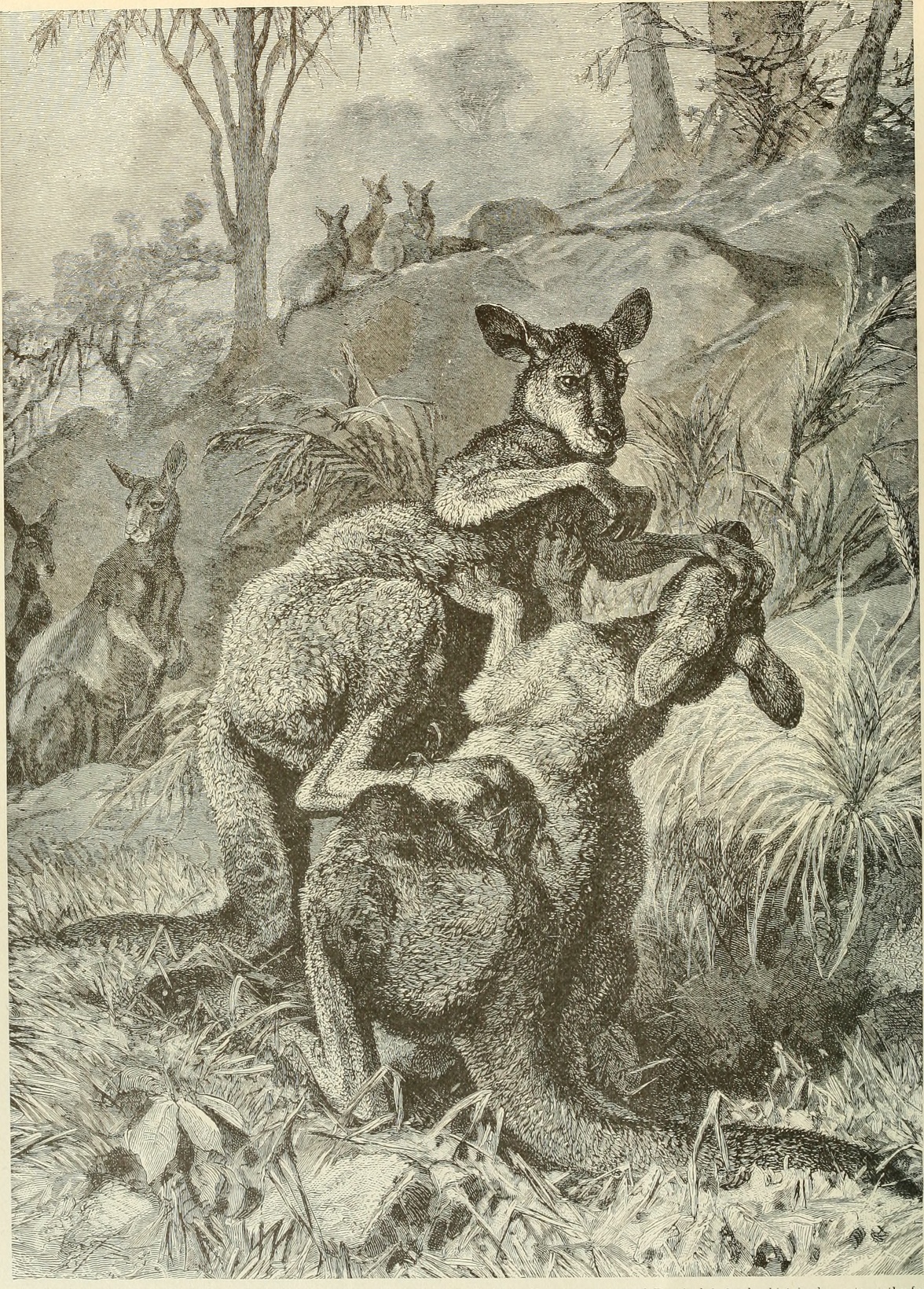
The fighting style of most wallabies and kangaroos consists of the use of the forelimbs to grab and hold an opponent around the head, neck or shoulders. They use their hindlimbs to kick forward and use their tails for balance and support.
Males often fight over females. The fighting has been described as boxing. Female generally don't box but they do play box with their joeys. When a kangaroo fights it leans back on its tail and inflicts powerful blows with its forepaws and hind feet. Most fights last less than ten minutes and the loser usually hops a way with only a few scratches and cuts.
Terry Domico wrote: "The challenge is given when one animal approaches another and stands upright. Once such a challenge is accepted, the combatants grapple, using their forefeet to paw their at the opponents head, shoulders and throat. As the action becomes more heated, one or both opponents lean back on their powerful tails and deliver heavy kicks with their hind feet. These blows are usually aimed at the abdomen, and they land (when they land) with a heavy thud."
When kangaroos are cornered by dogs or hunters they growl and stamp their feet. They have been observed killing dogs with a single blow from their back feet. Kangaroos chased by digs have also been observed leaping into rivers and seizing and drowning the dogs. Red kangaroos attacked in water have been observed holding dogs underwater with their paws until they drown.♮
Kangaroos Fear Sound of Their Thumping Feet
Kangaroos are often seen as pests as they can damage crops and property, and compete with livestock for food and water. But using the sound of foot thumps may be a deterrent. Jacquie van Santen of ABC wrote: Researchers think using the kangaroo's own alarm signal will be better than existing deterrents, which rely on artificial squeals that pest roos can grow used to.Dr Helena Bender, who was a PhD student at the University of Melbourne when she did the research, has published her findings in the latest issue of the journal Wildlife Research. [Source: Jacquie van Santen, ABC, December 6, 2005]
Kangaroos thump their feet, hitting one on the ground ahead of the other, when they sense danger and take flight. Often nearby kangaroos will also take flight when they hear the sound. Until now, the only commercially-available kangaroo deterrent devices have used recordings of non-natural sounds, often a high-pitched squeal. But studies have found no evidence that these high frequencies are effective for problem species or that they work for anything other than a very short period of time.
Dr Bender used a recording of an eastern grey kangaroo (Macropus giganteus) foot thump. She determined its effectiveness compared with a recording of background noise, the sound of rustling eucalypt leaves, over a seven-week period.She found that just over 60 per cent of kangaroos took flight in response to both the foot thump and the control signals, but more kangaroos took flight in the first three seconds when the foot thump was played. While the percentage of roos that took flight was almost identical, only the foot thump signal increased the level of alertness of the roos.
Dr Bender says she hopes her research will benefit rural Australia. "Reducing the presence of kangaroos in an area should result in a significant decrease in the amount of damage caused, and an increase in harvest yield," she says. "Moreover, for those kangaroos that remain behind, most of these will be in a state of alertness. When kangaroos are alert they cannot feed. This also means less damage to the agricultural property." She says the foot thump sound could also be used to guide kangaroos away from roadways, thus reducing the number of vehicles damaged by kangaroos and the number of kangaroos injured or killed by vehicles.
Kangaroo Mating and Reproduction
During the mating season, male red kangaroos rub their chest on bushes to spread their scent in an efforts to attract females. Males often box with one other over females in heat. There have been accounts of females also being injured when males are overly aggressive in their pursuit of them. Generally, the dominant male in a social group is the one who gets to mate with the females.Kangaroo mating sessions often last for three or four hours. Red kangaroos stop breeding during severe droughts and breed like crazy when the rains come.
Females macropods are polyestrus. The estrus cycle is between 28 and 45 days in length. Females may be receptive to males only for a brief time during this cycle. Females that have been studied undergo a postpartum estrus, within two days of birth, and typically conceive at that time. [Source: Todd Jewell, Animal Diversity Web (ADW) |=|]
Female kangaroos can dictate the pace of gestation, choosing the time when she'll deliver her joey. An expectant mother can even stop the development of her embryo for months and wait until the conditions are right for its continued development. Tyler Santora wrote in Live Science: Kangaroos give birth to only one joey at a time. But when they mate, if it's not the right conditions to raise a baby in — for example, if there's a drought — the animal's body will hold off on implanting the embryo into the uterus. Then, when the time is right, the embryo comes out of dormancy, and the mother begins gestation, Rick Schwartz, an animal care supervisor and national spokesperson at the San Diego Zoo, told Live Science. [Source: Tyler Santora, Live Science, January 9, 2022]
The delayed gestation or temporary suspension of development of the embryo is called embryonic diapause. Todd Jewell wrote in Animal Diversity Web: Embryonic dispause happens after the egg is fertilized and the embryo begins to develop, but the development is arrested at around the 70 to 100 cell stage. Because of the short gestation and the need for an empty pouch in which to nurse and incubate a newborn joey, this diapause is highly adaptive. After the first joey leaves the mother's pouch for good, then the embryo in the mother resumes the process of development. Because of embryonic diapause a mother can rapidly produce a new offspring, should her first joey fail to survive the harsh Australian environment. [Source: Todd Jewell, Animal Diversity Web (ADW) |=|]
Kangaroo Offspring and Parenting
Like all marsupials, kangaroos and wallabies lack a placenta, and so are unable to efficiently provide nutrients and oxygen to a large fetus. They therefore give birth to very altricial (underdeveloped) young, which are then nursed in a pouch, where they complete their development. Young often weigh less than one gram at birth. Red kangaroos, the largest macropds, weigh about 0.75 grams at birth. After birth, newborns makes their way from the birth canal to the opening of the pouch by squirming. Once in the pouch, young attach themselves to a nipple and feed of their mother’s milk. Red kangaroo young remain attached to the nipple for 70 days and do not stick their heads out of the pouch until they are five months old. They begin to leave the pouch for short intervals at around six months old, and may permanently leave the pouch around eight months of age. [Source: Todd Jewell, Animal Diversity Web (ADW) |=|]
A female kangaroo can give birth to up to four young over the course of a year or longer from just one instance of mating, he added. She may give birth to one joey, then her body will delay implantation of the next embryo until the first joey is a few months old and spending time outside of the pouch. The nutritional content of the milk changes depending upon the nutritional requirements of the joey. Thus, the milk produced while the joey is exclusively inside the pouch differs from the milk produced when the joey spends part of its time outside the pouch. "Her body can produce the right kind of milk nutrients for an 8-month-old, and the other teat can create the proper nutrients for a newborn," Schwartz said. [Source: Michael S. Joo, Animal Diversity Web (ADW) |=|]
Kangaroo mother are unique in the animal kingdom in that they often suckle joeys of different sizes and ages at the same time. The youngest offspring is attached to tiny teat within the pouch, while the older sibling, up to 5,000 times larger, is outside the pouch and from time to time sticks its head in the pouch to suckle on a much larger teat. The milk from each teat is very different in composition. When a kangaroo mother stops suckling one of her joeys, the levels of the nursing hormone prolactin drops and that signals the production of a new fertilized egg. All that nursing in the pouch requires a huge amount of energy for the mother kangaroo. "Lactation is very, very expensive," Dr. Marcie Logsdon, an associate professor in the College of Veterinary Medicine at Washington State University, told Live Science. "Lactation is more expensive than pregnancy, oftentimes."
Why Female Kangaroos Have Two — Sometimes Three — Vaginas
Female kangaroos have two vaginas — three when they've given birth. Why is this? Ashley Hamer wrote in Live Science: The most likely explanation is that it's an adaptation to Australia's unforgiving environment. Multiple vaginas — and uteruses, of which they also have two — enable female kangaroos, and all marsupials, to have multiple offspring at different stages of development at any given time. That helps increase the chances of one surviving to adulthood. "They can have a joey that's still dependent on them, but it's out of the pouch," Logsdon said.. "They can have a joey that's in the pouch, and they can have one that's kind of in reserve up there, waiting to start development."[Source: Ashley Hamer, Live Science, April 5, 2025]
When kangaroos experience drought conditions, they often can't get enough food to continue lactating, and that joey in their pouch dies. To pass their genes to the next generation, they need to produce another joey as quickly as possible. Luckily, pregnancy and lactation don't stop a kangaroo's estrous, or reproductive cycle. At any time during estrous, a male kangaroo's sperm can travel up one of the two lateral vaginas and fertilize an egg, which implants in whichever of the two uteruses isn't being used at the moment. (Although many other marsupials have a two-pronged penis to help send sperm through both vaginas, kangaroos have only one.)
But if there's already a joey in the pouch, there's a problem: That joey will need that pouch for 18 months, but an egg goes from conception to birth in about 30 days, according to Forrester. So the kangaroo's body puts the egg's development on pause. "If they're waiting for optimal conditions or maybe for their young to come out, that fertilized egg will just sit, waiting," Forrester said.
Once it's fully developed and ready to be born, the joey emerges through a new opening. "The central [vagina] doesn't fully connect to the opening into the outside until a female marsupial becomes pregnant for the first time," Logsdon said. "Then it connects and it opens up, and that's their road out."
The kangaroo's strange anatomy may also be a reason for their offspring's small size. Through a quirk of evolution, a female kangaroo's two urinary tracts pass through the spaces between the three vaginas. "If the babies got a lot larger, then there would be an issue because of that strange anatomy," Logsdon said. "It's not a very conducive environment to have large things passing in and out if you're going to have your urinary tract worked up in that too."
Kangaroo Pouches
The pouch of the female kangaroo is located on her belly and is made from a fold in her furry skin. Think of the kangaroo's pouch as a hoodie sweatshirt put on backwards, Schwartz told Live Science. The hood of the sweatshirt is the pouch, and the drawstrings are the mother's muscles she uses to open and close it. "It does open up quite a bit if she wants it to," . [Source: Tyler Santora, Live Science, January 9, 2022]
Tyler Santora wrote in Live Science: The inside of the pouch is the texture of the kangaroo's skin, but hairless. It's soft and comparable with the skin on the inside of a person's wrist, Schwartz said. The pouch is very warm inside, the same as the mom's body temperature: about 105 degrees Fahrenheit (40.5 degrees Celsius). Because of this, it can get sweaty in there.
The pouch contains four teats, or milk ducts. When a mama kangaroo gives birth to a joey through the vaginal canal after 32 or 33 days of gestation, her baby is extremely undeveloped. About the size of a jellybean and weighing less than a gram, the newborn joey uses its forelimbs to crawl up into its mom's pouch. There, it latches onto an elongated teat, which swells and pokes down the throat of the baby, holding it in place for about three-and-a-half to four months, Schwartz said.
Because the joey spends months in the pouch before emerging, it defecates inside. Later in development, because it is coming and going to explore, the joey tracks dirt in, Schwartz said. That means the mama kangaroo needs to do some housekeeping. To clean the pouch, she sticks her whole head in to scrape out the grime and droppings with her tongue, either working around a young joey or kicking out an older one while she works.
Joeys
Baby kangaroos are called joeys. At birth they are blind and naked and the size of a jelly bean. After they are born they use their sense of smell to find their mother's nipple and crawl several inches from the womb to the pouch where it closes its mouth around its mother's nipple.
A newborn kangaroo is underdeveloped and needs to spend a long time in its mother's pouch nursing and growing before it's ready for the outside world. The nipple expands inside the infants mouth so that it can’t lose its grip. With the joey anchored in place for several weeks the nipple acts like an exterior umbilical chord. At first the infant is unable to draw milk out itself. Muscles in the mothers teats bump milk inside the joey.
When they are about four months old, joeys are lean out if the pouch and nibble grass. During times of drought, females give saliva to thirsty joeys to drink. Tyler Santora wrote in Live Science: The joey stays inside the pouch for about four-and-a-half to five months before emerging, and then it begins to explore, always staying close to its mother, before returning to her pouch, Schwartz said. Over the next several months, the joey begins exploring farther away and for longer durations. [Source: Tyler Santora, Live Science, January 9, 2022]
Older Joeys
When they get older joeys leave the pouch to forage for food and climb back in the pouch to sleep and for security. At this stage joeys can do somersaults in their mothers pouch. When they are afraid of something and some distance away from their mothers they run full speed towards their mothers and dive head first into the mother pouch and then right themselves so their head pops out at the top by doing a somersault inside the pouch. At around eight months old joeys start geting more adventurous.
"The first 10 months, they go from being these pink, scraggly skeletons into little fuzzy cute babies that you see in the pictures," Kelly Forrester, a doctoral student at the University of Alberta who has co-authored studies on kangaroo reproduction, told Live Science. "And then the last eight months, you call them 'young at foot,' where they're coming in and out of the pouch and they're learning to hop around, but they're still pretty gangly and they can't thermoregulate … so 18 months of their life is spent highly reliant on mom." [Source: Ashley Hamer, Live Science, April 5, 2025]
Describing a joey at play, a scientists wrote in Natural History magazine, It "begins to play by jerking it head as if trying to shake a fly out if its ear. Then it takes several rapid sideways hops away from its mother and proceeds to hop in an elliptical pattern away from and back to her. During these runs, a joey executes quick changes of direction and often leaps of the ground, kicking out its hind feet in midair. [Source: Natural History, July 1999]
After eight months or so joeys are kicked out of their mother's pouch once and are allowed to nurse for a few weeks more before they have to fend for themselves. Joeys are weaned between 10 and 12 months, at which point they no longer have any connection the pouch.
Kangaroo Females Caring For Young Have to Eat More
For kangaroo mothers' caring for young is hard work and they eat more to keep up. Researchers at the University of Melbourne studied behavioral changes of lactating female eastern grey kangaroos and found they ate one and a half times more grass than their non-reproducing females, but this had its down sides health-wise [Source:Branwen Morgan, ABC, July 6, 2011]
Branwen Morgan of ABC wrote: Eating more and for longer periods, increased the animal's exposure to gastrointestinal parasites because they were feeding on fecal-contaminated pasture. Study author Dr Mark Elgar says kangaroos are generally quite careful about where they forage, but when food is scarce or where requirements are high they become less discerning. "We know mammals become more susceptible to parasites during lactation periods because the immune system is suppressed, but what we are suggesting is that on top of this, reproducing kangaroos have an enhanced likelihood of contracting disease," says Elgar.
The team also report, in the Journal of the Royal Society Biology Letters, that the additional time spent feeding was at the expense of the kangaroo's rest time. In general, kangaroos spend half of the day feeding, a third of the day resting and approximately one tenth of the day keeping an eye out for potential predators (vigilance). Elgar says they had expected that in the reproducing females, the additional time spent feeding would be offset by a reduction in 'vigilance' time and that "they'd therefore be putting themselves more at risk".
"Most people think there's a trade off between obtaining food and avoiding predators," he says. But the research revealed that vigilance time was unaffected. Instead, resting time was reduced by 13 per cent while foraging time increased by 16 per cent. In addition, reproducing females took 20 per cent more bites than non-reproducing females. This translated to an increased food consumption of 49 per cent. "People have been interested in the costs of reproduction and how they are manifested for a very long time, but field experiments are difficult to do because you can't simply compare reproductive and non-reproductive females," says Elgar. "Females that are reproducing may simply be in better condition; that is, have greater overall fitness."
To calculate the extent to which female kangaroos alter their behaviour during reproduction, the scientists randomly gave ten females a contraceptive implant and compared them with ten females who had been left to reproduce naturally in the Serendip sanctuary near Geelong. Observational data was collected over three discrete seven-day periods that covered three stages of lactation: early, mid and peak; the latter being when the joeys are close to completely leaving their mother's pouch at around nine months of age."We have been able to prove that reproducing females in the wild alter their behaviour in direct response to the energetic demands of reproduction," says Elgar, adding that the study has broad implications for other animals including endangered species.
Dr Steven Cork, who runs the environmental consultancy EcoInsights in Canberra, Australia, says this research answers one of those questions about how animals adapt to being able to find energy to produce young. "The results show how well-adapted they [kangaroos] are to their surroundings," he says. "The alternative for an animal is to spend more time with their head down feeding in which case they'd be more prone to being eaten by something."
Image Sources: Wikimedia Commons
Text Sources: Animal Diversity Web animaldiversity.org , National Geographic, Live Science, Natural History magazine, Australian Museum, David Attenborough books, Australia Geographic, New York Times, Washington Post, Los Angeles Times, Smithsonian magazine, Discover magazine, The Conversation, The New Yorker, Time, BBC, CNN, Reuters, Associated Press, AFP, Lonely Planet Guides, Wikipedia, The Guardian, Top Secret Animal Attack Files website and various books and other publications.
Last updated July 2025