
Home | Category: Kangaroos, Wallabies and Their Relatives
BRUSH-TAILED ROCK-WALLABIES
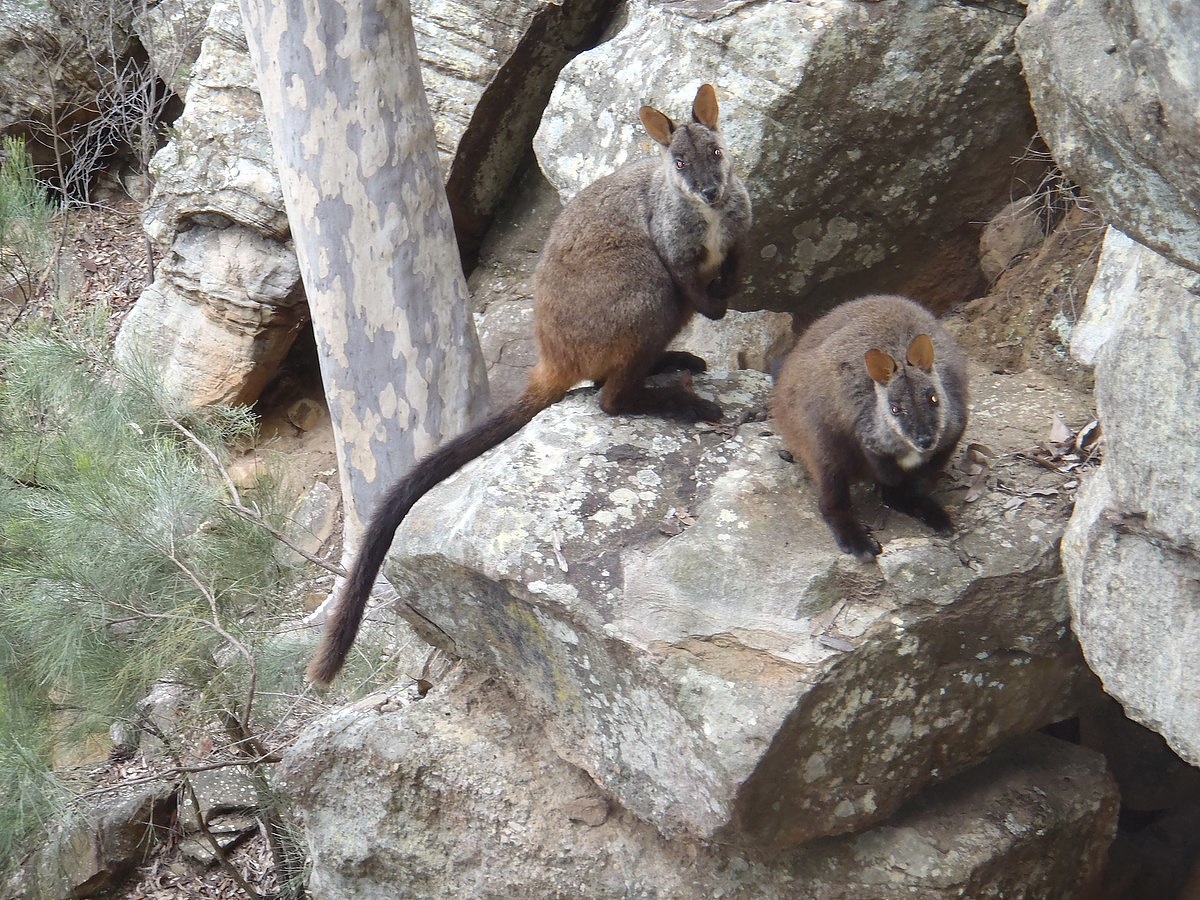
Brush-tailed rock-wallabies in the Watagan Mountains on the New South Wales Central Coast
Brush-tailed rock-wallabies (Petrogale penicillata) are also called small-eared rock-wallabies. They inhabit rock piles and cliff lines along the Great Dividing Range from about 100 kilometers north-west of Brisbane to northern Victoria, in vegetation ranging from rainforest to dry sclerophyll forests. Populations have declined seriously in the south and west of its range, but they remains locally common in northern New South Wales and southern Queensland. However, due to a large bushfire event in South-East Australia around 70 percent of all the wallaby's habitat had been lost as of January 2020. In 2018, the southern brush-tailed rock wallaby was declared the official mammal emblem of the Australian Capital Territory (ACT), although it has not been seen in the wild in the ACT since 1959. [Source: Wikipedia]
Brush-tailed Rock-wallabies are medium-sized rock-wallabies, with shaggy, thick fur that varies from rufous to grey-brown. They have a characteristic bushy tail, often dark or brown at the tip and longer than the head and body combined. A narrow hybrid zone has formed between Brush-tailed rock-wallabies and Herbert’s rock-wallabies (Petrogale herberti) in the north of Brush-tailed rock-wallabies's range. Some female hybrids are fertile, which allows limited gene exchange between the two populations. Captive brush-tailed rock-wallabies have lived over 11 years. [Source: Kathleen Bachynski, Animal Diversity Web (ADW) |=|]
Brush-tailed rock-wallabies live on rock faces close to grassy areas and often in open forests. They prefer sites with numerous ledges, caves, and crevices and typically occupy sites with a northerly orientation, in order to sun themselves in the morning and the evening. They have traditionally been found a wide variety of suitable rocky areas in habitats, including rainforest gullies, wet and dry sclerophyll forest, open woodland, and rocky outcrops in semi-arid country. But this less so than before. Brush-tailed rock-wallabies was introduced to Hawaii and New Zealand. In Hawaii, a small population descended from two animals, has existed on the island of Oahu since 1916. In New Zealand, brush-tailed rock-wallabies were introduced in the 1870s and can be found on Kawau, Rangitoto, and Montutapu islands. On some of these islands rock-wallabies are regularly culled when their numbers reach pest proportions.
On the International Union for Conservation of Nature (IUCN) Red List brush-tailed rock-wallabies are listed as Near Threatened. In CITES (Convention on International Trade in Endangered Species of Wild) they have no special status. In many parts of the brush-tailed rock-wallabies range, populations have been reduced to small, isolated colonies. Predation, notably by red foxes, and habitat degradation through vegetation and fire changes, competition with goats, rabbits and sheep, and vulnerability to drought and disease are all reasons why. Brush-tailed rock-wallabies have been observed to leave properties where sheep were introduced, suggesting that the habitat-specific rock-wallabies were starved out by the much more ubiquitous sheep. When brush-tailed rock-wallabies were more widespread in Australia, they were shot as agricultural pests. At that time they entered and feed in orchards, and vegetable gardens and fences several meters high were erected to deter them. In 1880, legislation was passed in New South Wales that declared kangaroos and wallabies as vermin. A bounty was offered on brush-tailed rock-wallabies.
RELATED ARTICLES:
WALLABIES: TYPES, CHARACTERISTICS, BEHAVIOR, REPRODUCTION ioa.factsanddetails.com
KANGAROOS AND WALLABIES (MACROPODS): CHARACTERISTICS, HISTORY, POPULATIONS ioa.factsanddetails.com
WALLABY SPECIES ioa.factsanddetails.com
WALLABY SPECIES OF SOUTHWEST AUSTRALIA ioa.factsanddetails.com
ROCK-WALLABIES: SPECIES, CHARACTERISTICS, BEHAVIOR AND REPRODUCTION ioa.factsanddetails.com
HARE-WALLABIES: SPECIES, CHARACTERISTICS, BEHAVIOR AND REPRODUCTION ioa.factsanddetails.com
QUOKKAS: CHARACTERISTICS, BEHAVIOR, REPRODUCTION, ROTTNEST ioa.factsanddetails.com
KANGAROO BEHAVIOR: FEEDING, REPRODUCTION, JOEYS ioa.factsanddetails.com
KANGAROOS HOPPING: MOVEMENTS, METABOLISM AND ANATOMY ioa.factsanddetails.com
MARSUPIALS: HISTORY, EVOLUTION, CHARACTERISTICS, BEHAVIOR, REPRODUCTION ioa.factsanddetails.com
MARSUPIALS IN AUSTRALIA ioa.factsanddetails.com
MARSUPIALS IN AUSTRALASIA (AUSTRALIA, NEW GUINEA, NEARBY ISLANDS) ioa.factsanddetails.com
Brush-Tailed Rock-Wallaby Characteristics and Diet
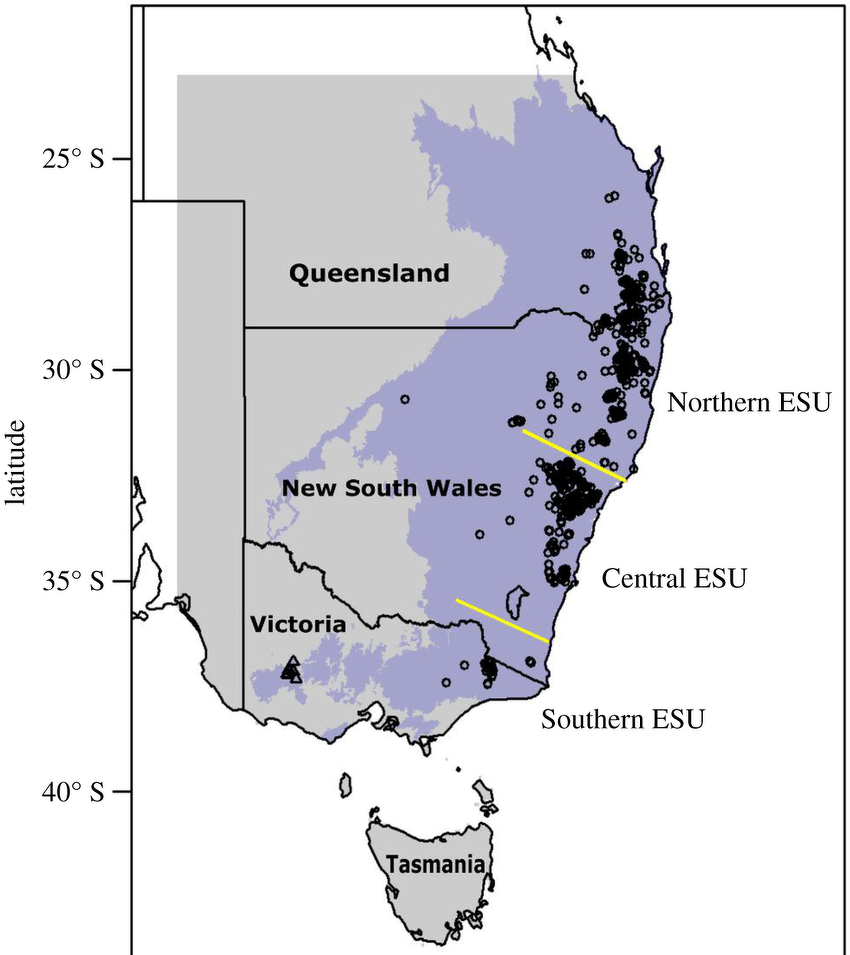
range of brush-tailed rock-wallabies on the east coast of Australia
Brush-tailed rock-wallabies range in weight from four to 10.9 kilograms (8.8 to 24 pounds) and have a head and body length of 45 to 58.6 centimeters (17.7 to 23 inches). They have long tails, slightly longer than their head and body length. Sexual Dimorphism (differences between males and females) is present: Males are larger than females. Head and body length averages 55.7 centimeters (22 inches) in males and 53.6 centimeters (21.6 inches) in females, while tail length averages 61.1 centimeters (24 inches) in males and 56.3 centimeters (22 inches) in females. [Source: Kathleen Bachynski, Animal Diversity Web (ADW) |=|]
Brush-tailed rock-wallabies have a dull-brown back, paler chest and belly, a rufous rump and black, furry feet. They have a black axillary patch often extending as a dark stripe to the margin of the hindlegs. Their tail darkens towards the end with a prominent brush. Their fur is long and thick, especially about the rump, flanks and base of tail. Animals from the northern part of the range tend to be lighter and have a less prominent tail brush.
Brush-tailed rock-wallabies are primarily herbivores (eat plants or plants parts). Grasses comprise 35 to 50 percent of their total diet, and also eat leaves, sedges, ferns, roots, bark, fruit, seeds and flowers. They tend forage in locations with more forbs (herbaceous flowering plants that are not grasses, sedges or rushes) and short green grasses. There is relatively little seasonality and regional variations in dietof different food types despite varying vegetation. This sugests clear food preferences. The brush-tailed rock-wallabies diverse diet gives them an advantage over more specialized herbivores during droughts.
Brush-Tailed Rock-Wallaby Behavior
Brush-tailed rock-wallabies are terricolous (live on the ground), saltatorial (adapted for leaping), nocturnal (active at night), motile (move around as opposed to being stationary), sedentary (remain in the same area), social (associates with others of its species; forms social groups), and have dominance hierarchies (ranking systems or pecking orders among members of a long-term social group, where dominance status affects access to resources or mates). Adult males have been found to have significantly larger nocturnal ranges than females, possibly due to their greater energetic requirements or in order to increase their mating opportunities. Range size is likely affected by the productivity and nutritional value of vegetation at different sites. High levels of home range overlap are probably due to patchy distributions of resources, which leads to aggregation at sources of shelter or food. [Source: Kathleen Bachynski, Animal Diversity Web (ADW) |=|]
Kathleen Bachynski wrote in Animal Diversity Web: Brush-tailed rock-wallabies are social animals that form small colonies with dominance hierarchies. Individuals have overlapping home ranges with exclusive den sites. Females are gregarious; they often share den sites with their female relatives and they regularly groom each other. Rock-wallabies maintain an attachment to a precisely defined habitat with a strict social organization. One observed population of brush-tailed rock-wallabies maintained, during both good and bad years, an adult population of five to seven individuals by violently evicting young soon after weaning. In captivity, this means that weaned young may be killed if they are unable to escape from the enclosure. Males are rarely within five meters of another male. When males are in close proximity, there is almost always a violent interaction. Females are more tolerant of the close proximity of other females than are males of other males. Females do, however, commonly displace one another and engage in agonistic interactions. Additionally, females have been seen driving away female and sub-adult male intruders from the vicinity of their refuges. |=|
Brush-tailed rock-wallabies sense and communicate with vision, touch, sound and chemicals usually detected by smelling. They leave scent marks produced by special glands and placed so others can smell and taste them and engage in allogrooming, where one animal bites and licks the fur of another animal, which may serve a role in reinforcing dominance status. Other communicative behaviors include vocalizations (a hissing cough sound), staring intensely, and aggressive behaviors such as nose jabbing (one animal thrusting its nose toward another animal). Males may examine potential female mates by approaching the female and sniffing her rump or cloaca. Evidence suggests that adult males deposit scent marks within their area of control. |=|
Their main known predators of Brush-tailed rock-wallabies are red foxes. Because Brush-tailed rock-wallabies tend to use the same diurnal resting sites predators may find it easy to learn where to find them. Furthermore, because colonies are small (due to declining population size), fewer individuals are available to be alert in order to detect and warn others of approaching threats. Typically, brush-tailed rock-wallabies are highly vigilant regardless of surrounding vegetation,
Brush-Tailed Rock-Wallaby Mating, Reproduction and Offspring
Brush-tailed rock-wallabies are polygynous (males have more than one female as a mate at one time), engage in year-round breeding, and practice embryonic diapause (temporary suspension of development of the embryo). Females have an estrus cycle, which is similar to the menstrual cycle of human females. The average gestation period is 31 days. One offspring is born. Brush-tailed rock-wallaby mating can take place soon after giving birth. In captive animals, post-partum estrus has been observed on the same day as birth, sometimes within a few hours. Development of the embryo is delayed until the pouch is vacated. [Source: Kathleen Bachynski, Animal Diversity Web (ADW) |=|]
Brush-tailed rock-wallabies have a different mating system than most related species: 1) a higher proportion of adult males are likely to take part in breeding and may do so for many years, 2) variance in male reproductive success is relatively low, and 3) only some weaned females, those able to establish themselves on a refuge, are likely to breed at all. The hand full of matings by brush-tailed rock-wallabies that have been observed have involved only females and males in established refuges. A notable feature of brush-tailed rock-wallabies, as well as other Petrogale species, is close and regular association between the refuge-guarding male and the females who use his refuge. Association involves mutual grooming and unusually high tolerance of proximity.
Young are altricial, meaning they are relatively underdeveloped at birth. Parental care is provided by females. After birth young attach themselves to one of the four teats in the pouch. Brush-tailed rock-wallaby young remain in the mother's pouch, where they receive protection and milk. for around seven months, when they are weaned After leaving the pouch, evicted young continue nurse suckle for about three more months. On average females reach sexual or reproductive maturity at age 18 months; and males do so at 20 months.
A birth of a rock-wallaby brush-tailed rock-wallaby has been observed. The female sat on the base of her tail, her body leaning forward in order to bring the head close to the urogenital opening and pouch. Birth was accompanied by a small amount of clear fluid and blood, which the mother cleaned as the newborn young went toward the pouch opening. It took 45 seconds for the infant to reach the pouch opening from the urogenital opening. The mother remained in the birth position for 10 more minutes, licking around the urogenital opening.
Image Sources: Wikimedia Commons
Text Sources: Animal Diversity Web animaldiversity.org , National Geographic, Live Science, Natural History magazine, Australian Museum, David Attenborough books, Australia Geographic, New York Times, Washington Post, Los Angeles Times, Smithsonian magazine, Discover magazine, The Conversation, The New Yorker, Time, BBC, CNN, Reuters, Associated Press, AFP, Lonely Planet Guides, Wikipedia, The Guardian, Top Secret Animal Attack Files website and various books and other publications.
Last updated July 2025