
Home | Category: Kangaroos, Wallabies and Their Relatives
RED KANGAROOS

Red kangaroos at Sturt National Park in New South Wales
Red kangaroos (Osphranter rufus or Macropus rufus) are the largest kangaroos, largest marsupials and most widespread kangaroos. They stand 1.8 meters (5.9 feet) tall, are 2.85 meters (9.3 feet) in length, including the tail, and weigh up to 90 kilograms (198 pounds). The tallest marsupial on record is a 2.13-meter (7-foot)-tall 79-kilogram (175-pound) red kangaroo. Red kangaroos have been recorded living up to 22 years in the wild although most individuals probably do not survive their first year of life. Their estimated population in 2019 was around 15.8 million individuals.
Red kangaroos live primarily in the outback. Fossil evidence indicates that they have adapted relatively recently to this environment in evolutionary terms, in the last million or so years or so, from animals similar to a wallaroo. Red kangaroos have become smaller as poachers have targeted the large animals for leather [Source: Terry Dawson, Natural History, April 1995]
Red kangaroos occurs over most of the dry, inland, central part of Australia — the outback. This expansive area includes scrubland, grassland, and desert habitats. Rainfall averages less than 50 centimeters a year. Red kangaroos prefer to forage in open plains habitats with neither trees nor bushes, but are seldom found in regions without shade and shelter from scattered trees. [Source: Tanya Dewey and Minerva Yue, Animal Diversity Web (ADW) |=|]
Red kangaroos not endangered. They are designated as a species of least concern on the International Union for Conservation of Nature (IUCN) Red List and have no special status on the Convention on International Trade in Endangered Species (CITES). The range of red kangaroo cover nearly 7.7 million square kilometers (three million square miles) and large chunks of this are within national parks. All Australian states regulate the hunting of kangaroos.[Source: Tanya Dewey and Minerva Yue, Animal Diversity Web (ADW) |=|]
Red kangaroos are regarded as crop pests and threats to livestock, which may consume the same forage as kangaroos. In areas where vegetation is limited, kangaroos may reduce forage significantly. Humans have historically hunted kangaroos for their meat and hides and such practices continue today for red kangaroos. A fairly large Australian industry for kangaroo skins and meat exists. Many red kangaroo are killed by cars and die during droughts. Red kangaroos are big strong animals. They have seriously injured and even killed humans and are known for drowning dogs. They have also seriously damaged cars and killed passengers of cars that collided with kangaroos.
RELATED ARTICLES:
KANGAROOS AND WALLABIES (MACROPODS): CHARACTERISTICS, HISTORY, POPULATIONS ioa.factsanddetails.com
KANGAROO BEHAVIOR: FEEDING, REPRODUCTION, JOEYS ioa.factsanddetails.com
KANGAROOS HOPPING: MOVEMENTS, METABOLISM AND ANATOMY ioa.factsanddetails.com
GREY KANGAROOS: EASTERN, WESTERN, CHARACTERISTICS, BEHAVIOR, REPRODUCTION ioa.factsanddetails.com
KANGAROOS AND PEOPLE: AUSTRALIANS, HISTORY, ART, SKIPPY ioa.factsanddetails.com
KANGAROOS IN MODERN AUSTRALIA: MEAT, LEATHER, CAR COLLISIONS AND ROO BARS ioa.factsanddetails.com
KANGAROO ISSUES: OVERPOPULATION, PESTS, CULLS, SHOOTERS, ANIMAL RIGHTS ioa.factsanddetails.com
KANGAROO ATTACKS: HUMANS, DOGS, HOW, WHY, WHERE ioa.factsanddetails.com
MARSUPIALS: HISTORY, EVOLUTION, CHARACTERISTICS, BEHAVIOR, REPRODUCTION ioa.factsanddetails.com
MARSUPIALS IN AUSTRALIA ioa.factsanddetails.com
MARSUPIALS IN AUSTRALASIA (AUSTRALIA, NEW GUINEA, NEARBY ISLANDS) ioa.factsanddetails.com
WALLAROOS: SPECIES, CHARACTERISTICS, BEHAVIOR AND REPRODUCTION ioa.factsanddetails.com
WALLABIES: TYPES, CHARACTERISTICS, BEHAVIOR, REPRODUCTION ioa.factsanddetails.com
TREE-KANGAROOS: CHARACTERISTICS, BEHAVIOR AND REPRODUCTION ioa.factsanddetails.com
TREE-KANGAROOS IN AUSTRALIA: BENNETT'S, LUMHOLTZ'S, CHARACTERISTICS, BEHAVIOR AND REPRODUCTION ioa.factsanddetails.com
TREE-KANGAROOS IN PAPUA NEW GUINEA: SPECIES, CHARACTERISTICS, BEHAVIOR, REPRODUCTION ioa.factsanddetails.com
TREE-KANGAROOS IN WEST PAPUA, INDONESIA: SPECIES, CHARACTERISTICS, BEHAVIOR, REPRODUCTION factsanddetails.com
Red Kangaroo Characteristics
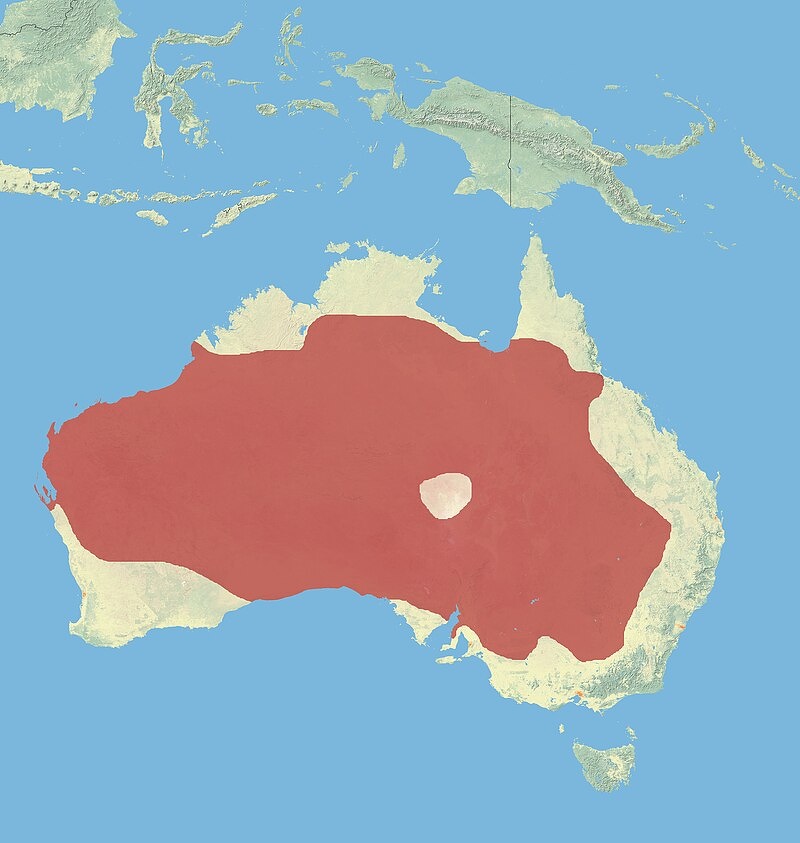
red kangaroo range
Red kangaroos are robustly built, with large, well-muscled tails and powerful hindquarters. They reach weights of 90 kilograms (198 pounds) and have a head and body length of 65 to 120 centimeters (25.6 to 47 inches). Their average basal metabolic rate is 31.353 watts. [Source: Tanya Dewey and Minerva Yue, Animal Diversity Web (ADW) |=|]
Sexual Dimorphism (differences between males and females) is present: Males are larger than females. Males can reach 90 kilograms (198 pounds) but few are over 78 (175 pounds). Females generally weigh between 30 and 39 kilograms (65 and 85 pounds). Males range in total body length from 1.3 to 1.6 meters (4.3 to 5.3 feet) and females from 0.85 to one meter (2.8 to 3.3 feet). Tail length is from one to 1.2 meters (3.3 to 4 feet) for males and 65 to 85 centimeters (25.6 to 33 inches) for females. Females have a forward facing pouch and four mammae.
Males are generally rich, rusty brown in color and females often a smokey blue and thus called blue-fliers, although these colors are reversed in some areas, with females being reddish and males blue-gray. The tail is strong enough to support the kangaroo's body weight. It acts as a balance when jumping, and is used, with the two legs, to form a tripod for resting. The second and third toes of red kangaroos are fused and shaped into a grooming claw. Their foreshortened upper limbs terminate in clawed paws used with great dexterity in eating, grooming, and self-defense.
Red kangaroos used be categorized in the genus macropus but are now listed in the genus Osphranter. Osphranter is a genus of large marsupials in the family Macropodidae, commonly known as kangaroos and wallaroos (among other species). In 2019, a reassessment of macropod taxonomy determined that Osphranter and Notamacropus, formerly considered subgenera of Macropus, should be moved to the genus level. This change was accepted by the Australian Faunal Directory in 2020.The genus has a fossil record that extends back at least into the Pliocene Period (5.4 million to 2.4 million years ago). [Source: Wikipedia]
Red Kangaroo Diet and Eating Behavior
Red kangaroos are exclusively herbivores (eat plants or plants parts). They usually feed on grasses, plants and shrubbery, with preferred diet items being green herbage including grasses and dicotyledonous flowering plants. Theseherbivores (animals that primarily eat plants or plants parts) can go without water for long periods of time by consuming moisture-filled succulent plants. Through their eating habits red kangaroos are important in shaping vegetation communities in the ecosystems in which they live. [Source: Tanya Dewey and Minerva Yue, Animal Diversity Web (ADW) |=|]
Red kangaroos are very in tune with their territory and know where and when to find the best food sources. During dry spells, red kangaroos live almost entirely on grass and shrubs comprised almost entirely of cellulose and lignite — with carbohydrates that are very difficult to digest. To process this food, red kangaroo stomachs contained specialized bacteria that ferments and breaks down the carbohydrates into digestible materials. The process is similar to what takes place in cud-chewing ruminants like cattle and sheep.
The fermenting vegetation sometimes make up 10 percent of a red kangaroos body weight. The bacteria use only small amount the plant's energy for themselves. The bacteria excrete nutritious fatty acids that are absorbed by the kangaroos. Through similar processes the kangaroo also obtain all the protein, vitamins and minerals they need. In emergencies the fluid-filled stomach can also be taped for water to keep the kangaroo from dehydrating.
How Red Kangaroos Keep Cool and Conserve Water
Red kangaroos drink much less than other animals of the outback. They need to drink only once a week (compared to twice a day during the summer for sheep) and survive on two or three liters of water a week in conditions in which people need ten liters a day. Few red kangaroos drink more than once every three days and many go two weeks without drinking.
Red kangaroos need only a fifth of the water that sheep need. They usually set up their territories within ten or fifteen miles of a water source. They are also very good at selecting green vegetation with a high moisture content and able utilize water from it. Unless there is a severe drought they can meet their water needs solely from they plants they eat.
Red kangaroos prevent water loss by concentrating their urine. They are able to secrete salts in their concentrated urine, and thus lose little water. Urea, the waste product of protein metabolism, is absorbed from the urine and passed back through the foregut and recycled into usable protein. This process saves water as do their dry feces, which are little pellets. produced by an elongated intestine.
In hot weather, red kangaroos need some water to cool themselves but mainly dissipate heat through panting, sweating and licking and do so with minimum water loss. Panting is the common method used by red kangaroos to stay cool. They also cool off with increased blood flow and air flow through their nostrils up to 64 times more than normal. Red kangaroos sweat they exert themselves but unlike either animals they stop sweating immediately when they stop exerting themselves.
In extremely hot weather, red kangaroos wipe fluids from the mouth and nasal glands on their forearms and spread the moisture by wiping and licking. It was long thought that this was an inefficient thing to do. In the mid-1990s scientists found they the place on their arms that the kangaroos liked contains many small blood vessels near the surface of the skin and licking that area cooled the blood that flowed through this area and on to the rest of their bodies.
Red Kangaroo Behavior
Red kangaroos are cursorial (with limbs adapted to running), terricolous (live on the ground), saltatorial (adapted for leaping), nocturnal (active at night), crepuscular (active at dawn and dusk), motile (move around as opposed to being stationary), nomadic (move from place to place, generally within a well-defined range), sedentary (remain in the same area), and social (associates with others of its species; forms social groups).[Source: Tanya Dewey and Minerva Yue, Animal Diversity Web (ADW) |=|]
Red Kangaroos are relatively territorial and sedentary. Males have home ranges of about 10 square kilometers (3.9 square miles) and females, seven square kilometers (2.7 square miles). A male’s range may overlap that of several females. The territory for an individual contains grazing land, a source of water within 16 kilometers (ten miles) and a shady area to rest. Individual may rest under the same trees or groups of bushes nearly everyday for years. Scientist had long thought that red kangaroos were able to survive as well as they do by utilizing their speed and endurance by moving around to widely scattered food and water sources. This assumption is wrong. They are able to survive so well by drawing nutrition from unnutritious materials ad conserving energy by spending much of their time resting.
Red kangaroos occur in small groups, averaging 10 mebers, called "mobs." These groups are made up mainly of females and their offspring, with one or several males. Females stay within their natal mob. Occasionally, large numbers of red kangaroos congregate in areas of excellent forage, sometimes numbering as much as 1,500 individuals. Red kangaroos are mostly active at night and rest in the shade during the day but sometimes move about during the day. Most of their active period is spent in grazing.
Red kangaroos communicate with vision, sound and chemicals usually detected by smelling and sense using vision, touch, sound and chemicals usually detected with smell. Like most mammals, red kangaroos are likely to make extensive use of chemical modes of perception and communication. They also have excellent vision and hearing, suggesting these are important sensory modes. |=|
Red Kangaroo Movements
Red kangaroo are relatively sedentary, staying within a relatively well-defined home range, but may travel widely in response to adverse environmental conditions such as drought. A red kangaroo was recorded traveling 216 kilometers. Population densities have been estimated by two, separate studies at 4.18 individuals per square kilometer and one individual per 89 hectares. [Source: Tanya Dewey and Minerva Yue, Animal Diversity Web (ADW) |=|]
Red kangaroos can sustain speeds of 24 to 40 kilometers per hour (15 to 25 miles per hour) for several miles and approach speed of 64 kilometers per hour (40 miles per hour) for short bursts. Even higher speeds have recorded, The hind legs of red kangaroos are powerful and the tail acts to balance the body in a bipedal hop as their legs propel them forwards.
Large kangaroos can leap as far as eight meters and as high as three meters, although 1.2 to 1.9 meters is more typical of an average pace. Red kangaroos also use their tail an a kind of 5-"legged" gait, where the forelimbs and tail balance the animal as the two rear legs are moved forward simultaneously.
Their large size, speed and endurance reduces the predation risks faced by red kangaroos, mostly from dingoes and humans. Very young joeys are protected in their mother's pouch and red kangaroos can use their robust legs and clawed feet to defend themselves from attackers with kicks and blows. Very young joeys, just out of the pouch, may be taken by large raptors.
Red Kangaroo Mating and Reproduction
Red kangaroos are polygynous (males have more than one female as a mate at one time). They engage in year-round breeding and practice embryonic diapause (temporary suspension of development of the embryo). There is no permanent association of males and females. A mature female, which is adequately nourished, and which is not suckling a young in its pouch already, becomes fertile at approximately 35 day intervals and is, like the male, potentially fertile throughout the year. Given favorable conditions, a mother red kangaroo produces and raises an average of three young every two years. The number of offspring is usually one but is occasionally two. The average gestation period is 33 days. Unlike the nursing period, pregnancy does not interrupt recurrence of fertility. [Source: Tanya Dewey and Minerva Yue, Animal Diversity Web (ADW) |=|]
During the mating season, male red kangaroos rub their chest on bushes to spread their scent in an efforts to attract females. Males compete for mating opportunities with several females and try to monopolize access to several females and actively drive away other males. This competition sometimes leads to "boxing" matches, where males hit at each other with their forepaws and kick with their feet. Mating sessions often last for three or four hours. Female kangaroo can dictate the pace of gestation, choosing the time when she'll deliver her joey. Red kangaroos stop breeding during severe droughts and breed like crazy when the rains come.
Sexual maturity is reached at 15 to 20 months in females and 20 to 24 months in males, but maturity may be delayed in unfavorable conditions. After young are born a female can mate the next day or the day after that. The fertilized egg resulting from this post-partum mating develops only to the blastocyst stage and then undergoes a period of embryonic diapause.. Development is resumed if the previous young, which is still suckling in the pouch, reaches 204 days old or if it dies or is removed. Individual females often have, simultaneously, a joey outside of the pouch, a joey in the pouch, and a blastocyst awaiting implantation.
Red Kangaroo Offspring and Parenting
Young red kangaroos are altricial, meaning they are relatively underdeveloped at birth, and cared for almost exclusively by their mothers. During the pre-weaning stage provisioning and protecting are done by females. The average weaning age is 12 months. Females reach sexual or reproductive maturity at 15 to 20 months. Males do so at 20 to 24 months. [Source: Tanya Dewey and Minerva Yue, Animal Diversity Web (ADW) |=|]
Red kangaroo joeys (young) are tiny when born, averaging only 2.5 centimeters long and 0.75 grams in weight. After they are born, they crawls up the mother's fur, into her pouch and immediately attaches themselves to a nipple to which they attach themselves for about 70 days. During this period, the sucking stimulus prevents the re-occurence of fertility cycles. Compared to the gestation period, the period of lactation is long, about one year in red kangaroos. |=|
Red kangaroo joeys are born with well-developed tongues, jaw muscles, nostrils, forelimbs, and digits. Otherwise their external features are embryonic. Joeys almost half the size of an adult still are capable of entering their mother's pouch, They do not leave the pouch permanently until they are about eight months old, and they continue to suckle for another four months after that. Most do not survive that long or die soon after they are weaned.
The harsh outback environment is very hard on young red kangaroos. Only after an unusual succession of rainy years do a large number of them survive until adulthood. In exceptionally dry years, nearly all young die before entering the pouch, Even in normal years few survive after they are weaned.
Image Sources: Wikimedia Commons
Text Sources: Animal Diversity Web animaldiversity.org , National Geographic, Live Science, Natural History magazine, Australian Museum, David Attenborough books, Australia Geographic, New York Times, Washington Post, Los Angeles Times, Smithsonian magazine, Discover magazine, The Conversation, The New Yorker, Time, BBC, CNN, Reuters, Associated Press, AFP, Lonely Planet Guides, Wikipedia, The Guardian, Top Secret Animal Attack Files website and various books and other publications.
Last updated July 2025