
Home | Category: Kangaroos, Wallabies and Their Relatives
WESTERN BRUSH WALLABIES
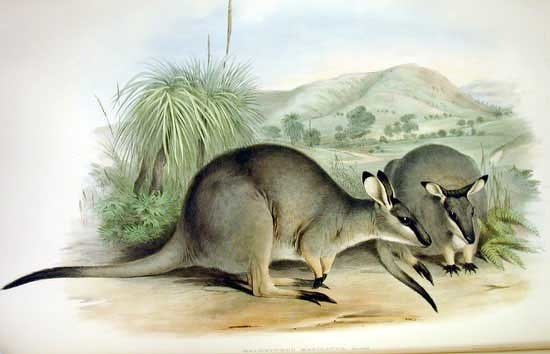
Images of Western brush wallabies made in 1863
Western brush wallabies (Notamacropus irma or Macropus irma) are also known as black-gloved wallabies. They live in the southwestern coastal region of Western Australia and prefer open forest or woodlands with seasonally wet sites and low vegetation. They are often found in dry schlerophyll forests, such as jarrah, and areas of mallee and dramatically scrub. It is rarely found in wet schlerophyll forests and is not found in ecosystems characterized by a thick understory, such as karri forests. [Source: Natalie Morningstar, Animal Diversity Web (ADW) |=|]
Western brush wallabies are grey with white around the face, arms, and legs. They have black "gloves" on their hands, which is reflected in its alternative common name. They are mainly diurnal (active during the day) and mostly eat grass.
Western brush wallabies are not endangered or threatened. They are designated as a species of least concern on the International Union for Conservation of Nature (IUCN) Red List and have no special status on the Convention on International Trade in Endangered Species (CITES). The main threat of Western brush wallabies has been red foxes, originally introduced from Europe in the 1800s. The IUCN lists the western brush wallaby as Least Concern because they are fairly widespread and the population is believed to be stable or increasing, as a result of red fox control programs.
Populations of Western brush wallabies were dramatically affected by a substantial increase in the size of fox populations in the early 1970s. In two surveys — one in 1970 and another in 1990 — researchers observed that, while the population size of western grey kangaroos remained stable, those of Western brush wallabies decreased by approximately 80 percent — from 10 per 100 kilometers to one per 100 kilometers. Land clearance for agriculture has also caused the population to Western brush wallabies to fragment and limited their range. For a time, Western brush wallaby skins were traded and exported in large numbers for fur. A total of 122,000 skins were trade in 1923. In recent years the number of individuals has increased and populations are believed to be stable or increasing due to red fox control programs.
RELATED ARTICLES:
WALLABIES: TYPES, CHARACTERISTICS, BEHAVIOR, REPRODUCTION ioa.factsanddetails.com
KANGAROOS AND WALLABIES (MACROPODS): CHARACTERISTICS, HISTORY, POPULATIONS ioa.factsanddetails.com
WALLABY SPECIES ioa.factsanddetails.com
WALLAROOS: SPECIES, CHARACTERISTICS, BEHAVIOR AND REPRODUCTION ioa.factsanddetails.com
ROCK-WALLABIES: SPECIES, CHARACTERISTICS, BEHAVIOR AND REPRODUCTION ioa.factsanddetails.com
BRUSH-TAILED ROCK-WALLABIES: CHARACTERISTICS, BEHAVIOR AND REPRODUCTION ioa.factsanddetails.com
HARE-WALLABIES: SPECIES, CHARACTERISTICS, BEHAVIOR AND REPRODUCTION ioa.factsanddetails.com
QUOKKAS: CHARACTERISTICS, BEHAVIOR, REPRODUCTION, ROTTNEST ioa.factsanddetails.com
KANGAROO BEHAVIOR: FEEDING, REPRODUCTION, JOEYS ioa.factsanddetails.com
KANGAROOS HOPPING: MOVEMENTS, METABOLISM AND ANATOMY ioa.factsanddetails.com
MARSUPIALS: HISTORY, EVOLUTION, CHARACTERISTICS, BEHAVIOR, REPRODUCTION ioa.factsanddetails.com
MARSUPIALS IN AUSTRALIA ioa.factsanddetails.com
MARSUPIALS IN AUSTRALASIA (AUSTRALIA, NEW GUINEA, NEARBY ISLANDS) ioa.factsanddetails.com
Western Brush Wallaby Characteristics and Diet
Western brush wallabies are the second largest native mammal in southwest Western Australia after Western grey kangaroos. Western brush wallabies range in weight from seven to nine kilograms (15.4 to 19.8 pounds) and range in length from 83 to 153 centimeters (2.7 to 5 feet). Their tails — which are between 54 and 97 centimeters (1.7 to 3 feet) long — make up a large share of their length. Their head and body length ranges from 45 to 52.5 centimeters (1.5 to 1.7 feet). Sexual Dimorphism (differences between males and females) is not present: Both sexes are roughly equal in size and look similar.[Source: Natalie Morningstar, Animal Diversity Web (ADW) |=|]
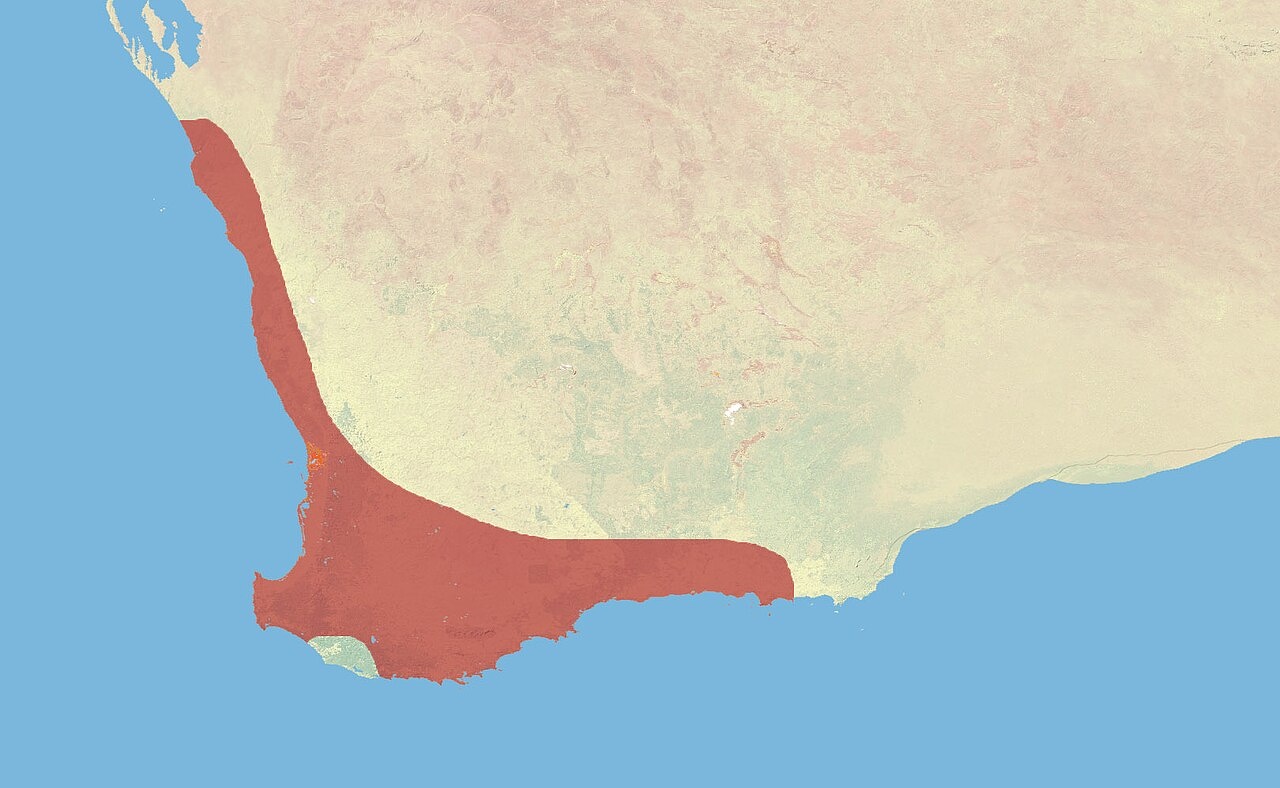
range of Western brush wallabies
Western brush wallabies are gray with slight brown patches on the neck and back. The alternative common name, black-gloved wallabies, is derived from the black coloring on all four limbs. The most distinctive features of western brush wallabies — and those most useful for distinguishing them from western grey kangaroos — are their facial characters. Western brush wallabies have two white stripes that extend from each of the ears to the end of the rostrum (hard, beak-like structures projecting out from the head or mouth). Their ears are black on the exterior and slightly lighter white or buff in the interior. The chest is gray, their abdomen is buff, and the tail has a black crest at the end. Some individuals have faint black banded patterning on their back. Western brush wallabies can further be distinguished from the western grey kangaroos by their smaller size, significantly shorter forelimbs, and distinct gait — they move quickly with the head kept low and the tail extended. Western grey kangaroos have a more upright posture.
Western brush wallabies are herbivores (eat plants or plants parts). They prefer native grasses and can survive without access to free water for extended periods of time. They generally graze (eat grass or other low-growing plants) in open areas.
Western Brush Wallaby Behavior
Western brush wallabies are terricolous (live on the ground), saltatorial (adapted for leaping), diurnal (active during the daytime), crepuscular (active at dawn and dusk), motile (move around as opposed to being stationary), sedentary (remain in the same area), solitary and social (associates with others of its species; forms social groups). [Source:Natalie Morningstar, Animal Diversity Web (ADW) |=|]
Western brush wallabies are active primarily in the early hours of the morning and in the late afternoon, and tend to rest alone or in pairs in the shade during the hottest hours of the day. Natalie Morningstar wrote in Animal Diversity Web: Their general activity cycle appears to be more diurnal (active during the daytime), than that of other wallabies in their geographic vicinity. Very little is known about Western brush wallabies social structure.
Western brush wallabies sense using vision, touch, sound and chemicals usually detected with smell. They communicate with vision, sound and chemicals and employ pheromones (chemicals released into air or water that are detected by and responded to by other animals of the same species).
Western Brush Wallaby Mating, Reproduction and Offspring
Western brush wallabies engage in seasonal breeding and employ embryonic diapause (temporary suspension of development of the embryo). Breeding intervals may vary according to unpredictable conditions, such as drought and the availability of food. Females typically give birth in April or May, with the number of offspring being one. [Source: Natalie Morningstar, Animal Diversity Web (ADW) |=|]
The mating system of western brush wallabies may be similar to that of Tammar wallabies described below. But there are key difference between the two species. For example, Tammar wallabies are sexually dimorphic, which is common in polygynous species, but Western brush wallabies are not.
Young Western brush wallabies are altricial, meaning they are relatively underdeveloped at birth, and parental care is provided exclusively by females. Young spend up to seven months in their mother’s pouch. Much of that time they are attached to one of the mother's four teats. After young leave leave the pouch they occasionally nurse while accompanying their mother on foot. Females cannot gestate another fertilized egg until after her current suckling offspring is weaned, meaning that she is fully invested in one offspring at a time both physiologically and behaviorally.
Tammar Wallabies
Tammar wallabies (Notamacropus eugenii or Macropus eugenii) are one of the smaller wallabies, weighing around five kilograms (11 pounds). Also known as dama wallabies or darma wallabies they are native to South and Western Australia. Although their geographical range has been severely reduced since European colonisation — mainly to Kangaroo Island in South Australia and fragmented areas in southwest Australia — they are listed as species of "Least Concern" by the International Union for Conservation of Nature (IUCN). Tammar wallabies have been introduced to New Zealand and reintroduced to some areas of Australia where it had been previously extirpated. [Source: Annette M. Labiano-Abello, Animal Diversity Web (ADW); Wikipedia]
Tammar wallabies live in areas of dense vegetation with low trees and bushes, in thickets and around the outskirts of forests in deserts, areas, savanna grasslands and scrub forests. Skull variations differentiate between tammar wallabies from Western Australia, Kangaroo Island, and mainland South Australia, making them distinct population groups. Their average lifespan in captivity is 9.8 years. Their average lifespan in the wild is 14.0 years.
Tammar wallabies are one of the smallest species of wallaby. They range in weight from four to 9.1 kilograms (8.8 to 20 pounds) and stand about 45 centimeters (1.5 feet) in height. They have a head and body length ranging from 52 to 68 centimeters (20.5 to 26.8 inches). They are endothermic (use their metabolism to generate heat and regulate body temperature independent of the temperatures around them). Their average basal metabolic rate is 7.78 watts. Tammar wallabies have elastic storage in the ankle extensor tendons, without which the animal's metabolic rate might be 30 to 50 percent greater. The design of their spring-like tendon saves energy. Economical muscle force generation is key for the two distal muscle–tendon units of the tammar wallaby. [Source: Wikipedia]
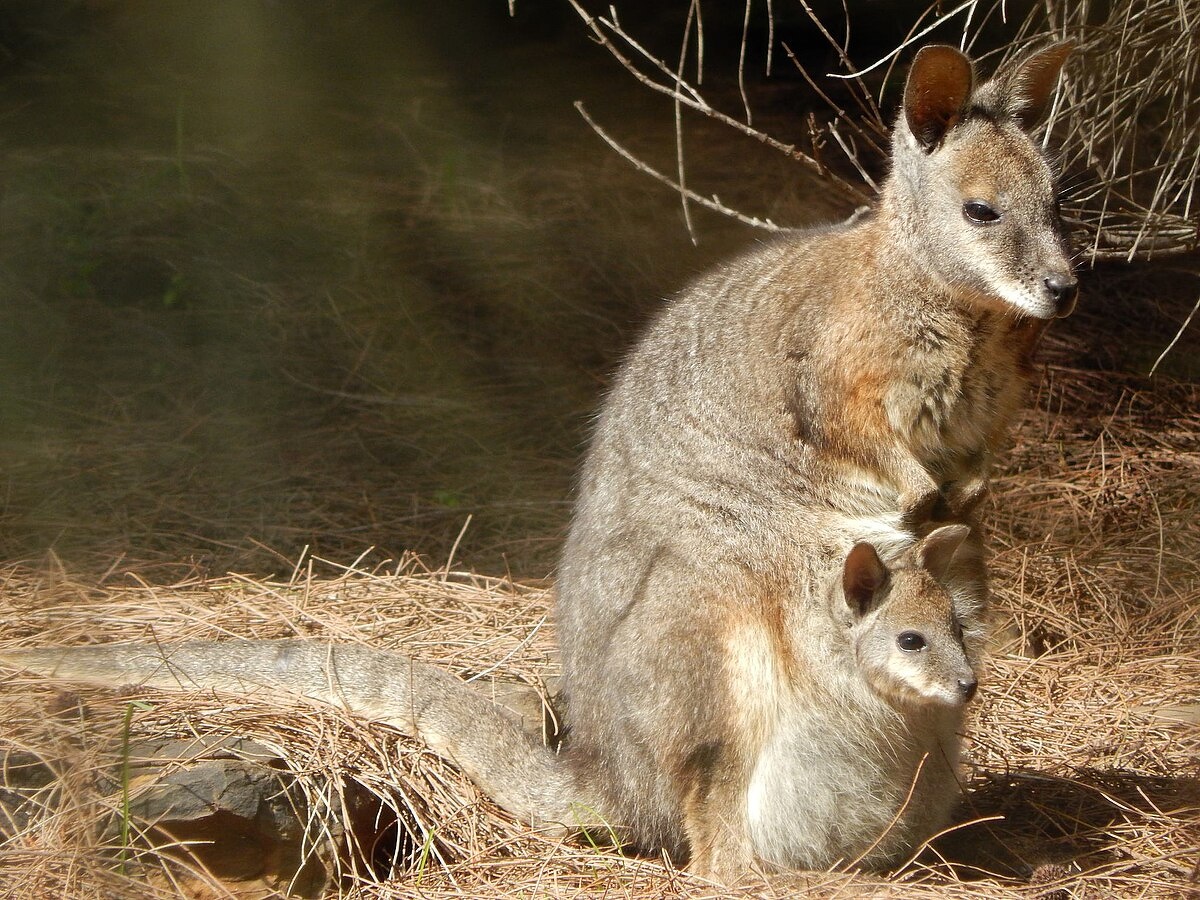
Tammar wallaby
Tammar wallabies have a small head and large ears. Their tail is long and thick at the base. This species has a gray to yellow belly and red legs. Sexual Dimorphism (differences between males and females) is present: Males are larger than females. The maximum recorded weight in males is 9.1 kilograms (20 pounds), while in females it is 6.9 kilograms (15.2 pounds). The head and body length of males is 59 to 68 centimeters (1.9 to 2.2 feet) and that of females is 52 to 63 centimeters (1.7 to 2.1 feet). The tails of males range from 38 to 45 centimeters (1.2 to 1.5 feet) and those of of females from 33 to 44 centimeters (1.1 to 1.4 feet). Males have considerably larger forelimbs and wider claws than the females.
Tammar wallabies have been very important in scientific research. They have been used in studies of human reproduction and sperm production in mammals. According to Russell Jones, tammar wallabies are ideal animals for studies of the transport of androgens (hormones that stimulate the development of male sex characteristics) to the accessory organs of reproduction. Humans have introduced tammar wallabies to islands previously uninhabited by them and they changed the ecosystem on these islands to some degree. The habitat of tammar wallabies may also be threatened by the introduction of new species, particularly rabbits.
Tammar Wallaby Behavior
Tammar wallabies are terricolous (live on the ground), saltatorial (adapted for leaping), nocturnal (active at night), motile (move around as opposed to being stationary), sedentary (remain in the same area), social (associates with others of its species; forms social groups), and have dominance hierarchies (ranking systems or pecking orders among members of a long-term social group, where dominance status affects access to resources or mates). A mob's home range may be up to 100 hectares in size. This territory may be partly shared with other mobs in the peripheral areas. Mobs are comprised of all ages and sexes and usually have up to 50 members. | [Source: Annette M. Labiano-Abello, Animal Diversity Web (ADW) |=|]
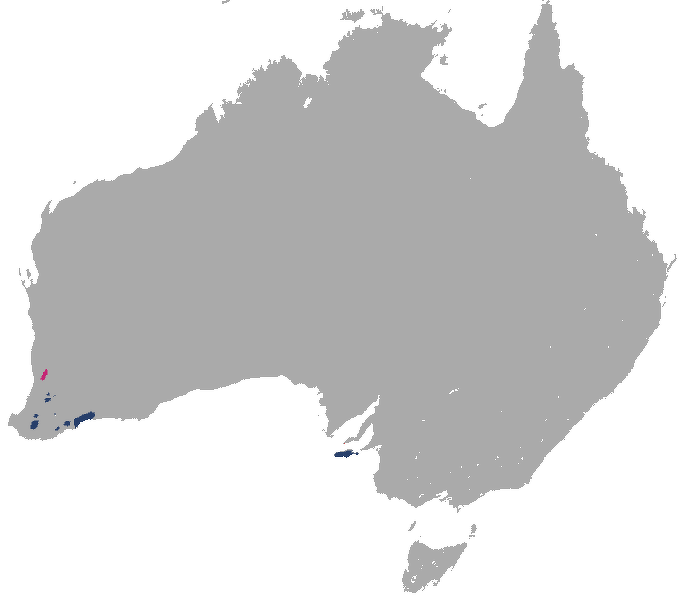
Tammar wallaby range: blue (native); red (reintroduced)
Tammar wallabies are a very social species. They socialize, feed, and mate in groups known as mobs with a hierarchial dominance structure. Higher ranking individuals are usually males. An individual's position in the hierarchy is generally based on size, which correlates with fighting ability. Individual with a greater height and more muscular forelimbs have a significant advantage over rivals while fighting. Dominance is determined through fighting. Males wrestle with one another until one proves he is the strongest. Dominant males have a higher chance of mating with females and reproducing. |=|
According to Animal Diversity Web: Variation in the appearance of structures related to size and strength plays a significant role in the "displaying" ritual shown by one male to another. "Displaying" is a series of postures or actions performed by an individual to impress and intimidate a rival during aggressive confrontation. In tammar wallabies, displaying includes several actions: the maintenance of an upright posture, the expansion of the chest, and the flexing of the forearms to showcase arm length and muscularity. Display behavior is also used as a part of a courting ritual. A male tries to impress a female with his strength and superior physical structure, showing her his dominance and rank. |=|
Tammar Wallaby Reproduction
Tammar wallabies employ embryonic diapause (temporary suspension of development of the embryo). The gestation period ranges from 25 to 28 days. The number of offspring is one. The weaning age ranges from 10 to 11 months. On average females reach sexual or reproductive maturity at age nine months; males do at two years. Male tammar wallabies have a long duration of spermatogenesis and a long period of sperm transit in comparison with other mammals. These characteristics lend this species to studies of sperm production. During pregnancy the embryo is still a "hollow ball" until about day 18. It is only in the last eight days that the cells transform into an identifiable embryo. Joeys weighs around one gram at birth when they crawl unassisted to its mother's pouch, where they remain for eight to nine months until they are physically fully developed.
Tammar wallaby females enter post-partum oestrus after giving birth and mate shortly after that. The fertilized ovum resulting from enters embryonic diapause at the blastocyst stage and reenters active embryonic development once the pouch young vacates.Tammar wallabies females sexually mature at eight months and males do do at 24 months. [Source:Natalie Morningstar, Animal Diversity Web (ADW) |=|]
Tammar wallabies have a polygynous mating system with clear male dominance hierarchies. Natalie Morningstar wrote in Animal Diversity Web: Reproductive success is closely correlated with physical size and presumably with success in fighting. The majority of first copulations with females are achieved by alpha males, with the majority of the offspring also sired by the alpha males that secure the first copulation. Females usually mate with more than one male and subsequent copulations have been observed with males other than the alpha.
Tammar wallabies also engage in a variety of behaviors to enhance reproductive success and secure mates. Males mate-guard pre- and post-copulation, check females, and intervene in consortships developing between a female and another male. Alpha males tend to engage in all of these sexual behaviors with greater frequency than lower-ranking males, making social stratification in Tammar wallabies distinct. Males of several macropod species also make a clucking sound when courting females to attract a mate. |=|
Image Sources: Wikimedia Commons
Text Sources: Animal Diversity Web animaldiversity.org , National Geographic, Live Science, Natural History magazine, Australian Museum, David Attenborough books, Australia Geographic, New York Times, Washington Post, Los Angeles Times, Smithsonian magazine, Discover magazine, The Conversation, The New Yorker, Time, BBC, CNN, Reuters, Associated Press, AFP, Lonely Planet Guides, Wikipedia, The Guardian, Top Secret Animal Attack Files website and various books and other publications.
Last updated July 2025