
Home | Category: Kangaroos, Wallabies and Their Relatives
GREY KANGAROOS
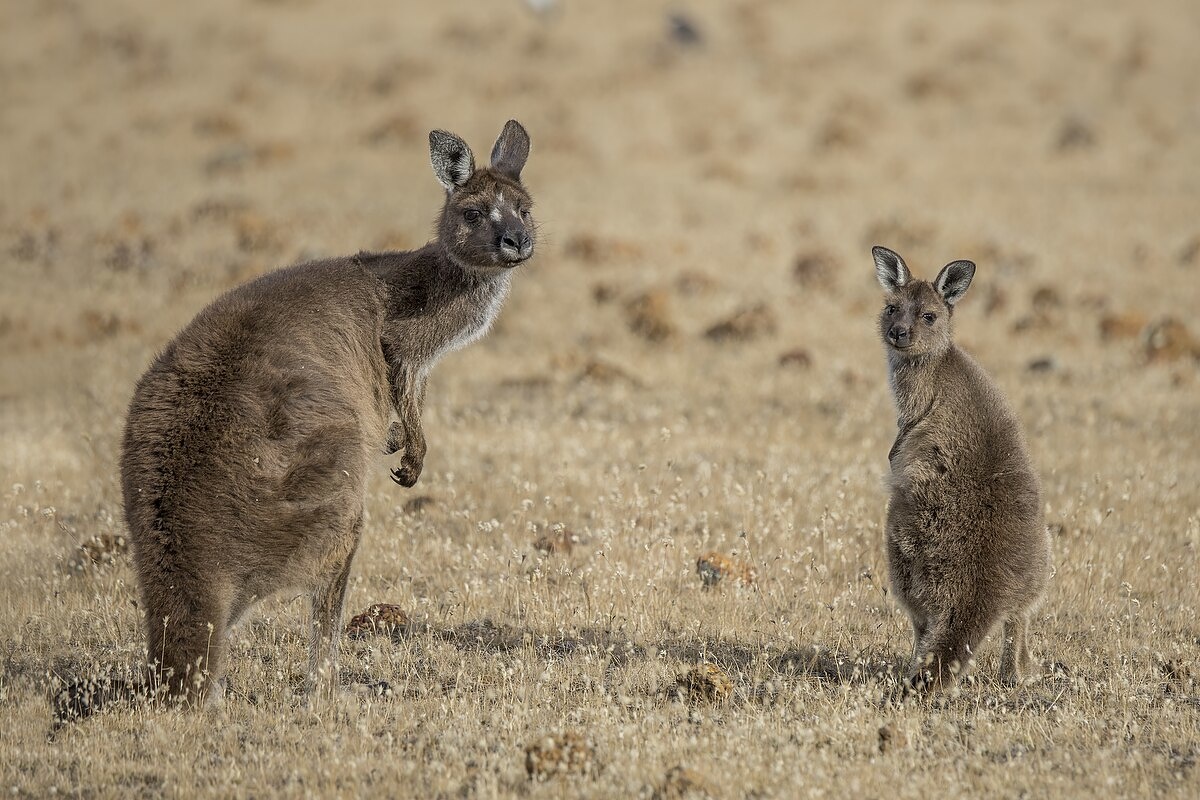
Kangaroo Island Western grey kangaroo (Macropus fuliginosus fuliginosus) female with joey
Grey kangaroos dwell in wetter coastal and forest regions than red kangaroos. They hop around the open forest and browse (eat non-grass plants such as bushes, shrubs and tree parts higher up off the ground) and graze (eat grass or other low-growing plants). Grey kangaroo young need 18 months of paternal care compared to 12 months for red kangaroos. Grey kangaroos need more water than red kangaroos. They have been able to expend into dryer regions by exploiting water troughs used to feed livestock.
There are two species of grey kangaroos: western grey kangaroos and eastern grey kangaroos. While both species show sexual dimorphism, with males significantly larger than females, Eastern Greys tend to be slightly larger overall than Western Greys. Eastern Greys tend to form smaller, open-membership groups (2-3 females with young), while Western Greys form larger groups of up to 15 females. Mature male Western Grey Kangaroos have a distinctive curry-like odor, leading to the nickname "stinker".
Western grey kangaroos were initially considered a subspecies of the eastern grey kangaroos. The standard metabolic rates of both eastern grey kangaroos and western grey kangaroos are lower than eutherians (non-marsupial mammals). Eastern grey kangaroos have a lower standard metabolic rate than western grey kangaroos. Both have been hunted for food by Australian aborigines and Europeans settlers. Dingoes may preys on grey kangaroo. Healthy large males are usually not preyed upon because of their size but young and old are vulnerable.
There are more eastern grey kangaroos than western grey kangaroos. The eastern grey kangaroo population is in the millions, while the western grey kangaroo has a population of 2.4 million Both species are considered "least concern" on the the International Union for Conservation of Nature (IUCN) Red List.
RELATED ARTICLES:
KANGAROOS AND WALLABIES (MACROPODS): CHARACTERISTICS, HISTORY, POPULATIONS ioa.factsanddetails.com
KANGAROO BEHAVIOR: FEEDING, REPRODUCTION, JOEYS ioa.factsanddetails.com
KANGAROOS HOPPING: MOVEMENTS, METABOLISM AND ANATOMY ioa.factsanddetails.com
RED KANGAROOS: CHARACTERISTICS, BEHAVIOR AND REPRODUCTION ioa.factsanddetails.com
KANGAROOS AND PEOPLE: AUSTRALIANS, HISTORY, ART, SKIPPY ioa.factsanddetails.com
KANGAROOS IN MODERN AUSTRALIA: MEAT, LEATHER, CAR COLLISIONS AND ROO BARS ioa.factsanddetails.com
KANGAROO ISSUES: OVERPOPULATION, PESTS, CULLS, SHOOTERS, ANIMAL RIGHTS ioa.factsanddetails.com
KANGAROO ATTACKS: HUMANS, DOGS, HOW, WHY, WHERE ioa.factsanddetails.com
MARSUPIALS: HISTORY, EVOLUTION, CHARACTERISTICS, BEHAVIOR, REPRODUCTION ioa.factsanddetails.com
MARSUPIALS IN AUSTRALIA ioa.factsanddetails.com
MARSUPIALS IN AUSTRALASIA (AUSTRALIA, NEW GUINEA, NEARBY ISLANDS) ioa.factsanddetails.com
WALLAROOS: SPECIES, CHARACTERISTICS, BEHAVIOR AND REPRODUCTION ioa.factsanddetails.com
WALLABIES: TYPES, CHARACTERISTICS, BEHAVIOR, REPRODUCTION ioa.factsanddetails.com
TREE-KANGAROOS: CHARACTERISTICS, BEHAVIOR AND REPRODUCTION ioa.factsanddetails.com
TREE-KANGAROOS IN AUSTRALIA: BENNETT'S, LUMHOLTZ'S, CHARACTERISTICS, BEHAVIOR AND REPRODUCTION ioa.factsanddetails.com
TREE-KANGAROOS IN PAPUA NEW GUINEA: SPECIES, CHARACTERISTICS, BEHAVIOR, REPRODUCTION ioa.factsanddetails.com
TREE-KANGAROOS IN WEST PAPUA, INDONESIA: SPECIES, CHARACTERISTICS, BEHAVIOR, REPRODUCTION factsanddetails.com
Western and Eastern Grey Kangaroos
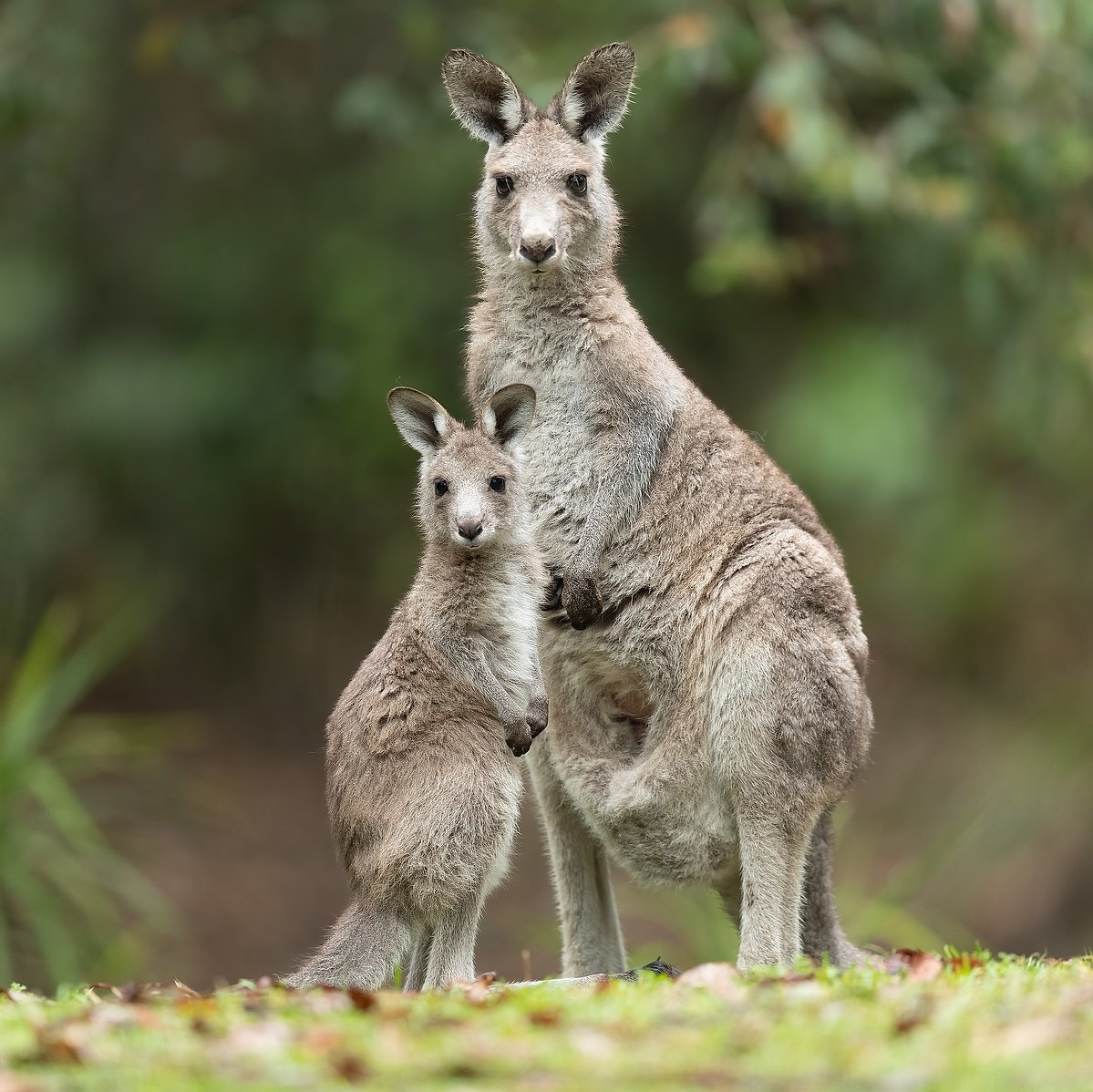
Eastern Grey Kangaroo mother and joey, Brunkerville, New South Wales, Australia
Western and eastern grey kangaroos are distinguished in part by their finely haired muzzles. Western grey kangaroos are a mostly southern species but are called western gray kangaroos because they live west of the Great Dividing Range. They are common in southern Western Australia, South Australia, western New South Wales and Victoria.
Eastern grey kangaroos live in the eastern third of Australia and are found primarily in the dry sclerophyll forests in Queensland, New South Wales and Tasmania. Mixed populations of eastern and western grey kangaroos live in Victoria and New South Wales. Hybridization between the two species has been reported in areas where their ranges overlap, but it is not common.
Though closely related, eastern and western grey kangaroos, thave distinct physical differences, particularly in fur color and facial features. Eastern Greys tend to be lighter in color, with a more grizzled grey face, while Western Greys are often a darker, more chocolatey brown, with a darker face, sometimes with a white line along the lower jaw. Western Grey Kangaroos generally have thinner, less furred ears with smaller, thinner hairs compared to Eastern Greys.
Eastern and western grey kangaroos are thought to have diverged within the last 2 million years. This divergence is believed to have occurred due to geographical isolation, possibly caused by aridification, marine incursions, or other barriers along the southern Australian coastline. The two species are closely related. They thought to have originated from a common ancestor tha lived in the southeastern and southwestern corners of Australia. This pattern of speciation, where a population is geographically separated, leading to the evolution of distinct species, is seen in other animals in southern Australia. While they can interbreed in captivity to produce hybrids, eastern and western grey kangaroos do not interbreed in the wild.
Western Grey Kangaroos
Western gray kangaroos (Macropus fuliginosus) range in weight from 25 to 75 kilograms (55 to 165 pounds) and can reach a height of almost 2.2 meters (seven feet). They range in length from 0.95 to 2.2 meters (3.1 to 7.3 feet). Sexual Dimorphism (differences between males and females) is present: Males are larger than females. Tail length ranges from 42.5 centimeters to one meter in males and 44 to 81 centimeters in females. Muscle mass makes up approximately 80 percent of the body weight. The tail is used as a counterweight when hopping. Western grey kangaroos vary in color from light brown to reddish shades of dark brown. They have a pale throat, chest and abdomen. Their muzzle is different from other kangaroo species in that it is covered with much finer hair. Western grey kangaroos have lived up to around 20 years old in captivity. In the wild, however, they rarely live past 10 years and many die young. [Source: David Miller, Animal Diversity Web (ADW) |=|]
Western gray kangaroos are found mostly in southern part of Australia — in southern Queensland, southern New South Wales, western Victoria and Kangaroo Island off of the southern coast of Australia. They occupy several different types of habitats: in woodlands, open forests, coastal heathland, scrub forests and open grassland areas. They have also been found on agricultural land, near city areas and on golf courses. These kangaroos prefer areas with heterogeneous habitats, because these areas are the most likely to meet their requirements for food and cover. There are two subspecies of western grey kangaroo: Kangaroo island western grey kangaroos (Macropus fuliginosus) on Kangaroo Island, and mainland western grey kangaroos (Macropus fuliginosus melanops) on mainland Australia.
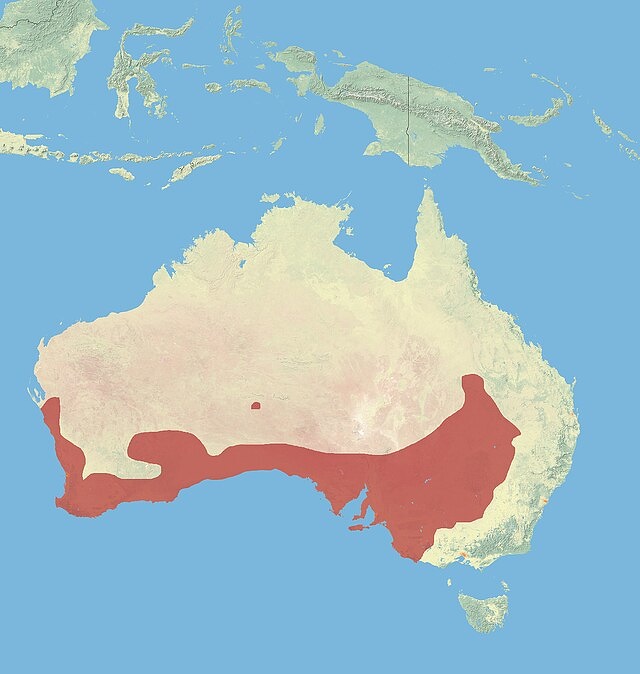
Western grey kangaroo range
Western gray kangaroos are ecotourism draws. Tourists enjoy viewing them at golf courses and in national parks. In some places they are hunted and their meat is sold in Australian supermarkets. They are also sometimes regarded as crop pests. Crops and livestock pastures have been damaged by western grey kangaroo foraging. Despite this, western gray kangaroos are protected species and controlled by state wildlife authorities. In 1987, there were an estimated 1.7 million western grey kangaroos. Permits to hunt them are issued in areas where they pose a threat to agriculture, livestock and efforts rehabilitate vegetation communities. |=|
Eastern Grey Kangaroos
Eastern grey kangaroos (Macropus giganteus) range in weight from 25 to 85 kilograms (55 to 187 pounds) and can reach a height of almost 2.2 meters (seven feet). They range in length 1.5 to 1.8 meters (4.92 to 5.91 feet). One way to identify them is by the black tip on their tails. Sexual Dimorphism (differences between males and females) is present: Males are much larger than females — two to three times heavier. Females usually don’t weigh more than 40 kilograms, while males can weigh up to 90 kilograms. If their survive their first yeas, eastern grey kangaroos can live for about seven to 10 years in the wild. Some in captivity have lived more than 20 years. Research in southern Queensland has shown that approximately 50 percent of Eastern grey kangaroo joeys there fail to live to independence. [Source: Michael S. Joo, Animal Diversity Web (ADW) |=|]
Eastern grey kangaroos can live relatively close to the coast — or further inland — in eastern Australia in New South Wales, all of Queensland with the exception of western Cape York, and parts of Tasmania, most notably in the northeast. They are the only species of kangaroo found in Tasmania. Eastern grey kangaroos occupy a wide variety of habitats, including open woodlands, grasslands and mountains with extensive forest cover. The typically inhabitat places with relatively high rainfall, but they are also found in semi-arid areas. Eastern grey kangaroos found near the coast are usually lighter colored than those inland, which can be pretty dark. Eastern greys in Tasmania and the southern portions of Queensland have longer fur than those in other areas.
The range of Eastern grey kangaroos overlaps major cities, leading to conflict. Hunt quotas are high, but actual kills are far lower. Their numbers were greatly reduced when hunting them was allowed and there was a sharp decline in their popluation in the late 1990s especially in Tasmania. There are laws that protect eastern grey kangaroos. Their populations have bounced back and is now listed in the millions but can rise and fall depending on rainfall and food and water availability. Eastern grey kangaroos can be pests. They often wander into gardens, graze in pastures intended for livestock and can overrun parks and golf courses. They are sometimes shot by farmers who want to protect their grazing land.
Western Grey Kangaroo Behavior

Eastern grey kangaroo range
Western grey kangaroos are terricolous (live on the ground), saltatorial (adapted for leaping), nocturnal (active at night), motile (move around as opposed to being stationary), , territorial (defend an area within the home range), social (associates with others of its species; forms social groups), and have dominance hierarchies (ranking systems or pecking orders among members of a long-term social group, where dominance status affects access to resources or mates). [Source: David Miller, Animal Diversity Web (ADW) |=|]
David Miller wrote in Animal Diversity Web: Western grey kangaroos form social groups called "mobs" consisting of kangaroos living in small family groups with an adult female as the matriarch, other group member females, and young. A daughter often remains close to her mother even after giving birth to a joey of her own. Males compete for dominance of the social groups, with the strongest male becoming the head of a mob. A dominant male kangaroo resides with the mob when females are fertile but separates from the mob in winter when breeding females are unlikely to come into oestrus. During breeding, young males may form single-sex groups that exist seperately from the mobs. Mature males may form loose associations with other males which are not long lasting and vary from year to year. Western grey kangaroos may have home ranges that are as large as 550ha. |=|
Western grey kangaroos are herbivores (eat plants or plants parts). They primarily eat grasses, forbs, leaves, tree bark, and shrubby browse. There are microorganisms in a digestive organ called the cecum that break down the cellulose of plants to make them easier to digest. Western grey kangaroo have a tolerance to fluoroacetate, which is a poison present in many legumes in southwestern Australia. They require relatively little water and is able to survive on plants high in fiber. Western grey kangaroos spend between six and 10 hours grazing per day, mostly at dawn and dusk. In captivity, these kangaroos are often fed a pelleted grain or hay. |=|
Eastern Grey Kangaroo Behavior
Eastern grey kangaroos are terricolous (live on the ground), saltatorial (adapted for leaping), nocturnal (active at night), motile (move around as opposed to being stationary), territorial (defend an area within the home range), social (associates with others of its species; forms social groups), and have dominance hierarchies (ranking systems or pecking orders among members of a long-term social group, where dominance status affects access to resources or mates). [Source: Michael S. Joo, Animal Diversity Web (ADW) |=|]
Michael S. Joo wrote in Animal Diversity Web: Eastern grey kangaroos are a social species. Their 'mobs' include one dominant male, about two ot three females with their young, and about two to three young males. As is common in all kangaroos, eastern greys move by hopping, usually around nine meters every hop. Also characteristic of most kangaroos, the legs of eastern greys are designed so that they expend less energy the faster they are moving, which can be up to speeds of 30 miles per hour. Eastern grey kangaroos spend most of their day under the shade, then move out at dusk to feed until dawn.
Eastern grey kangaroos do not have a broad home range like western grey kangaroos, which can have ranges in upwards of 500 hectares. On average, eastern grey kangaroos have a mean home range of about 42.9 hectares, but this value can range about 29.2 hectares above and below this point. Density dependence and the availability of renewable resources may be the determining factors that limiting the range of eastern grey kangaroos.
Eastern grey kangaroos communicate with touch and sound and sense using vision, touch, sound and chemicals usually detected with smell. Both male and female eastern grey kangaroos usually communicate with each other and their young using clucking noises. When alarmed, they can also emit a guttural cough. This cough is also heard when males warn each other, fight, or display dominance. All grey kangaroos stamp their hind legs on the ground when they sense danger. This stamping, along with the guttural noise, sends a warning that travels quite distantly.
Eastern grey kangaroos are herbivores (eat plants or plants parts) are primarily grazers (eat grass or other low-growing plants). They eat a wide variety of foliage ranging from grasses to forbs (broad-leaved herbs besides grass that grow on plains and meadows). Their preferred food, is grass, which grows on the plains that these kangaroos usually inhabit. In captivity, eastern greys are sometimes fed fruits, although this is not part of the usual diet in the wild.
Western Grey Kangaroo Mating, Reproduction and Offspring
Western grey kangaroos are polygynous (males have more than one female as a mate at one time) Interestingly and not capable of embryonic diapause (temporary suspension of development of the embryo) like many kangaroo species. They engage in year-round breeding.with a peak in spring and summer. The number of offspring is one. The average gestation period is 30 days. The average weaning age is 18 months.[Source: David Miller, Animal Diversity Web (ADW) |=|]
Sexual maturity is reached at approximately 20 months for males and 17 months for females. Females have an oestrous cycle of approximately 35 days. Males compete for females, with dominant males usually being the only ones that mate. Dominancy is determined through "boxing", which is a form of male competition.
Western grey kangaroo young are altricial, meaning they are relatively underdeveloped at birth. Parental care is carried out exclusively by females. Joeys weigh less than a gram at birth when they climb from the birth canal to the pouch where they grabs hold of a teat and nurse. Joeys begin to leave the pouch after an average of 46 weeks, and may continue to nurse from the pouch for up to an additional six months after leaving the pouch. After the joey has left the pouch, the female is capable of mating again.
Eastern Grey Kangaroo Mating, Reproduction and Offspring
Eastern grey kangaroos are polygynous (males have more than one female as a mate at one time) and engage in embryonic diapause (temporary suspension of development of the embryo). Eastern grey kangaroos breed seasonally, which is somewhat unusual for kangaroos — usually in the spring and early summer The number of offspring is usually one but is occasionally two. The gestation period ranges from 34.8 to 38 days. [Source:Michael S. Joo, Animal Diversity Web (ADW) |=|]
The estrus period for female eastern grey kangaroos lasts about 46 days, which is longer than the gestation period. Male eastern grey kangaroos often 'box' or exhibit other types of aggressive behavior to establish dominance. Dominant males are the ones most likely to mate with females in estrus. When a female eastern grey kangaroo reaches estrus, a male may approach her and sniff various parts of her body including her pouch and genital area. He may also make clucking noises and paw her head and tail, a behavior characteristic of many kangaroo species.
Young are altricial, meaning they are relatively underdeveloped at birth. During the pre-weaning and pre-weaning stages provisioning is done by females and protecting is done by males and females. The average weaning age is 9.5 months and the average time to independence is 11 months. Females reach sexual or reproductive maturity at 15 to 20 months and males do so at 20 months.
Eastern grey kangaroo joeys usually stays in the pouch for 11 months during which it feeds from its mother's milk. They feed for an additional nine months, on average, from the mother's milk, after they leave the pouch. During this time, the mother provides protection and food and also guidance as the joey comes closer to becoming fully independent. Females with joeys that are semi-independent to fully-independent from the pouch usually stay away from large groups, a behavior thought to avoid the risk of predation. |=|
Image Sources: Wikimedia Commons
Text Sources: Animal Diversity Web animaldiversity.org , National Geographic, Live Science, Natural History magazine, Australian Museum, David Attenborough books, Australia Geographic, New York Times, Washington Post, Los Angeles Times, Smithsonian magazine, Discover magazine, The Conversation, The New Yorker, Time, BBC, CNN, Reuters, Associated Press, AFP, Lonely Planet Guides, Wikipedia, The Guardian, Top Secret Animal Attack Files website and various books and other publications.
Last updated July 2025