
Home | Category: Kangaroos, Wallabies and Their Relatives
KANGAROO PRODUCTS
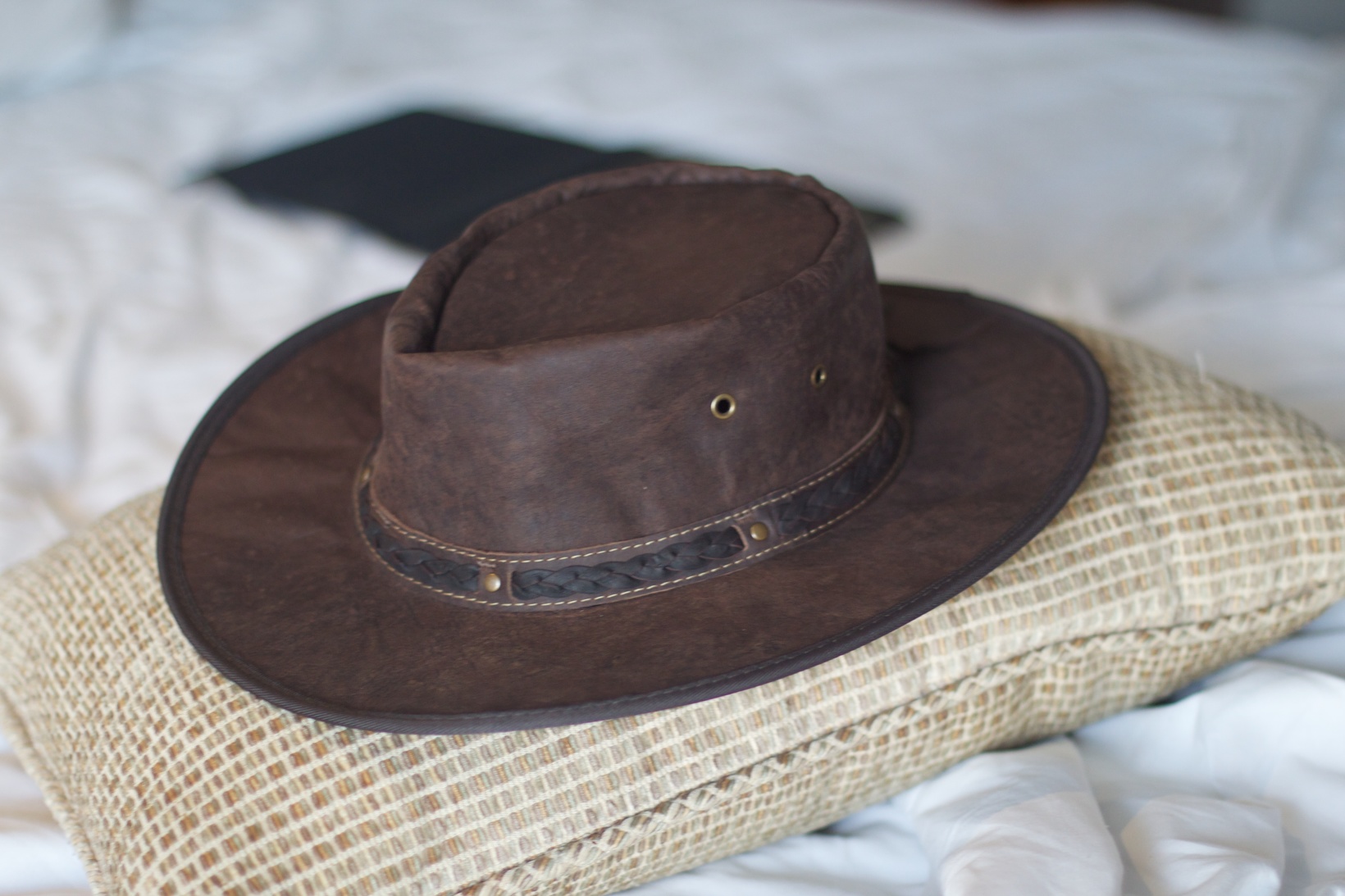
Kangaroo skin Aussie-style hat
Kangaroo meat is used for pet food and marketed for human consumption as hopping mutton. Kangaroo fur is used to make stuffed toys and their leather is fashioned into shoes, belts, dog collars and whips. At some tourist shops it is possible to buy small purses made from the scrotums of male kangaroos.∝ ♮
Jeremy Berlin wrote in National Geographic, Today meat, hides, and leather from four nonthreatened species have been exported to 56 countries. Global brands such as Nike, Puma, and Adidas buy strong, supple “k-leather” to make athletic gear. And kangaroo meat, once sold mainly as pet food, is finding its way into more and more grocery stores and high-end restaurants. [Source: Jeremy Berlin, National Geographic, February 2019]
Many motorcycle suits are made with kangaroo leather. Kangaroo leather is exported to Germany, Italy and Japan where it is fashioned into soccer balls and sunglasses cases. According to Stridewise: Adidas’ most popular soccer shoe of all time, the Copa, is made from kangaroo leather — but their marketing typically calls them “k-leather” to avoid putting anybody off. That said, there’s a lot of people who argue kangaroos are pest animals whose numbers are reasonably kept down with annual culling. Which means eating the meat and turning the hides into leather for, say, your new boots, is the responsible thing to do [Source: Stridewise].
RELATED ARTICLES:
KANGAROOS AND PEOPLE: AUSTRALIANS, HISTORY, ART, SKIPPY ioa.factsanddetails.com
KANGAROO ISSUES: OVERPOPULATION, PESTS, CULLS, SHOOTERS, ANIMAL RIGHTS ioa.factsanddetails.com
KANGAROO ATTACKS: HUMANS, DOGS, HOW, WHY, WHERE ioa.factsanddetails.com
KANGAROOS AND WALLABIES (MACROPODS): CHARACTERISTICS, HISTORY, POPULATIONS ioa.factsanddetails.com
KANGAROO BEHAVIOR: FEEDING, REPRODUCTION, JOEYS ioa.factsanddetails.com
KANGAROOS HOPPING: MOVEMENTS, METABOLISM AND ANATOMY ioa.factsanddetails.com
RED KANGAROOS: CHARACTERISTICS, BEHAVIOR AND REPRODUCTION ioa.factsanddetails.com
GREY KANGAROOS: EASTERN, WESTERN, CHARACTERISTICS, BEHAVIOR, REPRODUCTION ioa.factsanddetails.com
WALLAROOS: SPECIES, CHARACTERISTICS, BEHAVIOR AND REPRODUCTION ioa.factsanddetails.com
WALLABIES: TYPES, CHARACTERISTICS, BEHAVIOR, REPRODUCTION ioa.factsanddetails.com
TREE-KANGAROOS: CHARACTERISTICS, BEHAVIOR AND REPRODUCTION ioa.factsanddetails.com
TREE-KANGAROOS IN AUSTRALIA: BENNETT'S, LUMHOLTZ'S, CHARACTERISTICS, BEHAVIOR AND REPRODUCTION ioa.factsanddetails.com
Kangaroo Industry in Australia
The kangaroo industry in Australia is fairly large and is sourced with animals hunted annually based upon quota set by the state governments of Australia. The main products are meat and leather. Recognized as the largest commercial use of land-based wildlife globally, the Australia kangaroo industry gets kangaroos from their natural habitat rather than farming. The industry is regulated to ensure sustainability and animal welfare, with state and federal governments setting quotas based on population estimates.
Kangaroos are harvested by licensed shooters, adhering to strict codes of practice to ensure both animal welfare and food safety. Only four kangaroo species are taken — red kangaroos, Eastern grey kangaroos, Western grey kangaroos, and common wallaroos — and they are managed with annual quotas set based on population surveys, aiming to maintain sustainable populations and prevent over-harvesting. Animal welfare is a key consideration, with regulations in place to ensure kangaroos are harvested humanely. The industry contributes significantly to the Australian economy, with a gross value of production around A$200 million and supporting thousands of jobs.
The kangaroo industry is especially beneficial to rural economies in Australia. Jeremy Berlin wrote in National Geographic, A government-sanctioned industry, based on the commercial harvest of kangaroo meat and hides, exported $29 million in products in 2017 and supports about 4,000 jobs. Advocates point out that low-fat, high-protein kangaroo meat comes from an animal more environmentally friendly than greenhouse gas — emitting sheep and cattle. John Kelly, former executive director of the Kangaroo Industry Association of Australia, says, “Harvesting our food and fibers from animals adapted to Australia’s fragile rangelands is eminently wise and sustainable. Many ecologists will tell you that there is no more humane way of producing red meat.” [Source: Jeremy Berlin, National Geographic, February 2019]
Kangaroo Meat
South Australia was the first state to legalize the consumption of kangaroo meat. In trendy restaurants it is sometimes served a with wild peach and chili glaze or honey and port glaze. Laura Blumenfeld wrote in the Washington Post, "Looks like beef, chews like venison, leaves a disturbing aftertaste." Kangaroo meat has been called "the red meat that's good for you to eat." It contains less than two percent fat and almost no cholesterol. Because it is so lean food critics say it is best eaten rare. Smoke dried kangaroo meat will last for years and is said to be especially tasty in soups.∝

In an Australian supermarket
Nothing makes Australians happier than pulling a fast one on the yanks. In the early 80s American fast food companies believed they were receiving a new kind of beef from Australia. What it was however was kangaroo meat and even McDonald's bought some.
Kangaroo meat is marketed throughout the world as a quality game meat. Describing kangaroo dishes served up the Australian embassy in Japan, Tom Baker wrote in the Yomiuri Shimbun, “First came a salad for which kangaroo meat had been marinated in red wine before sliced and tossed together with lettuce nuts and fruit in a red wine vinaigrette...The meat was neither tough nor tender, but agreeably chewy. It had a mildly gamy taste that I got used to after a bite or two, and then began to enjoy it as it went well the flavors of the other ingredients. [Source: Tom Bake, Yomiuri Shimbun, July 2009]
The next dish as a kangaroo meat stew. “The meat was cut into chunks. It behaved and tasted very much as beef would , even separating into stringy sections when pressed with a fork. Tender chunks of bell peppers in the stew were a nice textural counterpoint to the meat. Jason Morgan, a meat producer known as the Meat Guy, told the Yomiuri Shimbun: “Kangaroo handles barbecue sauces very well...A plum sauce is also a common sauce for kangaroo, as are other sorts of tart fruit sauces. A raspberry sauce would also match very well with kangaroo...If you are doing the burger you pretty much prepare it as you would any hamburger patty. We also do loins as well as racks and rumps. We’ got steak cuts and chop cuts. And with those, you really just want to grill them over a very hot fire, just until they’re at medium rare to medium at the most. If you overcook it, because it’s got a low fat content, it’ll get chewy and dry. But when you nail it. When you have it just right at medium rare, its as good as some of the best beef that you will try.”
Kangaroo meat is 0.9 percent fat, compared to 14,6 percent for chicken thighs, 23.3 percent for beef sirloin and 33 percent for pork belly. About 3,000 to 4,000 tons of kangaroo meat was consumed each year in Australia in the mid 2000s. One meat seller told the Yomiuri Shimbun said it was a well-regulated model of “wise and sustainable wildlife utilization.” The Meat Guy said: “Kangaroo...is a low end herbivore in the Outback of Australia. They’re overpopulated right now with them and Australia doesn’t really have any big cars so hunting kangaroos for food is a very sustainable exercise.”
Eating Kangaroo More Eco Than Eating Beef?
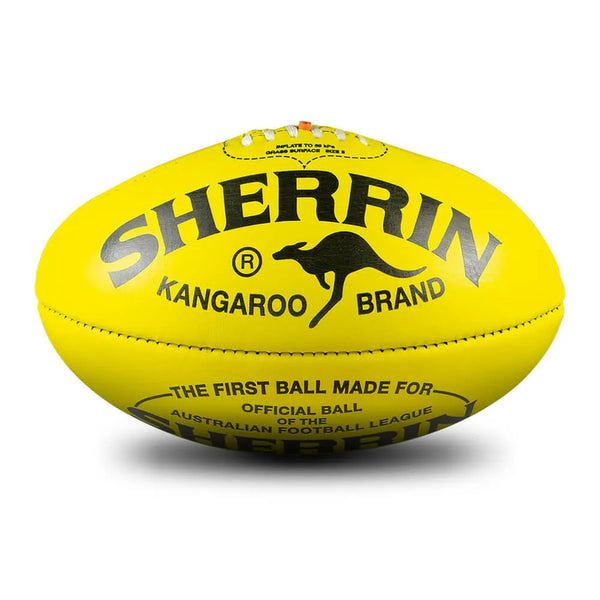
Australian rules football
In 2009, AFP reported: Saving the planet by eating kangaroos may seem like pie in the sky, but the offbeat menu comes with a scientific stamp of approval in Australia. The aim is to reduce damage to the environment, but the reasoning behind the push to put the animals on the menu is sharply different. [Source: AFP, January 5, 2009]
In the case of kangaroos, environmentalists say the national animal should become a dietary staple in place of cattle and sheep as part of the fight against global warming. The farm animals make a major contribution to Australia's greenhouse gas emissions simply by belching and farting, while kangaroos emit negligible amounts of dangerous methane gas.In other words, there should be more kangaroos and fewer farm animals. "For most of Australia's human history — around 60,000 years — kangaroo was the main source of meat," the government's top climate change adviser Professor Ross Garnaut noted in a major report on global warming recently. "It could again become important."
Garnaut's study concluded that by 2020, beef cattle and sheep numbers could be reduced by seven million and 36 million respectively, allowing for an increase in kangaroo numbers to 240 million by 2020, from 34 million now. He acknowledged, however, that there were some problems in this plan, including livestock and farm management issues, consumer resistance and thegradual nature of change in food tastes. The idea of farming kangaroos for human consumption is distasteful to some, but many health-conscious Australians already eat kangaroo meat. "It's low in fat, it's got high protein levels, it's very clean in the sense that basically it's the ultimate free range animal," says Peter Ampt of the University of New South Wales's institute of environmental studies.
Kangaroo Leather
According to Stridewise: Kangaroo leather, also sometimes called K-leather, is what most people would call an exotic leather, though that term typically brings to mind rare and exalted animals. In truth, kangaroos are to Australia like deer are in North America, where they outnumber humans two-to-one — many consider them pests and they’re far from rare. [Source: Stridewise]
Kangaroo leather is lighter, stronger, and more flexible than goat or cow hide. It’s usually thinner too, given you can make tough-as-nails kangaroo boots with skin that’s barely a millimeter thick. (Cowhide boots are usually 1.4 to two millimeters.) Unsurprisingly, this means that they make a much lighter final product: kangaroo leather boots usually weigh half as much as comparable cow-leather ones.
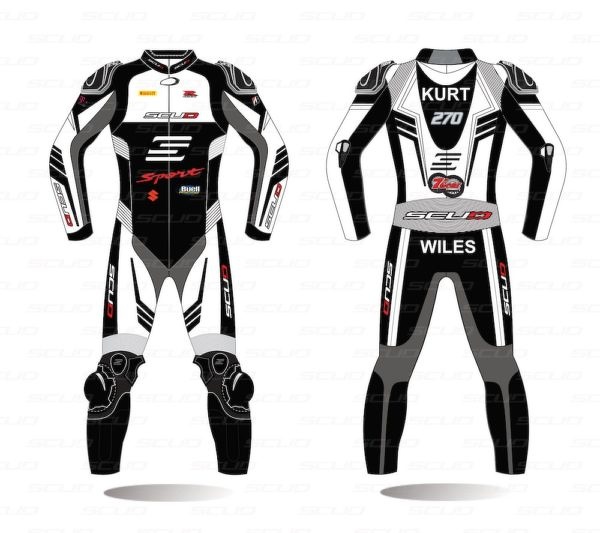
Kangaroo skin motorcycle suit
All that’s because the skin of the animals themselves are very different. The collagen fibers that make up kangaroo hide are fine, concentrated, highly uniform, and parallel to the surface of the skin, unlike cow skin’s irregular, bundled structure. Kangaroo hide also has very low fat content and a thin grain layer, without sweat glands and erector pili muscles, which means it doesn’t require the splitting and shaving that some other leathers require (hence the resulting thin, supple, strong leather). Plus, elastin is evenly distributed throughout the skin, which means it’s uniformly stretchy. All of these factors give kangaroo leather a ton of tensile strength: it can stand being pulled apart.
One of the most common uses of kangaroo leather is in whips because it’s super supple. It’s flexible enough to be easily braided and whipped through the air. Another popular use for kangaroo leather? Motorcycle suits, where it’s highly valued for its resistance to tearing and abrasion. And that’s a serious testimonial to k-leather’s toughness. Think about it, in the kind of sport where a mistake leaves you smeared across the asphalt, you want the only thing between your skin and a bloody, bloody disaster to be as tough as possible. Kangaroo leather is that thing.
Kangaroo leather comes in both chrome-tanned and veg-tanned varieties. Kangaroo leather does have some downsides. K-leather has a noticeable grain and does crease easily, though that creasing doesn’t usually lead to cracking because of the strength of the collagen fibers. Unless it’s corrected, it’s usually not the smoothest leather — almost all kangaroo leather has scars. It’s not the shiniest either, kangaroo has a matte texture that develops a patina quickly and it darkens faster than other leathers as well.
Car Collisions with Kangaroos
In Australia, there are over 7,000 insurance claims annually due to collisions with kangaroos. These collisions account for about five percent of all road accidents in the country. Plus, kangaroos and wallabies are involved in nine out of ten animal-related collisions. Figure there collisions between vehicles and kangaroos in which no insurance claims are made. In the 2000s, it was estimated that around 20,000 accidents a year in Australia were caused by collisions between vehicles and kangaroos. Kangaroos often causes extensive damage to vehicles. Many kangaroos and people have been killed too. In 2017 ambulances were called out to 172 vehicle crashes involving kangaroos just in New South Wales alone. Motorcyclists fare the worst in collisions with kangaroos, making up half of the fatalities that occur in kangaroo collisions.
Avoiding collisions with kangaroos while driving: 1) Take more care when driving in the evening time when kangaroos are more likely to be on the roads; 2) Where there are kangaroo signs, drive with caution; 3) If you see kangaroos on the side of the road, proceed with caution as they often travel together in mobs.
Kangaroos bound across the highways all over the place in Australia. Kangaroos are attracted to lights and many of them will aim for cars traveling at night rather than trying to avoid them. On some major throughways there are so many dead kangaroos that the stench of their rooting carcasses fills the air for miles. In some places, including the Australia capital of Canberra, a third of all car accidents are caused by collisions with kangaroos.
Winter months (June to August) and the period around dusk are particularly dangerous for kangaroo-vehicle. August is the the worst month for accidents while the lowest frequency occurs in February. Kangaroo car accidents are most likely to occur between 5:00pm and 10:00pm There are more collisions following long periods of dry weather. The most serious accidents are usually secondary collisions that occur after the collision with the kangaroo or as a result of drivers attempting to avoid collision with kangaroos. Forty-two percent of the fatal accidents that occurred between 2001-2005 in New South Wales in regards to animal collisions happened as a result of people swerving to avoid the animal. [Source: Budget Direct car insurance company]
Kangaroo-Car Collisions by State
While Queensland accounts for more than 50 percent of the nation's kangaroos, drivers are more likely to collide with one in New South Wales. New South Wales and Victoria have the most kangaroo crash claims. The top five places in Australia for kangaroo-related claims, are: 1) Queanbeyan (New South Wales ); 2) Roxburgh Park (Victoria), 3) Cessnock West (New South Wales ), 4) Doreen (Victoria) and 5) Mudgee (New South Wales ). [Source: Sharon Masige, Business Insider Australia June 13, 2019]
New South Wales (2001-2005)
Hit animal: 6423
Fatal crash: 25
Injury crash: 2115
Non-injury:4283
There were roughly 3.5 Kangaroo related casualties on the road per day in New South Wales during the period 2001-2005 — more than double that of Queensland. Dubbo has the highest number of claims, followed by Goulburn and Mudgee. [Source: Budget Direct car insurance company; East Coast Bullbars.]
Victoria (2001-2005)
Hit animal: 632
Fatal crash: 9
Serious injury crash: 215
Injury crash: 408
Sunbury is a hotspot, and Heathcote is considered Australia's most dangerous spot for animal collisions.
Queensland (2001-2005)
Hit animal: 3197
Fatal crash: 16
Hospitalisation crash: 649
Minor Injury crash: 981
Property damage crash:1551
Roma, Longreach, and Goondiwindi are known hotspots.
West Australia (2001-2005)
Hit animal: 108
Fatal crash: 7
Hospitalisation crash: 101
Collie is a hotspot.
South Australia (1 year, 2003)
Hit animal: 519
Fatal crash: 0
Casualty crash: 41
All crashes: 478
Mount Gambier, Whyalla, and Port Augusta are major hotspots.
Tasmainia (2 Years, 2006-2007)
Animal on road: 11
Serious casualties: 11
Scottsdale, Devonport, and Campbell Town are locations with high collision rates.
Canberra (3 Years, 2001-2003)
Struck animal:710
Fatal crash: 0
Injury crash: 13
Property damage crash:697
Northern Territories (2001-2005)
Hit animal: 36
Fatal crash: 4
Serious injury crash: 32
Katherine is a hotspot.
Collisions with Kangaroos Cost Australians Millions
Kangaroo collisions with vehicles cost Australian drivers more than $6 million in excess on insurance claims a year, according to research from Huddle Insurance's Roo Report. The average vehicle damage costs after a kangaroo crash are estimated to be around $4,000, with 15 percent of vehicles involved in kangaroo collisions completely totalled. [Source: Sharon Masige, Business Insider Australia June 13, 2019]
"While more than half (59 percent) of drivers believe that in the event of a collision with a kangaroo their comprehensive car insurance will cover the cost of the damage, only 80 percent of this group understand that they would be required to pay an excess," the report said. "The other 20 percent believe that they would be fully covered, with no excess payable, which is not the norm in Australia." "While comprehensive car insurance will cover the cost of damage in most cases, the majority of insurance brands including Huddle place the driver at fault, with an excess to pay when you claim," Jonathan Buck, joint CEO and co-founder of Huddle said in a statement.
Sharon Masige wrote in Business Insider Australia: In addition to insurance woes, the fear among Australian drivers of hitting a roo is real, with 49 percent "concerned" and 30 percent "very concerned" about knocking one while driving out of town. But the fear isn't just for the driver's personal safety. The report revealed that if no one is hurt in the collision, Australian drivers' next biggest concern is over the welfare of the roo itself. "Almost half (48 percent) stating [the welfare of the kangaroo] was their biggest worry," the report found. "This is closely followed by concern as to whether they could keep going on their journey (41 percent), the cost of the damage to their car (37 percent), whether their car insurance would cover the damage (32 percent) and how they would pay for the cost of repairs (19 percent).
Roo Bars
Many cars in South Australia are outfit with a roo bars — a looped piece of metal attached to the front bumper — that protects the car from collisions with kangaroos or other animals. Initially they were used mainly by people that needed them. Later, sort of like SUVs themselves, they became popular as a rugged ornament attached to SUVs that never left the suburbs.
Studies have shown that roos bars often do little to protect a vehicle from kangaroo collisions but they caused more serious injurious and many deaths to pedestrians hit with them.
In an efforts to make more effective roo bars, the General Motors subsidiary Hilden developed Robo Roo Two, a kangaroo-shaped crash test dummy made of metal, plastic and a leather skin. The robot was designed to be hit repeatedly and engineers design vehicles in which the occupants were less likely to be hurt.
Image Sources: Wikimedia Commons
Text Sources: Animal Diversity Web animaldiversity.org , National Geographic, Live Science, Natural History magazine, Australian Museum, David Attenborough books, Australia Geographic, New York Times, Washington Post, Los Angeles Times, Smithsonian magazine, Discover magazine, The Conversation, The New Yorker, Time, BBC, CNN, Reuters, Associated Press, AFP, Lonely Planet Guides, Wikipedia, The Guardian, Top Secret Animal Attack Files website and various books and other publications.
Last updated July 2025