
Home | Category: Kangaroos, Wallabies and Their Relatives
KANGAROO ISSUES IN AUSTRALIA
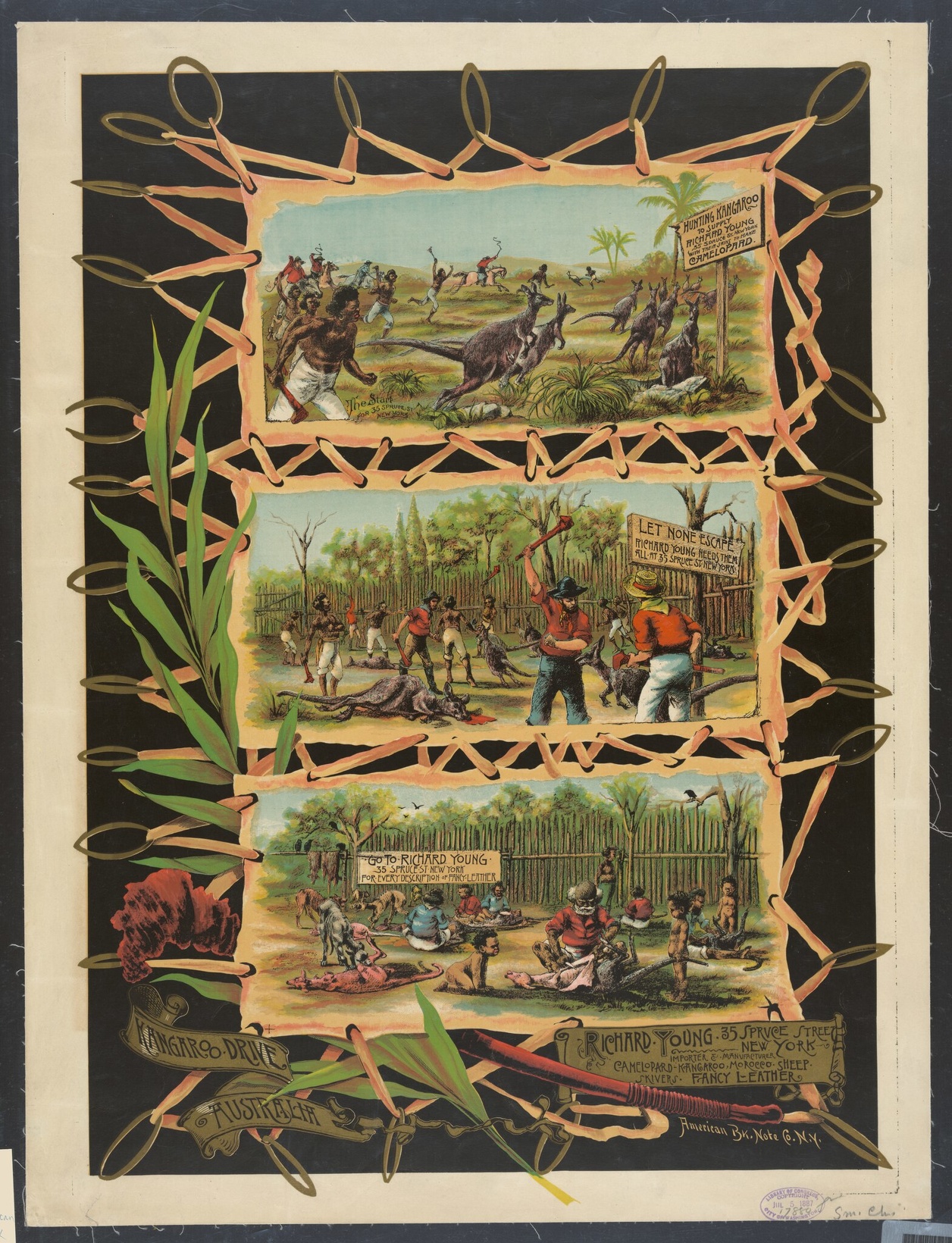
Humans have historically hunted kangaroos for their meat and hides and such practices continue today. A fairly large Australian industry for kangaroo skins and meat exists. Many kangaroo are killed by cars and die during droughts. Kangaroos can be big strong animals. They have seriously injured and even killed humans and are known for drowning dogs. They have also seriously damaged cars and killed passengers of cars that collided with them. When kangaroos consume water and forage intended for cattle and sheep and become so numerous they are regarded as traffic hazards, professional "roo shooters" are sometimes brought in to cull them.
Jeremy Berlin wrote in National Geographic: “Australia has a complicated relationship with its national symbol. Kangaroos are among the world’s most iconic, charismatic species — the living, bounding emblems of the country’s unique biodiversity. At once sublime and adorably absurd, they are evolutionary marvels — the only large animal that hops. And Australians are demonstrably proud of them. Kangaroos star in movies and TV shows, poems and children’s books. Their images adorn the country’s currency, coat of arms, commercial airlines, naval vessels, Olympic insignia, and athletic uniforms. “To outsiders, the big-footed, fat-tailed, perky-eared creatures are a stand-in for the country itself: Australia means roos, and roos mean Australia. There may be no animal and nation in the world more closely identified. [Source: Jeremy Berlin, National Geographic, February 2019]
“But there are more than twice as many kangaroos as people in Australia, according to official government figures, and many Aussies consider them pests. Landholding farmers, called graziers, say that the country’s estimated 50 million kangaroos damage their crops and compete with livestock for scarce resources. Australia’s insurance industry says that kangaroos are involved in more than 80 percent of the 20,000-plus vehicle-animal collisions reported each year. In the country’s arid, sparsely populated interior, the common belief is that roo numbers have swollen to “plague proportions.” In the absence of traditional predators such as dingoes and Aboriginal hunters, the thinking goes, killing kangaroos is crucial to balancing the ecology.
RELATED ARTICLES:
KANGAROOS AND PEOPLE: AUSTRALIANS, HISTORY, ART, SKIPPY ioa.factsanddetails.com
KANGAROOS IN MODERN AUSTRALIA: MEAT, LEATHER, CAR COLLISIONS AND ROO BARS ioa.factsanddetails.com
KANGAROO ATTACKS: HUMANS, DOGS, HOW, WHY, WHERE ioa.factsanddetails.com
KANGAROOS AND WALLABIES (MACROPODS): CHARACTERISTICS, HISTORY, POPULATIONS ioa.factsanddetails.com
KANGAROO BEHAVIOR: FEEDING, REPRODUCTION, JOEYS ioa.factsanddetails.com
KANGAROOS HOPPING: MOVEMENTS, METABOLISM AND ANATOMY ioa.factsanddetails.com
RED KANGAROOS: CHARACTERISTICS, BEHAVIOR AND REPRODUCTION ioa.factsanddetails.com
GREY KANGAROOS: EASTERN, WESTERN, CHARACTERISTICS, BEHAVIOR, REPRODUCTION ioa.factsanddetails.com
WALLAROOS: SPECIES, CHARACTERISTICS, BEHAVIOR AND REPRODUCTION ioa.factsanddetails.com
WALLABIES: TYPES, CHARACTERISTICS, BEHAVIOR, REPRODUCTION ioa.factsanddetails.com
TREE-KANGAROOS: CHARACTERISTICS, BEHAVIOR AND REPRODUCTION ioa.factsanddetails.com
TREE-KANGAROOS IN AUSTRALIA: BENNETT'S, LUMHOLTZ'S, CHARACTERISTICS, BEHAVIOR AND REPRODUCTION ioa.factsanddetails.com
Kangaroo Population Booms and Busts
Kangaroo populations go through booms and busts mainly with the former occurring when rainfall in plentiful and the latter when there are droughts but can also occur when booming populations eat up all the food. Li Cohen of CBS News wrote: An excessive population poses a risk to the animals themselves, as a surplus of animals means that there is not enough food and many end up starving to death. This is what happened in 2016 and 2017, when government figures showed that there were nearly 45 million kangaroos — about double the amount of people in the country, according to the BBC.
That population boom was believed to be because of a bout of rainy conditions increasing vegetation, but like many rainy seasons, it ended with a drought — and a heavy price. "The last drought we estimated that 80 or 90 percent of the kangaroos in some areas died," ecologist Katherine Moseby told AFP. "They are starving to death — going into public toilets and eating toilet paper, or lying on the road starving while their joeys are trying to feed."
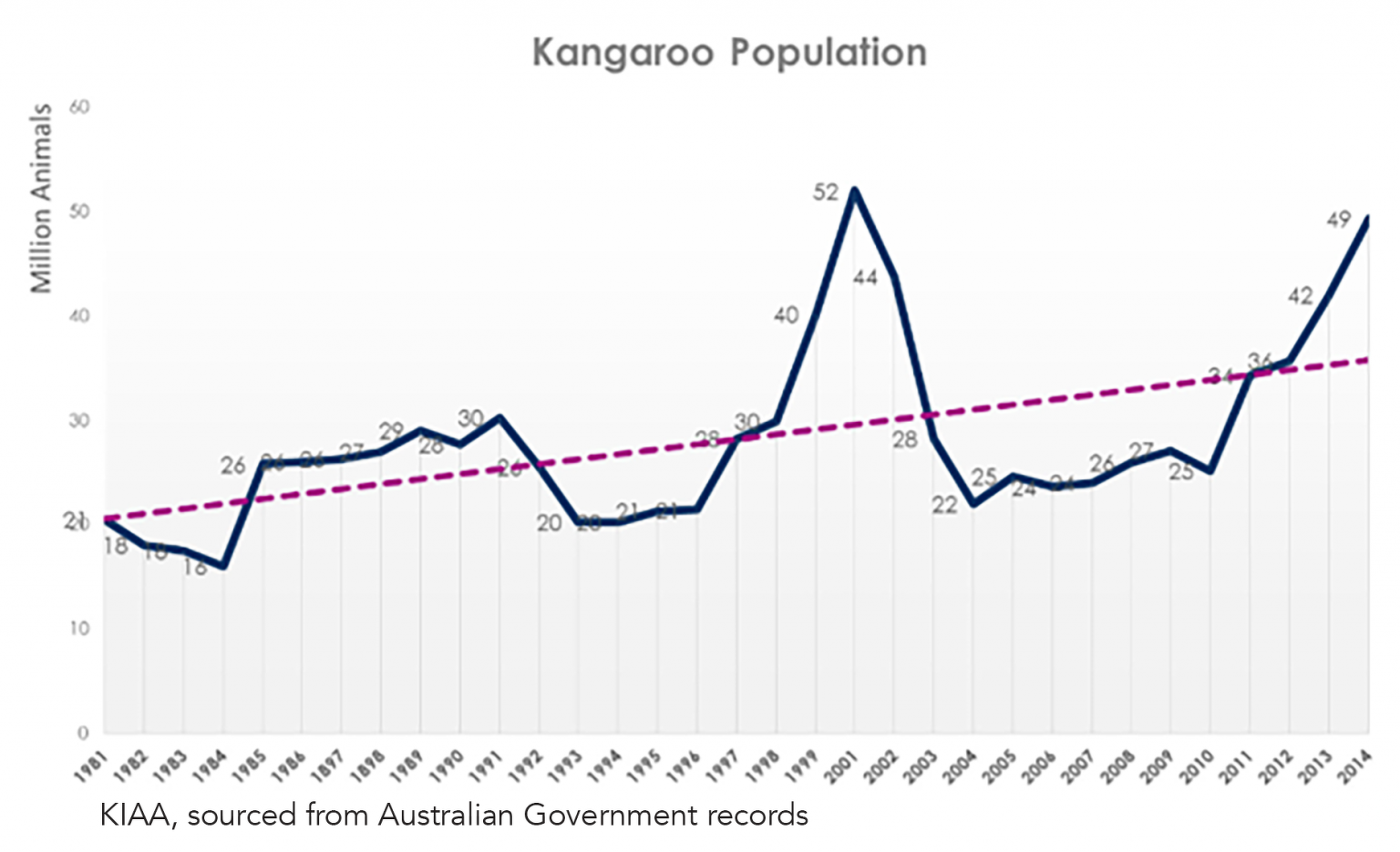
Dennis King, executive officer for the Kangaroo Industry Association of Australia, told AFP that he believes the country could see another situation like that soon, as weather in recent years has created conditions for another boom. "After three years of La Nina right down the east coast, we've seen the perfect growth scenario for kangaroos over the next couple of years," he said. "The breeding cycle really speeds up." And if that happens, he believes the population could hit as many as 60 million kangaroos — more than 2.3 times the number of people in Australia.
The droughts of 1982 and 1983 took a heavy toll on the kangaroo population. A year after the drought was over, however, their numbers increased by 40 percent. This miraculous comeback was due to fact that females, who had stopped breeding during the drought, were able to conceive seven days after the first rain.
During a severe drought in 2003, the Washington Post reported: Starving kangaroos have been terrifying drought-stricken Australian communities for months, gathering in school yards, invading towns and risking bullets from angry farmers by raiding gardens. While the drought on the eastern seaboard ends in floods, mobs of kangaroos are still bounding down main streets of parched country towns in search of food. In one reported case, kangaroos attacked and killed a dog. The worst drought in 100 years is cutting through a kangaroo population farmers say had grown to three times the nation's 20 million people, and turned the cuddly-looking animal into an overgrown pest. "All around the paddocks, under every tree, there's dead 'roos. What a terrible way to go, starving to death in their millions," kangaroo expert Brian Rutledge said from his property in the Queensland outback. [Source: Washington Post, June 1, 2003]
Kangaroos and Farmers
Farmers consider kangaroos to be pests, especially during a drought, when they eat up sparse pasture land intended for sheep and cattle. It is believed that there are now more kangaroos in Australia than there were when Europeans arrived. Farmers often say that they regard kangaroos as pest but would be very upset if they disappeared.
Farmers have also played a big part in the number of kangaroos spiraling out of control. Waterholes created for livestock have helped kangaroos, that otherwise would have died during drought conditions, survive and propagate. They have also killed potential kangaroo predators such as dingoes.
Describing what happened in 1983, when there was a major drough, one sheep rancher said, "The forest dried up...and the kangaroos came out, looking for food. They scratched up 40 acres of wheat seed near the forest. Then they ate the wheat that had sprouted. What they didn't eat they trampled and rolled on until it was ruined. In the process they got tangled in the fences and ripped apart."
While flying in a Cessna over a patch of thick scrub George Wilson, a leading kangaroo management researcher, told National Geographic: “That’s kangaroo country down there...“Down there” are dusty rangelands and the sunburned outback, a fragile landscape where fertile soil can quickly turn to dust and water supply never meets demand. Farming has always been a challenge on Earth’s second driest continent, and now climate change is exacerbating heat waves and droughts, intensifying pressure on agriculture and livelihoods. [Source: Jeremy Berlin, National Geographic, February 2019]
Kangaroos as Livestock Pests
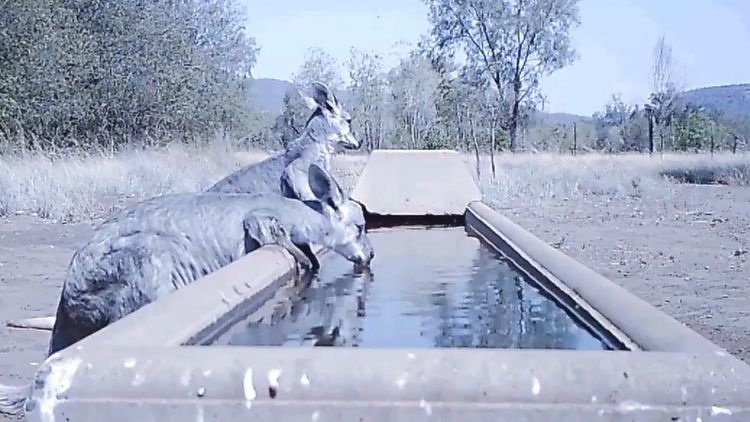
kangaroos drinking from a livestock tank
Kangaroos are regarded as crop pests and threats to livestock, which may consume the same forage as kangaroos. In areas where vegetation is limited, kangaroos may reduce forage significantly. Kangaroos are often blamed for degrading the outback environment. But, as it turns out, their padded feet do much less damage than the hooves of sheep and cattle which compact the soil, changes drainage patterns and make it difficult for grass and other plants to grow.
Some environmentalists propose that people should start eating kangaroos instead of beef and lamb. This, they say, will preserve the vegetation that is left on the outback. An Australian tabloid put it another way: "Eating Roos Will Save Them: Govt."^^
Jeremy Berlin wrote in National Geographic: In parched Milparinka, New South Wales, the Kuerschner family moves 2,000 sheep from Peak Hill Station to an area with more food and water. Landholding farmers, called graziers, say their livestock can’t compete with kangaroos for precious resources. [Source: Jeremy Berlin, National Geographic, February 2019]
“Overgrazing is a constant worry, says grazier Leon Zanker in Laurelvale. And kangaroos only make it worse. When there’s a drought, he can manage feed, water, and livestock accordingly. But kangaroos on his land aren’t his to manage — the government owns them. “If I let my cattle and sheep die of starvation, I could end up in jail” for animal cruelty, Zanker says. “But I can see my country degraded by kangaroos, and I can do nothing about it myself.”
Ways That Farmers Deal with Kangaroos: Culls and Fences
Farmers have a few options when dealing with kangaroos none of them ideal. Jeremy Berlin wrote in National Geographic: One is the commercial harvest. Graziers can allow licensed shooters to cull groups of kangaroos, called mobs, on their land. [Source: Jeremy Berlin, National Geographic, February 2019]
Another option is cluster fencing. Graziers with adjacent properties can band together and erect a government-subsidized fence around their farms. But critics say the barriers cruelly snare kangaroos, illegally hinder their access to water, and disrupt the migratory routes of other native animals. According to the Victoria government, fencing is not so humane and effective. Fencing risks animal welfare and is expensive to install and maintain.
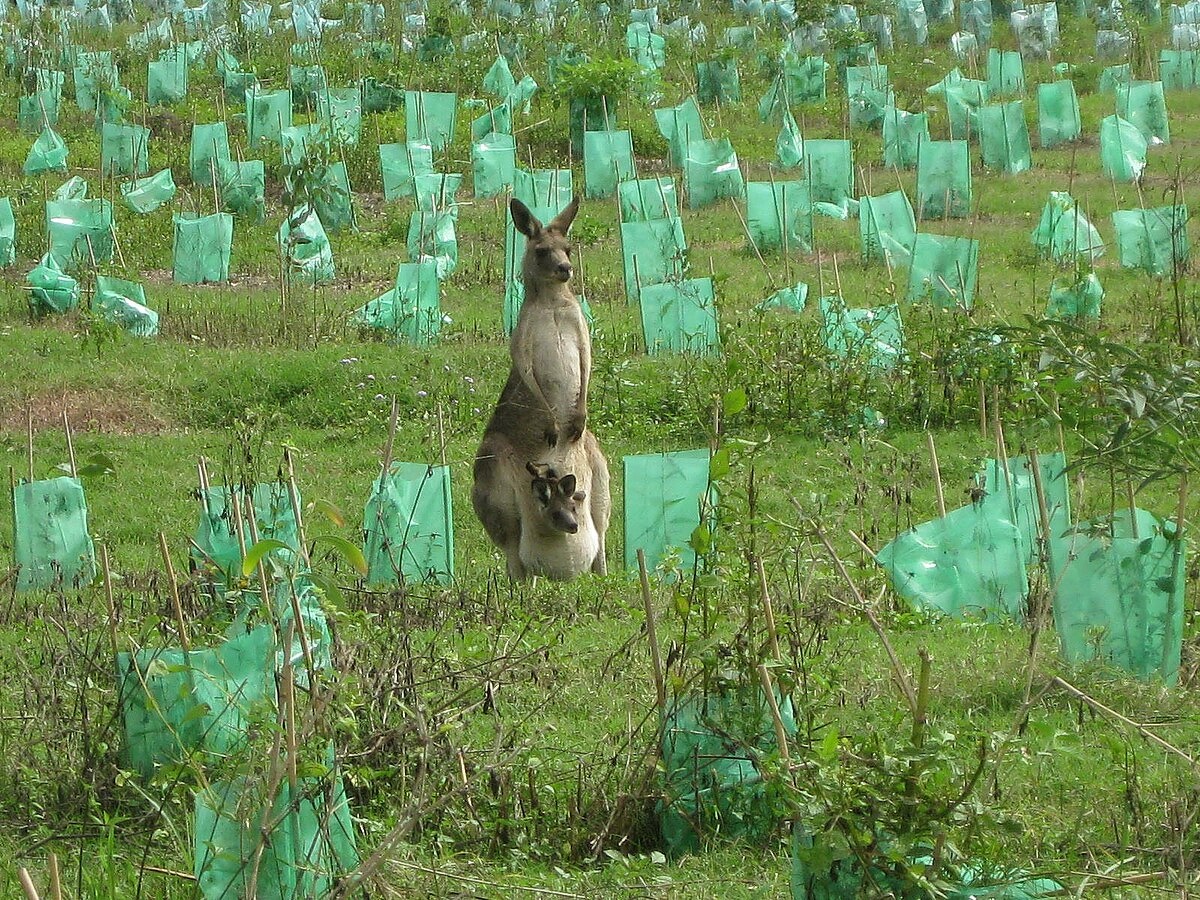
Kangaroo with joey — damaged young trees in background
“The final option is simple execution. A grazier can apply for a permit that authorizes killing a specific number of animals. At the time of my visit, Zanker had one to cull 500 roos. But many graziers with permits hire amateur shooters with no training or accreditation, unlike the marksmen employed and monitored by the industry. That creates its own problems, including thousands of maimed roos each year. “If you own a property,” Zanker says, “you’ve probably got a mortgage. And the bank wants its money. But there’s one animal you’re not allowed to manage, and you’re seeing your whole livelihood getting eaten out from under you. What would you do in that situation? Go and give the keys to the bank manager? Or go and buy a box of bullets?”
“George Wilson says that if roos were privately owned, then graziers — working independently or through wildlife conservancies — would protect the animals, treating them as assets. They could feed them, lease them, breed them, and charge hunters a fee for access. They just need an incentive to do so. “If you want to conserve something,” Wilson says, “you have to give it a value. Animals that are considered pests don’t have value.”
“Privatization could also help reduce grazing pressures. If kangaroos were more valuable than cattle or sheep, farmers would keep less livestock, which could be good for the environment. Under this scenario, landholders would work with the kangaroo industry on branding, marketing, and quality control. The government’s role would be oversight and regulation. Leon Zanker is all for it. “For us, the best outcome is to have a well-managed commercial industry that can keep kangaroo numbers in line with pasture and water conditions. But you’ve got to have the management tools, the ability, to keep things in balance. That’s what landowners right now are screaming out for.”
Kangaroo Culls
Cull means to reduce the population of a wild animal by selective slaughter. Four of Australia’s eight states and territories manage annual quota-based culls that supply meat and leather to kangaroo the industry. (Small-scale trial harvests are also under way in Victoria and Tasmania.) Under the federal code of practice, kangaroos can only be shot in the head, although heart shots are allowed for killing animals which are then wounded. To address the welfare of joeys orphaned when their mothers were shot, the industry moved to a male-only harvest in 2013. According to National Geographic: But As demand for kangaroo products has waned — in part because of publicity efforts by animal welfare organizations — the industry has been taking only a fraction of the annual cull allowed. In 2017 Australia’s total quota was about 7.2 million, yet fewer than 1.5 million kangaroos were shot. [Source: Jeremy Berlin, National Geographic, February 2019]
Li Cohen of CBS News wrote: Australia loves its iconic kangaroos so much that it's willing to kill them. In fact, some ecologists are now warning that doing so may need to soon be a priority. "It keeps the numbers down so that when we do get drought we don't get these welfare issues," ecologist Katherine Moseby told AFP. "If we saw them as a resource and managed them like that, we wouldn't get the catastrophic deaths that we see." [Source: Li Cohen, CBS News, May 10, 2023]
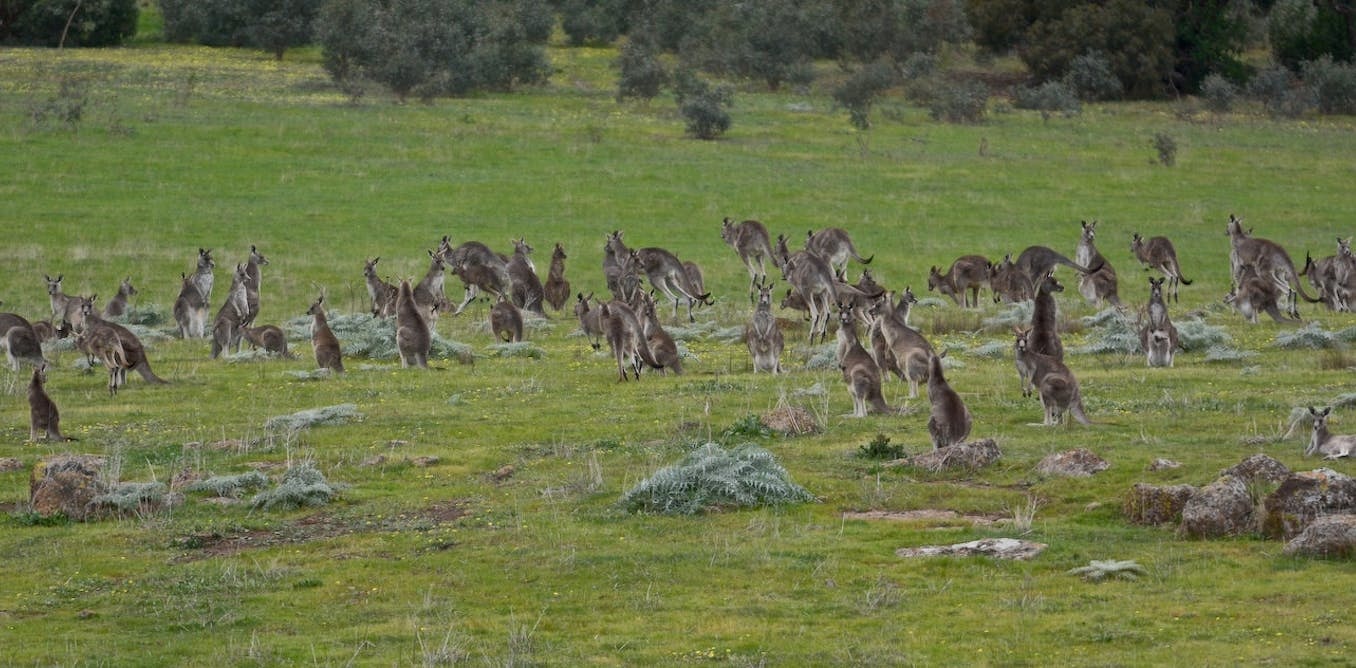
Kangaroo species are protected by the country, but the nation does allow commercial harvesting to kill the animals in small numbers and sell products worldwide. According to King's Kangaroo Industry Association of Australia, commercial harvesting is allowed in six of the eight Australian states and territories that have large populations.
In 1990, when there were almost twice as many kangaroos as people, the government decided to hire roo shooters to cull 5.2 million animals. Animal rights group protested the action, but because the kangaroos had become such pests, wildlife officials felt they had no other choice but to shoot the roos. In 1991, the trend continued, over four million kangaroos were killed with the endorsement of the government. The number of kangaroos that can be killed are based on quota system based on population estimates derived from aerial surveys. More are killed for sport or by farmers who believe that culling doesn't kill enough to protect their animals from overgrazing [National Geographic Earth Almanac December 1992].
Advocates of Kangaroo Culls
"Shooting is considered to be the most effective and humane method to control kangaroos because the animals die quickly and it reduces the numbers rapidly," the Victoria government said in a document about kangaroo population control in 2017, adding that shooting to maintain numbers is done according to national standards. [Source: Li Cohen, CBS News, May 10, 2023]
"Eastern greys are very cute, and a critical part of the ecosystem, but the huge number of kangaroos is destroying the ecosystem," Prof David Lindenmayer, a landscape ecology expert from the Australian National University, told the BBC. "We used to have a huge number of top predators like the Tasmanian tiger. However, indigenous overhunting took them out, and then settlers culled predators like dingoes. Now the bush is a bountiful food locker with lots of grass and water, and few predators other than the car." He says the real problem is that different value sets have clashed. "Animal welfare people care and protect some animals, but there are so many marsupials, they inhumanely starve to death," he says. [Source: Julian Lorkin, BBC, February 15, 2017]
"Commercial harvesting is strictly regulated and monitored to ensure conservation, animal welfare and health and safety standards are upheld," the King's Kangaroo Industry Association of Australia says. "State governments develop unique kangaroo management plans to conserve kangaroos, measure populations, set boundaries for the harvest, outline how it will be regulated and ensure it's not detrimental to the animals or their ecosystems."
Opponents to Kangaroo Culls
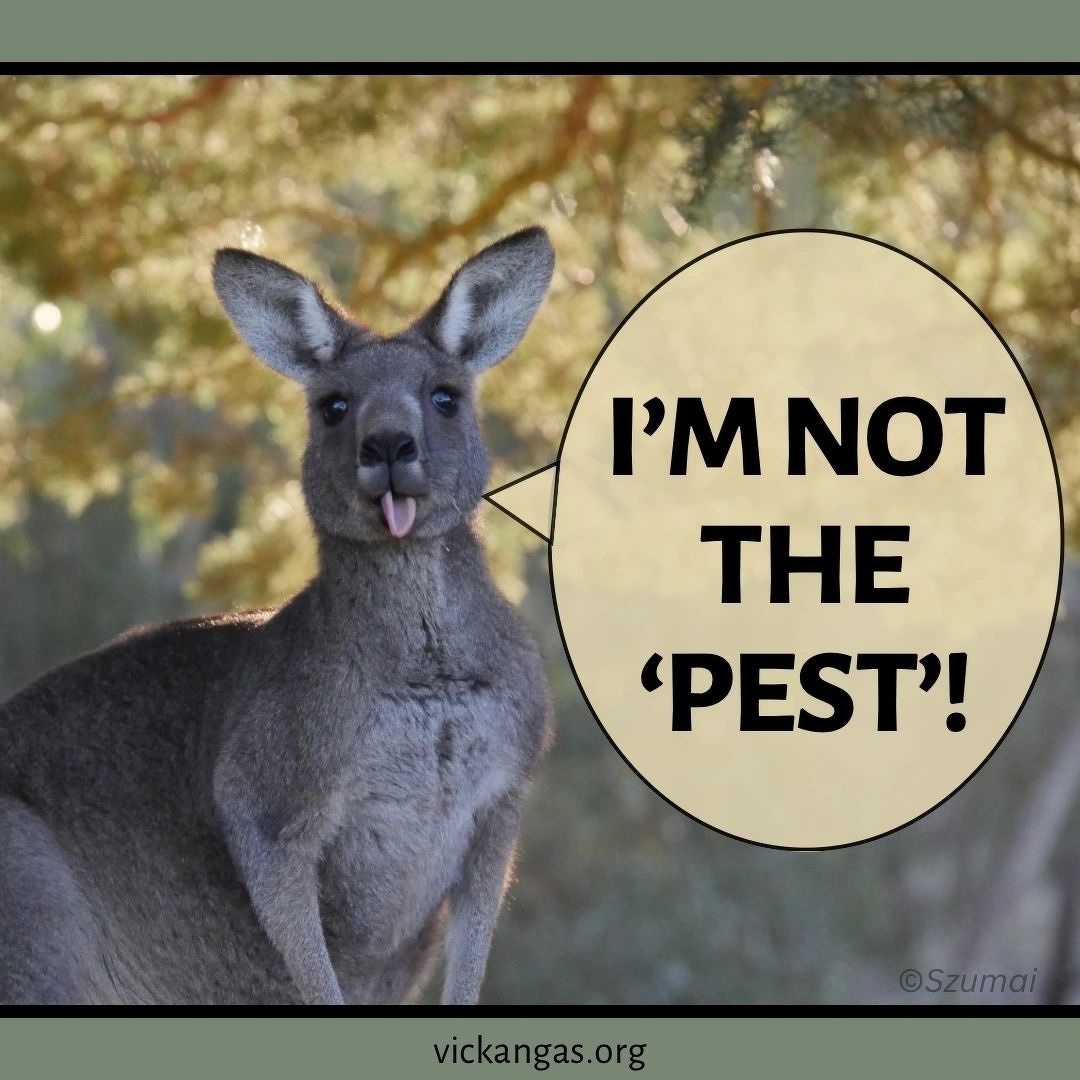
Opponents of culling and the kangaroo industry in general are a vocal minority. Jeremy Berlin wrote in National Geographic, Animal welfare organizations, celebrities, and a growing number of scientists call the culls inhumane, unsustainable, and unnecessary. Population estimates are highly debatable, they say, but “plague proportions” are biologically implausible. Joeys grow slowly, and many die, so kangaroo populations can expand by only 10 to 15 percent a year, and then only under the best of circumstances. [Source: Jeremy Berlin, National Geographic, February 2019]
It has been argued that roo shooting has had little affect on the number of red kangaroos. When adults are killed the are quickly replaced by youngsters that otherwise probably would not have survived. Garry McLean feeds orphaned kangaroos at Horizons Kangaroo Sanctuary in Agnes Water, Queensland. “They’re family animals just like we are,” says Nikki Sutterby of the Australian Society for Kangaroos. “They really suffer when they lose their joey—or when the joey loses its mum.”
Ray Mjadwesch, a scruffy freelance ecologist and critic of the kangaroo industry, says the methodology for counting the animals is flawed. Annual surveys include areas where kangaroos abound. But Mjadwesch says those numbers are extrapolated to places with few if any roos, resulting in inflated population estimates — a claim the industry disputes. “We have all these studies saying there are twice as many kangaroos as humans,” he says. “But look around — they’ve disappeared from the landscape. People only notice where they are. They don’t notice where they’re not.” “Over the past 200 years, he says, “kangaroo management has meant kangaroo shooting. We need a reset on that philosophy.”
"It is often claimed that kangaroos are shot because they compete with grazing animals — but this mass slaughter is purely and simply a commercial kill of Australian wildlife. In 2019, 1.57 million kangaroos were killed for the commercial industry," Animals Australia said in 2023, citing federal data that also showed there was an overall population of more than 42.5 million kangaroos that year. [Source: Li Cohen, CBS News, May 10, 2023]
George Wilson, a leading kangaroo management researcher, told AFP that while he understands the intention in wanting to protect the animals, ending the culling would only "make it worse" for them in the long run. "They say it's unethical, but it's unethical to let them starve to death," he said. "The cruelty is not doing anything about it."
Aboriginal View on Culling
Jeremy Berlin wrote in National Geographic: “Despite their long association with kangaroos, indigenous Australians have little say in how their country treats its national symbol. While there may be no single indigenous stance — groups are too geographically and culturally diverse — most agree that culling is a big concern. Dwayne Bannon-Harrison, a member of the Yuin people of New South Wales, says the idea that kangaroos are destroying the country is laughable. “They’ve been walking this land a lot longer than people have,” he says. “How could something that’s been here for millennia be ‘destroying’ the country? I don’t understand the logic in that.” [Source: Jeremy Berlin, National Geographic, February 2019]
A Gomeroi elder named Phil Duncan says Australia is an odd place: “The only country that eats its coat of arms.” He’s aghast at how kangaroos are treated. “Culling,” he says, “is getting in the way of our ability to teach our next generations about the connection to our country — to our totemic species.” “His solution is simple: Let Australia’s first people have the last word on kangaroo management. After all, they did just fine for thousands of years. “If you’re going to cull kangaroos,” says Duncan, “then there should be an industry. But that industry should be monopolized by Aboriginal people. We’d do it humanely. Give us the licenses. Let us do this.”
“Of course, getting there “would take a huge generational shift in ideologies. It would require a lot of champions within the parliamentary systems. But it could be done.” “In the meantime, Duncan has a more immediate message. “When tourists come to Australia, they want to hug a kangaroo, hold a koala bear, meet an Aboriginal person. All three are interconnected in our lore. Understand that connection. Don’t come out here to kill. Come out here to embrace.”
Roo Shooters
Professional "roo shooters" earn a bounty for every animal they shoot and kill several million kangaroos a year. In 1994, Laura Blumenfeld wrote in the Washington Post: Most of the 1,600 registered kangaroo shooters are part timers. A full time shooter bags between 6,000 and 10,000 kangaroos a year. In the past shooters were paid about $5.00 a carcass. These days they are paid based on carcass weight (about 15 cents a pound) and they shoot only males and large females. [Source: Laura Blumenfeld, Washington Post, December 1994]
About 20 kangaroos have to be shot each night just to break even. On average a shooter makes about $100 a night. In addition to legitimate roo shooting there is also a large amount of illegal of roo shooting done by weekend hunters for the fun of it. It is not known how many kangaroos are killed in this way. Many shooters like kangaroos. Many had pet kangaroos when they were children. They shoot the animals primarily for the money.
In 2019, Jeremy Berlin wrote in National Geographic: “As the sun goes down in rural Queensland, Brad Cooper goes to work. The stout kangaroo shooter pulls his truck off the road and into a paddock about 20 miles east of Mitchell. “We’ll get as many as we can tonight,” he says. “But I don’t like this wind. And neither do they.” “They” are the eastern grays he’s come here to kill. When wind gusts, mobs cluster warily, which makes it harder for shooters to pick off the adult males they’re legally allowed to harvest.
“Commercial shooters have to pass a marksmanship test and receive training on animal welfare and hygiene. Each month they have to report the details of their work to ensure that no harvest exceeds the quota. Cooper is 41 years old. He shot his first kangaroo when he was five. Today he works three nights a week, for six to eight hours at a time. His goal this evening is to kill 30 roos. His single-night record is 104. [Source: Jeremy Berlin, National Geographic, February 2019]
Roo Shooting Techniques
Roo shooters primarily go after red kangaroos, eastern grey kangaroos, western grey kangaroos and common wallaroos. Regulations require that shooters aim at the head with rifles. Handguns, steel-jawed traps, archery are not permitted.
Roo shooters drive around at night in Land Rovers and SUVs with a rack in the back to hang the carcasses. They use powerful beams of light to locate and stun their prey. When a kangaroo is sighted the roo shooter leans out of the window of his truck, rests his powerful rifle on a special padded armrest and dispatches the animal with a shot to the head, killing it instantly.
According to the Code of Practice for the Humane Shooting of Kangaroos of the 1990s, "Shot females must be examined for pouch young and if one is present it must also be killed." Roos shooters don't like the rule because it means they to spend an additional 25 cents for a bullet. Roo shooters prefer bullets with soft lead tips and scope-mounted .222 rifles. They don't like to work on windy nights. Gusts spook the kangaroos and the winds blow the bullets of course.
Roo Shooters in Action
Laura Blumenfeld wrote in the Washington Post in 1994, "The two men set out at 9:00pm...They rumble of the dirt road until a 4-by-6-miles of pasture, bordered by a fence” are reached. The “pastures are full of eyes, blue for sheep, green for cats, orange for foxes, but the jeep is interested in the yellow ones. Johnson is at the wheel, and Hanigan controls the spotlight...They roll past mulga trees with leafless, mangled trunks..."I saw an eye," Johnson says..."There it is” says Hannigan, swinging the light around, immobilizing a buck." "'Big fella,' Johnson says. He reaches for his rifle, Its paws are raised , stick'me up, bang , and the roo takes one last, surprised, jerky leap."
"'He all mushed up in the head,' Johnson says. The bullet struck between the ear and eye, A thick red gel oozes from its mouth. The animals is lying on it side; it kicks, shivers and shakes...'It takes a minute or two to realize it's dead.'...Johnson heaves the carcass hangs it upside down on the first off 44 meat hooks lining the truck. It stinks like spray of a male cat." The next roo is dropped from 120 yards, hit from behind, at the base of its skull. Another falls and another, until five bucks hang in arrow on the back of the truck." Periodically the men stop to gut the kangaroos before their stomach become boated and explodes.
Jeremy Berlin wrote in National Geographic in 2019: “As ragged clouds scuttle overhead, the half-moon plays peekaboo in the night sky. A sharp smell of saltbush fills the air. Cooper sweeps the lights on his truck back and forth, back and forth. A minute later he finds what he’s after. An adult male stands 300 feet away, six feet tall, staring at the truck’s lights as though hypnotized. Boom! The report from Cooper’s rifle rends the night. The kangaroo crumples in a heap.
“Cooper drives to the fallen roo. He yanks the carcass onto the truck bed and hangs it by a rear leg. Working with practiced efficiency, he bleeds the animal, then eviscerates it, inspecting the carcass for lesions or parasites that would compromise its market value. He hacks off the kangaroo’s forepaws, decapitates it, and slices off its tail — a delicacy to Aboriginals that’s left in the red dust. [Source: Jeremy Berlin, National Geographic, February 2019]
“Next comes paperwork: Every shooter must record the date and time of each kill, the name of the property, the species, and all the other information required by the food processor and the state authority. The red tape can be a pain, Cooper says, but it’s worth it. He gets paid 70 cents per kilogram for field-dressed carcasses. Some nights he can make a thousand dollars. When he’s done, he climbs back into his truck and drives on. Two males appear. Boom! Boom! The process repeats.
“A little before midnight the wind kicks up in earnest, and Cooper calls it a night. His final tally: 10 kangaroos. “There’s nothing normal about this job,” he says on the way back to Roma, where he’ll deposit his haul in a “chiller box” — a refrigerated depot where carcasses are stored before they’re processed. The hours are strange, the work brutal. Urbanites look down on his profession. “To them, we’re the lowest of the low,” Cooper says. “But city people are cut off from the animals in their lives. If a dog or a cat needs to be put down, a vet does it. They’re not directly responsible. But we are.”
Contraceptives and Fertility Control for Kangaroos
Fertility control has been used to control kangaroo populations, but according to the Victoria government, it less humane and effective than outright shooting them. Fertility control, the local government says, requires capturing the animals and risking their welfare, and only works for small-area population control.[Source: Li Cohen, CBS News, May 10, 2023]
In 2022, Canberra become Australia's first jurisdiction to rely on contraceptives to reduce kangaroo numbers Environment Minister Rebecca Vassarotti hopes the "more humane" approach will reduce shootings. ABC reported: The ACT has trialled kangaroo contraception since 2015. It involves injecting adult female roos with the drug GonaCon, by firing loaded darts at the animals. [Source: Charlotte Gore, Tahlia Roy, and Lisa Glenday, ABC, April 14, 2022]
Environment Minister Rebecca said GonaCon was long-lasting, and the trials had seen about 80 per cent of female kangaroos remaining infertile five years after their injection. In earlier years, the ACT government had resisted calls to use fertility treatments to cut kangaroo numbers, citing poor effectiveness and much higher costs. The government had hoped that contraceptives could largely replace conservation culling, but it confirmed GonaCon would be used alongside traditional population-control methods such as shootings.
Image Sources: Wikimedia Commons
Text Sources: Animal Diversity Web animaldiversity.org , National Geographic, Live Science, Natural History magazine, Australian Museum, David Attenborough books, Australia Geographic, New York Times, Washington Post, Los Angeles Times, Smithsonian magazine, Discover magazine, The Conversation, The New Yorker, Time, BBC, CNN, Reuters, Associated Press, AFP, Lonely Planet Guides, Wikipedia, The Guardian, Top Secret Animal Attack Files website and various books and other publications.
Last updated July 2025