
Home | Category: Kangaroos, Wallabies and Their Relatives
QUOKKAS
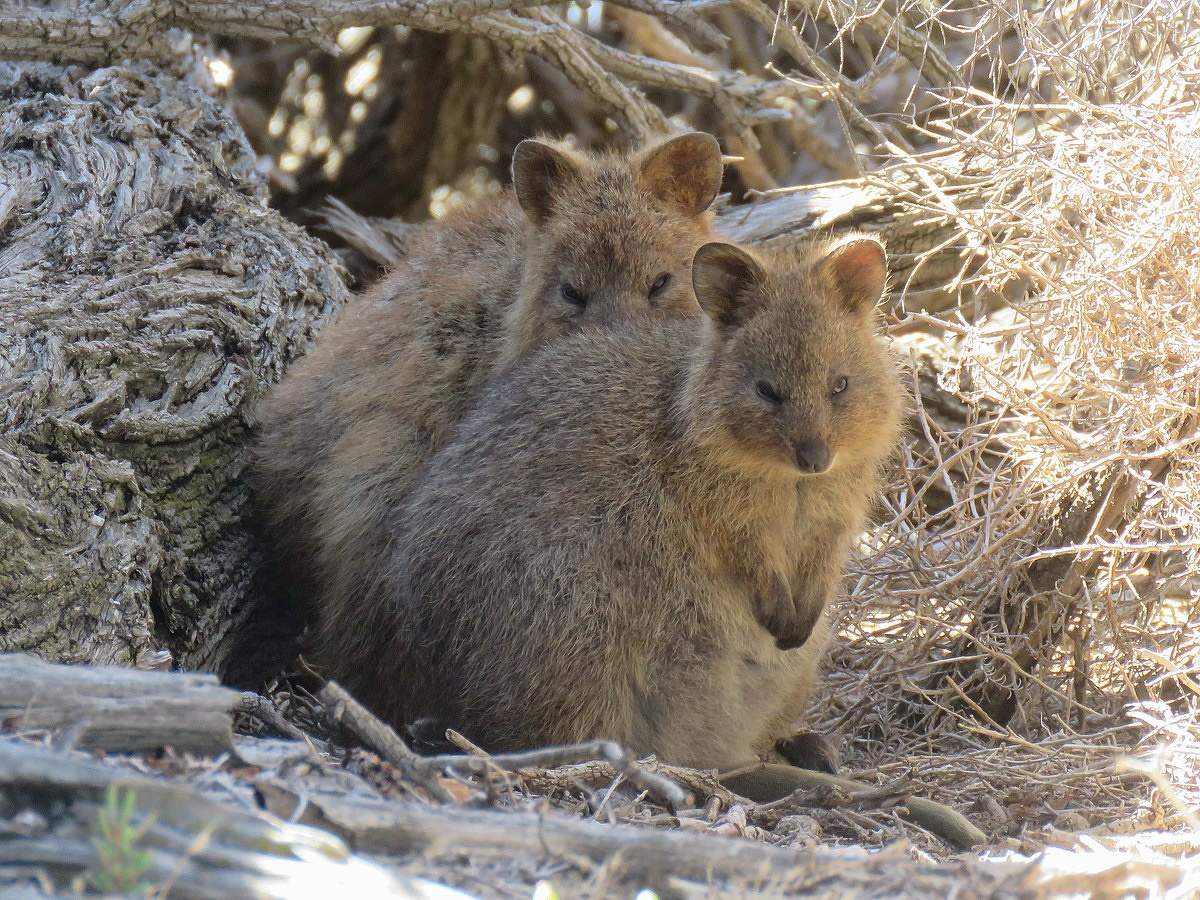
Quokkas at Rottnest Island
Quokkas (Setonix brachyurus) are small, marsupials found only in southwest Western Australia. About the size of a domestic cat, they are particularly abundant on Rottnest Island near Perth. Quokkas are very social animals. They are often found in groups of 100 or more and have been described as the world's happiest and friendliest animals and a are big tourism draw especially on Rottnest Island. People like to take photographs of them because they look like they are smiling at the camera. It is illegal to take them as pets.
Quokkas are the only member of the genus Setonix and one of the smallest wallabies. Like other marsupials, they are herbivorous, have a pouch and are mainly nocturnal. Quokkas are unique in the animal kingdom in that they can regenerate muscle tissue when given large doses of vitamin E.
On the International Union for Conservation of Nature (IUCN) Red List quokkas are listed as Vulnerable. On the mainland, introduced red foxes took a big toll on quokka populations in the 1930s. Dingoes have also been a threat. Human expansion and the resulting degradation quokka habitats have hurt quokkas.
Since quokkas are such a friendly species, unafraid of humans, people sometimes feed them food that is harmful to them. Climate change make also harm them. Although their bodies are good at tolerating dry summers and conserving water, higher temperatures and decreased rainfall could take them to their limit and degrade their habitat and plants there that they depend on for food and shelter. Some models hypothesize quokkas and other species could be gone by 2070. Conservation efforts include preserving and improving natural reserves and parks, managing and promoting the right kind of vegetation growth and controlling red foxes, domesticated cats and dogs as well as wild birds of prey and dingoes. The islands where quokkas live are predator free.
RELATED ARTICLES:
WALLABIES: TYPES, CHARACTERISTICS, BEHAVIOR, REPRODUCTION ioa.factsanddetails.com
KANGAROOS AND WALLABIES (MACROPODS): CHARACTERISTICS, HISTORY, POPULATIONS ioa.factsanddetails.com
WALLABY SPECIES ioa.factsanddetails.com
WALLABY SPECIES OF SOUTHWEST AUSTRALIA ioa.factsanddetails.com
ROCK-WALLABIES: SPECIES, CHARACTERISTICS, BEHAVIOR AND REPRODUCTION ioa.factsanddetails.com
BRUSH-TAILED ROCK-WALLABIES: CHARACTERISTICS, BEHAVIOR AND REPRODUCTION ioa.factsanddetails.com
HARE-WALLABIES: SPECIES, CHARACTERISTICS, BEHAVIOR AND REPRODUCTION ioa.factsanddetails.com
KANGAROO BEHAVIOR: FEEDING, REPRODUCTION, JOEYS ioa.factsanddetails.com
KANGAROOS HOPPING: MOVEMENTS, METABOLISM AND ANATOMY ioa.factsanddetails.com
MARSUPIALS: HISTORY, EVOLUTION, CHARACTERISTICS, BEHAVIOR, REPRODUCTION ioa.factsanddetails.com
MARSUPIALS IN AUSTRALIA ioa.factsanddetails.com
MARSUPIALS IN AUSTRALASIA (AUSTRALIA, NEW GUINEA, NEARBY ISLANDS) ioa.factsanddetails.com
Quokka Habitat, Range and Rottnest Island
Quokkas live on southwestern coast of Western Australia, in areas where rain is plentiful in the winter months from May to August and dry in the summer. On the mainland there are several isolated populations of quokkas live in nature reserves and national parks. Quokkas here are under pressure from climate issues, predators such as foxes and cats, and loss of habitat. Isolated, scattered populations exist in forest and coastal heath between Perth and Albany. A small colony inhabits a protected area of Two Peoples Bay Nature Reserve, where they co-exist with the critically endangered Gilbert's potoroo. Populations are much larger, more healthy and stable on Rottnest Island off Perth and Bald Island near Albany. [Source: Breanne Gartmann, Animal Diversity Web (ADW)]

quokka range
Quokkas like to feed on agonis, a plant that is endemic to southwest Australia, especially found in the northern jarrah forest and Agonis swamp habitat with dense vegetation. Swampy vegetation provides protection for quokkas on the mainland from their predators. Plants such as Gahnia trifida provide refuge quokkas on hot days on Rottnest Island. Due to their need for water, quokkas need be close to freshwater. Quokkas also like scrubland habitats in their early stages after a fire. Post fire new growth, especially 10 to 20 yearsafter a fire, provides a higher nutrient content for quokkas as well as other macropods. After this crucial time period, quokkas have traditionally disperse in search of new habitats, but this is now difficult due on the mainland due predators such as red foxes and human occupation. Since they tend to stay in the same places year-round, quokkas are able to cope with seasonal changes, including semi-arid habitats on Rottnest Island.
Rottnest Island (short 45 minute ferry ride from Freemantle) is where many wealthy Perth residents have beach houses and is a popular area for outdoor sports. The island's name is Dutch for rats nest, a name that was given to it by early Dutch explorers who mistook the quokkas on the island for rats. Quokkas run on the loose on Rottnest island in large numbers and many of them are tame enough to feed by hand. Known locally as "Rotto," the island is 28 kilometers (17 miles) long and five kilometers (3 miles) wide. It is 20 kilometers (13 miles) off the coast from Freemantle. The main tourist spots are Vlamingh's Lookout, named after the Dutch captain who "discovered" the island in 1696; and a number of salt lakes, where quokkas are often spotted.
Quokka Characteristics and Diet
Quokkas are relatively small. They range in weight from 1.6 to 4.2 kilograms (3.5 to 9.25 pounds) and have a head and body length of 40 to 90 centimeters (15.75 to 35.4 inches). Quokkas live about 10 years in the wild and up to 14 years in captivity. Their average basal metabolic rate is 4.695 watts. Sexual Dimorphism (differences between males and females) is present: Males are larger than females. Males weigh between 2.7 and 4.2 kilograms (six to 9.25 pounds) and females weigh between 1.6 and 3.5 kilograms (3.5 to 7.7 pounds). [Source: Breanne Gartmann, Animal Diversity Web (ADW)]
Quokkas are similar in appearance to other marsupials. Females have a pouch for carrying their young. The tail of quokkas, which is 25 to 30 centimeters (10 to 15 inches) long, is shorter than most pther wallabies.. They have coarse, bushy brown fur with a lighter underbelly, and strong hind legs. Quokkas have a large, hunched back and very short arms in front. They have a small head with a naked, black nose and round ears.
Quokkas are herbivores (eat plants or plants parts), frugivores (eat fruit) and granivores (eat seeds and grain). On Rottnest Island, quokkas comes out at night to forage. Depending on the season, adult male quokkas eat an average of 32 to 45 grams of dry food each day. The majority of their diet is comprised of succulents, shrubs, grasses, sedges and forbs (herbaceous flowering plants that are not grasses, sedges or rushes). The leaves they eat contain enough water so quokkas do not need to drink a lot throughout the year. Still they do drink and like to near water. They eat seeds, berries and other fruit if available. The can climb trees up to a meter and a half to forage. Quokkas do not chew their food, but rather they swallow it, regurgitate it and chew the cud.
Quokka Behavior
Quokkas are nocturnal (active at night), motile (move around as opposed to being stationary) and social (associates with others of its species; forms social groups). On the mainland, quokkas live in smaller colonies than on Rottnest Mainland family groups consist of one to two dozen individuals. On Rottnest Island, they live in much larger groups of up to 150 individuals. Quokkas have thick, strong hind legs that allow them to efficiently hop. They are not bad climbers either. to find food. These populations have average home ranges of 6.39 hectares. [Source: Breanne Gartmann, Animal Diversity Web (ADW)]
According to Animal Diversity Web: Although quokkas live in family units, they are not particularly social. Due to limited resources and predation on the mainland, quokkas appear to come together around resources such as fresh water, food and shelter. Especially during the dry season, quokkas tend to expand their living area and feeding environments in order to be closer to freshwater. This species is nocturnal, feeding at night and resting during the day, sheltered from the heat. Quokkas return to the same shelter day to day,
The social structure is different between female and male quokkas. Females tend to avoid each other more, whereas males occasionally come into contact over a female and form a hierarchy based on weight and size, with larger males more dominant. Dominant males occasionally fight other males for shelter.
Quokkas communicate with touch and sound and employ pheromones (chemicals released into air or water that are detected by and responded to by other animals of the same species). They sense using vision, touch, sound and chemicals usually detected with smell. Their sense of color vision is unusually well developed for marsupials. It is believed most wallabies don’t have color vision.
Quokka Mating, Reproduction and Offspring
Quokkas are polygynandrous (promiscuous), with both males and females having multiple partners, practice embryonic diapause (temporary suspension of development of the embryo) and engage in seasonal breeding Female quokkas on the mainland reproduce twice each year, whereas those on Rottnest Island only breed once a year. Breeding peaks between January and March. The number of offspring is usually one. The average gestation period is 27 days.
Female quokkas are usually the ones who choose which male they mate with. If she rejects a male, she run away and the male move on and seeks out another female. If the female reciprocates, she stays with the male and groom him, signalling that she is interested in reproducing. Larger, heavier males are more dominant in the quokka social hierarchy and mate more. Dominant males may fight off subordinate males for females. Only after a male has mated with a female does he defend her. This pair often spends two breeding seasons together; although, females have one to three partners while males keep one to five.
Young are altricial, meaning they are relatively underdeveloped at birth. Parental care is provided by females. Males provide no parental care although they usually defend females that are pregnant with their offspring. After birth joeys moves to their mother’s pouch, where they stay for six, receiving protection and mother’s milk. Average weaning age is eight months. Before that at around six months joeys emerge from the pouch and begins to exploring around. Sexual maturity occurs around eight months for females and thirteen months for males. After giving birth, a mother mates again and embryonic diapause occurs. This new embryo remains dormant for approximately five months. The body of the female detects if the the first joey has survived or not and responds. If the young dies, the embryo implants and develops, and if the joey is alive, the embryo disintegrates.
Rugby Players Accused of Hammer-Throwing Quokkas
In March 2009, players on the Western Force Super 14 rugby team were disciplined after being called before the Super 14 team's disciplinary committee over allegations of mistreating quokkas on Rottnest Island. The Australian reported: Western Australia police and the Rottnest Island Authority launched inquiries after a tourist complained that Force players were "hammer throwing" quokkas, a protected animal, during the team's pre-season camp on the island near Perth. [Source: Bret Harris and Nigel Wilson from The Australian, March 17, 2009]
A Force misconduct committee concluded that no player mistreated a quokka, however four players admitted to picking up quokkas and putting them down. Rottnest Island rangers issued infringement notices to the four players for handling the quokkas, which is against island regulations, resulting in $100 fines. But the Force reactivated its investigation after further serious allegations were made about the mistreatment of quokkas.
The Force said if any further allegations were substantiated, the misconduct committee would be reconvened. The fact the two players will appear before a "higher court" in the form of a board disciplinary tribunal indicates the allegations are very serious. The Force has indicated that sanctions for serious misconduct include a fine, suspension and termination of contract. "We have done an investigation and we believe two players have a case to answer," Force chairman Geoff Stooke said. "They will appear before a board disciplinary committee as soon as possible. We believe there was a situation where animals may have been mishandled and their safety may have been in danger. The positive thing is that we know no animal was injured and that was confirmed by the Rottnest Island Authority."
The island authority confirmed it had investigated a complaint from Don Andrews, a Sydney resident, who spent a night on the island. Andrews, according to both Force management and the island authority, said players had been trying to capture quokkas with a milk crate and had attempted to hammer throw one of the small marsupials by the tail. "Mr Andrews made the complaint to a ranger the night he was on the island," a Rottnest Island Authority spokesperson said. "The ranger went to investigate and could find no injured quokkas or any evidence of the claims made by Mr Andrews. There was another witness who said Western Force players were holding quokkas, but this person said there was no mistreatment. We've no evidence that substantiates Mr Andrews' claim and without that we can't take the investigation any further."
Image Sources: Wikimedia Commons
Text Sources: Animal Diversity Web animaldiversity.org , National Geographic, Live Science, Natural History magazine, Australian Museum, David Attenborough books, Australia Geographic, New York Times, Washington Post, Los Angeles Times, Smithsonian magazine, Discover magazine, The Conversation, The New Yorker, Time, BBC, CNN, Reuters, Associated Press, AFP, Lonely Planet Guides, Wikipedia, The Guardian, Top Secret Animal Attack Files website and various books and other publications.
Last updated July 2025