
Home | Category: Kangaroos, Wallabies and Their Relatives
KANGAROOS AND AUSTRALIA

Australian Boxing kangaroo flag, design used in 1983
According to “The Young Australians Alphabet” from 1871:
“K is that letter that
Makes KANGAROO
He can jump over me
And then over you”.
According to “The Australians Alphabet” from 1905:
“K Stands for Kangaroo
As swift as the gale,
There's a price on his head
For the soup in his tail...”
Kangaroos are pictured on Australian money and the Australian coat of arms. Flags with a picture of a boxing kangaroo are waved enthusiastically by Aussie sport fans at international events like the Olympics. "Skippy, the Bush Kangaroo" — a sort of Australian version of Lassie or Flipper — was a popular television series that ran from 1968 to 1970. "The fate of the kangaroos is inextricably bound with the fate of my country," wrote Tim Flannery in his book “Chasing Kangaroos.” He has argued that these animals not only serve as a symbol of Australia's past but are harbingers of it future in the face of climate change.
There are so many kangaroos at the Yeppon Golf Club in Queensland there is a rule that says, "A ball hitting a kangaroo — play as is." Oxford professor Filipe Fernandez-Armesto has argued that kangaroos could have been domesticated. He wrote: “A friend of mine had a pet kangaroo when he was a boy. After being released into the wild, the kangaroo often returned to visit him, climbed the steps and knocked on his bedroom door.”
The image of a “boxing” kangaroo first appeared in an 1891 cartoon inspired by exhibitions that pitted man against kangaroos. In the late 19th and early 20th century many traveling circuses featured competitions between kangaroos with boxing gloves and professional fighters. In the 1980s a boxing kangaroo by the name of "Killer Williard" was still making the rounds at boat shows and shopping center grand openings in the United States. Challengers who knocked down the kangaroo were sometimes given a prize — that is until the Humane Society stepped in. At a campground in Victoria's Grampians National Park tourist occasionally taunt and challenge local kangaroos to a fight.^^
Kangaroos have inspired human taxonomists. Kangaroo-paws are ground-dwelling plants related to lilies. They are all pollinated by birds. Some flowers point downwards so they can easily be reached by ground-hopping birds. Those that grow tall have stems strong and sturdy enough to support a bird.
RELATED ARTICLES:
KANGAROOS IN MODERN AUSTRALIA: MEAT, LEATHER, CAR COLLISIONS AND ROO BARS ioa.factsanddetails.com
KANGAROO ISSUES: OVERPOPULATION, PESTS, CULLS, SHOOTERS, ANIMAL RIGHTS ioa.factsanddetails.com
KANGAROO ATTACKS: HUMANS, DOGS, HOW, WHY, WHERE ioa.factsanddetails.com
KANGAROOS AND WALLABIES (MACROPODS): CHARACTERISTICS, HISTORY, POPULATIONS ioa.factsanddetails.com
KANGAROO BEHAVIOR: FEEDING, REPRODUCTION, JOEYS ioa.factsanddetails.com
KANGAROOS HOPPING: MOVEMENTS, METABOLISM AND ANATOMY ioa.factsanddetails.com
RED KANGAROOS: CHARACTERISTICS, BEHAVIOR AND REPRODUCTION ioa.factsanddetails.com
GREY KANGAROOS: EASTERN, WESTERN, CHARACTERISTICS, BEHAVIOR, REPRODUCTION ioa.factsanddetails.com
WALLAROOS: SPECIES, CHARACTERISTICS, BEHAVIOR AND REPRODUCTION ioa.factsanddetails.com
WALLABIES: TYPES, CHARACTERISTICS, BEHAVIOR, REPRODUCTION ioa.factsanddetails.com
TREE-KANGAROOS: CHARACTERISTICS, BEHAVIOR AND REPRODUCTION ioa.factsanddetails.com
TREE-KANGAROOS IN AUSTRALIA: BENNETT'S, LUMHOLTZ'S, CHARACTERISTICS, BEHAVIOR AND REPRODUCTION ioa.factsanddetails.com
People Ate Kangaroo 20,000 Years Ago in Northwest Australia
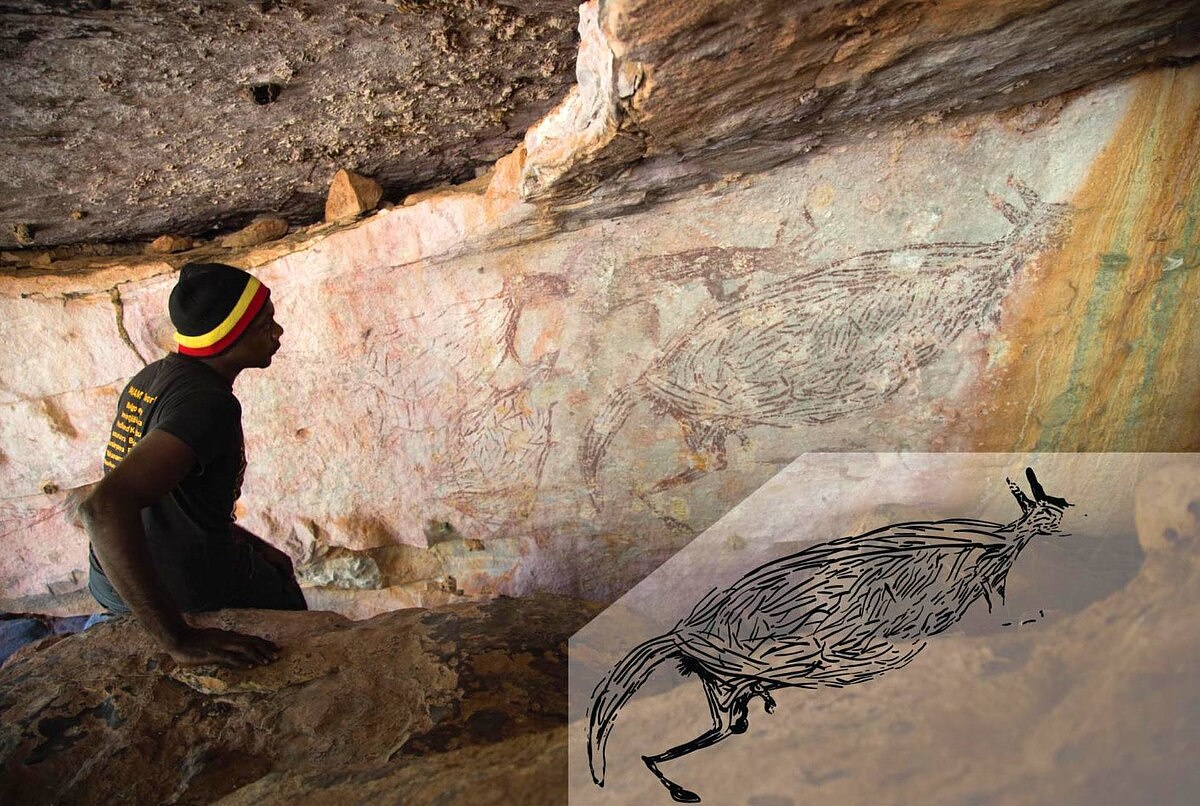
17,300 year old image of a kangaroo from Australia's Kimberley region
In 2018, archaeologists announced they had uncovered a huge trove of ancient artefacts — including evidence of a kangaroo barbecue — inside a remote cave in the far north-west of Australia, 10 kilometers from BHP Billiton’s Mining Area C iron ore mine in the Hamersley Ranges of the West Australian Pilbara region. A team of scientists from Scarp Archaeology and BHP, led by Michael Slack, said: “The guys have just uncovered an ancient campfire that, given the depth below the surface and the relationship with the stones around it, we think is potentially around 20,000 years old,” Dr Slack said. [Source: Ancientfoods, June 20, 2018, Original Article: Karen Michelmore, abc.net.au]
ABC (Australian Broadcasting Corporation) reported: The remnants of the ancient camp fire consist of about 20cm of fine white ash and contains pieces of charcoal which will be sent off for radiocarbon dating. “To make it even better, they found flake stone artefacts right next to the charcoal,” he said. “So we’ll get a really good association between people and the campfire itself, and we’ll have a really clear idea of how old it is.”
It was possible the stone tools were used to cut the meat for the fire, as remnants of kangaroo bone were also found. “We’ll have to have a look at them under the microscope, but they are the pieces that people were using in the site,” Dr Slack said. “A family sitting around a campfire having a meal probably.”
Related Article: PEOPLE WHO LIVED AUSTRALIA 20,000 TO 10,000 YEARS AGO ioa.factsanddetails.com ; ; VERY, VERY OLD AUSTRALIAN AND ABORIGINAL ROCK ART ioa.factsanddetails.com ; EARLY ABORIGINALS ioa.factsanddetails.com ; AUSTRALIAN HISTORY ioa.factsanddetails.com ; MODERN HUMANS 400,000-20,000 YEARS AGO factsanddetails.com
A two-meter-long life-size painting of a kangaroo, completer with anatomically correct genetalia, found in Western Australia’s Kimberley region has been identified as Australia’s oldest intact rock painting. By radiocarbon dating mud wasp nests, under the paint, a University of Melbourne team determined the was 17,500 to 17,100 years old. [Source: University of Melbourne, February 23, 2021]
Australia's Oldest Intact Rock Painting — 17,300 Year Old — Is of a Kangaroo

17,300 year old image of a kangaroo from Australia's Kimberley region
“This makes the painting Australia’s oldest known in-situ painting,” said Postdoctoral Researcher Dr Damien Finch, who pioneered the the new dating technique, which had never been sued before. “This is a significant find as through these initial estimates, we can understand something of the world these ancient artists lived in. We can never know what was in the mind of the artist when he/she painted this piece of work more than 600 generations ago, but we do know that the Naturalistic period extended back into the Last Ice Age, so the environment was cooler and dryer than today.”
The Kimberley-based research is part of Australia’s largest rock art dating project, led by Professor Andy Gleadow from the University of Melbourne. It involves the Balanggarra Aboriginal Corporation, the Universities of Western Australia, Wollongong, and Manchester, the Australian National Science and Technology Organisation, and partners Rock Art Australia and Dunkeld Pastoral. In an article published in in February 2021 in Nature Human Behaviour, Dr Finch and his colleagues detail how rock shelters have preserved the Kimberley galleries of rock paintings, many of them painted over by younger artists, for millennia – and how they managed to date the kangaroo rock painting as Australia’s oldest known in-situ painting.
The kangaroo is painted on the sloping ceiling of a rock shelter on the Unghango clan estate in Balanggarra country, above the Drysdale River in the north-eastern Kimberley region of Western Australia. Earlier researchers looked at the stylistic features of the paintings and the order in which they were painted when they overlapped, and were able to work out from there that the oldest style of painting is what’s known as the Irregular Infill Animal or the Naturalistic period, which often features life-size animals. This kangaroo is a typical example of paintings in this style.
Dr Sven Ouzman, from University Western Australia’s School of Social Sciences and one of the project’s chief investigators, said the rock painting would unlock further understanding of Indigenous cultural history. “This iconic kangaroo image is visually similar to rock paintings from islands in South East Asia dated to more than 40,000 years ago, suggesting a cultural link – and hinting at still older rock art in Australia,” Dr Ouzman said.
Kangaroos and Aboriginals
Aboriginals used to regularly hunt kangaroos. They ate the meat and used the sinews in the tail for bindings on spears and stone implements. The teeth were made into necklaces and fur was twisted into string. In colder areas skins were sewn together into coats. In warm areas they were made into handbags and airtight waterbags.
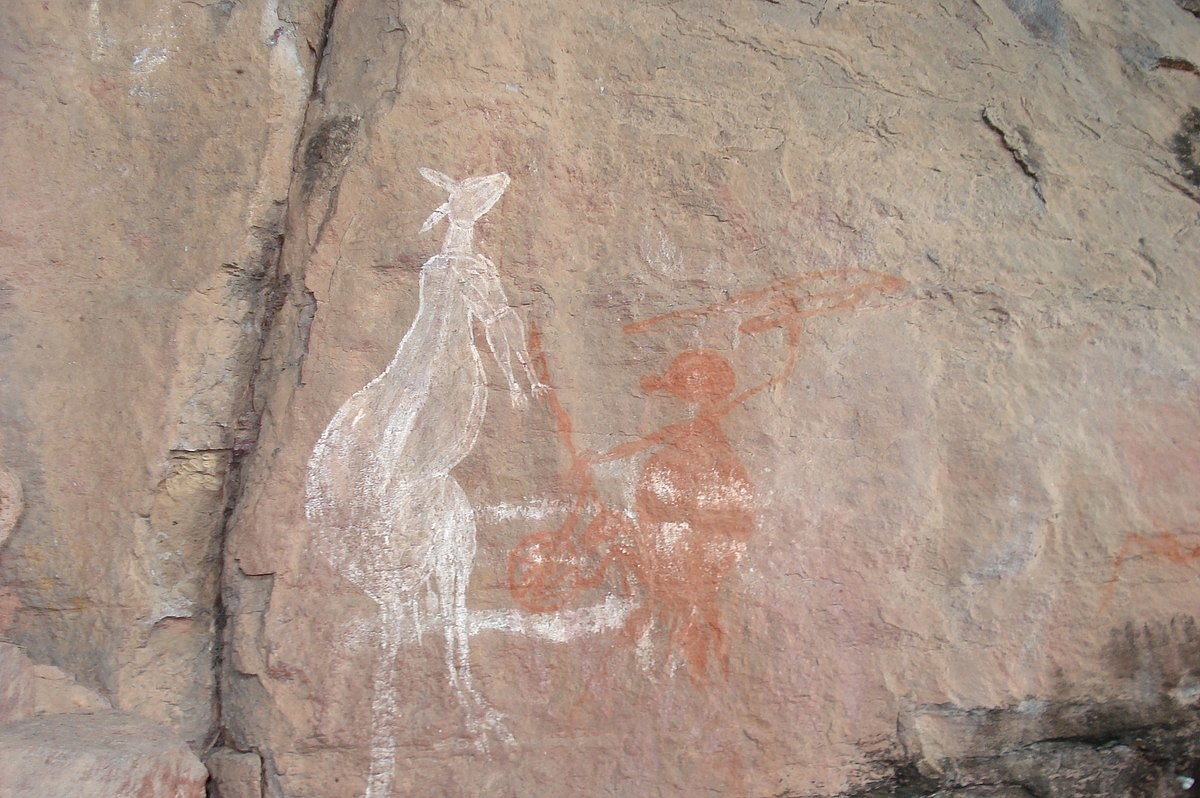
Aboriginal rock art, Nourlangie Rock, Kakadu
Early Aboriginals set bush fires to flush game for hunting. In the process they encouraged the growth of new shoots, the food fancied most by animals. They also gathered witchetty grubs from overturned logs, impaled gouanas, and hunted wombats and kangaroos. Most Aboriginal archeological sites reveal stones tools and fireplaces and little else. A necklace made from kangaroos teeth was unearthed from a 12,000-year-old tomb in Kow swamp in northern Victoria.
Jeremy Berlin wrote in National Geographic: In Woronora, half an hour from Sydney, 82-year-old Yuin elder Uncle Max “Dulumunmun” Harrison is explaining the complex relationship that indigenous Australians have with kangaroos — a cultural, social, and spiritual connection that stretches back at least 50,000 years. Native Australians have always eaten kangaroos, but they’ve done so according to strict protocols. Uncle Max says indigenous law permits hunting, but only seasonally and not during times of breeding. Nor should anything be wasted. Every part of a kangaroo should be used: meat for eating and sharing; sinew for making thread; skin for warm, waterproof garments, sewn with needles made from the bones; fur for bags and clothing. [Source: Jeremy Berlin, National Geographic, February 2019]
“But the relationship is about more than utility. Kangaroos are central players in the rich symbolic world Aboriginals call the Dreamtime — stories that explain life and creation. Songlines are part of this — paths across the outback that mark the routes traveled by ancestors. Uncle Max says kangaroo culls are damaging these tracks.
Europeans Discover Kangaroos
The first Europeans to see kangaroos were the crew on the “Batavia”, a ship under the Dutch navigator Francisco Pelsert that wrecked off the coast of western Australia in 1629. Some of the large macropods have thrived since European colonization, while others have declined as a result of hunting, habitat destruction, and predation and competition by introduced species. A few species have been lost entirely. According to legend the word "kangaroo" comes to us via Captain James Cook who asked some Aboriginal what this strange hopping animal was. It now turns out that "kangaroo" may actually have meant "I don't understand" in the local Aboriginal dialect.
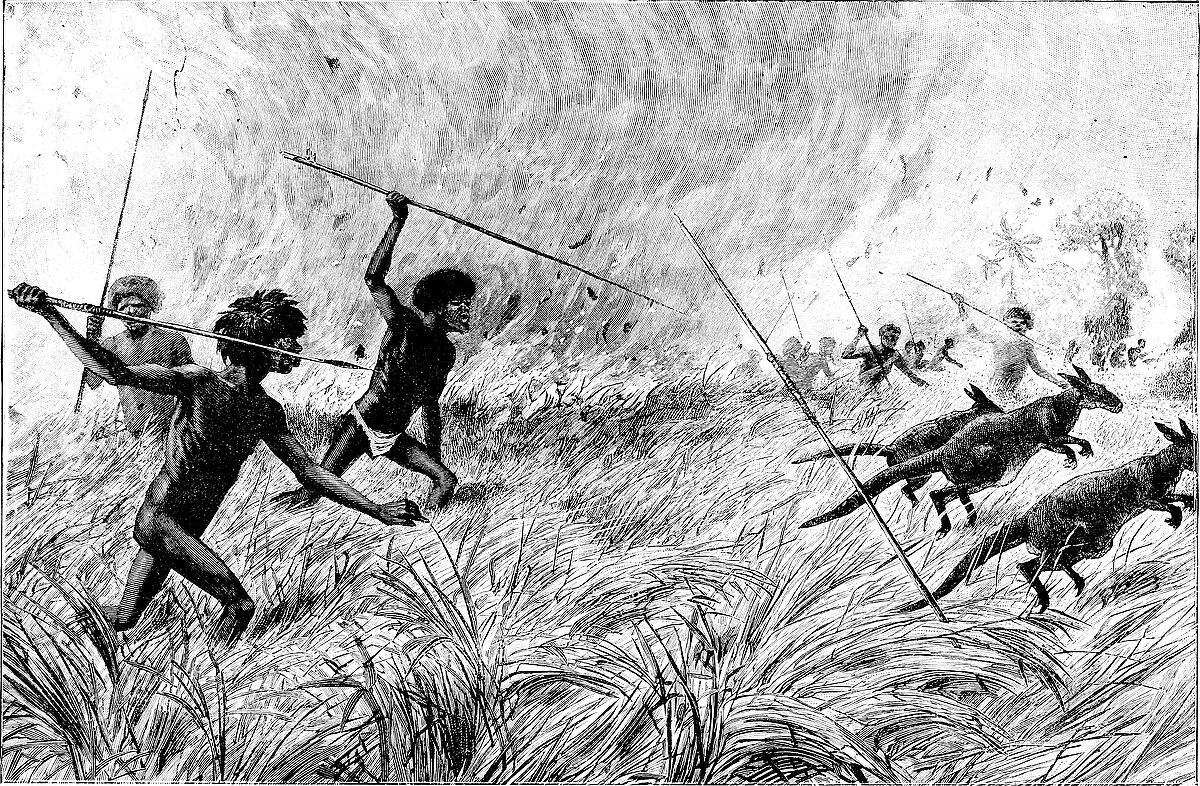
Aboriginal kangaroo hunt (1897)
Joseph Banks and Daniel Solander were key figures in James Cook's first voyage (1768-1771) aboard the HMS Endeavour, which stopped on the east coast of Australia. Richard Conniff wrote in Natural History magazine: Throughout the eighteenth century, astonishing creatures from distant regions seemed to turn up in London almost daily — the first zebra, the first giraffe, the first moose — each adding fuel to the raging national passion for the wonders of the natural world. In 1771, Banks and Solander brought back thousands of plant and animal specimens after three years traveling around the world with Captain James Cook on the Endeavour. Among their prizes were the skin and skull of a large creature with a head like a deer, said to rise up on two legs. It was also said to use those legs to go bounding across the grasslands of Australia like a hare, but with its long, heavy tail serving for balance. Banks announced it to the outside world with a borrowed Aboriginal name: "Kanguru." [Source: Richard Conniff, Natural History magazine, March 2008]
When the first live kangaroo was brought to Europe in 1791 it created such a stir that a mob of people stormed the London theater where it was being displayed. British travelers started bringing kangaroos back to Europe toward the end of the 18th century; by 1820, herds of them were wandering some English parks.
Early European settlers hunted kangaroos for food. Sheep and other livestock were considered to valuable to eat. When mutton and beef became fixtures of the dinner table, eating kangaroo meat was associated with being poor. Later hunting kangaroos became a sport. "Coursing clubs" were formed to hunt them on horseback and special kangaroo digs were bred to chase and corner the animals.
Kongouro from New Holland
“The Kongouro from New Holland' by George Stubbs was commissioned by Sir Joseph Banks (1743–1820) following his participation on Captain James Cook’s first voyage to the Pacific (1768–71). The painting was executed by George Stubbs (1724–1806), the foremost animal painter in Britain during the 18th century, within two years of Banks’ return. Banks’ decision to engage Stubbs so soon after his return in 1771 is testimony to the artist’s reputation as the foremost animal painter in Britain, and to the importance that Banks attached to kangaroos.
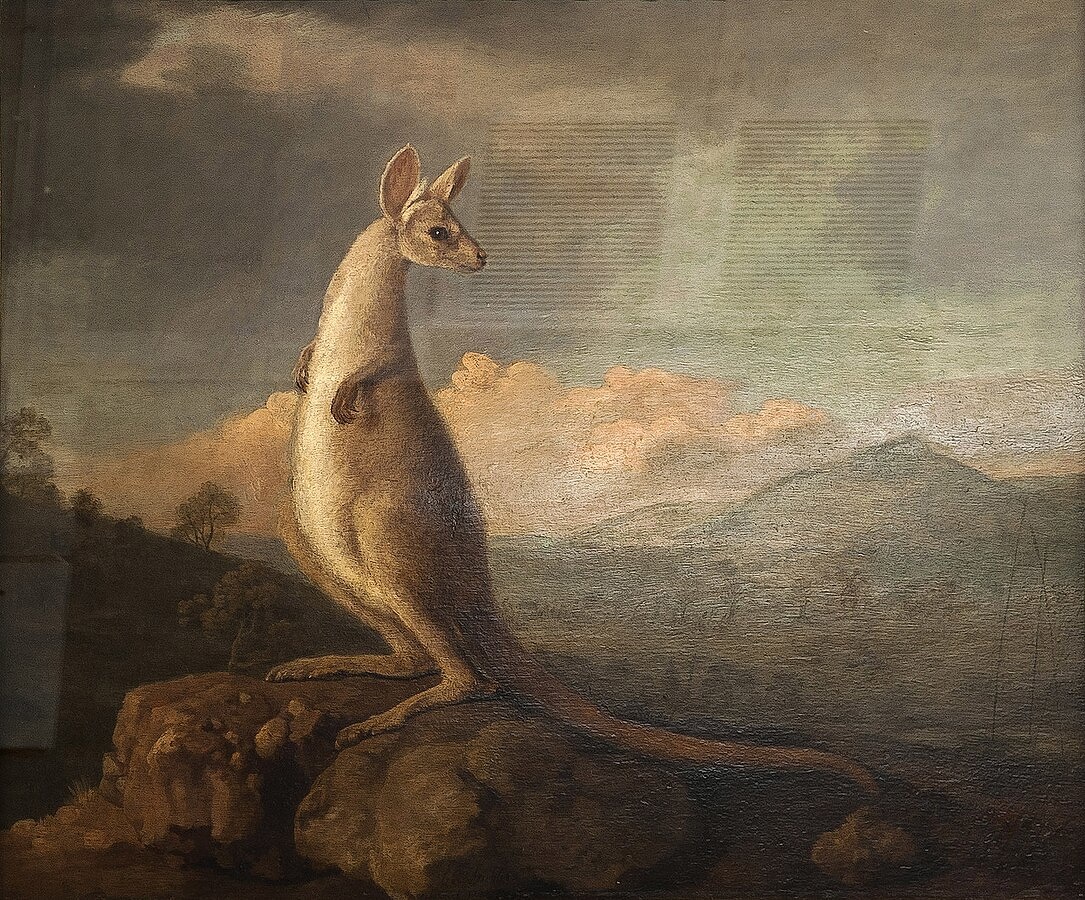
“The Kongouro from New Holland' by George Stubbs
Stubbs’ equestrian portraits may be more widely known today but the artistic importance of his ‘exotic’ subjects cannot be overestimated. Together with his anatomical studies, and more than the work of any other artist, Stubbs’s considerable painted menagerie of rare and unknown species (mainly from collected living examples then in Britain) embodies the interconnected status of the arts and natural sciences during the later 18th century. ‘Kangaroo’ and ‘Dingo’ are the only painted portraits by Stubbs of animals native to Australia, and the only occasion on which he was unable to observe his subject from life.
In the absence of live models, the artist worked from written and verbal descriptions provided by Banks himself and, in the case of the kangaroo, a small group of slight pencil sketches made by Parkinson and a stuffed or inflated pelt (now lost) that was in Banks’ possession. Stubbs exhibited both paintings at the Society of Artists in London in 1773, thus bringing to public attention two previously unknown animals that quickly became closely identified with the new world of Australia.
Later the same year, an engraving after the image of the kangaroo was used to illustrate John Hawkesworth’s ‘An account of voyages undertaken … for making discoveries in the Southern Hemisphere’ (1773). This was the first major publication emanating from Cook’s voyage, creating great public and scientific excitement about and interest in the Pacific. The image was engraved many more times and subsequently became the standard visual representation of the kangaroo throughout the 19th century.
Skippy the Bush Kangaroo
“Skippy the Bush Kangaroo” — known simply as as Skippy — was an Australian television series created by Australian actor John McCallum, Lionel (Bob) Austin and Lee Robinson. Produced from 1967 to 1969 and aired from 1968 to 1970, it was about the adventures of a young boy and his highly intelligent pet kangaroo, and the various visitors to the fictional Waratah National Park. It was filmed in today's Waratah Park and adjoining portions of Ku-ring-gai Chase National Park near Sydney. [Source: Wikipedia]
Ninety-one 30-minute episodes were produced. Additionally, a full-length film titled “Skippy and The Intruders” was released to theatres in 1969. "Skippy", the show's namesake star, was a female eastern grey kangaroo, who was befriended by 9-year-old Sonny Hammond, who with 16-year-old brother Mark are the children of widower Matt Hammond, the Head Ranger of Waratah National Park. The stories revolved around events in the park, including its animals, the dangers arising from natural hazards, and the actions of visitors (featuring numerous stars, predominately of the period in guesting roles). The boys' mother is said (in Episode 48 "The Mine") to have died shortly after Sonny was born.
The small and unusually intelligent Skippy was not a pet and it was often reiterated in the series that Skippy lived in the park and was free to come and go as she pleased. Skippy was found in the bush as a baby by Sonny — an orphan, her mother having been killed by shooters. It was always understood that once Skippy was old enough to look after herself she would go back to the bush, but a strong bond had been built up between Skippy and Sonny and the rest of the Hammond family. Skippy was a remarkable kangaroo. Capable of near-human thought and reasoning, she could understand everyone, open doors, carry things in her pouch, cross streams on narrow logs, foil villains, rescue hapless bushwalkers, untie ropes, collect the mail and even operate the radio. In one episode she plays drums in a band, in another she places a bet — and wins — on a horse at Randwick Racecourse.
Hospitals and Volunteer Groups That Help Kangaroos
Jeremy Berlin wrote in National Geographic: “Howard Ralph, a tall, trim doctor, sits in his drafty waiting room. He and his wife, Glenda, turned their land in Braidwood, an hour’s drive from Canberra, into a wildlife sanctuary in 2001. Today, aided by a small army of volunteers, Southern Cross Wildlife Care treats more than 2,000 animals a year. Over half are kangaroos. “Our main objective in life is animal welfare,” Ralph says. “We try to help these critters and get them to a state where they can be released back into the wild. We don’t discriminate among species. And we don’t give up easily.” “That means treating pain and managing stress, which can be fatal issues. Kangaroos, especially eastern grays, get stressed easily and can develop kidney failure and heart disease. “We see it all the time,” Ralph says.[Source: Jeremy Berlin, National Geographic, February 2019]
“They also see a lot of cruelty: kangaroos that have been shot in the face, hit with an ax, deliberately run over by a truck. Some can’t hop because of compound fractures to their legs. “In this so-called civilized country,” Ralph says, “things are done that shouldn’t be done. Sadly, a lot of it goes on not because there’s some population explosion. It happens because people think it’s funny or enjoyable to torment little creatures. We should be beyond the point where cruelty is acceptable. Under any circumstances.”
“Across Australia, dozens of roo refuges have popped up in recent years. Like Southern Cross, most are charities in the purest sense: Virtually every cent goes toward medicine and utilities. Ralph says he’s realistic about people’s views toward kangaroos, but hopeful that things may be getting better. “I think the general population is gradually changing,” he says. “Twenty years ago, few people thought these critters deserved to be respected. But there’s a growing awareness that they suffer pain. And we need to understand that and treat them accordingly.”
In the Capertee Valley, a few hours north of Canberra,Ray Mjadwesch, a scruffy freelance ecologist is standing in a thickly wooded plot, feeding a scrum of kangaroos on a nippy spring night. Twenty juveniles are jostling for the horse feed in his open hand. “Come on, guys!” says Mjadwesch. “No fighting. You’re all herbivores.”
“Six weeks earlier these roos lived 50 miles away, in Bathurst. That’s where Mjadwesch lives too, with his wife, Helen Bergen. Two years ago the couple led a massive volunteer effort to relocate hundreds of kangaroos from Mount Panorama, the site of a major international racetrack. Officials there wanted to kill the animals, but after years of bitter wrangling, Mjadwesch and Bergen gained permission to relocate them. Time will tell if it worked. The translocation may have disrupted family groups, and it’s unclear whether the roos will stay in their new home. Some have already dispersed, causing residents to complain about the new neighbors.
Brad Smith, from the Upper Hunter Wildlife Aid group takes in rescues orphaned joeys, many whose mother’s were killed in culls. "That pouch is well padded, and saves the joey, even if their mother is killed by a car, and leaves the youngster alive," he told the BBC. According to the BBC: Mr Smith feeds the joeys and distributes them to foster homes. Hand-rearing kangaroos is a labour-intensive process which can take up to two years. They are then released back into the wild, to face hunters again. Foster homes for joeys abound in the mining towns of the Hunter Valley, where the animals spend months in artificial pouches on A-frames. Over a decade Mr Smith has spent nearly A$40,000 (£24,000; $30,000) making the frames. "They always have to be raised in twos so they know what another roo looks like. A pair will buddy up and recognise their own species, and when released they will become accepted by a group. On their own, they think they are human, and bound towards hunters." [Source: Julian Lorkin, BBC, February 15, 2017]
Kangaroo Saves Man's Life
In September 2003, a kangaroo saved the life of farmer Len Richards of Morwell, eastern Victoria by alerting his family that he was lying unconscious nearby. He had been checking a tree in a paddock about 300 meters from the house during stormy weather, when he was hit on the head by a falling branch and knocked unconscious. The Australian chairty RSPCA said the rescuing roo — a 10-year-old western grey kangaroo named "Lulu" — had been the family's pet for years and was later awarded the National Animal Valor Award. [Source: News24.com, September 22 2003]
News24.com, reported: The kangaroo began banging on the door of the family home in Morwell, during weekend storms in the area, Rural Ambulance Victoria paramedic Eddie Wright told a Melbourne radio station. The man was knocked unconscious and could have died had he not been found so quickly, Wright said. "The kangaroo alerted them to where he was and went and sat down next to him and that's how they found him," he said. "The farmer's wife followed the kangaroo because he was acting out of character."
The kangaroo was wild, Wright said, but had been adopted by the family around a decade ago because it was blind in one eye. The incident has prompted comparisons with the old Australian children's TV show Skippy, about a kangaroo that solves crimes. "It's not a pet as such, it's just an animal that's adopted them over the years and comes and goes as it pleases, they were lucky yesterday it was in the area," said Wright. Richards was taken to hospital in Melbourne where he was receiving treatment for serious head injuries.
Image Sources: Wikimedia Commons
Text Sources: Animal Diversity Web animaldiversity.org , National Geographic, Live Science, Natural History magazine, Australian Museum, David Attenborough books, Australia Geographic, New York Times, Washington Post, Los Angeles Times, Smithsonian magazine, Discover magazine, The Conversation, The New Yorker, Time, BBC, CNN, Reuters, Associated Press, AFP, Lonely Planet Guides, Wikipedia, The Guardian, Top Secret Animal Attack Files website and various books and other publications.
Last updated July 2025