
Home | Category: Aboriginals
TORRES STRAIT ISLANDERS
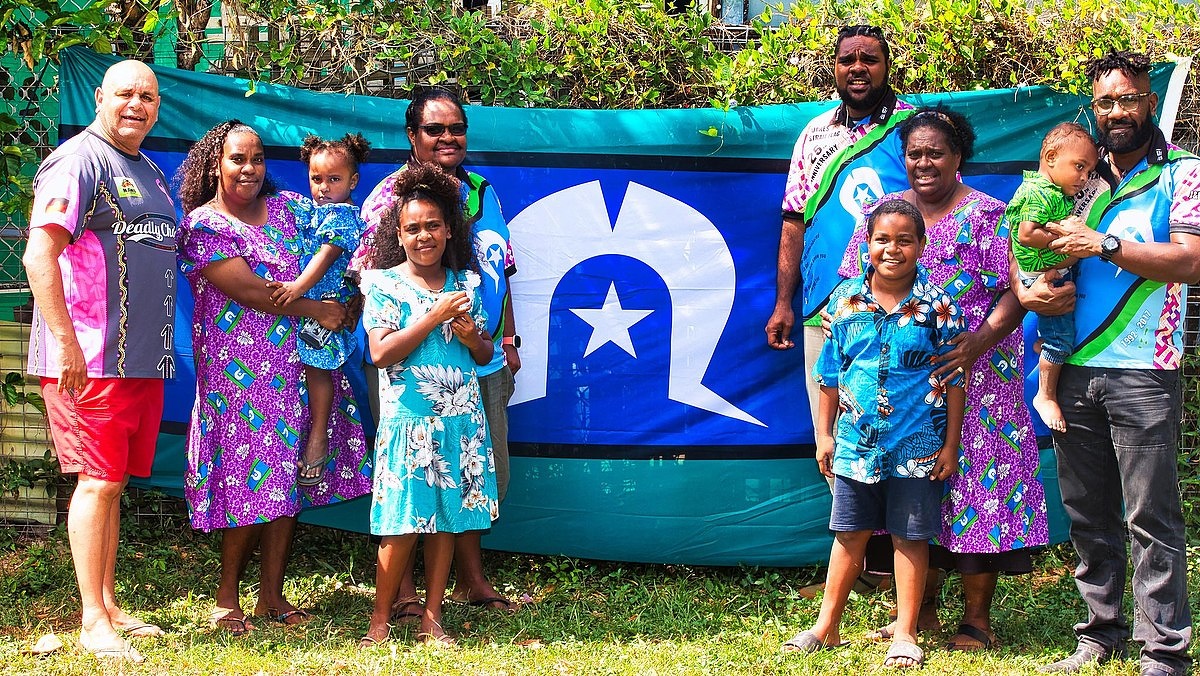
Torres Strait Flag Day in 2021
Torres Strait Islanders are a people of Melanesian descent who inhabit the islands between northeast Australia Queensland and Papua New Guinea. They are culturally and ethnically distinct from Australia's Aboriginal peoples, with their own languages and traditions. Known as skilled seafarers, farmers, and traders, Torres Strait Islanders preside over a rich, vibrant culture that includes traditional art, dance, and songs that are passed down through generations. In many ways they are more similar to the people of New Guinea than Aboriginal Australians.
Torres Strait Islander culture is centered around the sea, with traditional navigation, fishing, and trading forming a big part of their traditional life but they also practice agriculture. The islands have been inhabited for thousands of years but sustained European contact began only in the mid-19th century, with significant impacts from the pearl shell industry. Their art includes sculpture, printmaking, and mask-making. The islands and their inhabitants are among the most famous of ethnographic subjects as a result of the Cambridge University expedition of 1898, organized and led by A. C. Haddon.
Named after its Spanish discoverer, Captain Luis Baez de Torres, who first explored the region in 1606, the Torres Strait connects the Coral and Arafura and is situated between the southwestern coast of Papua New Guinea and Australia's Cape York. Of the more than 100 islands in the strait, only about 20 have ever supported permanent populations; the remainder are too small or lack the resources necessary for long-term habitation. The inhabited islands fall into four basic physical types. The Western Islands are large, elevated, and well-watered, their shorelines lined with mangrove swamps. The Central Islands are low sand cays formed on coral reefs. The Eastern Islands are small volcanic outcrops with fertile soils. To the north, close to the coast of Papua New Guinea, lie large, low-lying islands dominated by mangrove vegetation, which are fertile but prone to frequent flooding.[Source: Nancy E. Gratton, “Encyclopedia of World Cultures, Volume 2: Oceania,” edited by Terence E. Hays, 1996 |~|]
The islands are facing significant challenges from climate change, including rising sea levels, which threaten the environment and the Islanders' way of life. Despite such challenges, there is a strong focus on preserving culture and traditions, with indigenous languages now included in the national curriculum.
RELATED ARTICLES:
ABORIGINALS (FIRST NATION PEOPLE) OF AUSTRALIA: NAMES, DEMOGRAPHICS, LANGUAGES ioa.factsanddetails.com
ABORIGINALS IN QUEENSLAND: SOME GROUPS, CUSTOMS, LIFESTYLES ioa.factsanddetails.com
WIK MUNGKAN PEOPLE OF NORTHERN QUEENSLAND: HISTORY, CUSTOMS, LIFE ioa.factsanddetails.com
ABORIGINAL AUSTRALIANS IN NORTH NORTHERN TERRITORY: SOME GROUPS, CUSTOMS, LIFESTYLE ioa.factsanddetails.com
YOLNGU OF ARNHEM LAND: HISTORY, MUSIC, TRADITIONAL LIFE, CUSTOMS ioa.factsanddetails.com
TIWI PEOPLE OF NORTHERN AUSTRALIA: HISTORY, CUSTOMS, TRADITIONAL LIFE ioa.factsanddetails.com
EARLY MODERN HUMANS IN AUSTRALIA ioa.factsanddetails.com
LIFE OF EARLIEST HUMANS IN AUSTRALIA: TOOLS, WEAPONS, ART, SETTLEMENTS ioa.factsanddetails.com
AUSTRALIAN ABORIGINALS AT THE TIME EUROPEAN COLONIZATION BEGAN ioa.factsanddetails.com
AUSTRALIA ABORIGINALS FROM 1900 TO PRESENT: DISCRIMINATION, ASSIMILATION, SOME RESTITUTION ioa.factsanddetails.com
AUSTRALIA’S STOLEN GENERATIONS: VICTIMS, LAWS, RATIONALE, OUTRAGE ioa.factsanddetails.com
AUSTRALIAN ABORIGINAL RELIGION: TRADITIONAL BELIEFS, DEMOGRAPHY AND DEATH ioa.factsanddetails.com
AUSTRALIAN ABORIGINAL CUSTOMS, SOCIETY AND RITUALS ioa.factsanddetails.com
ABORIGINAL LIFE: WHERE THEY LIVE, WORK, DIET, HEALTH, ALCOHOL ioa.factsanddetails.com
TRADITIONAL ABORIGINAL LIFE: FOOD, HOMES, HUNTING ioa.factsanddetails.com
ABORIGINAL MEN AND WOMEN: GENDER, MARRIAGE ioa.factsanddetails.com
ABORIGINAL AUSTRALIAN SEX: PRACTICES, ATTITUDES, ADOLESCENCE ioa.factsanddetails.com
ABORIGINAL AUSTRALIAN ART ioa.factsanddetails.com
Torres Strait Islander Population and Languages
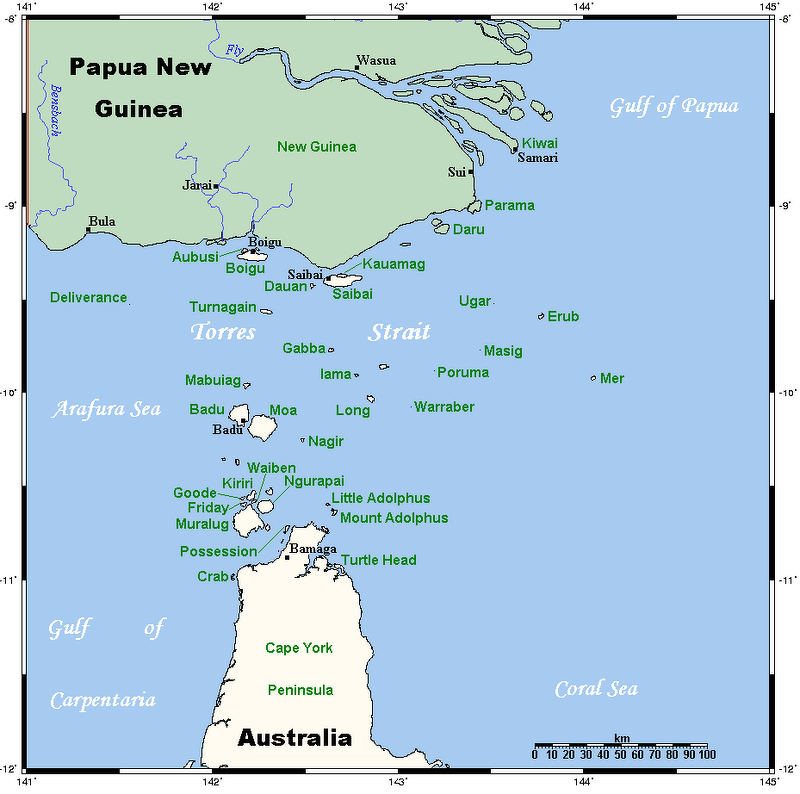
Torres Strait Islands
There are about 1 million Aboriginals and Torres Strait Islanders in Australia. Of these 4.2 percent (42,000) people identify as Torres Strait Islander only and 4.8 percent (48,000 people) identify as both Aboriginal and Torres Strait Islander. While many Torres Strait Islanders still live on the islands, a significant population — the "Torres Strait diaspora" — lives on the Australian mainland.
Key Torres Strait Islander languages include Kalaw Lagaw Ya and Meriam Mir, with Yumplatok (Torres Strait Creole) serving a lingua franca for trade and commerce and a language in its own right. The largest Aboriginal and Torres Strait Islander language by number of speakers is Yumplatok, with 7,596 speakers according to the 2021 Australia census. Yumplatok is a creole language spoken in the Torres Strait and parts of the Cape York Peninsula. It is a new language that developed from contact between Indigenous languages and English.
Meriam Mir (or Miriam), the Language of the Eastern Torres Strait Islands, is a member of the Eastern Trans-Fly Family, made up mostly of languages in New Guinea. On the other islands the language spoken (Mabuiag) contains a mix of Melanesian and Aboriginal linguistic elements. [Source: Nancy E. Gratton, “Encyclopedia of World Cultures, Volume 2: Oceania,” edited by Terence E. Hays, 1996 |~|]
Torres Strait Islanders History
Most evidence appears to indicate that Torres Strait Islands were originally settled by people from New Guinea, but linguistic and material cultural evidence suggests ties to Australian Aboriginal peoples that go far back in history as well. In any case the islanders traded with both New Guinea and Aboriginal neighbors long before Europeans arrived, and the legacies of these exchanges remain embedded in Torres Strait material culture and social life today. [Source: Nancy E. Gratton, “Encyclopedia of World Cultures, Volume 2: Oceania,” edited by Terence E. Hays, 1996 |~|]
Warfare, headhunting, and raiding were once common throughout the Torres Strait, supported by traditional beliefs that the taking of a human head marked a boy’s passage into full manhood. Raids were typically justified as acts of revenge for insults or injuries to one’s group, though over time enmities between particular islands or communities hardened into long-standing traditions. Conflict was carried out with bows and arrows, stone clubs, and braided cane shields. Warriors adorned themselves with distinctive feathered headdresses and shell ornaments. Before setting out, raiding parties consulted medicine men for magical assistance to ensure success, and dances and chants were later composed to celebrate victory. Colonial pacification and missionary influence eventually suppressed warfare and headhunting, bringing these practices to an end.
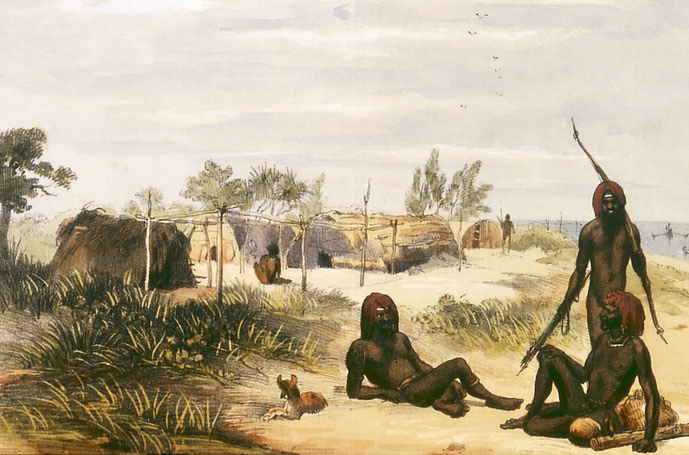
Illustration of Torres Islanders and their dwellings in 1849
The islands were first sighted by Europeans in the early 1600s but were largely ignored until the 1770 voyage of Captain Cook, shortly after which the straits became regularly traveled. These early contacts were largely incidental to the European use of the straits en route elsewhere, such as the British colony of New South Wales. By the middle of the 1800s, however, the straits attracted trepangers and pearlers whose impact upon island life was rather more dramatic: Islanders were forced to work, and women were often abducted. By 1863, Queensland had established a colonial post in the islands, and in 1871 the London Missionary Society landed teachers on Darnley Island. Conversion of the islanders to Christianity and to participation in the pearling industry was swift.
The conflicting goals and aims of the colonial administration vis-à-vis those of the society resulted in the withdrawal of the society and the entry of the Anglican church. Pentecostalism, introduced by islanders who had worked on the mainland, began attracting a strong following in the Islands by the late 1930s. The annexation of the islands by Queensland was completed by 1879. In 1898, elected Councils were established, but economic control of island life remained, and still largely remains, in outsiders' hands. Islanders participated in World War II, and memories of those "army days" inspired islanders to the effort of gaining full citizenship and civil rights — an effort that continues to this day.
At the time of European contact, the Torres islands supported an estimated 4,000–5,000 people, in settlements ranging from under 100 to more than 800. By the late 1800s, numbers had fallen to around 3,000, due to disease, overwork, and harsh treatment in the pearling and trepang industries. The first official census in 1913 recorded 2,368 islanders. More recent population figures are complicated by questions of identity and classification, but the 1981 Commonwealth census reported 15,232 Torres Strait Islanders, about half of whom were living and working on the Australian mainland.
Torres Strait Islanders Religion
Indigenous religion in the Torres Strait was quickly and thoroughly usurped by Christianity during the early years of European contact, and only fragmentary traces remain today. Traditional beliefs appear to have centered on a pantheon of culture heroes whose travels and exploits, recounted in creation myths, explained the origin of the islands’ physical features as well as many of the social and cultural practices of the islanders. Chief among these figures, particularly in the Western Islands, was Kwoiam, believed to have come from the Aboriginal peoples of Cape York. His deeds were commemorated during major ceremonial occasions.
Culture heroes, along with the objects they used and the places associated with them, were imbued with totemic significance, and diverse hero cults were maintained across the islands. Evidence suggests that these cults may have been influenced by both Aboriginal and Papuan traditions, grafted onto an older belief system that was itself totemic in character. [Source: Nancy E. Gratton, “Encyclopedia of World Cultures, Volume 2: Oceania,” edited by Terence E. Hays, 1996 |~|]
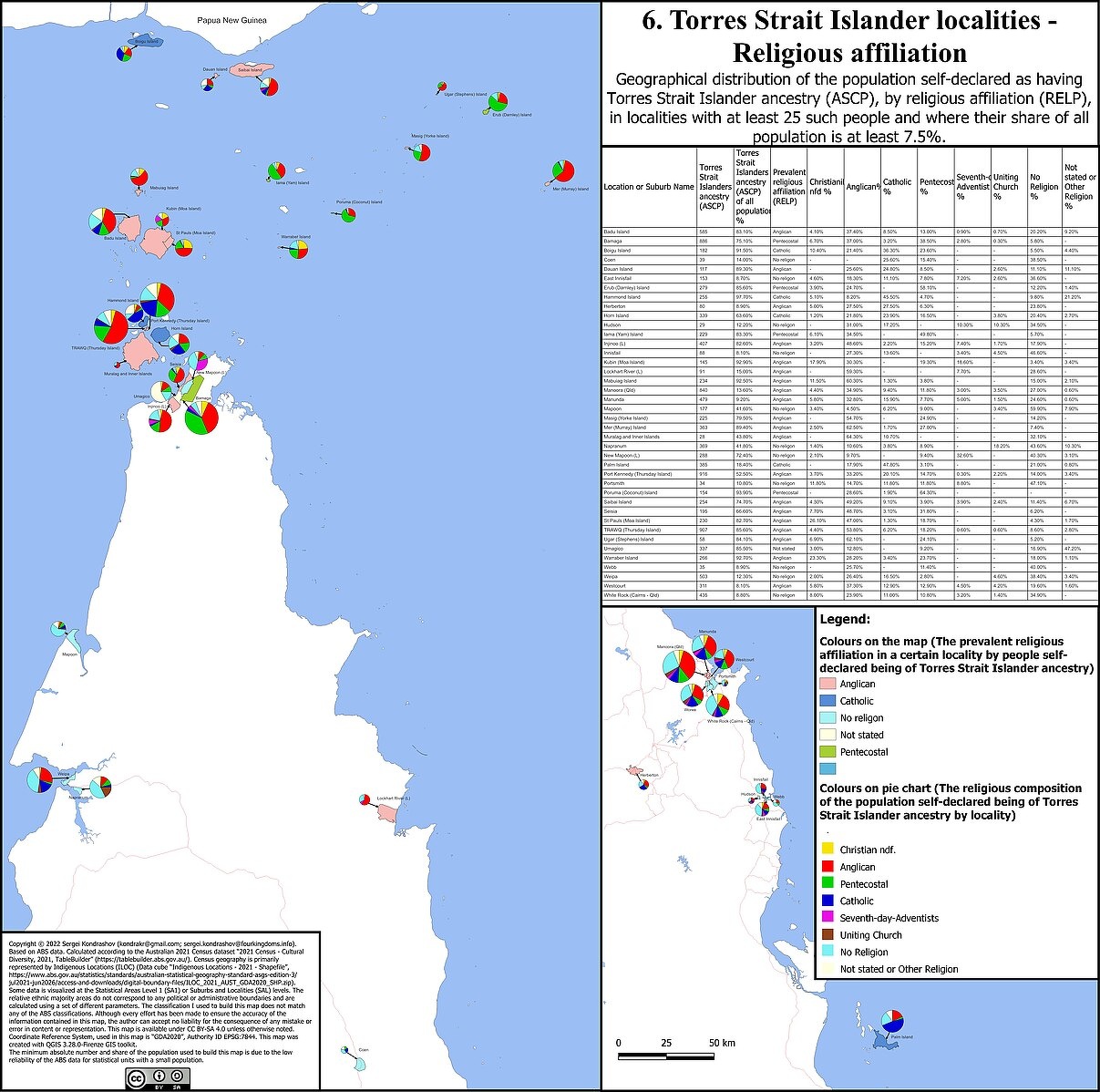
Christianity was first introduced in the late 18th century by the London Missionary Society. When the society withdrew from the strait in 1914, Anglicanism replaced it as the dominant creed. In the 1930s, Pentecostalism was brought back by islanders returning from Queensland, sparking a lasting rivalry with Anglicanism for followers. Today, Christianity in the Torres Strait incorporates elements of precontact religious practice, and magical recourse—used in gardening, fishing, healing, revenge, and other pursuits—continues to play a role in island life.
Traditionally, medicine men or magicians began their training in adolescence, apprenticing themselves to established practitioners. Instruction combined direct teaching, practical experience, and ritual ordeals. A novice achieved full status only after successfully casting a “hostile” spell—that is, causing the death of an intended victim through magic. At ceremonial occasions, the primary officiants were elder men of high standing within their villages, regarded as repositories of cult knowledge, ritual expertise, and magical power. Since the early period of missionary activity, island men have also been trained as ministers and priests, continuing a dual religious role in the region.
Death and Afterlife Traditional beliefs held that the spirit of the deceased could bring harm to the living community. Funerary ritual was therefore directed toward averting this danger by appeasing the spirit and releasing it to travel to an “Isle of the Dead” located somewhere in the west. Upon a man’s death, villagers responded with loud wailing and lamentation before abandoning the settlement to the corpse and to the widow’s male relatives, who constructed a platform for the body. At a later stage, the head of the corpse was removed for use in ritual divination to determine whether sorcery had caused the death and whether a revenge expedition was required. The widow kept the skull with her throughout her mourning period, carrying it as a token of grief, while the rest of the body was buried. In the present day, funerary practices generally follow Western norms, but a later “tombstone-opening” festival—marked by traditional feasting and dancing—continues to honor the deceased in a distinctly local way.
Torres Strait Islanders Marriage and Family
The traditional Torres Strait Islander domestic unit minimally consisted of a nuclear family plus one or more dependent relatives, generally of the grandparental generation. Throughout the islands there is a patrilineal bias (based on descent through the male line) on the reckoning of kinship, but maternal kin on the mother’s side are also recognized. Community groups tend to consist predominantly of patrilateral relatives (related on the father’s side), their spouses, and their children. However, descent is not traced very deeply. The concept of "family" has become strongly "privatized" in accordance with the majority practice of Australian society. [Source: Nancy E. Gratton, “Encyclopedia of World Cultures, Volume 2: Oceania,” edited by Terence E. Hays, 1996 |~|]
Traditionally, courtship was initiated by the prospective wife, who expressed her interest in a young man by sending him a small gift, usually through his sister. If the boy was interested, the girl's parents would negotiate the bride price with his family. After the bride-price was paid, the bride would be brought to her new husband's camp, where she would build a fire and begin her new responsibilities as a wife. Although there appears to have been no formal ceremony, a community feast and dance, which generally accompanied all major life cycle events, would be held.
Island custom permitted polygyny, but only the most successful leading men could afford the multiple bride-prices that polygynous marriages required. With the adoption of Christianity, the practice ended. Initially, postmarital residence was with the groom's family. After the birth of children, however, the young family would generally establish their own household and were free to live wherever they chose. Divorce was and still is frowned upon, but it did and does occur. ~
In regard to socialization, in earlier times, mothers taught their daughters about their future roles and responsibilities as wives and mothers by enlisting their help with daily tasks. Young boys were largely free of such responsibilities. Female initiation occurred at puberty and involved seclusion with a paternal aunt, who provided assistance and instruction. The male initiation ritual was more elaborate. Boys were secluded in pairs under the tutelage of a maternal uncle for up to three months. During this time, they observed dietary restrictions and learned proper adult male behavior. They also underwent physical trials intended to transform them into men. A central feature of male initiation was introducing the boys to the chants, lore, fetishes, and sacred masks of the culture heroes. For both boys and girls, these rites of passage marked the transition from childhood to adulthood.
Traditionally, sons inherited land rights, magic spells, and fetishes, although daughters might be given a small plot of land at marriage or inherit the entire plot if they had no brothers. Women's lore was passed from mother to daughter. |~|
Torres Strait Islanders Traditional Life
Traditionally, settlement types varied across the Torres Strait Islands. On islands that supported gardening, villages consisted of clusters of huts built along the shore, often with a cult shrine and adjacent garden plots. Construction styles differed regionally: in the east, people favored cone-shaped huts of reeds and grasses, while in the north long huts raised on stilts were common. On smaller or less fertile islands, only temporary shelters were erected, suited to populations relying primarily on hunting and gathering. Traditionally, men and initiated boys lived in a separate hut or camp section, apart from women and children. With the advent of Christianity, settlements were reorganized into clusters around church missions and schools, and housing came to follow a nuclear-family pattern.[Source: Nancy E. Gratton, “Encyclopedia of World Cultures, Volume 2: Oceania,” edited by Terence E. Hays, 1996 |~|]
The islanders’ principal protein sources are turtles, dugongs, fish, and shellfish. Agriculture has traditionally been limited, as most islands lacked extensive fertile land. Larger northern and eastern islands supported swidden horticulture, while elsewhere wild plants provided the bulk of vegetable food. Staples include yams, mangrove fruits, beans, nuts, and various fruits. Where cultivation was possible, yams are the primary crop, supplemented by bananas, taro, sugarcane, sweet potatoes, coconuts, and tobacco.
Men hunted sea turtles, often by harpooning or by slipping a rope around the flippers, and pursued dugongs with harpoons. Fishing employed multipronged spears, hooks and lines of turtle shell, and spear-throwers; in some areas, bamboo scoops and stone fish traps were also used. Men gathered crustaceans and shellfish, while women collected wild fruits, vegetables, and nuts in woven net bags. On horticultural islands, women carried out most weeding and harvesting, while men undertook the heavier work of clearing land and burning vegetation. Garden magic was the domain of men, whereas women handled food preparation and cooking. Both men and women initially participated in trepanging and pearling, but as deeper beds were exploited, the work became predominantly male. Men of Mabuiag in the Torres Strait Islands between New Guinea and Australia used to don two-meter (7-foot) crocodile masks made of turtle shell, bone and fiber during harvest, initiation and funeral rites.
Traditional Torres Strait Islanders Economic Activity
Marine resources always formed the foundation of subsistence, but their exploitation expanded commercially with European demand for trepang (sea cucumber) and pearl shell. By the mid-20th century, the introduction of plastics collapsed the pearl-shell market, undermining the local economy. This disruption spurred significant labor migration to mainland Australia and encouraged younger islanders to seek wage-based employment. [Source: Nancy E. Gratton, “Encyclopedia of World Cultures, Volume 2: Oceania,” edited by Terence E. Hays, 1996 |~|]
Because most islands lacked suitable timber and stone, many everyday items—such as canoe hulls, bows, arrows, spears, and clubs—were obtained through trade. Islanders, however, manufactured their own hoes and digging sticks from shell, and adzes and axes from giant clam shells. Turtle shell was also widely used for tools and implements. Mats woven from pandanus or coconut leaves served as sails, bedding, and materials for temporary shelters. Canoe construction, while beginning with imported hulls from Papua New Guinea, involved extensive local craftsmanship: attaching outriggers, floats, masts, paddles, platforms, and storage compartments. Islanders also produced masks, net bags, and ornaments made from shell, bone, teeth, and feathers.
Trade networks linked the Torres Strait Islands with both Papua New Guinea and the Australian mainland. Exchange with Papuans was especially important, involving pearl and turtle shell, conus shell, and even human heads, traded for canoes, drums, feathers, and weapons. Islanders also traded with Aboriginal peoples of Cape York, acquiring spears, spear-throwers, and ocher. Inter-island trade circulated foodstuffs, tobacco, and items of adornment such as pendants, ear ornaments, hair combs, armbands, and necklets.
Skill of Torres Strait Islander Spearfishers Questions the Need for a Long Childhood
Natalie Angier wrote in the New York Times: On the isle of Mer, a rugged landspit in the Torres Straits near Australia that could fit easily inside Central Park, some 430 traditional foragers called the Meriam subsist by grace of the sea. At low tide, young and old alike rush out to the reef. Women hurriedly gather up shellfish like conchs, clams and cowries, breaking open the shells to extract the meat and so keep their burdens bearable. Men aim bamboo spears tipped with iron to lance up snappers, sea perch, cod and squid; or they toss out baited hand lines to yank in needlefish, perch, tuna and mackerel. Boys and girls — some of them barely old enough to walk — gather, spear and fish by hand with equal zeal. [Source: Natalie Angier, New York Times, July 2, 2002]
Shellfish collecting is a physically demanding but relatively simple task, and the surest way to guarantee a meal. Spearfishing and hand-line casting, by contrast, are high-skill enterprises, which require detailed knowledge of the nature and behavior of each type of prey, robust powers of concentration and great dexterity in casting and jabbing. The best and most admired spearfisher on the island, the Meriam concur, is a 48-year-old man named Walter Cowley, who impales his quarry maybe half the time.
Yet as Dr. Douglas Bird and Dr. Rebecca Bliege Bird, anthropologists at the University of Maine in Orono, discovered in their studies of Meriam life, the proudest spearmen on the island are just barely better than . . . the children. In a detailed analysis of the productivity and fishing success rates of the people of Mer, the anthropologists were startled to find that children of crayon age were already dazzling with their spears and lines, and fully cognizant of the nuances of their marine ecosystem.”
The anthropologists have found evidence elsewhere that children are able to learn complex skills very rapidly: More recently, the researchers have studied the Mardu people of the Western Desert of Australia, and again found that children were adept hunters by the age of 5 or 6, and thereafter success was measured not by age, but by size.”
These findings shed some doubt on whether our extended childhoods are there for learning. Some scientists think that our long childhoods are simply the result of our long lifespans. But there is agreement that the brain is capable of learning very rapidly when it needs to: Dr. Bock proposes something of a middle ground between the two theoretical camps. As he sees it, learning is an important aspect of childhood, but it occurs in punctuated bursts rather than slowly and cumulatively, the timing driven, perhaps, by the dynamic architecture of the developing nervous system.”
Torres Strait Islander Ceremonies, Art and Medicine
The principal island ritual occasion is the tombstone opening, during which the grave marker is formally unveiled to kin and friends of the deceased. This event, which may occur many years after the burial, is marked by feasting and dancing and often draws participants from across the strait and even from the mainland. Other major ceremonies follow the Christian calendar, particularly Christmas and Lent. Of special importance is the 1 July festival, commemorating the arrival of “The Light”—the coming of the first mission teachers sent by the London Missionary Society. The celebration is distinguished by communal feasting, dancing, and singing. In pre-Christian times, hero-cult ceremonials were closely tied to initiation rites. They featured the reenactment of mythological events and the use of elaborate ceremonial costumes, including sacred masks. [Source: Nancy E. Gratton, “Encyclopedia of World Cultures, Volume 2: Oceania,” edited by Terence E. Hays, 1996 |~|]
Traditional medicine combined magical techniques with herbal remedies and occasional bloodletting. The choice of treatment depended upon diagnosis based on visible symptoms. Today, islanders make use of Western medical systems but continue to hold respect for traditional curing practices.
Traditionally, masks, headdresses, and personal ornaments were crafted with a high degree of decorative elaboration, while canoes were often richly carved. Musical traditions remain strong, with instruments including drums, panpipes, whistles, flutes, and rattles. The creation and performance of songs for festive occasions continues to be a highly valued skill. Dance is performed by troupes of young men, characterized by dramatic stamping and leaping movements, often staged as competitions between groups.
A Torres Strait Islander dance club in the Metropolitan Museum of Art collection dates to late 19th–early 20th century and us made of wood, paint and cassowary feathers. It measures 94.6 x 12.1 x 3.8 centimeters (37.25 inches high, with a width of 4.75 and a depth of 1.5 inches) [Source: Metropolitan Museum of Art]
See Separate Article: AUSTRALIAN ABORIGINAL ART FROM QUEENSLAND AND THE TORRES STRAIT ioa.factsanddetails.com
Torres Strait Dugong Hunting

dugong hunter in 1912
Eric Kjellgren wrote: Many coastal and island peoples in the western Pacific hunt the dugong, a large marine mammal related to the manatee. Esteemed for the large quantity of meat it provides, as well as for its fat, which is used in some areas to make body oil, the dugong is a prized but dangerous animal.' During the day, dugongs were hunted from canoes. The harpooning techniques originated in the Torres Strait and were subsequently adopted by a number of coastal Kiwai groups. Both practices had reportedly ceased in the Torres Strait by 1900. [Source: Eric Kjellgren, “Oceania: Art of the Pacific Islands in The Metropolitan Museum of Art”, 2007]
In areas where dugongs were especially abundant, the Torres Strait Islanders and Kiwai also hunted them from offshore platforms, built from slender bamboo poles surmounted by a narrow plank carved from the steering board of a canoe, on which the hunter stood. Constructed at low tide in shallow places covered by the sea grass on which the dugong habitually grazed, the platforms were used at night; the hunter waited in the moonlight for the dugong, normally shy in daylight hours, to come in to feed.
A single man, armed with a harpoon attached to a long length of rope, stood on each platform often for hours at a time, as other hunters sat in canoes nearby. A photograph of a hunter from Mabuiag Island in 1901 shows a him poised atop a dugong-hunting platform with his harpoon. A coil of rope, attached to the harpoon head, rests beside him, and a dugong charm hangs beneath the platform at the right, to lure the dugong within range.
When the dugong approached the platform, the hunter speared it with the harpoon and, seizing the line, dived into the water after it, allowing himself to be towed by the wounded animal until he was rescued by the men in the canoes. Among the Kiwai, if the hunt was successful, the men loudly sounded a shell trumpet as they approached the shore; the trumpet call indicated, in part, the number of dugongs that had been taken. If the hunt had failed, the men returned in silence.
Torres Strait Dugong Hunting Charm
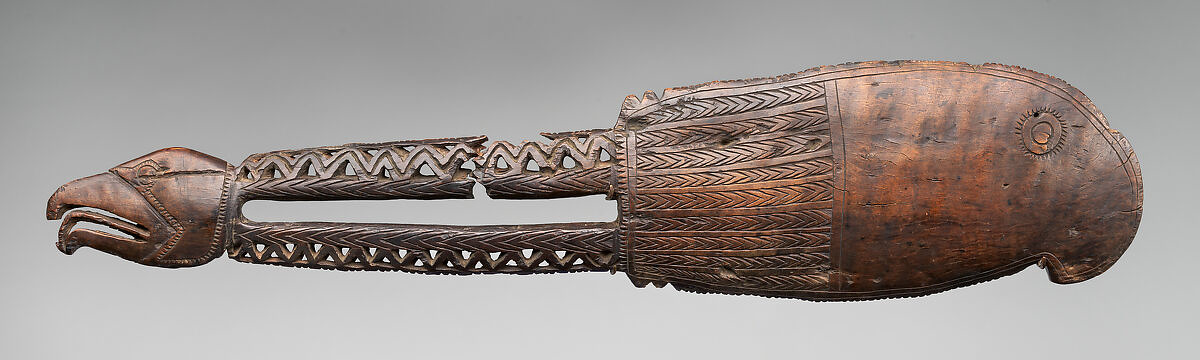
Eric Kjellgren wrote: Dugong hunting is an uncertain and often hazardous activity, and in many areas magical activities and objects are associated with it, designed to ensure a successful outcome. Up to the close of the nineteenth century, artists among the peoples of the Torres Strait, as well as some of the Kiwai people living in adjacent areas of New Guinea's southern coast, fashioned dugong hunting charms, whose supernatural powers aided the hunters in the capture of their often elusive quarry. [Source: Eric Kjellgren, “Oceania: Art of the Pacific Islands in The Metropolitan Museum of Art”, 2007]
Kiwai dugong hunting charm
Mounted in the bow of the canoe, the dugong charm was said to have the ability to attract the dugong or, in some cases, to be able to turn magically in the direction of the animals, indicating where they could be found. To entice the dugong within range, the dugong charm was suspended beneath the platform, its supernatural powers luring the animal to its death. In some areas of the Torres Strait the backs of dugong charms were hollowed out and a potent mixture of magical substances, prepared by a religious specialist (maidelaig), placed inside to increase their efficacy. In exchange for the services of the maidelaig, a successful dugong hunter was required to give him a portion of the meat. If the maidelaig did not receive his due, he might, on a future hunt, cause the moving harpoon line to wrap around the hunter's neck and strangle him.
The Metropolitan Museum of Art collection contains a 19th century dugon charm of the Torres Strait Islander or Kiwai people from Western Torres Strait or lower Fly River, Papuan Gulf. It is made of wood and is 62 centimeters (24 inches) long. This charm depicts the head of the dugong, recognizable by its drooping, fieshy muzzle; the elongated openwork body ends not in a tail but with the head of a bird, which may represent the totemic species of the object's owner. When the charm was in use, the openwork portions may have been adorned with leaves, feathers or other ornaments, possibly to increase its magical potency. The stylized representation of the features of the dugong and the prese nce of the bird head suggest that this charm may be of Kiwai origin, as the dugong charms from the Torres Strait proper tend to be more naturalistic in form.
Torres Strait Islanders Social and Political Organization
In traditional Torres Strait society, leadership was achieved rather than inherited, resting largely on an individual’s reputation for generosity and willingness to assist others. Yet the egalitarian character of island life, coupled with the autonomy of households, meant that leadership was required only in limited contexts. Warfare, land allocation, and dispute settlement were the main occasions when communitywide authority was exercised, and in such matters elders facilitated consensus. With the advent of colonial administration, island councils were established, and elected councillors assumed many of the traditional functions of elders while also mediating between islanders and government authorities. [Source: Nancy E. Gratton, “Encyclopedia of World Cultures, Volume 2: Oceania,” edited by Terence E. Hays, 1996 |~|]
Kinship, reckoned bilaterally, has long served as the organizing principle of island life. It provides the framework for assembling work crews, legitimizing residence in a community, and cooperating in the staging of feasts. Mechanisms of social control were traditionally informal, relying mainly on public censure or disapproval. Missionary influence, however, brought new forms of authority, as church representatives often assumed responsibility for regulating social conduct. Expulsion from the church became an institutionalized sanction to enforce compliance with community norms.
Disputes typically are mediated by friends or kin, and, failing that, by community elders who sought reconciliation before tensions escalated. Conflicts between members of different communities were often framed as accusations of witchcraft or sorcery, while disputes within communities were more likely to be expressed through verbal quarrels or, less frequently, physical fights.
Image Sources: Wikimedia Commons
Text Sources: “Encyclopedia of World Cultures, Volume 2: Oceania,” edited by Terence E. Hays, 1996, National Geographic, Live Science, Natural History magazine, Australian Museum, Australia Geographic, New York Times, Washington Post, Los Angeles Times, Smithsonian magazine, Encyclopedia.com, Times of London, Library of Congress, The Conversation, The New Yorker, Time, BBC, CNN, Reuters, Associated Press, AFP, Lonely Planet Guides, Culture Shock! Australia, Wikipedia, The Guardian and various websites, books and other publications.
Last updated November 2025