
Home | Category: Kangaroos, Wallabies and Their Relatives
RAT-KANGAROOS
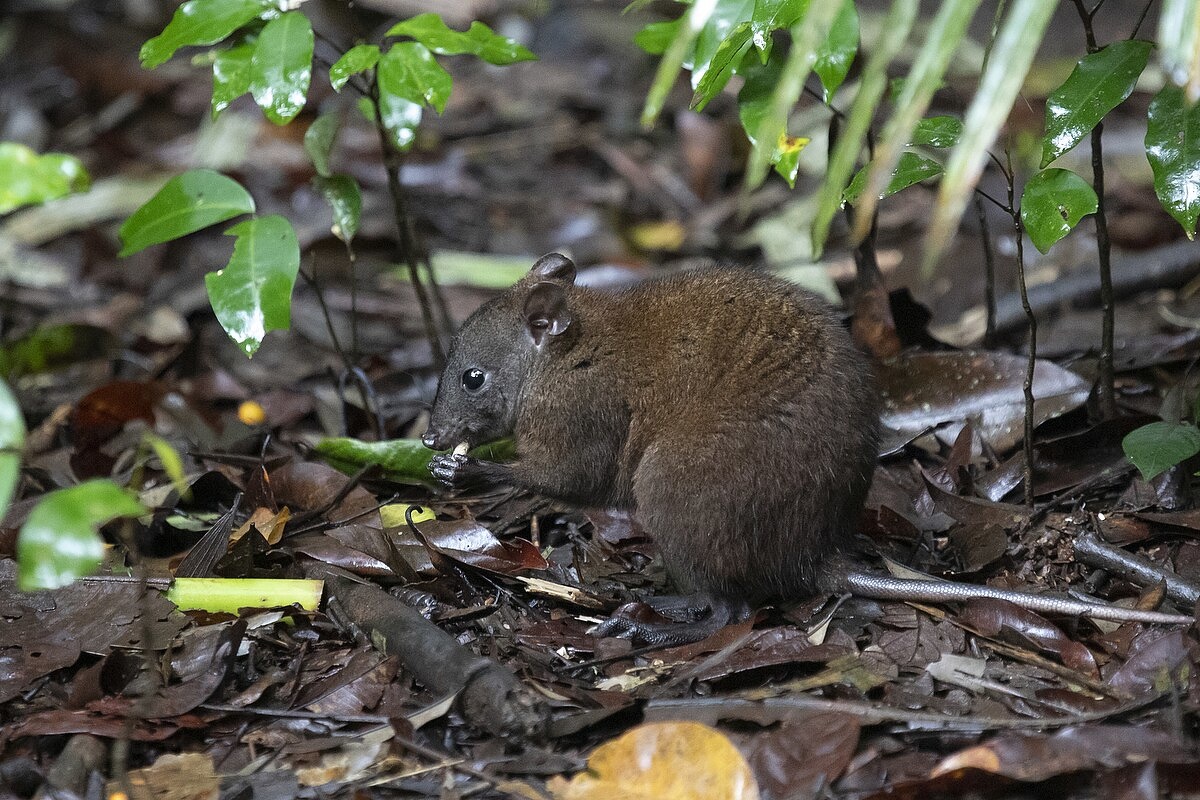
musky rat-kangaroo
Rat- kangaroos are a group of small to medium-sized marsupials belonging to the families Potoroidae and Hypsiprymnodontidae. Closely related to kangaroos and wallabies , they are found in Australia and Tasmania and are characterized by their rabbit-sized bodies, prehensile tails, and tendency to construct burrows or nests for shelter. Some species, like the musky rat-kangaroo, are active during the day, but most are nocturnal. [Source: Google AI]
Rat-kangaroos are generally much smaller than true kangaroos and wallabies, with most species weighing less than two kilograms. They have short hind feet, a somewhat prehensile tail, and furry coats. They inhabit undergrowth and forage for a variety of foods, including grasses, tubers, fungi, and insects. Rat-kangaroos construct nests or burrows for shelter and often use their prehensile tails to carry nesting material.
Musky rat-kangaroos are the only living members of the Hypsiprymnodontidae family. Rufous rat-kangaroos, or rufous bettongs, are the only species in the genus Aepyprymnus. Desert rat-kangaroos (Caloprymnus campestris) are also called the buff-nosed rat-kangaroo, plains rat-kangaroo and oolacunta. They are the only members of the genus Caloprymnus and are now considered extinct.
Many rat-kangaroo species have faced population declines since the arrival of Europeans in the 18th and 19th centuries, with some becoming extinct or surviving only on islands. Red foxes are a major threat to some species. It's important to note that "rat-kangaroos" are different from "kangaroo rats." Kangaroo rats (genus Dipodomys) are rodents native to North America, not marsupials, and are known for their bipedal hopping. Jerboas are small hopping rodent that live in the Middle East, North Africa and Central Asia.
RELATED ARTICLES:
BETTONGS: CHARACTERISTICS, BEHAVIOR AND REPRODUCTION ioa.factsanddetails.com
POTOROOS: SPECIES, CHARACTERISTICS, BEHAVIOR AND REPRODUCTION ioa.factsanddetails.com
PADEMELONS: SPECIES CHARACTERISTICS, BEHAVIOR AND REPRODUCTION ioa.factsanddetails.com
ROCK-WALLABIES: SPECIES, CHARACTERISTICS, BEHAVIOR AND REPRODUCTION ioa.factsanddetails.com
BRUSH-TAILED ROCK-WALLABIES: CHARACTERISTICS, BEHAVIOR AND REPRODUCTION ioa.factsanddetails.com
HARE-WALLABIES: SPECIES, CHARACTERISTICS, BEHAVIOR AND REPRODUCTION ioa.factsanddetails.com
QUOKKAS: CHARACTERISTICS, BEHAVIOR, REPRODUCTION, ROTTNEST ioa.factsanddetails.com
MARSUPIALS: HISTORY, EVOLUTION, CHARACTERISTICS, BEHAVIOR, REPRODUCTION ioa.factsanddetails.com
MARSUPIALS IN AUSTRALIA ioa.factsanddetails.com
KANGAROOS AND WALLABIES (MACROPODS): CHARACTERISTICS, HISTORY, POPULATIONS ioa.factsanddetails.com
KANGAROO BEHAVIOR: FEEDING, REPRODUCTION, JOEYS ioa.factsanddetails.com
KANGAROOS HOPPING: MOVEMENTS, METABOLISM AND ANATOMY ioa.factsanddetails.com
Potoroidae: Bettongs, Potoroos, and Rat-Kangaroos
Potoroidae is a family of marsupials that embraces bettongs, potoroos, and rat-kangaroos. They are closely related to kangaroos and wallabies (Macropodidae) and sometimes grouped as a subfamily within that family. Potoroidae embraces nine or ten species in four or five genera. They are all found in Australia. Like macropods, these small and secretive animals are diprotodont (having two large, forward-pointing incisors in their lower jaw) and syndactyl (have fused together toes). Several members of this family have not fared well following the arrival Europeans. Two species are believed to be extinct and two additional species are currently threatened with extinction. [Source: Phil Myers, Animal Diversity Web (ADW) |=|]
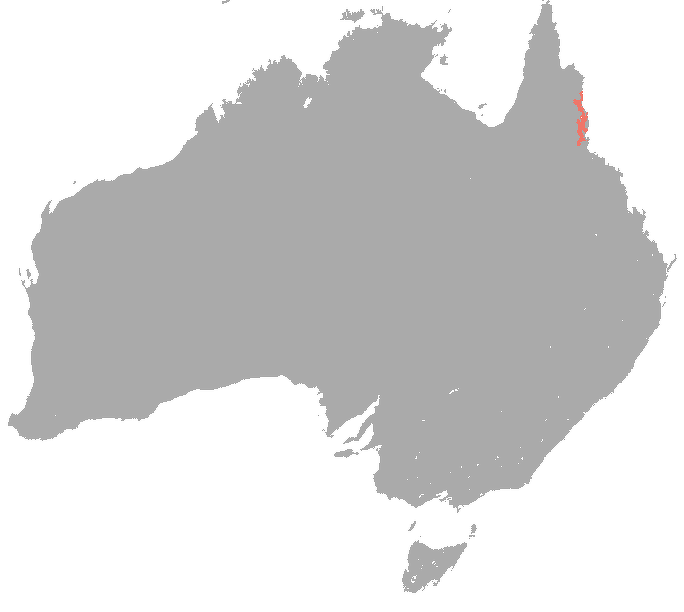
range of musky rat-kangaroos
Phil Myers wrote in Animal Diversity Web: Also like macropods, they have enlarged hind feet and powerful hind limbs. At high speeds they are adept hoppers. At slower speeds, their movement is more rabbit-like; they land with their weight on their forelimbs as well as hind, then transfer weight to the hindlimbs for the next hop. The forelimbs are smaller than the hindlimbs, but the disparity in size is not as great as in kangaroos and wallabies. As in the case of macropod hind feet, the fourth toe is the longest and strongest. It sits in a line with main limb elements and transmits thrust of hopping. It is not as well developed, however, as the fourth toe in macropods. The tail is semiprehensile.
The dental formula of potoroids is 3/1, 1-0/0 2/2, 4/4 = 32-34. The second and third upper incisors are small and placed lateral to and behind the first incisor, not lateral as in macropods. In other respects, the skull is similar to that of kangaroos. Canines are present and well-developed. The molars are stationary, that is, they don't show pattern of forward movement with aging that is seen in macropods. Young potoroids and macropods have two upper and lower premolars that are replaced in adulthood by a single, large, blade-like premolar in both jaws. |=|
Members of this family are omnivores (animals that eat a variety of things, including plants and animals) and herbivores (animals that primarily eat plants or plants parts), feeding mainly on underground fungi and tubers also taking some seeds and insects. They have a well developed marsupial pouch that opens anteriorly. Their reproductive pattern includes an embryonic diapause (temporary suspension of development of the embryo) like that of macropods. Their stomachs are less elaborately pouched than those of macropods; instead, they are unspecialized in some species and with a few simple chambers (with bacterial fermentation) in others. |=|
Musky Rat-Kangaroos
Musky rat-kangaroos (Hypsiprymnodon moschatus) are the smallest members of the macropod order, which includes kangaroos and wallabies. They are found only in the rainforests of Queensland in northeastern Australia. First described in the later 19th century, hey are similar in appearance to potoroos and bettongs, but are not as closely related. Their omnivorous diet include fruit, fungi and insects. Their name comes from a musky scent that is given off by both sexes.
Musky rat-kangaroos are the only members of the genus Hypsiprymnodon Not only are they the smallest macropods, but they are also morphologically the most primitive. They are regarded as earliest evolutionary link between ancestral opossum and kangaroos. In addition, they one of the very few truly diurnal macropods in Australia that are active during the daytime). They are also unique in that they have a well developed first digit on their hind foot. It is clawless and nonopposable to the other digits. In all other genera the first digit is not present. Their scaly tail is also unique and different from other species within the family.[Source: Laurel Dougherty, Animal Diversity Web (ADW) |=|]
Musky rat-kangaroos live in the Australian tropical rainforest along a 320-kilometer (200-mile) -long stretch of the coast of northeastern Queensland. They live in the dense vegetation surrounding lakes and streams and sleep in nests, but little else is known due to their reclusive nature. They rarely come into contact with humans but are relatively common in their range. Most of area where they is within the Wet Tropics World Heritage Area. On the International Union for Conservation of Nature (IUCN) Red List they are classified as a species of “Least Concern”.
Musky Rat-Kangaroo Characteristics and Behavior
Musky rat-kangaroos have an average weight of half a kilogram (1.1 pounds). Their body and head is 20.8 to 34.1 centimeters (8.2 to 13.4 inches) long and their tail is 6.5 to 12.3 centimeters (2.6 to 4.8 inches) long. They are dark brown or rusty grey in color and mostly covered by short velvety underfur. Their undersides are creamy tan color. The tail is scaly and naked like that of an opossum. The ears are naked and are thin, round, and dark in color. The claws are small, weak, and unequal in length. Females have four mammae and a well developed pouch. The forelimbs and hindlimbs are more similar in size than in other macropods. The dentition is adapted for a general diet, and the dental formula is (i 3/1,c 0-1/10, pm 2/2, meters 4/4) X two = 32 or 34. Throughout early life, molariform teeth migrate to make room for late erupting molars. This fourth molar doesn't erupt until very late in life. [Source: Laurel Dougherty, Animal Diversity Web (ADW) |=|]
Musky rat-kangaroos are different from other rat-kangaroos in that they are primarily insectivores (eat insects). They also eat worms, tuberous roots and palm berries. When they eat, they sit on their haunches and forage for food by turning over debris and digging. They are solitary, but have sometimes been seen in feeding aggregations of two or three, and are unusual in that are diurnal (active mainly during the daytime). Unlike most macropods, they run on all four limbs instead of hopping on the rear two. They use their tail to gather nesting material such as dried grass ferns and lichens. They sleep in these nests, which are frequently built in a clump of Lawyer Vine or between the plank butresses of a large tree. They are extremely shy and quick animals, which makes observation difficult. One account describes musky rat-kangaroos sunbathing spread eagle on a fallen log. Another claim that they are good climbers and spend some time in trees.
Breeding takes place between February and July (the rainy season). Usually two young are born and they leave the pouch after 21 weeks. For several more weeks the young reside in the nests of their mother. On average males and females reach sexual or reproductive maturity at one year of age.
Rufous Rat-Kangaroos
Rufous rat-kangaroos (Aepyprymnus rufescens) are also known as or rufous bettongs. Resembling a large mouse and about the size of a large house cat, they are the only species in the genus Aepyprymnus and the largest member of the potoroo-bettong family (Potoroidae). Rufous rat-kangaroos are active at night when they dig for plant roots and fungi. Like like other marsupials females carry young in a pouch. Though their range is smaller than it once was, their population is healthy and stable.
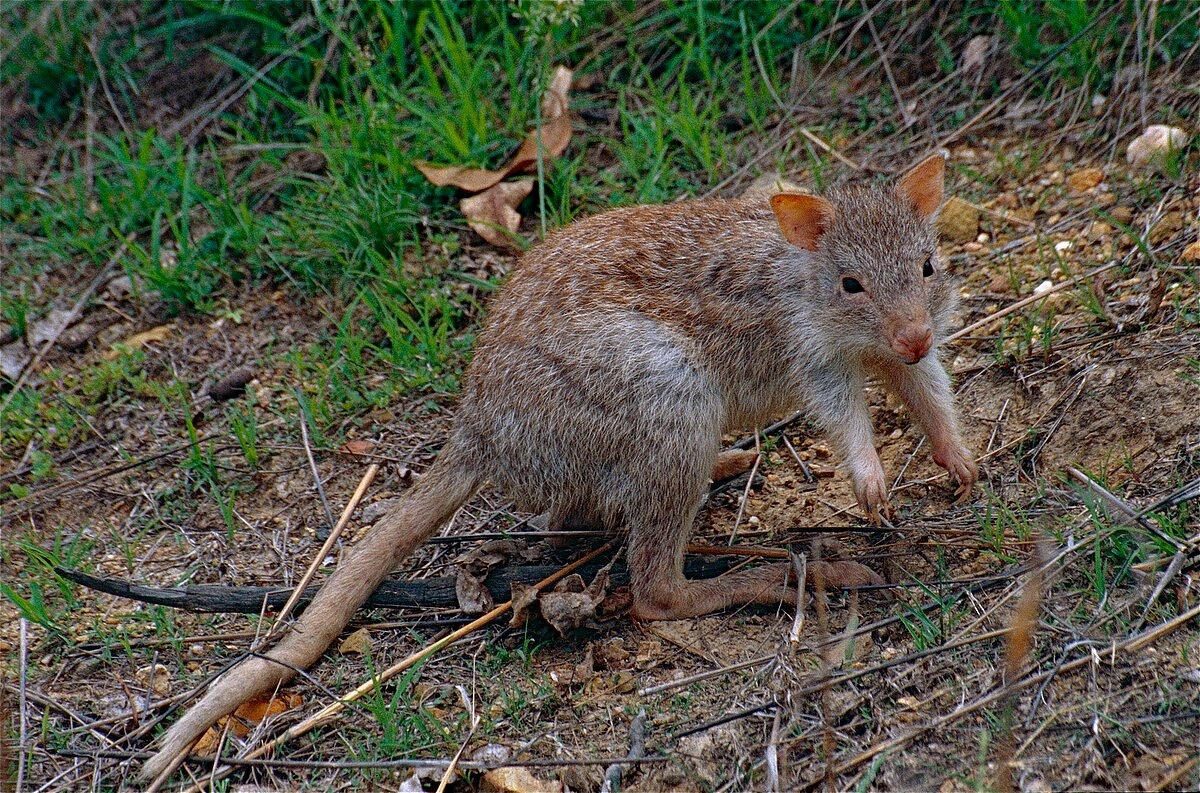
Rufous rat-kangaroo
Rufous rat-kangaroos is the most widely distributed potoroid in Australia, ranging from northeastern Queensland to northeastern New South Wales. A population lives on the border between New South Wales and Victoria. They are found in patches along the northern Australian coast. When taken at a young enough age, these animals can be tamed as pets but at the same time they can be crop pests. During the dry season especially, they eat plant roots, including potatoes and other tubers. [Source: Emily Peterson, Animal Diversity Web (ADW) |=|]
Rufous rat-kangaroos live mainly in open, temperate conditions from sea level to plateau tops. They thrive in grassy woodlands, coastal eucalypt forests, wet sclerophyll (hard leaf), and in low dry open woodlands with grassy understorey. All Rufous rat-kangaroos build conical-shaped nests that have one entrance. Nests can be found in the hollows of fallen trees, under bushes, in grass clumps, or more rarely in open ground. Rufous rat-kangaroos use materials such as grass, hay, straw, dry ferns, and fibrous vegetation to build their nests. They pick this material up with their forepaws and pass it down the body to the tail which places the material in the nest. Replacement grass is arranged in the nest by lifting up older building material with the nose to create space. Rufous rat-kangaroos use up to five nests at any one time. It has been suggested that nest building only occurs in the winter. On a monthly basis new nests are added as old nests are abandoned, and abandoned nests may be rebuilt and used by a neighboring Rufous rat-kangaroos. |=|
Rufous rat-kangaroos are not endangered. In their range they can be quite common. On the International Union for Conservation of Nature (IUCN) Red List they are classified as a species of “Least Concern”. The distribution of these marsupials is discontinuous over their range and may be contingent upon food and shelter availability. It is believed that the former range of rufous rat-kangaroos was more expansive prior to The arrival of Europeans in the 18th and 19th centuries, extending even further south into northeastern Victoria. Remains of these creatures have also been found in southwestern Victoria and on Flinders Island near Tasmania. The declining range of the species is believed to be the result of predation by foxes, agricultural land clearing, cattle grazing, and climatic fluctuations.
Rufous Rat-Kangaroo Characteristics and Diet
Rufous rat-kangaroos are largest of the small kangaroo-like species. They range in weight from 1.36 to 3.6 kilograms (3 to 7.9 pounds). Their head and body length ranges from 37.5 to 52 centimeters (14.8 to 20.5 inches). Their tail is 35 to 40 centimeters (13.8 to 15.8 inches) long and their total length ranges from 72.5 to 90 centimeters (28.5 to 35.5 inches) and their height is approximately 35 centimeters (13.8 inches). Their average basal metabolic rate is 5.978 watts. Sexual Dimorphism (differences between males and females) is present: Females are larger than males. Adult males weigh between 2.3 and 3 kilograms (5 to 6.6 pounds) and adult females weigh between 1.36 kilograms and 3.6 kilograms (3 to 7.9 pounds). The average life span of Rufous rat-kangaroos is greater than five years, and captive animals have been known to live to eight years old. [Source: Emily Peterson, Animal Diversity Web (ADW) |=|]
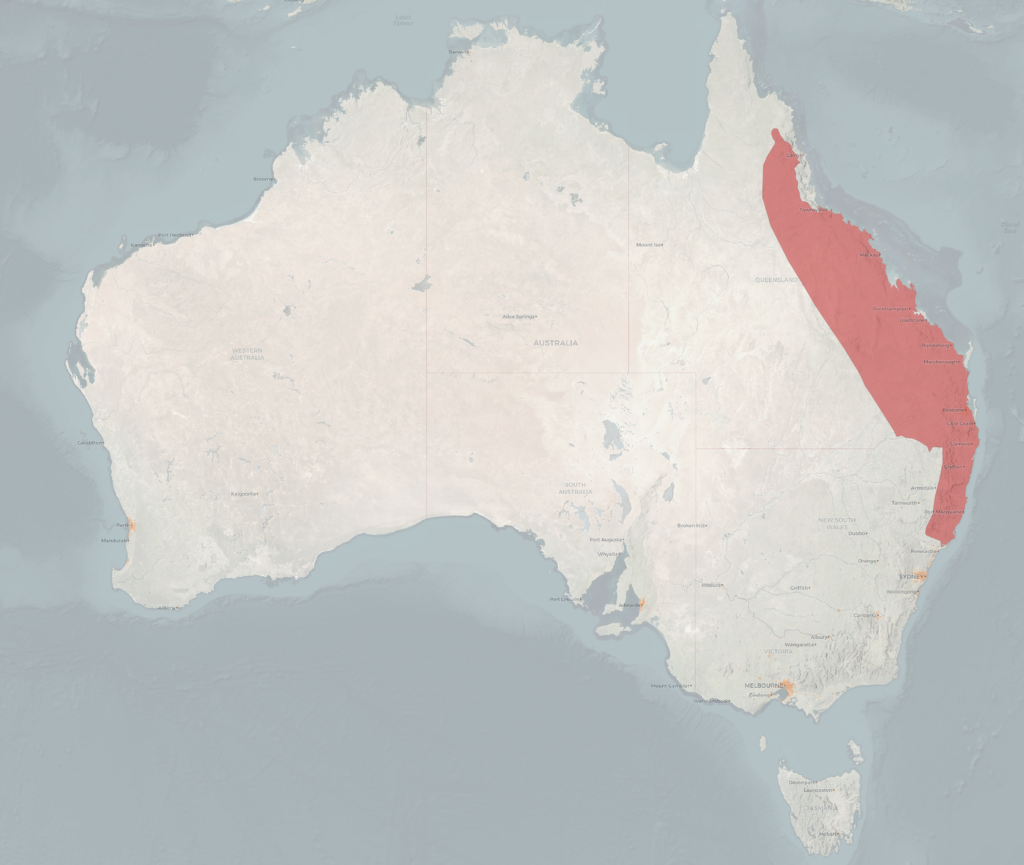
Rufous rat-kangaroo range
Rufous means reddish and thus it is no surprise that Rufous rat-kangaroos have a reddish-brown coat. Their fur is often described as grizzled, meaning it contains stiff, silver-white hairs. Their underside is much lighter than their back and sides and they have a very faint whitish hip stripe, a hair-covered snout and black hair on the back of their ears. Their curved foreclaws ideal for digging up and scratching for food. The skull of Rufous rat-kangaroos is short and broad compared to other potoroids. Their hindfeet lack the first toe, and the third digit is proportionately longer than the rest . The tail is semi-prehensile, thick, and evenly haired. Rufous rat-kangaroos has a dental formula 3/1, 1/0, 1/1, 4/4. The first upper incisors are long, sharp, and blade-like. The second and third upper incisors are smaller and laterally displaced |=|
Rufous rat-kangaroos are omnivores (eat a variety of things, including plants and animals). They emerge shortly after dusk to begin their search for food. They eat a variety of grasses, herbaceous plants, and use their foreclaws to dig for roots, tubers, and underground fungi. They sometimes consumer entire plants — seeds, flowers, leaves and all. Animal-based foods including the bones of dead animals and insect larvae. Rufous rat-kangaroos can extract enough water from their food so they can forego drinking except in times of drought, when they dig holes in creek beds in an attempt to reach water.
Rufous Rat-Kangaroo Behavior
Rufous rat-kangaroos are strictly nocturnal (active at night) and motile (move around as opposed to being stationary). They sleep during the day in their nests and browsing for food during the night. Rufous rat-kangaroosin their natural habitat are not afraid of humans at night. They are mostly soliatery but believed to exhibit highly ritualized behavior while communicating Rufous rat-kangaroos generally do not form long term bond but sometimes one male and two females with overlapping ranges spend time as a trio. This behavior agrees with recent findings that Rufous rat-kangaroos forms loose polygynous associations. [Source: Emily Peterson, Animal Diversity Web (ADW) |=|]
Rufous rat-kangaroos sleep alone in their nest but male territories can often include the nests of several females. Male territories range in size from 75 to 110 hectares (185 to 271 acres) while female territories ranges from 45 to 60 hectares (111 to 148 acres). Males are intolerant and aggressive towards other males, especially in captivity or in the presence of females. Males sometimes defend the female whom they are courting.
Rufous rat-kangaroos can move at high speeds over short distances, bounding solely on their hindlegs and using their forelegs to help them turning. This bipedal hop is mostly seen when the animals are traveling between feeding areas or when fleeing perceived dangers. Rufous rat-kangaroos move slowly while feeding and their locomotion is somewhat like that of a rabbit. They place their forelegs on the ground and bringing both of their hindlegs forward simultaneously while balancing slightly on their tail. When these rat-kangaroos are alarmed, they emit a low hissing call and stamp their hind feet like a rabbit. Females let out soft grunts to call pouch young that have strayed too far. Captive animals have been observed displaying "marking" behavior of introduced objects by rubbing them with their anal gland. |=|
Rufous Rat-Kangaroo Mating, Reproduction and Offspring
Rufous rat-kangaroos are polyestrus (females have multiple estrous cycles, periods of sexual receptivity, per year), with an estrus cycle occurring approximately every 34 days. Breeding can occur at any time during the year. The average gestation period is 23 days. The average number of offspring is usually one but twins are not uncommon. On average females reach sexual or reproductive maturity at 11 months; and makes do at 12½ months. [Source: Emily Peterson, Animal Diversity Web (ADW) |=|]
Emily Peterson wrote in Animal Diversity Web: Males visit female nests within their territory every night to determine if the female is sexually receptive. As the female approaches ovulation, the male waits either by the female or by her nest until she is sexually receptive. Both sexes can let out low growls during investigational behavior, which usually includes sniffing of the female by the male. A receptive female allows the male to smell her cloacal and pouch areas, and eventually permits copulation. |=|
Males will try to mount the female regardless of warning signals exhibited by unreceptive females. These females try to drive away courting males by making loud growling sounds, striking at the male with her forepaws, and dropping to her side and kicking at the male with her powerful hindlimbs. In response to this attack, Rufous rat-kangaroos males often stamp one outstretched hind foot near the female and thresh their tails. |=|
Once successful copulation has been achieved, the embryo has a gestational period of 22-24 days. After this time the embryo is born and affixes itself to one of the mother's four teats found in her pouch. The newborn young weighs approximately one gram at birth. Within one day of birth, the female will mate again to produce a quiescent blastocyte. The newborn will remain in the pouch for approximately 114 days before it is weaned. Rufous rat-kangaroos do not permanently leave the pouch until the 16th week. The juvenile animal stays with its mother for the ensuing seven weeks while it learns to feed, is groomed and shares its mothers nest.
Extinct Desert Rat-Kangaroos
Desert rat-kangaroos (Caloprymnus campestris) are also called the buff-nosed rat-kangaroos, plains rat-kangaroos and oolacunta. They are an species of rat-kangaroo that lived in desert regions of Central Australia. They were first recorded in the early 1840s and described by John Gould in London in 1843, on the basis of three specimens sent to him by George Grey, the governor of South Australia at the time. After that they were not seen until the 1930s and were officially declared extinct in 1994. They are the only mammal species to be rediscovered and then lost again. [Source: Wikipedia]
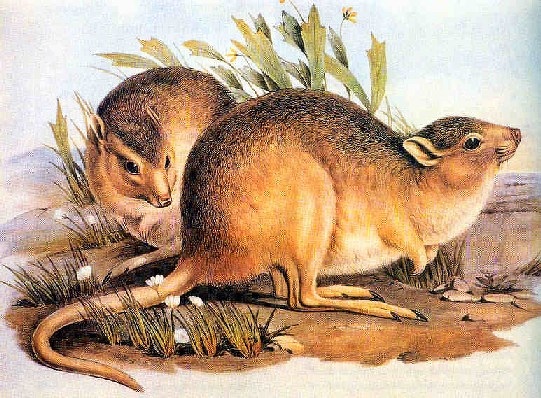
Illustration of desert rat-kangaroos by John Gould (1804-1881) in the book "Mammals of Australia"
After desert rat-kangaroo was first recorded in the early 1840s they were not recorded again for 90 years (aside from an unconfirmed report in 1878), and were widely believed to be extinct. The species — even before the arrival of Europeans — appears to never have been abundant. Following the relief of drought conditions which improved the local habitat, the animal was rediscovered in 1931 when Hedley Finlayson found a thriving colony of them. He made multiple returns, but after a few years, the population disappeared. The last confirmed record of the species came in 1935 from near Ooroowilanie, east of Lake Eyre.
Desert rat-kangaroos were thought to occupy a relatively small area in Southern Australia, extending just over the borders of Queensland and Northern Territory. They lived in arid, desert regions that included clay pans, sandridges and gibber plains. Vegetation in these areas is sparse and consists of saltbrush, cherropods and Emu bush. [Source: Lindsay DuVall, Animal Diversity Web (ADW) |=|]
Desert rat-kangaroos were well-adapted to the extremely barren and arid regions they inhabited; conditions too harsh for introduced species like European rabbits or domestic sheeps. However, by the 1930s, red foxes had spread to the areas inhabited by the desert rat kangaroo. The rapid decline of desert rat-kangaroos correlates with the appearance red foxes in their range. Predation by red foxes and feral cats, climate conditions and overhunting by indigenous Australians have all been were blamed for the species’ extinction. No reliable reports of the species have been made since 1935, but unconfirmed sightings in Queensland followed periods of rain in 1956–1957 and 1974–1975. Also, recent remains of this species have been found in the mid-1980s inside caves. On the International Union for Conservation of Nature (IUCN) Red List Desert rat-kangaroos are listed as Extinct.
It is possible that desert rat-kangaroos might still exist. The discovery of remains in the 1980s casts some doubt on their extinction. Professor Ronald Nowak stated in his 2005 book, "perhaps a small population still survives, awaiting the time when it again may increase in response to proper conditions." An animal was spotted in May 2011 off Peake Station and later identified from a museum skin as a desert rat-kangaroo. The area was surveyed in August 2011 and an old nest with some small macropod-like scats was found and some tracks were also found near a waterhole that might have been made by desert rat-kangaroos. DNA analysis of the scats failed to yield any usable DNA and no DNA was found in dingo and cat scats in the area as well. The sighting were labeled unconfirmed, but researchers Tony Robinson and Tiana Forrest said the possibility "that a small population of Caloprymnus, generally considered to be extinct throughout its former range across the Lake Eyre Basin, may have been present in this area in May 2011".
Desert Rat-Kangaroo Characteristics and Hopping
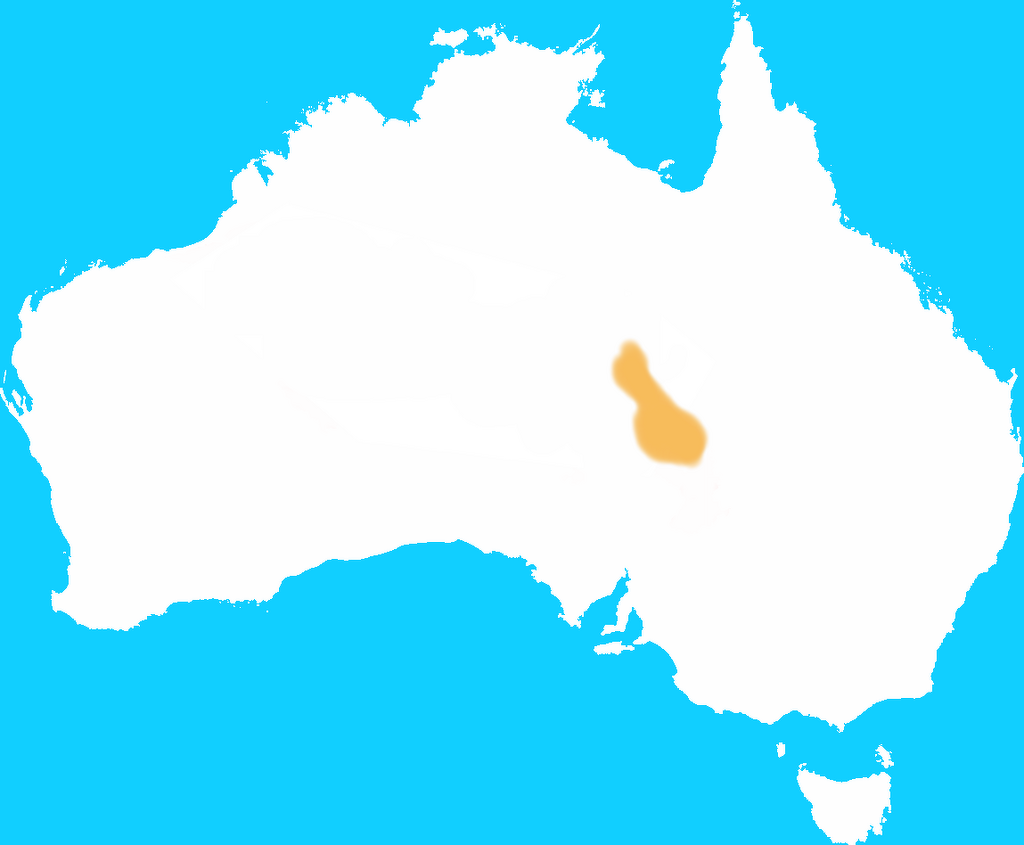
estimated range of desert rat-kangaroos before they went extinct
Desert rat-kangaroos had a body like a kangaroo, were about the size of a small rabbit, and were described as having a delicate and slender form. Their head and body length was estimated to be about 25.4 to 28.2 centimeters (10 to 11.1 inches), plus a 30.7-to-37.7- centimeter (12-to-14.8-inch) -long tail. Sexual Dimorphism (differences between males and females) was present with females being larger than males. [Source: Wikipedia]
Desert rat-kangaroos were pale, yellowish and ochre in color, which helped them blend in with their desert and clay soil surroundings. Their undersides were were lighter in color. Their head was short, blunt, and wide, different from that of any kangaroo or wallaby, with with a naked nose, and short and rounded ears that were covered with fur. The muzzle of desert rat-kangaroos was short with large upper lips. Neck glands were present in some specimens. Females had a pouch that opened upwards and four teats. Their teeth were different from other kangaroo-like animals. [Source: Lindsay DuVall, Animal Diversity Web (ADW) |=|]
The forelimbs of desert rat-kangaroos are quite delicate with bones weighing only one gram, while the hindlimbs were large with bones weighing 12 grams and helped the animals hop. Other characteristics that aided hopping were their long tail, some fused digits and long and extremely strong 4th toes in the hindfeet. Desert rat-kangaroos had a distinct method of hopping. They leaned forward with their relatively long extended when they moved at high speeds. Jumping was done with the hind back legs. Unlike other hopping marsupials, desert rat-kangaroos lands with their right foot in front of the left foot. It is said they could at full speed for as long as 20 kilometers. When moving at low speeds, desert rat-kangaroos moved like slow-moving rabbits. |=|
Desert Rat-Kangaroo Behavior, Diet and Reproduction
Desert rat-kangaroos were nocturnal (active at night) are motile (move around as opposed to being stationary). They were mainly herbivores (ate plants or plants parts) but also ate insects such as beetles and weevils. Mostly they foraged at night on foliage and stems of vegetation. They didn’t drink water and got all the water they needed ftom feeding on green plants. [Source: Lindsay DuVall, Animal Diversity Web (ADW) |=|]
Desert rat-kangaroos were solitary except for young offspring with mothers. They lived in nests built over shallow depressions in the ground. Nests were dug or borrowed from other animals and were crucial to survival in the desert. The nests they made themselves were "pits" lined with grass, which females carried to the nest with their tails, and covered with twigs. Desert rat-kangaroos spent most of the day sheltered from the desert sun in their nest. They sometimes peeking out of the top of the nest to observe their surroundings.
Desert rat-kangaroos females may have reached sexual maturity at approximately 11 months, while males did so about two months later. Females may have experienced estrus at three week intervals and could mate throughout the year but tended to breed more when environmental conditions were good. Females with pouched joeys were found between June and December. Young were born very undeveloped. Gestation was probably between on and two months, with staying in the pouch, perhaps for two to three months. All observed females had only one young at a time. Young stayed with their mothers for over one month after leaving the pouch. Some of the above reproductive behavior is based on rufous rat-kangaroos and other "rat" kangaroos, rather than by direct observation of desert rat-kangaroos.
Image Sources: Wikimedia Commons
Text Sources: Animal Diversity Web animaldiversity.org , National Geographic, Live Science, Natural History magazine, Australian Museum, David Attenborough books, Australia Geographic, New York Times, Washington Post, Los Angeles Times, Smithsonian magazine, Discover magazine, The Conversation, The New Yorker, Time, BBC, CNN, Reuters, Associated Press, AFP, Lonely Planet Guides, Wikipedia, The Guardian, Top Secret Animal Attack Files website and various books and other publications.
Last updated July 2025