
Home | Category: Kangaroos, Wallabies and Their Relatives
POTOROOS

Potoroo species: 6) Long-footed Potoroo (Potorous longipes), 7) Long-nosed Potoroo (Potorous tridactylus), 8) Gilbert's Potoroo (Potorous gilbertii)
Potoroo is the common name for species in the Potorous genus of small marsupials. They are closely related to Macropods, the suborder with kangaroos and wallabies, and is the only genus in the tribe Potoroini. The name potoroo comes from badaru, a word in the language of the Dharug Aboriginal people. Potoroos are sometimes cconsidered small kangaroos and called "rat-kangaroos." They were formerly very common in Australia, and early settlers reported them as being significant pests to their crops. But now all extant species are threatened by ecological changes that began with the arrival of Europeans in Australia. The main threats are predation by introduced species (especially foxes) and habitat loss.
There are three species of potoroo:
1) Long-footed potoroos (Potorous longipes) (endangered)
2) Gilbert's potoroo (Potorous gilbertii) (critically endangered).
3) Long-Nosed Potoroo (Potorous tridactylus)
The broad-faced potoroo (Potorous platyops) disappeared after its first description in the 19th century.
Many potoroos are primarily mycophagous (eat fungi) and their diet consists of multiple species of truffle-like fungi. The primary type of fungus consumed is hypogeous. Potoroos have enlarged hind feet and powerful hind limbs which allow they to hop at high speeds. They have a rabbit-like gait at slower speeds. They also have well-developed pouches (marsupium) that open towards the head and contains four mammae (teats).
The skulls of potoroos can be either narrow and elongated as is the case with the three living species or broad and flattened as is the case with the extinct broad-faced potoroo. An external occipital crest (a ridge of bone on the back of the skull) is strongly defined, particularly in the males, and there is no apparent sagittal crest (a ridge of bone that runs along the top of the skull). Potorous skulls have shallow and flattened auditory bullae. [Source: Wikipedia]
The dentition of potoroos is distinguished by sharp and strong canines, the broad permanent premolars are long and low with a profile that is serrated, concave, or horizontal at the cutting edge. An acutely pointed incisor extends from the long and narrow lower mandible. The dental formula of the genus is the same as other potoroid taxa: I3/1 C1/0 PM1/1 M4/4. Two premolars in juveniles are replaced by a permanent sectorial premolar.
RELATED ARTICLES:
BETTONGS: CHARACTERISTICS, BEHAVIOR AND REPRODUCTION ioa.factsanddetails.com
RAT-KANGAROOS: SPECIES, CHARACTERISTICS, BEHAVIOR AND REPRODUCTION ioa.factsanddetails.com
PADEMELONS: SPECIES CHARACTERISTICS, BEHAVIOR AND REPRODUCTION ioa.factsanddetails.com
ROCK-WALLABIES: SPECIES, CHARACTERISTICS, BEHAVIOR AND REPRODUCTION ioa.factsanddetails.com
BRUSH-TAILED ROCK-WALLABIES: CHARACTERISTICS, BEHAVIOR AND REPRODUCTION ioa.factsanddetails.com
HARE-WALLABIES: SPECIES, CHARACTERISTICS, BEHAVIOR AND REPRODUCTION ioa.factsanddetails.com
QUOKKAS: CHARACTERISTICS, BEHAVIOR, REPRODUCTION, ROTTNEST ioa.factsanddetails.com
MARSUPIALS: HISTORY, EVOLUTION, CHARACTERISTICS, BEHAVIOR, REPRODUCTION ioa.factsanddetails.com
MARSUPIALS IN AUSTRALIA ioa.factsanddetails.com
KANGAROOS AND WALLABIES (MACROPODS): CHARACTERISTICS, HISTORY, POPULATIONS ioa.factsanddetails.com
KANGAROO BEHAVIOR: FEEDING, REPRODUCTION, JOEYS ioa.factsanddetails.com
KANGAROOS HOPPING: MOVEMENTS, METABOLISM AND ANATOMY ioa.factsanddetails.com
Potoroidae: Bettongs, Potoroos, and Rat Kangaroos
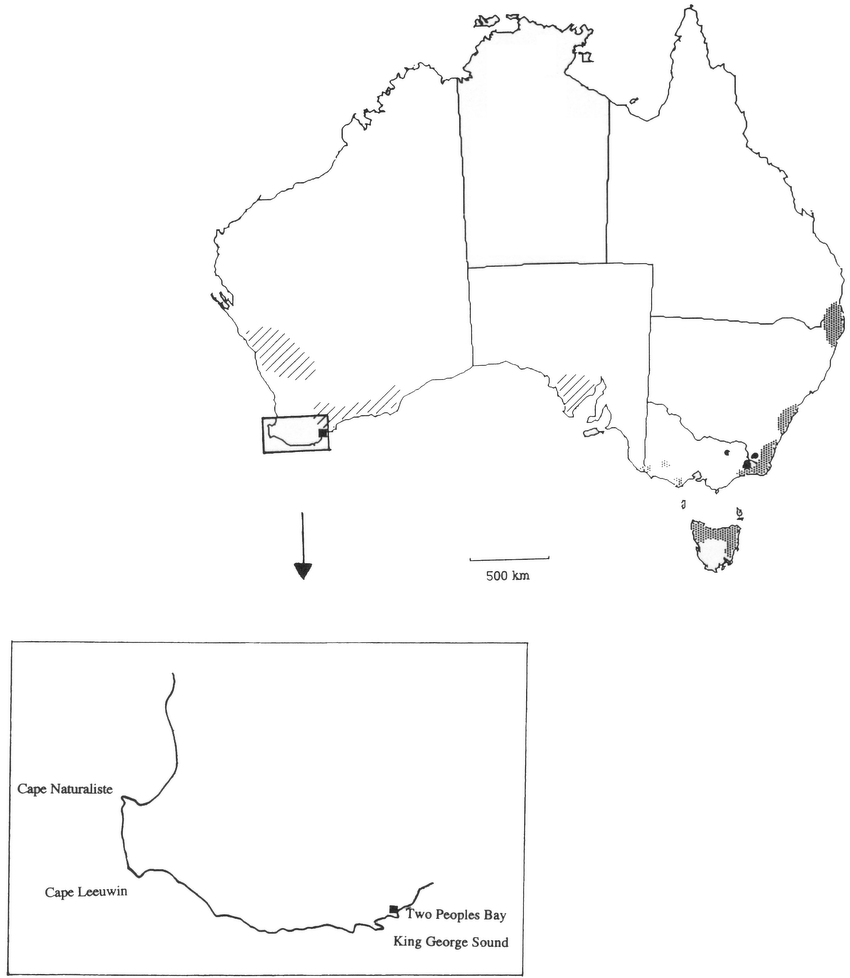
Range of Potorous species: 1) Long-footed potoroos: black; 2) Long-nosed potoroos: gray parts in southeast Australia and Tasmania; 3) broad-faced potoroo: historic range: striped (they are now extinct);
The only known extant population of Gilbert's potoroos is from Two Peoples Bay, Western Australia (black square); Inset: Southwest corner of Western Australia; Source: Researchgate
Potoroidae is a family of marsupials that embraces bettongs, potoroos, and rat kangaroos. They are closely related to kangaroos and wallabies (Macropodidae) and sometimes grouped as a subfamily within that family. Potoroidae embraces nine or ten species in four or five genera. They are all found in Australia. Like macropods, these small and secretive animals are diprotodont (having two large, forward-pointing incisors in their lower jaw) and syndactyl (have fused together toes). Several members of this family have not fared well following the arrival Europeans. Two species are believed to be extinct and two additional species are currently threatened with extinction. [Source: Phil Myers, Animal Diversity Web (ADW) |=|]
Phil Myers wrote in Animal Diversity Web: Also like macropods, they have enlarged hind feet and powerful hind limbs. At high speeds they are adept hoppers. At slower speeds, their movement is more rabbit-like; they land with their weight on their forelimbs as well as hind, then transfer weight to the hindlimbs for the next hop. The forelimbs are smaller than the hindlimbs, but the disparity in size is not as great as in kangaroos and wallabies. As in the case of macropod hind feet, the fourth toe is the longest and strongest. It sits in a line with main limb elements and transmits thrust of hopping. It is not as well developed, however, as the fourth toe in macropods. The tail is semiprehensile.
The dental formula of potoroids is 3/1, 1-0/0 2/2, 4/4 = 32-34. The second and third upper incisors are small and placed lateral to and behind the first incisor, not lateral as in macropods. In other respects, the skull is similar to that of kangaroos. Canines are present and well-developed. The molars are stationary, that is, they don't show pattern of forward movement with aging that is seen in macropods. Young potoroids and macropods have two upper and lower premolars that are replaced in adulthood by a single, large, blade-like premolar in both jaws. |=|
Members of this family are omnivores (animals that eat a variety of things, including plants and animals) and herbivores (animals that primarily eat plants or plants parts), feeding mainly on underground fungi and tubers also taking some seeds and insects. They have a well developed marsupial pouch that opens anteriorly. Their reproductive pattern includes an embryonic diapause (temporary suspension of development of the embryo) like that of macropods. Their stomachs are less elaborately pouched than those of macropods; instead, they are unspecialized in some species and with a few simple chambers (with bacterial fermentation) in others. |=|
Long-Footed Potoroos
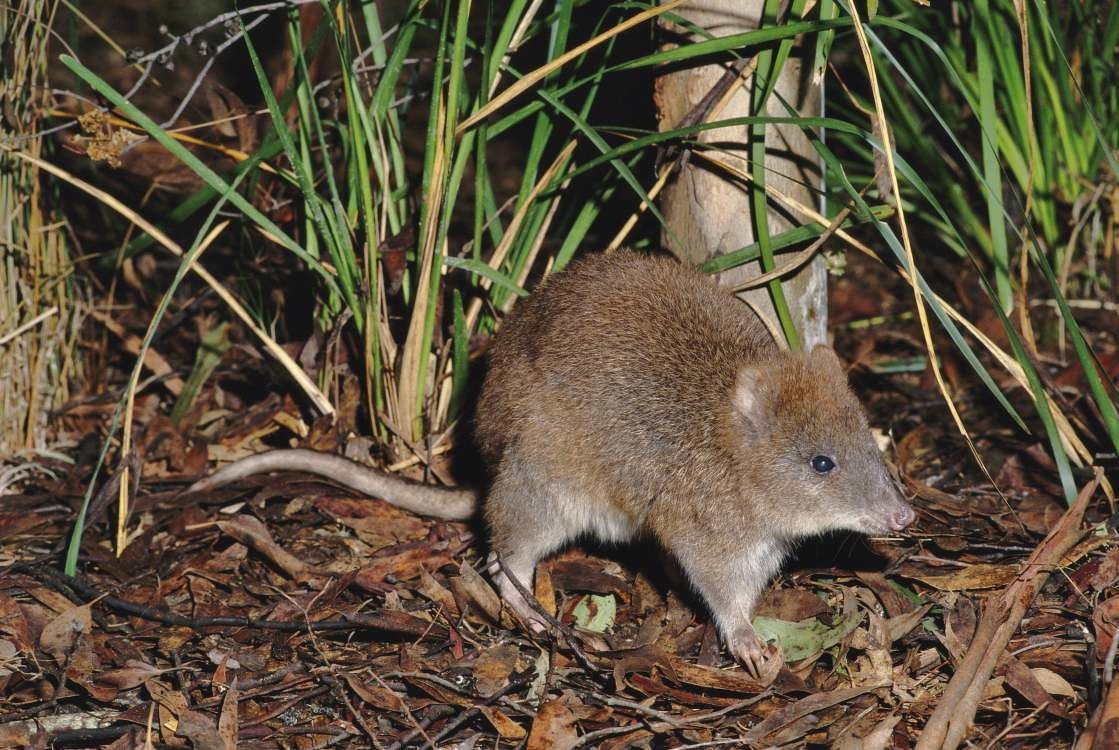
Long-footed potoroo
Long-footed potoroos(Potorous longipes) are largest species of Potorous and closely resemble long-nosed potoroos but have larger feet and a longer tail. First recorded in 1967 when an adult male was caught in a dog trap in the forest southwest of Bonang, Victoria. They are found southeastern Australia, restricted to an area around the coastal border between New South Wales and Victoria. Their average lifespan in captivity is 15.3 years.
Long-footed potoroos are found in East Gippsland, north-eastern Victoria south of Mount Buffalo, and south-eastern New South Wales mostly in a range of predominantly "wetter" forest types, from wet sclerophyll (hard leaf) forests at an altitude of 800 meters (2,625 feet) to lowland sclerophyll forests and warm temperate rainforest at 150 meters (492 feet). They are restricted areas with high soil moisture content throughout the year because of ecology of food items) and areas with densely vegetated locations for shelter. Most long-footed potoroos are found in sites with an average annual rainfall of 110 to 120 centimeters (43 to 47 inches). [Source: Mark Irwin, Animal Diversity Web (ADW) |=|]
On the International Union for Conservation of Nature (IUCN) Red List, long-footed potoroos they are listed as Endangered. Threats have including 1) habitat loss or fragmentation caused by logging and road construction associated with logging; 2) wildfire and fuel-reduction burning practices; and 3) introduced predators, including red foxes, dingoes, and feral dogs. Among the conservation efforts being carried out by the Department of Natural Resources and Environment in Australi careful management in national parks (namely the two known populations in Snowy River National Park), establishment of special management areas, predator control in management areas, long-term monitoring of populations, and public education about long-footed potoroos. |=|
Long-Footed Potoroo Characteristics, Duet, Behavior, Reproduction
Long-footed potoroos are about the size of a rabbit. They range in weight from one to two kilograms (2.0 to 4.4 pounds) and are around 70 centimeters (2.3 feet) long, including a 30- centimeter (one-foot) is the tail). Sexual Dimorphism (differences between males and females) is present: Males are most often heavier than females. Males are larger than females. Long-footed potoroos have strong front feet and claws. Their fur is dense and grey-brown in color — paler on the stomach and feet. They can be distinguished from other potoroos by their long back feet and toes.
Long-footed potoroo sare nocturnal (active at night), motile (move around as opposed to being stationary) and seek shelters in dense vegetation (ferns or thickets of wire grass) during the day to avoid predators. They are obligate fungivores (eat fungi), feeding on the fruiting bodies of more than 30 species of underground fungi, which grow in association with tree roots. Occasionally they eat insects, seeds, and other plant materials but 80 percent of their diet fungi. Long-nosed potoroo sniff the ground with a side to side motion near the vicinity of food. Once a a possible food source has been located, usually using the sense of smell, they begin digging with their fore paws to reach the food. Feeding locations are easily identified by small, cone-shaped holes, dug in search of fungi. |=|
Long-footed Potoroo likely breed throughout the year. Most young are born in the winter, spring, and early summe, The average gestation period is 38 days. There is usually one young per litter but there can be several litters per year, with the average being 2.5 to three young per year. Young remain in the pouch for 140 to 150 days. On average females reach sexual or reproductive maturity at two years one month.
Critically Endangered Gilbert's Potoroos
Gilbert's potoroos (Potorous gilbertii) are the world's rarest marsupials. They were first described in the West in 1840 by naturalist John Gilbert, who they were names after. It was then thought they animals went extinct until being rediscovered in 1994 at the Two Peoples Bay Nature Reserve (near Albany) in Western Australia. Conservation efforts have helped an initial wild population of 30 to 40 to grow over 100.
The only known population of Gilbert's potoroos is the one living at Two People's Bay park. In the park area, the potoroos hide from predators in brushy undergrowth. Other potoroos also like busy under growth and live in thick scrub, forests, low bushes, or long grass. [Source: Jennifer Gumas, Animal Diversity Web (ADW) |=|]
Gilbert's potoroos are approximately 55.8 centimeters (22 inches) in length, organization their 15.8-centimeter (6.2-inch) tail. The short, silky coat of Gilbert's potoroos is grayish-brown, fading to a reddish-brown color on the back. The under parts are whitish-gray, and the tail has hairs which are gray at the bottom and black at the tips. The face is long and narrow with a black line running from the nose to the forehead.
Gilbert's potoroos are one the world's rarest mammals. There were an estimated 100 remaining in the wild in 2022. On the International Union for Conservation of Nature (IUCN) Red List they are listed as Critically Endangered, one ranking short of being extinct. Many different factors have contributed to their near extinction: predation by introduced foxes and feral cats, disease, poisoned baits, and loss of land due to grazing cattle. Studies indicate that the single known small population of Gilbert's potoroos has experienced a dramatic, recent genetic bottleneck and are likely vulnerable to disease due to lack of genetic variation.
Gilbert's Potoroo Behavior, Diet and Reproduction
Much of what has been surmised about the behavior, diet and reproduction of Gilbert's potoroos has been deduced on studies of long-nosed potoroo, a closely related species, which are primarily nocturnal (active at night) and typically spend their days in simple nests, with females spending a particularly large amount of time nesting while they are breeding. Males are considered territorial (defend an area within the home range), but they defend home ranges only when nearby females are in estrus.
Studies of Gilbert's potoroos at Two Peoples Bay, found that the animal’s are mycophagous (eat fungi) and they eat multiple species of truffle-like fungi. They may also consume fleshy fruits, as seeds have been found in their scat. As with many of the potoroine species, the primary type of fungus consumed is hypogeous, with the above-ground fruiting bodies of epigeous fungi forming only a minor part of their diet. About 90 percent of the volume of material consumed by Gilbert's potoroos is hypogeous fungus. The spores of five fungal species have been recorded in faecal matter throughout the year; the total number is around 40 species. Plant matter consumed includes leaves and stems, and invertebrates have also been recorded in the excreta; this has been regarded as incidental ingestion while eating subterranean fungi. [Source: Wikipedia]
Female Gilbert's potoroos can give birth to two young a year, while carrying only one at a time. It has the ability to keep a second embryo in a state of diapause while the first embryo is growing. If the first baby does not go to term, the second baby starts growing right away. The gestation period for this species is unknown, but is estimated to be similar to the long-nosed potoroo at 38 days. Since so few are alive today, much of the reproductive cycle for Gilbert's potoroo remains unknown. The main breeding period is thought to be November–December, with similar breeding patterns to those of the long-nosed potoroo. Scientists have tried to breed them in captivity, but recent attempts have been unsuccessful, citing diet, incompatibility, and age as possible factors that influenced the lack of reproduction. Reproduction in the wild is thought to be progressing successfully, as many females found in the wild are with young.
Efforts to Help Gilbert's Potoroo
Researchers believe that the tiny population of Gilbert's potoroos in Two People's Bay managed to survive because the park did not employ the usual method of burning vegetation in the park. This extra brush gave the potoroos a place to hide from predators and allowed them to survive to the present. To prevent their extinction scientists estimate that the population of of Gilbert's potoroos must be increased to at least 500 individuals in order to provide sufficient genetic variation. To achieve this goal the Two People's Bay area must be conserved, local predators must be controlled, captive breeding programs must be created, and searches for other possible remaining populations of Gilbert's potoroos should be conducted.
In November 2015, a bushfire destroyed 90 percent of the habitat of Gilbert's potoroo in Two Peoples Bay. An estimated 15 of the 20 remaining individuals there were killed. Fortunately, seven of the potoroos were rescued before the fire swept through. [Source: Wikipedia]
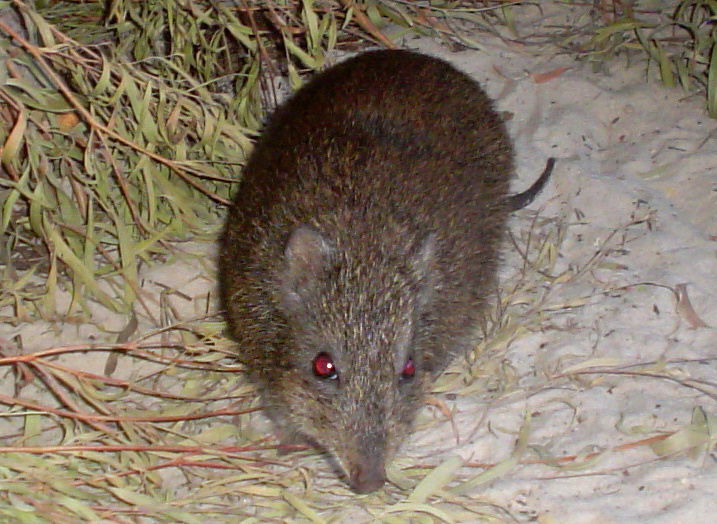
Gilbert's potoroo
Small populations are being established at Bald Island, off Albany, and more recently on Middle Island, off Esperance, all on the southern coast of Western Australia. Numbers have increased in recent years, and as of December 2018 it was estimated there weere 10 on Middle Island, 70 on Bald Island, 20 at Waychinicup National Park and two at Two Peoples Bay (also known as the Mt Gardner population).
After the rediscovery of Gilbert's potoroo in the 1990s, specimens were immediately taken into captivity for captive breeding to help increase the population. A few young were born in the first few years, but then breeding stopped due to age differences and a history of balanoposthitis, a disease that affects the male potoroo's penis and causes inflammation and ulceration if left untreated. This problem exists among the wild population; captive males are treated with antibiotics.
In 2016, Michaelmas Island, off the coast of Two Peoples Bay, was chosen as a new habitat location. The island's lack of predators was a key factor in its selection, which would provide Gilbert's potoroo with a similar level of long-term protection enjoyed by the quokkas of Rottnest Island, also in Western Australia. Four individuals (rescued from the Two Peoples Bay fire were translocated, but two died and the remaining two were removed and put back into the Two Peoples reserve after being looked after and fed to regain their normal weight. The animals had stayed only on the granite part, which covers a third of the island, and there had not been enough food to sustain them.[39]
In 2017, four animals were translocated as a temporary trial from Bald Island to Middle Island, a 10.4 square kilometer (4.0 square mile) island in the Recherche Archipelago. The signs were good, so a second trial began in 2018 with the translocation of 10 animals from Bald Island.
Long-Nosed Potoroos
Long-nosed potoroo (Potorous tridactylus) are native to forests and shrubland of southeastern Australia and Tasmania. They are solitary, nocturnal members of the potoroo and bettong family (Potoroidae) that spend much of their awak time digging at night for fungi, roots, or small insects. Like like kangaroos they carry their young (joeys) in a pouch. They are rarely seen in the wild. Among the indicators of their presence are the runways they make through the undergrowth and the hollow diggings they leaves behind when feeding on underground roots and fungi. There are two subspecies: P. t. tridactylus on mainland Australia, and P. t. apicalis on Tasmania, with lighter fur. [Source: Wikipedia]
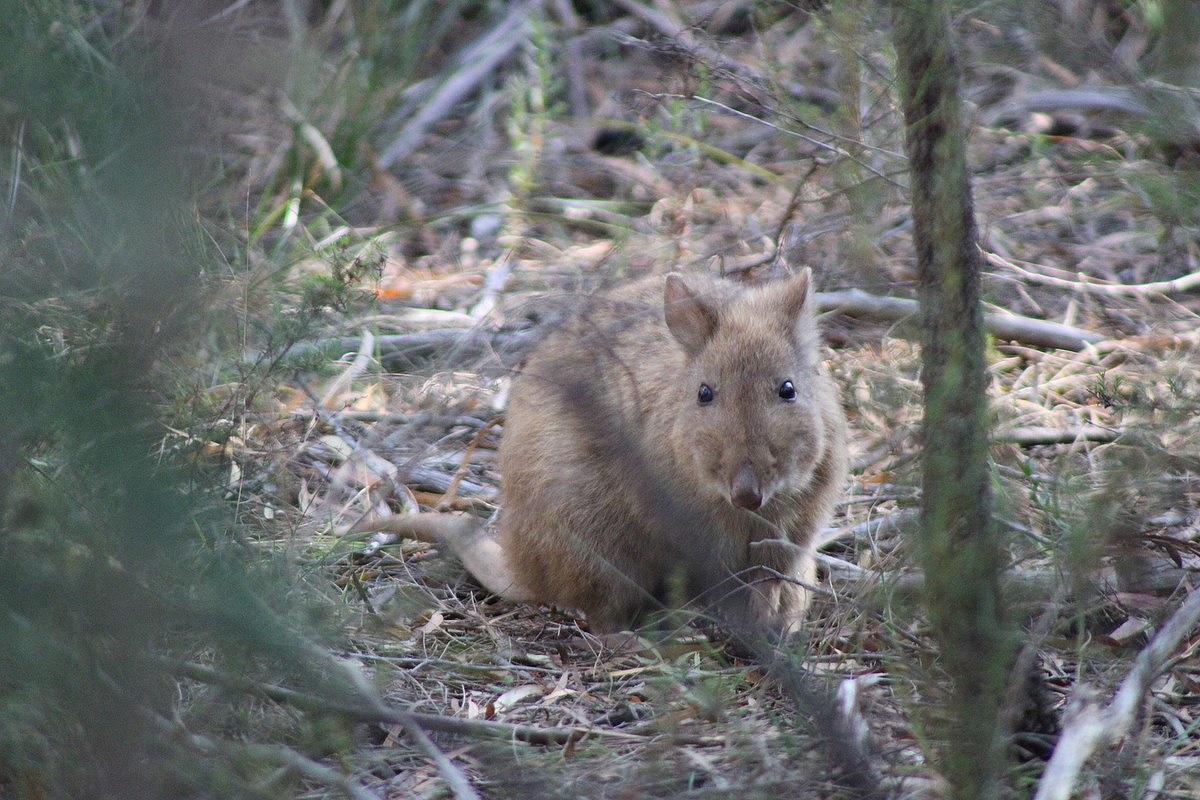
Long-nosed potoroo
Long-nosed potoroos can be found in coastal New South Wales, southeastern Queensland, coastal, near-coastal, and northeastern areas of Victoria, and the southwestern corner of Western Australia and northern and eastern Tasmania. Relatively thick ground cover is an important component of potoroo habitat and thus Long-nosed potoroos are most commonly found in forests and woods with grass tussocks, under bushes, and thick shrubs where the animals can make their above-ground nests of dry vegetation. [Source: Nathan Landesman, Animal Diversity Web (ADW) |=|]
Long-nosed potoroos are not endangered like some other potoroo species. On the International Union for Conservation of Nature (IUCN) Red List they are classified as a species of “Least Concern” and they are still relatively common in many parts of Australia. Even their numbers have declined as a result of habitat loss, predation by introduced species such as cats or foxes. competition with introduced rabbits for succulent food, the use of poisoned bait meant to control of rabbit populations and sport hunting. Most regional populations are relatively stable and many occur in conservation reserves; however, one isolated population in the Grampians region of Victoria is at risk because most of its habitat is outside the National Park boundary. An abundance of subfossil remains of these marsupials in cave deposits indicates that Long-nosed potoroo was very common in the past. It is not clear to what extent their decline is the result of human activities, but it is clear that very large areas of suitable habitat along the eastern coast of Australia have been developed by humans.
Long-Nosed Potoroo Characteristics and Diet
Long-nosed potoroos are a rabbit-sized rat-kangaroo with an elongated muzzle They range in weight from 0.7 to 1.8 kilograms (1.54 to 3.96 pounds). Their its head and body length ranges from 30 to 40 centimeters (11.8 to 15.7 inches) and their tail is about 15 to 26 centimeters (6 to 10.2 inches) long. Their average basal metabolic rate is 2.556 watts. [Source: Nathan Landesman, Animal Diversity Web (ADW) |=|]
The straight, soft fur of Long-nosed potoroos is grey or light chestnut brown in color on the back and sides and grayish or whitish on the belly. The tail often has a white tip. The median claws on the front limbs are very long and sharp — well adapted for scratching and digging. Their a downward-curving, semiprehensile tail used for carrying bundles of nesting materials. They have a dental formula of 3/1, 1/0, 2/2, 4/4, with well-developed canines and bunodont molars. Long-nosed potoroos were one of the first mammals recorded by Europeans in Australia. They were originally called "three-toed potoroo" when they actuall have four due to the fusing of the second and third digits.
The size, fur color and morphology of Long-nosed potoroo changes quite a bit depending oon where they live. The rufous-brown-colored population in the northeastern part of Tasmania is nearly twice the szie as grey-brown-colored population in northwestern part of Tasmania, which os only 200 kilometers away. The snout of animals from Queensland is relatively short and increases proportionally in size as one travels south and is most elongated and narrow in Tasmania. In addition, the proportion of individuals with a white tip on their tail is near zero in the most northern parts of their range but make up 80 percent of the population in Tasmania. |=|
Long-nosed potoroos are primarily mycophagous (eat fungi) but are recognized as omnivores (eat a variety of things, including plants and animals). They much of their food — cranberries, fungi, grasses, juicy stems, roots, and tubers — by digging shallow holes with the claws of their forefeet. Fungi is the main food source. Grasses are eaten only during winter when food availability is low. Insects and their larvae make up only of one or two percent of their winter diet but this can increase to 21 percent during the summer when there are loads of insects. To obtain a sufficient amount of fungi, potoroos have to use a variety of widely scattered feeding areas.
Long-Nosed Potoroo Behavior and Reproduction
Long-nosed potoroos are nocturnal (active at night), motile (move around as opposed to being stationary) and typically stay near cover during periods of activity. The wide range of food they eat and their digging habits provide them with strong survival tools and sometimes means they roam around quite a bit. Long-nosed potoroos are good at surviving brush fires that destroy aboveground food sources but not those underground.
Long-nosed potoroos are generally solitary except during periods of mating and in case of females with young. Male home ranges of approximately 25 hectares (47 acres) overlap with those of females, which are about five hectares (12.5 acres) in size. Home ranges of males appear to not overlap. Long-nosed potoroo generally have lifespans of four or five years but may live up to seven years.
Females can breed starting at one year of age. Females typically breed two or two and half times a year at any time during the year. Almost always a single young (joey) is born after a gestation period of approximately 38 days. Newborns measure two centimeters (3/4 inch) long and weighs 300 milligrams at birth. It takes 10 minutes for the joey to crawl to the mother's pouch. In the pouch, it attaches to a teat, where it remains for three months. Joeys continue to suckle until four months of age.
Female potoroos are polyoestrus. The 42 day estrus cycle of Long-nosed potoroo is at the upper limit of that observed in marsupials. Both sexes mate promiscuously, and breeding is continuous throughout the year with peaks in early spring and early summer. Birth is often followed by a post-partum estrus; mating at this time results in an embryo which remains dormant until the existing young leaves the pouch naturally or dies. After the existing young vacates the pouch or dies, the quiescent embryo resumes development and is born approximately 30 days later.
Image Sources: Wikimedia Commons
Text Sources: Animal Diversity Web animaldiversity.org , National Geographic, Live Science, Natural History magazine, Australian Museum, David Attenborough books, Australia Geographic, New York Times, Washington Post, Los Angeles Times, Smithsonian magazine, Discover magazine, The Conversation, The New Yorker, Time, BBC, CNN, Reuters, Associated Press, AFP, Lonely Planet Guides, Wikipedia, The Guardian, Top Secret Animal Attack Files website and various books and other publications.
Last updated July 2025