
Home | Category: Marsupials
TASMANIAN DEVILS, HUMANS AND CONSERVATION
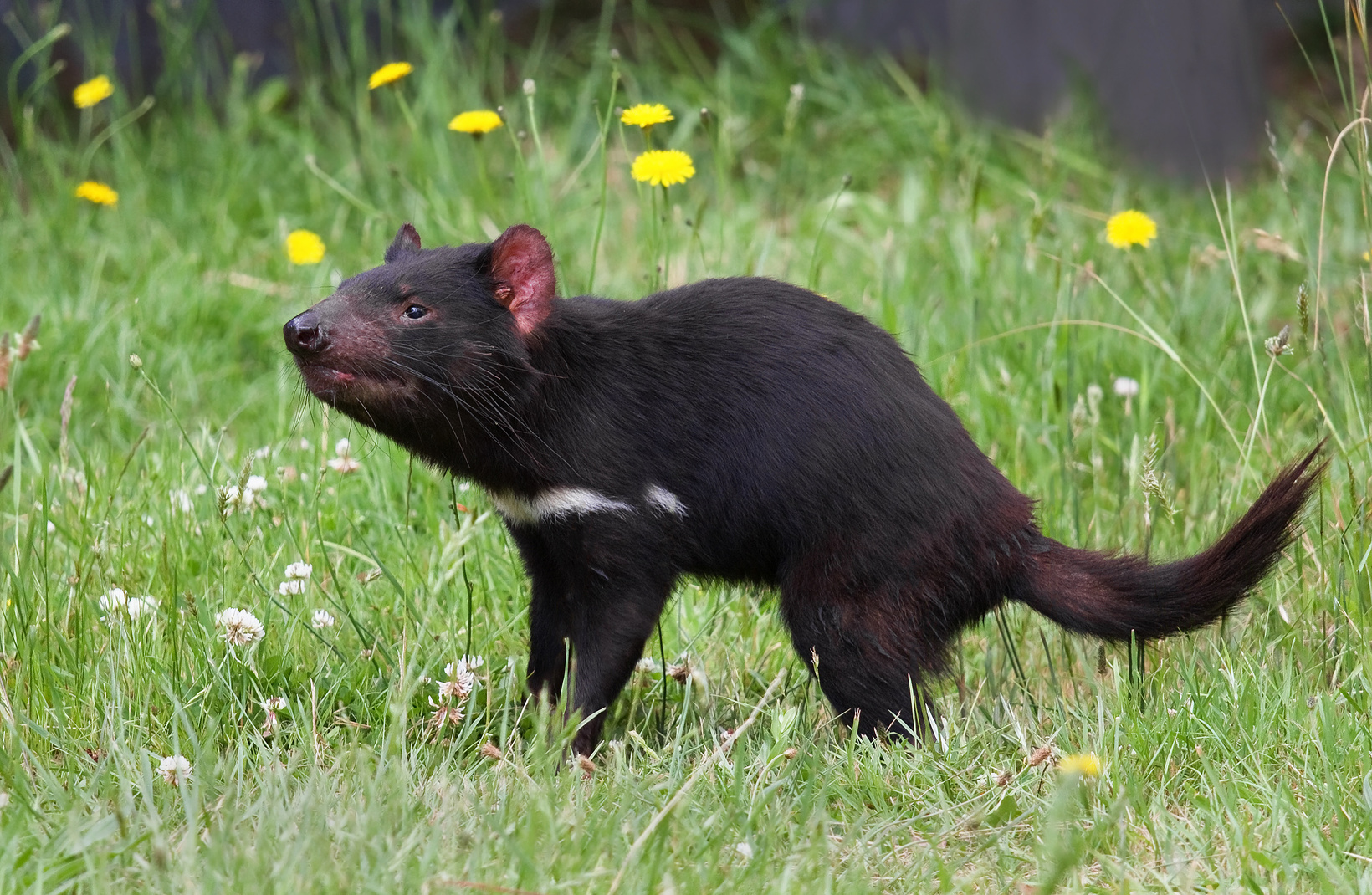
Tasmanian Devil at the Tasmanian Devil Conservation Park, Taranna, Tasmania
On the International Union for Conservation of Nature (IUCN) Red List, Tasmanian devils have been listed as Endangered since 2008 as their populations have declined since the mid 1990s mainly as a result of Devil Facial Tumor Disease (DFTD), a contagious cancer, which is estimated to have killed approximately 80 percent of the wild Tasmanian devil population. There is one remaining DFTD-free population in northwestern Tasmania. There are estimated to be fewer than 25,000 Tasmanian devils remaining in the wild. This is a significant decline from about 70,000 to 80,000 in the mid 200os and perhaps as many as 150,000 in the 1990s.
Tasmanian devils are symbols of Tasmania. Many organisations, groups and products associated with the state use the animal in their logos. They also help attract of tourists to Tasmania. Entrepreneur Geoff King created a unique restaurant in Tasmania where visitors pay to watch wild devils growl and shriek and rip into a carcass. The first time many people heard of them was through cartoon character created by Warner Bros. Looney Tunes that also gave the world Bugs Bunny and Daffy Duck. [Source: Tanya Dewey; Bridget Fahey; Almaz Kinder, Animal Diversity Web (ADW) |=|]
Tasmanian devils were nearly wiped out by hunting, trapping and poisoning in the early 1900s, in part because they were viewed as vermin and a threat to lambs and poultry by farmers. But they came back and have been officially protected since 1941. Their populations were growing and appeared healthy, when DFTD struck in 1996 and now threatens the survival of the species. By 2007, the disease had spread to more than half the species range. Areas where the disease is present have experienced a loss of up to 95 percent of the devil population there. In 2013, Tasmanian devils began being sent to zoos around the world as part of the Australian government's Save the Tasmanian Devil Program. Tasmanian devils are is also listed as "Endangered" under Tasmania's Threatened Species Protection Act 1995 and the Commonwealth's Environment Protection and Biodiversity Conservation Act 1999. [Source: Tanya Dewey; Bridget Fahey; Almaz Kinder, Animal Diversity Web (ADW) |=|]
Past disease experiences suggest the cancer may not wipe out all the devils, but lower numbers would leave them vulnerable to extinction from other threats. The devil's decline opens the door for the spread of European red foxes into Tasmania, which could threaten a prolific range of less well-known wildlife that has thrived in relative seclusion on the island state. [Source: Wendy Pugh, Reuters, Apr 10, 2004]
There are believed to be foxes in Tasmania but it is unclear exactly how many foxes are in Tasmania, Devils and foxes are the top predators in Tasmania. It is believed that there were a number of deliberate introductions of foxes in the late 1990s and early 2000s. Evidence of fox presence includes carcasses and DNA-positive scats. In the late 2010s, the Tasmanian government spent $US50 million dollars to eradicate foxes even though it wasn’t clear whether they even existed on the island. [Source: Brooke Jarvis, The New Yorker, June 25, 2018]
RELATED ARTICLES:
TASMANIAN DEVILS: CHARACTERISTICS, BEHAVIOR AND REPRODUCTION ioa.factsanddetails.com
TASMANIAN WOLVES: CHARACTERISTICS, BEHAVIOR AND REPRODUCTION ioa.factsanddetails.com
TASMANIAN WOLF EXTINCTION, SIGHTINGS, SEARCHES, BRINGING IT BACK ioa.factsanddetails.com
DASYURIDS AND DASYUROMORPHS (MARSUPIAL CARNIVORES) ioa.factsanddetails.com
NUMBATS: CHARACTERISTICS, BEHAVIOR AND REPRODUCTION ioa.factsanddetails.com
QUOLLS: CHARACTERISTICS, BEHAVIOR AND REPRODUCTION ioa.factsanddetails.com
QUOLL SPECIES OF AUSTRALIA: CHARACTERISTICS, BEHAVIOR, CONSERVATION ioa.factsanddetails.com
SMALL MARSUPIAL CARNIVORE SPECIES: MULGARA, DIBBLERS, KULTARRS, NINGAUI ioa.factsanddetails.com
DUNNARTS: SPECIES, CHARACTERISTICS, BEHAVIOR AND REPRODUCTION ioa.factsanddetails.com
PLANIGALES: SPECIES, CHARACTERISTICS, BEHAVIOR AND REPRODUCTION ioa.factsanddetails.com
ANTECHINUSES: SPECIES, FALSE ONES, CHARACTERISTICS, BEHAVIOR, SUICIDAL MATING ioa.factsanddetails.com
MARSUPIALS: HISTORY, EVOLUTION, CHARACTERISTICS, BEHAVIOR, REPRODUCTION ioa.factsanddetails.com
MARSUPIALS IN AUSTRALIA ioa.factsanddetails.com
Devil Facial Tumor Disease (DFTD)
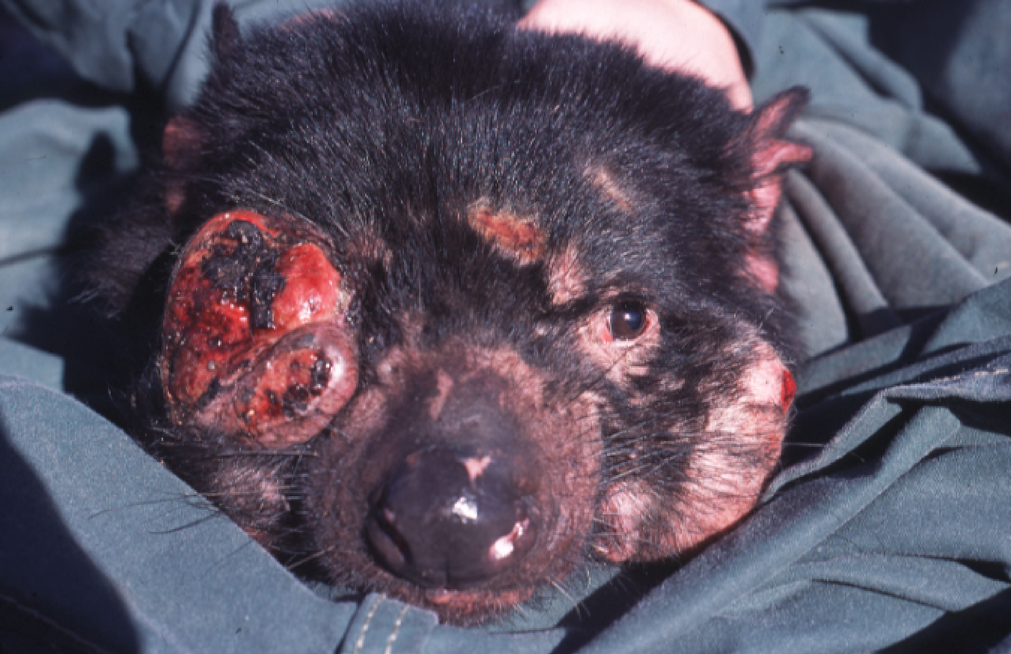
Tasmanian devil with Devil Facial Tumor Disease (DFTD)
Tasmanian devils are now plagued by putrefying cancerous facial tumours caused by Devil Facial Tumor Disease (DFTD), a contagious cancer, which grossly disfigures the animals and cause them to die within months of contracting the disease. There is some evidence that this disease is not new, but is endemic to Tasmanian devils. Historical record and epidemiological modeling suggest that this epidemic may cycle through Tasmanian devil populations at 77 to 146 year intervals. [Source: Tanya Dewey; Bridget Fahey; Almaz Kinder, Animal Diversity Web (ADW)
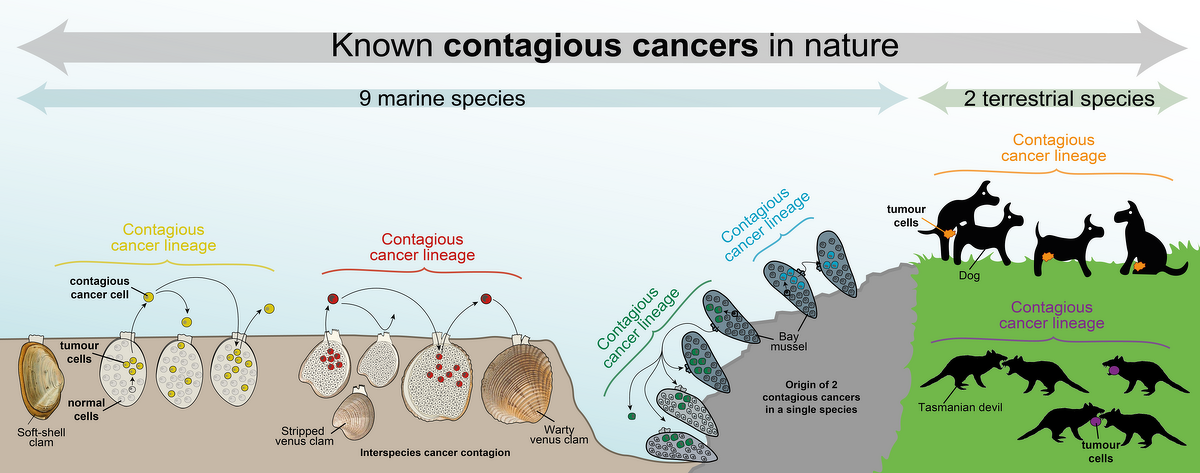
Abigail Tucker wrote in Smithsonian magazine: When the disfiguring lumps and lesions on the devils’ heads first appeared, scientists thought the disease must be caused by a virus. But it is actually an aggressive cancer, and the contagious agents are the tumor cells themselves. An animal transmits the disease cells to another one by biting. Huge tumors quickly bloom in the new host, making eating impossible; some animals starve before the cancer starts shutting down their vital organs. “It is undoubtedly one of the most successful cancer lineages that we know of,” says Elizabeth Murchison, a Tasmanian-born geneticist of the Wellcome Trust Sanger Institute in Cambridge, England. Her team recently reported that the disease originated in 1996 in a female devil; descendants of cells in her tumor live on in victims today. [Source: Abigail Tucker, Smithsonian magazine, May 2012]
The cancer doesn’t respond to chemotherapy, and even surgical removal of the tumors isn’t effective. Biologists have abandoned efforts to cull sick individuals from wild populations because the disease travels too fast. The government may fence off the one unscathed part of the island to protect the devils there, and uninfected “insurance populations” have been established on mainland Australia in case all the wild animals die.
The bedeviled animals’ best hope may be vaccines or genetic medicine.If scientists can learn which mutated genes are behind the cancer, they may be able to develop drugs to inhibit the activity of the tumor cells. But such a cure is years away, and if nothing changes the devils could go extinct within a few decades. “Will we make it in time?” says Janine Deakin, an Australian National University geneticist. “I don’t know.”
The disease may also add to biologists’ understanding of extinctions, which are typically blamed on factors such as hunting and habitat loss. Kristofer Helgen, a zoologist at the Smithsonian’s National Museum of Natural History, is studying an outbreak that may have struck the devils and an even bigger carnivorous marsupial, the Tasmanian tiger, a century ago.The tiger, inbred and overhunted, soon disappeared for good. That malady is probably unrelated to the modern cancer. But “in the span of a single century, we’ve seen two disease episodes severe enough to result in major declines,” Helgen says. “Disease may explain extinctions that would otherwise go unexplained. It may be one of the important things that causes the final blink-out.”
According to University of Cambridge: Tasmanian devils are affected by two independent transmissible cancers known as devil facial tumour one (DFT1) and devil facial tumour two (DFT2). Both cancers are spread by biting and cause the appearance of tumours on the face or inside the mouth of affected Tasmanian devils. The tumours often become very large and usually cause death of affected animals. DFT1 has spread widely around Tasmania and has caused declines in the Tasmanian devil population; DFT2, on the other hand, appears to be confined to a peninsula in south-east Tasmania. DFT1 epidemic has spread throughout most of Tasmania, and currently only areas of western and northwestern Tasmania are confirmed to have remained disease-free. DFT2 was first observed in 2014 in the south-east of Tasmania. To date, it has only been observed on the Channel Peninsula in south-east Tasmania.
Combating Devil Facial Tumor Disease (DFTD)
According to the University of Cambridge: There are no established treatments for DFT1 and DFT2. A number of chemotherapeutic agents have been trialled for DFT1, but none have shown any efficacy in treating the disease. Preliminary immunotherapy trials have shown some promise for DFT1. The Save the Tasmanian Devil Program is a government-funded initiative with the goal of saving the Tasmanian devil and maintaining the species as a viable member of the Tasmanian ecosystem. An insurance population has been established in order to ensure survival of the species. Research is directed towards understanding the cause, evolution and impacts of the disease with the goal of developing a vaccine, therapy or other intervention. In the late 2000s, Australian zoos bred 170 devils as “insurance populations.” [Source: University of Cambridge]
Fencing off un-diseased Tasmanian devils from diseased one is seen as one solution to DFTD. Associated Press reported in 2009: Scientists now want to build a double fence standing more than three feet tall to stop the cancer’s relentless spread toward the rugged northwest of the island, home to disease-free devils and World Heritage-listed rain forest. Plans to establish a wild colony on uninhabited Maria Island off Tasmania are controversial because of fears that devils could endanger rare birds and beetles.The Tasmanian government says it is considering offshore islands as well as fenced areas up to 12 miles long, but its first priority is the populations in mainland zoos. [Source: Rod McGuirk, Associated Press, January 2009]
Hamish McCallum, the senior scientist in the devil rescue program and professor of wildlife research at the University of Tasmania, said the only fence precedent he knew of was in South Africa, where the Kruger National Park was fenced on its southern and western borders in 1961 to prevent foot-and-mouth disease spreading from wildlife to cattle. The Tasmanian fence would be built in selective areas, such as some corners or a peninsula.“This isn’t going to be a huge barrier like the Berlin Wall across all of Tasmania,” McCallum said.Government wildlife biologist Nick Moonie noted that fences would also trap other animals such as wallabies and echidnas, some of which may need to move or migrate. Moonie, who advises both the devil rescue and fox eradication programs, suspects cancer won’t wipe out devils, but foxes just might.
In July 2008, in a study published in the Proceedings of the National Academy of Sciences journal, a team of Australian researchers reported that Tasmanian devils were mating and breeding much younger in response to DFTD. Lead author Dr Menna Jones, of the University of Tasmania's School of Zoology, says the move to early mating may help buy enough time for research to beat DFTD. "The disease is still going to overwhelm the devil, but it will slow it down," she says. "It gives us more time." She says the devil is showing its capacity to respond to the disease-induced increased adult mortality with a 16-fold rise in the proportion of females showing early sexual maturity. [Source: Dani Cooper, ABC, July 15, 2008]
ABC reported: The Australian Research Council-funded study examined five sites where individually marked devil populations have been studied before and after the arrival of the disease.The researchers say before the disease arrived at the five sites females devils on average began seasonal breeding at two years of age and produced a litter of about four babies annually for three years. Since the arrival of the disease the numbers of animals aged older than three years in the communities has plummeted. Before the disease arrived about 69 percent of females produced more than one litter in their lifetime. That figure dropped to around 35 percent once the disease spread through the community. "[Two-year-old] females now generally have one breeding opportunity and may not survive long enough to rear that litter," they say.
However, the team found early reproduction by one-year-old females increased substantially. Before the disease the percentage of one-year-old females breeding ranged from zero to 12.5 percent. "After the disease spread precocial breeding increased on average 16-fold to between 13.3 percent and 83.3 percent," the researchers write. The researchers say this shows the devils are responding to "disease-induced increased adult mortality with precocious sexual maturity". They say early breeding might be facilitated by faster growth due to the drop in population density reducing competition for food.The researchers say the life-history change might lead to a rapid adaptation toward a population genetically and demographically more robust to the effects of the facial tumour. "Any ability in devils to increase lifetime reproductive output beyond one litter, or indeed to rear a single litter to independence before death from cancer, should enhance the fitness of those individuals," they write."There is intense selection for anything that will give [the devil] an edge occurring." However, Jones says evidence of the disease being transmitted to younger animals is beginning to emerge, which could be due to their earlier entry into mating.
Vaccine for Devil Facial Tumor Disease (DFTD)?
A relatively new vaccine approach could help save Tasmanian devils. Andrew S. Flies, Ruth Pye and Chrissie Ong wrote in The Conversation: We have discovered that a modified virus, like the attenuated adenovirus used in the AstraZeneca COVID-19 vaccine, can make devil facial tumour cells more visible to the devil immune system. We have also found key immune targets on devil facial tumour cells. These combined advances allow us to move forward with a vaccine that helps the devil immune system find and fight the cancer. And we have a clever way to deliver this vaccine, too — with edible baits. [Source: Andrew S. Flies and Ruth Pye, University of Tasmania; Chrissie Ong, The University of Queensland, The Conversation, November 16, 2022]
DFT1 and DFT2 are transmissible cancers — they spread living cancer cells when the devils bite each other. This has presented a puzzle: a cancer cell that comes from another animal should be detected by the immune system as an invader, because it is “genetically mismatched”. For example, in human medicine, tissue transplants need to be genetically matched between the donor and recipient to avoid the immune system rejecting the transplant.Somehow, DFT1 and DFT2 seem to evade the immune system, and devils die from tumours spreading throughout their body or from malnutrition due to the facial tumours disrupting their ability to eat.
On the bright side, the immune systems of a few wild devils have been able to overcome DFT1. Furthermore, previous vaccine and immunotherapy trials showed the devil immune system can be activated to kill DFT1 cells and clear away sizeable tumours. This good news from both the field and the laboratory has allowed our team to zoom in on key DFT protein targets that the devil immune system can attack. This helps us in our quest to develop a more effective and scalable vaccine.
Even if we succeed in producing a protective DFT vaccine, we can’t trap and inject every devil. Luckily, clever researchers in Europe in the 1970s figured out that vaccines can be incorporated into edible food baits to vaccinate wildlife across diverse landscapes and ecosystems. In 2019, we hypothesised an oral bait vaccine could be made to protect devils from DFT1 and DFT2. Fast forward to November 2022 and the pieces of this ambitious project are falling into place.
For the complete article from which the material here is derived see “Thousands of Tasmanian devils are dying from cancer – but a new vaccine approach could help us save them.” The Conversation theconversation.com
Wild Tasmanian Devils Born on Mainland Australia for First Time in 3,000 Years
In May 2021, wild Tasmanian devils were born on mainland Australia for 1st time in 3,000 years in what was seen as a major step in reintroducing the species to the mainland and a major steep for keeping the species thriving in the face of devil facial tumor disease (DFTD),Harry Baker wrote in Live Science: To save the species from extinction, conservation organization Aussie Ark, in partnership with Re:wild and WildArk, started a rewilding project in 2011 to reintroduce Tasmanian devils to mainland Australia. That year, they transferred 44 Tasmanian devils to a captive breeding site, Devil Ark, in Australia, where more than 390 joeys have since been born under human supervision, according to Aussie Ark. [Source: Harry Baker, Live Science May 31, 2021]
In 2020, the team at Devil Ark released 26 of the captive Tasmanian devils, including seven reproductive-age females, into a 1,000-acre (400 hectares) sanctuary, making them the first wild Tasmanian devils in Australia since they were wiped out. By May 2021, at least seven joeys have been born among the wild devils, with the actual number likely to be closer to 20, Aussie Ark said. "We have been working tirelessly for the better part of 10 years to return devils to the wild of mainland Australia, with the hope that they would establish a sustainable population," Tim Faulkner, president of Aussie Ark, said in a statement. "Once they were back in the wild, it was up to them."
The wild population will continue to develop within the safety of the devils' sanctuary, which protects them from cars, feral pests, noxious weeds and wildfires, according to Aussie Ark, which also plans to reintroduce 20 additional captive devils to the sanctuary in late 2021 and 2022. "The fact that the adults have adapted so quickly is remarkable, and the joeys are one of the most tangible signs that the reintroduction of Tasmanian devils is working," Don Church, president of Re:wild, said in the statement. "This doesn't just bode well for this endangered species but also for the many other endangered species that can be saved if we rewild Australia."
Image Sources: Wikimedia Commons
Text Sources: Animal Diversity Web animaldiversity.org , National Geographic, Live Science, Natural History magazine, Australian Museum, David Attenborough books, Australia Geographic, New York Times, Washington Post, Los Angeles Times, Smithsonian magazine, Discover magazine, The Conversation, The New Yorker, Time, BBC, CNN, Reuters, Associated Press, AFP, Lonely Planet Guides, Wikipedia, The Guardian, Top Secret Animal Attack Files website and various books and other publications.
Last updated July 2025