
Home | Category: Marsupials
TIGER QUOLLS
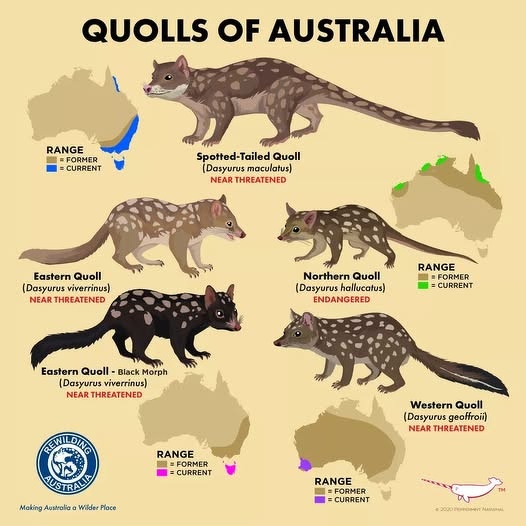
Tiger quolls (Dasyurus maculatus) are Australia’s largest marsupial carnivores. Also known as spotted-tail quolls and somewhat resembling light-colored Tasmanian devils, they are agile and strong and have very sharp teeth and largely stays out of sight during the day, resting in hollow logs or underground dens, and come out at night, traveling great distances in search of prey such as rabbits and possums which they quickly dispatch. Mothers takes parts of these animals back to their den to feed cubs during their first four or five months of life. Tiger quolls in the wild have a lifespan ranging from two years for smaller ones to four to five years for larger ones. The longest living tiger quoll in captivity lived six years and three months.
Tiger quolls are found in southeast Australia (eastern New South Wales, Victoria, southeastern South Australia), Tasmania and a small area of Queensland, mostly in dry and wet sclerophyll (hard leaf) forests, woodlands, rainforests, coastal heaths, coastal wet scrub, estuarine areas, rocky headlands, riparian forests near a river and open pastures at elevations of sea level to 1,500 meters (4921 feet). There are two subspecies: 1) D. maculatus maculatus and 2) D. maculatus gracilis. D. m. maculatus are rarely found in southeastern Queensland and almost extirpated from southeastern South Australia, and more common in Victoria and New South Wales from the coast to mountains. D. m. maculatus, are most commonly seen in Tasmania but also occur in Northern Queensland.[Source: Stephanie Verjinski, Animal Diversity Web (ADW) |=|]
Dry sclerophyll forests are typically made up of multi-aged tree stands with hard-leafed dominated under stories consisting of shrubs, sedges, and bracken ferns. Wet sclerophyll forests are the areas between dry sclerophyll forests and rainforest. Tiger quolls favor gullies and riparian flats and avoid mid-slopes seek out place where there is lots of prey. D. m. maculatus require a lot of ground cover for denning sites as well as rock out cropping for denning. Rocky outcrops are preferred for denning over den sites in logs and trees.
On the International Union for Conservation of Nature (IUCN) Red List, tiger quolls are listed as Near Threatened. In CITES (Convention on International Trade in Endangered Species of Wild) they have no special status. It is estimated that there are around 14,000 of them. Tiger quolls are threatened by loss of habitat mainly due to expanding urbanization and agriculture. Habitat fragmentation caused tiger quoll ranges to overlap with the territories of other predators, namely introduced ones like red foxes and the feral cats, which can outcompete quolls and feed on them. The poisoning of dingoes took a toll on quolls as they took poisoned meat in baited traps meant for dingoes.
RELATED ARTICLES:
QUOLLS: CHARACTERISTICS, BEHAVIOR AND REPRODUCTION ioa.factsanddetails.com
DASYURIDS AND DASYUROMORPHS (MARSUPIAL CARNIVORES) ioa.factsanddetails.com
NUMBATS: CHARACTERISTICS, BEHAVIOR AND REPRODUCTION ioa.factsanddetails.com
TASMANIAN DEVILS: CHARACTERISTICS, BEHAVIOR AND REPRODUCTION ioa.factsanddetails.com
TASMANIAN DEVIL CONSERVATION: HUMANS AND THE DEADLY DISEASE RAVAGING THEM ioa.factsanddetails.com
TASMANIAN WOLVES: CHARACTERISTICS, BEHAVIOR AND REPRODUCTION ioa.factsanddetails.com
TASMANIAN WOLF EXTINCTION, SIGHTINGS, SEARCHES, BRINGING IT BACK ioa.factsanddetails.com
SMALL MARSUPIAL CARNIVORE SPECIES: MULGARA, DIBBLERS, KULTARRS, NINGAUI ioa.factsanddetails.com
DUNNARTS: SPECIES, CHARACTERISTICS, BEHAVIOR AND REPRODUCTION ioa.factsanddetails.com
PLANIGALES: SPECIES, CHARACTERISTICS, BEHAVIOR AND REPRODUCTION ioa.factsanddetails.com
ANTECHINUSES: SPECIES, FALSE ONES, CHARACTERISTICS, BEHAVIOR, SUICIDAL MATING ioa.factsanddetails.com
MARSUPIALS: HISTORY, EVOLUTION, CHARACTERISTICS, BEHAVIOR, REPRODUCTION ioa.factsanddetails.com
MARSUPIALS IN AUSTRALIA ioa.factsanddetails.com
Tiger Quoll Characteristics and Diet
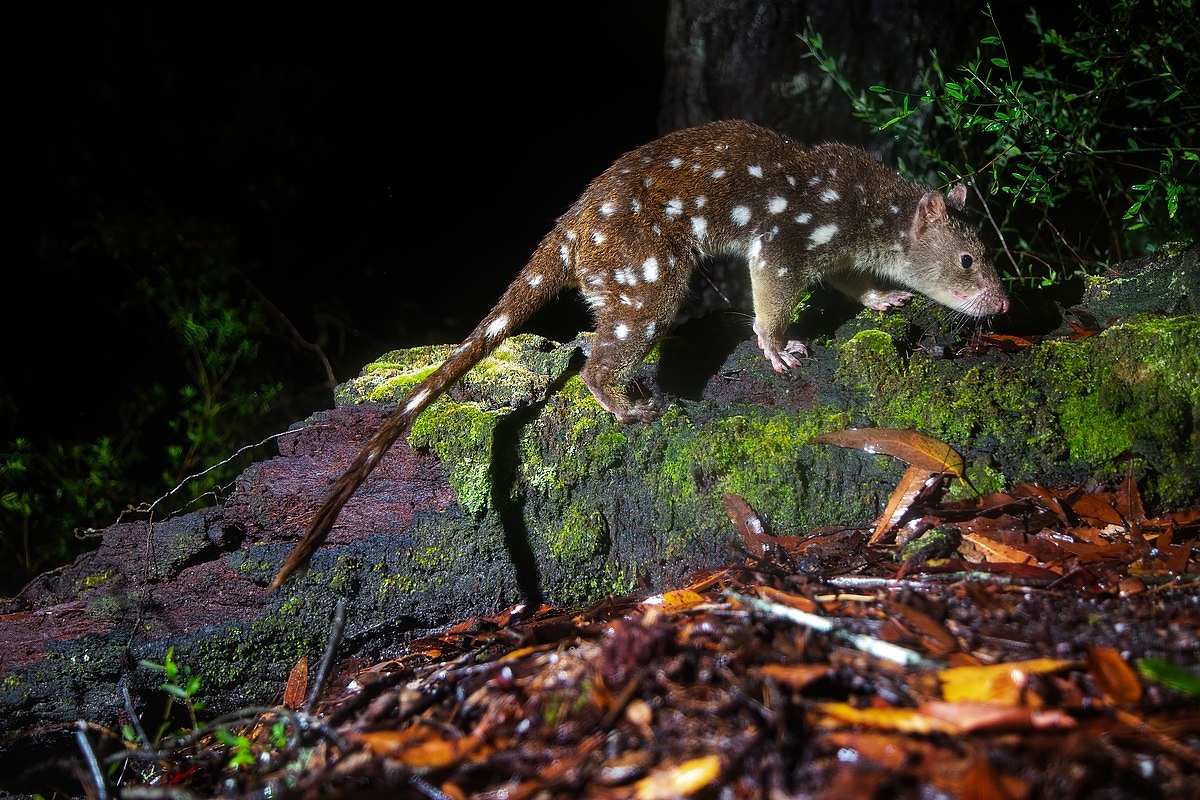
Tiger quoll at Barren Grounds Nature Reserve, New South Wales
Tiger quolls range in weight from 1.8 to seven kilograms (4 to 15.4 pounds), with their average weight being 1.8 to 3.5 kilograms (4 to 7.7 pounds). They range in length of from 69 to 113 centimeters (27.2 to 44.5 inches), with their average length being 75 centimeters (29.5 inches). Their head and body measures 40.5 to 51 centimeters (16 to 20 inches) , with a 34-to-49 centimeter (13.4-to-19.3 inch) tail Their average basal metabolic rate is 3.142 watts. [Source: Stephanie Verjinski, Animal Diversity Web (ADW) |=|]
Sexual Dimorphism (differences between males and females) is present: Males are larger than females.. Males weigh three to seven kilograms (6.6 to 15.4 pound) and have a head and body length of 38 to 76 centimeters (15 to 30 inches), with a 37-to-55 centimeter (14.5-to-21.6-inch) tail. Females weigh 1.6 to four kilograms (3.5 to 8.8 pounds) and have a head and body length of 35 to 45 centimeters (12 to 13.8 inches, with a 34-to-42 centimeter (12.8-to-17.7 -inch) tail.
Tiger quolls are the largest largest Dasyurid (marsupial carnivore). They can be distinguished from other quoll species by their spotted pattern. Tiger quolls have a red-brown body with bold white spots all over their body including their tail. They are the only quolls that have spots on their tails.
Tiger quolls are carnivores (eat meat or animal parts) and also recognized as insectivores (eat insects) and scavengers. They prey on greater gliders, European rabbits, long-nosed bandicoots, northern brown bandicoots, red-necked pademelons, common ringtail possums, and cuscuses. Less frequently, surprisingly during the summer, tiger quolls eat insects (Coleoptera and Cicadidae), reptiles, and birds. During the winter months, smaller tiger quolls consume more insects than mammal prey relative to larger individuals.
Tiger Quoll Behavior
Tiger quolls are arboreal (live mainly in trees), scansorial (good at climbing), cursorial (with limbs adapted to running), terricolous (live on the ground), diurnal (active during the daytime), nocturnal (active at night), motile (move around as opposed to being stationary) and territorial (defend an area within the home range). The home ranges of males varies from 1755.4 hectares to 3761.7 hectares (4,337 to 9,296 acres). Home ranges of females are much smaller, ranging between 496 hectares and 1113 hectares (1,225 to 2,750 acres). [Source: Stephanie Verjinski, Animal Diversity Web (ADW) |=|]
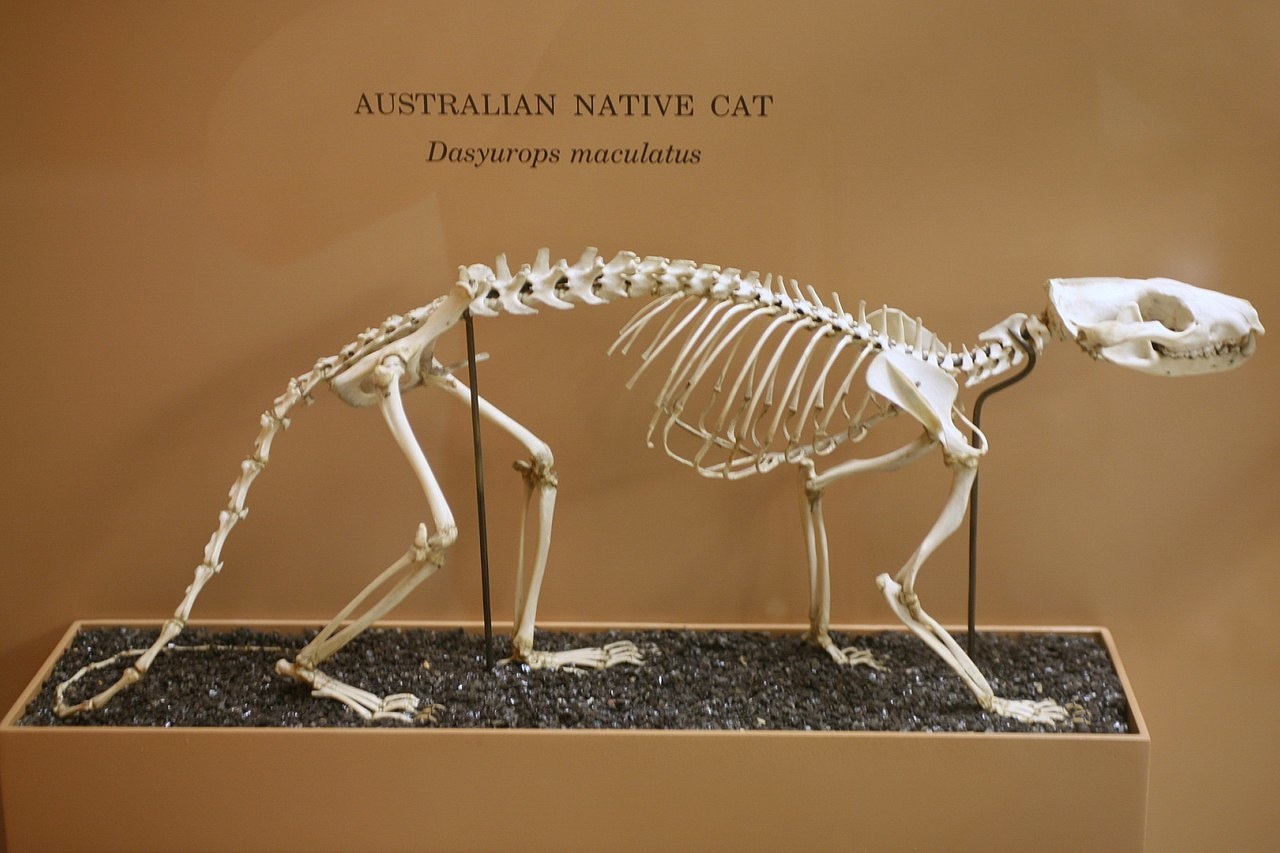
skeleton of a tiger quoll
Tiger quolls are mostly solitary but individuals share common latrines and denning sites. Females allow males territories to overlap with their territories. Males territories may overlap with other males. But females generally do not tolerate other females in their territories except fot their own female offspring. Males are found moving between multiple females territories during breeding season.
Tiger quolls sense and communicate with vision, touch, sound and chemicals usually detected by smelling. They also employ pheromones (chemicals released into air or water that are detected by and responded to by other animals of the same species) and scent marks produced by special glands and placed so others can smell and taste them. To define territoriality, many tiger quolls leave their scents at common latrines used by many quolls. During the mating season males leave scents marks to show they are sexually mature. During mating, females make a soft cooing noise during copulation. Mothers call their offspring with specific kinds of clucks and offspring respond. In defense and to warn off attackers, tiger quolls growl and make high pitched screeching noises.
The main known predators of tiger quolls are feral cats, red foxes and feral dogs. To escape predation tiger quolls hide in smaller, narrow den sites or cavities. They are good climbers and escape into trees from predators. If they feel threatened, they lower their ears, crouch down low to the ground, and make a screeching noise.
Tiger Quoll Mating, Reproduction and Offspring
Tiger quolls are polygynous (males have more than one female as a mate at one time) and females have an estrus cycle, which is similar to the menstrual cycle of human females. Tiger quolls breed once a year and engage in seasonal breeding — between April and July, autumn and winter in Australia. The average gestation period is 21 days. The number of offspring ranges from two to 6, with the average number of being three to five. [Source: Stephanie Verjinski, Animal Diversity Web (ADW) |=|]
Female tiger quolls have a short estrus period of only three to four days. When they are ready to mate they leave their scent at commonly-shared latrines for males to sense. When a male finds a receptive female he makes a series of vocalizations and follow the female around. She occasionally lifts her hind quarters to allow the male to sniff her, vocalizing as she does this. During copulation, the male hold himself in place on top of the female by holding the back of her neck with his teeth and stroking her sides and palpitating her abdomen, occasionally releasing his hold. During copulation, female lowers her head. halfway close her eyes and frequently vocalizes. Copulation can last for several hours up 24 hours. When its all over the female typically has lacerations to the back of her neck and a swollen neck. Occasionally, the female is killed.
Tiger quoll young are altricial, meaning they are relatively underdeveloped at birth. Parental care is provided by females. At birth, offspring are seven millimeters in length and develop the mother’s pouch for 12 weeks. After that offspring start eating food their mother female brings into the pouch The average weaning age is 18 weeks and the average time to independence is 18 weeks. On average males and females reach sexual or reproductive maturity at 340 days.
Males are not involved in parental care. When females carry offspring in their pouch, they walk with their hind quarters elevated so the belly does not touch the ground. This reduces pressure on the offspring. At about four weeks after offspring are born, females will start preparing the den site by gathering grasses, sedges, and other soft materials. After the offspring permanently leave the pouch, mothers rarely leave the den. Offspring and their mother call to each to indicate their location. After they leave the pouch offspring sometimes curl up next to their mother for warmth. After about 100 days, females spend less time with their offspring and start start acting aggressively towards them until they are fully independent,
Eastern Quolls
Eastern quolls (Dasyurus viverrinus) were formerly known as the eastern native cats. They occur in Tasmania and were once fairly widespread in southeastern Australia, including Kangaroo Island and King Island. but became extinct on the Australian mainland — and were last seen in the Sydney suburb of Vaucluse — in the 1960s as a result of disease, predators, and habitat loss in the 1970s but have since been reintroduced to fox-proof fenced sanctuaries in Victoria in 2003 and in the Canberra area (Australian Capital Territory) and at Booderee National Park at Jervis Bay on the south coast of New South Wales, Australia, a three-hour drive from both Sydney and Canberra in the late 2010s.
in 2016. Their average lifespan in the wild is one to three years One in captivity lived to 6.8 years..[Source: Tracy Dela Cruz, Animal Diversity Web (ADW) |=|]
Eastern Quolls live in rainforests, woodlands, and closed forests. They are mostly found where rainfall exceeds 60 centimeters per year. Their dens are usually in caves and hollow logs or trees. They were once found in Victoria and the Great Dividing Range from East Queensland to Tasmania, but now are only found naturally in Tasmania and Bruny Island. Occasional sightings have been reported in the New England region of New South Wales, suggesting there may be a small residual mainland population there.
Eastern quolls are the size of small cats, with males being significantly larger than females. Adult males are 53 to 66 centimeters (21 to 26 inches) in length, including a 20-to-28-centimeter (7.9-to-11-inch) and weigh of 1.1 kilograms (2.4 pounds) on average. Females are 48 to 58 centimeters (19 to 23 inches) long including a 17-to-24-centimeter (6.7-to-9.4-inch) tail, and weigh around 0.7 kilograms (1.5 pounds). Their average basal metabolic rate is 2.26 watts. Eastern quolls have a thick tapering snout, short legs, erect pink ears, a pink nose, a pointed muzzle, and very sharp teeth . They can be distinguished from other species of quoll by the presence of only four toes, rather than five, on the hind feet, and the pads of the feet are granulated, rather than striated as in the other species. Fur colors range from black to brown or tan with white spots on their bodies. The tail may have a white tip.
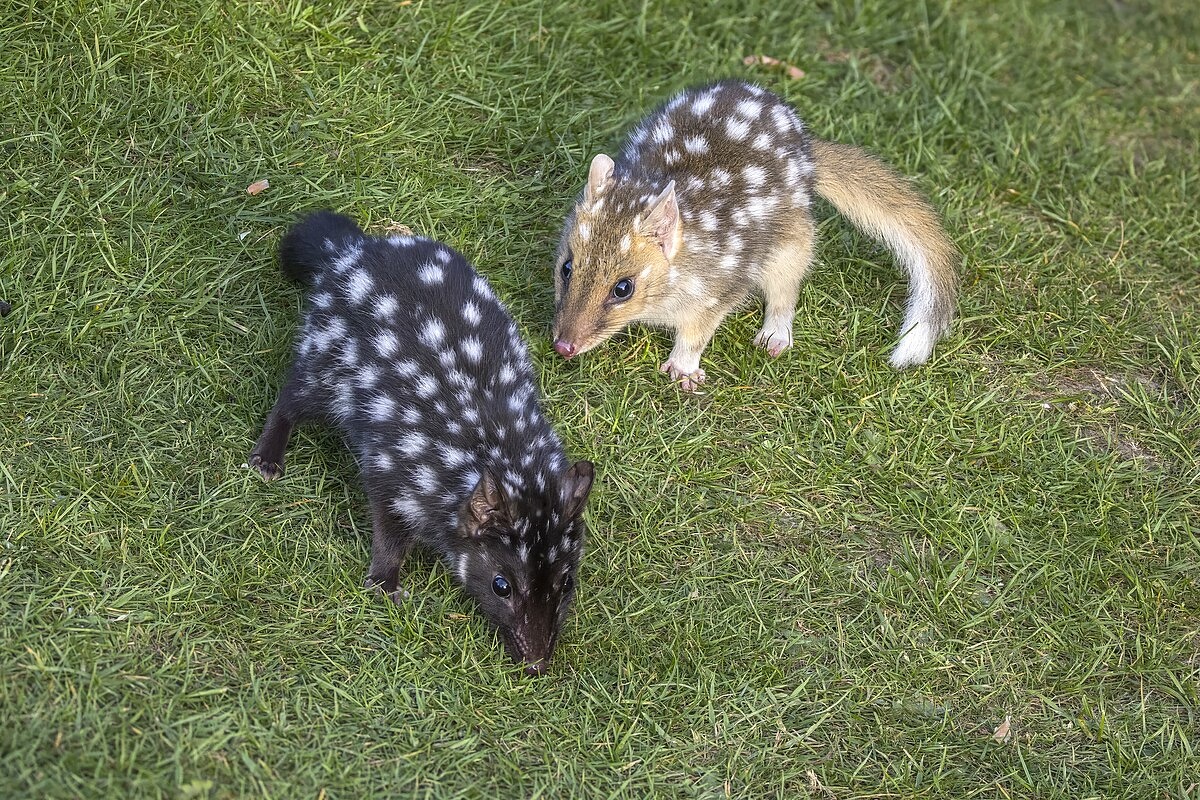
black and white morphs of eastern quolls
Eastern quolls are primarily solitary, terrestrial animals that hunt at night. They are sometimes observed during the day and are good at climbing trees. They feed mainly on insects but also eat small vertebrates (small marsupials, rats, rabbits, and mice), carrion, and some vegetable matter. well. Preferred prey are the cockshafer beetle, corbie shrub, dead animals, and fruit. Eastern quolls have a single breeding season — in late fall and early winter. The average gestation period is 20 days. The average number of offspring is six. Up to 30 young are born at one time but only six to eight survive as that is the number of mammae that females have. The young remain in their mother's pouch-like sking folds for eight weeks and are weaned at 18 weeks. On average males and females reach sexual or reproductive maturity at 11 months.
On the International Union for Conservation of Nature (IUCN) Red List and U.S. Federal List, eastern quolls are listed as Endangered. They were was previously listed as Near Threatened on the IUCBn Red List but that ranking was changed to Endangered due to a significant population decline — an estimated 50 percent in the past 10 years. Their main threats have been feral cats, unsuitable weather conditions, and destruction of their forest habitat. Competitors such as feral cats, dogs, Tasmanian devils, and European foxes prey on the quolls and sometimes outcompete them for some prey animals.
Western Quolls
Western quolls (Dasyurus geoffroii) are largest endemic mammalian carnivores in Western Australia. Also known as chuditch, they are mainly found in the southwest portion of Western Australia in the Jarrah forest, which embraces open forest, low open forest, woodland, and open shrub. Their range was once quite large, including stretches of desert in the arid part of Central Australia as well as parts of Queensland, New South Wales, Victoria, and South Australia The longest they are likely to live is four years. [Source: Wikipedia, York Fei Leung, Animal Diversity Web (ADW) |=|]
Western quolls are about the size of domestic cats and have a lean, short-legged body. They range in weight from 0.9 to 1.3 kilograms (two to three pound) and have a head and body of about 36 to 46 centimeters (14 to 18 inches), and a tail that is around 22 to 30 centimeters (8.7 to 11.8 inches) long. Their average basal metabolic rate is 2.991 watts. Males typically weigh around 1.3 kilograms (2.9 pounds), and females 0.9 kilograms (two pounds). Western quolls are rufous brown in colore and have 40 to 70 white spots on their back with a creamy white underside. They are well adapted for nocturnal life. The spots help diminish their outline under moonlight at night when hunting. The face is paler than the rest of the fur while the ears are white-rimmed. Western quolls have five toes on their hind feet, granular pads, large eyes, pointed ears and a black brush on their tail extends from halfway down to the tip. Often confused with eastern quoll, western quolls differ by possessing a first toe on the hind foot and a darker tail. Western quolls do not have the white-spotted brown coat and a long tail that eastern quoll and northern quolls have.

western quoll, from Arid Recovery
On the International Union for Conservation of Nature (IUCN) Red List Western qolls are listed as Near Threatened. The main threats have been habitat loss and fragmentation, predation by introduced foxes and cats and disease. Western quoll habitat has been degraded through controlled and frequent burns as well as the use of pesticides by farmers. Cats and foxes compete with western quolls for food and also prey upon them. Various organizations are working to protect and restore Western Quoll populations, including reintroduction programs in areas where they have become locally extinct.
Western Quoll Behavior, Diet and Reproduction
Western quolls are nocturnal (active at night), motile (move around as opposed to being stationary). and territorial (defend an area within the home range), creatures. Home ranges of males are large and probably overlap the territory of several females, however male and female Western quolls only meet for mating. The young disperse in November before taking up their own territories. Western quolls can climb trees and often nest in dens left by other animals, in logs, or in stone piles. The presence of Western quolls can be detected by bone accumulations beneath rocks and in tree hollows. They are rarely seen due to the reduction in their habitat by humans and numbers of introduced predators, such as foxes, birds of prey, and feral cats. |=|
The diet of Western quolls is diverse, and includes large insects, small vertebrates, carrion, rabbits, lizards, frogs, and invertebrates. In forested habitats they consume insects, freshwater crustaceans, reptiles, parrot-sized birds, and rabbit-sized mammals. In human-settled areas they occasionally raid chicken coops and rubbish bins. Western quolls kills larger prey by biting the back of the head or neck. They are primarily nocturnal ground foragers but do occasionally climb trees in serach of food. |=|
Western quolls breed seasonally, usually between May and July with a peak in June. The average gestation period is 16 days. with the average number of offspring being six. There have been cases where females produce more young than can be nurses. When that happened they young that don’t nurse die. Western quoll young remain in their mother's pouch-like skin folds for seven to fifteen weeks until they outgrow it. At this point they are left in the den while the female forages for food. Western quolls are independent at 18 weeks and weaned at 23 to 24 weeks, both the male and female are sexually mature at one year of age.
Northern Quolls

northern quoll, from Australian Wildlife Conservancy.
Northern quolls (Dasyurus hallucatus) in the past were known as northern native cats, North Australian native cats, little northern native cats and north Australia cats. They Mayali aboriginal language word for them is njanmak. In the wild female northern quolls may live up to three years, although one to two years is more common. Males only live up to one year. Mating is extremely energetically costly for them. Often they die within two weeks after mating. During the mating period, they experience weight loss, elevated androgens, loss of fur, and proliferation of parasites, increasing their risk of predation and vehicle collisions. [Source: Jenna Black, Animal Diversity Web (ADW) |=|]
Northern quolls live in 150-kilometer-wide band, across the northern Australian coast, from Pilbara region in western Australia to the northeast coast of Queensland. Since the arrival of Europeans, their population declined over much of their range and have become locally extinct on some Australian Islands. Most are found in six isolated populations: in the Hamersley Range, northern and western Top End, North Cape York tip, Atherton Tableland and the Carnarvon Range. Northern quolls are the most arboreal (tree-swelling) of the Australian quolls although they inhabit a variety of terrestrial habitats, including rocky escarpments, open eucalyptus forests and lowland savannahs and make their dens in tree hollows, rock crevices, logs, termite mounds and goanna burrows. Those living in savannah habitats have experienced the sharpest population decline.
Northern quolls are the smallest of the Australian quolls. They range in weight from 300 to 900 grams (10.6 to 31.7 ounces) and have a head and body length of 123 to 31 centimeters (4.84 to 12.20 inches). Their tail is long relative to their body and their average basal metabolic rate is 1.501 watts. Sexual Dimorphism (differences between males and females) is present: Males are larger than females. Males may weigh as much as 1,200 grams (1.2 kilograms, 2.6 pounds), but usually range between 400 to 900 grams (.9 and two pounds. Females range between 300 to 500 grams (.67 and 1.1 pounds). Males are slightly longer, ranging from 12.3 to 31 centimeters (4.8 to 12.2 inches) ; whereas females range from 12.5 to 30 centimeters (4.9 to 11.8 inches). The average tail length for males is 12.7 to 30.8 centimeters (5 to 12.1 inches); whereas female tail lengths range 20 to 30 centimeters (7.9 to 11.8 inches).
Northern are dusky grey-brown, with large white spots on their back and cream to white fur on their bellies. They have have well-defined serrated pads on their palms and soles and an unspotted tails. They have a big toe, with a total of five toes on their hind feet. Females don’t have a pouch. They have five to eight exposed teats, arranged in rows and surrounded by a marginal fold of skin (marsupium). Northern quolls are considered a carnivorous marsupial, although it primarily feeds on insects. Their diet also consists of other small mammals, birds, frogs, reptiles, and sometimes fleshy fruits. They also feed on cane toads, in part because they are easy to catch and are plentiful in some places, but the toad’s toxins harm and even kill them.
On the International Union for Conservation of Nature (IUCN) Red List Northern quolls are listed as Endangered. The main threats to Northern Quolls include: 1) the ingestion of poisonous, introduced cane toads; 2) habitat destruction and degradation as a result of agriculture and development; 3) predation and competition for prey from feral cats and foxes; and 4) fires. Northern quolls are listed as Critically Endangered under the Northern Territory's Territory Parks and Wildlife Conservation Act, and is on Schedule 1 of Western Australia's Wildlife Conservation Act. Efforts are being made to control cane toad in the northern quoll’s range. Their main known predators of northern quolls are dingoes, feral cats, olive pythons, king brown snakes and owls.
Northern Quoll Behavior
Northern quolls are arboreal (live mainly in trees), nocturnal (active at night), motile (move around as opposed to being stationary) and territorial (defend an area within the home range). Evidence of torpor and early morning lethargy has been observed, which is not a surprise as such torpor is common among marsupials inhabiting arid and tropical environments with variable resource availability. Males have a much larger home range than females, especially during the mating season. Males have an average home range area of 99 hectares (244 acres), whereas the average for female is 35 hectares (86 acres). [Source: Jenna Black, Animal Diversity Web (ADW) |=|]
Northern quolls are generally solitary and asocial. Males only contact females during short mating encounters. There is no evidence of a male dominance hierarchy and individuals appear to practice mutual avoidance in overlapping home ranges. Females generally do not tolerate other females in their territory. In low density areas there is no overlap between female home ranges; however, in higher density areas, foraging areas may overlap, but denning sites are not shared. A surviving young female of the last breeding season may inherit her mother’s territory when her mother dies, otherwise, young disperse into vacant areas and immediately take over rocky areas that become vacant when a neighbor dies.
Northern quolls sense using vision, touch, sound and chemicals usually detected with smell and communicate with sound and scent marks produced by special glands and placed so others can smell and taste them and Young northern quolls vocalize as early as 35 days old. Hearing doesn’t develop until approximately 65 days, at which time vocalizations become more adult-like. Calls of young last 100 to 200 milliseconds; while adult calls last one to two seconds. Young communicate vocally with their mother, providing information regarding location and expresing stress levels. When adult encounter one another they hiss as a form of acknowledgment. Scent marking by northern quolls has been frequently observed to mark territories and advertise presence to mates. Both females and males rub their chests on objects to spread their scent. They also urinate on the feces of other individuals and deposit scat in prominent places. When feces by another individual are found, they are is picked up, sniffed and examined.
Northern Quoll Mating, Reproduction and Offspring
Northern quolls are polygynandrous (promiscuous), with both males and females having multiple partners and engage in seasonal breeding. They breed once a year and the breeding season lasts from late May to August during the northern Australian dry season. The gestation period ranges from 21 to 25 days. The number of offspring generally ranges from five to eight but can be as high as 17 with at most eight surviving as their only eight teats available for nursing young. [Source: Jenna Black, Animal Diversity Web(ADW) |=|]
Births occur synchronously in a single population within a four week period, with little annual variation, but varies somewhat according to geographic location. Young are altricial, meaning they are relatively underdeveloped at birth. Parental care is provided by females. The average weaning age is four months. The post-independence period is characterized by the association of offspring with their mother and young may inherit the territory of their mother. On average males and females reach sexual or reproductive maturity at age 11 months.
Females generally do not tolerate other females in their territory. Feces markers are more commonly observed during the mating season, advertising female presence both to other females and males. Jenna Black wrote in Animal Diversity Web: Females are visited by multiple males during the mating season, with short encounters occurring at night in the female's den. It is rare for a female not to breed in any given year. Males are non-territorial and attempt to breed with as many females as possible during the breeding season, often traveling long distances from one female to another, monitoring the onset of estrus. The mating process has yet to be observed, although it appears to be quite aggressive, with females often showing distinct scars from males biting the back of their neck and clasping their sides during copulation. Males are the largest mammal and the only Dasyurid known to experience complete semelparity, usually dying within two weeks of mating.
When they are ready to give birth, females groom the area around their urogenital sinus, pouch and tail. Just before emergence of the young, a female will lift her posterior region and lick a cloudy mucus-like fluid, which is released from the urogenital sinus. During birth, females place their heads to the ground, keeping their urogenital sinus higher than the pouch region, with the base of their tail held away. The young are excreted in a gelatinous material and either drop to the ground or successfully climb their way along the mother to the pouch, aided by their senses and gravity. The average weight of a newborn is 18 milligrams and the average length is five millimeters. Offspring unsuccessful in latching to a teat soon perish. Northern quolls do not have a pouch. During birth, marginal ridges of skin develop around the teats and cover the young. Young are first released from the pouch-like skin fold at two months of age for short periods of time.
Northern quolls are semelparous. This means that offspring are all produced in a single group, after which the parent usually dies. Semelparous animals often only live through a single season or year but may live for many seasons. Both sexes put forth most of their reproductive energy in their first breeding season, which is when they are at their highest fitness level. Females care for the young on their own if for no other reason than that the father is usually dead. Studies indicate that females move from the rockier areas of her home range to the woodland areas near creeks when the young are around two months old. This is the time at which the young first detach from their mother. At this time females leave the young in a succession of nursery dens for periods of time, while foraging at night. When the young are weaned, females move them back to the rockier areas.
Image Sources: Wikimedia Commons
Text Sources: Animal Diversity Web animaldiversity.org , National Geographic, Live Science, Natural History magazine, Australian Museum, David Attenborough books, Australia Geographic, New York Times, Washington Post, Los Angeles Times, Smithsonian magazine, Discover magazine, The Conversation, The New Yorker, Time, BBC, CNN, Reuters, Associated Press, AFP, Lonely Planet Guides, Wikipedia, The Guardian, Top Secret Animal Attack Files website and various books and other publications.
Last updated July 2025