
Home | Category: Nature, Environment, Animals / Birds, Crocodiles, Snakes and Reptiles
BLACK SWANS
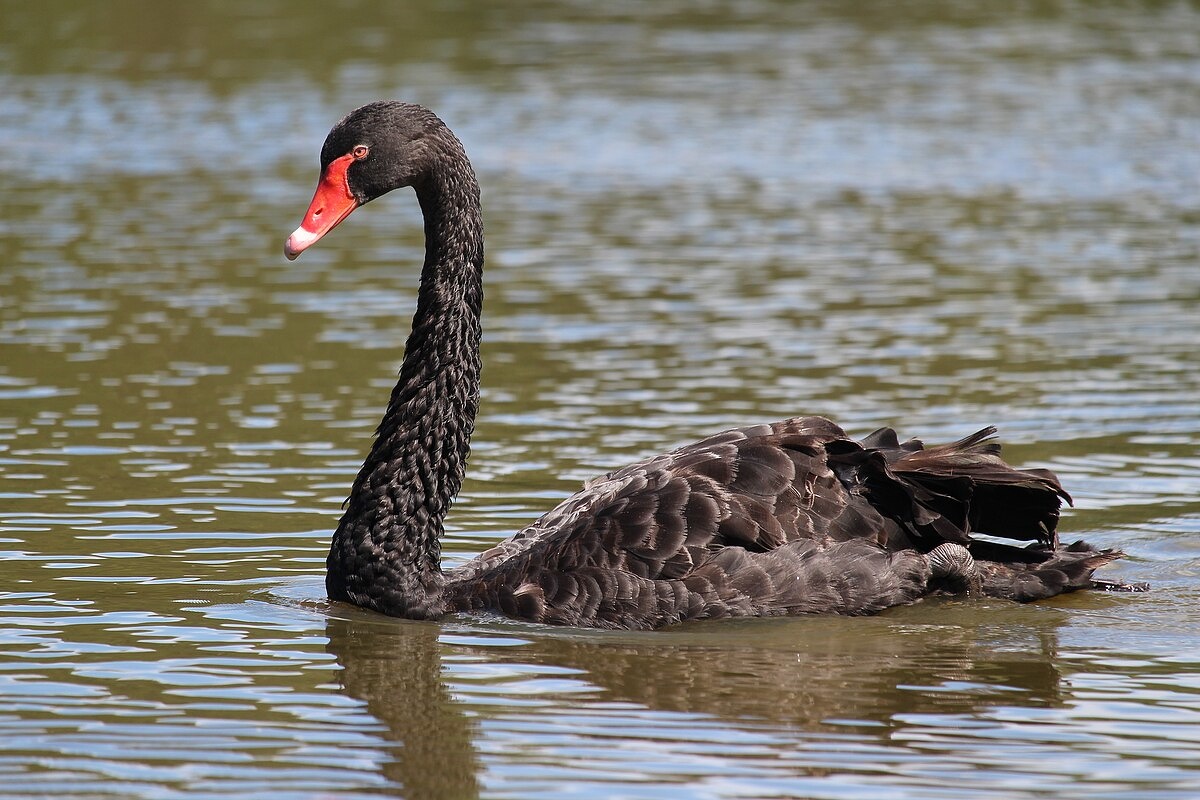
Black swan on Waterhen Lake in Oxenford in the Gold Coast of Australia
Australia has black swans (Cygnus atratus) with soot-black plumage, white primaries, and a coral colored bill. These birds are the state emblems of Western Australia. They gather in large flocks in and around fresh and backisk water and nest on islands on lakes or in reeds. Both males and females participate in the nesting. Their lifespan in the wild is as high as 40 years.
Swans are the largest of all waterfowl. Black swans' closest relatives are mute swans (Cygnus olor).According to Natural History magazine” Studies have revealed an unusual flexibility in the black swan’s breeding habits. It may nest whenever conditions are appropriate, and sometimes raises several broods in succession. Birds are ready to breed at 18 months of age. Desertion, divorce and various kinds of polygamy are common in young breeders, but pair bonds become increasingly stable as the partners mature.
Black swans not endangered or threatened. They are designated as a species of least concern on the International Union for Conservation of Nature (IUCN) Red List and have no special status on the Convention on International Trade in Endangered Species (CITES). They are not suffering from population declines. Populations range from the thousands up to tens of thousands in New South Wales. Humans have eaten black swan eggs and kept the birds as pets. Black swans are regarded as crop pests in some places, not only because they crops and plants, but because they kill vegetation by uprooting it. In order to manage black swan populations, hunting them is allowed in some places. [Source: Cheryl Jackson, Animal Diversity Web (ADW) |=|]
While swans are not a common food source in most of the world, North Korea is currently breeding and promoting the consumption of black swans due to food shortages. There are a number of black swan farms in China. In other regions, like New Zealand, black swans are hunted as game birds and are considered edible. [Source: Google AI]
RELATED ARTICLES:
SWANS: CHARACTERISTICS, BEHAVIOR, ATTACKS factsanddetails.com ;
SWAN SPECIES IN ASIA AND EUROPE: WHOOPERS, MUTES AND TUNDRA SWANS factsanddetails.com
BIRDS OF AUSTRALIA: COMMON, UNUSUAL AND ENDANGERED SPECIES ioa.factsanddetails.com
BLACK SWANS: CHARACTERISTICS, BEHAVIOR AND REPRODUCTION ioa.factsanddetails.com
CASSOWARIES: HISTORY, CHARACTERISTICS, BEHAVIOR AND REPRODUCTION ioa.factsanddetails.com
CASSOWARIES AND HUMANS: HISTORY, SIDE BY SIDE, ATTACKS ioa.factsanddetails.com
SOUTHERN CASSOWARIES: CHARACTERISTICS, BEHAVIOR AND REPRODUCTION ioa.factsanddetails.com
CASSOWARIES OF NEW GUINEA: SPECIES, WHERE THEY LIVE, WHAT THEY'RE LIKE ioa.factsanddetails.com
EMUS: CHARACTERISTICS, BEHAVIOR AND REPRODUCTION ioa.factsanddetails.com
EMUS AND HUMANS: MEAT, OIL, RANCHING AND WARS ioa.factsanddetails.com
BOWERBIRDS: BOWERS, TYPES, DECORATIONS, COURTSHIP DISPLAYS ioa.factsanddetails.com
BOWERBIRD SPECIES: CHARACTERISTICS, BEHAVIOR AND REPRODUCTION ioa.factsanddetails.com
LYREBIRDS: CHARACTERISTICS, BEHAVIOR AND REPRODUCTION ioa.factsanddetails.com
RIFLEBIRDS (PTILORIS): CHARACTERISTICS, BEHAVIOR, SPECIES, REPRODUCTION ioa.factsanddetails.com
KINGFISHERS: CHARACTERISTICS, BEHAVIOR AND REPRODUCTION factsanddetails.com
KOOKABURRAS: CHARACTERISTICS, LAUGHING, BEHAVIOR, SPECIES, REPRODUCTION ioa.factsanddetails.com
PARROTS OF AUSTRALIA-NEW GUINEA: SPECIES, COLORS, CHARACTERISTICS, BEHAVIOR ioa.factsanddetails.com
COCKATOO SPECIES: CHARACTERISTICS, BEHAVIOR AND REPRODUCTION ioa.factsanddetails.com
COCKATOOS: COLORS, DIET, LONG LIFESPANS, DANCING, VOCALIZATIONS, HUMANS ioa.factsanddetails.com
LITTLE PENGUINS: CHARACTERISTICS, BEHAVIOR AND REPRODUCTION ioa.factsanddetails.com
BIRDS: THEIR HISTORY, CHARACTERISTICS, COLORS factsanddetails.com ;
BIRD FLIGHT: FEATHERS, WINGS, AERODYNAMICS factsanddetails.com ;
BIRD BEHAVIOR, SONGS, SOUNDS, FLOCKING AND MIGRATING factsanddetails.com
Black Swan Habitat and Where They Are Found
Black swans are native to Australia (including Tasmania) and have been introduced to New Zealand, Europe, and North America. They are most commonly found in wetland habitats in southern Australia and tends to avoid the northern tropics of Australia. They are widespread across southern Australia, and in the southeast of Tasmania. [Source: Cheryl Jackson, Animal Diversity Web (ADW) |=|]
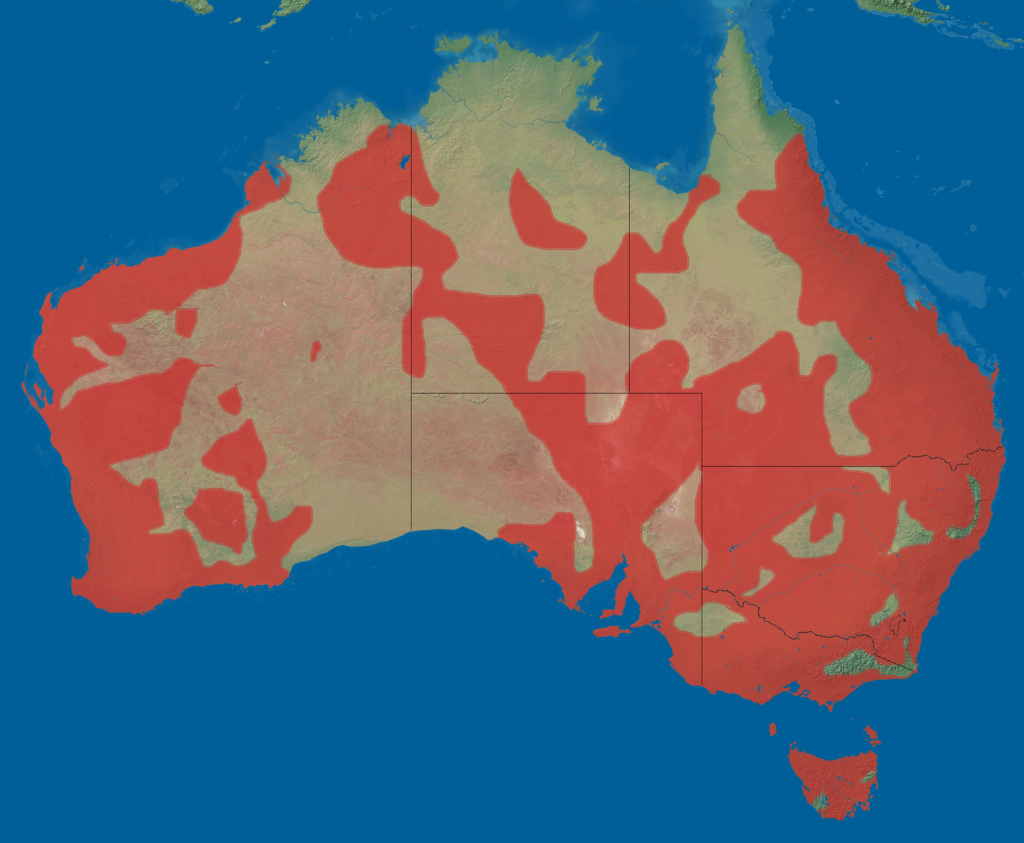
black swan range (red)
Black swans live in lakes, rivers, ponds, streams. coastal brackish water, wetlands, swamps, and estuaries in fresh, salt or brackish water. They prefer habitats with aquatic vegetation. While their natural habitat is aquatic they are sometimes found in terrestrial areas such as dry pastures or flooded fields when food is scarce. Within Australia, black swans are nomadic, with erratic migration patterns dependent on climatic conditions.
Black swans were introduced to various countries as ornamental birds in the 1800s. Some escaped and form stable populations. Black swans can be found alone or in loose companies numbering into the hundreds or even thousands. They are popular birds in zoological gardens and bird collections, and escapees are sometimes seen outside their natural range. They are often seen in New Zealand. There are wild populations in Japan, having originally been imported during 1950–1960
Black Swan Characteristics
Adult black swans are 1.1 to 1.42 meters (3.6 to 4.7 feet) in) in length and weigh 3.7 to 9 kilograms (8.2–19.8 pounds). Their wing span is between 1.6 and 2 meters (5.2 and 6.6 feet). Their neck, relative to their body, is longest among the swans and curved in an "S"-shape. Sexual Dimorphism (differences between males and females) is present: Males (known as "cobs") is slightly larger than the female (known as "pens").[Source: Wikipedia; Cheryl Jackson, Animal Diversity Web (ADW) |=|]
Black swans have the classical swan look with a long arched neck and raised eyebrows. They almost all Some of their wing feathers are white. They also have reddish or pinkish irises and red bills with a white line. Juveniles (cygnets) are greyish brown with light tipped feathers and a lighter colored bill.
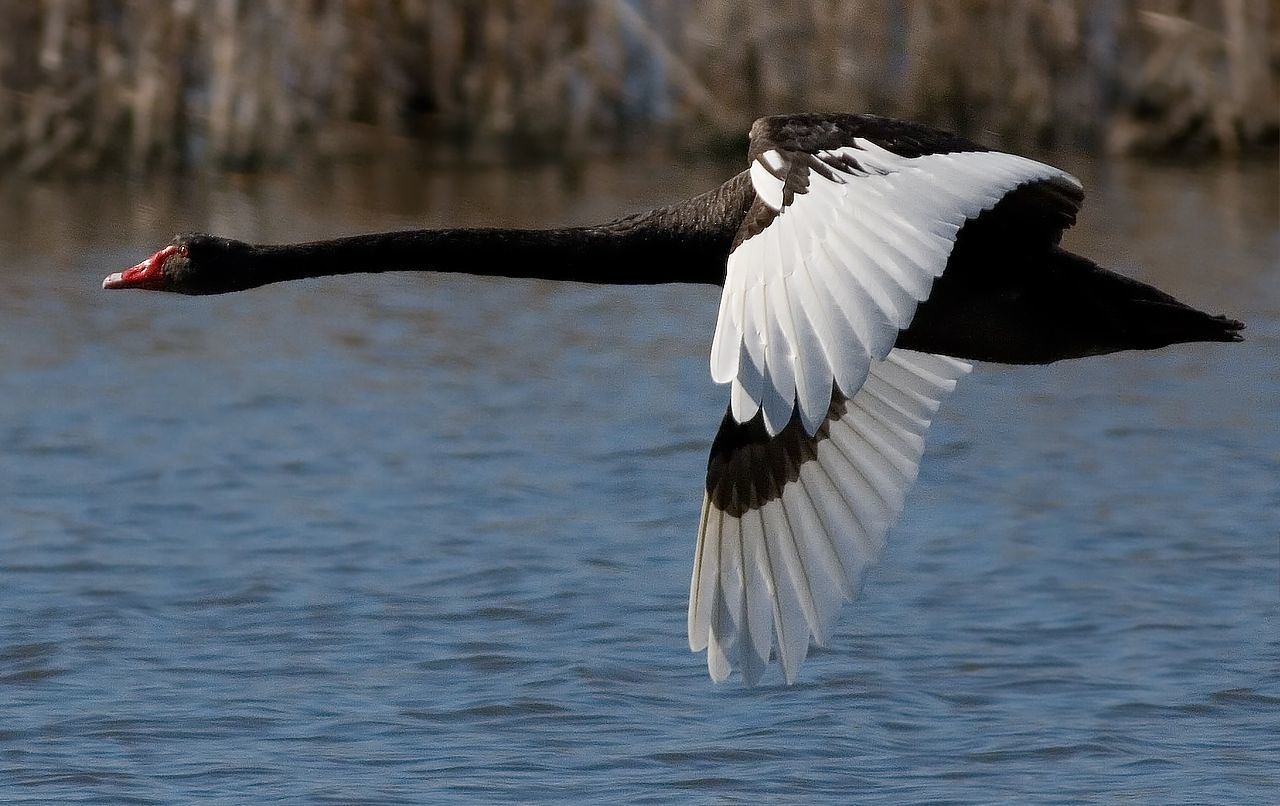
black swan in flight
When swimming, black swans hold their necks arched or erect and often carry their feathers or wings raised in an aggressive display. In flight, especially in poor light and at long range, black swans may be confused with magpie gooses. Black swans can be distinguished by their much longer neck and slower wing beat.
Black Swan Diet and Eating Behavior
Black swans are primarily herbivores (eat plants or plants parts) and also recognized as omnivores (eat a variety of things, including plants and animals) and folivores (eat leaves). Animal foods include insects. Among the plant foods they eat are leaves algae. |=|
Black swans mainly eat sub-aquatic foliage that it can reach under water using its long neck but also eat other vegetation and plants in the water or on land in pastures or on farm land. Some common aquatic plants that they feed on are: Typha, Potamogeton, Myriophyllum, Ruppia and algae.
There is some regional and seasonal variation in the black swans’ diet. In New South Wales the leaf of reedmace (genus Typha) is the most important food of birds in wetlands, followed by submerged algae and aquatic plants such as Vallisneria. In Queensland, aquatic plants such as Potamogeton, stoneworts, and algae are the dominant foods. The exact composition varies with water level; in flood situations where normal foods are out of reach black swans will feed on pasture plants on shore.
Black swans feed like other swans. When feeding in shallow water they dip their head and neck under the water and are able to keep their head flat against the bottom while keeping their body horizontal. In deeper water black swans “up-ends” to reach lower. Black swans are also able to filter feed at the water's surface.
Black Swan Behavior and Communication
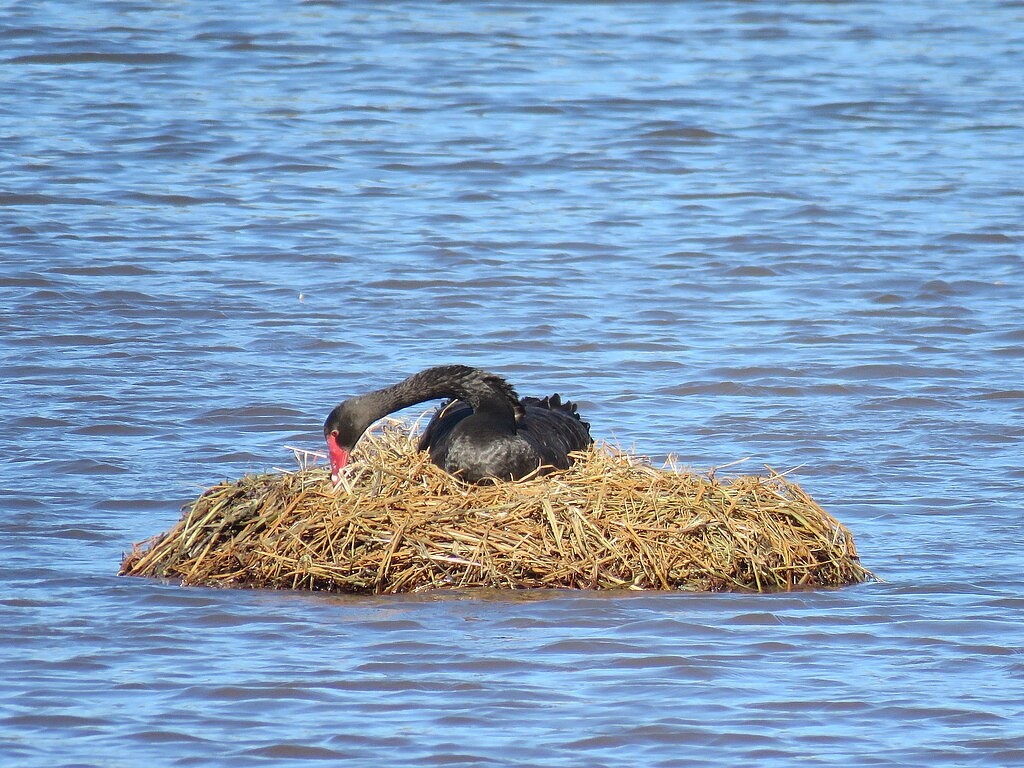
black swan nest
Black swans fly and are natatorial (equipped for swimming), diurnal (active mainly during the daytime), motile (move around as opposed to being stationary), nomadic (move from place to place, generally within a well-defined range), sedentary (remain in the same area), territorial (defend an area within the home range), social (associates with others of its species; forms social groups) and colonial (live together in groups or in close proximity to each other). [Source: Cheryl Jackson, Animal Diversity Web (ADW) |=|; Wikipedia]
Black swans tend to move in flocks. In flight, a wedge of black swans sometimes form as a line or a V, with individual birds flying strongly with undulating long necks, making whistling sounds with their wings and baying, bugling or trumpeting calls. Black swans are the least territorial of all swans and sometimes nest in colonies. They are nomadic when food is scarce but are otherwise sedentary. They feed at dusk and travel at night, calling as they fly, but most activity is during the day.
Black swans sense using vision, touch, sound and chemicals usually detected with smell and communicate with vision and sound. They employ duets (joint displays, usually between mates, and usually with highly-coordinated sounds) to communicate. Black swans have advertisment calls used in territorial defense and specific calls used in Triumph Ceremonies. They have a high pitched, weak voice but can issue musical and far reaching bugle-like sounds, both on the water and in flight, as well as a range of softer crooning notes. They also whistle, especially when disturbed while breeding and nesting. Among their visual displays are raising their shoulders or flapping their wings to threaten predators or other swans in their territory.
When threatened by predators targeting themselves, their young or their eggs, black swans flap their wings which produce loud noises and erect their necks erect and bills pointed down. Eggs are taken by Australian ravens, common rats and golden-bellied water rats, swamp harriers, white-bellied sea eagles, and other hawks. Fledglings are preyed on by swamp harriers, white-bellied sea eagles, quolls, golden-bellied water rats, and sometimes gulls and terns. ) |=|
The threatening behavior of black swans is similar to that of mute swans; they both flap and wave their wings with two or three strokes followed by a call. However, the wings of black swans make a louder sound than mute swans. Also the standing stance is different; black swans hold their necks erect with a downward point of the bill and ruffled feathers.
Black Swan Mating and Reproduction
Black swans are monogamous (have one mate at a time) and engage in seasonal breeding. They can breed repeatedly throughout the breeding season, which runs from February through September. The number of eggs laid each season ranges from five to six. On average females and males reach sexual or reproductive maturity between 18 to 36 months.[Source:Cheryl Jackson, Animal Diversity Web (ADW) |=|]
Desertion, divorce and various kinds of polygamy are common among young breeding black swans but pair bonds become increasingly stable as partners mature and pairs often mate for life. They are territorial and stay in solitary pairs when mating but are known to occasionally mate in colonies. The divorce rate aming black swans is about six percent. Recent studies indicate that around a third of all broods exhibit extra-pair paternity. An estimated one-quarter of all pairings are homosexual, mostly between males. They steal nests, or form temporary threesomes with females to obtain eggs, driving away the female after she lays the eggs. [Source: Wikipedia]
Cheryl Jackson wrote in Animal Diversity Web: One particularly interesting thing about the courting behavior of black swans is the "Triumph Ceremony". It is used to strengthen pair-bonds between mates, between parents and cygnets (baby swans), and for threatening territorial displays. The male swan approaches the female swan with wings and chin lifted, calling repeatedly. Then the female returns the same call. They then dip their heads alternating with erect postures. After this the birds call with their necks outstretched and bills pointed upward; then they hold their necks at a forty five degree angle and point their bills downward and at a right angle, they proceed to swim in a circle. These ceremonies are primarily initated by the male and tend to increase in frequency when there are more swans around.
Black Swan Nesting and Offspring
Usually the female black swans, and occasionally males, makes a nest of sticks, reeds, grasses, weeds dead leaves and debris into mound. This heap of a nest is between one and 1.5 meters (3 and 4½ feet) in diameter and up to one meter high, in shallow water or on islands. Nests are reused every year, restored and rebuilt as needed.
Female usually lay five or six eggs, each of them laid one day apart. There is a 35 to 48 day incubation period which begins when all the eggs have been laid. The eggs are greenish-white in color. Before incubation parents sit over the eggs without actually warming them. Both sexes incubate the eggs, with the female incubating at night. The change over between incubation periods is marked by ritualised displays by both sexes. If eggs accidentally roll out of the nest both sexes will retrieve the egg using the neck (in other swan species only the female performs this feat). Like all swans, black swans aggressively defend their nests with their wings and beaks.
Chicks are precocial and can swim and feed soon after hatching but are brooded on the nest for two to three weeks after hatching. They may ride on their parents' backs when they venture into deep water. The chicks fledge from five to six months after hatching but they remain in the family group until the next breeding season. Juvenile black swans often form flocks until they find a mate.
Image Sources: Wikimedia Commons
Text Sources: Animal Diversity Web animaldiversity.org , National Geographic, Live Science, Natural History magazine, Australian Museum, David Attenborough books, Australia Geographic, New York Times, Washington Post, Los Angeles Times, Smithsonian magazine, Discover magazine, The Conversation, The New Yorker, Time, BBC, CNN, Reuters, Associated Press, AFP, Lonely Planet Guides, Wikipedia, The Guardian, Top Secret Animal Attack Files website and various books and other publications.
Last updated August 2025