
SOUTHERN CASSOWARIES
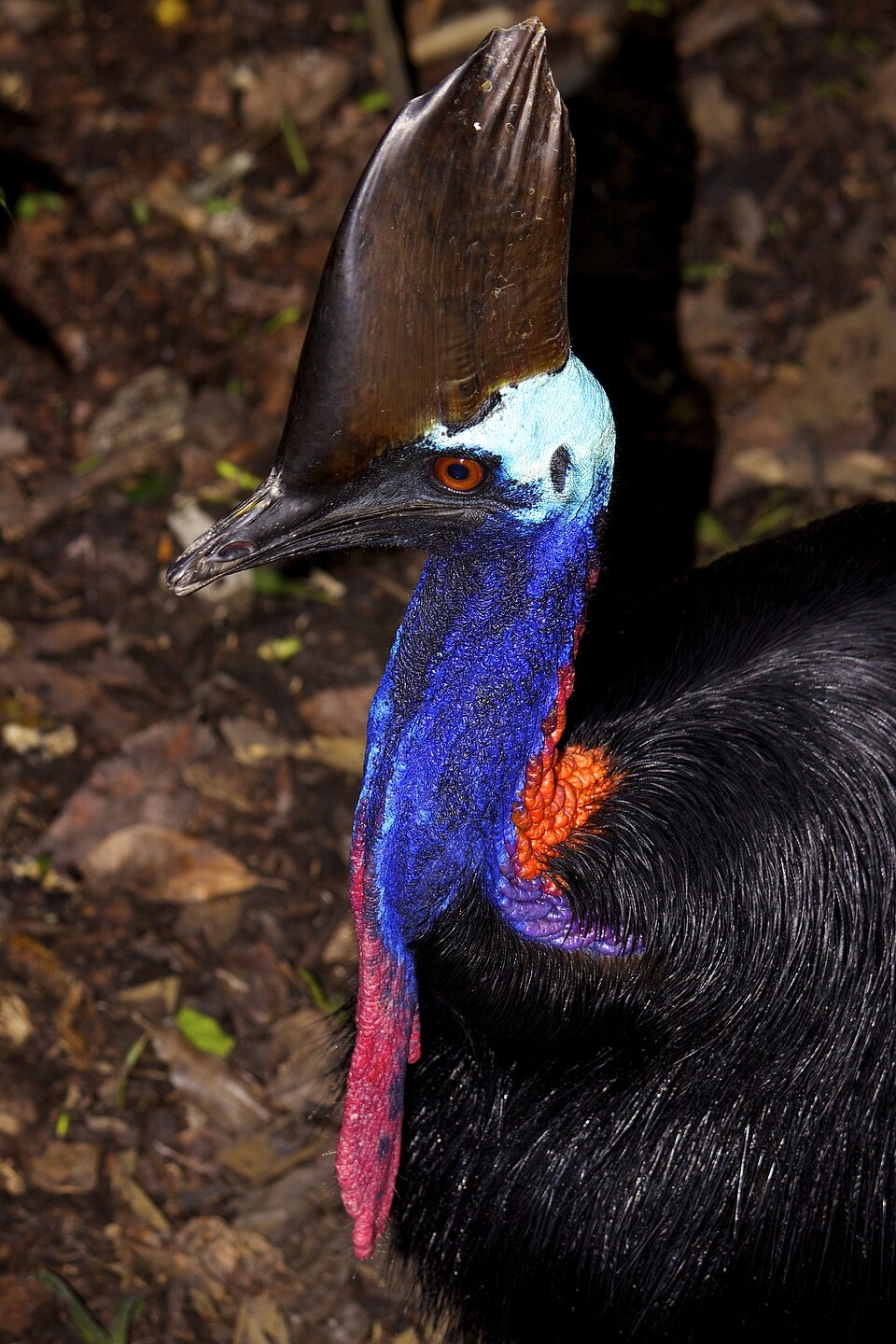
southern cassowary in Papua New Guinea
Southern cassowaries (Casuarius casuarius) are often called the world’s most dangerous bird based on the number of attacks with serious injuries that have been inflicted on humans. They can not fly but they can run at speeds of 48 kilometers per hour (30 miles per hour) and are good swimmers. Usually solitary, thet announce their presence with loud, deep booms that carry remarkably far in dense foliage. Their numbers are unknown. It has been estimated that there are 4,000 to 20,000 of them. [Source: Canon advertisement]
Native to tropical rainforests of northeast Australia, southern New Guineaa and some nearby islands, southern cassowary is the heaviest flightless bird in Australia — bigger than their relatives, emus — and the second-heaviest in the world after ostriches. Southern cassowaries have powerful, muscular legs that can deliver a powerful blow and tough, prehistoric-looking feet with claws that are up to 12.5 centimeters (5 inches) long. [Source: Hannah Osborne, Live Science published June 14, 2025
Southern cassowaries are among the most prehistoric-looking birds on Earth. They have been likened to a modern-day dinosaur due to their massive size, vivid colouration and powerful, raptor-like feet. Little is known about their lifespan in the wild, but in captivity they have lived 20 to 40 years.
Southern cassowaries are found in southern New Guinea (in both Papua New Guinea and the Indonesian Province of Papua), Cape York and eastern Queensland in Australia and the Ceram and Aru Islands of Indonesia. It is possible they were introduced to Ceram and the Aru Islands by humans. Southern cassowaries live primarily in lowland rainforests, typically at elevations of less than 1,100 meters (3,630 feet), and occasionally are found in eucalyptus forests, savannas, palm scrub, forested swamps, mangroves and fruit plantations. [Source: Dan Hulbert, Animal Diversity Web (ADW) |=|]
RELATED ARTICLES:
SOUTHERN CASSOWARIES: CHARACTERISTICS, BEHAVIOR AND REPRODUCTION ioa.factsanddetails.com
CASSOWARIES: HISTORY, CHARACTERISTICS, BEHAVIOR AND REPRODUCTION ioa.factsanddetails.com
CASSOWARIES AND HUMANS: HISTORY, SIDE BY SIDE, ATTACKS ioa.factsanddetails.com
EMUS: CHARACTERISTICS, BEHAVIOR AND REPRODUCTION ioa.factsanddetails.com
EMUS AND HUMANS: MEAT, OIL, RANCHING AND WARS ioa.factsanddetails.com
MOAS: HISTORY, CHARACTERISTICS, REPRODUCTION, EXTINCTION, DE-EXTINCTION? ioa.factsanddetails.com
MOA SPECIES: GIANT, SMALL AND HEAVY-FOOTED ONES ioa.factsanddetails.com
BOWERBIRDS: BOWERS, TYPES, DECORATIONS, COURTSHIP DISPLAYS ioa.factsanddetails.com
BOWERBIRD SPECIES: CHARACTERISTICS, BEHAVIOR AND REPRODUCTION ioa.factsanddetails.com
KOOKABURRAS: CHARACTERISTICS, LAUGHING, BEHAVIOR, SPECIES, REPRODUCTION ioa.factsanddetails.com
PARROTS OF AUSTRALIA-NEW GUINEA: SPECIES, COLORS, CHARACTERISTICS, BEHAVIOR ioa.factsanddetails.com
COCKATOO SPECIES: CHARACTERISTICS, BEHAVIOR AND REPRODUCTION ioa.factsanddetails.com
COCKATOOS: COLORS, DIET, LONG LIFESPANS, DANCING, VOCALIZATIONS, HUMANS ioa.factsanddetails.com
Northern Cassowaries
Northern cassowaries (Casuarius unappendiculatus) are also known as one-wattled cassowaries, single-wattled cassowaries and golden-necked cassowaries. They live in northern New Guinea in both Papua New Guinea and Papua and West Papua on the Indonesian side of New Guinea and also the Indonesian island of Yapen. In New Guinea, northern cassowary occur north of the Central Cordillera and some areas west of the Cendrawasih Bay, as far as Raja Ampat Regency, Batanta and Salawati in Indonesia. Northern cassowaries are found only in tropical lowland rainforests and coastal swamps at elevations range from sea level to 500 meters (1640 feet). Dwarf cassowaries occur at higher elevations. Southern cassowaries live further south. Northern cassowaries do not live in Australia. [Source: Rose Neikirk, Animal Diversity Web (ADW) |=|]
Northern cassowaries have traditionally been an important food source for humans in New Guinea. People there still consume both the meat and eggs of cassowaries. Many indigenous people in New Guinea made daggers from cassowary shin bones and nose pieces from cassowary quills. Northern cassowaries are regarded as dangerous but are not as large as southern cassowaries and their attacks have not been documented like those of southern cassowaries.
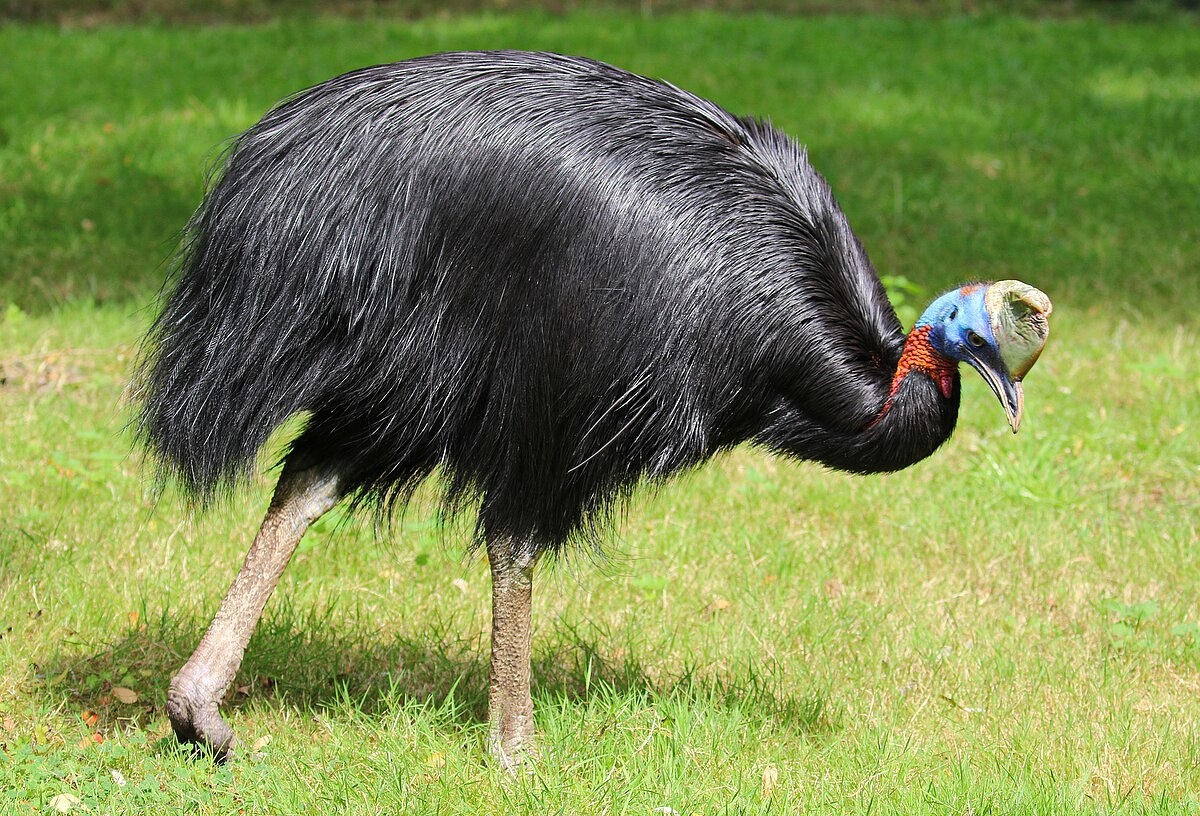
northern cassowary
On the International Union for Conservation of Nature (IUCN) Red List, northern cassowaries are listed as a species of least concern. Size estimates suggests that populations are larger than previously thought. They range over an area of 186,000 square kilometers (72,000 square miles) A 2000 survey estimated their numbers to be around at 9,300. However, some consder them to be the most threatened of three cassowary species as of 2022. Hunting is considered the biggest threat. Logging and slash-and-burn agriculture have diminished and degraded their habitat. Logging roads open up more areas of the forest to hunting. Guns have become more prevelent, making it much easier to kill adult cassowaries. Other threats include the diseases and aspergillosis and avian tuberculosis, and natural disasters, such as cyclones.
Northern cassowaries play important ecosystem roles. They eat many fruits and spread their seeds through defecation, thus helping the forest regenerate. The seeds of the rare rainforest plant ryparosa (Ryparosa kurrangii) has been shown to be much more successful at sprouting after passing through the digestives systems of cassowaries. Only four percent of seeds grow without passing through a cassowary, whereas 92 percent grow after cassowary digestion. There are a multitude of symbolic practices that use northern cassowaries as well. Different groups of people in New Guinea use northern cassowary feathers, excretions, bones, and body parts for rituals and medicines.
Northern Cassowary Characteristics, Lifespan and Diet
Perhaps with the exception of large crocodiles and crocodile monitor lizards, northern cassowaries are the largest vertebrates in northern New Guinea. Southern cassowaries are a little larger. Dwarf cassowaries are significantly smaller Northern cassowary range in weight from 20 to 25 kilograms (44 to 55 pounds) and measure 1.5 meters (4.9 feet) in length and stand 1.5 to 1.8 meters (4.9 to 5.9 feet) tall. Compared to southern cassowaries, northern cassowaries have a slightly shorter bill, at 12 to 13.7 centimeters (4.7 to 5.4 inches), but a slightly longer tarsal length, at 28 to 33.2 centimeters (11 to 13.1 inches). Sexual Dimorphism (differences between males and females) is present: Females are larger than males. Males weigh 30 to 37 kilograms (66 to 82 pounds) and females average 58 kilograms (128 pounds). [Source: Dan Hulbert, Animal Diversity Web (ADW) |=|]
Northern cassowaries have glossy feathers with a hair-like texture. They have a helmet-like casque on the tops of their heads, which are smaller and more upside-down U-shaped than the casques of southern cassowaries. Bright blue skin covers most of their long neck and a bright red wattle hangs from under the beak.Northern cassowaries have only one wattle, the source of their alternate common name, "single-wattled cassowaries." Southern cassowaries have two wattles and are sometimes called "double-wattled cassowaries." All cassowaries have long and powerful legs and three toes with claws.
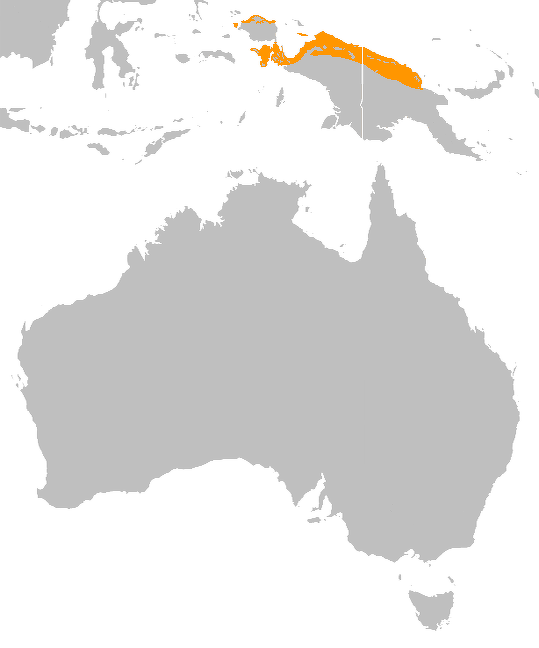
range of northern cassowary
Northern cassowaries can live up to 40 years in the wild and have lived in captivity to 61 years. Many wild cassowaries are killed when they are young because young cassowaries are easier to kill and hunters tend to target them. If they survive childhood, it is not uncommon for them to live a long life. Adult northern cassowaries are very difficult to hunt. They are elusive, hard to see, difficult to track and disappear into the forest at the slightest hint of danger. A single human hunter is lucky to kill one every five years, and a tribe of about 300 people averages about one adult bird kill per year. Tribes that hunt cassowaries in New Guinea believe that only a direct blow to the head or an arrow shot from very close range are the only sure ways to kill them. Some die in dog attacks. Cassowaries are sometimes caught in traps laid for feral pigs.
Northern cassowaries are technically omnivores (eat a variety of things, including plants and animals) but are primarily herbivores (eat plants or plants parts) and frugivores (eat fruit). Animal foods include birds, mammals, amphibians, reptiles, and insects and also eat dung. In the rain forest adult northern cassowaries can eat hundreds of berries and fruits in a day. They have been observed eating mice, rats, frogs, snakes, lizards, smaller birds and a variety of small insects, snails and dead animals. Young have been observed eating the feces of their fathers and clutch mates. Adults eat their own feces as they often contain undigested fruits.
Northern Cassowary Behavior
Northern cassowaries are cursorial (with limbs adapted to running), terricolous (live on the ground), motile (move around as opposed to being stationary), nomadic (move from place to place, generally within a well-defined range) and solitary. It is believed that home range of northern cassowaries is large and can vary from season to season and year to year. Northern cassowary family units show a preference for a particular nesting site, although they rarely visit the nest. Juvenile cassowaries that have been rehabilitated and re-released into the wild with GPS trackers show an affinity for the site at which they were released. [Source: Dan Hulbert, Animal Diversity Web (ADW) |=|]
Northern cassowaries live alone except when males and females come together briefly during the mating season and the nine-month period after hatching when they are raised by their fathers. When northern cassowaries are excited or agitated, the colors on their neck, irises and wattle deepen and they fluff out their feathers to appear bigger and more threatening. When they are startled, adult birds jump into the air and flail, often defecating in fear and run away. As they run, they crash through underbrush and jump over obstacles, making them hard to follow. Young cassowaries under nine months of age fall when startled, as if they are playing dead. This is the preferred time to hunt and capture them. In the absence of a male parent, hatchlings can imprint with humans taking care of them. There are examples of cassowaries rasied this way forming emotional bonds with human caretakers, so much so they will not mate and attack other cassowaries. .
Northern cassowaries are generally regarded as shy. Females are generally more aggressive during mating. In captivity, females attack males that attempt to eat before the female has finished. A male cassowary and his chicks were observed eating mainly in the cooler parts of the day. Northern cassowaries eat and defecate almost constantly. They even soil sleeping areas and sleep in their own feces. Hunters have Buddhist laid in wait in areas with lots of cassowary feces and they indicate a favored feeding area.
Northern cassowaries communicate with a call described as a drumlike “boom” mainly in the infrasound, or ultra low frequencies of sound, and actually made up of a series of sounds. It is believed that cassowaries use such a call because they are solitary birds often far from other cassowaries and need a call that travels over long distances to they can communicate. Lower frequencies travel better and farther in dense, rainforest than higher noises. Male cassowaries have been observed clacking their beaks and using their boom to call their young. When they boom in this capacity they hunch down and ruffle their feathers and the young run to the male and nestle in his feathers. Young northern cassowaries have been observed making a whistling sound and peeping.
Northern Cassowary Mating, Reproduction and Offspring
Northern cassowaries are polyandrous, with females mating with several males during one mating season, and engage in seasonal breeding southern Hemisphere winter and spring months (June to November). Females breed approximately four times yearly during the breeding season. The number of eggs laid each season ranges is between 12 and 20. [Source: Dan Hulbert, Animal Diversity Web (ADW) |=|]
During the winter and spring cassowaries become less aggressive towards each other in order to breed. Males court a female by dancing around her and swelling their necks while she stays still. This is followed by scratching her rump then rubbing necks together. After successful copulation, females are chased off and search for another mate, while males incubates the eggs until hatching, about 47 to 56 days. Male cassowaries prepare the nest. Females lay on average of four eggs per clutch. In captivity, females lay more eggs if eggs are immediately collected from the nest. Under these circumstances females have a laid up to 20 eggs in one clutch. After the eggs are in the nest, male cassowaries become aggressive towards the female and chase her off. Males then protect the eggs and raise the chicks. If a male approaches a female that is not ovulating she chases him off.
Females lay an average of four eggs per clutch and mate with about four males per season. Chicks remain with their father for nine to 18 months and reach sexual maturity at two years old in females and three years old in males. Sexual reproduction occurs late into life: up to 40 years old in females and 37 years old in males. There is an extended period of juvenile learning. Males protects the young and teach them how to find food and care for themselves. Males with chicks become aggressive towards any threat. While under their father’s care the chicks follow their him, even consuming his feces. Ticks and other bugs found on the father are another food source for the chicks. Their feathers of young cassowaries are brown and turn black by the time they reach maturity, at about three years old.
Dwarf Cassowaries
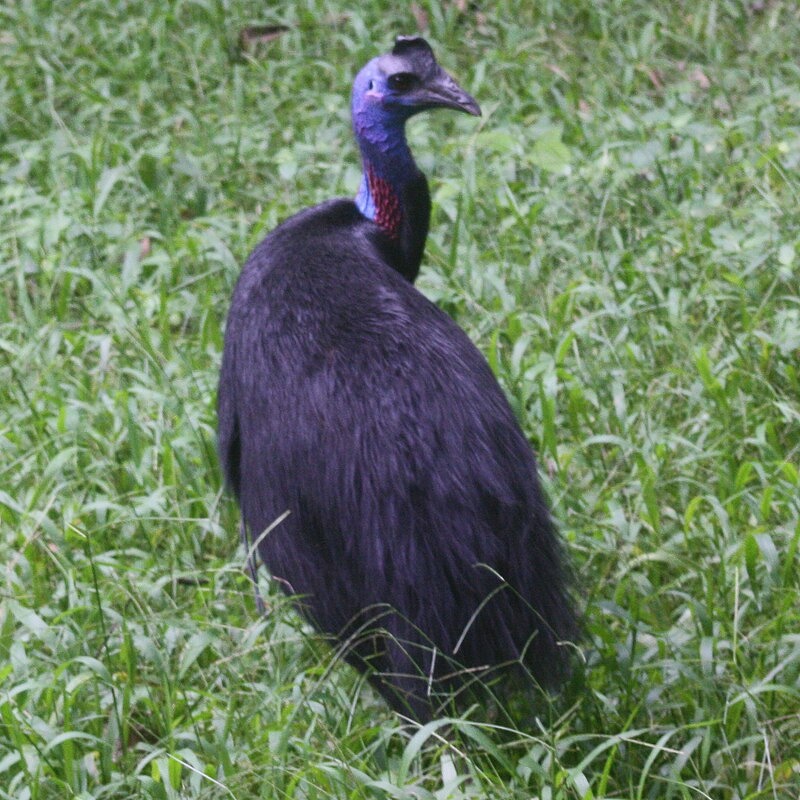
in Lae, New GuineaDwarf cassowary
Dwarf cassowaries (Casuarius bennetti) are also known as Bennett's cassowaries. little cassowaries, mountain cassowaries and muruk. As their name suggests they are the smallest of the three living species of cassowaries. They live on the island of New Guinea in Papua New Guinea and Papua and West Papua in Indonesia. Some live on the islands in the Bismarck Archipelago (part of Papua New Guinea's Islands Region), including New Britain and New Ireland, as well as on Yapen Island (part of Indonesia's Papua Province). It is believed that cassowaries may have arrived on these islands as a result of the ancient trade of cassowaries in the region. [Source: Wikipedia, Stephanie Jones, Animal Diversity Web (ADW) |=|]
Dwarf cassowaries live in higher altitudes than the other two cassowary species. They are typically found in steep mountainous terrain up to 3000 meters (9,842 feet) in thick vegetation in montane cloud forests and subtropical and tropical rain forests. They typically occur in a west-to-eat running strip in central New Guinea with the range of northern cassowaries to the north and the range of southern cassowaries to the south. This is a large area covering approximately 258,000 square kilometers (100,000 square miles). In areas where dwarf cassowaries do not encounter northern cassowary or southern cassowary they may descend to lower elevations and forage in lowland or open forest areas. There are two recognized subspecies: 1) C. b. bennetti - found throughout New Guinea except the Vogelkop Peninsula, as well as Yapen Island and New Britain; and 2) C. b. westermanni - found on the Vogelkop Peninsula
Dwarf cassowaries are the smallest of the cassowaries but still very large birds. They have an average weight of 18 kilograms (39.6 pounds) and range in length from one to 1.35 imeters (3.3 to 4,4 feet). Their plumage is black and coarse, and their feathers resemble drooping bristles. Their head and long neck are bare and blue and red in color. Their casque is much than that of northern and southern cassowaries. Also, unlike the other two species, dwarf cassowaries, do not have colored wattles of flesh hanging from their necks. Dwarf cassowaries legs lack feathers and are solid and powerful. They have three toes. On the innermost one is an enlarged claw, which can be up to 10 centimeters (4 inches) long. in length. Females and males are monomorphoric, although females are larger than males. Sexual Dimorphism (differences between males and females) is present: Females are larger than males but both look the same. Their average lifespan in captivity is 26 years.
Dwarf cassowaries are omnivores (eat a variety of things, including plants and animals) but are mainly herbivores (eat plants or plants parts) and frugivores (eat fruit). They mainly eat fruits that have fallen on the forest floor or are low enough on trees and shrubs that they can pluck them. Dwarf cassowaries use their casque to plow through leaf litter and upturn other sources of food, such as fungi, insects, plant tissue, and small vertebrates, including lizards and frogs. They also eat leaves seeds, grains, nuts and fruit.
On the International Union for Conservation of Nature (IUCN) Red List, dwarf cassowaries were they are listed as Near Threatened in the early 2010s due to stress from habitat loss and degradation, hunting and being kept in captivity. In 2015, their status was changed to a species of least concern. Dwarf cassowaries have traditionally been hunted and kept in captivity for meat and feathers by highland tribes.
Dwarf Cassowary Behavior and Communication
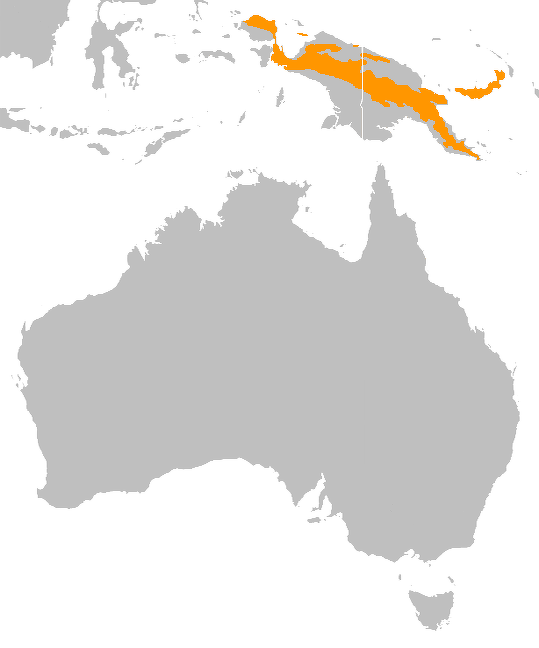
range of dwarf cassowaries
Dwarf cassowaries are terricolous (live on the ground), diurnal (active mainly during the daytime), motile (move around as opposed to being stationary), sedentary (remain in the same area) and territorial (defend an area within the home range). Their home territories range from one to five square kilometers (0.4 to 2 square miles). The size and shape of the ranges change based on the food supply and whether ot not it is breeding season. Female cassowaries tend to have home ranges that overlap with the home ranges of several males. [Source: Stephanie Jones, Animal Diversity Web (ADW) |=|]
Dwarf cassowaries are solitary and shy and are rarely seen in the wild. They are active during the day, spending their time searching for food. They are usually alone but are are sometimes seen in pairs — presumably mating pairs — small groups, usually a male with offspring. If these birds are cornered, they will defend themselves with powerful kicks. Dwarf cassowaries have reportedly killed both humans and dogs when they were provoked.
The call of dwarf cassowaries is a loud boom at a frequency near the lower end of human hearing and help the solitary birds communicate with other dwarf cassowaries in thick forests. The calls of captive dwarf cassowaries have been measured at frequencies as low as 23 Hz. Researchers noticed that dwarf cassowaries begin and end their vocalizations with a much louder, longer “roar” that they measured at 200 to 100 Hz, with lower, shorter booms in between. These calls lasted about 10 seconds.
Dwarf cassowaries defend themselves with the large claws on their innermost toes and a powerful kicks. Dogs and humans are their main predators. Cassowaries are responsible for the distribution of seeds found in large fruits of about 70 species of trees. The fruits of these trees are too large for many other forest dwelling fruit eaters to disperse. They also play a role in the dispersal of smaller seeds for about 80 plant species
Dwarf Cassowary Mating, Reproduction and Offspring
Little is known about the mating system of dwarf cassowaries but it is assumed that it similar to that of northern and southern cassowaries, which are are polyandrous, with females mating with several males during one mating season, and engage in seasonal breeding. Cassowary females generally breed one to three times during an annual breeding season, whuch begins in May or June and lasts until October or November. The number of eggs laid each season ranges from four to six. The time to hatching ranges from 49 to 52 days. The average of independence ranges from from seven to 16 months. On average males and females reach sexual or reproductive maturity at age four years.
Female southern cassowaries become more tolerant of males as the breeding season approaches. Eventually, male and female pairs form. When the female is ready to lay eggs, the pair finds a nesting site. The male dances around the female in circles while his throat trembles and swells and he emits a series of low booming calls. Finally, the male leads the female a short distance from the nest where the female squats and allow the male to mount her. The eggs are laid shortly after copulation. In captivity, Southern cassowaries has been known to copulate between the laying of each egg. After the eggs have been laid, the female will leave to mate with other males.
Young are precocial. This means they are relatively well-developed when born. Parental care is provided by males. Once the female has laid a clutch of eggs, she moves on to find another male with which she can mate and produce more eggs. The eggs are incubated by the male, who is also responsible for raising and defending the chicks. The chicks will follow their father but are responsible for feeding themselves.
Image Sources: Wikimedia Commons
Text Sources: Animal Diversity Web animaldiversity.org , National Geographic, Live Science, Natural History magazine, Australian Museum, David Attenborough books, Australia Geographic, New York Times, Washington Post, Los Angeles Times, Smithsonian magazine, Discover magazine, The Conversation, The New Yorker, Time, BBC, CNN, Reuters, Associated Press, AFP, Lonely Planet Guides, Wikipedia, The Guardian, Top Secret Animal Attack Files website and various books and other publications.
Last updated August 2025