
Home | Category: Nature, Environment, Animals / Birds, Crocodiles, Snakes and Reptiles
LITTLE PENGUINS
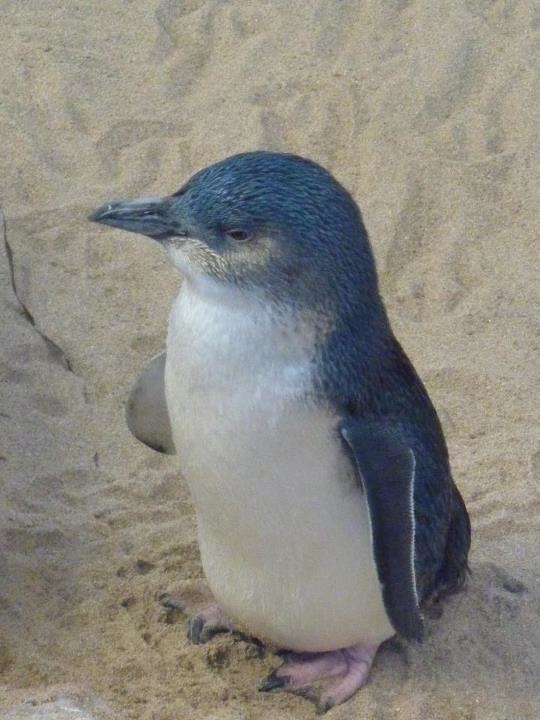
Australian Little Penguin (Eudyptula novaehollandiae) at Penguin Island near Perth
Little penguins are the smallest species of penguin. Also known as fairy penguin, little blue penguin, or blue penguin, owing to its slate-blue plumage, are stand about 30 centimeters (one foot) tall and found along the southern coasts of Australia, from Western Australia to New South Wales, and also breeds in Tasmania and parts of New Zealand, including the Otago region. They were widely known as fairy penguins in Australia, but the name was deemed politically incorrect. The Maori call them kororā.
There are considered to be two species of little penguin: the Australian Little Penguin (Eudyptula novaehollandiae) and the New Zealand Little Penguin (Eudyptula minor), although some authorities still classify them as one species with subspecies. This division is based on mitochondrial DNA analysis, which revealed significant genetic differences between the Australian and New Zealand populations. Australian little penguin are the only penguin species that breeds on the Australian mainland. There are five others that do so in New Zealand.
Little penguins dive for food throughout the day and returns to burrows on the shore at dusk, making them the only nocturnal penguin species on land. Their feathers are dense in melanosomes, which increase water resistance and give them their unique blue colour. Little penguins on average live around six years. One banded individual was recaptured at the age of 25 years and eight months old.
RELATED ARTICLES:
PENGUINS: CHARACTERISTICS, HISTORY AND SWIMMING ioa.factsanddetails.com ;
ENDANGERED PENGUINS: DECLINING NUMBERS, THREATS ioa.factsanddetails.com ;
PENGUIN BEHAVIOR, SEXUALITY AND YOUNG ioa.factsanddetails.com
EMPEROR PENGUINS: CHARACTERISTICS, BEHAVIOR, SWIMMING ioa.factsanddetails.com
NEW ZEALAND PENGUINS: SPECIES, HISTORY, CHARACTERISTICS, BEHAVIOR, REPRODUCTION ioa.factsanddetails.com
Little Penguin Habitat, Subspecies and Range
Little penguins are found throughout the southern coast of Australia and as far north as the South Solitary Island off the coast of New South Wales. They are also native to the coasts of New Zealand. There are six recognized little penguin subspecies: 1) E. m. novaehollandia is geographically located in Australia. The other five subspecies — 2) E. m. iredaei, 3) E. m. variabilis, 4) E. m. albosignata, 5) E. m. minor and 6) E. m. chathamensis, are distributed around New Zealand. Recently the little penguins in New Zealand were classified as a separate species — distinct from the species in Australia.
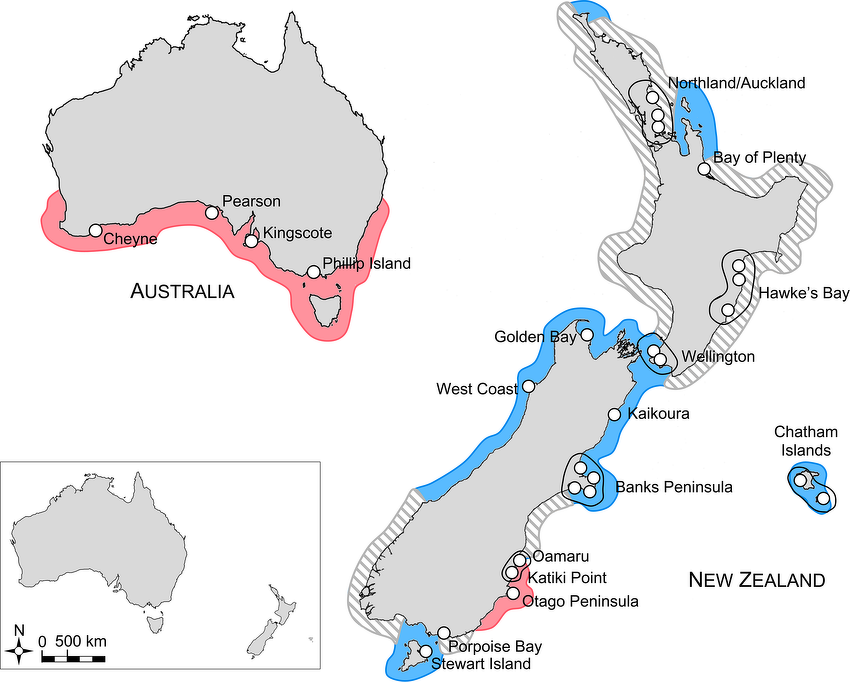
Australian Little Penguin (Eudyptula novaehollandiae) in pink; New Zealand Little Penguin (Eudyptula minor) in blue
Little penguins are marine seabirds and spend much of their life in the sea. When on land, they inhabit coastal area with good nesting conditions. They nest in burrows dug in the sand or under vegetation. If the ground is too soft to hold a burrow, these penguins also nest in caves and rock crevices. Habitats include rocky coastline, and savanna, scrub forests for along coasts. Little penguins used to be a common sight in Sydney Harbor but they are not seen so much there now. [Source: Ashley Chung, Animal Diversity Web (ADW) |=|]
Phillips Island (130 kilometers, 80 miles south of Melbourne and accessible by car) is the home of thousands of little penguins. They congregate on this 39 square-mile island from November to January and the best time to visit is at dusk when the penguins return from a day at sea and retire to their sandy burrows at Summerland Beach. Unfazed by the tourists that admire them, the penguins usually pop out of the surf in groups of eight to ten with their bellies so full of fish they can sometimes barely walk. When they return to their nests they discourage the partly-ingested fish to feed their young. Tourists that watch the spectacle, known as the Penguin Parade, are not allowed to walk on the beach. They have to stand behind a roped off area or sit in the grandstand. There is a huge colony of Bass Strait fur seals on the island as well as koalas and large flocks of short-tailed sheerwaters.
Little Penguin Characteristics
Little penguins are the smallest of the 18 species of penguin. They range in weight from 1.1 to 1.2 kilograms (2.4 to 2.6 pounds) and their average length is 30 centimeters (11.8 inches). By contrast, the largest penguins, emperor penguins, weigh between 19 and 46 kilograms (41.8 to 101 pounds) and reaches lengths of 1.15 meters (3.8 feet), Sexual Dimorphism (differences between males and females) among little penguins is not pronounced. Both sexes are roughly equal in size and look similar. Males are a little larger and have longer and deeper bills than females. Males have an average bill length of 3.57 centimeters and an average bill depth of 1.54 centimeters. Females have an average bill length of 3.45 centimeters and an average depth of 1.41 centimeters. Flipper length is similar in both genders with an average of 11.75 centimeters (4.6 inches). [Source: Ashley Chung, Animal Diversity Web (ADW) |=|]
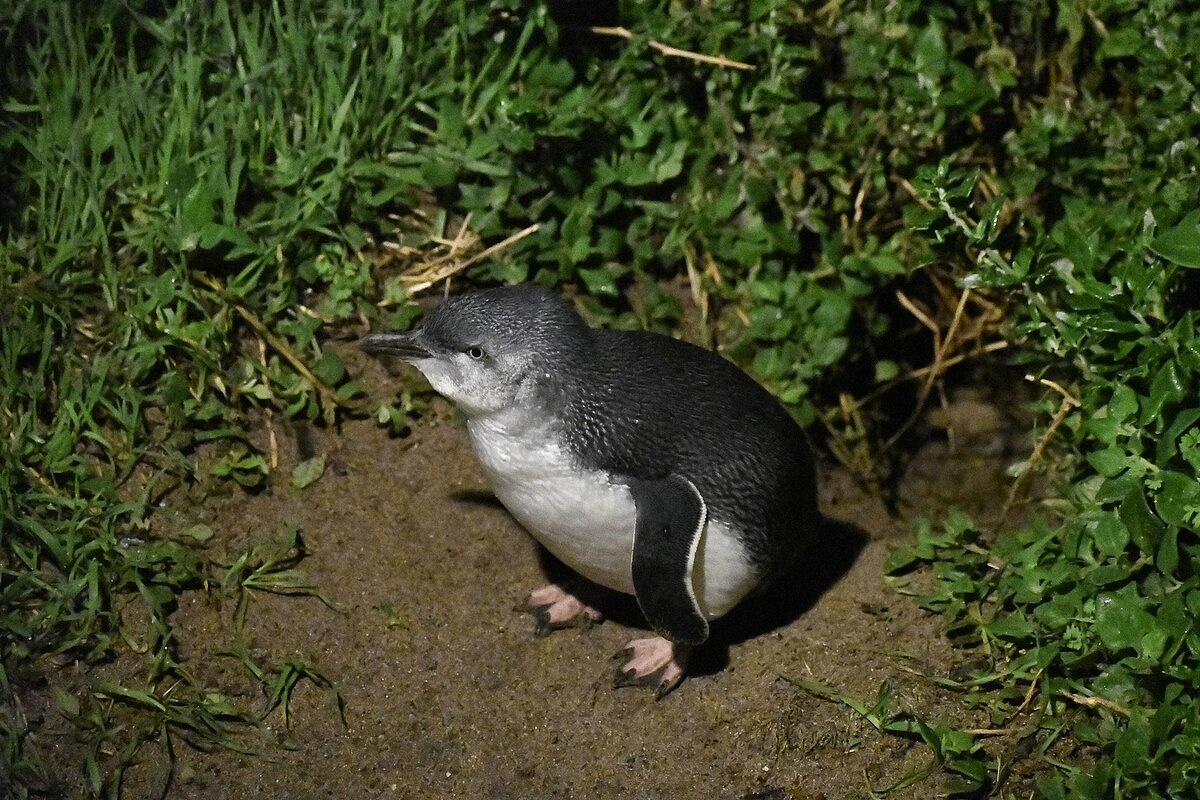
New Zealand Little Penguin (Eudyptula minor)
Little penguins black bill with an average length of 3.5 centimeters (1.4 inches) and eyes that can be silver, blue, grey, or hazel. Their chin and throat are white along with the underside of their flippers and torso. The top of the head, neck and top side of their flippers and torso are indigo-blue. The color of their undersides ranges from white to gray to brown. The color of their feathers can become duller with age. The back plumage of juveniles is a brighter light blue than the indigo-blue of the adults. The juveniles also have thinner and shorter beaks.
Little penguins are endothermic (use their metabolism to generate heat and regulate body temperature independent of the temperatures around them) and homoiothermic (warm-blooded, having a constant body temperature, usually higher than the temperature of their surroundings). |=|
Little Penguin Behavior and Diet
Little penguins are fossorial (engaged in a burrowing life-style or behavior, and good at digging or burrowing), natatorial (equipped for swimming), nocturnal (active at night), motile (move around as opposed to being stationary), sedentary (remain in the same area), territorial (defend an area within the home range) and colonial (live together in groups or in close proximity to each other). Burrow nests are usually over two meters apart in little penguin colonies. However, when the penguins nest in caves the nests are often closer than two meters apart. [Source: Ashley Chung, Animal Diversity Web (ADW) |=|]
Little penguins are carnivores (eat meat or animal parts) and mainly piscivores (eat fish). Animal foods include fish, mollusks, squid, octopi and aquatic crustaceans. Little penguins use pursuit-diving technique to catch prey in shallow depths. The majority of their diet is made up of Clupeiformes fish, such as anchovies and sardines. The variety of fish consumed depends on locality. In recent years, it seems, that the amount of available prey is declining and the penguins have to venture farther from shore and go on longer foraging trips.
Little penguins are considered the most nocturnal penguins, but generally the diurnal (act in the day) as they spend all day foraging at sea and return to land to roost at dusk. In the breeding season, penguins swim out only an average of eight to nine kilometers from shore for about 12 to 18 hours at a time. These relatively short trips are probably because chicks have a limited ability to thermoregulate and need to be fed constantly. During the non-breeding season, penguins can take long distance trips of up to 710 kilometers, but typically they stay within 20 kilometers of shore.
Little penguins can dive to depths of 67 meters, but mostly they remain within five meters of the surface. They use a greater amount of energy to dive into the water than larger penguins do. When the penguins return to shore from the sea, they parade back to their nests in groups. In the breeding season, these penguins often parade with the same group in the morning when the head to the shore and when they parade back at dusk.
Little Penguin Communication and Aggressive Displays
Little penguins sense using vision, touch, sound and chemicals usually detected with smell and communicate with vision, and sound, sometimes employing duets (joint displays, usually between mates, and usually with highly-coordinated sounds). Little penguins are highly vocal at night while roosting in their burrows. The sound of their calls can range from low rumbles to loud trumpeting. Vocalizations are used to attract mates, keep in contact with others, warn others of dangers and accompany aggressive displays. Each little penguin has a distinctive individual song that is used by parents and siblings to distinguish one another from the masses.[Source: Ashley Chung, Animal Diversity Web (ADW) |=|]
Little penguins have over a dozen aggressive behavior displays, which can be divided into four categories: 1) stationary warnings, 2) rapidly advancing towards the intruder, 3) brief physical contact and 4) physical attacks. All four behaviors are accompanied by different types of physical displays and vocalizations. |=|
According to Animal Diversity Web: 1) Stationary warning displays occurs when the threat is one to three meters away from the penguin. The penguin spreads its flippers, holding its body erect and giving the intruder a direct look accompanied by a loud vocalization. 2) When the penguin rapidly advances towards the intruder, it walks quickly or lunges towards the intruder with a bray-like call. 3) Brief physical contact can range from touching bills to slapping the intruder with a flipper. 4) If the penguin is in its burrow, it lunges out to peck the intruder with its bill. If the intruder does not retreat, penguins resort to physical attacks that include biting and beating with flippers. |=|
Little Penguin Mating and Reproduction
Little penguins are monogamous (have one mate at a time) and breeding tend to return to the same nest year after year. Pairs appear to only split up after an unsuccessful nesting attempts or death. They engage in seasonal breeding — usually once a year from June until December, but may vary geographically. Females have the ability to lay an additional clutch of eggs if the first one fails or if young fledgle early in the breeding season. The number of eggs laid each season ranges from one to two and is usually two. The time to hatching ranges from 31 to 40 days. On average males and females reach sexual maturity at age three years.[Source: Ashley Chung, Animal Diversity Web (ADW) |=|]
Courtships begins with male little penguins performing courtship displays and giving mating calls. During their courtship display, males emits braying sounds and hold their body upright with flippers above their back, neck stretched, and their head facing towards the sky. These displays can be performed alone or in unmated male groups. Occasionally, males perform in front of nests they have constructed. After a female chooses a male, they perform a display together in which one individual stands upright and spreads its flippers with head bowed, which signals the other bird to follow and they walk in small circles around the nest, braying as they go. After this display by male and female, copulation takes place. |=|
Little penguins breed in loose colonies. They nest are typically in ground burrows but can be on rocky cliffs or in caves. The eggs are smooth and white in appearance. They have an average weight of 53 grams (1.8 pinces) and an average diameter of 4.2 centimeters (1.7 inches). The breeding cycle of little penguins depends on nesting location and a variety of other environmental factors. Nutrition, age, breeding date can influence the timing of the breeding cycle and nesting success. A lack of nutrition has been shown to delay the breeding process. The probability of breeding success also increases with age, which has been attributed to the experience of older penguins.
Little Penguin Offspring and Parenting
Little penguin young are semi-altricial, meaning they are relatively underdeveloped at birth, but possess downy feathers. Parental care is provided by both females and males. During the pre-birth, pre-weaning and pre-independence stages provisioning and protecting are done by males and females. Young fledge around 50 to 65 days after birth and become independent about occurring at 57 to 78 days. Most juvenile penguins reach reproductive maturity at three years old. [Source: Ashley Chung, Animal Diversity Web (ADW) |=|]
Newly-hatched little penguin chicks on average weigh of 36 to 47 grams (1.3 to 1.8 ounces). The chicks require brooding as they are unable to leave the nest, and are unable to feed themselves. The 18 to 38 days after hatching is called the "guard period". During this time both parents brood the young, trading off every three to four days. After the initial guard period, the parents relax their duties and guard chicks only at night. Fledging occurs when the chicks are almost adult size, weighing 0.8 grams to 1.1 kilograms.
Both male and female little penguins may build their nest together, but males generally take on a greater role in physically building the burrow while females do more of the incubation duties but not so much more males. After chicks are born, both parents to brood the young during the "guard period." Parents swap duties every three to four days so that one broods the chicks while the other forages and brings back food for the chicks to feed on.
Little Penguins, Humans, Predators and Conservation
Little penguins are not endangered or threatened. They are designated as a species of least concern on the International Union for Conservation of Nature (IUCN) Red List and have no special status according to the Convention on InternationalTrade in Endangered Species (CITES). It is believed that the global population of the two two species of little penguin exceeds one million, however, the subspecies E. m. albosignata is now considered endangered. It is only found on the Banks Peninsula on South Island, New Zealand. [Source: Ashley Chung, Animal Diversity Web (ADW) |=|]
The population of little penguins is believed to be declining due to introduced predators, decreasing populations of prey and oil pollution. They have been hurt by oil dumped by ships in the Southern sea. To prevent the ingestion of oil some penguins have been placed in woolen sweaters that kept them from preening their oil-contaminated feathers. Large-scale industrial fishing results in low prey densities for penguins and other fish-eating sea animals. Human settlements, coastal erosion, pollution and roads have affected the breeding ground of these penguins.
Little penguins are a tourism draw. The penguin parades on some of the islands where they live such as Phillip Island attract hundreds of thousands of visitors annually. These penguins are also of interest to scientists because of their small sizes and the way they use energy to thrive in sometimes cold water environments.
The main predators of little penguins are introduced species that include dogs, weasels, rats, foxes and cats. Pacific gulls and King's skinks are natural predators that eat the eggs and young of little penguins on land. Adult little penguins are eaten by sharks, seals, and orcas and other sea creatures in the sea.
As a defense against predation, little penguins move in groups to and from the ocean. This anti-predator technique occurs a few hours before dawn and a few hours after dusk when it is dark. As penguins are less mobile on land, making mass land movements under the cover of darkness is likely another method used to avoid predation.
Autopsies on dead penguins indicate that foxes or dogs are responsible for many attacks on little penguin based on the nature of the bite marks. DNA swabs are also analysed to figure out what animals are responsible for attacks. Angelika Treichler from local group Manly Environment Centre told the Sydney Morning Herald that attacks often happen at dusk when the nocturnal penguins come ashore. She urged dog owners to keep their animals on leads. [Source: Abhinav Ramnarayan, The Guardian, July 13, 2009]
Dogs and Snipers Deployed to Protect Little Penguins
Middle Island, a beautiful, rugged and windswept piece of land off the coast of southern Victoria, is home to a little penguins. But when foxes made their way to the island, they nearly wiped the colony out. They were saved by a farmer came up with a novel way to protect the birds — with dogs. There were hundreds of little penguins on Middle Island before the foxes got to them. "We went from a point where we had around 800 penguins down to where we could only find four," Peter Abbott from the Penguin Preservation Project told the BBC. "In our biggest bird kill, we found 360 birds killed over about two nights. Foxes are thrill killers. They'll kill anything they can find." [Source: Jon Donnison, BBC, December 14, 2015]
Jon Donnison of the BBC wrote: That particular incident was in 2005, but the problem had been building up for a few years. Middle Island — which is uninhabited by humans — is separated from the mainland by a stretch of water measuring no more than 20 or 30 meters. At low tide, and when sand builds up in the narrow channel, foxes can cross from the mainland barely getting their paws wet. The problem first became apparent in the year 2000 when the sea's natural current led to increased sand build-up. Over time the fox population grew as it became clear they had an easy source of food.
The little penguins faced being wiped out on Middle Island — until a chicken farmer, by the made-for-cinema name of Swampy Marsh, came up with a plan. He suggested sending one of his Maremma dogs to protect the birds. "In Australia those dogs are generally used for chicken protection or goats or sheep," says Abbott. The dog, the first of several to be used on Middle Island, was called Oddball — and Oddball made quite an impact. "We immediately saw a change in the pattern of the foxes," says Abbott.
"Leading up to when the dog went on the island, every morning we'd find fox prints on the beach. Putting a dog on the island changed the hierarchy. The foxes can hear the dogs barking, they can smell them so they go somewhere else." Amazingly, since Oddball and his four-legged successors were introduced 10 years ago, there has not been a single penguin killed by a fox on Middle Island as of 2015, when dogs patrolling Middle Island were Eudy and Tula, named after the scientific term for the fairy penguin: Eudyptula. They were the sixth and seventh dogs to be used and a new puppy is being trained up by Peter Abbott and his team to start work in 2016.
The dogs operate in the penguin's breeding season, usually from October to March, when they spend five or six days a week on the island. Even when the dogs are not there, their lingering scent is enough to keep the foxes away. The film about penguin and dog story — “Oddball” — was popular in Australia and brought a fair amount of tourists to the Middle Island area.
In 2009, fox or dog attacks on little penguins at beach near Sydney led Australia's wildlife authorities to post snipers at night to protect the birds. The Guardian reported: A colony of about 120 little penguins at Quarantine beach lost about nine of its number to attacks. Two snipers took their first watch but were unable to shoot the animals responsible. "We've got infrared cameras as well to detect fox movements along with fox baiting … This is really a microcosm of the devastation foxes can wreak in some areas," the National Parks and Wildlife Service told the Sydney Morning Herald. "We've had no luck so far finding what has done this so we'll keep on trying. We'll be there for as long as necessary." [Source: Abhinav Ramnarayan, The Guardian, July 13, 2009]
Image Sources: Wikimedia Commons
Text Sources: Animal Diversity Web animaldiversity.org , National Geographic, Live Science, Natural History magazine, Australian Museum, David Attenborough books, Australia Geographic, New York Times, Washington Post, Los Angeles Times, Smithsonian magazine, Discover magazine, The Conversation, The New Yorker, Time, BBC, CNN, Reuters, Associated Press, AFP, Lonely Planet Guides, Wikipedia, The Guardian, Top Secret Animal Attack Files website and various books and other publications.
Last updated August 2025