
Home | Category: Animals / Birds, Crocodiles, Snakes and Reptiles
SOUTHERN CASSOWARIES
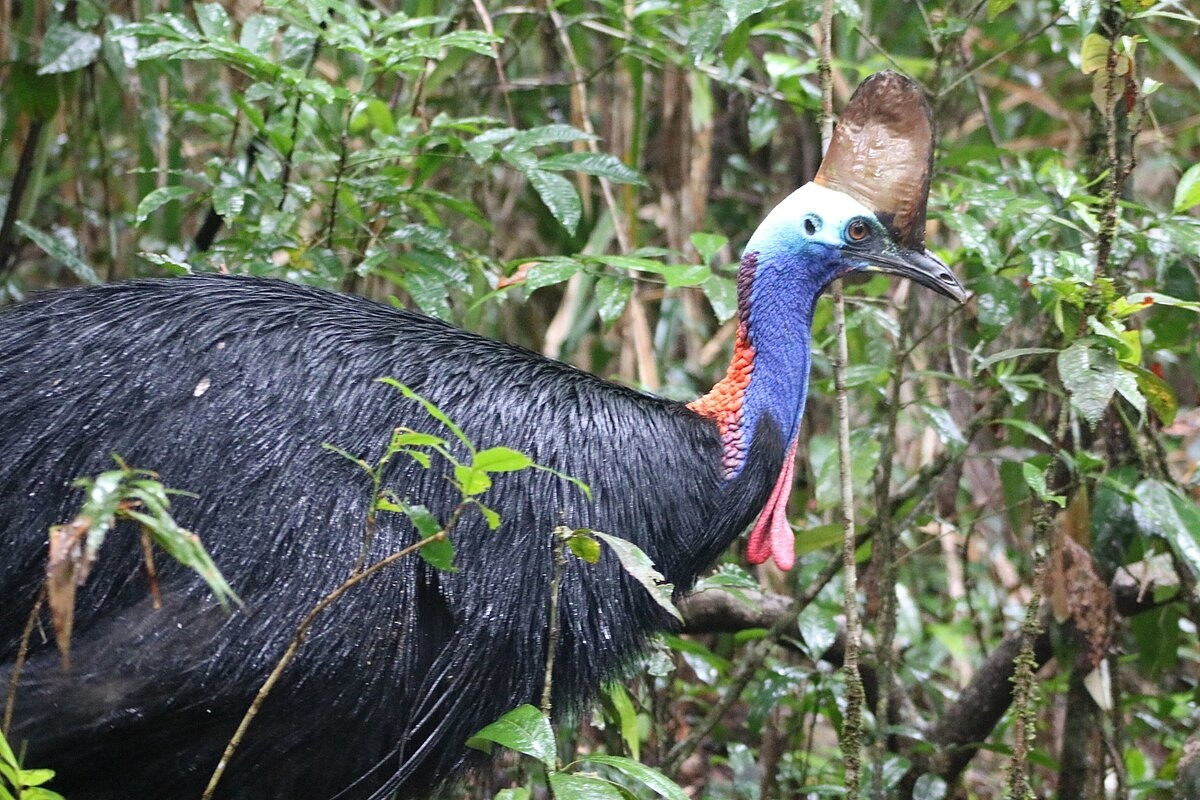
southern cassowary
Southern cassowaries (Casuarius casuarius) are often called the world’s most dangerous bird based on the number of attacks with serious injuries that have been inflicted on humans. They can not fly but they can run at speeds of 48 kilometers per hour (30 miles per hour) and are good swimmers. Usually solitary, thet announce their presence with loud, deep booms that carry remarkably far in dense foliage. Their numbers are unknown. It has been estimated that there are 4,000 to 20,000 of them. [Source: Canon advertisement]
Native to tropical rainforests of northeast Australia, southern New Guineaa and some nearby islands, southern cassowary is the heaviest flightless bird in Australia — bigger than their relatives, emus — and the second-heaviest in the world after ostriches. Southern cassowaries have powerful, muscular legs that can deliver a powerful blow and tough, prehistoric-looking feet with claws that are up to 12.5 centimeters (5 inches) long. [Source: Hannah Osborne, Live Science published June 14, 2025
Southern cassowaries are among the most prehistoric-looking birds on Earth. They have been likened to a modern-day dinosaur due to their massive size, vivid colouration and powerful, raptor-like feet. Little is known about their lifespan in the wild, but in captivity they have lived 20 to 40 years.
Southern cassowaries are found in southern New Guinea (in both Papua New Guinea and the Indonesian Province of Papua), Cape York and eastern Queensland in Australia and the Ceram and Aru Islands of Indonesia. It is possible they were introduced to Ceram and the Aru Islands by humans. Southern cassowaries live primarily in lowland rainforests, typically at elevations of less than 1,100 meters (3,630 feet), and occasionally are found in eucalyptus forests, savannas, palm scrub, forested swamps, mangroves and fruit plantations. [Source: Dan Hulbert, Animal Diversity Web (ADW) |=|]
RELATED ARTICLES:
CASSOWARIES: HISTORY, CHARACTERISTICS, BEHAVIOR AND REPRODUCTION ioa.factsanddetails.com
CASSOWARIES AND HUMANS: HISTORY, SIDE BY SIDE, ATTACKS ioa.factsanddetails.com
CASSOWARIES OF NEW GUINEA: SPECIES, WHERE THEY LIVE, WHAT THEY'RE LIKE ioa.factsanddetails.com
EMUS: CHARACTERISTICS, BEHAVIOR AND REPRODUCTION ioa.factsanddetails.com
EMUS AND HUMANS: MEAT, OIL, RANCHING AND WARS ioa.factsanddetails.com
MOAS: HISTORY, CHARACTERISTICS, REPRODUCTION, EXTINCTION, DE-EXTINCTION? ioa.factsanddetails.com
MOA SPECIES: GIANT, SMALL AND HEAVY-FOOTED ONES ioa.factsanddetails.com
BIRDS OF AUSTRALIA: COMMON, UNUSUAL AND ENDANGERED SPECIES ioa.factsanddetails.com
BOWERBIRDS: BOWERS, TYPES, DECORATIONS, COURTSHIP DISPLAYS ioa.factsanddetails.com
BOWERBIRD SPECIES: CHARACTERISTICS, BEHAVIOR AND REPRODUCTION ioa.factsanddetails.com
LYREBIRDS: CHARACTERISTICS, BEHAVIOR AND REPRODUCTION ioa.factsanddetails.com
KOOKABURRAS: CHARACTERISTICS, LAUGHING, BEHAVIOR, SPECIES, REPRODUCTION ioa.factsanddetails.com
PARROTS OF AUSTRALIA-NEW GUINEA: SPECIES, COLORS, CHARACTERISTICS, BEHAVIOR ioa.factsanddetails.com
COCKATOO SPECIES: CHARACTERISTICS, BEHAVIOR AND REPRODUCTION ioa.factsanddetails.com
COCKATOOS: COLORS, DIET, LONG LIFESPANS, DANCING, VOCALIZATIONS, HUMANS ioa.factsanddetails.com
Southern Cassowary Characteristics
Southern cassowaries are large, robust birds with long, powerful legs for running and defense. They are the largest of the three cassowary species. Adults are 1.5 to 1.8 meter (4.9 to 5.9 feet) tall, although some females may reach 2 meter (6.6 feet) and weigh 58.5 kilograms (130 pounds). It is not uncommon to see exceptionally large females weighing more than 70 kilograms (150 pounds). The largest southern cassowary ever recorded weighed 85 kilograms (187 pounds) and 190 centimeters (6.3 feet) tall. Sexual Dimorphism (differences between males and females) is present: Females are larger than males. Females are 127 to 170 centimeters (50 to 67 inches) long and weigh up to 59 kilograms (129 pounds). Males weigh between 29 to 34 kilograms (64 to 75 pounds).
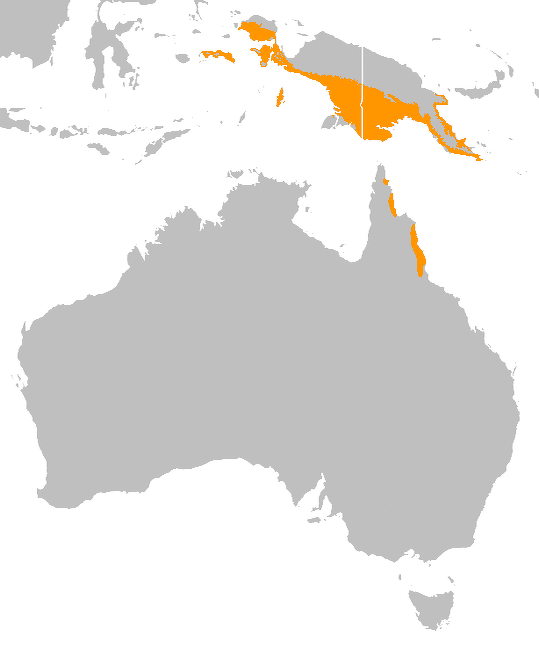
southern cassowary range
Southern cassowaries have a striking and unusual appearance. Their neck and head have no feathers and are vividly colored in shades of blue and red, They the only one of the three species of cassowary to have two bright red flaps of skin, called wattles, hanging from their neck. Because of this they are also known as double-wattled cassowaries and two-wattled cassowaries. The wattles are thought to help cassowaries relay social cues to others: For example, if they shake their heads and clap their wattles it may be a sign of territorial aggression. The bodies of southern cassowaries are covered with dark brown or black feathers which look more like thick, coarse hair. This coat provides protection from sharp thorns and branches as they move through dense vegetation. wings are extremely small and there are vestiges of primary feathers in the form of five or six long white spines.
Hannah Osborne of Live Science wrote: One of the cassowary's most prehistoric-looking features is its feet. Each foot has three toes, with the inner toe bearing a dagger-like claw that can grow up to 5 inches (12 centimeters) long. These claws aren't just for show; they're capable of delivering powerful, slashing kicks that can injure or even kill potential threats, including humans. Their legs are extremely muscular and adapted for quick, forceful movements, which helps them lash out at predators, such as crocodiles and pythons. [Source: Hannah Osborne, Live Science published June 14, 2025
On their heads there is a large helmet-like bony casque which is made of trabecular bone and cartilage. The exact function of the casque is still debated among biologists, but research suggests these structures act as "thermal windows," or radiators, allowing the bird to release excess heat in hot weather and conserve it in cooler conditions. It may also amplify and direct the birds' low-frequency calls, helping them communicate over long distances.
Southern Cassowary Diet and Seed Dispersal
Southern cassowaries are technically omnivores (eat a variety of things, including plants and animals) but are primarily primarily herbivores (eat plants or plants parts) and frugivores (eat fruit), feeding on fruit, seeds, fungi, snails, fish, frogs, small birds, small mammals, carrion, reptiles, insect and non-insect arthropods such as spiders.
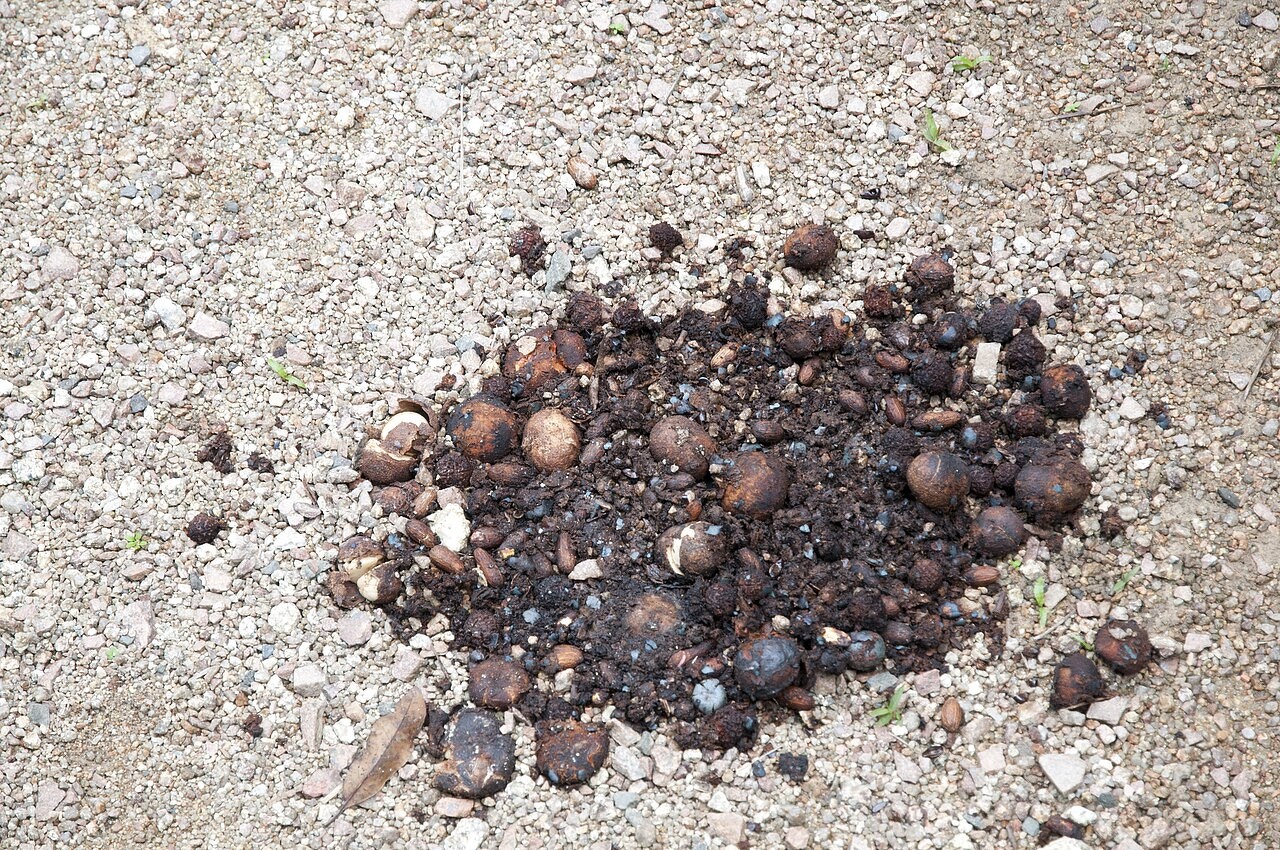
cassowary scat, containing seeds
Southern cassowaries feed mostly on fruits from canopy species in the forests where they live. Because these birds cannot fly they must rely on finding fruit that has fallen to the ground.. Inspection of the feces have revealed more than 300 plant species. Among the commonly ingested fruits and plants are Davidsonia pruriens, Acemena divaricata, Polyalthia michaelii, and Acronychia acronychioides.
Cassowaries are important seed disperers for numerous plant species they eat. When cassowaries eat the fruit the seeds pass through their digestive system and are dispersed far from where they originally fell. The seeds are often still intact and viable after being digested and excreted by cassowaries. A typical pile of cassowary dung contains as much as one kilogram of seeds. One study identified from 78 plants species in cassowary scat and found that 70 of these species' seeds were able to germinate. These species included large number from the Lauraceae (laurel) family as well as mulberries (Moraceae), palms (Arecaceae), myrtles (Myrtaceae) and fruits listed above.
Southern Cassowary Behavior
Southern cassowaries are cursorial (with limbs adapted to running), terricolous (live on the ground), diurnal (active mainly during the daytime), motile (move around as opposed to being stationary), sedentary (remain in the same area), solitary, territorial (defend an area within the home range). Southern cassowaries have a home territory, which they stronly defend against other cassowaries. In the forest they will produce a very deep, loud territorial roar which can be heard by cassowaries a significant distance away. It is unknown how large the home territory of individual cassowaries is but based on the number of fruit and plant species they feed on, which can dispersed over a large area. each cassowary requires fairly large home range. [Source: Dan Hulbert, Animal Diversity Web (ADW) |=|]
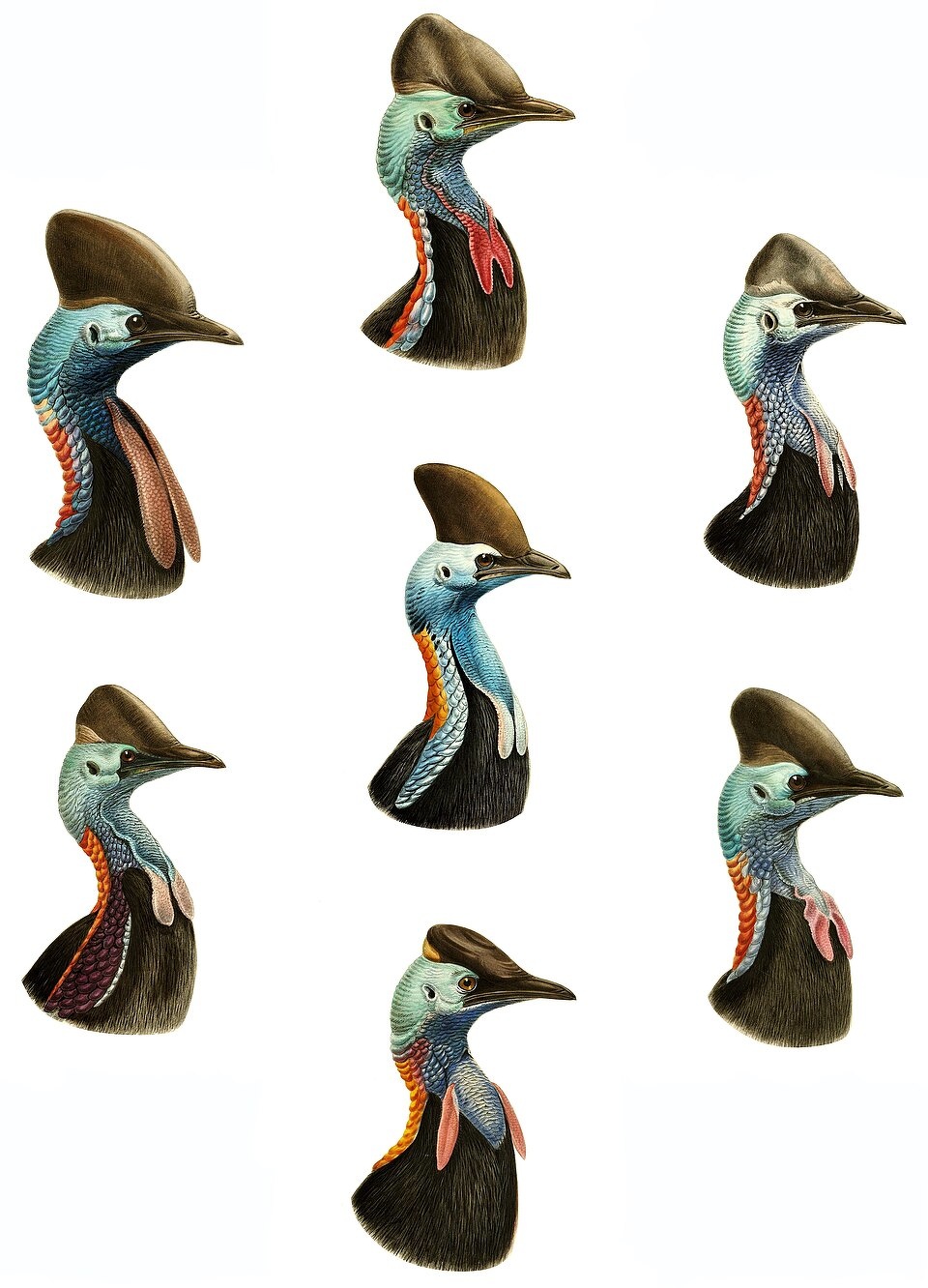
Head diversity of southern cassowaries (1900)
Southern cassowaries are solitary and shy, but they can be aggressive and will occasionally attack humans using their powerful legs to lash out with their large claws. Southern cassowaries have the very small wings and are unable to fly. Instead they rely on their powerful legs for mobility and defense. They can be almost silent while moving slowly through the forest. When alarmed, they are capable of crashing through the forest at high speeds, using the bony casques on the top of their head to push vegetation out of their way. Southern cassowaries are very good swimmers and are also good jumpers.
Southern cassowaries communicate with sound and sense using vision, touch, sound and chemicals usually detected with smell. In the forest they communicate with each other by issuing very loud deep roars which can travel far through the trees and vegetation. These roars are up to 40 decibels louder than the surrounding forest noise, and are at frequencies which are at the very bottom end of what humans can perceive, about 23 Hertz.
Cassowaries are one of the only birds to have been recorded making vocalizations this low. There has been some speculation about whether the casques on their heads are somehow linked to these sounds. The casques could possibly play a role in receiving or producing these sounds. These calls are believed to be mainly for territorial purposes — warning and informing other cassowaries of their presence.
Southern Cassowary Mating, Reproduction and Offspring
Southern cassowaries are polyandrous, with females mating with several males during one mating season, engage in seasonal breeding. Females mate with two to three males during the mating season, which is in the southern winter, from June to July. The number of eggs laid each season ranges from four to eight. The incubation period (time to hatching) ranges from 47 to 61 days. [Source: Dan Hulbert, Animal Diversity Web (ADW) |=|]
The breeding for southern cassowaries season is in winter, when fruit is most abundant. The nest is a pad of vegetation on the ground and there are typically about four bright green eggs in a clutch. Incubation is done exclusively by male. s and , lasts for 47 to 61 days. On average males and females reach sexual or reproductive maturity at age three years.
Female southern cassowaries lay a new set of eggs every time they mate. The courtship ritual consists of the males making a “boo-boo-boo” call while inflating his throat. After the eggs are laid all care of the eggs and offspring are done by males (See Below). Young are precocial. This means they are relatively well-developed when born. independence occurring on average at9 months. Cassowary chicks are brown with black stripes running the length of their bodies for their first three to six months. Juveniles are brown instead of black and have smaller casques. They do not get the vividly colored necks until they are about one year old.
Male Cassowaries and Their Parenting Duties and Chicks
Unlike many animal species, male cassowaries are the primary caregivers for their offspring not females. Males sit on their eggs for about 50 days and once the eggs have hatched, they tend to their chicks for around nine months. Pre-birth and pre-independence provisioning and protecting is done males. Males construct a nest — which is a mat of vegetation — incubate the eggs there for 47 to 61 days. The chicks are dependent on their fathers for protection from predators and for teaching them how to find food for themselves. At around nine months, males abandon the juvenile cassowaries. [Source: Dan Hulbert, Animal Diversity Web (ADW); Hannah Osborne, Live Science, June 14, 2025]
On one southern cassowary family, Olivia Judson wrote in National Geographic: “Dad has a territory near Kuranda, a small town in the hills behind Cairns; he has lived here for at least 30 years. His territory includes a patch of dense forest, a road, and the garden of Cassowary House, a guesthouse where I’m staying for a few days. Despite the summer heat, the bed has an electric blanket — to keep the sheets dry in the sodden rain forest air. And while I sit on a veranda drinking coffee, Dad and his three chicks stroll about below. [Source: Olivia Judson, National Geographic, September 2013]
“Dad’s casque veers off at an angle and looks a bit mangled. His chicks, which are about four weeks old and almost knee-high, make funny whistling-peeping sounds as they run about. He mostly stays silent — but from time to time clacks his bill, making a loud banging noise. He burps too. And occasionally he booms. That is, he tucks his head down low, inflates his neck, and makes a series of low booming noises. As he does this, his feathers puff up. When he sits down, the chicks cuddle up to him, often snuggling into his feathers.
“The chicks have obviously different temperaments. One is adventurous, and wanders far from the family group; sometimes this triggers booming from Dad. Another chick is timid, and keeps close to Dad. This one often seeks its father’s attention. Now and then they touch the tips of their bills together — a cassowary kiss? — but the contact seems to be instigated by the chick, not the father. The chick also picks ticks off its father’s neck and eats them. Yum.
“Dad and the chicks seem to follow a loose routine. They eat in the morning, rest during the hot part of the day, and eat again toward dusk. Sometimes they go for a bath in a creek. A bird of prey — a goshawk — has a nest high in a nearby tree, and often the cassowaries stop underneath to see if any food — a dead lizard or perhaps a snake — has been dropped. If it has, they eat it.
Southern Cassowaries, Humans and Conservation
On the International Union for Conservation of Nature (IUCN) Red List southern cassowaries are listed as Vulnerable. It is also listed as Endangered under the Australian Commonwealth Environment Protection and Biodiversity Conservation Act 1999. In Queensland, the Wet Tropics population is listed as Endangered, while the Cape York populations are listed as Vulnerable.
Southern cassowaries figure prominently in the mythology of some indigenous peoples of New Guinea and Australia. In New Guinea, they have traditionally been captured as chicks or hatched from eggs and raised in villages for their feathers, used in headdresses, and the quills, used as nose ornaments. When the birds reached a certain size they are killed for food and because they become more aggressive and dangerous when they are adult. Chinese residents in the Aru islands feasted on giant cassowary feet along along with antler-marrow stew from deer there. [Source: Dan Hulbert, Animal Diversity Web (ADW) |=|]
The biggest threats to southern cassowaries are destruction, fragmentation and degradation of of their habitats along with introduced predators, collisions with vehicles and hunting. These birds are also sometimes killed by cars. Feral pigs dig up their nests and dogs go after young birds, even adult cassowaries. In Australia, the destruction of their rainforest habitat has largely stopped and in New Guinea there are still large tracts of forest and what goes on there and how many cassowaries are there are largely unknown. |=|
Although they are usually shy, southern cassowaries can be aggressive towards people, especially when kept in captivity or hand-fed by humans. Nesting males or males with chicks can be particularly aggressive. Southern cassowaries have charged people, jumping at them while slashing with their 12 centimeters claws. But despite being labeled by the Guinness Book of World Records as the worlds most dangerous bird cassowaries are rarely seen and prefer to avoid confrontation and people when possible.
Image Sources: Wikimedia Commons
Text Sources: Animal Diversity Web animaldiversity.org , National Geographic, Live Science, Natural History magazine, Australian Museum, David Attenborough books, Australia Geographic, New York Times, Washington Post, Los Angeles Times, Smithsonian magazine, Discover magazine, The Conversation, The New Yorker, Time, BBC, CNN, Reuters, Associated Press, AFP, Lonely Planet Guides, Wikipedia, The Guardian, Top Secret Animal Attack Files website and various books and other publications.
Last updated August 2025