
Home | Category: Animals / Birds, Crocodiles, Snakes and Reptiles
COCKATOOS
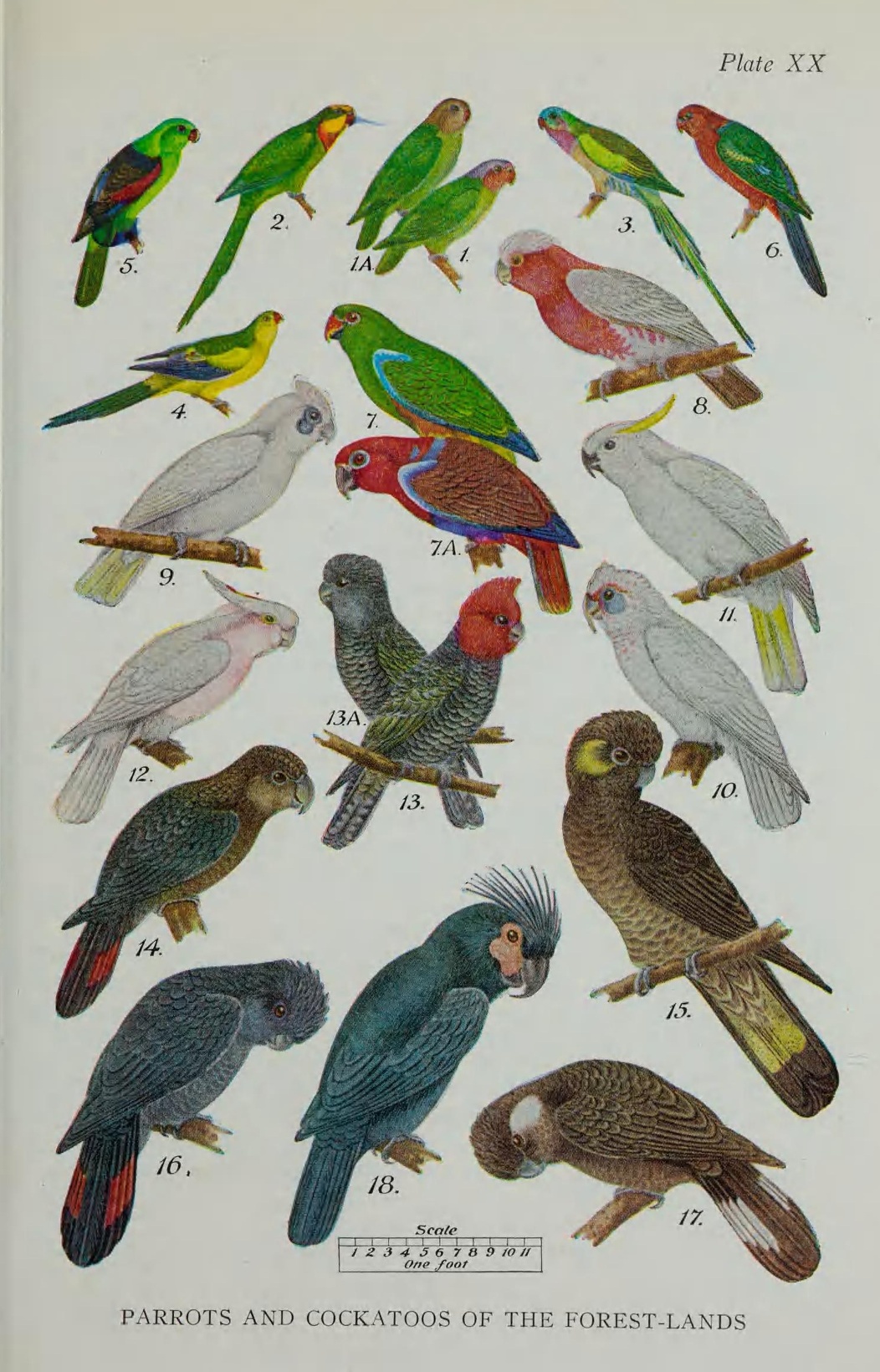
Some cockatoo and Australian parrot species: 1) red-cheeked parrot 2) superb parrot, 3) princess parrot, 4) regent parrot, 5) red-winged parrot, 6) king parrot, 7) red-sided parrot, 8) galah, 9) little correla, 10) corella, 11) white cockatoo, 12) pink cockatoo, 13) gang-gang cockatoo, 14) glossy black cockatoo, 15) yellow-tailed black cockatoo, 16) red-tailed black cockatoo, 17) white-tailed black cockatoo, 18) palm cockatoo
Cockatoos are parrots. There are 21 species of cockatoo and they belong to the family Cacatuidae and superfamily Cacatuoidea. Along with true parrots (Psittacoidea) and large New Zealand parrots (Strigopoidea), they make up the order Psittaciformes. Cockatoos have a mainly Australasian distribution, ranging from the Philippines and the eastern Indonesian islands of Wallacea to New Guinea, the Solomon Islands and Australia.
Cockatoos are identified by their prominent crests and curved bills. Their plumage is generally white, grey, or black — less colourful than that of other parrots — often with coloured features in the crest, cheeks, or tail. Cockatoos are usually large birds — larger than other parrots, with the exception of cockatiels, the smallest cockatoo species, which are medium-sized. Cockatiels are one of the earliest offshoots of the cockatoo lineage. The remaining species are in two main clades: 1) The five large black-coloured cockatoos of the genus Calyptorhynchus; and 2) the 12 species of white-plumaged cockatoos of the genus Cacatua. The three monotypic genera that branched off earlier are the pink and grey galahs, the mainly grey gang-gang cockatoo and the large black-plumaged palm cockatoo.
Cockatoos are monogamous and nest in tree hollows. Some cockatoo species have suffered from habitat loss and degradation. The clearing of large, mature trees has resulted in a shortage of suitable nesting hollows. Competition between cockatoo species for nesting sites is high, and may result in egg or nestling death when cockatoo individuals fight over a nest. Cockatoos play an important role in the dispersal of seeds for many fruit-bearing trees. Many plant species have evolved methods to attract large, fruit-eating birds to enhance and increase the probability of seed dispersal. [Source: Justine Zingsheim, Animal Diversity Web (ADW) |=|]
The word cockatoo dates from the 17th century and is derived from Dutch kaketoe, which in turn is from the Indonesian-Malay kakatua. Seventeenth-century variants include cacato, cockatoon and crockadore. Cokato, cocatore and cocatoo were used in the 18th century
Cockatoos and Humans
According to “The Young Australians Alphabet” from 1871:
C is for COCKATOO
With a gay crest,
He chatters and thinks he is
One of the best”.
Cockatoos are popular pets but they can be difficult to take care of. Cockatiels are the easiest cockatoo species to maintain and is by far the most frequently kept in captivity. White cockatoos are more commonly found in captivity than black cockatoos. The illegal animal has contributed to the decline of some cockatoo species in the wild. Glossy black cockatoos sell for up to $50,000 apiece on the black market. Black palm cockatoo sell for between $12,000 and $20,000. Australia has laws outlawing the commercial exporting of wildlife. Birds are often smuggled into Hong Kong, Singapore, Indonesia, Thailand and Malaysia.
Some cockatoo species have adapted well to human changes and are considered agricultural pests. They take quickly to accepting food from humans and are known for raiding bird feeders and showing up in backyards expecting handouts. They may destroy wood decks, the paneling of houses and chew away at any timber structure to keep their beaks sharp. AFP reported: In some parts of Sydney, locals wake up to see their timber decking looking like the scene of a chainsaw massacre. The cause of the mess? Sulfur-crested cockatoos; birds that chew wood to keep their beak healthy. "They eat fruit from peoples' trees and the wood on verandahs and window sills," explains Kris French; a member of Birds in Backyards, a conservation programme focusing on birds living in cities. "They usually chew branches of trees," says Adrian Davis, a PhD student at Sydney University studying parrot populations, "but they can adapt quite well to the city and yes; sometimes people get their house chewed." [Source: Remi Noyon, AFP, April 22, 2011]
RELATED ARTICLES:
COCKATOO SPECIES: CHARACTERISTICS, BEHAVIOR AND REPRODUCTION ioa.factsanddetails.com
PARROTS OF AUSTRALIA-NEW GUINEA: SPECIES, COLORS, CHARACTERISTICS, BEHAVIOR ioa.factsanddetails.com
BOWERBIRDS: BOWERS, TYPES, DECORATIONS, COURTSHIP DISPLAYS ioa.factsanddetails.com
BOWERBIRD SPECIES: CHARACTERISTICS, BEHAVIOR AND REPRODUCTION ioa.factsanddetails.com
LYREBIRDS: CHARACTERISTICS, BEHAVIOR AND REPRODUCTION ioa.factsanddetails.com
RIFLEBIRDS (PTILORIS): CHARACTERISTICS, BEHAVIOR, SPECIES, REPRODUCTION ioa.factsanddetails.com
BIRDS OF AUSTRALIA: COMMON, UNUSUAL AND ENDANGERED SPECIES ioa.factsanddetails.com
BLACK SWANS: CHARACTERISTICS, BEHAVIOR AND REPRODUCTION ioa.factsanddetails.com
KINGFISHERS: CHARACTERISTICS, BEHAVIOR AND REPRODUCTION factsanddetails.com
KOOKABURRAS: CHARACTERISTICS, LAUGHING, BEHAVIOR, SPECIES, REPRODUCTION ioa.factsanddetails.com
EMUS: CHARACTERISTICS, BEHAVIOR AND REPRODUCTION ioa.factsanddetails.com
EMUS AND HUMANS: MEAT, OIL, RANCHING AND WARS ioa.factsanddetails.com
CASSOWARIES: HISTORY, CHARACTERISTICS, BEHAVIOR AND REPRODUCTION ioa.factsanddetails.com
CASSOWARIES AND HUMANS: HISTORY, SIDE BY SIDE, ATTACKS ioa.factsanddetails.com
SOUTHERN CASSOWARIES: CHARACTERISTICS, BEHAVIOR AND REPRODUCTION ioa.factsanddetails.com
CASSOWARIES OF NEW GUINEA: SPECIES, WHERE THEY LIVE, WHAT THEY'RE LIKE ioa.factsanddetails.com
LITTLE PENGUINS: CHARACTERISTICS, BEHAVIOR AND REPRODUCTION ioa.factsanddetails.com
BIRDS: THEIR HISTORY, CHARACTERISTICS, COLORS factsanddetails.com ;
BIRD FLIGHT: FEATHERS, WINGS, AERODYNAMICS factsanddetails.com ;
BIRD BEHAVIOR, SONGS, SOUNDS, FLOCKING AND MIGRATING factsanddetails.com
Cockatoo Characteristics

cockatoo range
Cockatoos as we said above are parrot. There are over 400 species of parrot (including macaws and cockatoos). These these birds are found in primarily in tropics of every continent except for Europe and Antarctica. They vary in size from pygmy parrots to three-foot-long hyacinth macaws. Parrots are defined by their powerful hooked beaks and zygodactyl feet, in which the two middle toes point forward and the two outer toes point backwards, which make them agile climbers and graspers. They feed primarily on fruits, nuts and seeds. Most large parrots make their nests in cavities in decaying trees and the loss of these trees has the profound affect on their ability to reproduce.
Cockatoos range in length from 30 to 60 centimeters (one to two feet) and weigh 0.3 to 1.2 kilograms (0.66 to 2.65 pounds), with the exception of cockatiel, which are considerably smaller and slimmer. The movable headcrest, which is present in all cockatoos, is striking in many species. It is raised when the birds land from flying or when they are aroused. Cockatoos share many features with other parrots, including the characteristic curved beak shape and zygodactyl feet mentioned above but differ in the presence of their erectile crest and their lack of the Dyck texture feather composition which causes the bright blues and greens seen in true parrots. [Source: Wikipedia]
Like other parrots, cockatoos have short legs, strong claws, a waddling gait and often use their strong bill as a third limb when climbing through branches. They generally have long broad wings used in rapid flight, and are capable, with speeds up to 70 kilometers per hour (43 miles per hour) being recorded for galahs. The members of the genus Calyptorhynchus and larger white cockatoos, such as the sulphur-crested cockatoo and the pink cockatoo, have shorter, rounder wings and a more leisurely flight.
Cockatoo Plumage, Colors and Feathers
The body plumage of the cockatoos is generally black, grey or white, with the exception of galahs and Major Mitchell's cockatoos which are pinkish in color. Many species have smaller areas of color on their plumage, often yellow, pink and red, usually on the crest or tail. Several species have a brightly coloured bare area around the eye and face known as periophthalmic rings. The large red patch of bare skin of the palm cockatoo is the most extensive and covers some of the face. The plumage of males and females is similar in most species. [Source: Wikipedia]
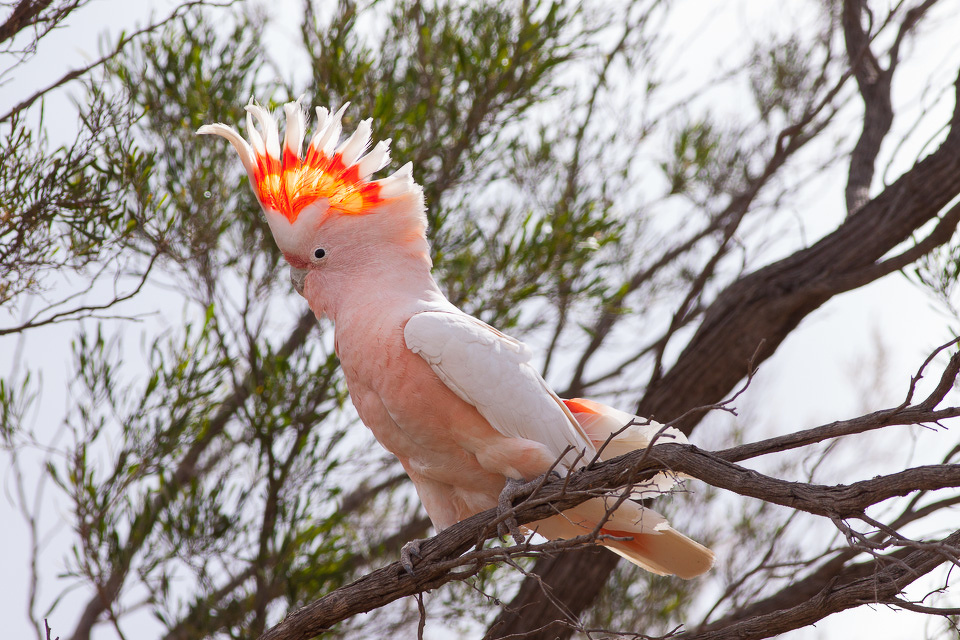
pink cockatoo (Major Mitchell's cockatoo)
Cockatoos maintain their plumage with frequent preening throughout the day. They remove dirt and oil and realign feather barbs by nibbling their feathers. They also preen other birds' feathers, helping them to reach hard to get at places. Cockatoos produce preen-oil from a gland on their lower back and apply it by wiping their plumage with their heads or already oiled feathers. Powder-down is produced by specialised feathers in the lumbar region and distributed by the preening cockatoo all over the plumage.
Moulting is very slow and complex. Black cockatoos appear to replace their flight feathers one at a time, their moult taking two years to complete. This process is much shorter in other species, such as the galah and long-billed corella, which each take around six months to replace all their flight feathers.
Cockatoos — the World’s Longest Living Birds
Sulphur-crested cockatoos hold the record for being the longest-lived bird, with a captive individual named Cocky Bennett reaching 120 years old. He resided at a hotel and is said to have been born in 1796. When died featherless in 1916. His owner made sure an obituary was printed for him. Cocky Bennett traveled around the globe several times with his owner, Captain Ellis on his ship. After the captain died, Cocky was passed on to Ellis’ nephew. Cocky Bennett changed hands a few times, before settling in at the hotel, where he was known as the “Cock of the bar,” for the witty phrases he mimicked. He lost his last feathers twenty years before his death. [Source: Animals A-Z, Zoë Miller,Azmi Haroun, Business Insider, December 25, 2022]
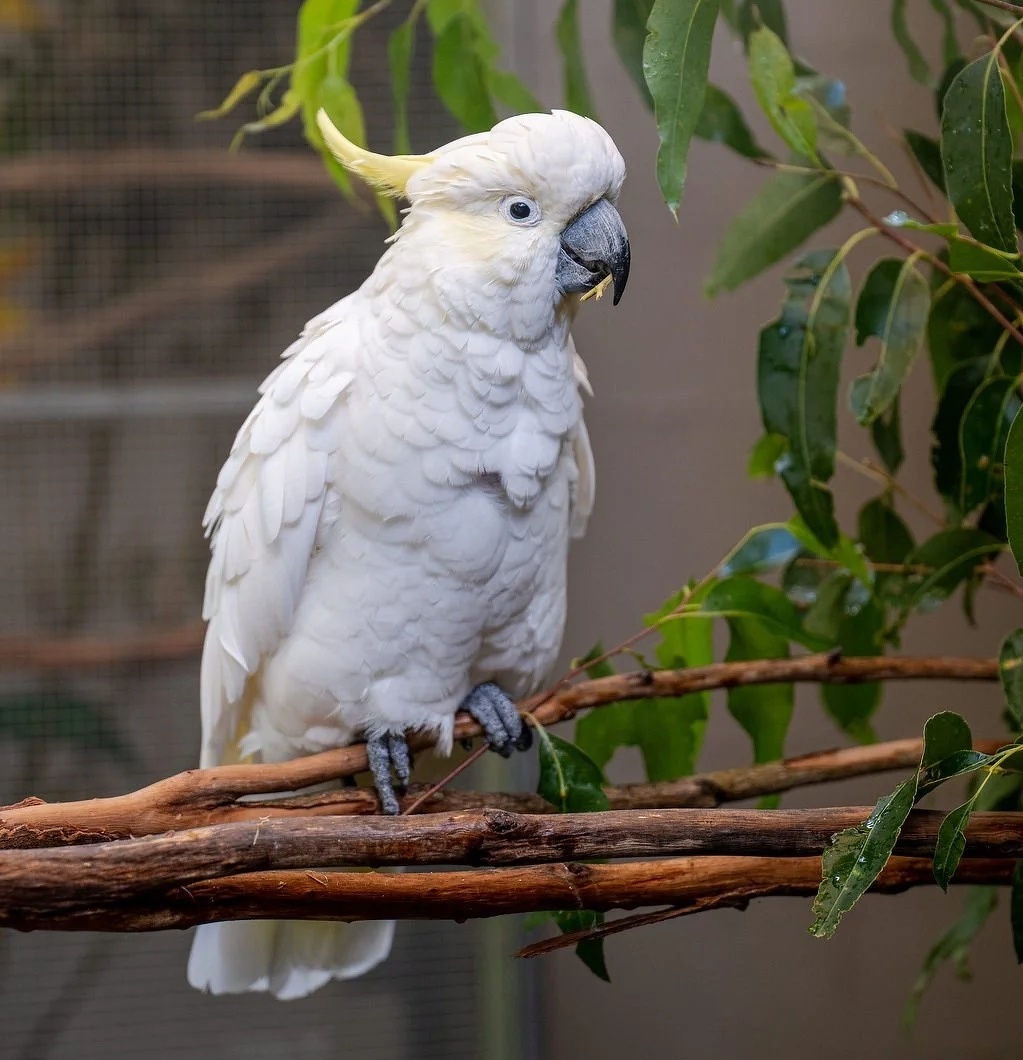
Fred
Fred, a sulfur-crested cockatoo at Bonorong Wildlife Sanctuary in Tasmania, Australia, died in January 2025 at the age, it is said, of 1007 or 108. On November 1, 2014 Fred celebrated his 100th birthday. He received a birthday cake from Queen Elizabeth of England. Despite this, Fred’s exact age isn’t known as he had lived in captivity in several locations across his life. Another a sulphur-crested cockatoo was over 80 years old when it died at the London Zoo in 1982.
Cockatoos and tortoises have been known to live for 100 years or more, Jonathan, a giant tortoise born in the Seychelles islands, is 190 years old. Greenland sharks can live upwards of 400 years. Bowhead whales can live over 200 uears
Cockatoos generally have a lifespan of 60 years, but some have lived for over a century in captivity. Cookie, a pink cockatoo, was also famous for his longevity. He lived to be 83 at Brookfield Zoo outside Chicago, Illinois, and died in 2016. Cookie is the oldest cockatoo recognized by Guinness Book of World Records recognizes as the oldest. Cookie was a male and his birthdate was recorded — June 30, 1933. He was greatly loved and received gifts, letters, and cards from people around the world.
Cockatoo Diet and Feeding Behavior
Cockatoos are versatile feeders, eating range of mainly vegetable food items, including seeds, tubers, corms, fruit and flowers, as well as insects. They often feed in large flocks, particularly when ground-feeding. Seeds make up a large part of the diet of all species, and these are opened with their large and powerful bills. Galahs, corellas and some of the black cockatoos are primarily ground-feeders; others feed mostly in trees. The ground-feeders tend to forage in noisy squabbling groups where seeds are concentrated and dispersed lines where food is more sparsely distributed. They prefer open areas where visibility is good. Western and long-billed corellas have elongated bills that enable them to excavate tubers and roots. Pink cockatoo walks in a circle around the doublegee (Emex australis) to twist out and remove the underground parts.
Tree-feeding cockatoo forage in the canopy of trees, taking advantage of serotiny (the storage of a large supply of seed in cones or gumnuts by plant). These are common in Eucalyptus, Banksia and Hakea trees and are a natural feature of the Australian landscape in dryer regions. These woody fruiting bodies are inaccessible to many species and are harvested by parrots, cockatoos and some rodents. The larger cones can be opened by the large bills of cockatoos but are too strong for smaller animals. Many nuts and fruits are at the end of small branches which can not to support the weight of the foraging cockatoo, which instead bend the branches towards them and and holds them with their foot while eating.
Cockatoos have a large bill, which is kept sharp by rasping the two jaws together when resting, and a large muscular tongue which helps manipulate seeds inside the bill so that they can be de-husked before eating. During the de-husking, the lower jaw applies the pressure, the tongue holds the seed in place and the upper jaw acts as an anvil. The eye region of the skull is reinforced to support muscles which move the jaws sideways. The bills of male cockatoos are generally slightly larger than those of females except with palm cockatoo, where males have a significant;y larger bill.
While some cockatoos are generalists taking a wide range of foods, others are specialists. The glossy black cockatoo specialises in the cones of trees of the genus Allocasuarina, preferring a single species, A. verticillata. Most of the diet of yellow-tailed black cockatoos is made up of insects. The large bill is used in order to extract grubs and larvae from rotting wood. The amount of time cockatoos spend foraging varies with the season. When food is plentiful they may need to feed for only a few hours in the day, in the morning and evening, and spend rest of the day roosting or preening in trees, but during the winter most of the day may be spent foraging. Cockatoos have large crops, which allow them to store and digest food for some time after retiring to a tree.
Cockatoo Behavior
Cockatoos are diurnal (active during the day) and require daylight to find their food. They don’t become active at dawn; instead they wait until the sun has warmed their roosting sites before taking flight to feed. All species are generally social and roost, forage and travel in colorful and noisy flocks. These vary in size depending on availability of food; in times of plenty, flocks are small and number a hundred birds or less, but in droughts or other times when food is hard to come by flocks may contain thousands or even tens of thousands of birds. Once a flock of 32,000 little corellas was recorded in the Kimberley region. . Species that inhabit open country form larger flocks than those of forested areas. [Source: Wikipedia]
Some species require roosting sites that are located near drinking sites; other species travel great distances between the roosting and feeding sites. Cockatoos have several characteristic methods of bathing; they may hang upside down or fly about in the rain or flutter in wet leaves in the canopy. Cockatoos have a preferred "footedness" analogous to human right and left handedness. Most species are left-footed with 87–100 percent of individuals using their left feet to eat, but a few species favor their right foot.
Some pet owners say that parrots and cockatoos are very affectionate birds. Scientists Robert Ridgely says: "When they nuzzle each other in the wild, they're mostly just getting rid of lice." Parrots and cockatoos are often seen hanging upside down from tree limbs, a position they sometimes take to bathe.
Cockatoo Intelligence
Cockatoos are known for being very curious. Pet ones need a steady supply of objects to play with, chew, dismantle and destroy. They can learn new skills through social interaction. In New South Wales, researchers and citizen scientists were able to track the spread of lid-flipping skills as cockatoos learned from each other to open garbage bins. Bin-opening spread more quickly to neighboring suburbs than suburbs further away. In addition, birds in different areas developed their own variants for accomplishing the complex task.
According to Live Science: Cockatoos are particularly intelligent birds, able to use tools, solve puzzles, and even play golf. Sulphur-crested cockatoos they have learned to open trash bins, earning them the nickname "trash parrots." They even manage to outwit humans trying to deter them in what scientists describe as an "innovation arms race." "[Cockatoos] have a playful curiosity," Alice Auersperg, cognitive biologist at the University of Veterinary Medicine Vienna in Austria told Live Science. "They are highly persistent in their object manipulation, and easily reinforced if a behavior turns out to be rewarding." [Source: Olivia Ferrari, Live Science, June 4, 2025]
In 2022, wildlife biologists described a community of wild, sulfur-crested cockatoos in Sydney, that had learned how to open the lids of curbside trash bins on garbage day in order to get at the leftovers inside. A study found that the garbage bin-opening cockatoos were successful in about half their attempts to open the bins. Males appeared to be better at it than females. [Source: Andrew Paul, Popular Science, June 5, 2025]
According to Popular Science: The study’s authors suggest bin lids might necessitate more physical strength from the birds, thus requiring “modifying the cost-reward trade-off for smaller females.” Another possibility is that competition for the limited garbage resources may lead to favoring dominant males. The researchers believe that the trashcan adaptations illustrate how innovation may be a “key mechanism” for certain parrot species to continue adapting in the face of human-induced change.
Cockatoos Learn to Drink from Drinking Fountains
Sulpher-crested cockatoos in Sydney have learned to drink from twist-handle water fountains, turning the knob with their feet and using their body weight to keep he handle down. They even queue on a nearby fence to have a drink, waiting to take turns on the fountain, video footage has revealed. The behavior qualifies as a new local tradition, according to a study published June 4, 2025 in the journal Biology Letters co-authored by Lucy Aplin, a cognitive ecologist at Australian National University, and Barbara Klump, of the Max Planck Institute Institute of Animal Behavior, who analyzed videos of these cockatoos performing their fountain-manipulating skills. [Source: Olivia Ferrari, Live Science, June 4, 2025]
“Overall, these observations showed that individuals operated the drinking fountain using coordinated action with both feet, with one (most often the right) foot on the twist-handle (valve) and one foot gripping the rubber spout (bubbler) or both feet on the valve,” the team wrote in their paper. “The weight of the bird would then be lowered to turn the twist-handle clockwise and keep it from springing back and the head turned to access the flowing water.” After 44 total days of observations, scientists observed the cockatoos attempting to use the drinking fountains 525 times over at least two years. While the cockatoos used several strategies to use the fountains, the most common moves that led to both success and failure were virtually identical. Approximately 41 percent of the birds successfully utilized the fountains. Regular users, marked with the red paint , learned a little better through trial and error, getting the fountain to produce water about 52 percent of the time. [Source: Popular Science Andrew Paul, June 5, 2025]
Olivia Ferrari wrote in Live Science: The research team installed two motion-triggered cameras surrounding one drinking fountain with a rubber top with embedded spout, and a spring-loaded twist handle. "I was not surprised to see that cockatoos in Sydney had learned how to use water fountains," Berenika Mioduszewska, animal cognition researcher at the University of Veterinary Medicine Vienna told Live Science. "These birds are highly curious and manipulative. If the design of a fountain incidentally allows for cockatoo manipulation, it may only be a matter of time before an inquisitive individual starts playing with it and discovers a new source of water."
Aplin said the behavior probably began as an individual innovation, then spread in the local population through observing other birds. But individual cockatoos do have distinct styles in the way they operate the fountain, so while they may have gotten the idea to use the fountain from other birds, they likely worked out the fine details individually through trial and error. "Altogether, this tells us that this behavior is widespread and well established within the local population of birds, with some birds fully knowledgeable, and others still in the process of learning," Aplin said. "That suggests that it has spread to form a local 'drinking tradition' in the area."
It's not completely clear why these birds choose to solve this complex puzzle to drink from water fountains, when other water sources are available. The cockatoos appear to use the drinking fountains as their main source of water, regardless of whether there's a queue. The researchers theorize the birds prefer the taste of the water, or they feel safer from predators at a fountain in an open area with better visibility of potential threats. The research is part of a larger project, the "Clever Cockie Project," which studies how behavioral flexibility could enable cognitively complex species like cockatoos to adapt in cities. "The paper also highlights the importance of persistence and focus: longer attempts at the water fountains, and those made when fewer other cockatoos were present, were significantly more likely to succeed," Mioduszewska said. "It offers a valuable lesson from the cockatoos — when mastering a skill, it is important to keep trying and to minimize distractions whenever possible."
Cockatoo Vocalizations
The vocalisations of cockatoos are loud and harsh. They serve a number of functions, including allowing individuals to recognize one another, alerting others of predators, indicating individual moods, maintaining the cohesion of a flock and as warnings when defending nests. The use of calls and number of specific calls varies by species; the Carnaby's black cockatoo has as many as 15 types of call, whereas others, such as the pink cockatoo, have fewer. Some, like the gang-gang cockatoo, are comparatively quiet but do have softer growling calls when feeding. In addition to vocalisations, palm cockatoos communicate over large distances by drumming on a dead branch with a stick. Cockatoo species also make a characteristic hissing sound when threatened. [Source: Wikipedia]
Some cockatoo can say human words and phrases like parrots. Generally, though, cockatoo are not good at mimicking human speech, with the exception of little corellas that are renowned talker. Some wild cockatoos have picked up human speech from ex-captive birds that joined their a flock. Parrots and cockatoo mimic rather than understand what they say although they are still very intelligent animals. Grey African parrots have shown they can use rudimentary symbols, distinguish colors and perform complicated tasks in the laboratory.
Cockatoos and parrots can make a lot of noise. The frequency of calls acts as a mood indicator with more frequent call characterizing stress. Scientists studying some species of parrot found that at daylight they began screeching and squawking so loud they could be heard three kilometers (two miles) away, and maintained this level the entire day, except for a few hours in the afternoon when they were relatively quiet. Young parrots learn to screen out the noises of other birds and communicate in their own language at an early age. But scientist are not sure what they say. "It doesn't appear to be territorial or connected with sex" one naturalist suggested. "It could be directions, or caution, or saying this or that tree is where the food is".
Cockatoos Know At Least 30 Different Dance Moves
In a study published online in August 2025 in the journal PLoS ONE., Dr. Natasha Lubke of Charles Sturt University and her colleagues analyzed 45 videos posted on social media (YouTube, Facebook, Tik Tok and Instagram) that showed cockatoos dancing. They identified a total of 30 distinct dance movements — 17 of which had not previously been described scientifically. [Source: Science News, August 7, 2025]
Science News reported: These newly-identified dance moves included headbanging, sidesteps and body rolls. The researchers found that some birds also performed their own individual dance moves, often by combining several of the movements in unique ways. Closely related species did not display more similar dances, and each species had a unique top 10 most common dance moves.
Parrots in captivity have been reported to show dance behavior in response to music, which may involve complex cognitive processes including imitation, vocal learning and synchronized, rhythmic movement. Dance behavior in parrots may be indicative of a positive welfare state raising the possibility of using music as a form of environmental enrichment.
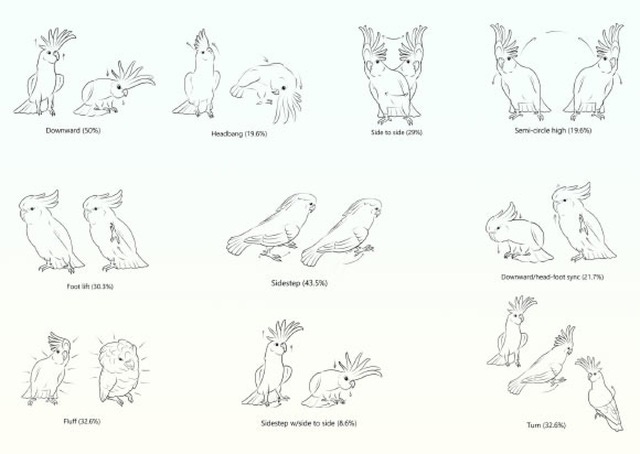
cockatoo dance moves
In the August 2025 study, the scientists also investigated dancing behavior in six cockatoos from three species housed at Wagga Wagga Zoo in Australia. They played the birds music, an audio podcast, or no audio, and found that all birds performed dance moves, regardless of whether music was being played or not. They found that dancing behavior is present in at least 10 out of 21 species of cockatoo. “The similarities with human dancing make it hard to argue against well-developed cognitive and emotional processes in parrots, and playing music to parrots may improve their welfare,” said Charles Sturt University’s Professor Rafael Freire.
Spontaneous dancing in time to music has only been reported in humans and parrots, although some wild birds also display rhythmic movements as part of their courtship displays. However, what motivates captive birds to dance remains unclear. Cockatoos appear to display a wide repertoire of dance moves, many of which are similar to the courtship displays of wild parrots. This suggests that their dancing abilities may have originated as courtship behavior that has been redirected towards their owners.
“By analyzing dance behavior of cockatoos from 45 videos as well as cockatoos at Wagga Wagga Zoo and Aviary, I showed that dancing behavior is more common in cockatoos than previously thought and was seen in 10 of the 21 cockatoo species,” Lubke said. “My analysis also indicated that dancing is far more complex and varied than previously thought, recording 30 different movements seen in multiple birds and a further 17 movements that were seen in only one bird.As well as supporting the presence of positive emotions in birds and advancing dance behavior as an excellent model to study parrot emotions, the work suggests that playing music to parrots may provide a useful approach to enrich their lives in captivity, with positive effects on their welfare.”
Cockatoo Mating, Reproduction and Offspring
Cockatoos are monogamous and pairs can stay together for many years. Many birds pair up in flocks before they reach sexual maturity and delay breeding for a year at least. Females breed for the first time between the ages of three and seven years and males are often older. It has been suggested that sexual maturity is delayed so birds can develop the skills for raising and parenting young, which is takes a long time compared with other birds. Young of some species remain with their parents for up to a year. Courtship is generally simple, particularly for established pairs, with the black cockatoos alone engaging in courtship feeding. Established pairs preen each other, but all forms of courtship disappear when the incubation of eggs begins, possibly due to the strength of the pair-bond.
Like most parrots, cockatoos are cavity nesters, nesting in holes in trees, which they are unable to excavate themselves. These hollows are formed from decay or destruction of wood by branches breaking off, fungi or insects such as termites or even woodpeckers. In many places these holes are scarce and the source of competition, both with other members of the same species and with other species and types of animal. In general, cockatoos choose hollows only a little larger than themselves, hence different-sized species nest in holes of corresponding (and different) sizes. When given the choice, cockatoos prefer nesting over 7 or 8 meters (23 or 26 feet) above the ground and close to water and food. The nesting hollows are lined with sticks, wood chips and branches with leaves. Cockatoos may display site fidelity, returning to the same nesting sites in consecutive years.
Cockatoo eggs are oval and initially white and do become discoloured over the course of incubation. They range in size from 5.5-×-37-centimeters (2.2-×-1.5 inches) for palm and red-tailed black cockatoos, to 2.6-×-19 centimeters (1.0-x-0.75 inches) in cockatiels. Clutch size often varies according to the size of the birds, with palm cockatoo and other larger cockatoos laying a single egg while the smaller species lay between two and eight eggs. Food supply can also play a role in clutch size. Some species can lay a second clutch if the first fails. Around 20 percent of eggs laid are infertile. Depending on the species incubation and brooding duties can undertaken alone by females as is the case of the black cockatoos or can done by by both males and females. Among black cockatoos, females are provisioned by males several times a day.
Cockatoo incubation times are dependent on species size, with smaller cockatiels incubating their eggs for around 20 days and the larger Carnaby's black cockatoo incubating their eggs for up to 29 days. The young of all species are born covered in yellowish down, with the exception of palm cockatoo, whose young are born naked. The nestling period also varies by species size, with larger species having longer nestling periods. It is also affected by season and environmental factors and by competition with siblings in species with clutch sizes greater than one. Much of what is known about the nestling period of some species is dependent studies of captive birds.
Cockatiels can fledge after five weeks and the large palm cockatoos do so after 11 weeks. During this period, young become covered in juvenile plumage while remaining in the hollow. Wings and tail feathers are slow to grow initially but more rapid as the primary feathers appear. Nestlings quickly reach about 80–90 percent of adult weight about two-thirds of the time through this period.
Image Sources: Wikimedia Commons
Text Sources: Animal Diversity Web animaldiversity.org , National Geographic, Live Science, Natural History magazine, Australian Museum, David Attenborough books, Australia Geographic, New York Times, Washington Post, Los Angeles Times, Smithsonian magazine, Discover magazine, The Conversation, The New Yorker, Time, BBC, CNN, Reuters, Associated Press, AFP, Lonely Planet Guides, Wikipedia, The Guardian, Top Secret Animal Attack Files website and various books and other publications.
Last updated August 2025