
Home | Category: Animals / Nature, Environment, Animals / Birds, Crocodiles, Snakes and Reptiles
PARROTS OF AUSTRALIA AND NEW GUINEA
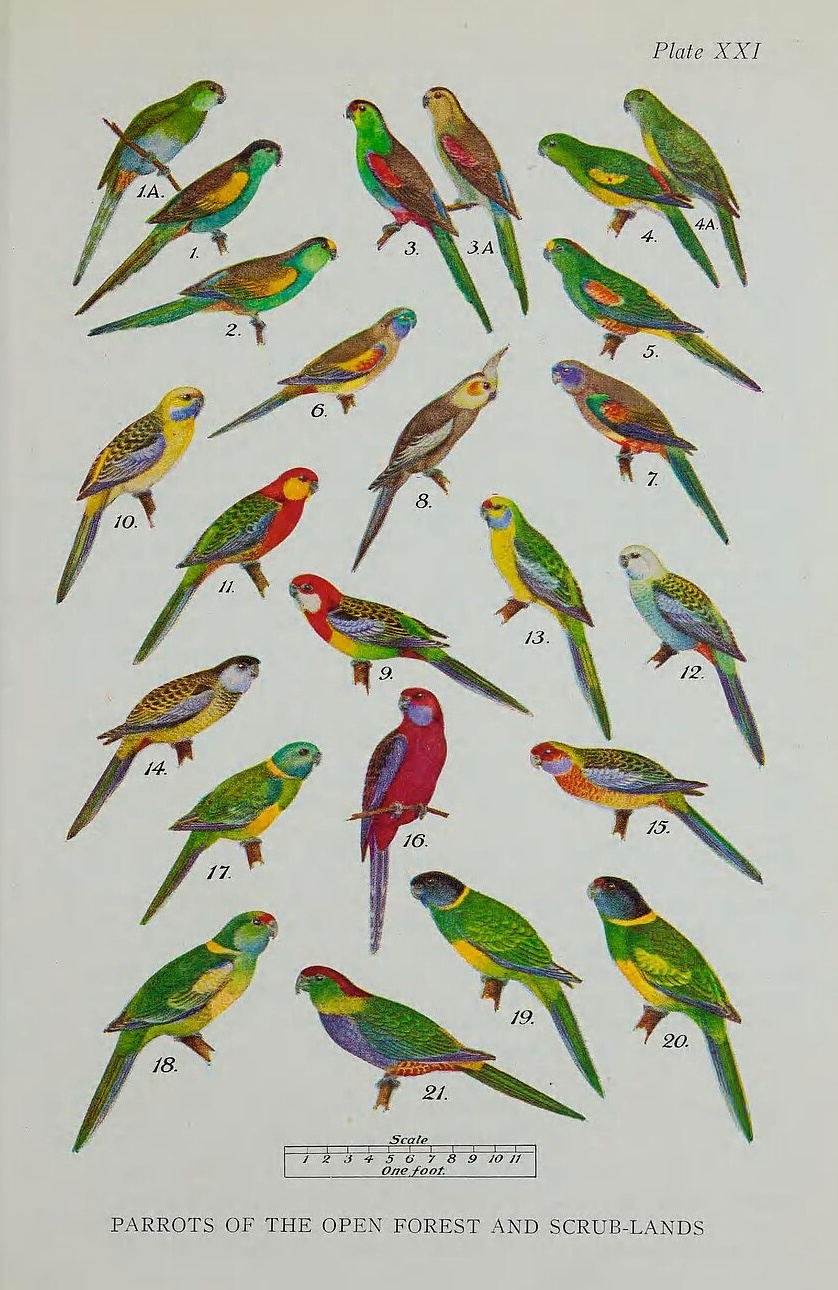
Some parrot species of Australia: 1) hooded parrot, 2) golden-shouldered parrot, 3) paradise parrot, 4) red-backed parrot, 5) mulga parrot, 6) little blue bonnet, 7) blue bonnet, 8) cockatiel, 9) Eastern rosella, 10) yellow rosella, 11) Western rosella, 12) pale-headed rosella, 13) green rosella, 14) northern rosella, 15) Adelaide rosella, 16) crimson rosella, 17) Cloncurry parrot, 18) ringneck parrot, 19) Port Lincoln parrot, 20) twenty-eight parrot, 21) red-capped parrot
Australia is home to 56 to 57 species of parrots, which represent one-sixth of the world's total parrot species. These include various types such as cockatoos, lorikeets, rosellas, and the Budgerigar. Cockatoos are a distinct family, including species like galahs, cockatiels, and sulphur-crested cockatoos. Lorikeets are known for their colors, with rainbow lorikeets being the most vivid and common example. Rosellas are another group. There are seven subspecies of crimson rosella.
The Australian parrot population is divided into two families within the Psittaciformes order: 1) the Cacatuidae (Cockatoo) family, which embraces 21 species, 14 of which, including cockatoos, cockatiels, galahs, and corellas, are found in Australia; and 2) Psittacidae (True Parrots), which has 42 species in Australia including lorikeets and rosellas. Brilliant red-and-green and red-and-blue parrots and crested cockatoos are as common as pigeons in some cities. Rosellas are usually red in color. The red, yellow and blue eastern rosella is common in rural southeast Australia.
New Guinea is also rich in parrots diversity, including the well-known eclectus parrot (known for its male and female color differences), the distinctive Pesquet's parrot and numerous species of cockatoos and pygmy parrots such as buff-faced pygmy parrots. New Guinea — including Papua New Guinea and West Papua and Papua in Indonesia — has around 56 species of parrots. Of these approximately 38 species are endemic to New Guinea and its surrounding areas, meaning they are found nowhere else in the world. Some are also found Australia or have close relatives there.
New Guinea serves as a vital center for parrot biodiversity, with a significant number of species. Pesquet's parrots (Psittrichas fulgidus) are also known as vulturine parrots. A unique species in New Guinea's upland forests, sometimes hunted for its valuable feathers for decoration. Among the cockatoos found on New Guinea are large, black palm cockatoo. Several species of lorikeets and lories make their home in New Guinea including the purple-bellied lory. Some parrot species, like the Vulturine Parrot, are vulnerable due to factors such as hunting for their feathers. Habitat loss and introduced species are also threats to some parrot populations.
RELATED ARTICLES:
COCKATOO SPECIES: CHARACTERISTICS, BEHAVIOR AND REPRODUCTION ioa.factsanddetails.com
COCKATOOS: COLORS, DIET, LONG LIFESPANS, DANCING, VOCALIZATIONS, HUMANS ioa.factsanddetails.com
BOWERBIRDS: BOWERS, TYPES, DECORATIONS, COURTSHIP DISPLAYS ioa.factsanddetails.com
BOWERBIRD SPECIES: CHARACTERISTICS, BEHAVIOR AND REPRODUCTION ioa.factsanddetails.com
LYREBIRDS: CHARACTERISTICS, BEHAVIOR AND REPRODUCTION ioa.factsanddetails.com
RIFLEBIRDS (PTILORIS): CHARACTERISTICS, BEHAVIOR, SPECIES, REPRODUCTION ioa.factsanddetails.com
BIRDS OF AUSTRALIA: COMMON, UNUSUAL AND ENDANGERED SPECIES ioa.factsanddetails.com
BLACK SWANS: CHARACTERISTICS, BEHAVIOR AND REPRODUCTION ioa.factsanddetails.com
KINGFISHERS: CHARACTERISTICS, BEHAVIOR AND REPRODUCTION factsanddetails.com
KOOKABURRAS: CHARACTERISTICS, LAUGHING, BEHAVIOR, SPECIES, REPRODUCTION ioa.factsanddetails.com
EMUS: CHARACTERISTICS, BEHAVIOR AND REPRODUCTION ioa.factsanddetails.com
EMUS AND HUMANS: MEAT, OIL, RANCHING AND WARS ioa.factsanddetails.com
CASSOWARIES: HISTORY, CHARACTERISTICS, BEHAVIOR AND REPRODUCTION ioa.factsanddetails.com
CASSOWARIES AND HUMANS: HISTORY, SIDE BY SIDE, ATTACKS ioa.factsanddetails.com
SOUTHERN CASSOWARIES: CHARACTERISTICS, BEHAVIOR AND REPRODUCTION ioa.factsanddetails.com
CASSOWARIES OF NEW GUINEA: SPECIES, WHERE THEY LIVE, WHAT THEY'RE LIKE ioa.factsanddetails.com
LITTLE PENGUINS: CHARACTERISTICS, BEHAVIOR AND REPRODUCTION ioa.factsanddetails.com
BIRDS: THEIR HISTORY, CHARACTERISTICS, COLORS factsanddetails.com ;
BIRD FLIGHT: FEATHERS, WINGS, AERODYNAMICS factsanddetails.com ;
BIRD BEHAVIOR, SONGS, SOUNDS, FLOCKING AND MIGRATING factsanddetails.com
Lorikeets and Lories
Lorikeets and lories are a members of the parrot family. They have a tongue with little papillae that act as brushes allowing the birds to sweep up nectar, their primary source of food. The majority have very brightly coloured plumage. Lorikeet and lories belong to Loriini, a tribe of small to medium-sized arboreal parrots characterized by their specialized brush-tipped tongues used for feeding on nectar of various blossoms and soft fruits, preferably berries. The species form a monophyletic group within the parrot family Psittaculidae. Traditionally, they were considered a separate subfamily (Loriinae) from the other subfamily (Psittacinae) based on the specialized characteristics, but recent molecular and morphological studies show that the group is positioned in the middle of various other groups. They are widely distributed throughout the Australasian region, including southeastern Asia, Polynesia, Papua New Guinea, Timor Leste and Australia. [Source: Wikipedia]
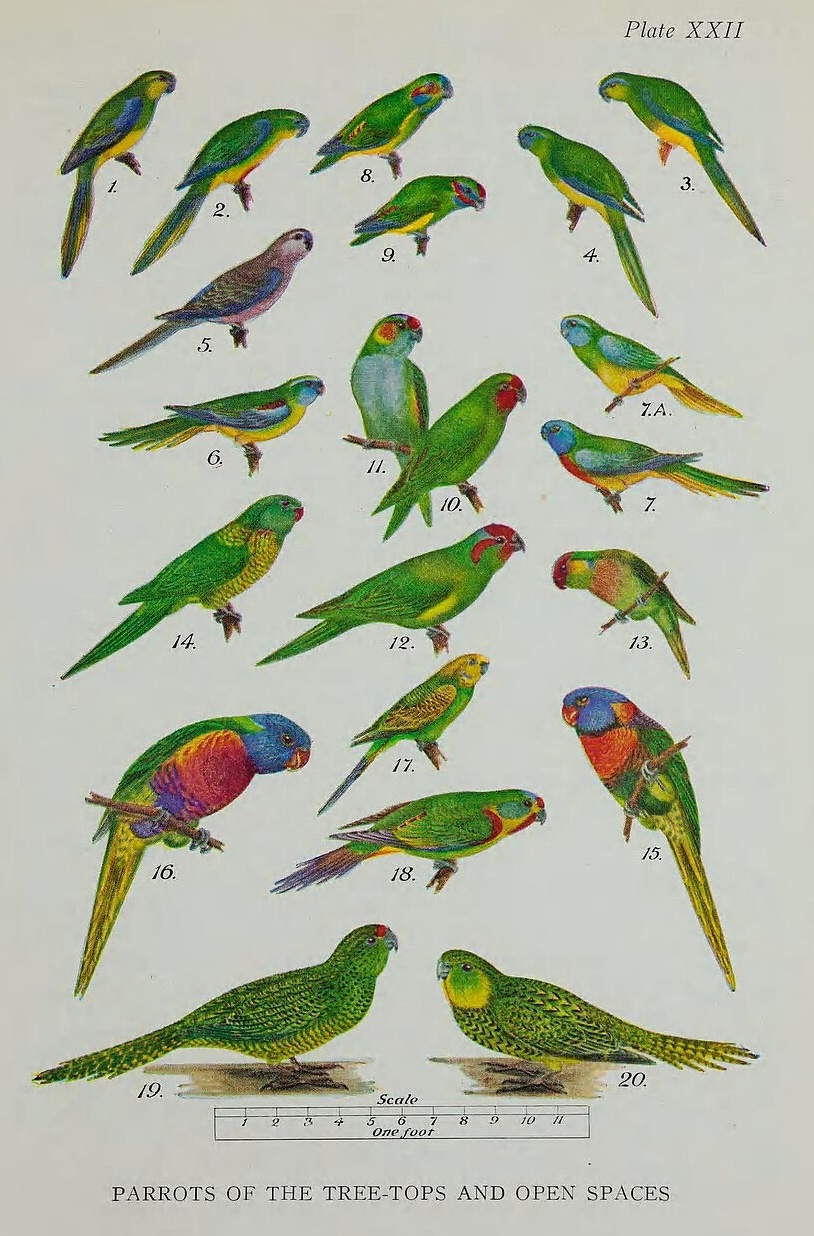
Some lorikeet and parrot species in Australia: 1) blue-winged parrot, 2) orange-breasted parrot, 3) elegant parrot, 4) rock parrot, 5) Bourke parrot, 6) turquoise parrot, 7) scarlet-chested parrot, 8) blue-browed lorilet, 9) red-browed lorilet, 10) little lorikeet, 11) purple-crowned lorikeet, 12) musk lorikeet, 13) varied lorikeet, 14) scaly-breasted lorikeet, 15) red-collared lorikeet, 16) rainbow lorikeet, 17) budgerigar, 18) swift parrot, 19) ground parrot, 20) night parrot
The word "lory" comes from the Malay word “luri” — a name used to describe a number of species of colorful parrots. It first appeared in the West in a 1682 book by the Dutch writer Johan Nieuhof about his travels in the East Indies. The difference between the "lory" and "lorikeet" is subjective, sort of like the difference between of "parrot" and "parakeet". Species with longer tapering tails are generally referred to as "lorikeets", while species with short blunt tails are generally referred to as "lories". In literature a "Lory" famously appears in Chapter III of Lewis Carroll's “Alice's Adventures in Wonderland”. Alice argues with the Lory about its age.
The tribe Loriini contains 61 species divided into 19 genera:
1) Oreopsittacus — Plum-faced lorikeet
2) Charminetta — Pygmy lorikeet
3) Hypocharmosyna — 2 species
4) Charmosynopsis — 2 species
5) Synorhacma — Striated lorikeet
6) Charmosyna — 3 species
7) Charmosynoides — Duchess lorikeet
8) Vini — 11 species
9) Neopsittacus — 2 species
10) Lorius — 6 species
11) Psitteuteles — Varied lorikeet
12) Parvipsitta — 2 species
13) Pseudeos — 2 species
14) Chalcopsitta — 3 species
15) Glossoptilus — Goldie's lorikeet
16) Trichoglossus sensu lato
Glossopsitta — Musk lorikeet
17) Saudareos — 5 species
18) Eos — 6 species
19) Trichoglossus — 10 species
Lorikeets and lories can feed from on flowers of about 5,000 species of plants. Many fruit orchard owners consider them pests because the can amass in large groups groups and strip trees containing fresh fruit. They are also frequent visitors at bird feeders that supply lorikeet-friendly treats, such as store-bought nectar, sunflower seeds, and fruits such as apples, grapes and pears. Occasionally they have been observed feeding on meat.
Most species of lorikeets and lory are plentiful enough so they are classified as species of of least concern on the International Union for Conservation of Nature (IUCN) Red List of Threatened Species. Still, many are threatened and decreasing in number due to deforestation and habitat loss and degradation. Ultramarine lorikeets are endangered and is listed as one of the 50 rarest birds in the world. Blue lorikeets are classified as vulnerable. The introduction of European rats to the small island habitats of these birds is a major threat. Conservation efforts are often focused more on relocating the birds to locations free of predators rather than trying to get ride of the introduced predators.
Rainbow Lorikeets
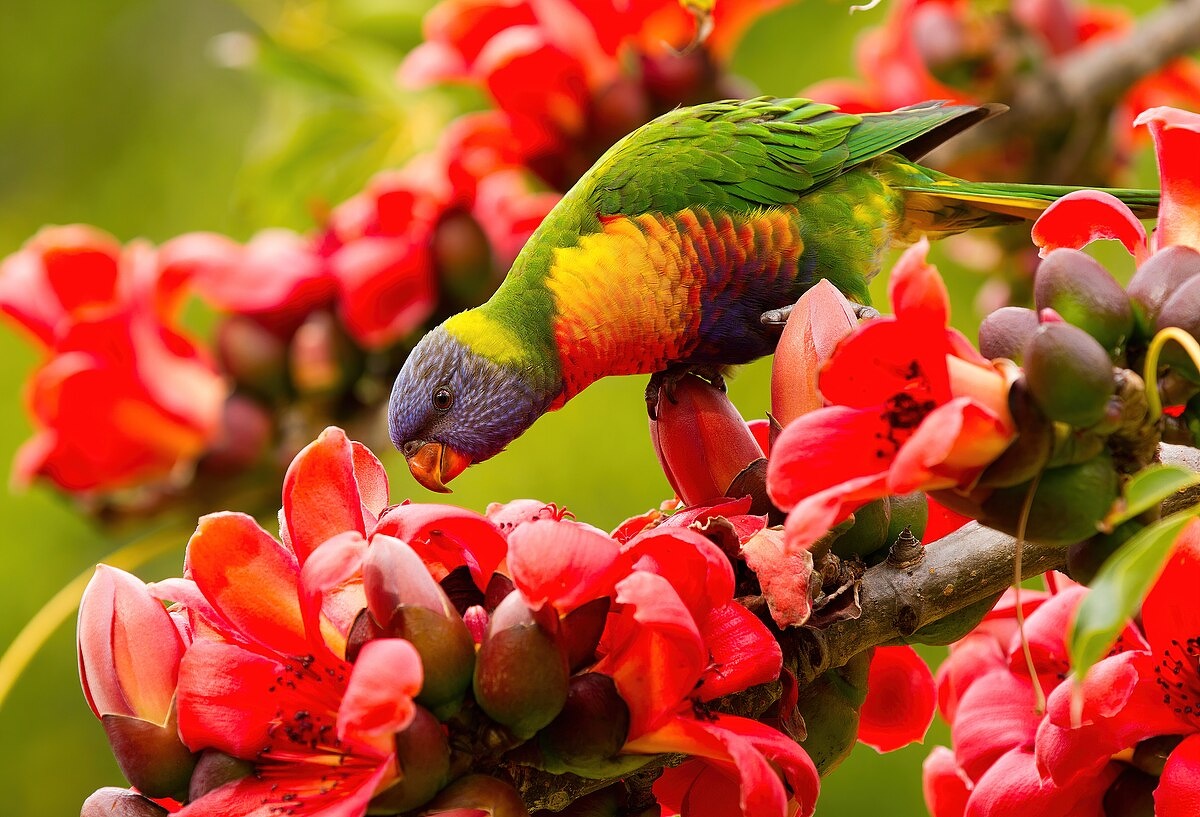
Rainbow lorikeet feeding on nectar from flowers of the red silk cotton tree (Bombax ceiba) in Brisbane, Queensland
Rainbow lorikeets (Trichoglossus moluccanus) are one of the world's most colorful birds. They have red bills, deep blue heads with a greenish-yellow nuchal collar, an orange breast, blue belley green wings, backs and tails, brown lower bodies and yellow legs. The thighs and rump are green. In flight a yellow wing-bar contrasts clearly with the red underwing coverts.
Rainbow lorikeets are species of parrot native in Australia. They are far from threatened and are quite plentiful in many places along the eastern coast, from northern Queensland to South Australia. Their habitat includes rainforest, coastal bush and woodland areas. Rainbow lorikeets have been introduced to Perth, Western Australia; Tasmania; Auckland, New Zealand; and Hong Kong.
Six taxa traditionally listed as subspecies of rainbow lorikeets are now treated as separate species. Red-collared lorikeets (T. rubritorquis) were considered a subspecies of rainbow lorikeets but are now considered a separate species. A review in 1997 led to the recommendation of splitting off some of the most distinctive taxa from the Lesser Sundas (islands in Indonesia east of Bali) as separate species; the scarlet-breasted lorikeet (T. forsteni), the marigold lorikeet (T. capistratus) and the Flores lorikeet (T. weberi). In 2019, rainbow lorikeets in Australia were split into three species: rainbow, coconut (T. haematodus) and red-collared lorikeets (T. rubritorquis). [Source: Wikipedia]
Rainbow lorikeets are medium-sized parrots. They range in length from 25 to 30 centimeters (9.8 to 11.8 inches) including the tail, and weight between 75 to 157 grams (2.6–5.5 ounces). There is little to visually distinguish between the sexes. Juveniles have a black beak, which gradually brightens to orange in the adults. The markings of rainbow lorikeets resemble those the coconut lorikeets (Trichoglossus haematodus), but with a blue belly and a more orange breast with little or no blue-black barring. Unlike eclectus parrots, rainbow lorikeets do not have any obvious dimorphic traits. Males and females look identical, and surgical sexing by a vet or DNA analysis of a feather is used to determine the sex of individuals.
Rainbow Lorikeet Diet, Behavior and Reproduction
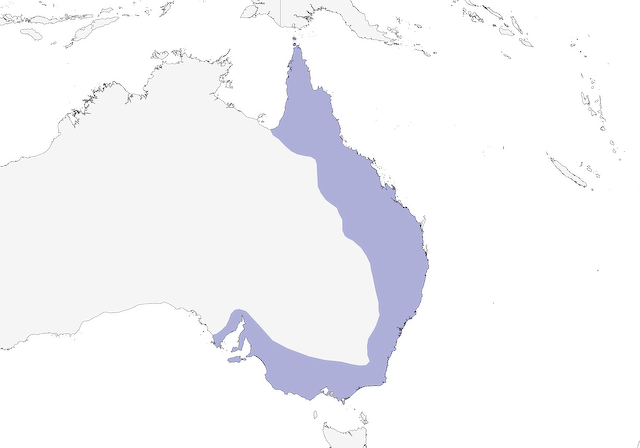
Rainbow lorikeet range
Rainbow lorikeets feed mainly on fruit, pollen and nectar. Their tongue is covered with fleshy hairs that enable them to sweep up nectar in their mouths. These parrots love to feast on the scarlet flowers of the grevillea plant. They also feed on nectar from eucalyptus, Pittosporum, Spathodea campanulata (African tulip-tree), and Metroxylon sagu (sago palm). In Melanesia coconuts are an important food source and rainbow lorikeets are important pollinators of these. They also consume the fruits of Ficus, Trema, Muntingia, as well as papaya and mangoes already opened by fruit bats. In many places, including campsites and suburban gardens, wild lorikeets are so used to humans that they can be hand-fed. The Currumbin Wildlife Sanctuary in Queensland, Australia, is noted for its thousands of lorikeets. Around 8:00am and 4:00pm each day the birds gather in a huge, noisy flock in the park's main area expecting handouts. Visitors are encouraged to feed them a specially prepared nectar, and the birds land on people's arms and heads to consume it. Wild rainbow lorikeets can also be hand-fed by visitors at Lone Pine Koala Sanctuary in Brisbane, Queensland, Australia.
Rainbow lorikeets are mostly monogamous and pair for long periods, often for life. In southern Australia, they usually breed in late winter to early summer (August to January). Elsewhere in Australia, breeding has been recorded in every month except March, varying from region to region due to changes in food availability and climate. Nesting sites vary and can include hollows of tall trees such as eucalypts, palm trunks, or overhanging rocks. Pairs sometimes nest in the same tree with other rainbow lorikeet pairs, or other bird species. Typically one to three eggs are laid, which are incubated for around 25 days. Incubation duties are carried out by the female alone.
Rainbow lorikeets often gather in large cackling groups. They may eat crops such as apples, and raid maize and sorghum fields. Many fruit orchard owners consider them pests. In urban areas, the birds can create a lot of noise and deposit their smelly droppings all over the place. Rainbow lorikeet was accidentally released into the southwest Western Australia near the University of Western Australia in the 1960s and are now regarded as pests. They outcompete come indigenous bird species such as the purple-crowned lorikeet, Carnaby's black cockatoos, for food for increasingly scarce nesting hollows.
Drunken Lorikeets
In 2010, National Geographic reported: A slew of Australian parrots are truly going “down under”. Red-collared lorikeets have been found stumbling around, falling off their perches and showing signs similar to human drunkenness. Lisa Hansen, a veterinary surgeon at the Ark Animal hospital told the London Times, “They act quite like a drunken person would. They stumble around and are very uncoordinated.” [Source: National Geographic, June 3, 2010
This is not a new phenomenon, however. Aussies have come to expect the seemingly inebriated parrots each year at the end of Darwin’s wet season, which typically lasts between November and May. In an article about Australia’s monsoons from the November 2004 issue of National Geographic, writer Roff Smith noticed the quirky bird’s drunken habits: The only drunks we saw were rainbow lorikeets, a noisy flock of them, stoned on the overripe and fermenting fruit scattered beneath the huge mango tree that shaded the homestead at Vanrook Station. They chattered incessantly and chased their reflections into windows. Humans, it seems, aren’t the only creatures around here susceptible to a touch of mango madness.
Hansen also told the Times that the birds appear to suffer from headaches, disorientation, and general lethargy (sounds awfully like hangover symptoms) after they have been treated. And what is their treatment you ask? Getting fed sweetened porridge and fresh fruit — the bird equivalent of greasy food the morning after.
But as with humans, the intoxication of these birds is not really a laughing matter. Some take months to recover while others have died from the mysterious illness. This year there have been over 200 birds treated and still no one quite knows what causes their symptoms. Some of the theories include a fermented nectar from a plant in their diet or an unknown virus.
Eclectus Parrots
Eclectus parrots are medium-sized parrot distinguished by the extreme difference in colorations between the sexes, with males being being bright green and females, predominantly red. The difference of colors is so different that scientists long thought there were two different species. Eclectus parrots are found throughout Papua New Guinea and Indonesia, occurring as far east as Sumba and as far west as the Solomon Islands. They also occur parts of Australia. Places where the eclectus parrot have been introduced include Palau, Singapore, Hawaii and the Goram Islands.
Eclectus is a genus of parrot with four known species called eclectus parrots. The four living species of Eclectus parrot (with subspecies) are:
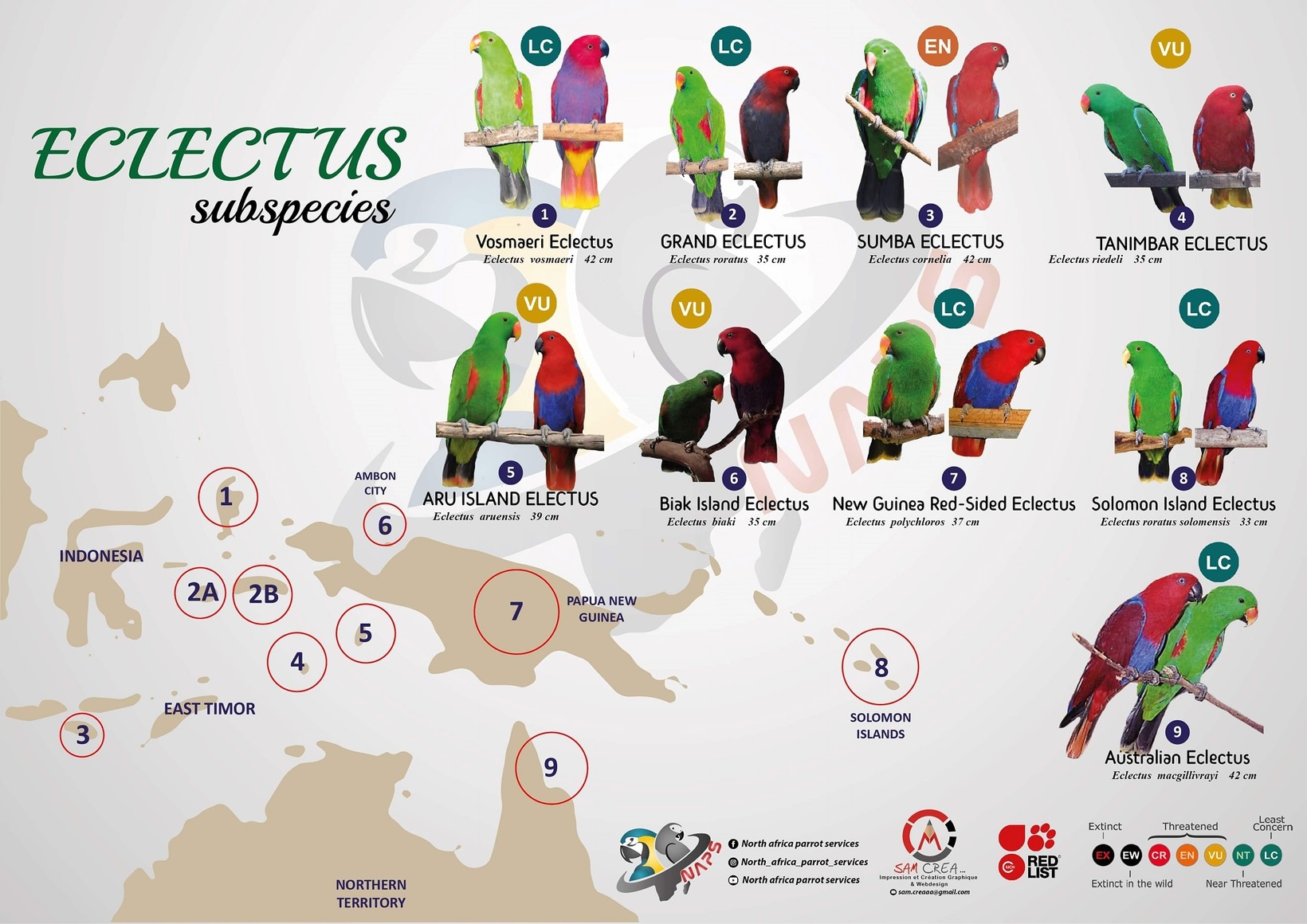
1) Moluccan eclectus (Eclectus roratus) with two living subspecies:
) A) Grand eclectus (Eclectus roratus roratus) lives in central Moluccas including Buru, Seram, Ambon, Haruku and Saparua.
B) Eclectus roratus vosmaeri resides in northern Moluccas including Morotai, Halmahera and Obi. E. r. vosmaeri are larger in size and are more brightly colored with other pronounced yellow markings on the male and female.
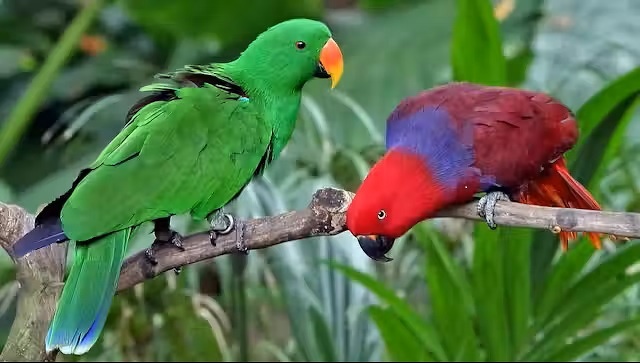
Eclectus parrot male (green) and female (reddish)
2) Sumba eclectus (Eclectus cornelia) is found in Sumba in the Lesser Sunda Archipelago (islands east of Bali). E. r. cornelia is generally larger; males have more green on the dorsal side while females are entirely red with colorful markings.
3) Tanimbar eclectus (Eclectus riedeli) resides in Tanimbar Islands in southern Moluccas. E. r. riedeli is smaller and both male and females have more blue, red, and purple coloring.
4) Papuan eclectus (Eclectus polychloros) with three subspecies.
A) Eclectus polychloros polychloros in southeastern Moluccas including Aru and Kai islands, and New Guinea (including Biak Islands). The former subspecies aruensis and biaki are now included within the nominate subspecies, polychloros. E. r. polychloros is more brightly colored and larger in size. E. r. biaki is larger, these females have more bright red on their neck. E. r. aruensis differ mostly in coloration. The males have more yellow tails, and the females have more red with less black than do Eclectus roratus they are similar to E. r. polychloros.
B) Eclectus polychloros solomonensis is found in the Bismarck Archipelago (including Admiralty islands) and Solomon islands. E. r. solomonesis resemble E. r. polychloros, but have smaller relative size and have smaller beaks, markings on males tend to be more green than yellow.
C) Australian eclectus (Eclectus polychloros macgillivrayi) occurs in Cape York Peninsula and northeast Queensland. E. r. macgillivrayi is like E. r. polychloros but larger. E. r. westermani are now extinct. They were more dull and often considerably smaller.[Source: Wikipedia]
Eclectus parrots typically live in tropical climates in dense rainforests, often near water or coastal areas. They are commonly observed in regions that have tall trees and seek out nests 14 to 22 meters above the ground, usually away from the forest interior. They occur at elevations from 14 to 1000 meters (46 to 3281 feet) at an average elevation of 500 meters (1640 feet). Eclectus parrots are primarily herbivores (eat plants or plants parts) and recognized as folivores (eat leaves), frugivores (eat fruit) granivores (eat seeds and grain) and nectarivores (eat nectar). Among the plant foods they eat are leaves, seeds, grains, nuts, fruit, berries, nectar, leaf buds, blossoms and flowers obtain from the canopies of the forest. Some fruits are cracked open and the pulp is eaten; others provide seeds and nuts. Eclectus parrots feed alone, in pairs, or in large groups. Such foraging choices are often made based on food availability. Eclectus parrots have a hook shaped beak, the upper mandible (lower jaw bone) extending further than the lower. Parrots use this small extension to crack open seeds or to dig pulp out of fruit.
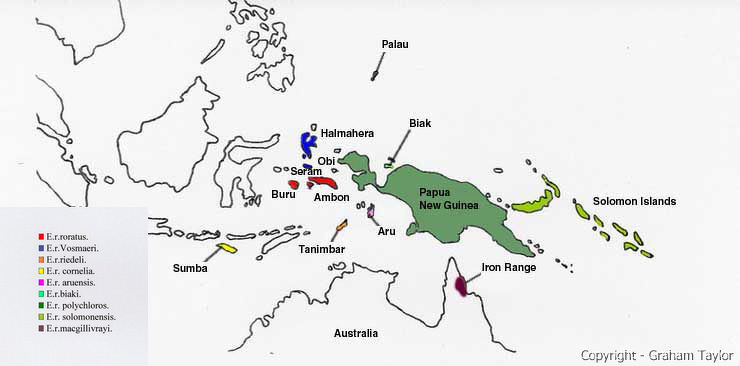
range of Eclectus parrots
On the International Union for Conservation of Nature (IUCN) Red List Eclectus parrots are classified as a species of “Least Concern” although some populations are threatened by habitat loss and degradation. Eclectus parrots do well in captivity, and are a very popular pet across the world. The United States and most other countries only import parrots bred in captivity to prevent illegal hunting and capturing of birds in there native habitats. An effort is also made to prevent accidental or purposeful releasing of previously captive birds into the wild. Eclectus parrots are not regarded as pests in their native range. However, they can be in agricultural pests in places they have been introduced such as Hawaii.
Eclectus Parrot Characteristics and Male-Female Differences
Eclectus parrot range in weight from 500 to 600 grams (1.1 to 1.4 pounds) with a head and body length of 10.5 to 13.3 centimeters (4.1 to 5.2 inches). Their total length, including their tail, about 35 to 42 centimeters (14–17 inches). Their wing length ranges from 22.8 to 24.7 centimeters (9 to 9.72 inches). Eclectus parrots are known to survive and reproduce for up 28 years in captivity. The reported lifespan of Eclectus species varies widely, from around 20 years to more than 60 years. Many owners of eclectus parrots have reported ages up to 45 years, and say the birds show no obvious signs of age-related health decline. [Source: Aretta Jennings, Animal Diversity Web (ADW) |=|; Wikipedia]|
Sexual Dimorphism (differences between males and females) is present: Males are larger than females. Sexes are colored or patterned differently. The head and body of males ranges from 11.5 to 13.3 centimeters (4.7 to 5.3 inches) long. The head and body of females ranges from 10.5 to 11.9 centimeters (4.2 to 4.8 inches) in length. All chicks are hatched with grey down feathers on them. As their feathers start to emerge the sex of the chick can be determined.
While both sexes are similar in size the males tend to be a little larger and the females have brigther plumage. Males are primarily green and quite colorful. They have a yellow tinted crown and blue coloring throughout the primaries. Their wing coverts are red, as are the feathers on the underside of the wing. The tail feathers are shades of green, blue, and yellow-ish white towards the tip. The males have grey legs. Their mandible (lower jaw bone) is coral colored on the top and black on the bottom. Females are noticeably different. They are mostly red, with darker burgundy color on the wing coverts. The breast of the females are dull purple. There are tints on the back and rump. The abdomen of the female is a dull purple, as are the under wing coverts. Their mandible (lower jaw bone) is quite different than the males, being completely black.
Eclectus Parrot Behavior and Communication
Eclectus parrots fly and are arboreal (live mainly in trees), diurnal (active mainly during the daytime), motile (move around as opposed to being stationary), sedentary (remain in the same area), territorial (defend an area within the home range) and social (associates with others of its species; forms social groups). Males will leave the roosting area in search for food. Their average territory size is three square kilometers (1.15 square miles). [Source: Aretta Jennings, Animal Diversity Web (ADW) |=|]
Eclectus parrots are very social birds. They are often seen in flocks, or occasionally alone or in pairs. Female are more timid and often less likely to be seen. This may be due to there being less females than males in a nesting area. Males are seen more often outside of nesting areas than females. It is typical for females to actively look for a hollow to live in because they do not build their own. These birds devote a majority of their time collecting food, eating and resting. While defending their territory they act aggressively and show an open beak as a way of frightening other members of the species. They will often “hide” their beak, in order to say they are backing down from the confrontation.
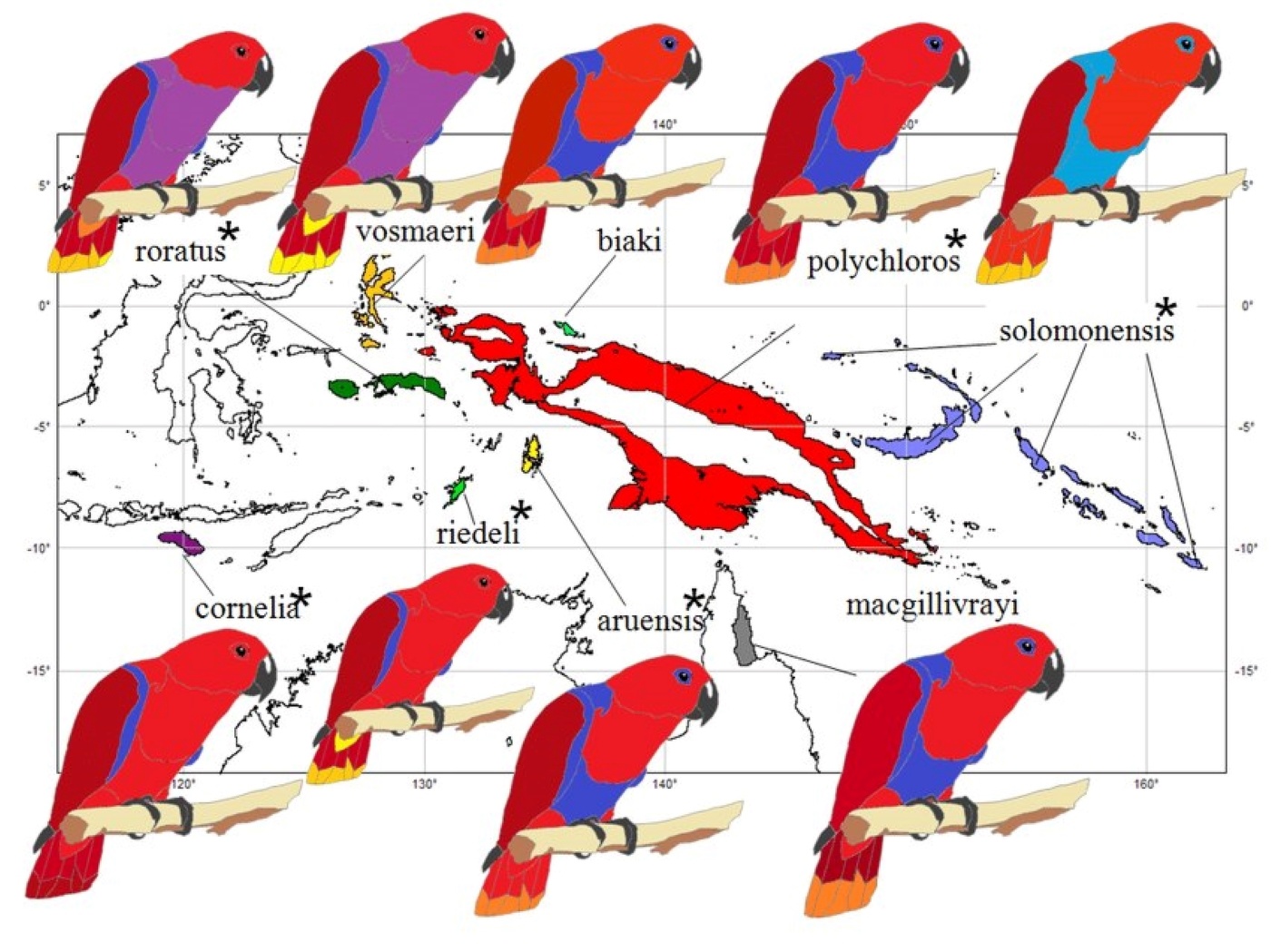
eclectus parrot female species colorations
Eclectus parrots communicate with vision and sound and sense using vision, touch, sound and chemicals usually detected with smell. Eclectus parrots are known fore being loud, noisy birds. They often make calls during flight and while roosting. They screech they make repeatedly when in the air has been described as sounding like “krraach-krraak” Cries and soft whistle-like sounds are heard during feeding. Both sexes have been observed making a “chee-ong” sound, often when they are paired. There are no observed defense sounds. Eclectus parrots use sensitivity to ultraviolet wavelengths to identify mates. They may use this in the acceptance and rejection of eggs as well. While feeding they are more alert and can detect changes in the immediate area they occupy. When they flock they engage in social facilitation — using certain physical ques to create a uniform group.
Eclectus Parrot Mating, Reproduction and Offspring
Eclectus parrots are polyandrous, with females mating with several males during one mating season, and polygynandrous (promiscuous), with both males and females having multiple partners. The long breeding season extends from April to December. In northern parts of their range the breeding season may be from May to January. Further south it may be from March to November. The number of eggs laid each season ranges from zero to three, with average being two. The average time to hatching (incubation time) is 28 days. Parental care is provided by both females and males. The average fledging age is 13 weeks and the average time to independence is six months. On average males and females reach sexual or reproductive maturity at three years of age. [Source: Aretta Jennings, Animal Diversity Web (ADW) |=|]
A group of eclectus parrots in a given area may consist of more males than females, due to female competition for dry hollows. Eclectus parrots tend to polyandrous when only one female inhabits an area with multiple males. They are more likely to be polygynandrous when there are multiple females in an area. Males and females compete during the breeding season for different reasons. Females may challenge one another over nesting sites. A majority of their time is spent being pregnant and incubating their eggs. They try to choose a nesting site with lots of food resources nearby. Males spend their time trying to attract mates. Females may sit at the opening of their nesting site — usually a hollow in a tree — and show the bright red feathers of the underwing. Males typically bring food to females who are nesting and focus more attention on females displaying their bright red feather. To get the attention of females, males have plumage with special UV coloration which is attractive to females. Most parrots are bonded before their mating. Foreplay consists of preening each other, bowing and wing-flapping.
Eclectus parrots like to nest in the hollows of tall trees — with nest sites being 14 to 22 meters above the ground, typically away from the forest interior. The nests tend to have an entrance that is 25-30 centimeters (10 to 15 inches) in length and anywhere from 60 centimeters to 300 centimeters (two to 10 feet( in depth. Eclectus parrots often choose nest locations based on resource availability and whether or not they have a high chance of a predator interference during feeding.
Females often incubate eggs while multiple males provide them with food and protection. This is because females may mate with multiple males in their nesting group. They are cooperative breeders. Females incubate the eggs until they hatch and stay with the chicks until they fledge, after which they are looked after by males in the nesting group, with females making frequent visits to the nest. Females invest more time in raising young than males, but males are the more abundant in the group than are females. Females are said to be able to manipulate the sex of their hatchling. Often there are multiple breeding seasons in a row in which females produce offspring of only one sex.
Australian King Parrots
Australian king parrot (Alisterus scapularis) are species of parrot endemic to eastern Australia, ranging from Cooktown in Queensland to Port Campbell in Victoria. Like Eclectus parrots, they are known for the extreme colorations differences between the sexes, except the males are mostly red and the females are green. These birds are usually found in humid and heavily forested upland regions in eucalyptus woods in and areas adjacent to subtropical and temperate rainforest. They feed on fruits and seeds gathered from trees or on the ground. There are subspecies are which are differentiated by size: 1) A. s. minor and 2) A. s. scapularis. A. s. minor are found at the northern limit of the species range and about 5 centimeters (2 inches) smaller in length. Naturally occurring hybrids with the red-winged parrots have been recorded from Bell in southeastern Queensland. "Australian king parrot" is the official name by the International Ornithologists' Union (IOC). [Source: Wikipedia]
Adult Australian king parrots of both sexes are about 43 centimeters (17 inches) in length, including their long, broad tail. Females have a a green head and breast, a grey beak. Males have a red head, breast, and lower undersides, with a blue band on the back of the neck between the red above and green on the back, the wings are green and each has a pale green shoulder band, the tail is green, and the rump is blue. The male has a reddish-orange upper mandible with a black tip, a black lower mandible with an orange base, and yellow irises. Juveniles of both sexes have brown irises and a yellowish beak, and otherwise resemble the female.[4]
Australian king parrots are frequently seen in small groups with various species of rosella. In Australia, king parrots are occasionally bred in aviaries and kept as calm and relatively quiet household pets if hand-raised. As pets, they have limited "talking" ability and normally prefer not to be handled, but they do bond readily to people and can be very devoted. They tend to be selective in their choice of seeds that they eat, preferring black sunflower seeds and tend not to ingest small seeds found in pre-packaged retail bags.
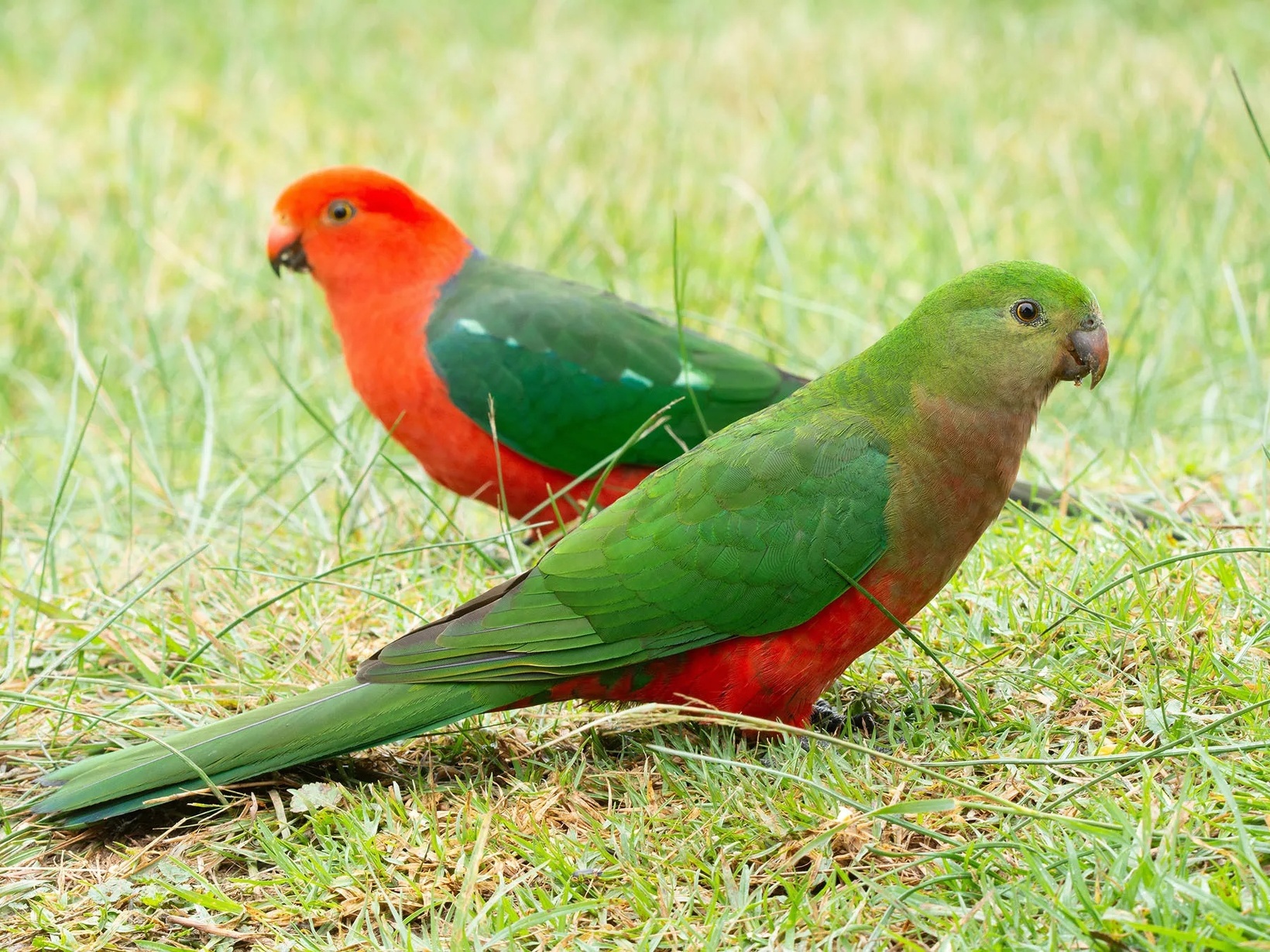
Australian king parrots: female (front); male (back)
Australian king parrots are relatively unknown outside Australia. Life expectancy in the wild is unknown, but some pets have been known to live up to 25 years. King parrots are near the bottom of the pecking order. At a food source of seeds, the approximate order is as follows: cockatoo, rainbow lorikeet, magpie, corella, galah, king parrot, crimson rosella.
Princess Parrots
Princess parrots (Polytelis alexandrae) are colorful birds also known as Queen Alexandra parrot Alexandra's parakeet, Princess of Wales parakeet, rose-throated parakeet, and spinifex parrot. Their plumage is mostly green with a pink throat, bluish crown and rump, and bright green shoulders. Found only in central and western Australia, they are nomadic and often seeking acacia trees, their favorite food source, which are found about twenty miles from water. They live in some of the largest and driest deserts in the world — the Great Sandy Desert, the Gibson Desert and the Great Victoria Desert — in open, sandy and dry outback with spinifex, casuarinas and acacia trees, eucalyptus scrubland, and grassland savannah.
Princess parrots are medium-sized parrots, with average weight of 113.4 grams (four ounces) and an average length is 45.7 centimeters (18inches). Their wing length ranges from 15.5 to 16.1 centimeters (6.11 to 6.36 inches). Sexual Dimorphism (differences between males and females) is present: Males are larger than females. Sexes are colored or patterned differently with the male being more colorful. Males have a blue crown with blue-gray on the sides of head, and pink around the chin and throat. Their body is olive-green, and the tops of his wings are bright green with a blue-violet under wing. They have orange eyes, an orange beak and gray legs with pink. Each foot has three black-tipped toes. Females look like males, except their crown is a gray-mauve, their wings are a duller color green, and their tail feathers are shorter than the males'. The wing length of females is about 0.6 centimeters (0.25 inches) shorter than that of males Young are a duller color than their mothers until they are eight to nine months old. At this point the color differences between the males and females start to appear. |=|

princess parrots by Elizabeth Gould (1804–1841)
Princess parrots are herbivores (eat plants or plants parts). Their diet is mainly herbaceous plants low to the ground, and grass seeds. Fruit and blossoms of the acacia are their preferred food. They also eat berries and other seeds. Princess parrots are motile (move around as opposed to being stationary), nomadic (move from place to place, generally within a well-defined range), social (associates with others of its species; forms social groups) and colonial (live together in groups or in close proximity to each other). They are rarely seen by humans. When they are seen they are usually in pairs or small groups of up to fifteen or twenty individuals. They often breed in small colonies. Princess parrots communicate with a "clack-clack" vocalization followed by a clucking sound, which sounds similar to domestic hens. Their call note is a simple whistle. They are mostly quiet and rarely call. They migrate according to seasonal plant growth and in this way this way maintain a year-round food source. They are remarkably tame and easily approached by humans. They may nest in an area and then depart, sometimes not returning for up to twenty years.
Princess parrots engage in seasonal breeding — from September to December. Most parrots are monogamous, During courtship male princess parrots are very aggressive when approaching females. The males stand in an upright position with their head feathers raised, their pupils dilated, their head bobbing up and downs his head and their wings and tail sread as they run back and forth in front of the female. The nests are usually found in holes at the top of high trees, or in holes of eucalyptus tree branches. There is often more than one nesting pair per tree. Nests are composed of fine sawdust/ wood shavings and are lined with small pieces of rotted wood. The average number of eggs laid is five per season. The average time to hatching is three weeks. Only females incubate the eggs. Young are altricial, meaning they are relatively underdeveloped at birth. The average fledging age is two to three months. On average females and males reach sexual or reproductive maturity at age three to five years. After young leave the nest they often accompany their parents but it is very common for them not return to that breeding area for many years. |=|
On the International Union for Conservation of Nature (IUCN) Red List princess parrots are listed as Near Threatened. In CITES (Convention on International Trade in Endangered Species of Wild) they are in Appendix II, which lists species not necessarily threatened with extinction now but that may become so unless trade is closely controlled. Threats to these birds include: habitat modifications, changes in the amounts of water available, changes in burning regimes, introduced predators and introduced competitors.
Dracula Parrots (Pesquet's Parrots)
Pesquet's parrots (Psittrichas fulgidus) are also known as Dracula parrots the vulturine parrots. Endemic to hill and montane rainforests in New Guinea, Pesquet's parrot, they resemble vultures, love to eat figs, flowers and nectar and get their name from their scream-like call that brings to mind vampires.[Source: Lydia Smith, Live Science published April 12, 2025]
Pesquet's parrots are fairly large parrots. They average about 46 centimeters (18 inches) in length and weigh between 0.6 and 0.8 kilograms (1.3 and 1.8 pounds). They can live for around 20 to 40 years. Their plumage is mostly black and dark grey, but they have red feathers around the belly, tail and wings. Adult males have red patches behind their eyes, which distinguishes them from females.
Lydia Smith wrote in Live Science: The species' guttural, rasping screams are very distinct. Unlike the chirps or squawks of typical parrots, the call of the Dracula parrot is a harsh screech that sounds more like a mythical predator than a fruit-eating bird. This unusual sound likely evolved as a way for the birds to communicate across the dense forests of New Guinea, and possibly to deter potential threats.
Dracula parrots often make the unusual noises during flight. This may be to help individuals stay in contact with their flock mates on the wing, especially in areas with thick foliage, where the birds can easily lose sight of one another. Their screams may also serve as territorial signs or With their long, hooked beaks and semi-bald heads, Dracula parrots resemble vultures. But unlike the meat-eating birds of prey, the parrots aren't as bloodthirsty as their nickname suggests. Instead, they're keen fruit-eaters with a particular taste for figs and, occasionally, flowers or nectar. The birds lack feathers on their faces, and this localized baldness is thought to help prevent matting when they're eating messy fruits.
Although little is known about the breeding habits of Dracula parrots, it's thought that they nest in large, hollow trees. They typically mate once a year and lay one or two eggs at a time. Because of their highly prized feathers and the market for captive exotic birds, Dracula parrots have been hunted and are now classed as "vulnerable" on the IUCN Red List of Threatened Species.
Budgerigars
Budgerigars (Melopsittacus undulatus) are also known as budgies and common parakeets. Widespread throughout Australia, they are nomadic flock parakeets that sometimes seen in flocks several thousand strong and are the world's most common caged birds. Their small size, low cost, easy maintenance and ability to mimic human speech helps make them the third most popular pet in the world after dogs and cats. Budgies have been bred in captivity since the 19th century. In both captivity and the wild, budgerigars breed opportunistically and in pairs. Their average lifespan in captivity is 23.9 years.
Budgerigars are small, streamlined parrots with an average weight of 30 grams (1.1ounces) and range between 18 and 20 centimeters (7.1 to 7.9 inches) in length. Their average basal metabolic rate is 0.3035 watts. They are unlikely to be mistaken for any other parrot because of their small size, pointed wings and tails, and distinct plumage patterns wild budgerigars have a yellow forehead, a yellow and black striped head with purple and black markings on the cheeks, a pointed bill whose upper part extends over the lower part, and a yellow throat. Theare the only bird known to use their feet for scratch the undersides of their tail.ccording to ornithologist J. Lee Kavanau, Budgerigars exist in more color varieties than most other species of bird or animal. The scattered colors of their plumage are accentuated in ultra-violet light, especially the sides of their cheeks, which may play a part in the slection of mates. Caged species differ greatly in their plumage color and patterns. [Source: Kelly Sims, Animal Diversity Web (ADW) |=|]
Budgerigars are found across Australia except for coastal areas in the far east and the far southwest. This species has also been introduced to many areas around the world including South Africa, Japan, U.S., Puerto Rico, Switzerland, and New Zealand, however, they have only successfully been established in southwest Florida. In Australia, budgerigars live in semi-arid and sub-humid habitats mainly in the interior of Australia. However, they sometimes can be found in dry grasslands of the southeast.
Budgerigars number in the millions in the wild and in captivity. Because there are so many of them and so many variables can be applied to them they have attarcted the attention of scientists. More is known of their biology than of any other parrot. |=| On the International Union for Conservation of Nature (IUCN) Red List they are classified as a species of “Least Concern”. Their ability to consume a large number of seeds when in flocks makes them a pest in the eyes of farmers. Naturally they tend to plain olive green and but having been bred for so many years in captivity means they now exist in more than 30 major color varieties.
Budgerigar Behavior, Diet and Reproduction
Budgerigars fly and are diurnal (active mainly during the daytime), motile (move around as opposed to being stationary), nomadic (move from place to place, generally within a well-defined range), and social (associates with others of its species; forms social groups). They become active just before sunrise with preening, singing, and movement within trees. After sunrise, the birds fly to the foraging area and feed throughout the day. They do not forage during midday or in extremely hot weather, instead they take shelter in the shade and remain motionless. Towards sundown, they congregate by calling loudly and flying at high speeds around trees. They then return to their roosting site just after sunset and remain at rest until the next morning. Budgerigars aggregate into large flocks and are strongly social. Their grouping allows for greater success in feeding and also helps in protection from predators. There does not seem to be any hierarchy in groups based upon the relatively few battles among individuals, but females are generally more aggressive than males. [Source: Kelly Sims, Animal Diversity Web (ADW) |=|]
Budgerigars are primarily herbivores (eat plants or plants parts) and granivores (eat seeds and grain). Among the plant foods they eat are seeds, grains and nuts. They are very successful ar exploiting limited of food and water resources. They are ground-feeders and thus prefer to take the seeds of grasses and crop plants, particularly spinifex and tall tussock grasses. They first dehull the seed and then swallow it whole or broken. These seeds are extremely energy rich and are equivalent to the caloric content of animal tissue. Therefore, no alternate food source is necessary. Budgerigars are very scheduled in their drinking habits and drink about 5.5 percent of their body weight daily. To meet this requirement they often locate themselves near water holes.
Budgerigars are mostly monogamous (have one mate at a time) but rarely polygynandrous (promiscuous), with both males and females having multiple partners. Breeding can take place during any time of the year but most frequently occurs after the rainy season when seeds are in abundance. Grass seeding is most plentiful in the winter in northern Australia and during the spring and summer in southern Australia. Budgerigars make their nest in pre-existing cavities that are available in fence posts, logs, and Eucalyptus trees. Several nests can be found on the same tree branch three to five meters apart. They fill their nests with decayed wood dust, droppings, and any other soft material available.
Usually around five eggs are laid each season. The average time to hatching is 18 days. Young are altricial, meaning they are relatively underdeveloped at birth. The female chooses the nest site and incubates while the male spends most of the time foraging and feeding himself, his mate and all the chicks until the chicks Parents often have several broods in succession when lots of food is available. On average males and females reach sexual or reproductive maturity at 180 days. Their average lifespan in captivity is 21 years. |=|
Image Sources: Wikimedia Commons
Text Sources: Animal Diversity Web animaldiversity.org , National Geographic, Live Science, Natural History magazine, Australian Museum, David Attenborough books, Australia Geographic, New York Times, Washington Post, Los Angeles Times, Smithsonian magazine, Discover magazine, The Conversation, The New Yorker, Time, BBC, CNN, Reuters, Associated Press, AFP, Lonely Planet Guides, Wikipedia, The Guardian, Top Secret Animal Attack Files website and various books and other publications.
Last updated August 2025