
Home | Category: Animals / Birds, Crocodiles, Snakes and Reptiles
COCKATOO SPECIES
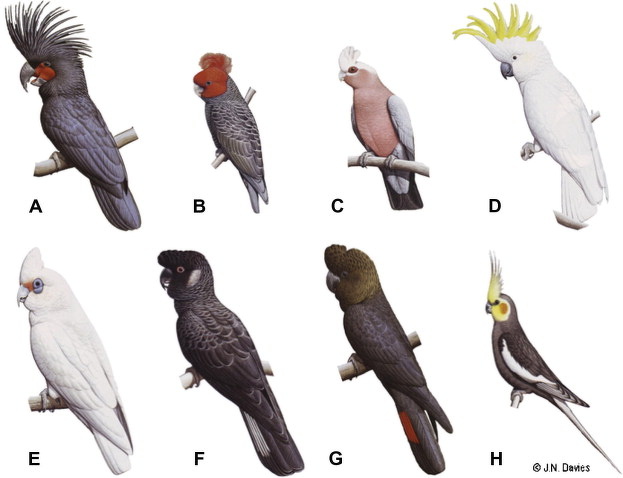
Some cockatoo species: A) Palm cockatoo (Probosciger aterrimus); B) Gang-gang cockatoo (Callocephalon fimbriatum); C) Galah (Eolophus roseicapillus); D) Sulphur-crested cockatoo (Cacatua galerita); E) Western corella (Cacatua pastinator); F) Baudin’s black-cockatoo (Calyptorhynchus baudinii); G) Glossy black-cockatoo (Calyptorhynchus lathami); and H) Cockatiel (Nymphicus hollandicus)
There are 21 species and 44 recognized subspecies of cockatoo in the family Cacatuidae:
Genus Nymphicus
Cockatiel (Nymphicus hollandicus)
Subfamily Calyptorhynchinae: Black cockatoos
Genus Calyptorhynchus — black-and-red cockatoos
Red-tailed black cockatoos (Calyptorhynchus banksii) (5 subspecies)
Glossy black cockatoos (Calyptorhynchus lathami) (3 subspecies)
Genus Zanda – black-and-yellow/white cockatoos)
Yellow-tailed black cockatoos (Zanda funerea) (2–3 subspecies)
Carnaby's black cockatoos (Zanda latirostris)
Baudin's black cockatoos (Zanda baudinii)
Subfamily Cacatuinae
Tribe Microglossini: One genus with one species (the black palm cockatoos.)
Genus Probosciger
Palm cockatoos (Probosciger aterrimus) (4 subspecies)
Tribe Cacatuini: Four genera of white, pink and grey species
Genus Callocephalon
Gang-gang cockatoos (Callocephalon fimbriatum)
Genus Eolophus
Galah (Eolophus roseicapilla) (3 subspecies)
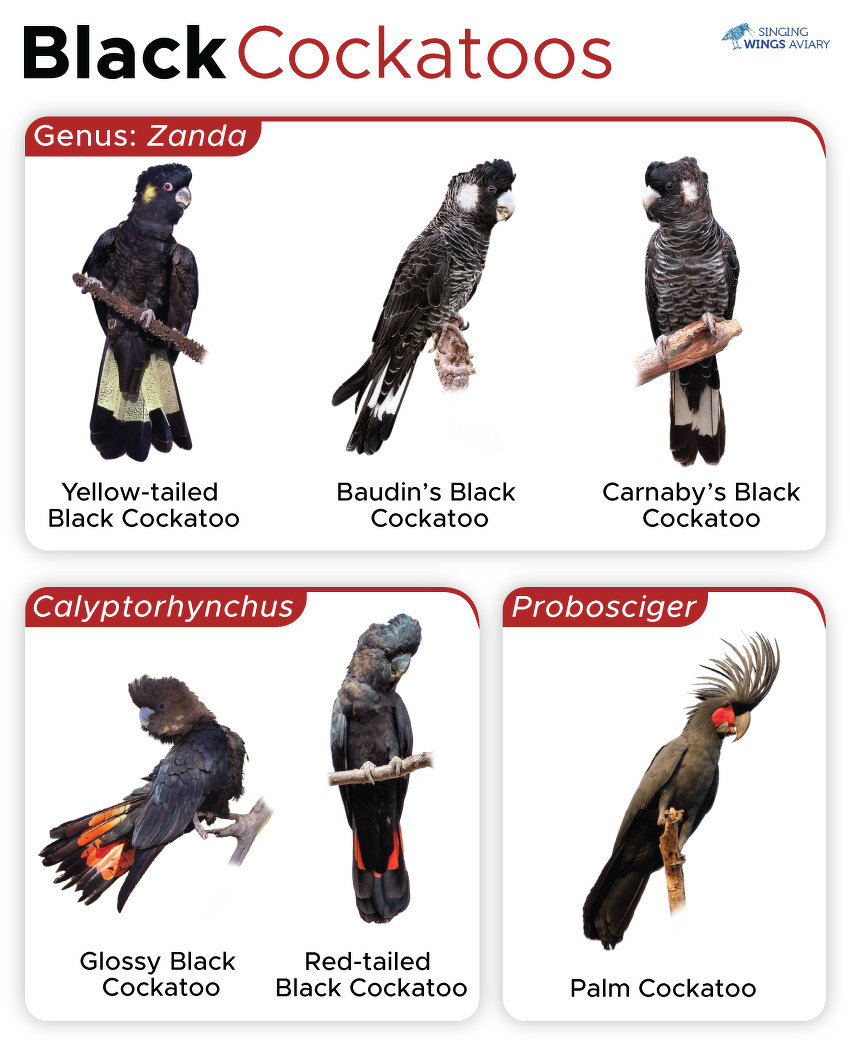
From Singing-Wings-Aviary
Genus Cacatua (13 species)
Subgenus Cacatua – true white cockatoos
Yellow-crested cockatoos (Cacatua sulphurea) are also known as lesser sulphur-crested cockatoos (5 subspecies)
Citron-crested cockatoos (Cacatua citrinocristata)
Sulphur-crested cockatoos (Cacatua galerita) (4 subspecies)
Blue-eyed cockatoos (Cacatua ophthalmica)
White cockatoos (Cacatua alba) are also known as umbrella cockatoos
Salmon-crested cockatoos (Cacatua moluccensis) are also known as Moluccan cockatoos
Subgenus Licmetis – corellas
Long-billed corella (Cacatua tenuirostris)
Western corella (Cacatua pastinator) (2 subspecies)
Little corella (Cacatua sanguinea) are also known as bare-eyed cockatoos (4 subspecies)
Tanimbar corella (Cacatua goffiniana) are also known as Goffin's cockatoos
Solomons cockatoos (Cacatua ducorpsii) are also known as Ducorps's cockatoos
Red-vented cockatoos (Cacatua haematuropygia) are also known as Philippine cockatoos
Subgenus Lophochroa — pink cockatoos
Pink cockatoos (Cacatua leadbeateri) are also known as Major Mitchell's cockatoos and Leadbeater's cockatoos (2 subspecies)
The most marked sexual dimorphism occurs in gang-gang cockatoos and the two species of black cockatoos in the subgenus Calyptorhynchus — red-tailed and glossy black cockatoos. The iris color differs in a few species, being pink or red in the female galah and the pink cockatoo and red-brown in some other female white cockatoo species. The males all have dark brown irises. The Carnaby’s Cockatoo is unique to Western Australia.
The pink and grey galah (pronounced with the stress on the ‘lah’, after quickly saying gal) is one of one most common members of the cockatoo and parrot family seen in Australia. It is large bird with a pinkish-red breast and head and grayish white wings. It sighted all over Australia, often scratching for seeds on the sides of roads. The birds are the sources of several derogatory terms for humans like that “silly galah and “mad as a gumtree full of galahs” — meaning full-on crazy.
RELATED ARTICLES:
COCKATOOS: COLORS, DIET, LONG LIFESPANS, DANCING, VOCALIZATIONS, HUMANS ioa.factsanddetails.com
PARROTS OF AUSTRALIA-NEW GUINEA: SPECIES, COLORS, CHARACTERISTICS, BEHAVIOR ioa.factsanddetails.com
BOWERBIRDS: BOWERS, TYPES, DECORATIONS, COURTSHIP DISPLAYS ioa.factsanddetails.com
BOWERBIRD SPECIES: CHARACTERISTICS, BEHAVIOR AND REPRODUCTION ioa.factsanddetails.com
LYREBIRDS: CHARACTERISTICS, BEHAVIOR AND REPRODUCTION ioa.factsanddetails.com
RIFLEBIRDS (PTILORIS): CHARACTERISTICS, BEHAVIOR, SPECIES, REPRODUCTION ioa.factsanddetails.com
BIRDS OF AUSTRALIA: COMMON, UNUSUAL AND ENDANGERED SPECIES ioa.factsanddetails.com
BLACK SWANS: CHARACTERISTICS, BEHAVIOR AND REPRODUCTION ioa.factsanddetails.com
KINGFISHERS: CHARACTERISTICS, BEHAVIOR AND REPRODUCTION factsanddetails.com
KOOKABURRAS: CHARACTERISTICS, LAUGHING, BEHAVIOR, SPECIES, REPRODUCTION ioa.factsanddetails.com
EMUS: CHARACTERISTICS, BEHAVIOR AND REPRODUCTION ioa.factsanddetails.com
EMUS AND HUMANS: MEAT, OIL, RANCHING AND WARS ioa.factsanddetails.com
CASSOWARIES: HISTORY, CHARACTERISTICS, BEHAVIOR AND REPRODUCTION ioa.factsanddetails.com
CASSOWARIES AND HUMANS: HISTORY, SIDE BY SIDE, ATTACKS ioa.factsanddetails.com
SOUTHERN CASSOWARIES: CHARACTERISTICS, BEHAVIOR AND REPRODUCTION ioa.factsanddetails.com
CASSOWARIES OF NEW GUINEA: SPECIES, WHERE THEY LIVE, WHAT THEY'RE LIKE ioa.factsanddetails.com
LITTLE PENGUINS: CHARACTERISTICS, BEHAVIOR AND REPRODUCTION ioa.factsanddetails.com
BIRDS: THEIR HISTORY, CHARACTERISTICS, COLORS factsanddetails.com ;
BIRD FLIGHT: FEATHERS, WINGS, AERODYNAMICS factsanddetails.com ;
BIRD BEHAVIOR, SONGS, SOUNDS, FLOCKING AND MIGRATING factsanddetails.com
Palm Cockatoos
Palm cockatoos (Probosciger aterrimus) are among the rarest, most valuable and bizarre looking birds in the world. Also known as goliath cockatoos, great black cockatoos and king cockatoos. they are very a large, smoky-grey-black parrots in the cockatoo family, distinguished by a crest of long feathers on the top of their head, prominent bright-red cheek patches and a very large and strong, sharply-hooked black beak.
Palm cockatoos look like a black-bodied red-faced parrots with a cockatoo headdress, They are among the world's most intelligent and rhythmically-inclined birds known for the drumming noise they make by banging a stick against a hollow tree or log whose resonance has been carefully selected. uses it as a drumstick. Their scientific name — Probosciger aterrimus — is derived from the Greek words "proboscis" which means nose and "gero" which means to carry and Latin "aterrimus," meaning very black.
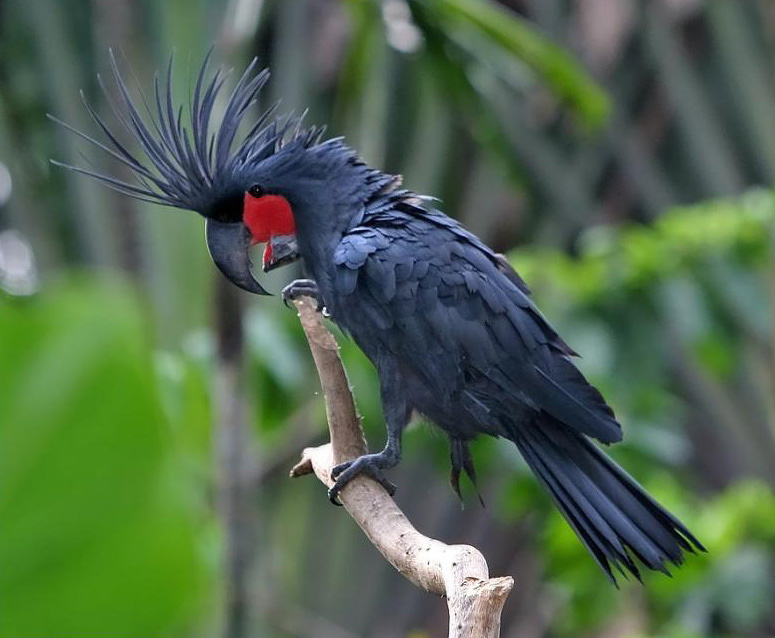
Palm cockatoo
Palm cockatoos are native to New Guinea, the Aru Islands of Indonesia and the Cape York Peninsula in Queensland. The are found in Papua New Guinea and Papua and West Papua in Indonesian New Guinea as well as Misool Isle (Western Papuan Islands) and other islands. There are three subspecies: 1) P. a. atterimus, found in the Misool Isles, Aru Islands, and Northern Australia; 2) P. a. goliath, the largest of the subspecies, found in Papua and West Papua and the Papuan Islands, and 3) P. a. stenolopus, in Papua New Guinea and Papua and West Papua.
Palm cockatoos reside found in rainforests, including gallery forests, forest edges, monsoon woodlands, eucalypt and paperbark woodlands, partly cleared areas, and dense savannas. They nest and roost in large tree. During the day they roost near food or water sources and at night roost in or near a nest tree. They live at elevations up 1300 meters (4265 feet) but are generally found below 750 meters (2,460 feet). [Source: Justine Zingsheim, Animal Diversity Web (ADW) |=|]
On the International Union for Conservation of Nature (IUCN) Red List, palm cockatoos are listed as Near Threatened. CITES (Convention on International Trade in Endangered Species of Wild) places them in Appendix I, which lists species that are the most endangered among CITES-listed animals and plants. Palm cockatoos are threatened by habitat loss and degradation, logging and seasonal fires. Beginning in the 1970s, keeping them as pets became popular, and since then have been targeted for illegal animal trade. On way they have been hunted and captured is by using arrows covered in sticky resin. There are laws with stiff penalties prohibiting the export of palm cockatoo without a permit in Australia. There are also laws in Papua New Guinea and Indonesia but they are more easily ignored or skirted.
Palm Cockatoo Characteristics and Diet
Palm cockatoos are the largest of all parrots. They range in weight from 0.5 to 1.1 kilograms (1.1 to 2.5 pounds) and stand 49 to 68 centimeters (1.6 to 2.2 feet) tall. Their wingspan ranges from .70 to one meter (2.3 to 3.3 feet). Wing length is around 35.1 centimeters (13.8 inches); tail length is 23.8 centimeters (9.4 inches); and bill length is 9.1 centimeters (3.6 inches). Sexual Dimorphism (differences between males and females) is present: Males are larger than females. Females range in weight from .5 to .95 kilograms (1.1 to 2.1 pounds) and males range in weight from .54 to 1.1 kilograms (1.2 to 2.5 pounds). Their strong mandibles (lower jaw bones) used for cracking nuts are larger in males than in females. [Source: Justine Zingsheim, Animal Diversity Web (ADW) |=|]
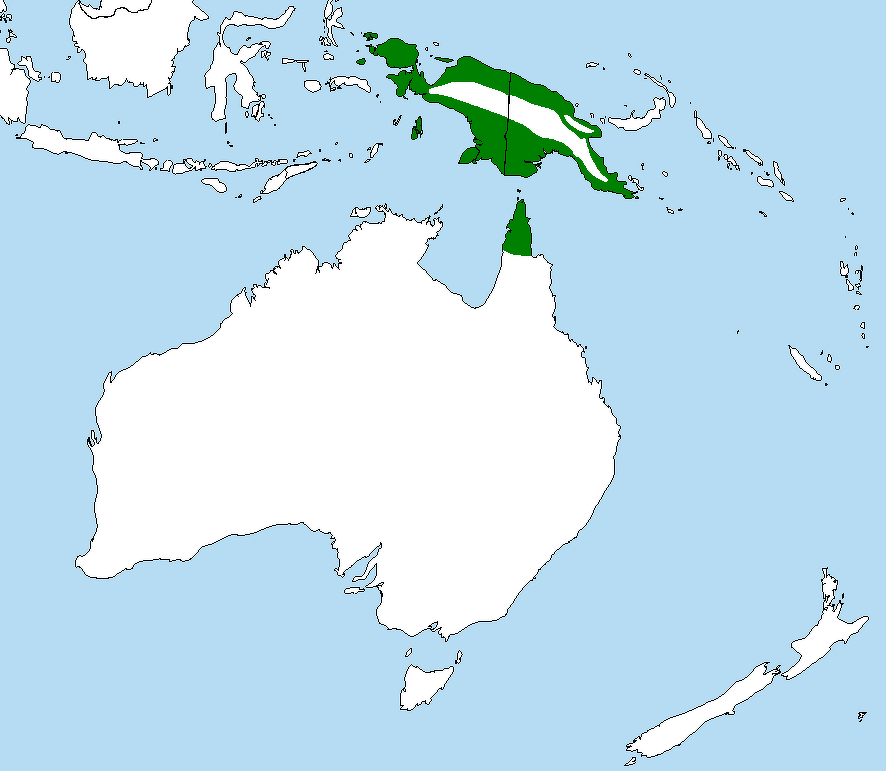
Palm cockatoo range in green
Palm cockatoos are almost all black or very dark smokey grey with a 15-centimeter (six-inch) erectile crest on their head. Their beaks never close completely, always revealing a bit of their black-tipped red tongues. Their mouth configuration makes it easier for the birds to hold nuts in their mouth and crack them at the same time. Their legs are grey-black with few feathers on their thighs. Their red facial markings are their most distinctive characteristic. Their cheek skin changes color based on their health or level of stress. When highly stressed the skin changes to a pinkish-beige color. When they are highly excited the skin changes to yellow. The underfeathers of young birds are lined with a pale yellow and in very young birds (under 18 months old), the tip of the bill and the eye ring are white. Their average lifespan in captivity is 56.3 years. |=|
Palm cockatoos are technically omnivores (eat a variety of things, including plants and animals) but are mainly herbivores (eat plants or plants parts), frugivores (eat fruit) and granivores (eat seeds and grain). They primarily eat leaf buds, seeds, and fruits. They sometimes also eat insects and their larvae. They forage primarily in the forest canopy, but may also forage on the forest floor for fallen fruits and seeds. They crush seeds and hard fruits with their sharp, strong mandibles.
Palm Cockatoo Behavior and Communication
Palm cockatoos fly and are arboreal (live mainly in trees), diurnal (active mainly during the daytime), motile (move around as opposed to being stationary), sedentary (remain in the same area), territorial (defend an area within the home range), and social (associates with others of its species; forms social groups). Palm cockatoos may remain quite close to their nesting sites or travel relatively long distances in search of food or water. They spend a lot of time high in the forest canopy or flying between roosting and foraging areas. Their territory includes several trees with possible nesting sites. These birds tend visit these sites throughout the year for various reasons, increasing the frequency of such visits during the breeding season. Wild and captive palm cockatoos behavior differently. Captive birds may develop compulsive behaviors, such as feather picking. They can also mimic human sounds and language. Wild palm cockatoos are known for being bold and accept food from humans and raid bird feeders. [Source: Justine Zingsheim, Animal Diversity Web (ADW) |=|]
Palm cockatoos are found alone, in pairs, and in larger groups. They are highly social, gathering in groups early in the day in favorite locations where they spend time preening and interacting. When it rains they can be seen hanging upside down with their wings and tails stretched out, taking a makeshift shower. a bath. Palm cockatoos often feed in large groups, where one "sentinel" bird watches out for predators. If a predator or other threat is sensed, the “sentinel” gives an alarm cry to alert the rest of the flock. Confirmed reports of predation on palm cockatoos are rare. Common brushtail possums steal eggs from glossy black cockatoo nests, a close relative of palm cockatoos. Egg predation was found to greatly reduce the population size of the glossy black cockatoos. Arboreal snakes and large birds of prey are also potential nest predators and may take adults. |=|
Palm cockatoos are one of the loudest parrot species. They make loud whistling calls. The most common call heard is the contact call which is a disyllabic whistle. When they are alarmed they produce a sharp, harsh screech. Other calls include grunts, mournful-wailing cries, whistles, and screeches. They also use mimicry and sense using vision, touch, sound and chemicals usually detected with smell.
Palm cockatoos sometimes communicate by stomping noisily on a perch. They are famous for using sticks or nuts to drum against hollow logs and tree, sometimes up to 200 times. This is usually used to advertise territorial boundaries. They may express their moods and stress by erecting their crest and changing their cheek color, which can also be with mood, stress, and can also indicate health.
Palm Cockatoo Mating, Reproduction and Offspring
Palm cockatoos are monogamous (have one mate at a time) and stay together for life. They engage in seasonal breeding — once a year, usually between August and January, but varies with local climate. The average number of eggs per season is one. The incubation time (time to hatching) ranges from 30 to 35 days. Young are altricial, meaning they are relatively underdeveloped at birth. During the pre-birth stage provisioning is done by females and protecting is done by males and females. Pre-weaning provisioning is done by males and protecting is done by males and females. During the pre-independence stage provisioning and protecting are done by males and females. The post-independence period is characterized by the association of offspring with their parents. [Source: Justine Zingsheim, Animal Diversity Web (ADW) |=|]
During the mating season males and females approach each other with wings extended. Before mating the male makes loud whistles and bows several times during which the skin on the face usually become deep red. Sometimes male bang a stick against a tree while calling out, as a territorial gesture near the nesting sight.
Palm cockatoos cannot excavate their own nesting cavities. Instead they use previously hollowed cavities in large trees, such as palms. Their nesting holes tend to be about one meter (3.3 feet) in depth and 25 to 60 centimeters (0.8 to 2 feet) in diameter. They are lined with a pile of broken twigs at the bottom, upon which the egg rests. The same site is often used year after year. Although both parents participate in incubation, females incubate the egg more than males and males spend more of their time foraging for food.
After hatching, chicks are brooded mostly by females. Males also brood the young, but are mainly responsible for finding food. After leaving the nest, the young bird is dependent on the parents for at least another six weeks because of its inability to fly. Young take 100 to 110 days to fledge, the longest period to fledging of any parrot species. The age in which they become independent ranges from 142 to 152 days. After this, the young stays relatively close to the parents until the next breeding season, whereupon the parents evict the previous year's young from their territory. Females and males reach sexual or reproductive maturity at seven to eight years.
Pink Cockatoos

pink cockatoo in flight
Pink cockatoos (Cacatua leadbeateri), also known as Major Mitchell's cockatoo and Leadbeater's cockatoos. They are colorful, medium-sized cockatoo that inhabits arid and semi-arid inland areas across Australia, with the exception of the north east. Pink cockatoos mainly inhabit the interior central and southwest areas of Australia. There are two subspeciess: 1) C. l. leadbeateri can be found in eastern Australia; and 2) C. l. mollis is lives in central and western Australia. Pink cockatoos inhabit arid to semiarid regions, with nearby water sources, in scrublands, wooded grasslands, and savannas but nest in forested areas. They require tall, hollow trees to nest in. They prefer areas with Callitris, Allocasuarina, and Eucalyptus plants for foraging and move from place to place, generally within a well-defined range to locate adequate food resources.[Source: Stephanie Cox, Animal Diversity Web (ADW) |=|]
Pink cockatoos are not endangered or threatened. They are designated a species of least concern on the IUCN Red List. They beautiful and colorful birds, making them an ecotourism draw and sought after as pets. Pink cockatoos populations have declined as a result of habitat loss and fragmentation. Much of their forest habitat has been cleared for farms and agricultural fields. Nesting trees and hollows are in short supply. Pink cockatoos are often reluctant to fly across open, tree-less habitats, and thus vegetation corridors are needed to connect their habitats. The birds are also threatened by humans who illegally collect eggs, chicks, or adults for the pet trade. Pink cockatoos occasionally feeds on agricultural crops. Falcons, eagles, red foxes and cats prey of pink cockatoos.
Pink cockatoos are technically omnivores (eat a variety of things, including plants and animals) but are mainly herbivores (eat plants or plants parts), frugivores (eat fruit) and granivores (eat seeds and grain). Pink cockatoos mainly feed on seeds, nuts, grains, fruits and tubers. They prefer habitats with many trees of the genus Callitris, Allocasuarina, Acacia and Eucalyptus to whose seeds and fruits they consume. They forage both in the trees and on the ground. Their large bills help them crack open thick-shelled nuts and seeds, as well is breaking open tree branches to access insect larvae. These cockatoos have been known to raid farmland and eat grain.
Pink Cockatoo Characteristics and Lifespan
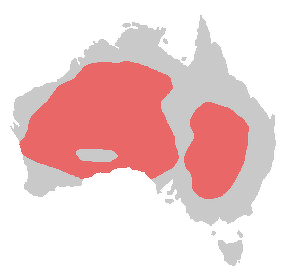
pink cockatoo range in red
Pink cockatoos range in weight from 300 to 450 grams (10.6 ounces to just shy of one pound) and are 35 to 40 centimeters (13.8 to 15.7 inches) long. Their average wingspan is 81 centimeters (31.9 inches). Sexual Dimorphism (differences between males and females) for the most part is not present: Both sexes are roughly equal in size and look similar but females are also slightly smaller. Eye color ranges from dark brown in males to a lighter reddish brown in females. Large males are the most colorful. Female plumage is similar to that of males except is it duller with a white upper belly. Their crest may have a slightly larger yellow band than males. Juveniles resemble females but with even paler plumage, light brown eyes, and duller frontal band. [Source: Stephanie Cox, Animal Diversity Web (ADW) |=|]
Pink cockatoos are distinctively colored. Their back, tail, and wings are white but their breast, head, and stomach can vary in color from pale salmon to robust pink. The underside of the wings and base of the tail are also pink or salmon but often richer and deeper in color. Pink cockatoos are best known for their prominent crest, which is banded red-yellow-red with white tips. Just before the crest is a white patch of plumage with a red frontal band above the bill. The crest’s bands can be used to distinguish the two subspecies. Subspecies C. l. leadbeateri has a more prominent yellow band while subspecies C. l. mollis has little to no yellow in the crest. Pink cockatoos have a very strong bill which is off-white or pale beige in color with a downward curve. Their feet are gray.
Pink cockatoos is a long-lived species. They live to be 50 to 60 years old in the wild. Cookie was famous for his longevity. He lived to be 83 at Brookfield Zoo outside Chicago, Illinois, and died in 2016. Cookie is the oldest cockatoo recognized by Guinness Book of World Records recognizes as the oldest. Cookie was a male and his birthdate was recorded — June 30, 1933. He was greatly loved and received gifts, letters, and cards from people around the world.
Pink Cockatoo Behavior, Communication and Reproduction
Pink cockatoos fly and are arboreal (live mainly in trees), diurnal (active mainly during the daytime), motile (move around as opposed to being stationary), sedentary (remain in the same area), solitary, territorial (defend an area within the home range) and social (associates with others of its species; forms social groups). Nesting pink cockatoos defends a territory of 30 square kilometers (11.6 square miles). [Source: Stephanie Cox, Animal Diversity Web (ADW) |=|]
Breeding pairs are very territorial and do not nest closer than one kilometer to another nesting pair. During the non-breeding season pairs often interact with many other pairs creating flocks of 10 to 50 birds. They can often be seen with other cockatoo species including galahs and little corellas. During the day pink cockatoos can be found on the ground or in trees often foraging for seeds. They are weak fliers. Their flight is slow, labored and at a low altitude flight. When flying long distance, they often fly short distances and rest before taking flight again. Pink cockatoos tend to stay in one general area but engage in local migrations in search of food resources.
Pink cockatoos communicate with vision, touch and sound and sense using vision, touch, sound and chemicals usually detected with smell. They have has a characteristic “creek-ery-cree” call that can be heard over very long distances. They use a a soft contact call, with a frequency of one call per minute, when foraging and even softer calls when it is about to feed its young. Their crest is also used to visually attract a mate, ward off opposing males, and communicate alarm or distress to nearby birds.
Pink cockatoos are monogamous (have one mate at a time) and may mate for life. They engage in seasonal breeding — once a year, with breeding season occuring from August to December, but can begin as early as May in northern populations. The number of eggs laid each season ranges from two to five. The time to hatching ranges from 23 to 30 days. Young are altricial, meaning they are relatively underdeveloped at birth. Parental care is provided by both females and males. During the pre-birth, pre-weaning and pre-independence stages provisioning and protecting are done by males and females. The post-independence period is characterized by the association of offspring with their parents.
Courtship rituals including of visual displays where the male struts while bobbing his head, swaying, and lifting his wings for the female. The female raises her crest and bows in response, and the two softly chatter to each other. If the female accepts him they proceed to allopreen and occasionally feed each other. Mated pairs use allopreening to reinforce their lifelong bond. Pink cockatoos is nest in the cavity of trees — preferably a hollow three to 20 meters above ground in a eucalyptus tree near water. They are unable to excavate new cavities and rely on natural hollows or those constructed by other animals. Both males and females build the nest using bits of wood and pebbles. The same nest is often used year after year.
Young remain in the nest for six to eight weeks before they fledge. Parents, mostly the male, continue to feed fledgelings for eight additional weeks, meaning they become independent at around 16 weeks after birth. Juveniles join their parents to form small, family groups that remain together for some time after the young reach independence. Females and males reach sexual or reproductive maturity at three to four years and males do so at three to four years.
Sulphur-Crested Cockatoos
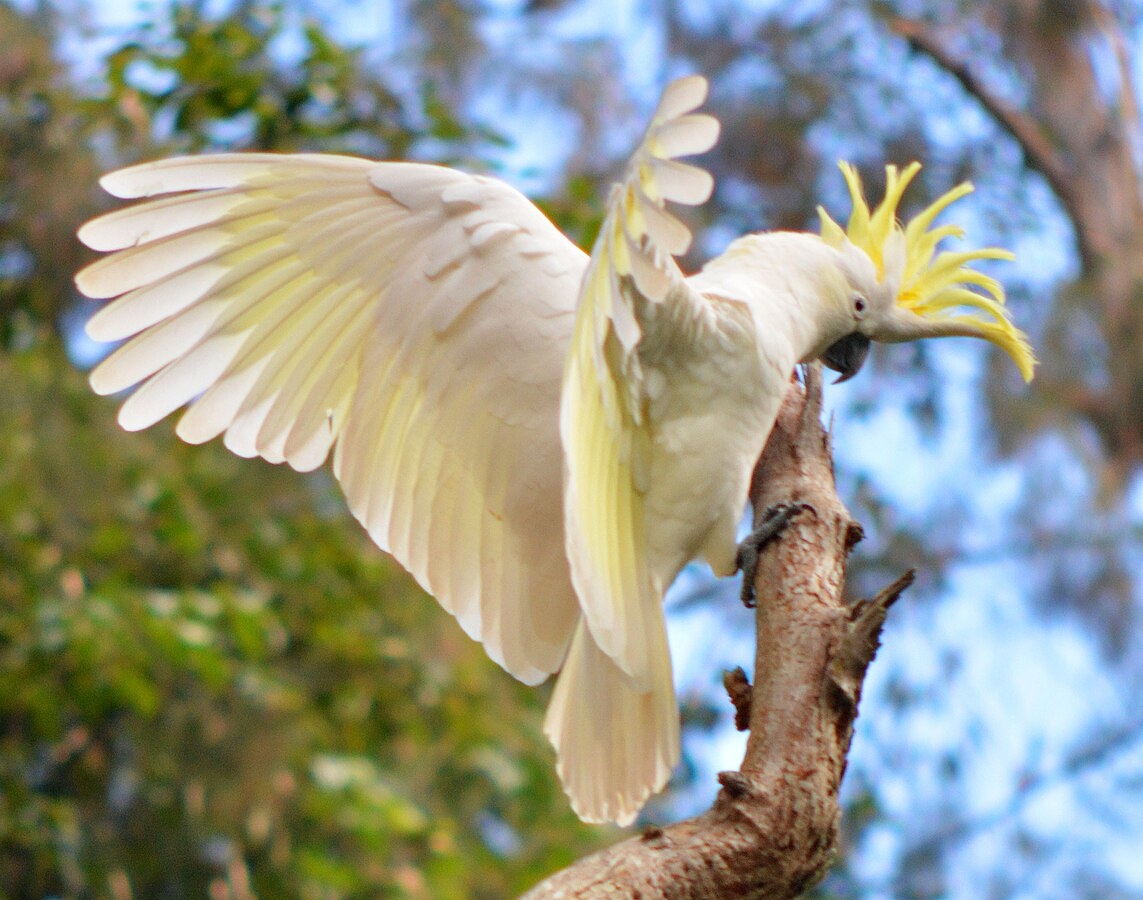
Sulphur-crested cockatoo
Sulphur-crested cockatoos (Cacatua galerita) are relatively large white cockatoos. They are highly intelligent and sought after as pets but are known for being very demanding. Wild ones can be very numerous in some places to the point they are considered pests. Sulphur-crested cockatoos are generally found in wooded area of Australia, New Guinea, and some of the islands of Indonesia. They are plentiful through eastern and northern Australia and have been introduced to western Australia and New Zealand. They are found in temperate forests, scrub forests and tropical and subtropical rainforests at elevations from sea level to 1450 meters (4757.22 feet). They are also occur in the vast savannas of northern Australia and in suburban and urban areas, especially in parks, backyards and gardens. [Source: Kyle Thomas, Animal Diversity Web (ADW) |=|]
There are four recognised subspecies of sulphur-crested cockatoos:
Triton cockatoos (C. g. triton) are found in New Guinea and the surrounding islands
Eleonora cockatoos(C. g. eleonora) are restricted to the Aru Islands in the Maluku province of eastern Indonesia
Mathews cockatoos (C. g. fitzroyi ) live in northern Australia from West Australia to the Gulf of Carpentaria.
Greater sulphur-crested cockatoos (C. g. galerita ) occur from Cape York to Tasmania in eastern Australia
Triton cockatoos and Eleonora cockatoos tend to be smaller than greater sulphur-crested cockatoos. Mathews cockatoos differs from greater sulphur-crested cockatoos by having a pale blue eye ring instead of white; additionally the yellow feathers are slightly darker, and the crest feathers are longer.
Sulphur-crested cockatoos are one world’s longest living animals. They can live for decades in the wild but have reportedly lived over a 100 years in captivity. They are primarily granivores (eat seeds and grain) in the wild, feeding both on the ground and in trees. They also feed on nuts, fruits, blossoms, insects and insect larvae. Sometimes they raid farms and eat newly planted or ripening grain crops. See COCKATOOS: COLORS, DIET, LONG LIFESPANS, DANCING, VOCALIZATIONS, HUMANS ioa.factsanddetails.com
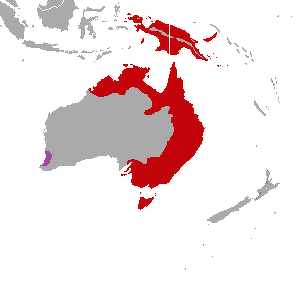
Sulphur-crested cockatoo range
Sulphur-crested cockatoos are not endangered or threatened. They are designated as a species of least concern on the IUCN Red List. Sulphur-crested cockatoos are generally common and abundant. A 2024 estimate by the Victorian government indicated there were around 7.7 million individuals in that Australian state alone. They are so numerous in some crop growing areas that farmers are allowed to get a permit to shoot them. Otherwise its prohibited to hunt, trade of export wild bird in Australia. Sulphur-crested cockatoos can also chew and rip up timber on houses. See COCKATOOS: COLORS, DIET, LONG LIFESPANS, DANCING, VOCALIZATIONS, HUMANS ioa.factsanddetails.com
Sulphur-Crested Cockatoo Characteristics, Behavior and Reproduction
Sulphur-crested cockatoos are large birds. They range in weight from 0.7 to 0.95 kilograms (1.5 to 2.1 pounds), with an average weight is 0.8 kilograms (1.8 pounds). Their average length is 50 centimeters (1.6 feet) and their average wingspan is just over a meter (103 centimeters, 3.4 feet).Their average basal metabolic rate is 3.419 watts. Sulphur-crested cockatoos are white with a distinctive sulphur-yellow crest which can be erected or held folded down on top of head. The underside of their wings and tail is pale yellow. Sexual Dimorphism (differences between males and females) is present: sexes are colored or patterned differently. Males and females have identical plumage but males have darker eyes than the female. Up close females can be identified their red tinted brown eyes. [Source: Kyle Thomas, Animal Diversity Web (ADW) |=|]
Sulphur-crested cockatoos fly and are arboreal (live mainly in trees), flies diurnal (active mainly during the daytime), motile (move around as opposed to being stationary), sedentary (remain in the same area), and social (associates with others of its species; forms social groups). They often form noisy flocks of a dozen to several hundred birds. When foraging for food these large flocks will often split into small groups, coming together again at the evening roost site. Feeding is often done on the ground. When a flock feeds several bird fly in circles or serve as sentries in trees, watching for dangers, while they others concentrate on eating. Predators include powerful owls, red foxes and cats. Sulfur-crested cockatoos generally seek out shelter and shade during the middle of the day, resuming feeding in late afternoon and evening before drinking and returning to roost. Sulphur-crested cockatoos remain in the same general area year round. They may travel long distances to forage but almost always return to their original roost site.
Sulphur-crested cockatoos are noisy birds. They communicate with vision, sound and mimicry and sense using vision, touch, sound and chemicals usually detected with smell. Their primary method of communication it seems is screeching. The distinctive raucous call of sulphur-crested cockatoos is very loud and is designed to travel great distances through the forested environment. The cacophony created by a large flock of sulphur-crested cockatoos can be deafening. These They also use their crests to communicate emotion. They will raise and spread their beautiful crests when they are excited or sense danger and during mating rituals.
Sulpher-crested cockatoos in Sydney have learned to drink from twist-handle water fountains, turning the knob with their feet and using their body weight to keep he handle down. They even queue on a nearby fence to have a drink, waiting to take turns on the fountain, video footage has revealed. See COCKATOOS: COLORS, DIET, LONG LIFESPANS, DANCING, VOCALIZATIONS, HUMANS ioa.factsanddetails.com
Sulphur-crested cockatoos are monogamous (have one mate at a time) and engage in seasonal breeding — breeding once a year between August and January in the southern parts of their range and between May and September in the northern parts of their range. The number of eggs laid each season ranges from two to three. The average time to hatching is 27 days. Young are altricial, meaning they are relatively underdeveloped at birth. During the pre-birth stage provisioning is done by females and protecting is done by males and females. During the pre-weaning and pre-independence stages provisioning and protecting are done by males and females. The post-independence period is characterized by the association of offspring with their parents. The average fledging age is 70 days. On average males and females reach sexual or reproductive maturity at age three to four years.
The courtship ritual of sulphur-crested cockatoos includes raising of the crest, bobbing of the head, and moving the head from side to side in a figure-of-eight pattern while uttering soft chattering notes. Before mating, the birds usually preen each other's plumage. They generally nest in a high tree hollow, usually near water. Both parents incubate the eggs. During the incubation period and six to 10 weeks afterwards both parent birds are very quiet so not to attract predators to their nests. Goannas (monitor lizards) and birds such as pied currawongs, butcherbirds and ravens may feed on eggs, nestlings and fledglings. After the eggs hatch, chicks are fed by both parents. Offspring leave the nest after independence is reached at 70 days but often remain with their parents indefinitely.
Endangered White Cockatoos
White cockatoos (Cacatua alba) are also known as umbrella cockatoos. They are endangered, mostly-white cockatoos endemic to tropical rainforest on islands of eastern Indonesia. They are similar to other species of white cockatoo such as yellow-crested cockatoo, sulphur-crested cockatoo, and salmon-crested cockatoo, all of which have yellow, orange or pink crest feathers instead of white. White cockatoos are mainly found in the North Moluccas of the Maluku province of Indonesia on the islands of Halmahera, Bacan, Ternate, Kasiruta, Tidore, and Mandioli. They have also been seen Obi and Bisa islands but this population is believed to have originated from escaped captive birds, White cockatoos occupy rainforests, open woodland, mangroves, swamps, agricultural areas at elevations of 300 to 900 meters (984 to 2953 feet). and are particularly common around the edge of clearings and rivers. They spend most of their time in the tree canopy and tall secondary vegetation may be their preferred habitat. [Source: Erin Lane, Animal Diversity Web (ADW) |=|]
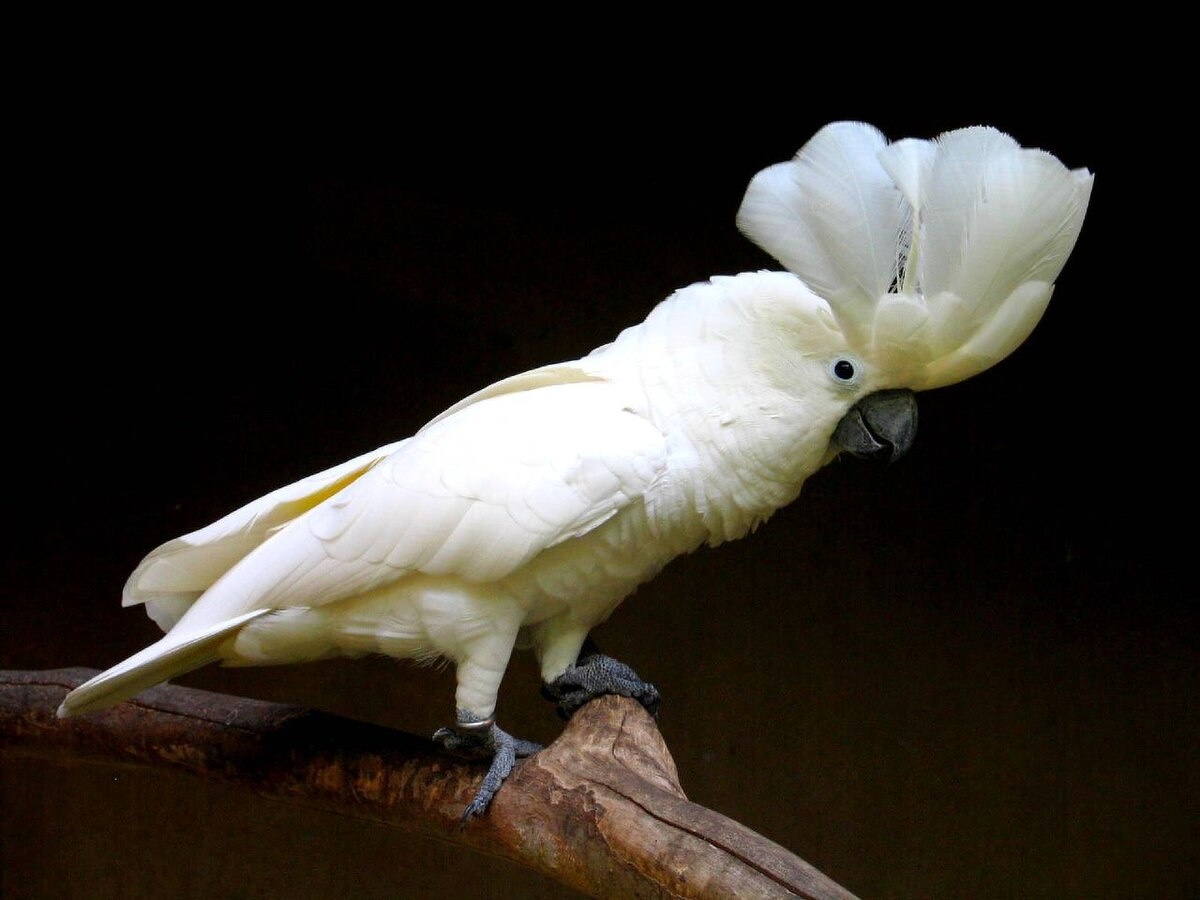
white cockatoo
White cockatoos are large for birds but medium-sized for cockatoos. They range in weight from 0.5 to .630 kilograms (1.1 to 1.4 pounds) and have an average length is 46 centimeters (1.5 feet). Each wing is 25 to 31 centimeters (9.84 to 12.20 inches) long. White cockatoos have blunt-ended feathers and pale yellow, lemony coloration on the undersides of their wings and tail which is visible when when they fly.. But otherwise their feathers are white. They are often referred to as "umbrella cockatoos" because of their broad, backward-bending crest. When surprised, excited or alarmed, these birds extend their striking head crest, which has a semicircular, umbrella-like shape. The beak and legs are dark grey. Sexual Dimorphism (differences between males and females) is present: Males are larger than females. Sexes are colored or patterned differently and ornamentation is different. Both sexes have a pale blue eye-ring, but males have a dark brown iris while females have a reddish iris. Females usually have a smaller head and beak than males. White cockatoos can live over 40 years in captivity and 30 years in the wild.
White cockatoos have been listed as Endangered on the IUCN Red List of Threatened Species due to severe population declines driven by habitat loss and unsustainable capture for the pet trade since 2021. Before that they were classified as vulnerable. In CITES (Convention on International Trade in Endangered Species of Wild) they are in Appendix II, which lists species not necessarily threatened with extinction now but that may become so unless trade is closely controlled. |=|
White cockatoos have been commonly sold as pets worldwide and sold for around cost $1,500 each in the 2000s. It has been estimated that 17 percent of the world's population of these birds was removed annually between 1990 and 1993 for the pet trade. At that time the U.S. was by far the largest consumer of wild caught white cockatoos, with 10,143 imports recorded between 1990 and 1999. At that time wild populations were relatively resistant to pressures from the pet trade market. But not so anymore. The Indonesian government began issuing quotas on trapping in 1988 after becoming a part of CITES. However, the quotas were poorly enforced. In 1999, no quota was issued, making any capture illegal. The zero quota remains in effect but is poorly enforced. Surveys by the Indonesian NGO ProFauna suggest that significant levels of trade in wild-caught white cockatoos still occur, with more than 200 taken from the wild in north Halmahera in 2007. Approximately 40 percent of the parrots (white cockatoo, chattering lory, violet-necked lory and eclectus parrot) caught in Halmahera are smuggled to the Philippines, while approximately 60 percent go to the domestic Indonesian trade, especially via bird markets in Surabaya and Jakarta. The illegal trade of protected parrots violates Indonesian Act Number 5, 1990 (a wildlife law concerning Natural Resources and the Ecosystems Conservations). [Source: |=|, Wikipedia]
White Cockatoos Behavior, Diet and Reproduction
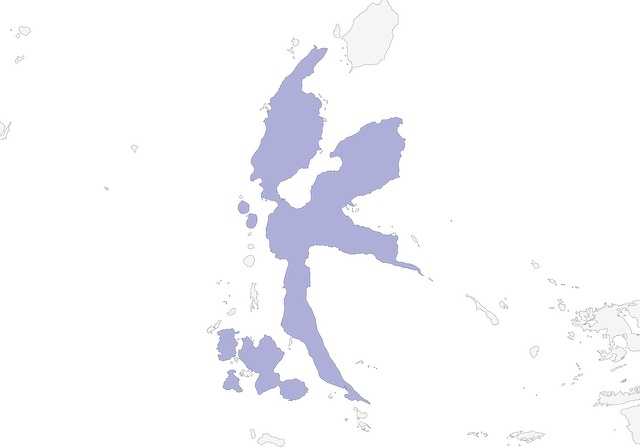
white cockatoo range in the North Moluccas in eastern Indonesia
White cockatoos fly and are diurnal (active mainly during the daytime), motile (move around as opposed to being stationary), nomadic (move from place to place, generally within a well-defined range), wander in search of food, and social (associates with others of its species; forms social groups). Erin Lane wrote in Animal Diversity Web White cockatoos generally occurs singly, in pairs and small groups, or in flocks of up to fifteen birds. In the afternoon, they gather in groups of up to fifty birds. Although they are social, with the exception of mating pairs, they generally do not form close bonds with one another. As a result, there is no firmly defined order of dominance in the community. White cockatoos communicate with vision, touch and sound and sense using vision, touch, sound and chemicals usually detected with smell. Mates communicates with each other through a variety of gestures and noises. They also scratch each other during the mating ritual. [Source:Erin Lane, Animal Diversity Web (ADW) |=|]
White cockatoos mainly feed on fruits in trees. They have been often observed eating papayas, durians, langsats and rambutans as well as forest fruits and have also been seen eating crickets and small lizards. When they were more plentiful they sometimes raided corn fields and caused considerable damage. White cockatoos are extremely bright and inquisitive birds. They have the ability to use tools, such as using a branch to scratch their backs. Birds in captivity require nearly constant mental stimulation. They are constantly moving, climbing, and doing gymnastics. In captivity, birds with too little mental stimulation often become neurotic, plucking their feathers to the point of baldness. Captive white cockatoos are known to be very affectionate with their human companions, acting much more like a dog than a bird in this respect.
White cockatoos are monogamous (have one mate at a time) and often mate for life. They can become very depressed if their partner is taken away. In the absence of a mate, white cockatoos in captivity will bond to the human taking care of them. In the wild, white cockatoos engage in seasonal breeding — breeding once a year. when vegetation growth is at its peak, usually between December and March. The average number of eggs laid per season is two. The average time to hatching is 30 days. Young are altricial, meaning they are relatively underdeveloped at birth. Both parents are involved in caring for young, although females play a larger role. Pre-birth protection and pre-weaning and pre-independence stage provisioning and protecting are done by males and females. The average fledging age is three months and the age in which they become independent ranges from 3.5 to four months. Females and males reach sexual or reproductive maturity at five to six years.
The courtship ritual of white cockatoos is very interesting. It begins with the male showing off his body by ruffling his feathers, spreading his tail feathers, extending his wings, and erecting his crest. He then bounces about. The female avoids him at first, but eventually permits him to come near her. They then scratch each other around the head and tail. This serves to strengthen the bond between the two birds. After some time, the male mounts the female and they mate through the joining of the cloaca. Adults that have previously mated successfully have a much shorter courtship ritual, and the female often approaches the male. |=|
During the breeding season pairs leave their group and find a nesting spot. They generally choose nesting holes in only the largest trees, and nest between five to 30 meters above ground. Males and females share the responsibility of incubating the eggs until they hatch. Typically, parents raise only one of the chicks. If the first chick to hatch is healthy, they care for that one. If it is malformed or unhealthy, they raise the second chick. Once a chick is able to care for itself, the family group of three joins the parents’ flock.
Image Sources: Wikimedia Commons
Text Sources: Animal Diversity Web animaldiversity.org , National Geographic, Live Science, Natural History magazine, Australian Museum, David Attenborough books, Australia Geographic, New York Times, Washington Post, Los Angeles Times, Smithsonian magazine, Discover magazine, The Conversation, The New Yorker, Time, BBC, CNN, Reuters, Associated Press, AFP, Lonely Planet Guides, Wikipedia, The Guardian, Top Secret Animal Attack Files website and various books and other publications.
Last updated August 2025