
Home | Category: Birds, Crocodiles, Snakes and Reptiles
EMUS AND HUMANS

Australia coat of arms
Emus are farmed for meat, leather and oil. They are not endangered or threatened.They are designated as a species of least concern on the International Union for Conservation of Nature (IUCN) Red List. There are an estimated 625,000 to 725,000 wild emus in Australia, according to Bush Heritage Australia. These numbers do not include farmed emus. Emus are abundant on mainland Australia. In Tasmania however, they were hunted off the map by European settlers.
The Australians Alphabet” from 1905:
“E stand for Emu
With wonderful legs,
Who'd ever think that
they were folded in eggs...”
Emus are sometimes regarded as crop pests. If given the opportunity, emus will forage on crops such as wheat. Farmers often install tall fences to keep emus off their land. In the early 1930s, a large migration of emus to an agricultural town ended violently. The emus spoiled or consumed vast wheat fields. The military was called in to eradicate the emus in what some call the "Emu War". However the operation was unsuccessful. The emus used natural camouflage and speed to avoid detection and capture. See Below. [Source: George Shorter, Animal Diversity Web (ADW) |=|]
Emus are popularly but unofficially regarded as the national bird of Australia. One appears with a red kangaroo on the Coat of Arms of Australia and the Australian 50-cent coin. Emus have been featured on numerous Australian postage stamps and product labels and trademarks. The hats of the Australian Light Horse are decorated with emu feather plumes. [Source: Wikipedia]
RELATED ARTICLES:
EMUS: CHARACTERISTICS, BEHAVIOR AND REPRODUCTION ioa.factsanddetails.com
CASSOWARIES: HISTORY, CHARACTERISTICS, BEHAVIOR AND REPRODUCTION ioa.factsanddetails.com
CASSOWARIES AND HUMANS: HISTORY, SIDE BY SIDE, ATTACKS ioa.factsanddetails.com
SOUTHERN CASSOWARIES: CHARACTERISTICS, BEHAVIOR AND REPRODUCTION ioa.factsanddetails.com
CASSOWARIES OF NEW GUINEA: SPECIES, WHERE THEY LIVE, WHAT THEY'RE LIKE ioa.factsanddetails.com
MOAS: HISTORY, CHARACTERISTICS, REPRODUCTION, EXTINCTION, DE-EXTINCTION? ioa.factsanddetails.com
MOA SPECIES: GIANT, SMALL AND HEAVY-FOOTED ONES ioa.factsanddetails.com
BIRDS OF AUSTRALIA: COMMON, UNUSUAL AND ENDANGERED SPECIES ioa.factsanddetails.com
KOOKABURRAS: CHARACTERISTICS, LAUGHING, BEHAVIOR, SPECIES, REPRODUCTION ioa.factsanddetails.com
PARROTS OF AUSTRALIA-NEW GUINEA: SPECIES, COLORS, CHARACTERISTICS, BEHAVIOR ioa.factsanddetails.com
COCKATOO SPECIES: CHARACTERISTICS, BEHAVIOR AND REPRODUCTION ioa.factsanddetails.com
COCKATOOS: COLORS, DIET, LONG LIFESPANS, DANCING, VOCALIZATIONS, HUMANS ioa.factsanddetails.com
Emus and Aboriginals
Emu hold a high place in Australian Aboriginal mythology and are showcased is several origin and creation stories such as that of the Yuwaalaraay and other groups in New South Wales who say that the sun was made by throwing an emu's egg into the sky. In Victoria, some terms for the emu were Barrimal in the Dja Dja Wurrung language, myoure in Gunai, and courn in Jardwadjali. The birds were known as murawung or birabayin to the local Eora and Darug inhabitants of the Sydney basin. [Source: Wikipedia]
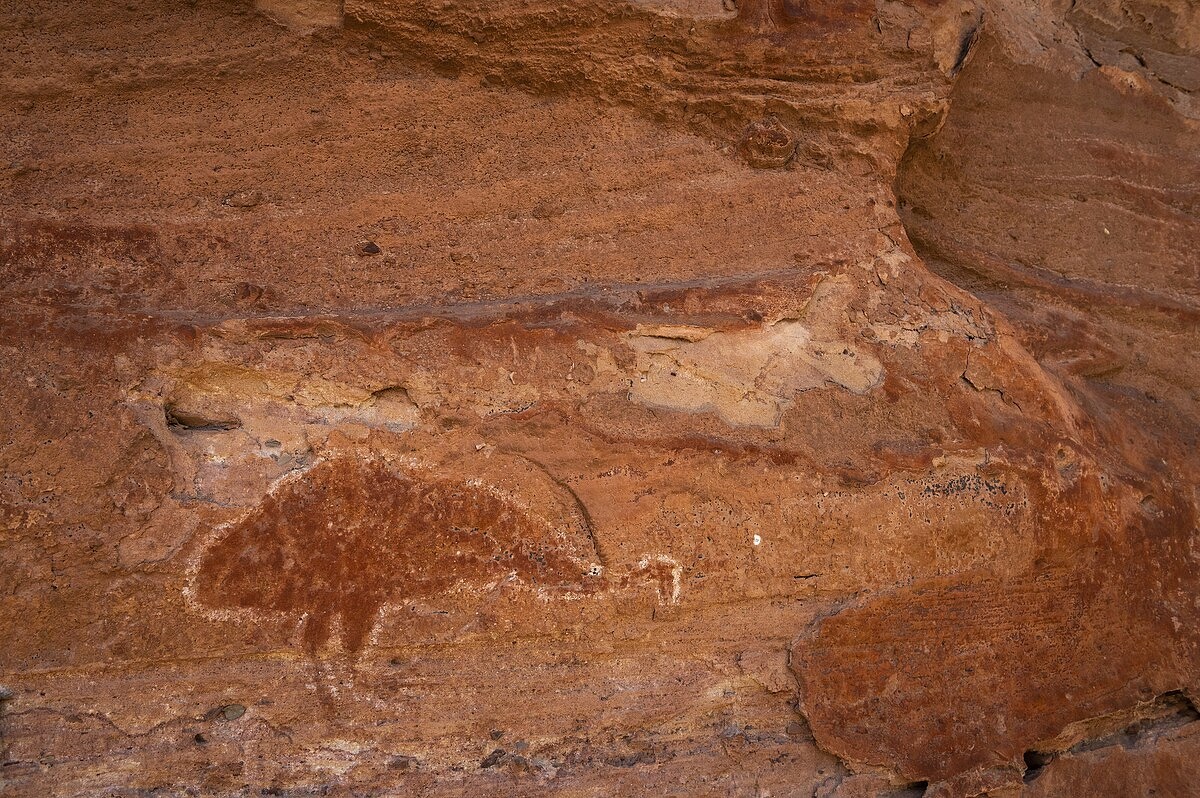
an emu in ancient Aboriginal rock art in Keep River National Park
One story from Western Australia holds that a man once annoyed a small bird, who responded by throwing a boomerang, severing the arms of the man and transforming him into a flightless emu.The Kurdaitcha man of Central Australia is said to wear sandals made of emu feathers to mask his footprints.
Many Aboriginal language groups throughout Australia have a tradition that the dark dust lanes in the Milky Way represent a giant emu in the sky. Several of Sydney rock engravings depict emus and the birds are mimicked in Indigenous dances. Hunting emus, known as kari in the Kaurna language, features in the major Dreaming story of the Kaurna people of the Adelaide region about the ancestor hero Tjilbruke.
In Western Australia, Emu beer has been produced since the early 20th century by Swan Brewery, which continues to produce a range of "Emu" branded beers.
Emu Meat
Humans have utilized emu for food for thousands of years. In areas where they were endemic, emus were hunted and were an important source of meat to Aboriginal Australians, who also foraged their eggs. The birds were a food and fuel source for early European settlers. Emu meat is available in Australian supermarkets. According to one survey in the early 2000s, about five percent of Australians regularly eat emu meat.
One example of how emu was traditionally cooked by Aboriginals comes from the Arrernte of Central Australia who called it Kere ankerre: “Emus are around all the time, in green times and dry times. You pluck the feathers out first, then pull out the crop from the stomach, and put in the feathers you've pulled out, and then singe it on the fire. You wrap the milk guts that you've pulled out into something [like] gum leaves and cook them. When you've got the fat off, you cut the meat up and cook it on fire made from river red gum wood.”

emu burgers
Emu meat is 98 percent fat free, red in color and tastes more like veal or beef than chicken or turkey. It has been described as "beefy but gamy." One breeder said that emu meat "tastes like choice rib-eye beef" when broiled. Emu meat has more protein, calcium and iron and less calories, cholesterol and fat than beef, chicken or turkey. The best cuts are said to come from the thigh and the larger muscles of the drum or lower leg, which is also true with other poultry. Dark emu meat is considered for cooking purposes by the US Food and Drug Administration to be a red meat because its red color and pH value approximate that of beef. [Source: Wikipedia, Washington Post]
Emu Products: Medicines, Oil and Leather
Humans have also used emus for a long time as sources of medicine, drugs, leather, oil and decorative items. Aboriginals used the fat as bush medicine and rubbed it into their skin. It served as a valuable lubricant, was used to oil wooden tools and utensils such as the coolamon, and was mixed with ochre to make the traditional paint for ceremonial body adornment. Emu leather has traditionally been used to make purses and wallets. Emu leather has a distinctive patterned surface, due to a raised area around the feather follicles in the skin, Lint-free emu feathers can be used to clean computer parts. The feathers and eggs of emus have been used in decorative arts and crafts. In the 19th century emu eggs were engraved with portraits, similar to cameos, and scenes of Australian native animals.
Each adult emu contains about four liters (a gallon) of oil. The oil comes from the subcutaneous and retroperitoneal fat and is obtained by heating the macerated adipose tissue. The liquefied fat is filtered to get a clear oil, which consists mainly of fatty acids including 42 percent oleic acid, 21 percent linoleic acid and 21 percent palmitic acid. Anti-oxidants found in it include carotenoids and flavones. Among the therapeutic effects attributed to emu oil are lowering cholesterol, treating allergies, preventing scarring and stretch marks, and treating headaches. [Source: George Shorter, Animal Diversity Web (ADW) |=|]
Emu oil is a key ingredient in body lotions, anti-aging creams and moisturizing face cream, and ointment for burns. Studies show that emu oil thickens the skin, has anti-inflammatory properties, increases cell regeneration and easily penetrates the skin.

Tests suggest that emu oil is better for your skin than mineral oil-based products. Even so the USDA regards pure emu oil as an unapproved drug and was highlighted in a 2009 article entitled "How to Spot Health Fraud". Even so emu oil has been credited with easing of gastrointestinal inflammation. Test on rats have shown that it has a significant effect in treating arthritis and joint pain, more so than olive or fish oils. It has also been scientifically shown to improve the rate of wound healing, but the mechanism responsible for this effect is not understood. Many athletes in Australia use emu oil for after-event massages.
Emu Ranching
Commercial emu farming started in Western Australia around 1970. The commercial emu industry in Australia is based on stock bred in captivity, and all states except Tasmania have licensing requirements to protect wild emus. Outside Australia, emus are farmed on a large scale in the U.S., Peru, and China and to a lesser extent in some other countries. According to the U.S. Census of Agriculture, there were approximately 11,500 emus in the United States as of 2017. This likely an undercount but is far cry from the days when they numbered in the hundreds of thousands
Emus breed well in captivity, and are kept in large open pens to avoid leg and digestive problems that arise from inactivity. They are typically fed on grain supplemented by grazing, and are slaughtered at 15 to 18 months. An emu can gain one kilograms on three or four kilograms of feed compared to eight or 10 kilograms for a cow.
Emu ranching was fairly big in business in the United States. At one time there were two million emus and 5,500 members in American Emu Association. At one point there were 400,000 emus in Texas alone raised by 2,000 breeders. At that time emu steak sold for about $8 a pound in Texas and more than 100 restaurant in the U.S. offered emu meat.
The emu trade in the U.S, in the 1980s and 90s was dominated by pyramid schemes in which breeders were encouraged to sell offspring to new breeders. At the height of emu mania breeding pairs were selling for $50,000. The bottom fell out of the emu market around 1994 and the birds became worth next to nothing. Many farmers set their emus free and police were pestered with complaints by people reporting emus running around their backyards,
By 2013 the emu business was a shadow of its former self, with one or two thousand producers, down from over 5,000 in 1998. Those still in the business increasingly relied on sales of oil for their profit, although, leather, eggs, and meat were also sold. In addition to their use in farming, emus are sometimes kept as pets, though they require adequate space and food in order to live healthily. In the United Kingdom, emus used to be regulated in under the Dangerous Wild Animals Act, however, after a review of the act in 2007, they were no longer considered to be dangerous and it was allowed to keep them — as well as a long list of other animals — without a license.
Emu Wars
Brielle Jaekel wrote in FreightWaves: In 1932, twenty thousand emus descended on Western Australia in migration, almost decimating farmlands that provided much-needed wheat and supplies to Australia. Farmers were unable to stop them from eating their crops, with some saying their farmland was rightfully the emus’. In desperation, the farmers continuously called on the government for help. They implored the government to send ammunition or take military action. Most of the farmers were ex-soldiers themselves, according to Scientific American. [Source: Brielle Jaekel, FreightWaves, October 13, 2023]
After World War I, veterans had nowhere to go and no jobs to fill, so the Australian government provided them with plots of land to farm. More than 5,000 soldiers took to Western Australia to try their luck at farming. But the area’s land was difficult to farm and after 1929 low prices resulting from the Great Depression put additional strain on the farmers. Subsidies for wheat were promised but never fulfilled.
In 1932, the soldiers-turned-farmers begged for ammunition to help fight the emus, since they had difficulty obtaining it themselves during the Depression. At the same time, the Australian government was under pressure to show that it was giving other World War I veterans something to do. So the idea to declare war against the emu in Western Australia arose. According to Australian Geographic the Seventh Heavy Battery of the Royal Australian Artillery was assigned the task, with Maj. G.P.W. Meredith as its commander...Thus Australia set out to conquer the birds and save its merchant business, and it did so with machine guns.
If the story sounds too much like the plot of a movie, it is in fact true, but was also be covered in two films. One short, risque comedic film, “The Emu War,” produced by Umbrella Entertainment, premiere on October 22, 2023. It takes some liberties with the plot line. A feature-length film is also in development, written by John Cleese, according to The Guardian.
How Emus Won the Battle But Lost the War
Brielle Jaekel wrote in FreightWaves: The emus turned out to be incredibly resilient. They displayed remarkable speed and agility, making them difficult targets for the soldiers. They also proved to have difficult-to-pierce skin, leaving one soldier to say that they need to be shot in the back of the head with their mouths closed or through the front with their mouths open, according to an article in The Guardian. [Source: Brielle Jaekel, FreightWaves, October 13, 2023]
As a result, the soldiers struggled to effectively reduce the emu population. Only a few dozen were dead the first day despite thousands of soldiers shooting at thousands of emus. Some soldiers claimed the emus had even elected leaders to facilitate evacuations. The next day the Seventh Heavy Battery tried again and waited for thousands of emus to enter an area in range of a set up a machine gun. Thousands of birds swarmed the area, perfectly in range, but the gun jammed. Quickly, the enemy caught on to the gambit and took off, successfully avoiding their human foes and relocating. Another strategy to mount a machine gun on a truck failed when the vehicle could not keep up with the birds, according to Australian Geographic.
Newspaper reports at the time make the war even more humorous, with reports of emus holding their territory firm. “No treaty of peace has been concluded, and the emus remain in possession of disputed territory,” said an article in The Daily News from Perth on November 9, 1932. “It is, therefore, expected that regular military operations will be followed by guerrilla warfare, which may continue for years and may be accompanied by stories of horrible atrocities. The emu commander is maintaining a studied silence as to his future plans, but it is understood that he is much impressed with the capacity for resistance shown by raw troops and confident that they will continue to uphold the best traditions of the race. He is credited with the intention to arrange for a suitable poem to commemorate the emu glory on the field of Campion.”
Some progress was made as the war raged on for two weeks. However, Meredith estimated even when they were successful, it cost 10 bullets for every emu taken down. Troops were eventually recalled. No human soldiers were killed. A total of 2,500 rounds of ammo was spent but only approximately 200 emus were killed. After the soldiers returned home, federal labor parliamentarian A.E. Green was asked if the troops would receive a medal. He replied that any medals should go to the emus. Regrouping, the government decided that the farmers would be given ammunition to fight for their own farms. After that, 57,034 emus were killed over the course of six months in 1934.They even instituted a bounty on the emus in the decades that followed, which resulted in 284,700 killed in Western Australia from 1945 to 1960, and the crops were saved.
Studying Emus To Work Out How Dinosaurs Walked and Behaved
Paleontologist Brent Breithaupt of the University of Wyoming Geological Museum is studying emus and their tracks to work how dinosaurs from the middle Jurassic, 165 million years ago, moved. Mead Gruver of Associated Press wrote: The similarities between emu tracks and fossilized dinosaur tracks at the Red Gulch site in Wyoming are indeed remarkable: Both are two-legged. Both have three long, narrow toes. Both have indentations from claws at the tips of those toes. The tracks have similar padding. The tracks are roughly the same size — most four to five inches (10 to 13 centimeters), although some of the dinosaur tracks are as large as eight inches (20 centimeters). Plenty is known about emus.. But precious little is known about whatever dinosaur species made thousands of tracks at Red Gulch in northern Wyoming. In fact, very few mid-Jurassic dinosaur fossils have ever been found in North America. "We don't find the dinosaur dead in its tracks, and so we don't really know," Breithaupt said. "If we ever do find the bones, it will be new to science." [Source: Mead Gruver, Associated Press, January 30, 2007]
Breithaupt is pretty sure the Red Gulch dinosaurs were a type of theropod, a wide-ranging group of two-legged, short-armed meat-eaters that included the mighty Tyrannosaurus rex. He uses a formula that applies to all sorts of bipeds to estimate the dinosaurs' size: Foot length times four roughly equals hip height. "Take your basic emu there, put a long dinosaur tail on it, put a slightly different neck and head on it, that's about the size we have," he said.
By observing emus and studying their tracks at Rabbit Creek Enterprises, an emu farm in northern Colorado, he's gone a step further. He has a few ideas about the dinosaurs' behavior. Breithaupt may have put a riddle about the dinosaur tracks to rest: Why did their feet sometimes cross in front of one another when they walked? Emus, Breithaupt has noticed, often look around as they walk. If they see something to their left, they'll cross their right foot over to the left side, stop, and look in that direction. They might then see something to their right. Same thing: They cross their left foot over to the right, stop, and look right. Also, the dinosaur tracks occur in synch with one another, suggesting they walked in groups and were gregarious. Emus, it turns out, are gregarious as well. At Rabbit Creek, they pace around the edges of their corral in threes and fours.
Image Sources: Wikimedia Commons
Text Sources: Animal Diversity Web animaldiversity.org , National Geographic, Live Science, Natural History magazine, Australian Museum, David Attenborough books, Australia Geographic, New York Times, Washington Post, Los Angeles Times, Smithsonian magazine, Discover magazine, The Conversation, The New Yorker, Time, BBC, CNN, Reuters, Associated Press, AFP, Lonely Planet Guides, Wikipedia, The Guardian, Top Secret Animal Attack Files website and various books and other publications.
Last updated August 2025