
Home | Category: Birds, Crocodiles, Snakes and Reptiles
EMUS
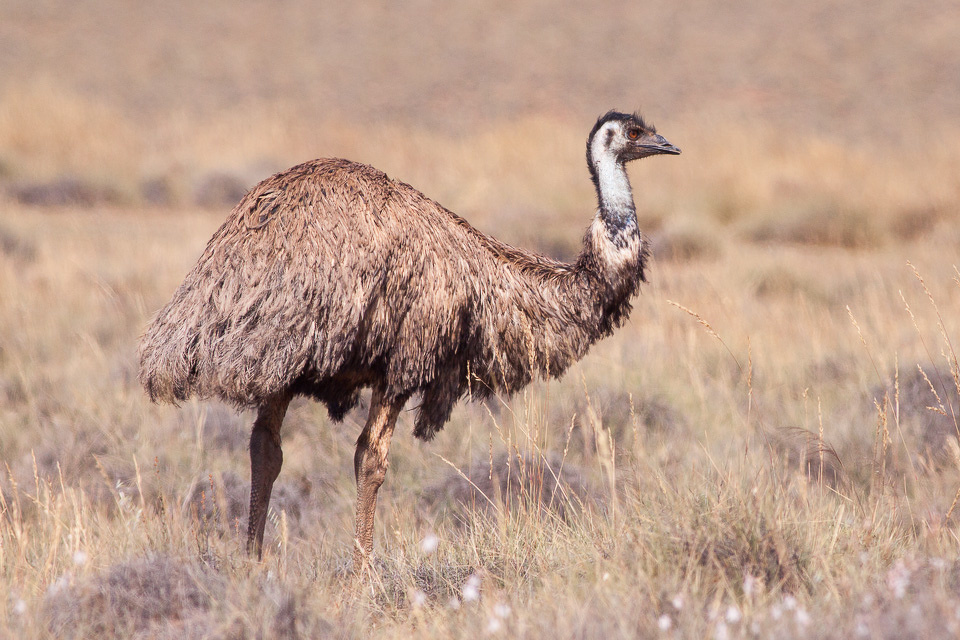
Emu at Flinder's Range National Park, South Australia
Emus (Dromaius novaehollandiae) are the world's second heaviest birds after ostriches and the third largest birds in terms of body and head length after ostriches and cassowaries. They are found primarily in the Australian outback and are close relatives of cassowaries.
Emus are found exclusively in Australia and inhabit nearly the entire continent. Lower densities exist along the eastern coast, which is very developed, and toward the center of Australia, where its really, really hot and arid. Emus have a nomadic lifestyle and occupy nearly all available biomes found in Australia: savannah grassland, forests, semi-deserts and agricultural and livestock areas. They prefer a subtropical climate and tend to occupy areas with water in the vicinity and most often seen in savannah areas. They avoid heavily wooded areas and deserts. [Source: George Shorter, Animal Diversity Web (ADW) |=|]
Emus are not endangered or threatened. They are designated as a species of least concern on the International Union for Conservation of Nature (IUCN) Red List and have no special status on the Convention on International Trade in Endangered Species (CITES). There are an estimated 625,000 to 725,000 wild emus in Australia, according to Bush Heritage Australia. The population is considered stable by the IUCN. Their number are influenced seasonal rains and can drop significantly during droughts.
In captivity, with a stable supply of food and water, emus have lived up to 20 years. Their average lifespan in the wild is seven years and they only attain that of they survive their first years of life. Stresses such as dry periods and lack of food reduce their lifespan.
The primary predator of emus are dingoes. Dingoes mainly go after emu nests, consuming the eggs, and young. When dingoes raid a nest, one dingo distract the incubating male, so that the nest becomes exposed. When attacking emus, predators target the head and neck. To defend against dingo attacks, emus exploit their height by quickly leaping away. Emus leap to put distance between the dingo's mouth and their neck. This is often accompanied by a kicking defense, which can be lethal for the dingo. Against eagles and hawks, emus, especially young ones, have little practical defense. Wedge-tailed eagle attempt to break the necks of emus by tackling them after a dive. Emus blend in well in grassland environment. When they escape a threat they often run in in wild, unpredictable, seeking cover when they can(a rarity in their habitat). |=|
RELATED ARTICLES:
EMUS AND HUMANS: MEAT, OIL, RANCHING AND WARS ioa.factsanddetails.com
CASSOWARIES: HISTORY, CHARACTERISTICS, BEHAVIOR AND REPRODUCTION ioa.factsanddetails.com
CASSOWARIES AND HUMANS: HISTORY, SIDE BY SIDE, ATTACKS ioa.factsanddetails.com
SOUTHERN CASSOWARIES: CHARACTERISTICS, BEHAVIOR AND REPRODUCTION ioa.factsanddetails.com
CASSOWARIES OF NEW GUINEA: SPECIES, WHERE THEY LIVE, WHAT THEY'RE LIKE ioa.factsanddetails.com
MOAS: HISTORY, CHARACTERISTICS, REPRODUCTION, EXTINCTION, DE-EXTINCTION? ioa.factsanddetails.com
MOA SPECIES: GIANT, SMALL AND HEAVY-FOOTED ONES ioa.factsanddetails.com
BIRDS OF AUSTRALIA: COMMON, UNUSUAL AND ENDANGERED SPECIES ioa.factsanddetails.com
KOOKABURRAS: CHARACTERISTICS, LAUGHING, BEHAVIOR, SPECIES, REPRODUCTION ioa.factsanddetails.com
PARROTS OF AUSTRALIA-NEW GUINEA: SPECIES, COLORS, CHARACTERISTICS, BEHAVIOR ioa.factsanddetails.com
COCKATOO SPECIES: CHARACTERISTICS, BEHAVIOR AND REPRODUCTION ioa.factsanddetails.com
COCKATOOS: COLORS, DIET, LONG LIFESPANS, DANCING, VOCALIZATIONS, HUMANS ioa.factsanddetails.com
Ratites (Flightless Birds) and Their Evolution
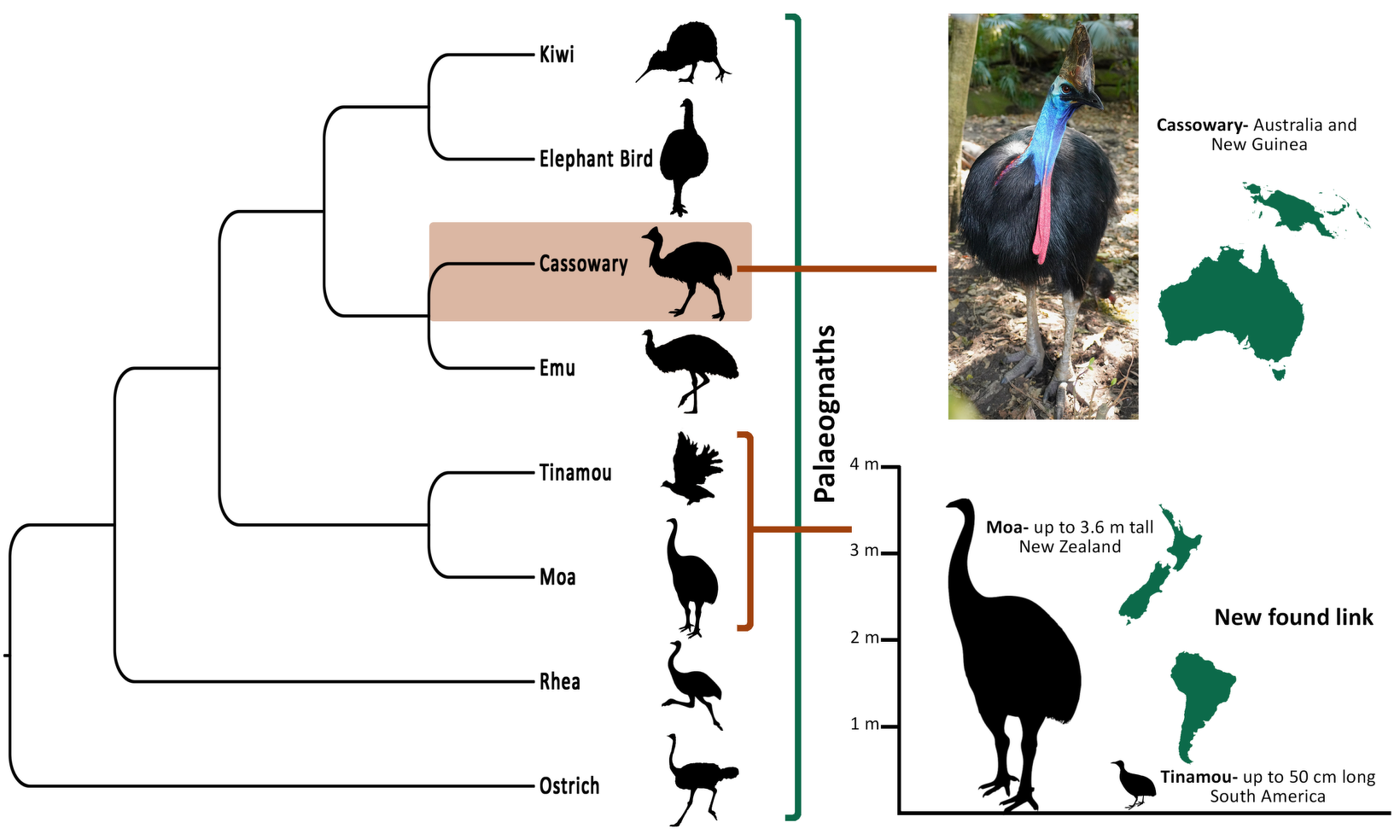
one view of the evolutionary tree of ratities, by Phoebe McInerney, Flinders University
Emu are ratites, a group that embraces all flightless birds that lack a keel (a ridge of bone that extends outward from the breastbone on which flight muscles of flying birds are attached). Ratites are comprised of six extant families and some extinct families. The five families are Aptergyidae (kiwis), Casuariidae (cassowaries), Dromaiidae (emus), Rheidae (rheas), Tinamidae (Tinamous) and Struthionidae (ostriches). The family for the elephant bird is the extinct ratite family Aepyornithidae. The "moa family" belong the extinct Dinornithiformes. Ratites They are mostly large, long-necked, and long-legged, with the exceptions being the kiwi, which is also the only nocturnal extant ratite, and tinamous which can fly. Ratites were previously known as Struthioniformes. The name ratite is derived the birds’ raft raft-like sternum. [Source: Wikipedia, Ellie Bollich, Animal Diversity Web (ADW) |=|]
Derek Grzelewski wrote in New Zealand Geographic: The name ratite, from ratis, Latin for raft, refers to the birds’ sternum, which is flat and raft-like, lacking a keel to which flight muscles could be attached. The sterna of flighted birds have a keel to which their large flight muscles are attached, and these birds are sometimes termed carinates (from the Latin carina, a keel). Just to confuse the issue, though, some ratites — the South American tinamous, for example — have a keeled breast-bone and can fly. On the other hand, the kakapo, whose parrot relatives can fly extremely well, have a sternum as flat as that of any kiwi or moa. [Source: Derek Grzelewski, New Zealand Geographic. January-March 2000]
It was first thought that ratites shared a common flightless ancestor on the ancient supercontinent Gondwana, which later fragmented, leading to the diversification of ratites on different continents. However, modern genetic studies suggest that ratites may have lost the ability to fly independently and the ancestors of living ratites diverged relatively recently, after the breakup of Gondwana. This suggests that the loss of flight occurred in different ratite lineages — an example of convergent evolution, the process by which distantly related animals independently evolve similar traits or features as a result of adapting to similar environments or ecological niches.
Evidence suggests that ratites might have evolved flightlessness multiple times, with different lineages developing similar traits (such as large size, reduced wings) in response to similar environmental pressures. For example, kiwis, despite being geographically close to other ratites, are more closely related to extinct elephant bird, suggesting independent evolution of flightlessness. Tinamous, small, flying birds from South America, are also now considered to be part of the ratite lineage, further complicating the picture.
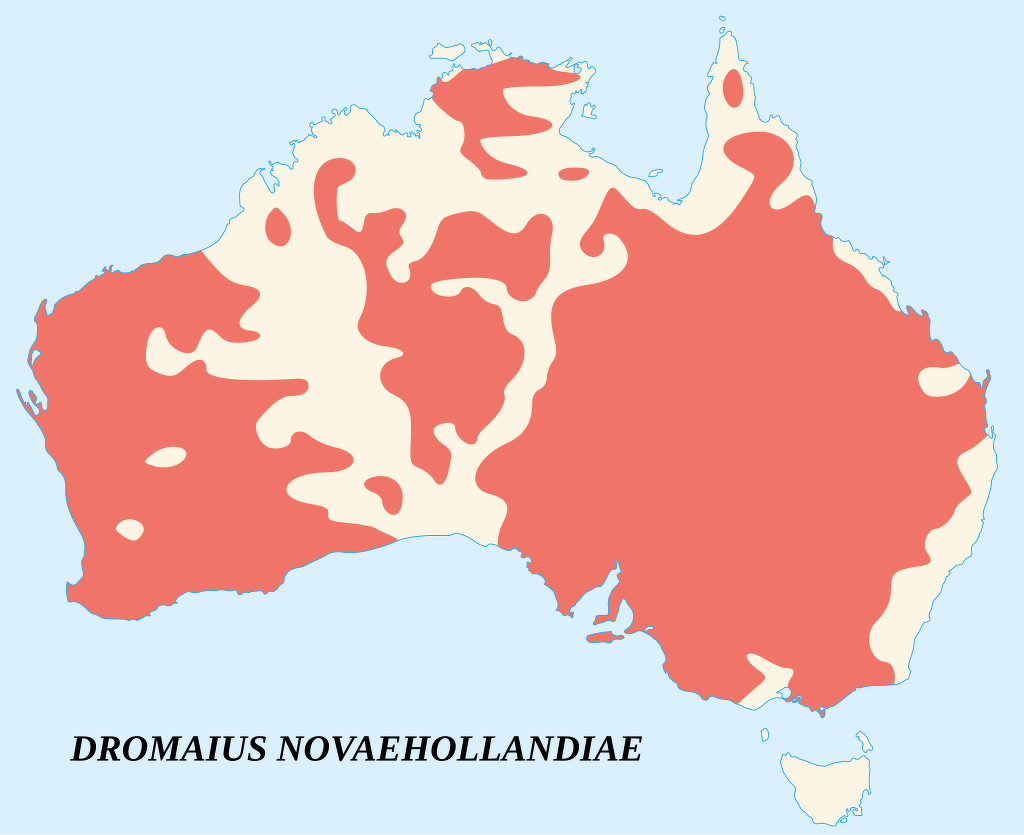
emu range in red
Flightless birds have survived in a terrestrial environment dominated by mammals primarily because they have long legs that allow them to run at great speeds — faster than potential mammal predators. Ostriches, rheas and emus live in open grasslands or semi-desert where there is lot of room to run, Cassowaries are stockier and have shorter legs. They live in tropical forest, where they have no predators.
Flinders University researchers studying cassowary’s eating, breathing and vocal structures found a surprising link between two vastly different birds in the primitive palaeognath family thought to be each other’s closest relative — the small flighted South American tinamou and the extinct New Zealand moa. In a study published in BMC Evolutionary Biology, researchers from Flinders University analyzed the throat structures involved with breathing, eating and vocalising (the syrinx, hyoid, and larynx) in cassowaries with advanced scanning technologies able to generate 3D image these structures and found they were similar to those of emus, their closest relatives. No surprise there. “What did surprise us though was that despite extensive variation in this region between cassowaries and other primitive living birds, known as palaeognaths, the extinct New Zealand moa and the living South American tinamou were very similar,” said Phoebe McInerney, lead author on the papter and a PhD student at Flinders. DNA analysis also concluded that moa and tinamou are close relatives even though moas were huge and flightless, birds and tinamou are small, flighted partridge-like bird. [Source: Flinders University, January 17, 2020]
For more on this See Ratites and Their Evolution Under MOAS: HISTORY, CHARACTERISTICS, REPRODUCTION, EXTINCTION, DE-EXTINCTION? ioa.factsanddetails.com
Emu Characteristics
Emus generally range in weight from 36 to 40 kilograms (79.3 to 88.1 pounds) and reach lengths of 1.9 meters (6.2 feet), with their average length being 1.75 meters (5.7 feet). They can weigh up to 60 kilograms (132 pounds). Sexual Dimorphism (differences between males and females) is present: Females are larger than males. [Source: George Shorter, Animal Diversity Web (ADW) |=|]
Emus have dull, brown plumage, huge thorny feet and long bluish necks. Unlike cassowaries, which they are closely related to, they don’t have feathers on their head and neck and don't have a helmet-like casque on the top of their heads. Emus have an insulated double layer of feathers, which gives them protection from the heat. Their shaggy hair-like feathers are not not streamlined as their main purpose is to provide insulation from direct sunlight. Plumage color varies somewhat the environment, and tends to blend in with the surroundings the birds live in.
Emus have a long, sparsely covered neck that is whitish-blue. Their heads are covered in wispy black feathers. Their large black beak specialized for grazing. Emus have small, undeveloped wings that don’t come anywhere close enough to providing enough power get off the ground. These very small vestigial wings are capable of flapping though.
Emus on the Run
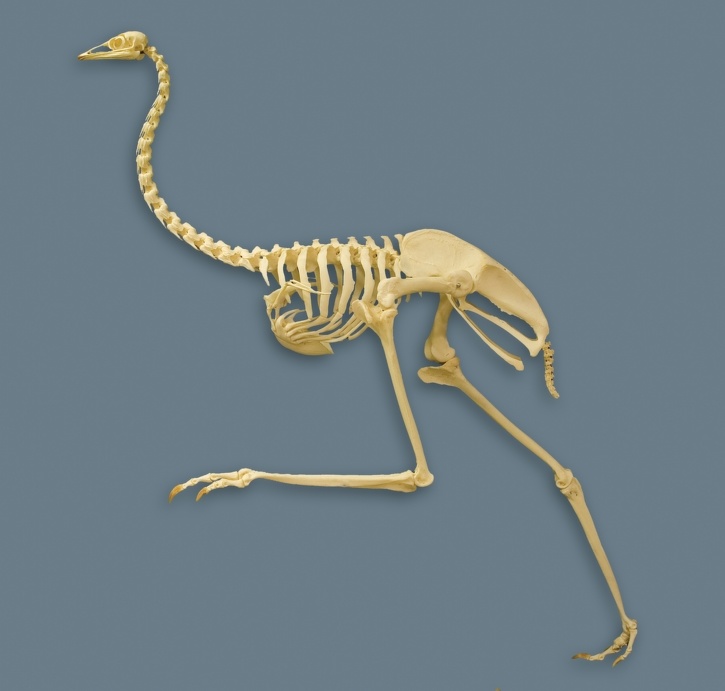
emu skeleton
Adult emus can run at speeds up to 50 kilometers per hour (31 miles per hour) for fairly long distances — it is said, for 16 kilometers (10 miles) — with strides that almost reach meters (10 feet). The speed was measured by a car chasing an emu. Emus are good swimmers.
Emus feet are similar in design to other running birds. They have three forward-facing toes but no rear-facing toes. Their long bare legs are similar to those of other flightless birds. Emus are the only bird with calf muscles, which aids them in both sprinting and long distance running. The high strength of these legs allows them to jump high and perform extremely powerful kicks. Emus are capable of breaking through fences or maiming predators. Emus defend themselves with kicks powerful enough to kill a frail man. Emus should be approached from the back. They can lash out with powerful kicks when they are approached from the front.
Emus flap their wings when running, perhaps as a means of stabilising themselves when moving fast. They can achieve their high speeds due to their highly specialised pelvic limb musculature. Emus are unique among birds in that their gastrocnemius muscles in the back of their lower legs have four bellies instead of the usual three. The pelvic limb muscles of emus contribute a similar proportion of the total body mass as do the flight muscles of flying birds. When walking, emu takes strides of about one meter (3.3 feet), but at full gallop, a stride can be as long as 2.75 meters (9 feet).
During the day emus are often seen dashing across the outback at a distance in groups of a dozen are so birds. Emus have very small brains (about the size of a pea). They run down the road straight when chased by a car. They don't have the sense to run to the right or left.
Emu Diet and Feeding Behavior
Emus are omnivores (eat a variety of things, including plants and animals) and recognized as carnivores (eat meat or animal parts) insectivores (eat insects), herbivores (eat plants or plants parts), frugivores (eat fruit), granivores (eat seeds and grain), lignivores (eat wood) and coprophage (consume feces),. Animal foods include mammals, amphibians, reptiles, insects, non-insect arthropods such as spiders. Among the plant foods they eat are wood, bark, stems, seeds, grains, nuts and fruit. They also eat dung. [Source: George Shorter, Animal Diversity Web (ADW) |=|]
Emus primarily feed on fruits, seeds, insects, and small animals. They feed on animal droppings, but reject leaves and dry grasses. In the outback emus mainly feed on seeds and fruit. They are fond of wheat. In some places they regarded as crop pests.
Emus in capacity eat around 1.8 kilograms (four pounds) of food. They have no crop for storing or breaking down food, but instead have a modified esophagus that is able to store food upwards of 30 minutes before entering the stomach. Since emus may go without food for weeks, they are able to store large amounts of fat in preparation for such events. Emus are able to lose more than half their body mass during long periods without food. Such adaptations allow male emus to endure an entire incubation period without eating
Through their nomadic, Seasonal and migratory movements and diets, emus disperse seeds of many low growing plants over a wide area. Some seeds have a specialized coating that, after digestion, increases their chances of sprouting. Emu can impact farmlands that are not fenced to keep them out. Emus display herding behavior and migrate when searching for food. Many small insects fall prey to the emus, who will eat opportunistically.
Emu Behavior
Emus are cursorial (with limbs adapted to running), terricolous (live on the ground), diurnal (active mainly during the daytime), motile (move around as opposed to being stationary), nomadic (move from place to place, generally within a well-defined range) and migratory (make seasonal movements between regions, such as between breeding and wintering grounds). Their home territories range from five to 10 square kilometers (1.9 to 3.8 square miles), with the average being seven square kilometers (2.7 square miles). This area is dynamic, as emus are always on the move in search of water and food. [Source: George Shorter, Animal Diversity Web (ADW) |=|]
Emus are generally solitary but can be social when it is advantageous for them. They sometimes share nests to ward off predators and searching for food together. In the the case of the latter, large groups migrate all at once from one food source to another. During incubation periods emus turn off their nomadic tendencies. Emus are strictly diurnal. When they do sleep, they wake up often due to predatory threats and hydration needs.
Emus have a playful curiosity with each other and with other animals that has been observed often among captive birds. They have frequently been observed pecking or biting another animal and running away, like it was ome kind of prank. One emu breeder old the Washington Post, "They're big oversexed chickens. You can't cuddle them up. They'll come over and check you out — they're real curious — but they're so stupid, they can't even find the gate."
Emus communicate with vision and sound and sense using vision, touch, sound and chemicals usually detected with smell. They have inflatable neck sack, and can create sounds loud enough to be heard two kilometers away. One of their calls sounds like "e-moo". In the mornings these large flightless birds communicate with one another with a deep "Thub...Thub...Thub" call according to writer Terry Domico. During courtships, emu male and female participate in a dance consisting of struts and snake-like head movements. Males must make the correct moves, otherwise the female can rapidly change her mind and become aggressive.
Emu Mating and Reproduction
Emus have the second largest eggs in the animal kingdom behind ostriches. Ostrich eggs weigh 1100 grams, emus eggs weigh 637 grams. Emus engage in seasonal breeding once a year. They begin breeding in December to January, up to once daily. Nesting generally occurs around 50 days after breeding but emus can employ sperm-storing — producing young from sperm that has been stored, allowing it be used for fertilization at some time after mating — in lean times, such as during droughts.
The number of eggs laid each season ranges from five to 24, with a per season average of 10. The time to hatching ranges from 48 to 56 days, with average being 50 days. The dark-green or bluish eggs are laid in a cavity in the ground. Males incubates the eggs by sitting on them. Males also take care of the chicks. On average males and females reach sexual or reproductive maturity at age 18 months.[Source: George Shorter, Animal Diversity Web (ADW) |=|]
Emus are generally polygynandrous (promiscuous), with both males and females having multiple partners, but not all females have multiple partners. The mating season begins with male and female emu engaging in a courtship dances in which females judge the males and only mate with them if male emu's performance is good enough; if it is the female may become aggressive and shoo the male away. Success of the male emu means up to five months of mating privileges with the courted female. Before the female emu lays her eggs, her mate try to court other females before being occupied with incubation. After the males start incubating the eggs female emus go off and seek to mate with unoccupied males. The female’s post-mating polygamy does not come without costs. Females run the risk of losing their mate, which could mean her eggs will not be incubated. To prevent this, some females guard the male from accessing other females. At this time the female emu may try to stabilize the relationship. When incubation begins male become aggressive to all other emus, including the mothers of the eggs they are incubating.
After pairing, emus breed until eggs are laid. From insemination to the time eggs are laid is 48 to 56 days. Female emus are able to store sperm, allowing them to continue laying eggs every three days after her initial clutch. This initial clutch can range from five to 24 eggs. Females can create more nests if necessary, which are incubated by males different than the one incubating the first clutch.
Emu Nesting and Offspring
A single nest may contain the eggs of several females. Male emus are responsible for egg incubation, which starts after the last egg is laid in order to minimize the incubation period. During the incubation period, male emus generally do not consume food, drink, or pass waste; they are able to survive on stored fat alone. After 48 to 56 days of incubation, all the eggs hatch within a period of days. [Source: George Shorter, Animal Diversity Web (ADW) |=|]
After females lay their eggs, they have little to do with them other than occasionally visiting the incubating male. Male emus are defensive toward all other emus, and takes great care in protecting the nest. Male emus find a suitable location for eggs and build the nest from dead grass and foliage surrounded by larger brush. Because this nest is largely flat, male emus take special care to gather the eggs that roll away. Male emus rotate and turn the eggs every few hours to ensure consistency of incubation and hatching time.
Parental care is provided by males. The average birthweight of chicks is 500 grams. There is an extended period of juvenile learning. After hatching, males protect their chicks and teach them how to find food. Emu chicks are vulnerable to attacks from dogs and dingoes. They have stripes along their backs and look a lot like cassowary chicks. The stripes provide camouflage. Males maintain their aggressive stance toward all other emus, including the mother. This period of dependence lasts up to seven months. Young become fully grown and independent between 15 to 18 months.
Image Sources: Wikimedia Commons
Text Sources: Animal Diversity Web animaldiversity.org , National Geographic, Live Science, Natural History magazine, Australian Museum, David Attenborough books, Australia Geographic, New York Times, Washington Post, Los Angeles Times, Smithsonian magazine, Discover magazine, The Conversation, The New Yorker, Time, BBC, CNN, Reuters, Associated Press, AFP, Lonely Planet Guides, Wikipedia, The Guardian, Top Secret Animal Attack Files website and various books and other publications.
Last updated August 2025