
Home | Category: Marsupials
EASTERN BARRED BANDICOOTS
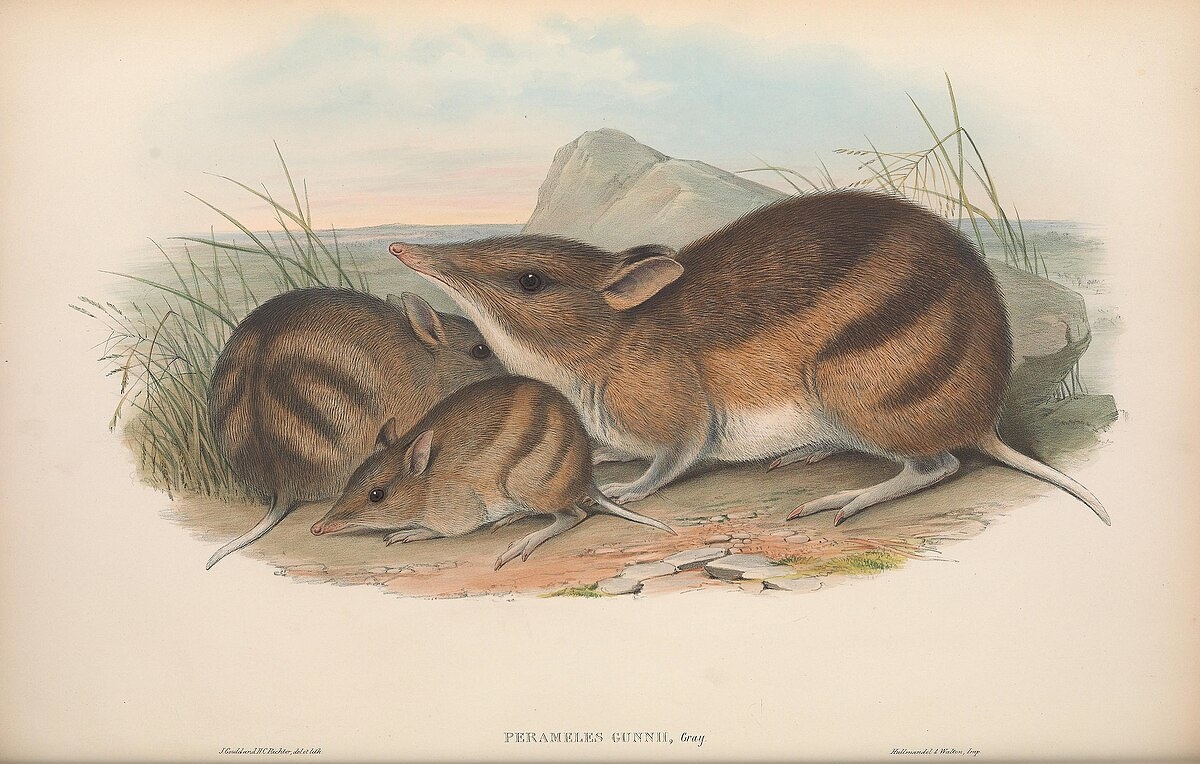
Illustration by Eastern barred bandicoot by Gould in 1863
Eastern barred bandicoot (Eastern barred bandicooti) are about the size of a rabbit and are native to Victoria in southeastern Australia, where they are struggling, and the island of Tasmania, where they are relatively abundant. One of three surviving bandicoot species in the genus Perameles, they are distinguished from their vert close relative — the long-nosed bandicoots — by the three or four dark horizontal bars found on their rump. The lifespan of the Eastern Barred Bandicoot is less than three years. [Source: Wikipedia]
Eastern barred bandicoot once lived between Melbourne and the South Australian border on mainland Australia but now are restricted to a small part of Victoria. In Tasmania, they are found primarily in the north and east. Molecular investigation indicates that the mainland and Tasmanian populations are genetically-distinct enough to be categorized as subspecies. Eastern Barred Bandicoot typically live in the grasslands and grassy woodlands. They like tall dense grass and shrub cover; most are found near a water supply. Many have adapted to living near humans — in bush blocks, tree shelter belts, and on farms where they can hide from predators. They can also be found in gardens, cemeteries, and car dumps. [Source: Eric Lancaster, Animal Diversity Web (ADW) |=|]
Eastern barred bandicoots have an average weight of is 640 to 766 grams (22.5 and 27 ounces) and have a a head and body length of up to 34 centimeters. (13.4 inches), with a 10-centimeter (3.9-inch) -long tail. The head is elongated and slender, with a pink nose and whiskers at the end and large, prominent rabbit-like ears at the top. The skull is flattened and the rostrum (hard, beak-like structures projecting out from the head or mouth) is very long. Females have a pouch. The fur of Eastern barred bandicoots is greyish brown and very soft. The torso and hindquarters have the characteristic pale bars or stripes — the source of bandicoot’s name. Eastern barred bandicoot are easily distinguishable from the brown bandicoot in that the latter lacks stripes. The underside and tail of Eastern barred bandicoots is creamy white. There are strong claws on their hands and feet. Their dental formula is 4/3, 1/1, 3/3, 4/4. Their average basal metabolic rate is 1.902 watts.
RELATED ARTICLES:
BANDICOOTS: CHARACTERISTICS, BEHAVIOR AND REPRODUCTION ioa.factsanddetails.com
BANDICOOT SPECIES IN NORTHERN, EASTERN AND WESTERN AUSTRALIA ioa.factsanddetails.com
BILBIES: CHARACTERISTICS, SPECIES BEHAVIOR AND REPRODUCTION ioa.factsanddetails.com
POSSUMS OF AUSTRALIA AND NEW GUINEA: SPECIES: CHARACTERISTICS, BEHAVIOR AND REPRODUCTION ioa.factsanddetails.com
BRUSHTAILED POSSUMS: CHARACTERISTICS, BEHAVIOR, REPRODUCTION, SPECIES, PESTS ioa.factsanddetails.com
GLIDERS OF AUSTRALIA AND NEW GUINEA: MARSUPIAL EQUIVALENTS OF FLYING SQUIRRELS ioa.factsanddetails.com
GLIDER SPECIES (SUGAR, MAHOGANY, GREATER, YELLOW-BELLIED): CHARACTERISTICS AND BEHAVIOR ioa.factsanddetails.com
CUSCUSES: CHARACTERISTICS, SPECIES, BEHAVIOR AND REPRODUCTION ioa.factsanddetails.com
CUSCUSES OF SULAWESI factsanddetails.com
MARSUPIALS: HISTORY, EVOLUTION, CHARACTERISTICS, BEHAVIOR, REPRODUCTION ioa.factsanddetails.com
MARSUPIALS IN AUSTRALIA ioa.factsanddetails.com
MARSUPIALS IN AUSTRALASIA (AUSTRALIA, NEW GUINEA, NEARBY ISLANDS) ioa.factsanddetails.com
Eastern Barred Bandicoot Diet, Behavior and Reproduction
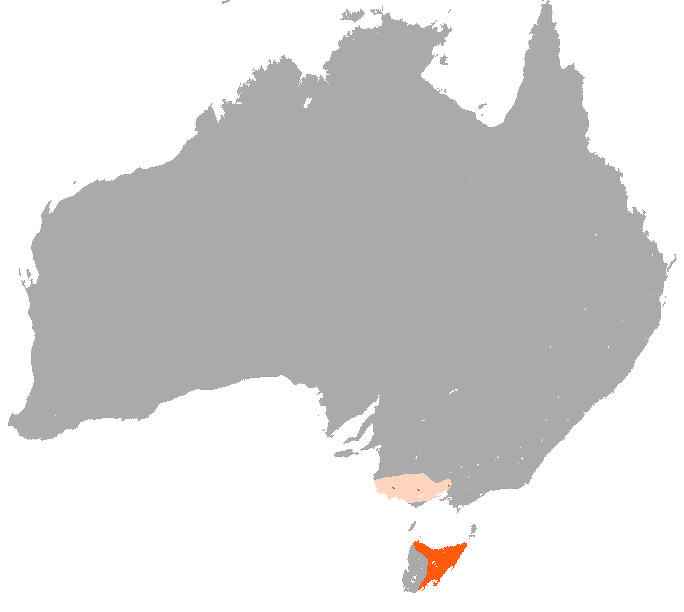
Eastern barred bandicoot range: (orange — native, light orange — reintroduced)
Eastern barred bandicoots are solitary, terricolous (live on the ground), nocturnal (active at night), crepuscular (active at dawn and dusk) and motile (move around as opposed to being stationary), sedentary (remain in the same area). During the day they stay in their nest, which are usually no more than a shallow depression in the ground with a dome of grass pulled over the top. Only one adult bandicoot occupies a nest. After dusk they emerge and immediately begin foraging for food. When they are disturbed Eastern barred bandicoots are quite vocal — snuffling, sqeaking, and hissing trying to make the danger go away. They can move very fast — combining galloping and jumping a meter at a time. They are also known to be very aggressive. The only time that eastern barred bandicoots intermix with others is during the breeding season and they are looking for a mate. The home range for males is approximately 100 acres (40 hectares ), and 75 acres (30 hectares ) for females. These territories do overlap. |=|[Source: Eric Lancaster, Animal Diversity Web (ADW) |=|]
Eastern barred bandicoots mainly consume invertebrates such as earthworms in the soil but also eats small vertebrates, a variety of invertebrates, and some vegetation. They use their well developed sense of smell to locate food and their strong claws and their long slender nose to dig small conical holes in the ground from which their food is extracted. Food items include root-eating grubs, cockchafers, corbies, worms, beetles, and some plant material such as roots and berries. One study found lot of berries in the eastern barred bandicoot's diet.
Eastern barred bandicoots have a very high reproductive rate but their mortality rate is also extremely high, particularly among juveniles. Females may begin breeding as young as age as three months and may produce three or four litters during a breeding season. The average gestation period is only 12 days and litter sizes are have one to four young, meaning that females can produce up to nearly 16 young in one breeding season. In Tasmania, young are born between late May and December. Young remain in the mother's pouch for about 55 days and remain with their mother in the nest for a week or two after they leave the pouch. This is the only time that one will find an eastern barred bandicoot sharing its nest. On average females reach sexual or reproductive maturity at three months and males do so at five months.
Recovery of Endangered Eastern Barred Bandicoots
On the International Union for Conservation of Nature (IUCN) Red List, Eastern barred bandicoot are listed as Near Threatened; On the U.S. Federal List they are classified as Endangered. In CITES (Convention on International Trade in Endangered Species of Wild) they are in Appendix I, which lists species that are the most endangered among CITES-listed animals and plants. The mainland population in Victoria is the focus of ongoing conservation efforts.
The wild population of eastern barred bandicoot on mainland Australia was estimated to be only 300 and 400 animals in the 2000s. Reasons for the decline include habitat degradation, grazing by eastern grey kangaroos, predation by introduced species such as cats, dogs and foxes, the use of pesticides, and accidents with motor vehicles. The lifespan of the eastern barred bandicoot is less than three years. Cats and dogs have wiped out some populations. Cats carry the disease Toxoplasmosis, which can be transmitted to eastern barred bandicoots and is often fatal.[Source: Eric Lancaster, Animal Diversity Web (ADW) |=|]
Eastern barred bandicoot have been making a comeback in southern mainland Australia and have been were taken off Victoria's "extinct in the wild" list. The BBC reportedly “Now, after 30 years of conservation efforts, the number has jumped from just 150 animals to an estimated 1,500. It is the first time Australia has changed the status of an animal from "extinct in the wild" to "endangered". When recorded population levels of the bandicoots plunged in the years leading up to the late 1980s, conservation teams in the state of Victoria invested millions of dollars setting up captive breeding programs. “They created predator-free sites — some of which were protected by trained dogs — and moved some of the animals to fox-free islands.[Source: BBC, September 16, 2021]
Conservation efforts have been led by Victoria's Environment Ministry and Zoos Victoria. They set up captive breeding programs and released Eastern barred bandicoot into the wild and created several sub-populations. The captive program has been very positive with solid growth rates and 95.6 percent of wild source gene diversity retained.
Southern Brown Bandicoots
Southern brown bandicoots(Isoodon obesulus) are short-nosed bandicoots that were long regarded as a brown bandicoot subspecies and were only elevated to species status in 2018. They are found mostly in southern Australia. A subspecies in southwestern Australia is known locally as the quenda (from the Noongar word 'kwinda'). [Source: Wikipedia]
Southern brown bandicoots are found sporadically throughout the southernmost coastal regions of Australia — on the southern tip of Western Australia, in the coastal region of Victoria to New South Wales, a small part of the northernmost coastal Queensland, and throughout Tasmania. Southern brown bandicoots are associated most with coastal areas but are found in other habitats. They prefer areas with dense, swamp-like vegetation and brush up to one meter tall near bodies of water such as lakes, streams, or the ocean. They also inhabit inland areas such as forests and scrubland with dense ground vegetation, which provided them with protection and has lots of insects to eat. [Source: Kasey Blevins, Animal Diversity Web (ADW) |=|]
Southern brown bandicoots are not endangered or threatened. They are designated as a species of least concern on the International Union for Conservation of Nature (IUCN) Red List and have no special status on the Convention on International Trade in Endangered Species (CITES). Their numbers are relatively healthy and stable especially in protected areas and national parks. Threats have included urbanization, deforestation, other forms of habitat degradation, road accidents and predation mainly by foxes and cats.
Southern Brown Bandicoot Characteristics and Diet
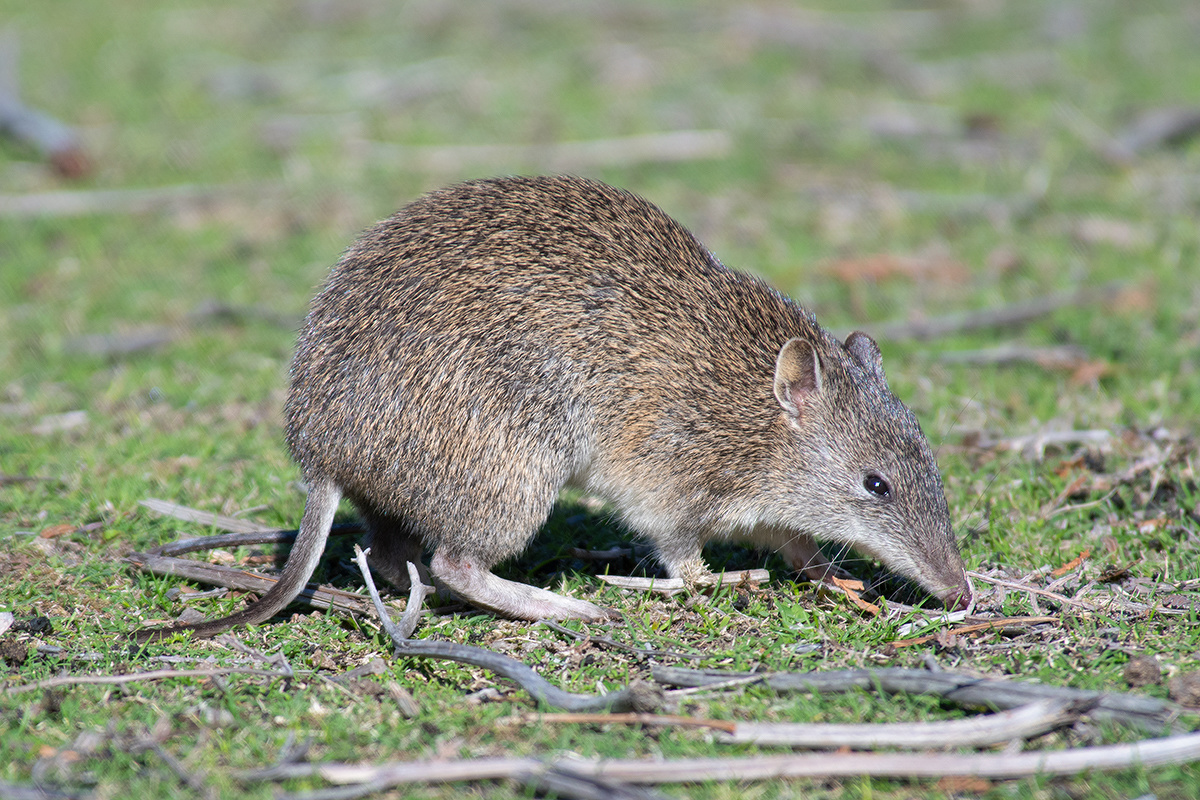
Southern brown bandicoot on Maria Island, Tasmania
Southern brown bandicoots range in weight from 0.4 to 1.85 kilograms (0.9 to 2 pounds) and are 37 to 50 centimeters (14.6 to 19.7 inches) in length, with their tail making up as much as 40 percent of their length. Their average basal metabolic rate is 1.238 watts. Sexual Dimorphism (differences between males and females) is present: Both sexes look similar but males are slightly larger. They average 33 centimeters in body and head length, with a 12.4-centimeter tail, compared to 30 centimeters for females, who have a 11.3-centimeter tail. Some individual have a a small tail of no tail at all — the result of fighting between males. [Source: Kasey Blevins, Animal Diversity Web (ADW) |=|]
Southern brown bandicoots have very short, coarse fur that can include a mixture of colors ranging from black and grey to brown and golden yellow. Unlike many other bandicoots, they have very small ears that are rounded at the top and face outwards. The snout of southern brown bandicoots is much smaller than that of long-nosed bandicoot (Perameles nasuta). The lifespan of southern brown bandicoot in the wild is two to four years. They typically live up to 6.5 years in captivity.
Southern brown bandicoots are omnivores (animals that eat a variety of things, including plants and animals). They mainly eat insects and non-insect arthropods such as ants, beetles, earthworms, centipedes, crickets, butterflies, and earwigs. However, they also eat plants, fungi, seeds, grain, nuts and flowers. When searching for food, southern brown bandicoots use their sense of smell to locate food sources and usually dig small holes in the soil to get it. It is common to see lots of holes in areas with high concentration of food. Southern brown bandicoots have also been observed foraging in aboveground vegetation and leaf litter. An indication of the presence of southern brown bandicoots are small cylindrical-shaped scratch marks and holes in the soil that they leave behind when they stick their nose into the ground. These holes can be several centimeters deep.
Southern Brown Bandicoot Behavior
Southern brown bandicoots are terricolous (live on the ground), fossorial (engaged in a burrowing life-style or behavior, and good at digging or burrowing), diurnal (active during the daytime), nocturnal (active at night), crepuscular (active at dawn and dusk), motile (move around as opposed to being stationary), sedentary (remain in the same area) and have daily torpor (a period of reduced activity, sometimes accompanied by a reduction in the metabolic rate, especially among animals with highmetabolic rates). The home range for southern brown bandicoot varies on the amount of other bandicoots in the area. Males can have a range varying between two to seven hectares (5 to 17 acres), while females range between one to three hectares (2.5to 4.5 acres). Both males and females tend to avoid one another except during the breeding season. [Source: Kasey Blevins, Animal Diversity Web (ADW) |=|]
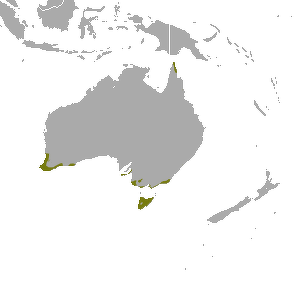
range of southern brown bandicoot
Southern brown bandicoots tend to be more active during the day in the winter, when they are active for six to seven hours a day. Almost all of this time is spent searching for food, getting water, grooming or feeding. Southern brown bandicoot nest-shelters are made various shrubbery and vegetation that the animals collect and make into a sort of dome over a shallow hole such as a vacant rabbit hole or a depression in the ground. Places selected for shelter-nests are hidden by vegetation and bush.
Bandicoots are solitary, except during the breeding season. When males meet one another, they are often hostile towards one another. During fights for dominance, males bite and attack each other with their forepaws. Such attacks often leave males with all or part of their tail missing. Females, whether coming in contact with males or females, tend to avoid one another. Bandicoot digging turns over an average of 10 kilograms of soil per day.
Southern brown bandicoots sense and communicate with vision, touch, sound and chemicals usually detected by smelling. Their eyesight is adpated for noctural foraging but smell is more important in locating food. Males have been observed aggressively naso-nasal and naso-anal sniffing each other, retreat, and then repeating. Four specific sounds and vocalizations by southern brown bandicoots have been identified: 1) high-pitched, bird-like sounds used to locate one another; 2) loud “chuff, chuff” noises, often combined with a loud squeaky whistle, used when threatened; 3) a loud shriek, when southern brown bandicoots are experiencing fear or pain; and 4) and “whuff, whuff” sound made when irritated.
Among the predators of southern brown bandicoots are red foxes, wild dogs, domestic and feral cats, owls and tiger snakes. For defense southern brown bandicoot mainly hide in ground vegetation, with their fur color providing camouflage.
Southern Brown Bandicoot Mating, Reproduction and Offspring
Southern brown bandicoots have a high reproductive rate thanks to a short gestation period, rapid sexual cycle and long breeding season. The gestation period ranges from 12 to 16 days. The number of offspring ranges from two to six, with the average number of offspring being around three. The rapid sexual cycle allows the female to have the capability to be in heat before one litter is weaned, meaning it is able to have another litter almost immediately after the prior one leaves the pouch. [Source: Kasey Blevins, Animal Diversity Web (ADW) |=|]
Southern brown bandicoots are polygynandrous (promiscuous), with both males and females having multiple partners, and engage in seasonal breeding. Females can breed up to four times during the breeding season from July to February in Victoria, extending to February in Tasmania, with females having a different partner every time they breed..
Parental care is provided by females. Young are altricial, meaning they are relatively underdeveloped at birth. At birth, neonates weigh between 0.2-0.4 grams and are about one centimeters long but they develop quickly into adults. Young spend two months in their mother’s pouch. While in the pouch, they are nursed on one of her eight teats.Not all of the teats get used at one time because of the average litter size and the rapid weaning of the litters. The weaning age ranges from 60 to 70 days and the age in which they become independent ranges from 70 to 75 days.
After the young leave the pouch, they are left to live and fend for themselves as solitary individuals. Both males and females reach reproductive maturity in four to six months after being born. Males continuously grow throughout their lifetime. Females stop growing around 18 to 24 months.
Extinct Pig-Footed Bandicoots
Pig-footed bandicoots (in the genus Chaeropus) have not been seen since the 1950s and are believed to be extinct. They once ranged across southwest and central Australia and were wiped by lost of habitat to ranchers and attacks by introduced foxes and feral cats. Pig-footed bandicoots were found throughout central and south Australia and in Victoria. They resided in a variety of habitats. In the central deserts they lived in sand dunes and sand plains. In Victoria, they resided in the grassy plains. In other areas, they favored open woodlands containing shrubs and grass.
In 2019 the description of the population was revised, recognizing: 1)The southern pig-footed bandicoot (Chaeropus ecaudatus); 2) the central western population as Chaeropus yirratji. Also two southern pig-footed bandicoot subspecies were recognized based on earlier descriptions: A) Chaeropus ecaudatus ecaudatus (found in southeastern Australia) and B) Chaeropus ecaudatus occidentalis (found in western and southwestern Australia). [Source: Wikipedia]
Pig-footed bandicoots get their common name from their feet, which are kind of like those of a pigs, They received their scientistic name — Chaeropus ecaudatus, which means a "tailless pig-foot" — after the discovery of a specimen that had lost its tail, perhaps in a fight with another pig-footed bandicoot. The scientist who described it assumed it was tailless, when, in fact, it the longest tail of all bandicoots. When the mistake was recognized it was too late to rename it.[Source: Rebecca V. Normile, Animal Diversity Web (ADW) |=|]
On the International Union for Conservation of Nature (IUCN) Red List, Pig-footed bandicoots are listed as Extinct. There is some debate over when pig-footed bandicoots were last seen. The last reliably dated museum specimen was from 1901. However, the Pintupi people in the central deserts report that it survived there until the 1950s. There has been some disagreement over the taxonomic classification of pig-footed bandicoots. They were listed under the subfamily Peramelinae, which includes all of the non-spiny bandicoots. Later pig-footed bandicoots were placed in their own family, Chaeropodidae, based on the due to the uniqueness of its physical characteristics.
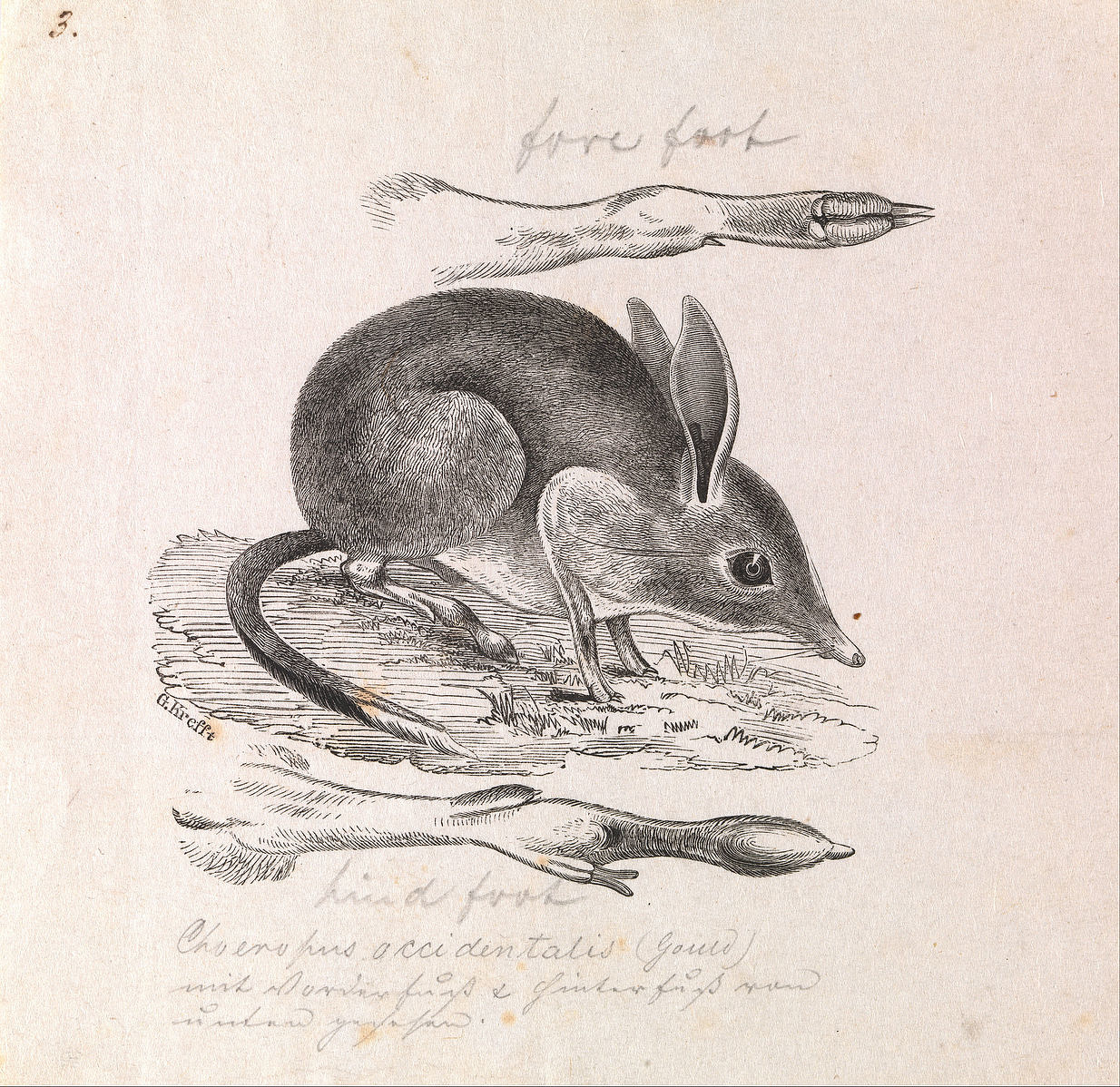
Pig-footed bandicoot illustration by the German artist Gerard Krefft (1830-1881)
The collapse of the species seems to have happened relatively quickly after the Europeans began moving into their range. Pig-footed bandicoots were never really hunted much by Europeans or locals but some Aboriginal grousp ate their meat as a delicacy, and used the tail tuft as an ornament. Before European settlement, local Aboriginals natives burned small grass areas which soon regenerated, providing a fresh supply of food and shelter for bandicoots. Europeans stopped the burning and introduced livestock ranching, with sheep and cattle grazing on grass areas that the bandicoots liked, negatively impacting and changing the pig-footed bandicoot's habitat. Pig-footed bandicoots were also negatively impacted by rabbits, foxes, and cats — all of which competed with pig-footed bandicoots for food or ate them — introduced by Europeans they were not the main cause of their extinction. The decline of the pig-footed bandicoots began before these new fauna were introduced.
Pig-Footed Bandicoot Characteristics and Behavior
Pig-footed bandicoots had a compact body and pointed head, similar to other bandicoots and had course, orange-brown fur on their back and a lighter fawn-color fur on their underside. Their body and head length was 23 to 26 centimeters (9 to 10.3 inches). Their longish orange-brown was 10 to 15-centimeters (3.9 to 5.9 inches) long and ended with a black tuft. pig-footed bandicoot had long "rabbity" ears and their legs and feet were very different than other bandicoot species. Both their forelegs and hindlegs were long and thin. The forefeet had only two functional toes with hoof-like nails, resembling those of a pig. On their hindfeet, the second and third toes were fused, and only the fourth was used in locomotion. Pig-footed bandicoots had about 46-48 teeth inside their long jaws. The incisors were flattened and polyprotodont, and the cheek teeth were selenodont. [Source: Rebecca V. Normile, Animal Diversity Web (ADW) |=|]
Pig-footed bandicoots were omnivores (eat a variety of things, including plants and animals) Their tooth and intestinal structures were like that of herbivorous (plants or plants parts) diet of most bandicoots. Aboriginals reported that they ate termites and ants, and may have even eat to flesh. In captivity they ate grass, lettuce, roots, and grasshoppers, confirming a more herbivorous diet.
Pig-footed bandicoots are believed to have been solitary and not as fully nocturnal (active at night) as other bandicoots. Depending on their environment, they lived in grass-lined nests or dug short burrows with a nest at the end. These bandicoots were ground-living and probably used their sense of smell to find food on the ground, or in the holes they dug.
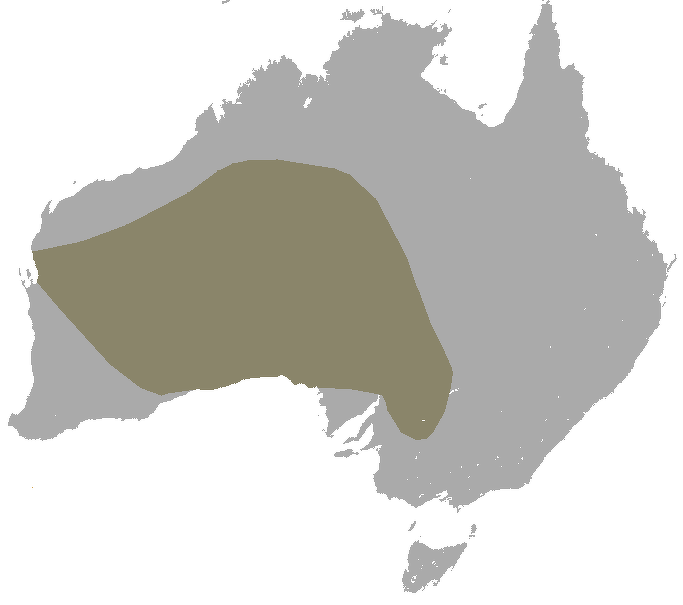
former range of pig-footed bandicoots
The most notable behavior of the pig-footed bandicoot was their movement, which was extremely varied, depending on which gait it took. Their slow gait looked like a bunny-hop, with the weight of the body taken by the forelimbs while the hindlimbs were brought forwards together. The intermediate gait was an awkward quadrepedal run with the hindlimbs moving alternately. At high speed they used a smooth, galloping gait. Aboriginals reported the animals could reach great speeds upon being pursued.
Pig-footed bandicoots possessed eight teats, but did not carry more than four young per litter. Females had a well developed pouch which opened towards the rear. Bandicoots, in general, have a very short gestation period. Otherwise not much is known about the reproduction of pig-footed bandicoots Image Sources: Wikimedia Commons
Text Sources: Animal Diversity Web animaldiversity.org , National Geographic, Live Science, Natural History magazine, Australian Museum, David Attenborough books, Australia Geographic, New York Times, Washington Post, Los Angeles Times, Smithsonian magazine, Discover magazine, The Conversation, The New Yorker, Time, BBC, CNN, Reuters, Associated Press, AFP, Lonely Planet Guides, Wikipedia, The Guardian, Top Secret Animal Attack Files website and various books and other publications.
Last updated July 2025