
Home | Category: Nature, Environment, Animals / Marsupials
BRUSHTAILED POSSUMS
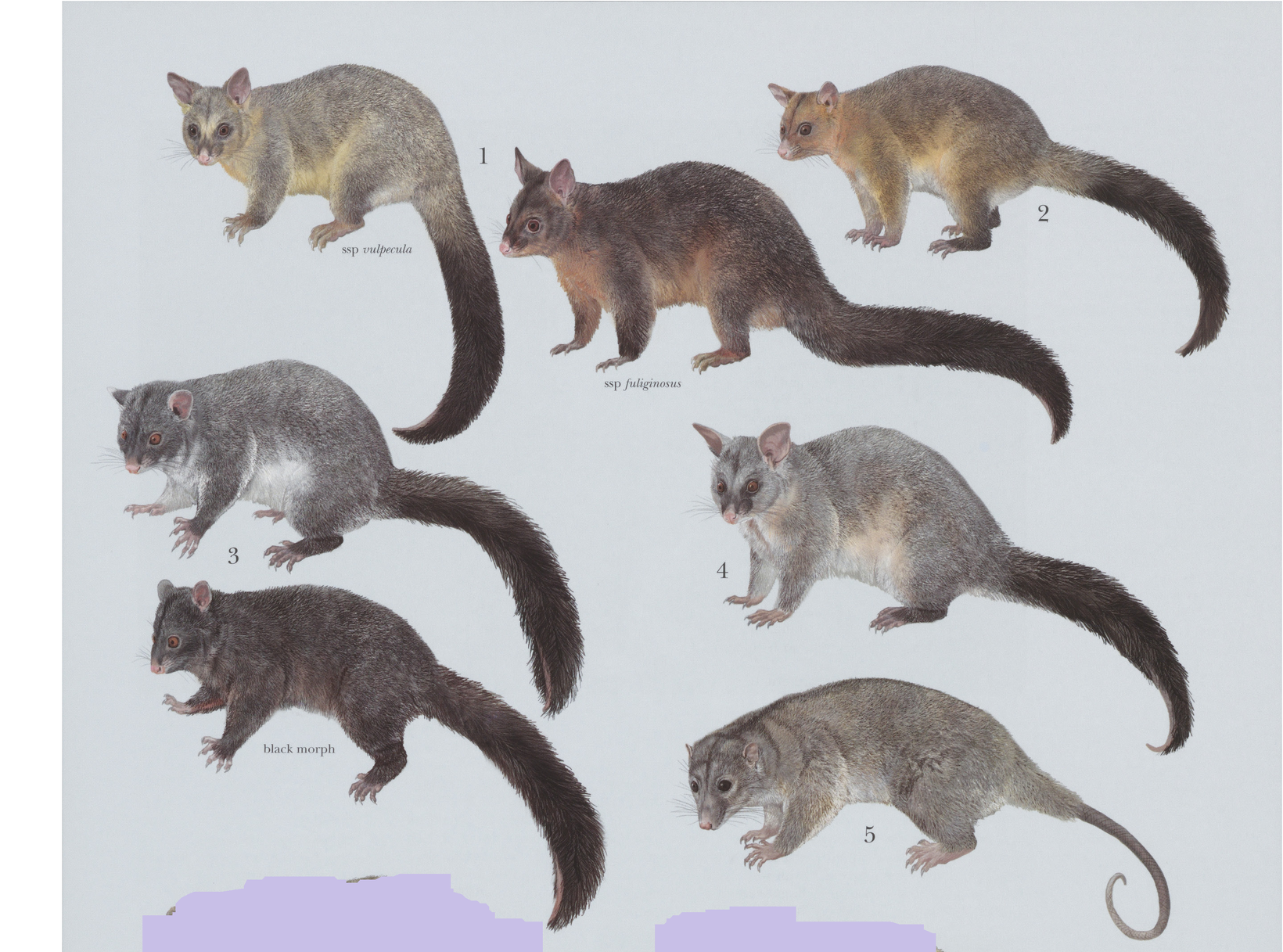
Brushtailed Possum Species: 1) Common Brushtailed Possum (Trichosurus vulpecula), 2) Coppery Brushtailed Possum (Trichosurus johnstonii), 3) Short-eared Brushtailed Possum (Trichosurus caninus), 4) Mountain Brushtailed Possum (Trichosurus cunningham), 5) Scaly-tailed Possum (Wyulda squamicaudata)
Brushtail possums are the members of the genus Trichosurus in the Phalangeridae family of marsupials. Only distantly related to American possums, they are native to Australia (including Tasmania) and some small nearby islands and are most common in eastern and southeastern Australia. There are five species. The most common is the common brushtail or grey possum, which are widespread in every state and territory of Australia. They are often regarded as a pest not just in Australia but also New Zealand where they have been introduced.
The five species of brushtail possum are:
Northern brushtail possum (Trichosurus arnhemensis), formerly a subspecies of Common brushtail possum (Trichosurus vulpecula arnhemensis)
Short-eared possum (Trichosurus caninus)
Mountain brushtail possum (Trichosurus cunninghami)
Coppery brushtail possum (Trichosurus johnstonii), formerly a subspecies of Common brushtail possum (Trichosurus vulpecula johnsoni)
Common brushtail possum (Trichosurus vulpecula)
Brushtail possums are nocturnal marsupial that are about 75 centimeters (two and a half feet) long from nose to the end of their tail and can live up to 12 years. They are usually gray and black in color, look like giant furry mouses, and have rusty streaks on their undersides that are scent glands. Brushtail possums are unique among marsupials in that they have shifted their hypaxial muscles (at the front of the trunk and including the body wall, diaphragm and abdominal muscles) from the epipubic bones that marsupial possess to the pelvis, much like non-marsupial mammals, meaning that their breathing cycle is more similar to non-marsupial mammals than other marsupial. In general, brushtail possums they are more terrestrially oriented than other possums, and in some ways might parallel primates.
Brushtail possums spend their days in burrows or hollowed dogs. Unlike their North American cousin, they don't "play possum." They cough and hiss instead. Females generally live longer and are stronger fighters than males. They generally give birth to a single joey that lives the first four months in their mother's kangaroo-like pouch and thenJuly 31, 2025 emerge to ride for another two months on their mother's back. When the young possums strike out on their own, young females generally stay in the mother's territory while males disperse as far as ten miles from their birth site.
RELATED ARTICLES:
POSSUMS OF AUSTRALIA AND NEW GUINEA: SPECIES: CHARACTERISTICS, BEHAVIOR AND REPRODUCTION ioa.factsanddetails.com
GLIDERS OF AUSTRALIA AND NEW GUINEA: MARSUPIAL EQUIVALENTS OF FLYING SQUIRRELS ioa.factsanddetails.com
GLIDER SPECIES (SUGAR, MAHOGANY, GREATER, YELLOW-BELLIED): CHARACTERISTICS AND BEHAVIOR ioa.factsanddetails.com
CUSCUSES: CHARACTERISTICS, SPECIES, BEHAVIOR AND REPRODUCTION ioa.factsanddetails.com
CUSCUSES OF SULAWESI factsanddetails.com
MARSUPIALS: HISTORY, EVOLUTION, CHARACTERISTICS, BEHAVIOR, REPRODUCTION ioa.factsanddetails.com
MARSUPIALS IN AUSTRALIA ioa.factsanddetails.com
MARSUPIALS IN AUSTRALASIA (AUSTRALIA, NEW GUINEA, NEARBY ISLANDS) ioa.factsanddetails.com
Common Brushtail Possums
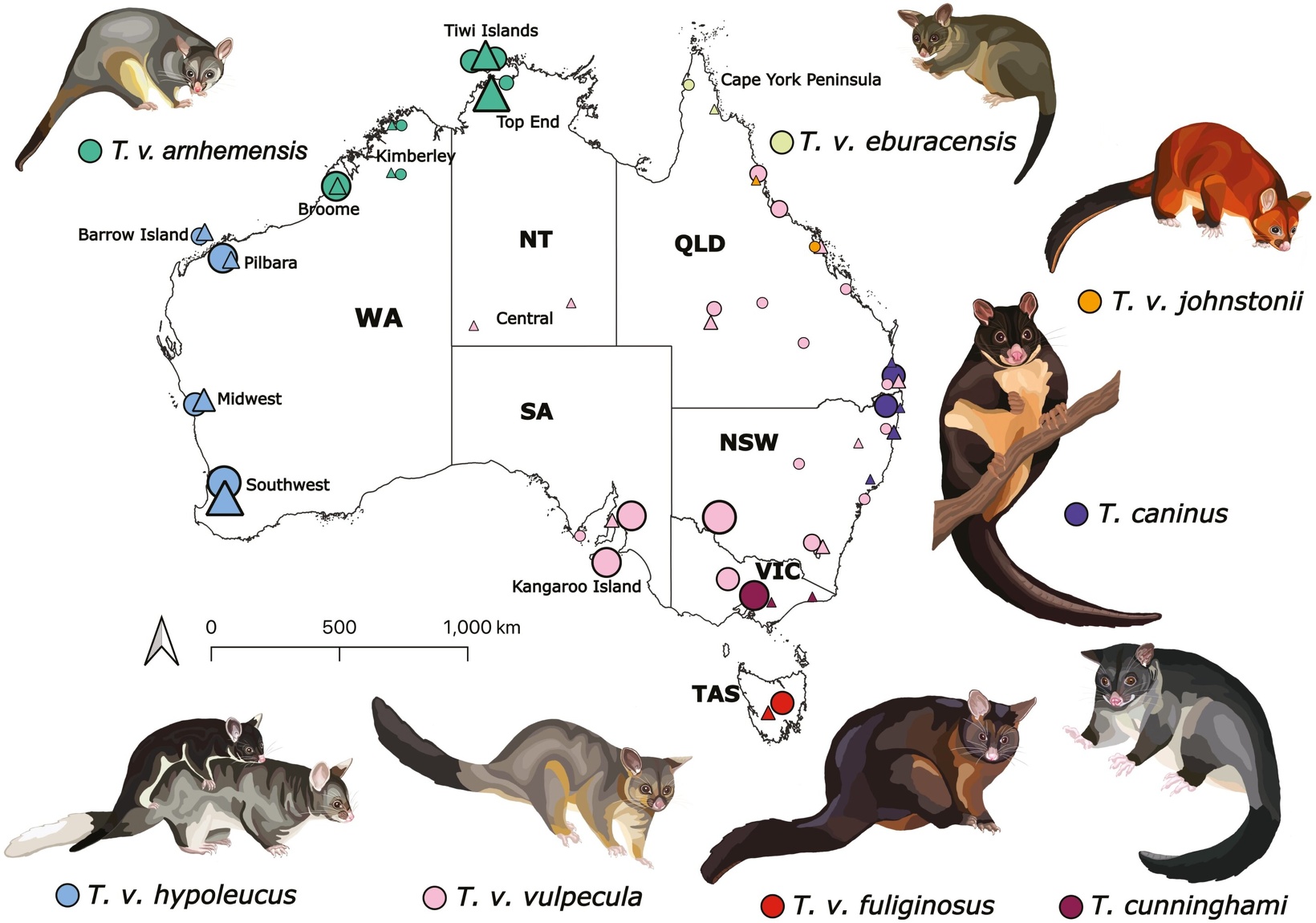
Locations of brushtail possums
five brushtail possum species:
Northern brushtail possum (Trichosurus arnhemensis)
Short-eared possum (Trichosurus caninus)
Mountain brushtail possum (Trichosurus cunninghami)
Coppery brushtail possum (Trichosurus johnstonii), formerly a subspecies of Common brushtail possum (Trichosurus vulpecula johnsoni)
Common brushtail possum (Trichosurus vulpecula)
five common brushtail possum subspecies
South-eastern common brushtail possum and central brushtail possum (Trichosurus vulpecula vulpecula)
Northern brushtail possum (Trichosurus vulpecula arnhemensis)
Cape York brushtail possum (Trichosurus vulpecula eburacensis)
Tasmanian brushtail possum (Trichosurus vulpecula fuliginosus)
South-western brushtail possum or Koomal (Trichosurus vulpecula hypoleucus); from Edith Cowan University
Common brushtail possums (Trichosurus vulpecula) are large-eyed, tree-dwelling Australian natives that have been introduced to New Zealand where they are regarded as pests. They are commonly known as brushtail possums, bushy-tail possums, silver-grey possums, and silver-grey brushtail possums. In some regions, particularly in New Zealand, where they are an introduced pest, they may also be referred to as paihamu, a transliteration of "possum" in Māori.
Common brushtail possums are a nocturnal, semi-arboreal marsupials and the second largest possum species. They have the widest distribution of any Australian mammal and can be found throughout most of Australia and Tasmania. They only place they are not found in Australia is the really harsh, dry, hot interior of the country. They also thrives in New Zealand, where they were introduced in 1840.
Common brushtail possums are usually found in forested or woodland areas, which vary greatly throughout their range. In Tasmania, they occur throughout the rainforests and dry woodlands that cover over 60 percent of the island. In northwest Australia, they favor eucalyptus forests and mangroves. In southern Australia, they usually live in wooded areas, but are sometimes found living a semi-terrestrial life where they den in rock crevasses and termite mounds. In New Zealand, common brushtail possums are mostly commonly found in forested areas. [Source: Grace Meyer, Animal Diversity Web (ADW) |=|]
Common brushtail possum subspecies and former subspecies (now species)
South-eastern common brushtail possum and central brushtail possum (Trichosurus vulpecula vulpecula) are typically grey in color: and found throughout southern Australia.
Northern brushtail possum (Trichosurus vulpecula arnhemensis) are usually grey in color and found in the northern tropical regions of Australia. They are now recognized as the species Trichosurus arnhemensis.
Cape York brushtail possum (Trichosurus vulpecula eburacensis) are typically grey in color and found in Cape York, Queensland.
Coppery brushtail possum (Trichosurus vulpecula johnsoni) are typically red in color and found in eastern Queensland. They are now recognized as the species Coppery brushtail possum (Trichosurus johnstonii)
Tasmanian brushtail possum (Trichosurus vulpecula fuliginosus) are black in color and found in Tasmania.
South-western brushtail possum or Koomal (Trichosurus vulpecula hypoleucus)
In Australia, common brushtail possums are the wild animal most often seen by city dwellers. The animals do well in a wide range of human-modified environments. Around human habitations, they are known for ravaging fruit trees, and vegetable gardens, and even raiding kitchens. But their once vast distribution has been greatly affected by drought, epizootic disease and intrusion of invasive mammals into their habitat.
Common Brushtail Possum Characteristics and Diet
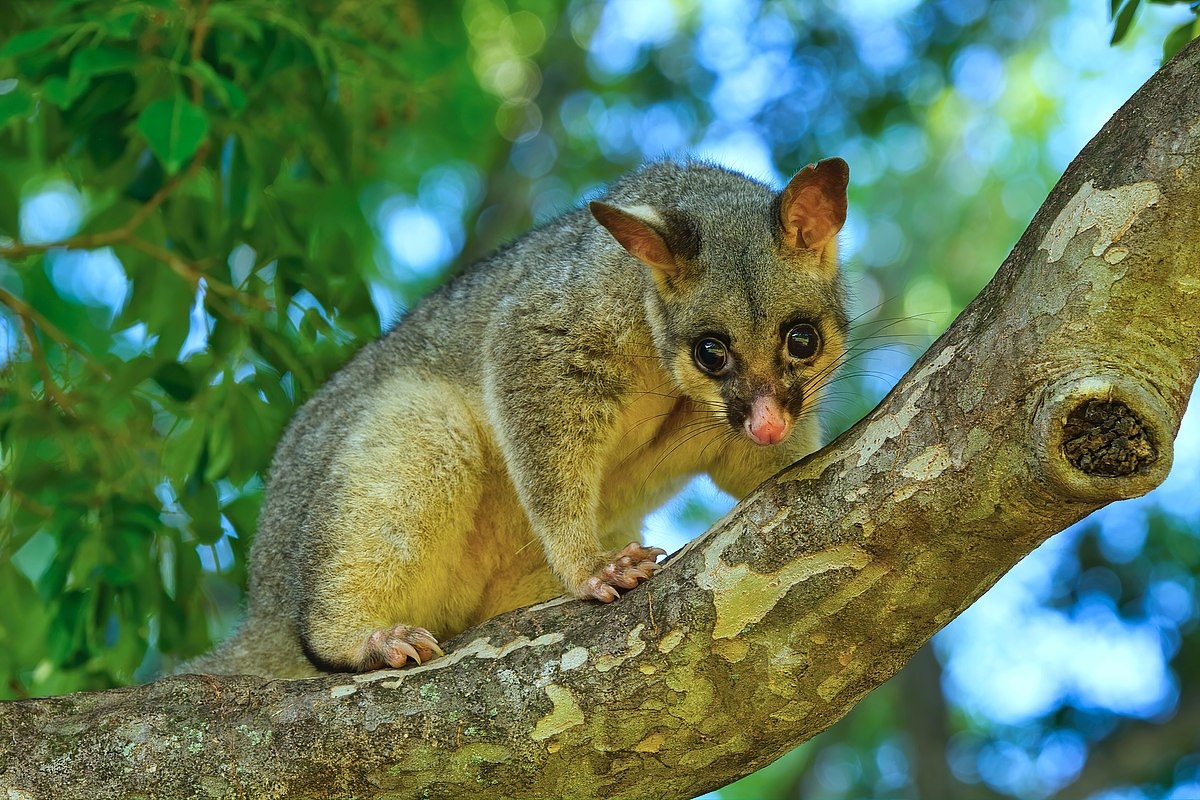
light brown and reddish common brushtail possum in Brisbane
Common brushtail possums range in weight from 1.2 to 4.5 kilograms (2.7 to 9.9 pounds). They have a head and body length of 32 to 58 centimeters (12.6 to 22.8 inches) and a tail length of 24 to 35 centimeters (9.4 to 13.8 inches). Their average basal metabolic rate is 3.8 watts. They can live up to 13 years in the wild and 14.7 years in captivity. but typically live to seven years if they survive their youth. The mortality rate for common brushtail possums is 75 percent for those under one year of age. That number drops considerably as the young mature. The mortality rate is only around 20 percent among adults. Sexual Dimorphism (differences between males and females) Males tend to be larger than females. The coat of males is often be reddish at the shoulders. Females brushtail possum have a well-developed pouch. [Source: Grace Meyer, Animal Diversity Web (ADW) |=|; Wikipedia]
Common brushtail possums have large eyes, tall pointed ears and a bushy prehensile tail — the source of their name — adapted to grasping branches. Their fore feet have sharp claws and the first toe of each hind foot is clawless, but has a strong grasp. The animals groom themselves with their third and fourth toes which are fused together. The fur of common brushtail possums is short but dense, and its tail is typically long and is covered in long bushy fur. In some subspecies, the fur on the tail is the same length as on the rest of the body. Throughout its range, there is considerable variation in the coat color of common brushtail possums. Color seems to vary according to habitat, and helps identify the subspecies mentioned above. In all subspecies, the underside is lighter than the sides and back. A scent gland located on the chest is used to mark territories. The reddish secretions from this gland give the fur around it a brown or reddish appearance. Like most marsupials, females have a small pouch that opens towards the head.
Common brushtail possums are omnivores (eat a variety of things, including plants and animals). They typically eats leaves, shoots, and flowers and have a remarkable ability to make use of available food sources in their range. Their diet includes a large number of highly toxic flowers and leaves. They prefer to feed on Eucalyptus flowers, which are toxic, but also eat from a number of various other trees and shrubs as well as clovers, grasses, garden fruits and turnips. They have also been observed eating animal matter such as insects, birds' eggs and chicks, and other small vertebrates. Brushtail possums may eat three or four different plant species during a foraging trip, unlike some other arboreal marsupials, such as the koala and the greater glider, which focus on single species. The brushtail possum's rounded molars cannot cut Eucalyptus leaves as finely as more specialised feeders. They are more adapted to crushing their food, which enables them to chew fruit or herbs more effectively. The brushtail possums' caecum lacks internal ridges and cannot separate coarse and fine particles as efficiently as some other arboreal marsupials. Brushtail possums cannot rely on Eucalyptus alone to provide sufficient protein. They have a more generalised and mixed diet, but it does provide adequate nitrogen.
Common Brushtail Possum Behavior and Reproduction
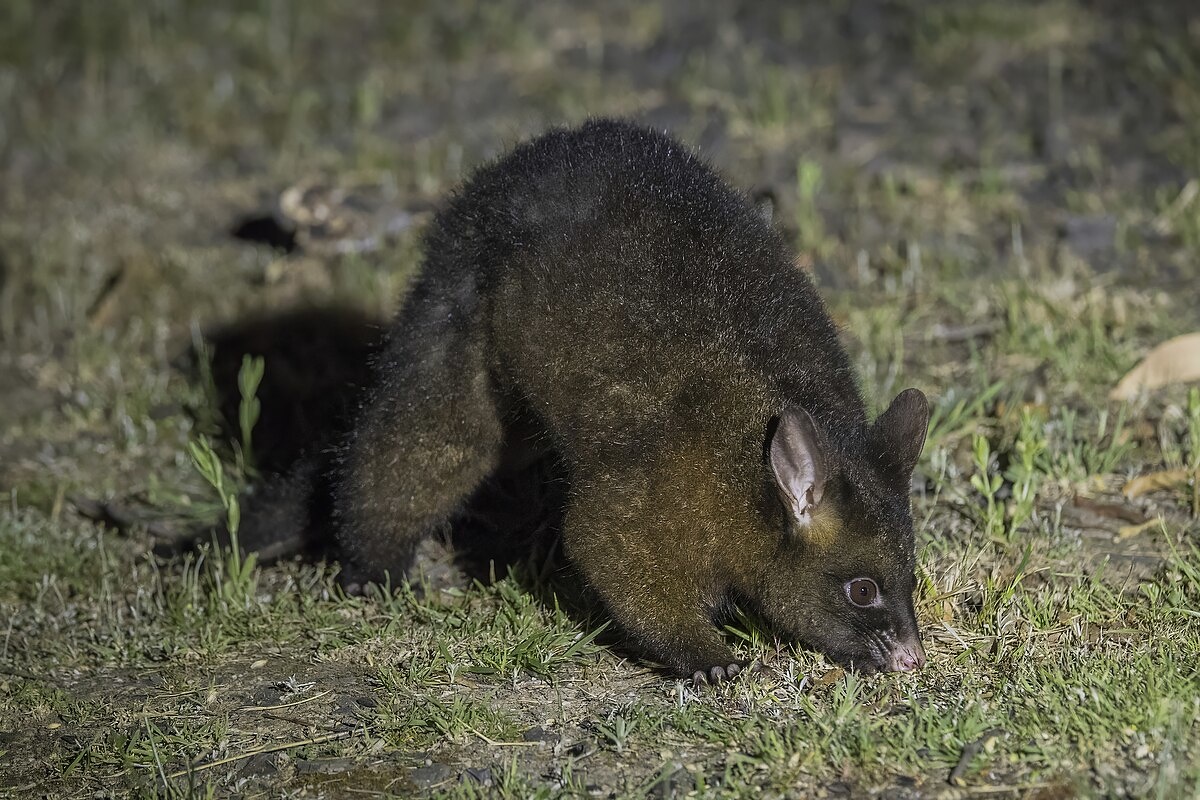
dark brown, blackish common brushtail possum near Scottsdale, Tasmania
Common brushtail possums are arboreal (live mainly in trees), nocturnal (active at night) and motile (move around as opposed to being stationary). During the day they rests in hollowed out logs or trees, but in more urban areas, it finds shelter wherever it can, including in peoples' attics. At night they forage for food
Common brushtail possums are regarded as a solitary species but in some places they are so numerous that home ranges of that many individuals overlap. The animals mark their territories using both anal secretions and secretions from the scent gland on their chests. Although they do not live in groups, clear dominance hierarchies have been observed where co-dominants of the same sex purposely avoid one another. There appears to be very little direct aggression among individuals. Common brushtail possums uses deep, guttural vocalizations both to communicate territory location and to attract mates during the breeding season. [Source: Grace Meyer, Animal Diversity Web (ADW) |=|]
Common brushtail possums are mostly seasonal breeders. There are typically two breeding seasons but is rare for a female to give birth twice in one year. The highest number of births occur in the fall, with fewer occurring in the spring. Some populations of the subspecies of Northern brushtail possum are known to breed continuously throughout the year. The females' estrus cycle lasts for about 25 days. The average gestation period is 17 days. The average number of offspring is one. On average females reach sexual or reproductive maturity at 10½ months and males do so at two years. Young stay in their mothers’ pouch for about four months and cling to her back for some weeks after that. Young are typically weaned by about six months, and disperse anytime between eight and 18 months.
Common Brushtail Possums, Humans and Conservation
Common brushtail possums are plentiful are far from being endangered or threatened. They are designated as a species of least concern on the International Union for Conservation of Nature (IUCN) Red List and have no special status on the Convention on International Trade in Endangered Species (CITES).
Tasmania exports fur and meat of common brushtail possums to China and Taiwan. At one time, New Zealand had a thriving fur industry that exported hundreds of thousands of brushtail possum pelts each year. Throughout their range, common brushtail possums are considered major agricultural pests, eating various kinds of crops. They have caused severe damage to eucalyptus and pine forests, and wreaked havoc in family gardens. In addition, On top of this common brushtail possums are known to carry of bovine tuberculosis which is highly contagious and can be passed on to livestock. |=|
Although once hunted extensively for their fur in Australia, common brushtail possums are now protected there. In Tasmania, the species is partially protected, but is still hunted in an annual hunting season. In addition, landowners in Tasmania can obtain Crop Protection Permits allowing them to kill common brushtail possums in the name of protecting their crops.. Common brushtail possums has thrived extensively in New Zealand, where it was introduced. There are no restrictions on hunting them in New Zealand, and even though thousands of animals of killed each year, their population does not decline. |=|
History of Brushtail Possum in New Zealand
The first bushtail possums were introduced to near the southern tip of South Island in 1837. They didn't survive. Those that were brought to nearby South Roverton in 1858 thrived. More animals were brought in, especial between 1890 and 1900, and "liberated" all over New Zealand. By 1911, farmers were complaining that possums were eating up fruits and grains. By 1922, there were reports that they were damaging forests. In 1920 the government refused to give permission for further "liberations" although trappers continued to release them illegally. After World War II, the possums became so numerous that stiff penalties were introduced for releasing them and poisoning them was legalized.
Up until fairly recently, New Zealand exported a million possum pelts a year. The best fur has traditionally been used in making fur coats, with mid-priced and lower-priced ones being used in everything from jackets and children clothing to polishing cloths and packing material for delicate jet-engine parts. The majority of the trappers who caught the possums were loners who lived in the forest. They spent their afternoons setting traps, and their morning collecting dead possums and preparing the hides for drying. Many lived in small shacks for months at a time with only a dog for a companion. In the 1980s, there were an estimated 100,000 full-time and part-time trappers. One of them, "Possum Bill" McCabe of Morrinsville, told Smithsonian magazine he caught more than 100,000 possums in his career and 700 in one night.
In the late 1980s the bottom fell out of the possum pelt business. Pelts that sold for US$8 a piece in 1987 were worth only US$2 in 1990. The collapse was due partly to the anti-fur animal rights movement but mostly to declining demand for possum fur, over production of mink fur, and warm weather in the northern hemisphere that reduced the demand for winterwear. Trappers say they need to earn around US$5 per pelt to make trapping worthwhile. Without trappers the number of possums has begun to increase.
Brushtail Possum Pests in New Zealand
Brushtail possum are arguably the most damaging introduced species in New Zealand. They were brought there from Australia in 1837 to establish a fur trade in New Zealand and now live almost everywhere there in fairly large numbers. Adult possums have no natural predators and they reproduce at the rate of 20 million offspring a year.[Source: Noel Vietmeyer, Smithsonian magazine]
There are around 70 million brushtail possums in New Zealand — even more than the country's ubiquitous sheep. With a population of just 5.3 million people, that works out to about 13 possums for every human. The possums consume an estimated 20,000 tons of plant material everyday, including flowering trees, and gobble up endangered lizards, frogs and snails.If that isn't enough the are responsible for transmitting bovine tuberculosis, which ravages cattle who pick up the disease by sniffing dead possums and passing it on to other cattle.
Richard C. Paddock wrote in the Los Angeles Times: Possums has found its niche in the woods of New Zealand, where it is devouring vegetation and threatening many of the country's more than 1,000 endangered species — including kiwis. New Zealand has no natural predator to hunt the possum, which has spread throughout 95 percent of the country. The only possum-free zones are small islands, protected peninsulas and a nature preserve in Wellington that is fenced off like "Jurassic Park." [Source: Richard C. Paddock, Los Angeles Times September 9, 2001
New Zealanders were slow to recognize the destructive habits of the possum, and they continued importing mating pairs from Australia until the 1920s to boost the fur trade. Today, possums consume an estimated seven million tons of vegetation a year, mainly the new growth of native trees. In some areas, possums have eaten the entire forest canopy. Trees often die after two years of heavy possum noshing, which has helped the animal earn a place on the World Conservation Union's list of 100 worst alien species. While possums were long believed to be vegetarians, scientists recently captured them on video stealing eggs and eating rare adult "kokako" birds in their nests.
Indigenous bird species have been driven from certain areas because the possums eat the flowers and berries they feed on. Possums also chew up gardens and electrical wiring in homes and have taken their toll on flowering Pohutukawa trees, regarded as the New Zealand Christmas tree, and rata trees, which turn bright red in the summer. In some places, possums have been blamed for reducing the number of big trees by 10 to 20 percent. Entire herds of cattle that have picked up bovine tuberculosis from the possums. There are fears that humans may pick up a mutation of the disease.
In Australia, brushtail possums are plentiful but they are not regarded as pests because their numbers are kept in check by carpet pythons, monitor lizards, owls, dingoes, and feral dogs and cats. They must also compete with a dozen or so other arboreal marsupials for supplies of vegetation and food.
See Separate Article: EFFORTS TO CONTROL INTRODUCED ANIMALS IN NEW ZEALAND ioa.factsanddetails.com
Mountain Brushtail Possums
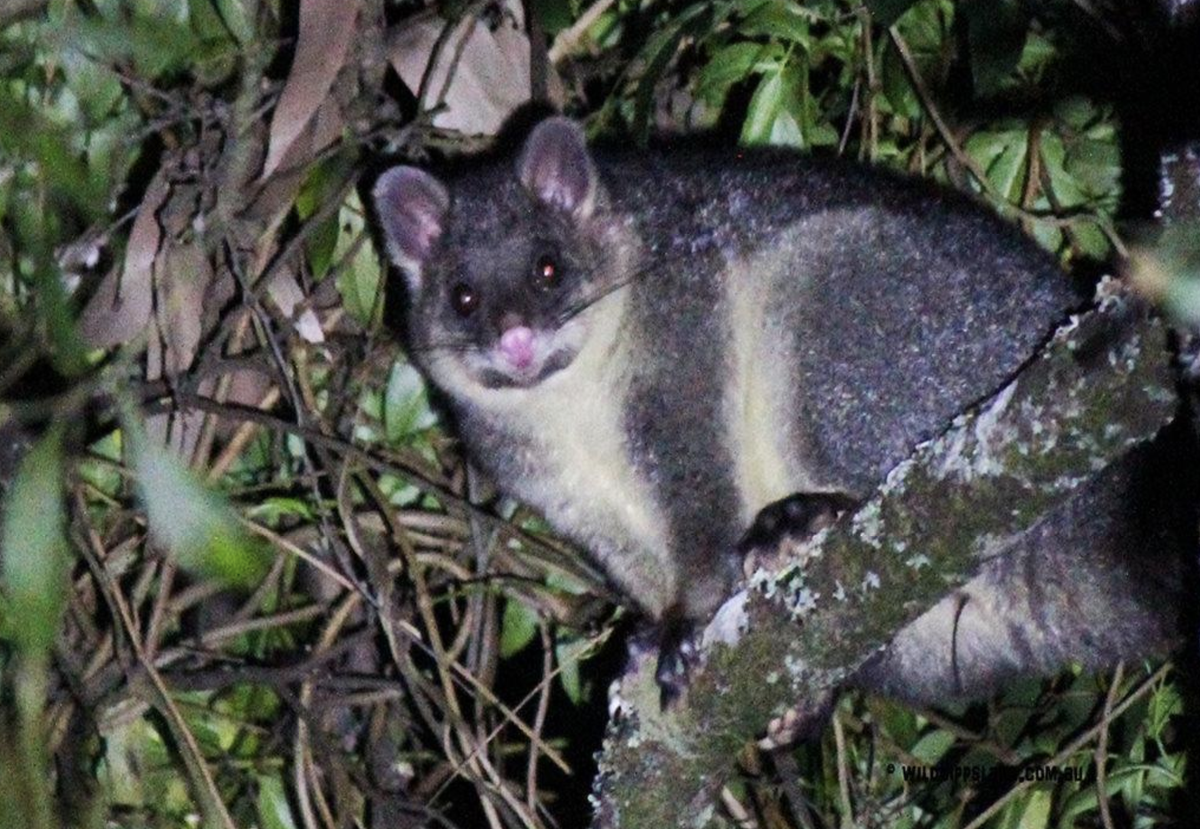
mountain brushtail possum, from the Australian museum
Mountain brushtail possums (Trichosurus cunninghami) are also known as southern bobucks. They are native to southeastern Australia and were was not described as a separate species until 2002, when they were distinguished from short-eared possums (Trichosurus caninus). Mountain brushtail possums range from Victoria to central Queensland. They semi-arboreal (live partly in trees) and are mostly found in wet sclerophyll (hard leaf) forests at elevations from sea level to 1300 meters (4265 feet). They usually live in above-ground dens (either tree hollows or nest boxes) and typically use multiple den-trees. They also occasionally den in thick ground vegetation. Due to logging, farming, and other human activities, the primary habitat of most populations is now fragmented forest by agricultural land. [Source: Helen McCreary, Animal Diversity Web (ADW) |=|]
Mountain brushtail possums are medium-sized marsupials. They range in weight from 2.5 to 4.5 kilograms (5.51 to 9.91 pounds) and are 81 to 93 centimeters (31.9to 36.6 inches) long, including their tails. They have thick, light gray-brown fur, and long, dark gray, bushy tails. They differ morphologically from their close relatives, short-eared possums, which is found directly to the north of mountain brushtail possums. Sexual Dimorphism (differences between males and females) is not present: Both sexes are roughly equal in size and look similar. Their lifespan in the wild is estimated to be up to 12 years. However, it appears as though fewer males reach that age than females. They may be the longest lived marsupial.
Mountain brushtail possums are herbivores (eat plants or plants parts). They mainly eat acacia leaves, fungi, lichens, buds, fruit, and sometimes bark. Acacia is an integral part of their seasonal diet, with different species of the plant consumed at different times of the year. Mountain brushtail possum predators are preyed on by introduced foxes foxes) and may also be taken by large snakes or raptors. The main threat to populations is human action — the clearance of land for forestry and agriculture.
Mountain brushtail possums not endangered or threatened. They are designated as a species of least concern on the International Union for Conservation of Nature (IUCN) Red List and have no special status on the Convention on International Trade in Endangered Species (CITES). They are sometimes regarded as crop pests in southeastern Australian pine plantations.
Mountain Brushtail Possum Behavior and Reproduction
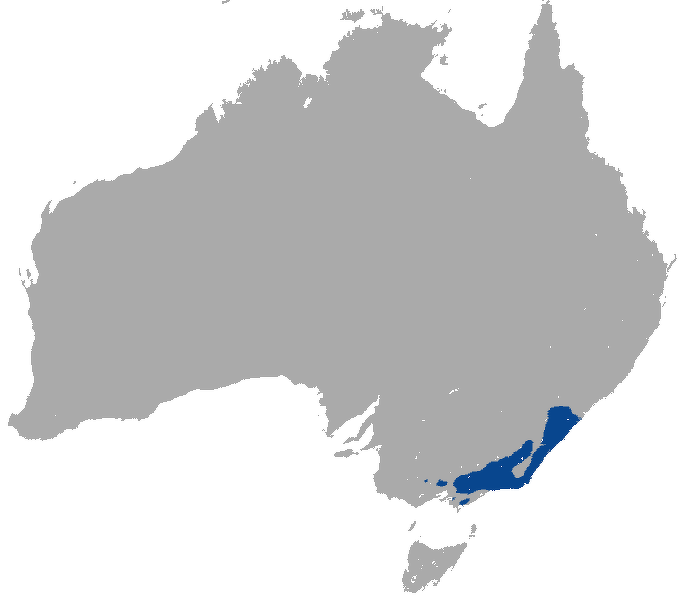
range of mountain brushtail possum
Mountain brushtail possums are arboreal (live mainly in trees), terricolous (live on the ground), nocturnal (active at night), motile (move around as opposed to being stationary), sedentary (remain in the same area), and social (associates with others of its species; forms social groups). Mountain brushtail possums stay in their dens during the day and leave at night to forage. They communicate with vision, touch, sound and chemicals usually detected by smelling and scent marks produced by special glands and placed so others can smell and taste them and sense using vision, touch, sound and chemicals usually detected with smell. [Source: Helen McCreary, Animal Diversity Web (ADW) |=|]
Their home territories range from 5.6 to 6.4 hectares (13.8 to 15.8 acres). Both male and female have home ranges of similar size. The home ranges of subadults are significantly smaller. They often remaining in the same small home range for their entire lives. Adults form strong pair-bonds and often share the same suite of different dens with their offspring. The home ranges of paired individuals overlap as well, as opposed to non-paired individuals, who remain more exclusive in their home ranges.
Mountain brushtail possums appear to be monogamous (have one mate at a time) and may sometimes be polygynous (males have more than one female as a mate at one time). They engage in seasonal breeding and breed once a year. The breeding season is January to February. The gestation period ranges from 15 to 17 days.. The number of offspring is usually one. Helen McCreary wrote in Animal Diversity Web: Adults are strongly paired and remain very close to each other, staying in the same den on approximately 70 percent of the days during mating season. Females form a pair-bond at two to five years of age and the bonds only end at the death of one pair member. However, genetic evidence suggests that mountain brushtail possums are not monogamous; molecular paternity analysis has shown that 35 percent of young result from extra-pair copulations. Males that sired more than one offspring a year, outside of the pair bond, are generally larger, indicating that dominance results in reproductive success.
Young mountain brushtail possums are altricial, meaning they are relatively underdeveloped at birth. Parental care is carried out by females. The weaning age ranges from five to six months, with the time to independence ranging from 17 to 18 months. The post-independence period is characterized by the association of offspring with their parents. Females reach sexual or reproductive maturity at two to five years and males do so at two to three years. Mountain brushtail possum offspring spend approximately six months in the pouch, then one to two months riding on the mother’s back. Males spend the least amount of time with their female partners when the females are carrying young on their back, and are therefore much less involved in the care of offspring.
Short-Eared Possums
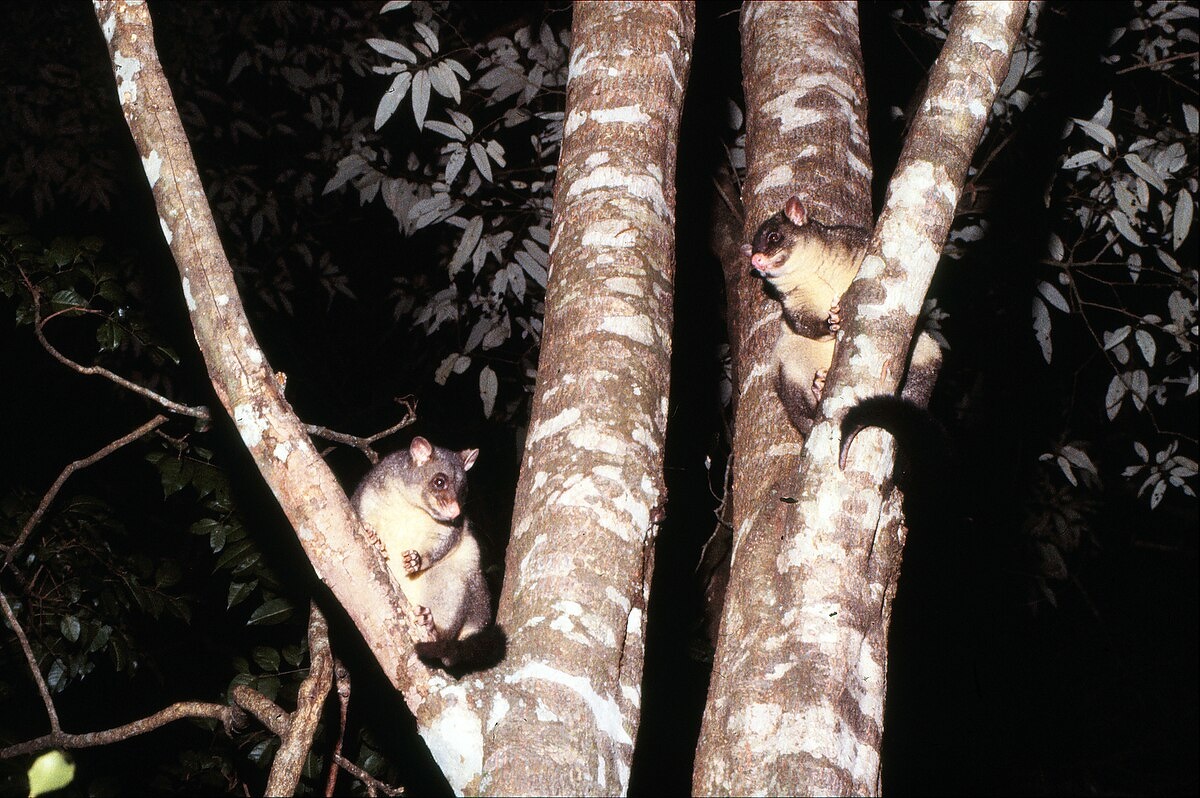
Short-eared possums
Short-eared possum (Trichosurus caninus) are found north of Sydney, New South Wales, on Australia’s eastern coast. They were classfied under the mountain brushtail possum, its closest relative, but are now regarded as separate species. They reside in a variety of forest types in southeastern Queensland, eastern New South Wales and eastern Victoria. They prefers wetter forests but their presence in a wide variety of climates and conditions showcases their ability to adapt to varying conditions. Short-eared possums are thought to live approximately seven years in the wild. Generally, females live longer than the males. The oldest known female lived to 17 years, while the longest living male lived 12 years. [Source: Kevin Afflerbaugh, Animal Diversity Web (ADW) |=|]
Short-eared possums are stocky possums that range in weight from 2.5 to 4.5 kilograms (5.5 to 9.9 pounds) and range in length from 74 to 92 centimeters, (29.1 to 36.2 inches) including the tail. They are in a thick grey to dark grey fur and lack the color variations of their close relative common brushtail possums. Their tail is almost as long as their body and covered with fur, except on the bottom near the terminal end. Females have a pouch that opens towards their head. Their ears are similarily rounded but smaller than those of common brushtail possums. Short-eared possums possesses scent glands in its chin, chest and anal areas. The chest gland produces a clear secretion, as opposed to that of common brushtail possums whose chest gland stain their fur brown.
Short-eared possums are generally arboreal (live mainly in trees) but spend a lot of time on the ground searching for foods among fallen logs and low shrubs. They are generally a herbivores (eat plants or plants parts) and frugivores (eat fruit) that feed on shrub leaves, fruit, buds, fungi, bark and eat insects. Their main known predators are carpet pythons, dingoes and tiger quolls. Short-eared possums are able climbers and can climb a tree or rocks to escape predators. It can also swim and can take to the water to flee trouble.
On the International Union for Conservation of Nature (IUCN) Red List Short-eared possums are classified as a species of “Least Concern”. They are regarded as crop pests and the past were killed for that reason. They were also trapped for their very thick fur but there is not much dmeand for that now. Short-eared possums are very common throughout their range. While not as common as common brushtail possums, they are trapped to control their populations and minimize damage to pine plantations where they strip the bark off trees.
Short-Eared Possum Behavior and Reproduction
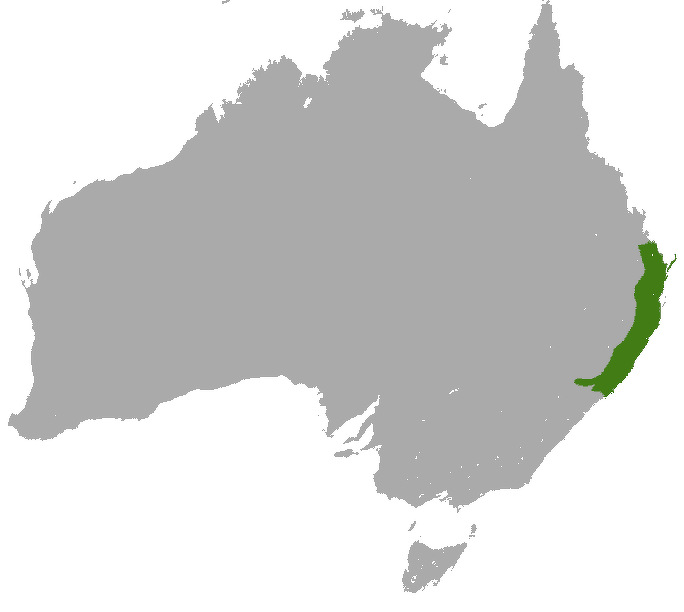
Short-eared possum range
Short-eared possums are nocturnal (active at night), motile (move around as opposed to being stationary), arboreal (live mainly in trees) and territorial (defend an area within the home range). They are generally solitary even though the range of individuals may overlap with those of others, particularly those of the opposite sex sex if there is a high population density. There is some evidence suggesting they may form pairs during breeding seasons. They maintain their territories through vocalization and scent markings. Short-eared possums rest during the day when in tree hollows. They come down from the trees at night to search for food. [Source: Kevin Afflerbaugh, Animal Diversity Web (ADW) |=|]
Short-eared possums are monogamous (have one mate at a time) and are polygynandrous (promiscuous), with both males and females having multiple partners. They engage in seasonal breeding. The breeding season is in the spring and fall. Females are polyestrus (females have multiple estrous cycles, periods of sexual receptivity, per year). The gestation period ranges from 15 to 17 days. The number of offspring is one. Short-eared possums are thought to be polygynandrous as male and female territories often overlap considerably creating many breeding opportunities. However, the fact that male and females have been caught in traps together suggests they may form mating pairs. Mates are attracted using both vocalizations and scent glands.
The majority of the births occur between March and April. Young are altricial, meaning they are relatively underdeveloped at birth. Parental care is carried out by females. Young spend five to six months in the mother's pouch. After this young spend two to five months nursing outside the pouch before being weaned. The weaning age ranges from seven to 11 months. Once weaned, young continues to spend time in their mother's home territory for 18 to 36 months until finally dispersing, with the females usually leaving earlier than males. However, sometimes young stay in the mother's territory, which may lead to mating by close relatives. On average females reach sexual or reproductive maturity at age three years and males do so at two to three years. When females five birth at two their young rarely survives. If the young die, occasionally a second young is born. |=|
Image Sources: Wikimedia Commons
Text Sources: Animal Diversity Web animaldiversity.org , National Geographic, Live Science, Natural History magazine, Australian Museum, David Attenborough books, Australia Geographic, New York Times, Washington Post, Los Angeles Times, Smithsonian magazine, Discover magazine, The Conversation, The New Yorker, Time, BBC, CNN, Reuters, Associated Press, AFP, Lonely Planet Guides, Wikipedia, The Guardian, Top Secret Animal Attack Files website and various books and other publications.
Last updated September 2025