
Home | Category: Island Ethnic Groups
NISSAN ISLANDERS
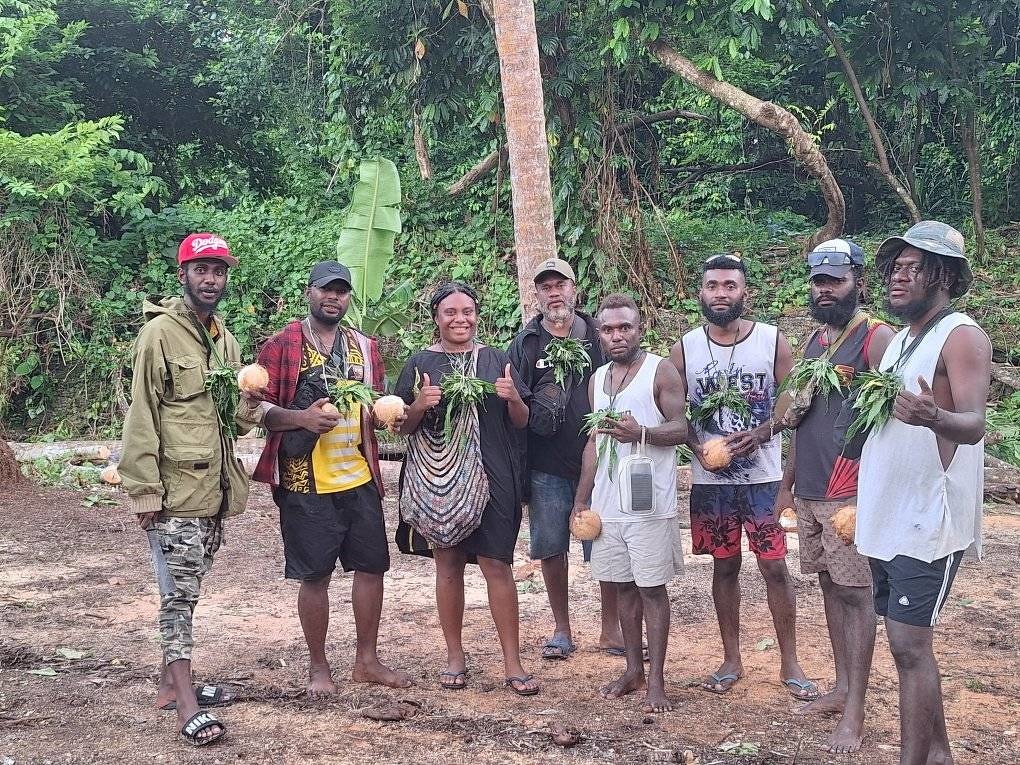
Nissan islanders
The Nissan people are the indigenous inhabitants of Nissan Atoll (Green Islands) and Pinipel Atoll in the Autonomous Region of Bougainville. Also known as Green Islanders, they are Melanesians who speak Nehan, a non-Austronesian language with two main dialects — one on Nissan and one on Pinipir. Most islanders also speak Melanesian Pidgin. [Source: Google AI]
Their traditional subsistence practices center on gardening t aro, yam, and cassava and fishing, and community life remains closely tied to the sea. Island communities have long engaged in regional exchange with neighboring islands and mainland areas but access remains difficult, dependent on unreliable and sometimes dangerous sea travel that complicates health care, supply delivery, and mobility. Nissan islanders also face challenges from climate change.
Early European visitors estimated the population of Nissan Island at 1,500 or fewer. A 1940 census recorded 1,427 people, rising to 3,094 in 1971 (2,551 on Nissan and 543 on Pinipir), nearly half of whom were born after 1955. The Christian organization Joshua Project estimated the population in the 2020s at around 13,000.
RELATED ARTICLES:
BOUGAINVILLE ISLANDERS — SIWAI, TINPUTZ, NAGOVISI — AND THEIR HISTORY, SOCIETIES AND CULTURE ioa.factsanddetails.com
NASIOI OF BOUGAINVILLE: HISTORY, RELIGION, LIFE, SOCIETY ioa.factsanddetails.com
NEW IRELAND ETHNIC GROUPS — MADAK, LESU, AND LAK— AND THEIR TRADITIONS AND SOCIETIES ioa.factsanddetails.com
ART FROM NEW IRELAND: MALAGAN, FUNERARY FIGURES AND DRUMS ioa.factsanddetails.com
EAST NEW BRITAIN ETHNIC GROUPS — THE BAINING AND TOLAI — AND THEIR CUSTOMS, LIFESTYLES AND DANCES ioa.factsanddetails.com
WEST NEW BRITAIN ETHNIC GROUPS — NAKANAI, AROWE — AND THEIR TRADITIONS AND SOCIETIES ioa.factsanddetails.com
MASKS AND ART OF NEW BRITAIN ioa.factsanddetails.com
TROBRIAND ISLANDERS: HISTORY, RELIGION, BIG MEN POLITICS, ECONOMY ioa.factsanddetails.com
TROBRIAND ISLANDER CULTURE: CUSTOMS, MATRILINEAL SOCIETY, SEX AND YAMS ioa.factsanddetails.com
ART FROM THE TROBRIAND ISLANDS AND MASSIM REGION OF PAPUA NEW GUINEA ioa.factsanddetails.com
ISLANDERS OF NORTHERN PAPUA NEW GUINEA ON MANAM, WOGEO AND MANUS ioa.factsanddetails.com
SOUTHEAST PAPUA NEW GUINEA ISLANDERS OF MASSIM, MILNE BAY AND DOBU, ROSSEL AND GOODENOUGH ISLANDS ioa.factsanddetails.com
Nissan Islands
The Nissan or Green Island Group forms part of the North Solomons and links the Bismarck Archipelago with the Solomon Islands. Nissan Atoll, located at 154°10 E and 4°27 S, lies 110 kilometers east of New Ireland and 64 kilometers northwest of Buka, which in turn is just north of Bougainville Island. The climate is wet tropical, with average daily temperatures in the 20s°C and heavy rainfall; in 1971 the islands received 320 cm of rain.
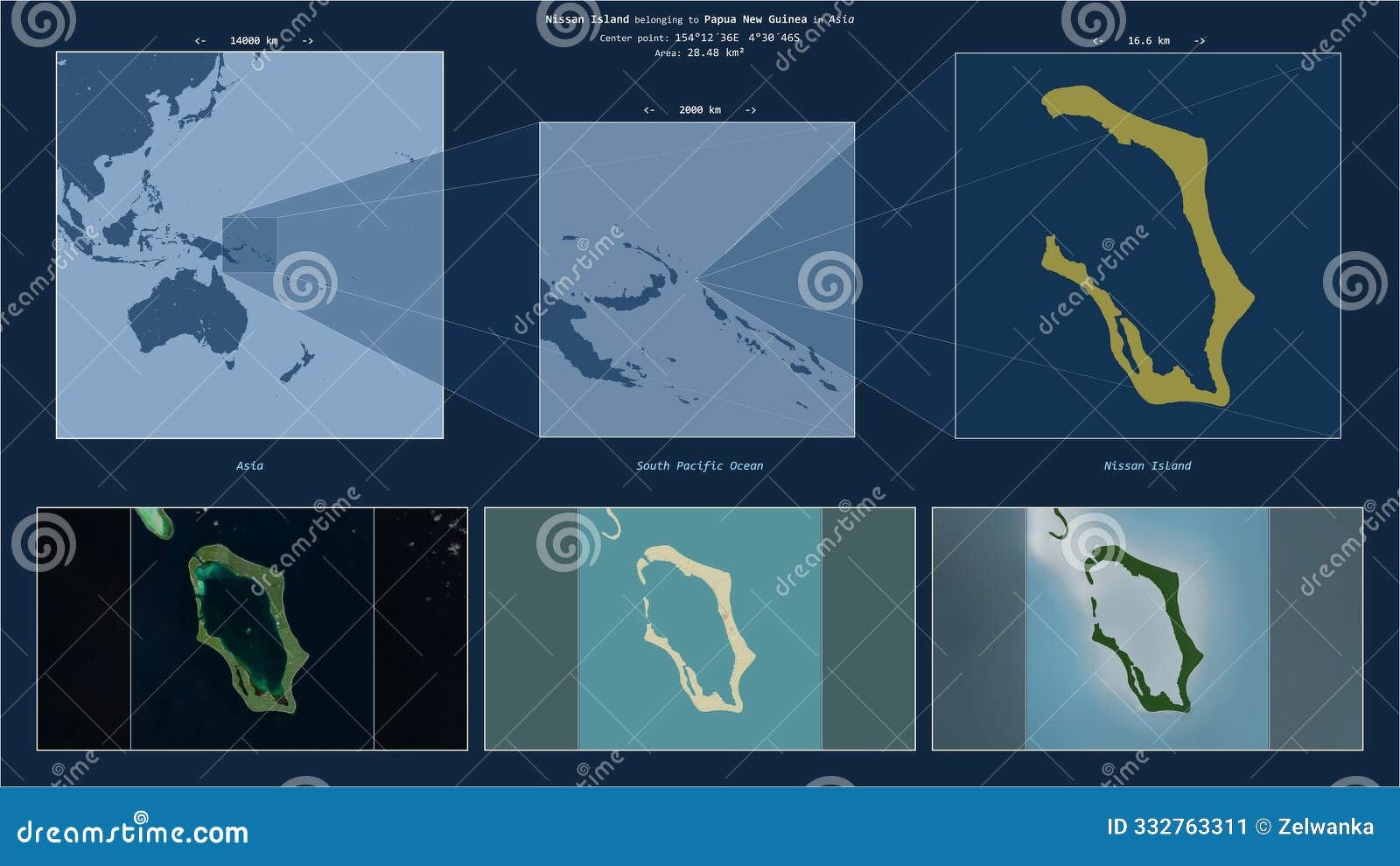
Nissan Islands, dreamstime
Nissan atoll is elliptical-shaped — about 15 kilometers long and up to 7 kilometers wide — with a narrow land rim (never more than 2 kilometers across) surrounding a large lagoon, broken by three passages on the northwest side. Pinipir (Pinipel) lies 2.5 kilometers farther northwest and consists of a long, narrow island less than 10 kilometers in length plus a small uninhabited islet.
As low-lying atolls, Nissan and Pinipir are highly vulnerable to sea-level rise and severe weather. Islanders report increasingly erratic conditions, from prolonged droughts to heavy rains that damage crops. Many households still rely on traditional materials for housing and tools, with limited access to modern technology. Limited transport and environmental stress make communities susceptible to shortages, sometimes necessitating emergency assistance.
Nissan Island History
Most scholars agree that the Nissan people are Melanesians of Bukan origin, though some suggest the atoll may have first been settled by Polynesians and later overtaken by migrants from Buka. Cultural influences from New Ireland are also evident on Nissan. [Source: Steven R. Nachman, “Encyclopedia of World Cultures, Volume 2: Oceania,” edited by Terence E. Hays, 1996]
The first Europeans to record the islands were the Dutch explorers Jacob Le Maire and Willem Schouten in 1616, followed by Abel Tasman in 1643 and Philip Carteret in 1767. By the 1870s, European labor recruiters were taking islanders to plantations in Queensland, Fiji, and Samoa. After 1885, the Forsayth Company of New Britain established a coconut plantation on Nissan.
In 1890, Georg Schmiele, an official of the German colonial administration, visited the atoll to investigate the murder of a Forsayth trader. He documented local customs, mapped the group, and identified it by what he believed was the local name—Nissan. Australia assumed control of New Guinea in 1914, and Nissan was incorporated into the Bougainville District. Catholic missionaries from the Society of Mary expanded their work to Nissan in 1926, with the first resident priest arriving in 1939.
During World War II, the Japanese occupied Nissan in 1942 until a joint American–New Zealand force drove them out. The Allies then built a major base on the atoll and relocated most islanders to Aola on Guadalcanal, where many died from malaria. After the war, an Australian civilian administration returned, later replaced by the government of Papua New Guinea in 1975. Mission-run primary schools opened in the postwar years, and the islands now have access to both high school and vocational education.
Nissan Islander Religion
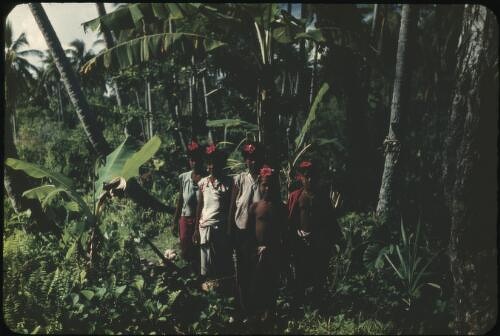
Nissan islanders in 1960
According to the Christian-group Joshua Project, an estimated 98 percent of Nissan Islanders are Christian, and many regularly attend Catholic church and village chapel services. At the same time, traditional beliefs remain strong, and people often interact ritually with a range of local supernatural beings, including spirits of the dead and various nonhuman bush spirits. [Source: Steven R. Nachman, “Encyclopedia of World Cultures, Volume 2: Oceania,” edited by Terence E. Hays, 1996]
A dangerous form of supernatural power, barang, is believed to be associated with women’s menstrual blood and with male magician societies who obtain this power from bush spirits. These bush spirits are generally considered malicious, especially when not controlled by ritual specialists. A wider pantheon of nonhuman beings—linked to dance magic (buai) and masked performances such as dukduk and tubuan—receives particular attention during dance competitions held at mortuary feasts. Spirits of the dead are not necessarily harmful, but they may interfere in human life. They are invoked in divination and in magical rites, where they act as former experts assisting the living practitioner.
Death and Funerals: In the past, Nissan Islanders disposed of the dead by weighting the body and dropping it into the sea. Today, the deceased receive Catholic burials in village cemeteries. Formerly, a sequence of rituals accompanied a death to help the spirit transition to the afterworld. The final mortuary feast—and the smaller ceremonies leading up to it—continues to honor the dead and formally release them from their lingering claims on the living community.
Religious Practitioners: Catholic religious life is led by foreign priests and sisters, supported by local catechists. Islanders attribute illness to both natural causes and to sorcery or malicious spirits, and a large number of magical cures and corresponding harmful spells exist. Many adults practice forms of magic that involve manipulating words and symbolic objects, and magical knowledge is considered essential to nearly all significant activities. Certain rituals are restricted to trained specialists, such as members of male weather-magician societies or dance magicians who perform buai rites introduced after World War II from New Ireland and the Gazelle Peninsula. In earlier times, powerful societies of grand sorcerers also operated. Islanders today also make use of Western biomedicine and consult local medical orderlies.
Nissan Islander Society and Politics
Nissan Islanders often describe their society as egalitarian, with major differences in wealth or power relatively rare. Still, factors such as sex, age, family name, personal character, and individual achievement influence a person’s standing. Big-men occupy a higher status than ordinary men, but rankings among big-men themselves are fluid and seldom agreed upon. [Source: Steven R. Nachman, “Encyclopedia of World Cultures, Volume 2: Oceania,” edited by Terence E. Hays, 1996]

lagoon-side dwelling
Political Organization: Nissan is part of the Bougainville (North Solomons) Autonomous Region of Papua New Guinea and elects its own local leaders. At the village and sometimes hamlet level, authority is also held by traditional big-men—important persons whose claims to leadership are inherited from their fathers, sometimes along with the land on which their hamlet stands.
Big-men must continually demonstrate leadership, coordinating communal work, settling disputes, showing generosity, and organizing mortuary feasts. Because islanders value egalitarianism, big-men often lead indirect-ly, and villagers observe certain formal avoidances toward them. Another figure known in the past was the loia, a leader also surrounded by ceremonial avoidances. Competition for leadership roles appears to have been more common historically than it is today. Today, most formal responsibilities for social regulation lie with provincial officials and local representatives. Even so, big-men and village elders continue to mediate disputes. A traditional method of reconciliation, poluk, involved exchanging pigs and shell rings, but is now uncommon.
Common sources of conflict include marital infidelity, land disputes, boundary disagreements, roaming pigs, gossip, and issues such as theft, unpaid debts, or suspicions of sorcery. Intervillage rivalries persist; in earlier times these sometimes escalated into warfare and cannibalism, though today they lead only to occasional group fights.
Nissan Islander Family
The nuclear family forms the core household, although related households—typically those connected through the male heads—often work together in economic activities.Parents allow children to mature at their own pace and show affection mainly through physical closeness. A central value instilled in children is shame, considered essential to proper character. Punishment generally takes the form of scolding or teasing. Outside school, children are expected to help with household tasks but spend much time in informal, unstructured play. [Source: Steven R. Nachman, “Encyclopedia of World Cultures, Volume 2: Oceania,” edited by Terence E. Hays, 1996]
Marriage within the same moiety is permitted but not preferred; marriages within the same sib are discouraged. People usually marry within their own villages or districts, though external marriages are common today, especially among those living or studying elsewhere. Traditionally, parents and relatives arranged marriages, but couples today often take the initiative and seek family approval afterward. The ideal pattern is brother–sister exchange, or at minimum, the expectation that a sib giving a woman in marriage will eventually receive one in return. Relatives contribute to bride-wealth, typically cash, shell rings, and store goods. A traditional bride-giving accompanies church weddings.Newly married couples usually establish their household near the husband’s father and brothers. Polygamy, once practiced, is now rare. Because of Catholic norms, divorce is uncommon, as it also was traditionally.
Inheritance: Men own land and movable wealth such as pigs and shell rings. A man may indicate how his property should be distributed before his death, but typically sons inherit jointly, later dividing the land. If there are no sons, inheritance passes to a man’s brothers and their sons, or failing them, to his sisters’ sons.
Nissan Islander Kinship and Land
Nissan Islanders trace descent matrilineally (through the female ine), and descent groups extend across multiple villages and districts. The population is divided into two major moieties—“Eat the Dog” and “Eat the Pigeon”—each broken into sibs named after dietary taboos (tobu). Some sibs include localized subgroups named for specific land areas. While descent groups no longer own property, they play important roles in regulating marriage and balancing the political autonomy of formerly independent villages. [Source: Steven R. Nachman, “Encyclopedia of World Cultures, Volume 2: Oceania,” edited by Terence E. Hays, 1996]
Kinship Terminology resembles a variant of the Hawaiian (generational) system, in which relatives of the same generation are grouped mainly by gender. However, Nissan terminology distinguishes a man’s mother’s brother from other male relatives of the parental generation. The brother–sister relationship is considered the most important in society. It is governed by formal avoidances known as walatur (“causing to stand up”), which traditionally require a brother not to remain seated while his sister is standing.
Land Tenure: All land is divided into named sections, including settlement areas and beachfronts. Each section is owned by an individual or a small group. Men inherit land from their fathers, and sons initially hold the land jointly before dividing it. Sisters and their children maintain recognized usufructuary rights to that land. Population growth and the conversion of garden land into coconut plantations have reduced the availability of cultivable land, encouraging increasing out-migration from the islands.
Nissan Islander Life and Villages
In the 1990s, Nissan Atoll had fifteen villages, and Pinipir had three, with populations ranging from 80 to 337 people. Most villages comprise one or two hamlets, with houses either scattered or clustered in the bush. Before European contact, settlements were smaller and strategically located inland because of frequent intergroup warfare. Hamlets—usually arranged in single or double rows of houses—were originally formalized by colonial administrators for ease of governance. Many families maintain two residences: one in the hamlet and another near their garden plots to protect crops from roaming pigs. [Source: Steven R. Nachman, “Encyclopedia of World Cultures, Volume 2: Oceania,” edited by Terence E. Hays, 1996]
Traditional Houses are single-room, windowless, rectangular structures, built on the ground with steeply pitched sago-thatch roofs and areca-palm bark walls. Today, many homes are built on piles and incorporate introduced materials such as plywood, sawn timbers, concrete, and galvanized iron roofing. A Men’s house (iabas) forms the center of each settlement. Formerly, all unmarried boys over age nine slept there, along with visiting males. Although many of its traditional functions are fading, it still serves as a men-only clubhouse for planning, discussion, and socializing.
Chores and Work: Women carry out most domestic and child-care tasks. Men perform the heavy subsistence labor—especially land clearing and other strength-intensive garden work—and take the lead during ceremonies, with women contributing behind the scenes. People with specialized ritual or technical skills assist others as needed, and some church and government workers receive wages for their roles.
Men build houses and make single-outrigger dugout canoes, which have replaced traditional double-outrigger and plank canoes. They also carve masks, dance paraphernalia, and large wooden slit gongs used in men’s houses. Women plait coconut-frond baskets and mats and sew pandanus-leaf hoods and carrying straps. Islanders no longer produce stone tools, Tridacna shell arm rings, or traditional weapons; most tools today are of Western origin.
Nissan Islander Culture
Ceremonies: The most elaborate ceremonies on Nissan revolve around pig feasts, organized by villages or hamlets under the leadership of big-men. Hosts provide pork and other delicacies, big-men deliver formal speeches, and villagers exchange substantial portions of pork to settle obligations linked to the deaths of relatives—acts that also confirm inheritance rights, including claims to leadership. [Source: Steven R. Nachman, “Encyclopedia of World Cultures, Volume 2: Oceania,” edited by Terence E. Hays, 1996]
These feasts are also major venues for ritual competition between villages. Host weather magicians publicly work to ensure clear skies, while rival magicians discreetly call for rain. Villages also compete in choral line dances, for which magicians perform secret rites intended to secure their team’s success and undermine the performances of others.
The Arts are very much alive on the Nissan Islands. Cultural expressions include the Fishing Dance, which dramatizes their close relationship with the sea. Traditional songs and stories remain central to community life. Contemporary performance arts draw heavily on dances brought from New Ireland and New Britain, which islanders adapt or reinterpret. These dances feature hourglass drum accompaniment and elaborate costumes, including masks, carved dance sticks, and wooden headpieces.
Nissan Islander Agriculture and Economic Activity
Nissan Islanders practice slash-and-burn horticulture. After a taro blight following World War II, yams replaced taro as the staple crop. Other foods include sweet potatoes (introduced in German times), tobacco, sugarcane, and minor crops such as cassava, pumpkins, corn, beans, watermelons, tomatoes, and cabbages. Gardens lie fallow for long periods between plantings.Tree crops—found both in gardens and semi-managed bush plots—include coconuts, bananas, plantains, papayas, breadfruit, Barringtonia, Canarium nuts, and betel nut (Areca catechu). On Pinipir, mangrove fruit is an important staple due to extensive mangrove swamps.[Source: Steven R. Nachman, “Encyclopedia of World Cultures, Volume 2: Oceania,” edited by Terence E. Hays, 1996]
Fishing is central to the economy, conducted in both lagoon and open sea using purchased hooks and lines, locally made spears and spear guns, nets, baskets, scoops, a plant-based stupefying agent from Pongamia pinnata, and occasionally dynamite. Marine resources include fish, crabs, lobsters, shellfish, sea worms (paiolo), and giant turtles.
Domestic Animals include chickens, dogs (eaten in some villages), cats, and—most importantly—pigs. Pigs are central to ceremonial life and, along with large Tridacna-shell rings, constitute traditional wealth. Because pigs can damage copra production, some villages have reduced or eliminated them; most pigs today are semi-domesticated or feral.
Store-bought foods such as coffee and canned fish or meat are also popular. Since the German colonial period, people have produced copra for cash income; more recently, cocoa cultivation has spread. Islanders have long sought wage employment elsewhere—on plantations, in towns, on boats, and, from the 1970s onward, in Bougainville’s multinational copper-mining operations. Some send remittances home; others establish new households away from Nissan.
Trade: Historically, Nissan Islanders traded with northern Buka (from Nissan) and Anir Island off New Ireland (from Pinipir). Nissan contributed pigs, while Bukans supplied clay pots, pipes, and weapons, and Anir traders provided shell rings, red ocher, tobacco, and river stones. Local trade within Nissan continues, especially the exchange of food and services within villages. Some islanders pursue small-scale commercial ventures, including coconut and cocoa production or operating trade stores.
Image Sources: Wikimedia Commons
Text Sources: “Encyclopedia of World Cultures, Volume 2: Oceania,” edited by Terence E. Hays, 1996, National Geographic, Live Science, Metropolitan Museum of Art, Natural History magazine, Australian Museum, New York Times, Washington Post, Los Angeles Times, Smithsonian magazine, Encyclopedia.com, Times of London, Library of Congress, The Conversation, The New Yorker, Time, BBC, CNN, Reuters, Associated Press, AFP, Lonely Planet Guides, Google AI, Wikipedia, The Guardian and various websites, books and other publications.
Last updated November 2025