
Home | Category: Island Ethnic Groups / Arts, Culture, Sports
ART FROM NEW IRELAND
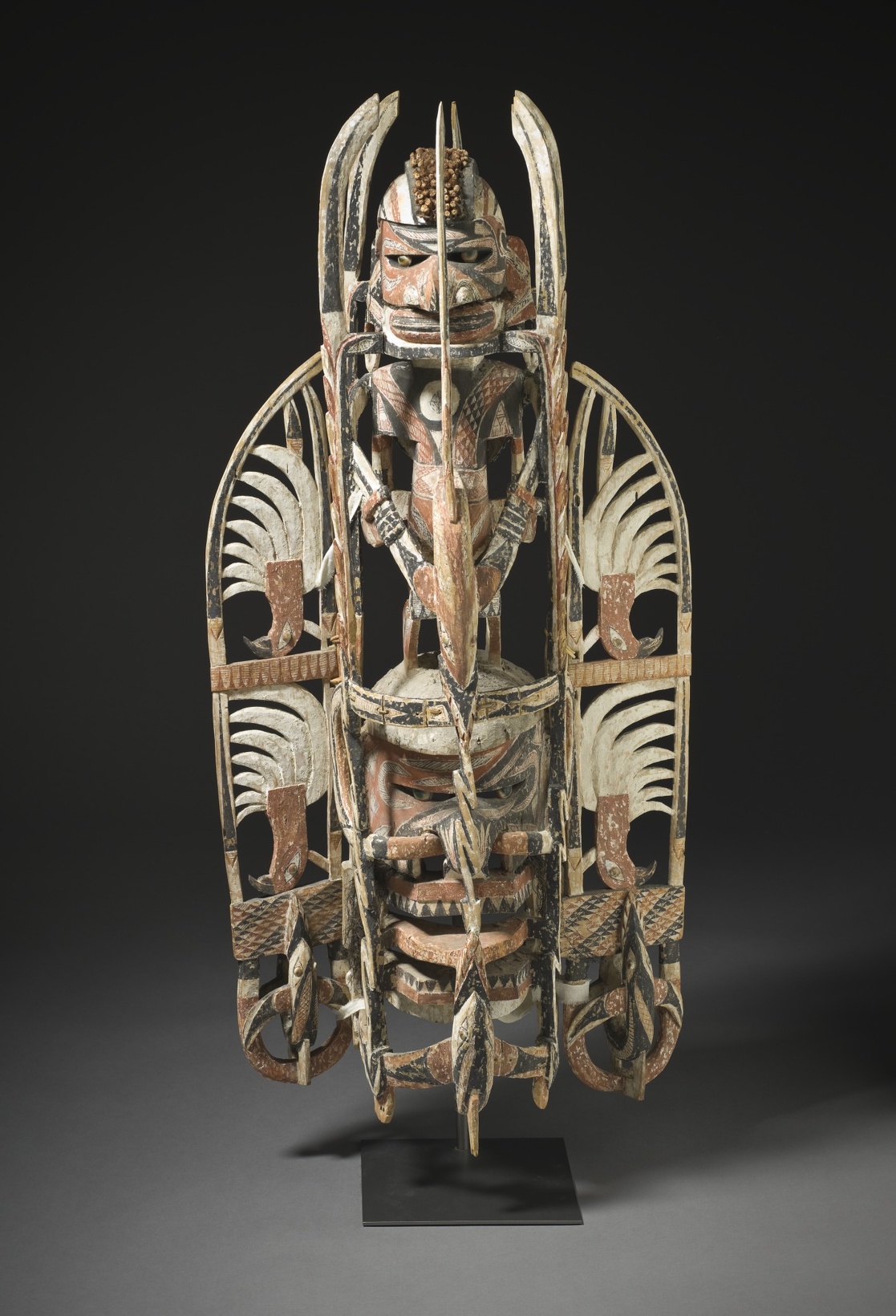
New Ireland mask and adornments, 1890
New Ireland is a large island in Papua New Guinea about 800 kilometers (500 miles) east of northern New Guinea. Also known as Niu Ailan, or Latangai, New Ireland is about 7,404 square kilometers (2,859 square miles) in area and has a population of around 120,000 people. Named after the European island of Ireland, it is the largest island of New Ireland Province, lying northeast of New Britain island. Both islands are part of the Bismarck Archipelago, named after Otto von Bismarck. They are separated by Saint George's Channel. [Source: Wikipedia]
The first inhabitants of the Bismarck Archipelago arrived around 33,000 years ago after sailing from what is now Papua New Guinea. Later arrivals included the Lapita people approximately 3,000 years ago. Three distinct cultural practices are characteristic of the native people of New Ireland: Kabai, Malagan and Tubuan. In 1616 the Dutch sailors Jacob Le Maire and Willem Schouten were the first Europeans to set foot on the island.
Culturally and artistically New Ireland is known for; 1) Malagan — funerary arts that originate in Tabar Group, and have been imported to the northern region of New Ireland; 2) Kulap — chalk limestone funerary sculptures; and 3) Tatanua — "The person who organises a tatanua performance must select the music and dancers, assemble a male chorus and acquire the masks. The masks are usually rented from one of the sculptors who makes them." An Uli ancestor figure from New Ireland, 28.75 inches (73 centimeters) in height sold for US$3.26 million in November 2017 at Christie’s in Paris
Eric Kjellgren wrote: The signature art forms of New Ireland are its funerary sculpture. These include the distinctive chalk figures, or kulap, of southern New Ireland, created as temporary abodes for the spirits of the dead, as well as the spectacular openwork malagan carvings of the north. Among the most striking and technically complex of all Oceanic wood sculpture, the boldly polychromed malagan constitute a sort of visual resume, revealing the lifetime achievements of the deceased in acquiring the rights to create the specific types of malagan carvings displayed at the final memorial ceremony. Despite the enormous investment of time and labor involved in their production, malagan are made only for onetime use in the memorial ceremony, after which they are discarded or destroyed. [Source: Eric Kjellgren, “Oceania: Art of the Pacific Islands in The Metropolitan Museum of Art”, 2007]
Deborah Waite wrote: Much collecting by outsiders was accomplished between 1880 and 1915, the period of German colonization of New Ireland and neighboring islands. The northern part of New Ireland was more accessible than the south, resulting in a preponderance of objects from that area. Although many of the objects came to reside in ethnological museums, they did not go unnoticed by European artists of the end of the nineteenth and early twentieth centuries, specifically artists belonging to the French Surrealist and German Expressionist movements. [Source: Deborah Waite, Contemporary Pacific; Honolulu Vol. 20, Iss. 2, (2008)]
RELATED ARTICLES:
NEW IRELAND ETHNIC GROUPS — MADAK, LESU, AND LAK— AND THEIR TRADITIONS AND SOCIETIES ioa.factsanddetails.com
EAST NEW BRITAIN ETHNIC GROUPS — THE BAINING AND TOLAI — AND THEIR CUSTOMS, LIFESTYLES AND DANCES ioa.factsanddetails.com
WEST NEW BRITAIN ETHNIC GROUPS — NAKANAI, AROWE — AND THEIR TRADITIONS AND SOCIETIES ioa.factsanddetails.com
MASKS AND ART OF NEW BRITAIN ioa.factsanddetails.com
BOUGAINVILLE ISLANDERS — SIWAI, TINPUTZ, NAGOVISI — AND THEIR HISTORY, SOCIETIES AND CULTURE ioa.factsanddetails.com
NASIOI OF BOUGAINVILLE: HISTORY, RELIGION, LIFE, SOCIETY ioa.factsanddetails.com
NISSAN ISLANDERS: HISTORY, RELIGION, SOCIETY, LIFE ioa.factsanddetails.com
TROBRIAND ISLANDERS: HISTORY, RELIGION, BIG MEN POLITICS, ECONOMY ioa.factsanddetails.com
TROBRIAND ISLANDER CULTURE: CUSTOMS, MATRILINEAL SOCIETY, SEX AND YAMS ioa.factsanddetails.com
ART FROM THE TROBRIAND ISLANDS AND MASSIM REGION OF PAPUA NEW GUINEA ioa.factsanddetails.com
ISLANDERS OF NORTHERN PAPUA NEW GUINEA ON MANAM, WOGEO AND MANUS ioa.factsanddetails.com
SOUTHEAST PAPUA NEW GUINEA ISLANDERS OF MASSIM, MILNE BAY AND DOBU, ROSSEL AND GOODENOUGH ISLANDS ioa.factsanddetails.com
Lunet or Livika (Friction Drums) from New Ireland
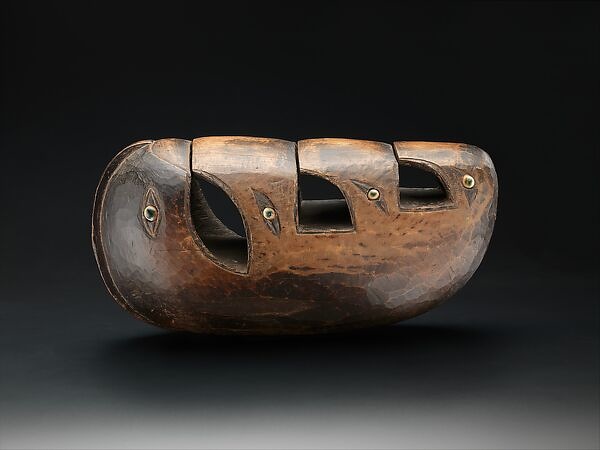
Lunet or Livika (Friction Drums) from New Ireland
A Lunet or Livika (friction drum) is a wood and shell musical instrument from Northern New Ireland. Dating to the late 19th-early 20th century, an example at the Metropolitan Museum of Art is 9.25 inches high, with a width of 20 inches and a depth of 8.25 inches (23.5 x 50.8 x 21 centimeters)
In northern New Ireland, wooden drums known as lunet were used as musical instruments during malagan ceremonies, elaborate feasts that honored the dead. In contrast to the complex funerary carvings displayed during these ceremonies, drums were neither painted nor adorned with intricate designs. Instead, they were unique in their simplicity of form, and their decoration was limited to a series of carved, almond-shaped eyes inset with opercula, the calcified "doors" that originally covered the openings of snail shells. [Source: Metropolitan Museum of Art]
Lunet were "friction drums" with three sound-producing wedges (or "tongues") on top. These wedges, each cut to a different size, separated from each other and have small spaces hollowed out underneath. A musician would have played the drum by moistening one of his hands with water and rubbing it across the wedges, creating a unique blend of tones reminiscent of the cry of the bird for which the drum was named.
Kulap (Funerary Figure)
A Kulap (Funerary Figures) is a stone sculpture made with chalk and paint from Southern New Ireland. Dating to the late 19th century, one work at the Metropolitan Museum of Art is 19.12 inches high, with a width of 4.25 and a depth of 4.5 inches (48.6 × 10.8 × 11.4 centimeters) [Source: Metropolitan Museum of Art]
In the southern part of New Ireland, artists have created chalk figures portraying both male and female subjects. Housed in small shrines constructed in the forest outside the village, the figures played a central role in a cult of the dead. Variable in their individual styles and attributes, it is possible that the figures were intended to portray specific individual ancestors whose supernatural powers could be harnessed to benefit their living descendants.
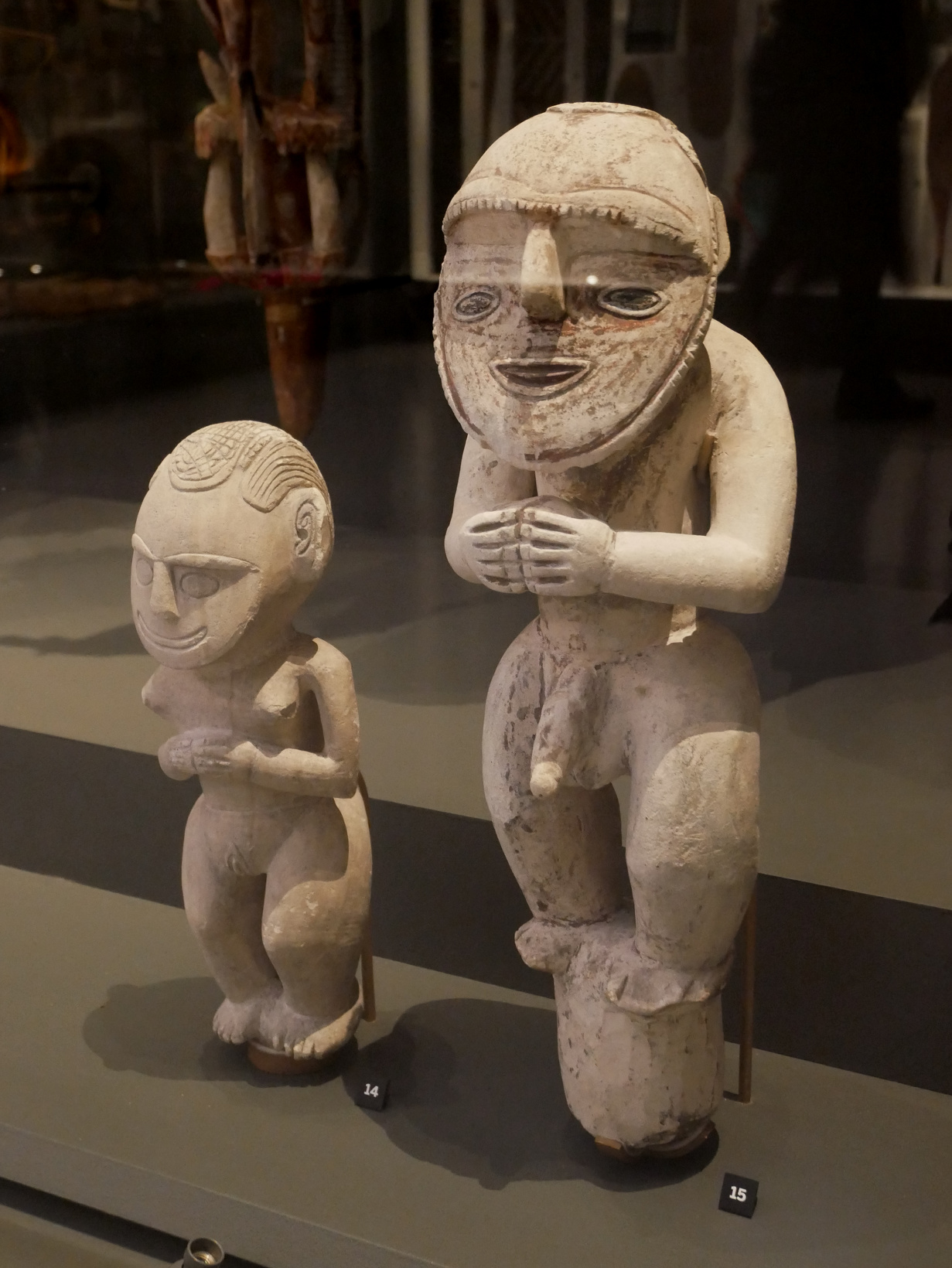
two kulaps
Eric Kjellgren wrote: Robust in proportion but at times, subtly expressive, kulap figures are distinctive to southern New Ireland. Made of a fine-grained chalklike limestone, the kulap were funerary carvings created to commemorate individuals who had recently died. Used throughout the region, kulap were reportedly produced by specialist artists from the Punam region of the Rossel Mountains, in the island 's rugged interior, where the limestone quarries were located. [Source: Eric Kjellgren, “Oceania: Art of the Pacific Islands in The Metropolitan Museum of Art”, 2007]
Whenever a man or woman from a prosperous family died, a male relative journeyed to the Rossel Mountains, where he purchased or commissioned either a male or a female kulap figure, depending on the gender of the deceased. On returning home, he presented the figure in secret to a local leader who was responsible for the reception of kulap images. 4 The figure was placed, together with other kulap, in a memorial shrine erected inside a larger building, surrounded by an enclosure. Only men were permitted inside the enclosure, where they were allowed to view the images and performed dances in their honor, but in some instances the women gathered outside to lament their lost relatives.
Standing within the shrine, which was decorated with the variegated leaves of ornamental plants, the kulap served as temporary abodes for the spirits of the dead, which might otherwise wander, bringing harm or misfortune to the living.
After a certain period of time had passed, the figures were secretly removed by the men and destroyed or, during the colonial period, often sold to Westerners. 8 The practice of carving kulap was rapidly abandoned following the adoption of Christianity by the peoples of southern New Ireland in the late nineteenth and early twentieth centuries, and the last examples were probably created about 1910.
Malagan Funerary Carvings
Malagan funerary carvings are ceremonialwood sculptures from northern New Ireland They are decorative ornaments or figures intricately carved for the cycle of funeral rituals. Primarily concerned with honoring and dismissing the souls of a specific individual, malangan carvings were usually destroyed, allowed to rot, or sold after use in a ceremony. A Malangan mask, measuring 60 inches (101.5 centimeters) in height, was sold for US$150,000 at a Christie’s auction in Paris in June 2020.
One malangan in the Metropolitan Museum of Art collection is made with paint, shell and fiber. Dating to the late 19th-early 20th century, it is 34 inches high, with a width of 5 inches and a depth of 11 inches (86.4 x 12.7 x 27.9 centimeters).A malagan made around the same time in Tubar village, New Ireland is 84.5 inches high, with a width of 10.7 inches and a depth of 2. 9 inches (214.6 x 27.1 x 7.5 centimeters). Another made of in Northern New Ireland from wood, paint, shell, vegetable fiber is 26.25 inches high, with a width of 3.7 inches and a depth of 3.5 inches (66.7 x 9.7 x 8.9 centimeters) [Source: Metropolitan Museum of Art]
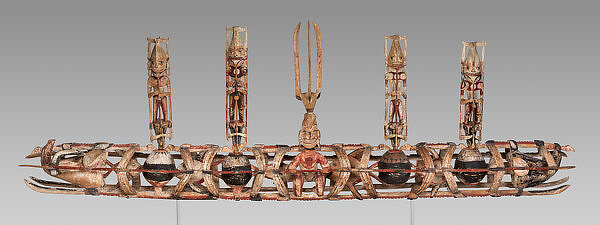
malagan
Eric Kjellgren wrote: Spectacular and ephemeral, the malagan carvings of northern New Ireland are among the most intricate sculptures in Oceania. The term malagan refers collectively to a complex series of ceremonies and the visual art forms associated with them. Various malagan rites mark nearly all important stages of an individual’s life; the largest and most impressive malagan carvings are displayed during the final memorial ceremony for the deceased. Throughout life, individuals seek to acquire rights, similar to Western copyrights, to specific malagan images and the rituals associated with them. [Source: Eric Kjellgren, “Oceania: Art of the Pacific Islands in The Metropolitan Museum of Art”, 2007]
Men, in particular, compete with one another to acquire the rights to the greatest number of malagan, possession of which confers social status and prestige; they seek to obtain both the malagan of their own clan and those of the clan into which they have married.
The interpretation of the imagery of malagan is inextricably tied to the individual name, history, and ceremonial context of each image. When such information is absent, the significance of the motifs cannot be precisely determined. Human, fish, bird, mammal, and other images that appear in malagan portray beings associated with individual clans. Each of them represents a different manifestation of the single life-giving supernatural force that sustains the clan. As the members of the clan are an embodiment of the same vital force, these images symbolically represent the deceased. One particularly large malagan, 8 feet 4 inches (2.5 meters) in height, depicts a human figure (maramarua) emerging from the mouth of a fish, an image often symbolic of death at sea.
In contrast to the intricately carved malangan from the north of New Ireland, Uli ancestor figures from central New Ireland are less ornate. Hermaphroditic in form and believed to be imbued with the spiritual powers of the deceased leader, they were traditionally kept in ritual houses and paraded during lengthy fertility, initiation, or funerary rites.
Malagan Funerary Ceremony
Eric Kjellgren wrote: Some forms of malagan are made in connection with the initial funerary ceremonies that take place shortly after the death of a member of the community. These include horizontal bird friezes, known as vaval or vuvil, such as the one seen here, which portrays a rooster clutching a snake in its beak. [Source: Eric Kjellgren, “Oceania: Art of the Pacific Islands in The Metropolitan Museum of Art”, 2007].
At a person’s death, some malagan are carved for the initial funerary ceremonies. Displayed atop freestanding poles at the conclusion of the initial funeral rites, they serve as kupkup ci malaga (restriction-breaking malagan), which signal the end of ceremonial restrictions associated with mourning. However, the most numerous and spectacular carvings are created and displayed during the final ceremony to commemorate the deceased, which often occurs months or years after death. The carvings essentially constitute a visual resume of the deceased’s lifetime achievements in obtaining malagan rites.
The brilliantly painted array of malagan figures is the focus of the memorial ceremony, which lasts from one to three days and includes dances, feasting, and the sacrifice of pigs. The figures themselves effectively constitute a visual resume of the deceased, representing his or her lifetime achievement in obtaining malagan rights. The performance of the rites frees the living from their obligations to the dead and allows the spirits of the deceased to become acclimated to the realm of the dead. Having served their purpose, the malagan carvings are destroyed, allowed to rot, or sold to outsiders.
Because of the great expense involved, a single memorial ceremony is often held to honor several deceased persons. During the initial preparations, the individuals responsible for the ceremony, who hold the appropriate malagan rights, commission a sculptor or sculptors to carve examples of all the forms of malagan to which the deceased had acquired the rights during his or her lifetime.
Making and Destroying Malagan
Eric Kjellgren wrote: Although malagan are made from relatively soft wood, production of the intricate openwork images often requires several months. Once the carvings are complete, the eyes of the images are inlaid with the mottled opercula of marine snails, which resemble the pupil and iris of the human eye. The figures are then brightly painted, in white, red, black, yellow, and other colors. [Source: Eric Kjellgren, “Oceania: Art of the Pacific Islands in The Metropolitan Museum of Art”, 2007]
The process of painting is believed to enliven the figures, which serve during the memorial ceremony as temporary abodes for supernatural beings associated with the clan. Once they have been painted, the malagan figures are displayed in specially constructed structures inside a fenced compound built for the rites.
Having served their purpose, the intricate malagan carvings are destroyed, allowed to rot, or sold to outsiders. Sometimes a group of malagan images are displayed inside a specially constructed house. Following the memorial ceremony, both the house and the elaborate carvings are typically destroyed or allowed to rot away.
Kapkap (Pendant or Head Ornament)
A kapkap is pendant or head ornament. Dating to the late 19th-early 20th century, one displayed at the Metropolitan Museum of Art is made from Tridacna shell, turtle shell and fiber and is half an inch deep with a diameter of 5.25 inches (1.3 × 13.3 centimeters). [Source: Metropolitan Museum of Art]
According to the Metropolitan Museum of Art: The kapkap is a form of adornment found throughout Solomon Islands, Island New Guinea and parts of mainland Papua New Guinea. The term kapkap originates from New Ireland, where this example was made, but has also become widely adopted in museums for related adornments from across the region. Kapkap are comprised of a polished disk of giant clamshell (Tridacna gigas) overlaid with a delicate fretwork of carved turtle shell.
Throughout Oceania, the luminosity, hardness, and durability of the giant Tridacna clamshell are highly valued. While the grinding of the clamshell into a perfectly round disk is undertaken by a group of men, the carving of the turtle shell is performed by a single specialist (the aitak) who works alone and in seclusion. The turtle shell and clamshell are then tied together using string that is threaded through a hole in the center of the disk. Some kapkap incorporate an additional element of a colorful seed pod or glass trade bead at its center. The materiality and manufacture of kapkap both indicate the prestige of these adornments. It takes immense skill to carve the turtle shell into such intricate and symmetrical geometric designs. The circular form and solid permanence of the clam shell disks also refers to the cyclical and eternal nature of time.
Kapkap would primarily be worn by men as a marker of status. The larger the kapkap, and the larger the fretwork design, the higher the status bestowed. In New Ireland they are most often worn as a chest ornament, suspended from the neck, though in Solomon Islands they are commonly worn on the forehead. The wearer of a kapkap in New Ireland is known as a maimai, or one who has the right to speak on behalf of the clan. In some dialects, the name kapkap is itself translated as knowledge. Kapkap are formally presented to a new maimai during the feasts that accompany malangan mortuary ceremonies. The wearing and ownership of kapkap signifies the maimai’s authority and proximity with the powerful forces associated with the ancestral domain.
Image Sources: Wikimedia Commons
Text Sources: Metropolitan Museum of Art, Eric Kjellgren, “Oceania: Art of the Pacific Islands in The Metropolitan Museum of Art”, William A. Lessa (1987), Jay Dobbin (2005), Encyclopedia of Religion, Encyclopedia.com; “Encyclopedia of World Cultures, Volume 2: Oceania,” edited by Terence E. Hays, 1991, Wikipedia, Encyclopedia.com, New York Times, Lonely Planet Guides, Library of Congress, The Guardian, National Geographic, Smithsonian magazine, The New Yorker, Reuters, Associated Press, AFP, BBC, CNN, and various books, websites and other publications.
Last updated November 2025