
Home | Category: Island Ethnic Groups / Arts, Culture, Sports
NEW BRITAIN AND ITS ART
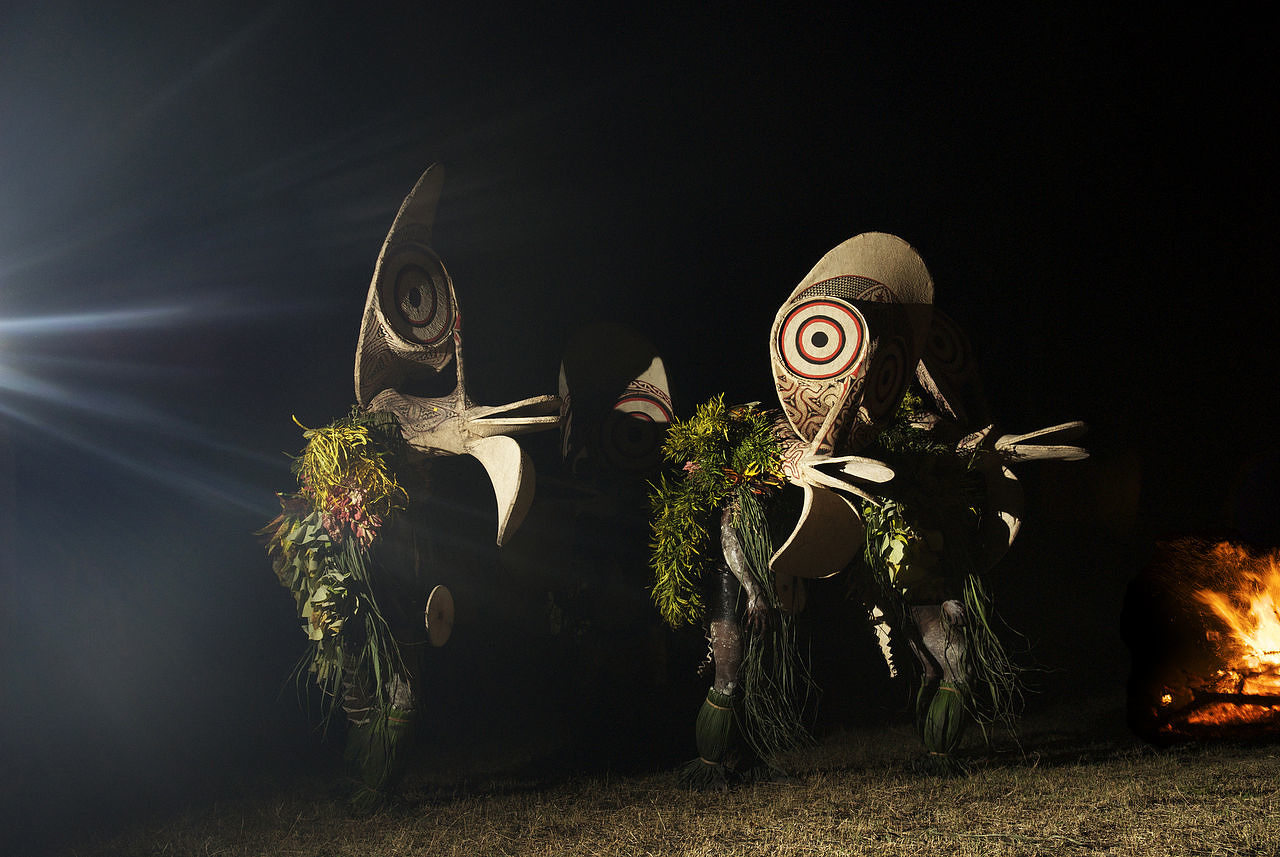
Baining Fire Dancers
New Britain (Niu Briten is Tok Pisin) is the largest island in the Bismarck Archipelago — part of the Islands Region of Papua New Guinea. It is separated from New Guinea by the Solomon Sea and from New Ireland by St. George's Channel. Its capital Rabaul is a beautiful town despite the fact it was the site of a spectacular volcano eruption in 1937 and 1994 and was turned into a fortress by the Japanese in World War II.
About a half million people live in New Britain. The indigenous people there comprise two main groups: the Papuans, who have inhabited the island for tens of thousands of years, and the Austronesians, who arrived around 3,000 years ago. About ten Papuan languages and about forty Austronesian languages are spoken, along Tok Pisin ( New Guinea Pidgin) and English.
The Papuan population is largely confined to the eastern third of the island and a couple of small enclaves in the central highlands. Among the more interesting ethnic groups are the Tolai and Sulka people (See Below). While the Tolai of the Rabaul area of East New Britain have a matrilineal society, other groups are patrilineal in structure. There are numerous traditions which remain active today, such as the dukduk secret society (also known as tubuan) in the Tolai area.
The peoples of the island of New Britain northeast of New Guinea are remarkable for the scale and variety of their ritual arts, which include diverse forms of masks and other ceremonial paraphernalia. Many of the island’s largest and most spectacular art forms are made from ephemeral materials such as plant pith or bark cloth (a paper-like textile made from the inner bark of certain trees). For both day and night dances, Contemporary New Britain peoples are predominantly Christian, but many of these ritual art forms continue to be created and used alongside, or as part of, Christian religious observances.
RELATED ARTICLES:
EAST NEW BRITAIN ETHNIC GROUPS — THE BAINING AND TOLAI — AND THEIR CUSTOMS, LIFESTYLES AND DANCES ioa.factsanddetails.com
WEST NEW BRITAIN ETHNIC GROUPS — NAKANAI, AROWE — AND THEIR TRADITIONS AND SOCIETIES ioa.factsanddetails.com
NEW IRELAND ETHNIC GROUPS — MADAK, LESU, AND LAK— AND THEIR TRADITIONS AND SOCIETIES ioa.factsanddetails.com
ART FROM NEW IRELAND: MALAGAN, FUNERARY FIGURES AND DRUMS ioa.factsanddetails.com
BOUGAINVILLE ISLANDERS — SIWAI, TINPUTZ, NAGOVISI — AND THEIR HISTORY, SOCIETIES AND CULTURE ioa.factsanddetails.com
NASIOI OF BOUGAINVILLE: HISTORY, RELIGION, LIFE, SOCIETY ioa.factsanddetails.com
NISSAN ISLANDERS: HISTORY, RELIGION, SOCIETY, LIFE ioa.factsanddetails.com
TROBRIAND ISLANDERS: HISTORY, RELIGION, BIG MEN POLITICS, ECONOMY ioa.factsanddetails.com
TROBRIAND ISLANDER CULTURE: CUSTOMS, MATRILINEAL SOCIETY, SEX AND YAMS ioa.factsanddetails.com
ART FROM THE TROBRIAND ISLANDS AND MASSIM REGION OF PAPUA NEW GUINEA ioa.factsanddetails.com
ISLANDERS OF NORTHERN PAPUA NEW GUINEA ON MANAM, WOGEO AND MANUS ioa.factsanddetails.com
SOUTHEAST PAPUA NEW GUINEA ISLANDERS OF MASSIM, MILNE BAY AND DOBU, ROSSEL AND GOODENOUGH ISLANDS ioa.factsanddetails.com
Masks of New Britain
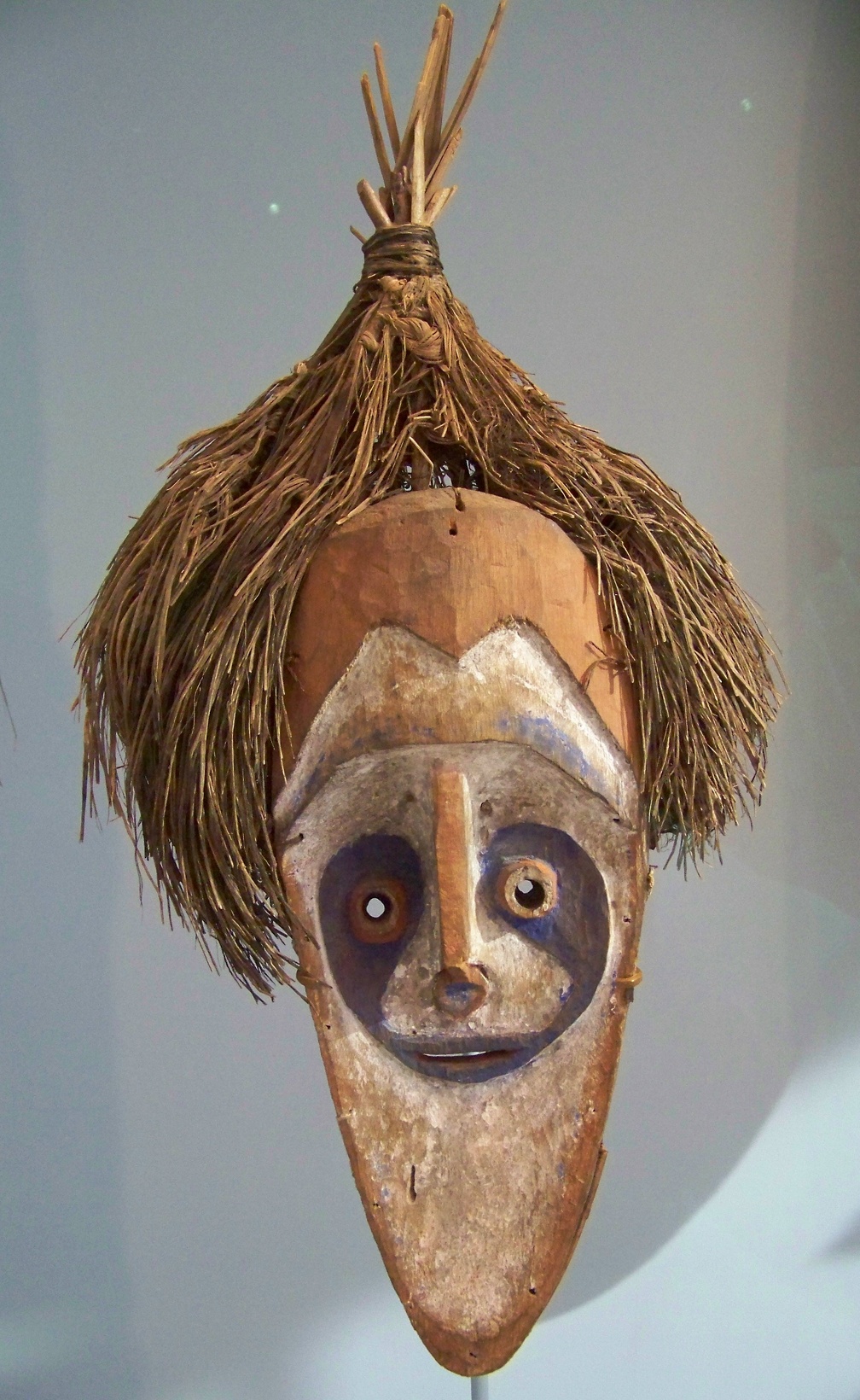
mask from the Duke of York Islands
Eric Kjellgren wrote: New Britain is particularly well known for the variety and scale of its ritual masks, which were often made from ephemeral materials. The Kilenge people produce both wood and bark-cloth masks, a tradition shared with neighboring peoples in the Vitiaz Strait and on the northeastern coast of New Guinea, as well as bukumo, gigantic semicircular masks whose features are adorned with long, radiating lengths of cane. [Source: Eric Kjellgren, “Oceania: Art of the Pacific Islands in The Metropolitan Museum of Art”, 2007]
In northern New Britain the Sulka people fashion enormous, vividly colored masks, headdresses, and dance wands. These are predominantly made from plant pith and other highly perishable materials, although some include more durable wood elements. The neighboring Baining people create a diversity of bark-cloth masks, which formerly included hareiga, among the largest of all Oceanic headdresses, reaching heights of up to fifty feet (fifteen meters).
The masks of the Duke of York Islands, between New Britain and New Ireland, are part of a broader masking tradition that originally extended from southern New Ireland to the Tolai people of northern New Britain. In the Duke of York Islands and southern New Ireland, masks are often crowned with vegetable fiber, likely representing hair. There is no historical information on the use of such masks in the Duke of York group, where the tradition appears to have ceased in the late nineteenth or the early twentieth century. However, one can get some notion of the masks' possible function, and of the possible meaning of their imagery, by examining the masks' use among the Tolai, where the tradition persists.
The crocodile mask made of barkcloth, bamboo, wood and paint by the Banning people. Dating to the late 20th century, it is18 inches high and 60 inches wide (45.7 x 152.4 centimeters). [Source: Metropolitan Museum of Art]
Tolai Masks
The Tolai people produce a variety of mask forms in wood and fiber as well as dance wands and other ritual paraphernalia. The masks are usually made of wood and paint. Dating to the mid to late 19th century, one mask at the Metropolitan Museum of Art originates from the Gazelle Peninsula region on New Britain and is 18 inches high, with a width of 3 inches and a depth of 3 inches (45.7 × 7.6 × 7.6 centimeters)
A Lore Mask made by the Tolai of New Britain is made of wood, paint and fiber. Dating to the late 19th-early 20th century, it is 26 inches high, with a width of 13 inches and a depth of 4 inches (66 × 33 × 10.2 centimeters) According to the Metropolitan Museum of Art: Known by variants of the name lor, which means skull in Tolai, the masks have white faces with mouths that often appear to be smiling. The tradition of lor mask making persists among the Tolai. Today, Tolai lor masks are worn by performers in a dance called tambaran kakao (spirit that crawls). [Source: Eric Kjellgren, “Oceania: Art of the Pacific Islands in The Metropolitan Museum of Art”, 2007]
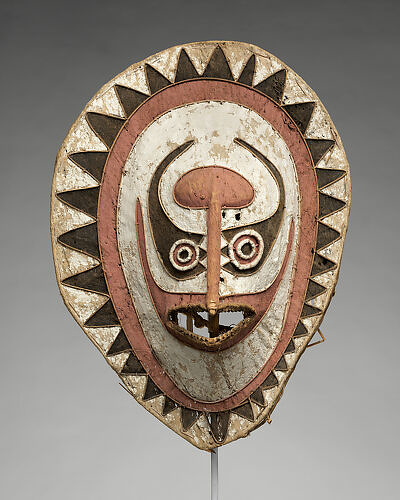
Tolai mask
The masks reportedly represent a spirit that comes to a local leader in dreams and reveals the details of dance paraphernalia and choreography. The term lor also refers to another type of mask, formerly worn by the Tolai, made from the frontal portion of a human skull overmodeled with various substances Such skull masks may have been the original prototypes of the wood examples. Among the Tolai, some forms are worn with broad, hatlike headdresses surmounted by figurative carvings.
According to the Tolai writer Julie To'Liman-Turalir, for masks are worn today by performers in a spirit dance called tambaran kakao (spirit that crawls). During the tambaran kakao the dancers perform a dance of crawling movements to the songs and rhythms of an all-male chorus accompanied by an ensemble of drums. One early-twentieth-century account suggests that the masks were used in dances that honored the dead. The for mask reportedly represented a spirit that came to a local leader in dreams, during which it revealed the details of dance paraphernalia and choreography. Ambivalent in nature, the spirit had the power to help or to harm the living, depending on how it was treated."
Tolai Dance Wand (Bair)
A Tolai dance wand (Bair) at the Metropolitan Museum of Art was made by the Tolai people in the late 19th-early 20th century from wood, paint, feathers and shell. Measuring 37 inches (94 centimeters) in lenth, it is adorned with the lively image of a spirit (tabalivana) and was fashioned by an artist from the Tolai people of the Gazelle Peninsula, in New Britain.
Eric Kjellgren wrote: Today, as in the past, the Tolai create a great variety of ceremonial paraphernalia, known collectively as pokopoko, which are worn or carried as an essential element of dances, rituals, and musical performances.' The term bair refers specifically to dance wands or shields, which are carried in pairs by male performers during a particular dance known as kulau (young coconut). The dance may be performed only by men if bair are carried, but women may perform it without the dance wands. When not in use, the wands are kept in a sacred house, the pal na pidik, together with other dance accessories. The name of the objects changes depending on their context. Stored inside the sacred house, the wands are known simply as pokopoko (ceremonial paraphernalia); they are called bair only when used in kulau performances. [Source:Eric Kjellgren, “Oceania: Art of the Pacific Islands in The Metropolitan Museum of Art”, 2007]
In contrast to other forms of Tolai sculpture, which are created by carvers or specialists in malevolent magic, bair and other dance accessories are made, or designed, by tena buai, men and women who have been initiated into the sacred knowledge of music. The term buai denotes the sacred gift or talent, inherited from recent ancestors, that enables an individual to compose music, choreograph dances, and design ritual paraphernalia.-The central images of the wands represent spirits (tabalivana), and in designing bair, artists draw upon a preconceived mental image of the spirit to be represented. Although the spirit is the most important element of the design, the term hair actually refers to the saw-toothed edges (ngitngit) characteristic of the wands.
The central spirit image of hair is often stylized almost to the point of abstraction. However, at least one element of the spirit, such as its eyes or leg, must be rendered in a form recognizable to the spectators. In the present work the spirit is shown nearly complete, with prominent eyes, a teardrop-shaped head, a slender body, and flexed legs ending in out-turned triangular feet with numerous delicate toes, which resemble the w and 's saw-toothed edges. Adorned with feathers and brightly painted with indigenous white, yellow, and pink pigments, the work also makes extensive use of washing blue, a cleansing agent introduced by European traders that was adapted by many Melanesian peoples to create a deep blue paint.
A photograph taken in 1900 shows a group of Tolai men proceeding to the dance ground. Clad in full ceremonial regalia, the dancers carry pairs of dance wands, which will be used in the performance.
Masks and Art of the Sulka People

sulka headdress
In northern New Britain the Sulka people fashion enormous, vividly colored masks, headdresses, and dance wands. These are predominantly made from plant pith and other highly perishable materials, although some include more durable wood elements. Masks made by the Sulka people in the Gazelle Peninsula region of New Britain are fashioned from bark, bamboo, leaves, fiber, and paint. Dating to 1885-1914, one example at the Metropolitan Museum of Art is 44 inches high, with a width of 16 inches and a depth of 14.5 inches (111.8 × 40.6 × 36.8 centimeters). Another is 13.5 inches × 9 inches (34.3 × 22.9 centimeters). [Source: Metropolitan Museum of Art]
Eric Kjellgren wrote: In creating masks and other ceremonial paraphernalia, artists of the Sulka people of northeastern New Britain consciously seek to achieve magnificence, striving through the use of bold form and vivid colors to maximize the visual impact on the viewer. Brightly colored and ephemeral, Sulka ritual arts are created for onetime use in dances and other rites, where their fleeting beauty is believed to allow the audience to briefly glimpse the divine. 1 Afterward, the objects are ritually burnt or sold to outsiders. [Source: Eric Kjellgren, “Oceania: Art of the Pacific Islands in The Metropolitan Museum of Art”, 2007]
Headdresses of the Sulka People
Sulka headdresses are called Kapurei: In their ceremonial arts, the Sulka people of northern New Britain consciously seek to achieve magnificence, striving to maximize the visual impact on the viewer. Brightly colored and ephemeral, Sulka ritual arts are created for one-time use in dances and ceremonies, during which their fleeting beauty allows the audience to briefly glimpse the divine. Afterward, the objects are destroyed.
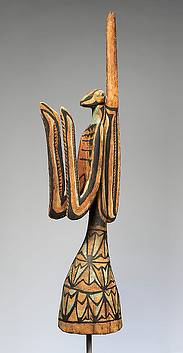
One kapurei at the Metropolitan Museum of Art was made the Sulka people on the Gazelle Peninsula of New Britain from wood and paint. Dating to the late 19th-early 20th century, it is 43.5 inches high, with a width of 10.25 inches and a depth of 8.75 inches (110.5 x 26 x 22.2 centimeters) This headdress is worn on top of the head like a helmet. It portrays a praying mantis (kovio), possibly a clan emblem. Although its exact use is uncertain, it was probably a kapurei, a conical headdress that formed the base for a large ceremonial dance w and (rei) as much as nine feet (3 meters) high that was attached to the undecorated projection at the top.
Eric Kjellgren wrote: The headdress was originally painted in vivid blue, black, and reddish pigments, which have since faded to subtler hues; the underside is hollowed out to allow it to be worn on top of the head like a helmet. The headdress portrays a praying mantis (kovio), an insect that may have served as a clan emblem, alert and poised as if to strike. [Source: Eric Kjellgren, “Oceania: Art of the Pacific Islands in The Metropolitan Museum of Art”, 2007]
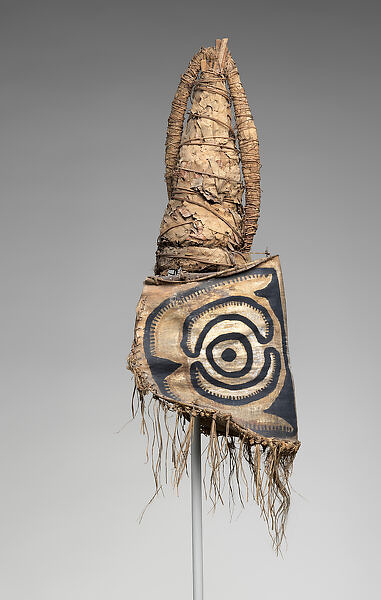
Sulka mask
The exact function of the work is not documented, but it is likely a kapurei, a type of conical headdress that once formed the base of a tall ceremonial dance w and (rei ), which was attached to the undecorated projection at the top and which extended as much as nine feet (three meters) above the mantis effigy. 3 In former times dance wands were carried by performers during mortuary ceremonies, known as a nek or nik, intended to capture the spirit of the deceased, the a nek consisted of a series of dances performed to accompany a sequence of six songs.
During the ceremony there were two lines of performers, an outside group carrying dance wands and an inside group without them; the flexible, brightly painted rei undulated in time to the dancers' movements. Separate forms of rei were made for performers of each sex; the men's wands (ha/) were taller than the women 's (kapek). 6 The culmination of the ceremony occurred during the final dance, known as kangursin, in which the dead person 's spirit was lured into chasing one of the performers, who was said to catch it by the h and and lead it out of the lines of dancers, thus separating it permanently from the world of the living. 7 Although the nek rites have largely ceased, contemporary Sulka artists continue to make and use rei and to perform the associated dances as part of Christian religious observances.
Masks of the Baining People
The neighboring Baining people of northern New Britain create a diversity of imposing bark cloth masks, which formerly included hareiga, among the largest of all Oceanic headdresses, reaching heights of up to fifty feet (fifteen meters).
According to the Metropolitan Museum of Art: The dramatic bark cloth kavat masks created by Central Baining peoples are used exclusively in the night dance, a nocturnal performance lit by firelight. The Central Baining practice both day dance and night dance rites. The day dance, accompanied by an orchestra of women, is devoted to female fertility, agriculture, and the mourning of the dead, phenomena typically associated with the community.
The night dance, by contrast, is accompanied by a male orchestra and dedicated to spirits, animals, and commodities associated with the surrounding forest, which are represented by the kavat masks. Several dozen forms of kavat masks exist, each of which depicts a spirit linked with a specific animal, plant, product, or activity associated with the forest. The rounded form of this mask suggests that it portrays a leaf spirit.
A Mask (Kavat) in the Metropolitan Museum of Art collection was made by the Kairak Baining people from barkcloth, bamboo, and paint. Dating to the 1973, it originates from Papua New Guinea, New Britain and is 54 inches high, with a width of 30 inches and a depth of 14 inches (137.2 x 76.2 x 35.6 centimeters)
A mask made by the Chachet Baining people is fashioned from bamboo, barkcloth and paint. Dating to the 1972, it is12 inches high, with a width of 9.5 inches and a length of 22.5 inches (30.5 x 24.1 centimeters x 57.2 centimeters). Another is 12 inches high, with a width of 8 inches, and a length of 24.5 inches (30.5 x 20.3 centimeters x 62.2 centimeters)
Hareiga (Headdress Effigy)
Hareiga (Headdress Effigy)
Eric Kjellgren wrote: Carried atop the heads of dancers, the towering hareiga (bark-cloth-effigy headdresses) formerly made by the Chachet Baining people of New Britain are the most massive headdresses in the Pacific. The largest examples were of colossal proportions, reaching heights of forty-five or fifty feet (fourteen to fifteen meters) and requiring twenty men to support and raise them above the head of a single performer.' [Source: Eric Kjellgren, “Oceania: Art of the Pacific Islands in The Metropolitan Museum of Art”, 2007]
Hareiga are made from lightweight materials: they consist of a framework of split bamboo overlaid with leaves and bark cloth constructed around a central bamboo pole. However, the tallest examples, so massive that their weight could crush the dancer, were probably raised to no more than a forty-five-degree angle. Comparatively small examples were erected atop the heads of dancers during the ceremony by groups of men carrying bamboo poles.
There is little information about the meaning and significance of hareiga. Only a handful of examples survive, and all of them seem to represent either humanlike beings, as here, or stylized animals." Some of the humanlike images appear to have been created in male-female pairs, and the present work, whose female identity is clearly marked, may originally have been accompanied by a male counterpart. Such paired effigies possibly depicted the original ancestral couple, Herini and his wife, Sichi, the legendary progenitors of the community. 13 In their form, however, these beings, with their tall, treelike bodies and bulbous, tuber-shaped heads, appear to combine the characteristics of humans and food-bearing plants, perhaps in evocation of the connection between the ancestral spirits and a bountiful harvest.
There is some question as to the maximum heights of the hareiga. Earl German sources reported examples as much as forty-five meters (146 feet 3 in.) tall. . However, there is some debate as to whether these accounts may have confused the units of measurement, substituting meters for feet. One Hareiga in the Metropolitan Museum of Art collection was made by the Chachet Baining people from barkcloth, paint, bamboo and leaves. Dating to the late 19th-early 20th century, it is 15 feet tall, with a width of 30 inches and a depth of 36 inches (457.2 × 76.2 × 91.4 centimeters).
Hareiga Dance
Eric Kjellgren wrote The enormous hareiga effigies formerly appeared at the climax of the Chachet Baining "day dance," known as hirei or sarecha, an annual rite held to celebrate the ripening of taro and other crops and to commemorate individuals who had died during the previous year. [Source: Eric Kjellgren, “Oceania: Art of the Pacific Islands in The Metropolitan Museum of Art”, 2007]
Although the hareiga were made and danced by men, both sexes participated in the dance, which centered on female activities and fertility, such as the growth and ripening of crops and childbearing. At the climax of the performance, one or more hareiga entered the dance ground, carried by groups of men equipped with long bamboo poles. Each individual who was to dance a hareiga donned a conical headdress, called a sareiga, to serve as a base for the effigy. The men with the poles then strove to erect the figure atop the dancer's head, using the poles to lift and support it in as close to a vertical position as possible.
When the effigy was in place, the performer danced briefly, after which the hareiga was lowered and often immediately destroyed or stripped of its bark cloth by the participants in the ritual. 9 The tallest hareiga were carried by adult men, but shorter examples, such as the present work, which at fifteen feet is comparatively small, were carried by adolescents or children, some as young as three years of age.
The last recorded appearance of hareiga was in 1927.15 Although hareiga are no longer made today, the Chachet Baining day dance continues to be performed, often in association with Christian or national holidays and accompanied by other types of bark-cloth effigies and dance regalia.
Image Sources: Wikimedia Commons
Text Sources: Metropolitan Museum of Art, Eric Kjellgren, “Oceania: Art of the Pacific Islands in The Metropolitan Museum of Art”, William A. Lessa (1987), Jay Dobbin (2005), Encyclopedia of Religion, Encyclopedia.com; “Encyclopedia of World Cultures, Volume 2: Oceania,” edited by Terence E. Hays, 1991, Wikipedia, Encyclopedia.com, New York Times, Lonely Planet Guides, Library of Congress, The Guardian, National Geographic, Smithsonian magazine, The New Yorker, Reuters, Associated Press, AFP, BBC, CNN, and various books, websites and other publications.
Last updated November 2025